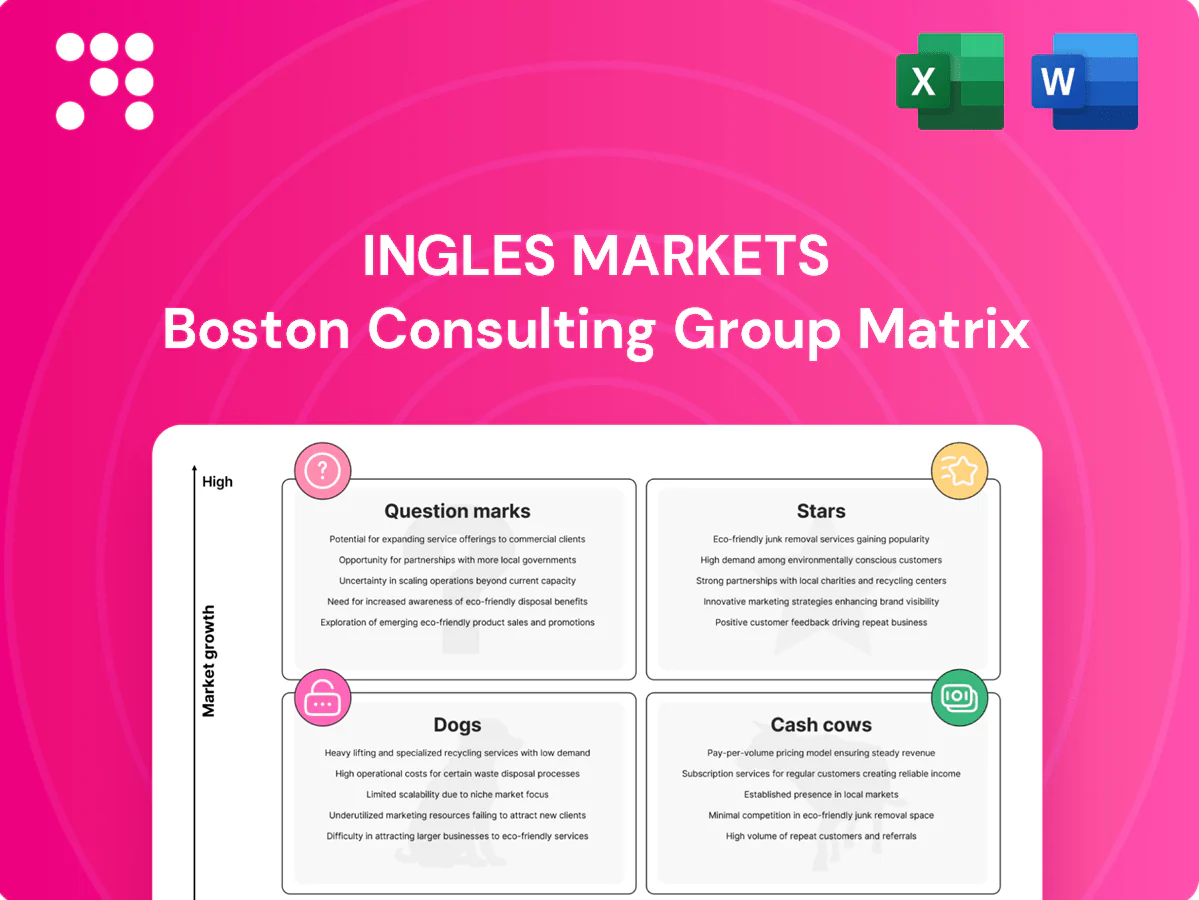
Ingles Markets Boston Consulting Group Matrix

Download Your Competitive Advantage
Curious where Ingles Markets’ products fall—Stars, Cash Cows, Dogs, or Question Marks? This preview scratches the surface; buy the full BCG Matrix to get quadrant-by-quadrant placements, data-backed recommendations, and a practical roadmap for where to invest, divest, or double down. Purchase now for a ready-to-use Word report plus an Excel summary and start making sharper, faster strategic moves.
Stars

SE Supermarkets Growth
Ingles’ core Southeastern supermarkets—about 200 stores—are Stars: strong local share in fast‑growing metro corridors is driving traffic and same‑store sales growth. Regional population inflows (Sunbelt migration) lift category top‑line, making stores a growth engine; feed them with prime sites, sharper pricing, and local assortments. If momentum holds, today’s Stars can mature into tomorrow’s Cash Cows.
Fresh Perimeter
Fresh Perimeter: produce, meat and bakery drive repeat trips and higher baskets; the US fresh perimeter grew about 6% in 2024 and now represents roughly 45% of average basket spend, a market still expanding. Ingles wins on perceived quality and freshness in many towns, giving it lead share. It needs steady investment in sourcing and in‑store presentation; stay on the gas to protect share as the segment grows.

Private-Label Dairy
Owning the milk plant gives Ingles a direct cost and quality advantage that drives shelf leadership in private-label dairy, supporting better margins and faster replenishment. Private-label penetration in U.S. grocery rose to roughly 20% by 2024, and steady-to-growing dairy demand in many Southeastern households supports volume stability. Continued innovation in formulations and pack sizes can trade up baskets while maintaining plant uptime and brand trust preserves the pole position.

Fuel-Plus-Grocery Trips
Fuel-Plus-Grocery Trips sit in the Stars quadrant as Ingles leverages attached forecourts to boost visit frequency in fast-growing corridors; Ingles operates about 198 stores and roughly 98 fuel centers, driving higher basket consolidation and market share gains in 2024.
- Trip frequency: higher consolidation of errands
- Investment: forecourt experience + basic rewards
- Outcome: fuel drives store footfall as local populations climb
Integrated Supply Chain
Vertical integration across distribution, dairy and retail gives Ingles Markets measurable speed and reliability; with ~200 stores and five distribution centers in 2024 this reduces stockouts and shortens replenishment cycles. In fast-growing markets that efficiency converts to fuller shelves and price competitiveness, while ongoing cold-chain upgrades protect fresh-share. Scale effects justify continued targeted capex to expand logistics capacity.
- ~200 stores (2024)
- 5 distribution centers (2024)
- Prioritize cold-chain & logistics capex to defend share
Southeast grocer - ~200 stores, fresh + private-label lift baskets; fuel forecourts boost visits
Ingles’ core ~200 Southeastern stores are Stars—strong local share plus Sunbelt population inflows drive same‑store growth. Fresh perimeter (≈6% growth in 2024) and owned dairy/private‑label (~20% US penetration) boost baskets and margins. Attached fuel (≈98 forecourts) raises visit frequency; scale (5 DCs) underpins fast replenishment and justifies targeted capex.
| Metric | 2024 |
|---|---|
| Stores | ~200 |
| Fuel centers | ~98 |
| DCs | 5 |
| Fresh perimeter growth | ≈6% |
| Private‑label US | ≈20% |
What is included in the product
 Detailed Word Document
Ingles Markets BCG Matrix: strategic review of Stars, Cash Cows, Question Marks, Dogs with investment and divestment recommendations.

 Customizable Excel Spreadsheet
One-page Ingles BCG Matrix placing each unit in a quadrant to spot priorities fast, export-ready for C‑suite slides.
Cash Cows

Established Markets
Mature towns where Ingles already dominates deliver stable, high-margin cash: Ingles operates about 196 stores across seven Southeastern states, generating roughly $8.1 billion in annual net sales in FY2024, with comparable-store margins above regional grocery averages. Growth in these markets is modest, but share is defensible with light promotion and community loyalty. Optimize labor scheduling, shrink control, and product mix to sustain free cash flow. Milk these stores to fund selective expansions.
Shopping Centers Rent
Owned shopping centers generate predictable rental annuity for Ingles, supporting its ~195-store footprint and contributing steady cash flow with low incremental capex in mature submarkets. Tightening occupancy toward mid-90s and trimming maintenance can lift NOI while refinancing when rates ease preserves spread. Excess cash funds remodels and tech investments without stressing store operations.

Center-Store Staples
Center-store staples—pantry, canned and dry grocery—are slow-growth (~1–2% CAGR) but high-turn (inventory turns ~10–12/yr) and represented roughly 28% of Ingles Markets basket, underpinning steady cash flow from fiscal 2024 net sales of $5.48B. Optimizing assortment and private label protects margin, while minimal promo keeps the flywheel efficient.

Frozen & Dairy Core
Frozen & Dairy Core delivers steady everyday demand with strong on-shelf availability and owned processing that sustain healthy margins; these assortments typically show modest, dependable category growth (~3% annual) while covering a disproportionate share of operating costs for chains like Ingles.
- Everyday demand
- Owned processing = margin lift
- Modest ~3% growth
- Strict shelf discipline & waste control
- High margin contribution pays many bills
In-Store Non-Food Basics
Household, paper and cleaning supplies are mature but sticky; Ingles’ basket advantage sustains share with limited marketing and low SKU churn. Maintain disciplined endcap placement and price gaps to protect margin; 2024 sales mix shows these SKUs funding growth investments without extra promo pressure.
- Low marketing, high repeat
- Endcap discipline
- Maintain price gaps
- Cash funds growth bets
Mature grocery stores deliver steady high-margin cash to fund targeted expansion
Mature Ingles stores (≈196 stores; FY2024 net sales $8.1B) generate steady, high-margin cash that funds selective expansion. Owned centers and center-store staples (≈28% basket; cited $5.48B) add predictable rental and inventory-driven cash. Priorities: labor, shrink, assortment, owned-processing to protect FCF.
| Metric | 2024 |
|---|---|
| Stores | 196 |
| Net sales | $8.1B |
| Center-store | $5.48B |
| Inventory turns | 10–12/yr |
Delivered as Shown
Ingles Markets BCG Matrix
The file you're previewing is the exact Ingles Markets BCG Matrix you'll receive after purchase—no watermarks, no placeholders, just the finished analysis. It's formatted for clarity and ready to drop into strategy sessions, investor decks, or board materials. After buying, the full, editable document is delivered immediately to your inbox with market-backed insights and clean visuals. No surprises—just a ready-to-use strategic tool you can present or adapt right away.

Download Your Competitive Advantage
Curious where Ingles Markets’ products fall—Stars, Cash Cows, Dogs, or Question Marks? This preview scratches the surface; buy the full BCG Matrix to get quadrant-by-quadrant placements, data-backed recommendations, and a practical roadmap for where to invest, divest, or double down. Purchase now for a ready-to-use Word report plus an Excel summary and start making sharper, faster strategic moves.
Stars
SE Supermarkets Growth
Ingles’ core Southeastern supermarkets—about 200 stores—are Stars: strong local share in fast‑growing metro corridors is driving traffic and same‑store sales growth. Regional population inflows (Sunbelt migration) lift category top‑line, making stores a growth engine; feed them with prime sites, sharper pricing, and local assortments. If momentum holds, today’s Stars can mature into tomorrow’s Cash Cows.
Fresh Perimeter
Fresh Perimeter: produce, meat and bakery drive repeat trips and higher baskets; the US fresh perimeter grew about 6% in 2024 and now represents roughly 45% of average basket spend, a market still expanding. Ingles wins on perceived quality and freshness in many towns, giving it lead share. It needs steady investment in sourcing and in‑store presentation; stay on the gas to protect share as the segment grows.
Private-Label Dairy
Owning the milk plant gives Ingles a direct cost and quality advantage that drives shelf leadership in private-label dairy, supporting better margins and faster replenishment. Private-label penetration in U.S. grocery rose to roughly 20% by 2024, and steady-to-growing dairy demand in many Southeastern households supports volume stability. Continued innovation in formulations and pack sizes can trade up baskets while maintaining plant uptime and brand trust preserves the pole position.
Fuel-Plus-Grocery Trips
Fuel-Plus-Grocery Trips sit in the Stars quadrant as Ingles leverages attached forecourts to boost visit frequency in fast-growing corridors; Ingles operates about 198 stores and roughly 98 fuel centers, driving higher basket consolidation and market share gains in 2024.
- Trip frequency: higher consolidation of errands
- Investment: forecourt experience + basic rewards
- Outcome: fuel drives store footfall as local populations climb
Integrated Supply Chain
Vertical integration across distribution, dairy and retail gives Ingles Markets measurable speed and reliability; with ~200 stores and five distribution centers in 2024 this reduces stockouts and shortens replenishment cycles. In fast-growing markets that efficiency converts to fuller shelves and price competitiveness, while ongoing cold-chain upgrades protect fresh-share. Scale effects justify continued targeted capex to expand logistics capacity.
- ~200 stores (2024)
- 5 distribution centers (2024)
- Prioritize cold-chain & logistics capex to defend share
Southeast grocer - ~200 stores, fresh + private-label lift baskets; fuel forecourts boost visits
Ingles’ core ~200 Southeastern stores are Stars—strong local share plus Sunbelt population inflows drive same‑store growth. Fresh perimeter (≈6% growth in 2024) and owned dairy/private‑label (~20% US penetration) boost baskets and margins. Attached fuel (≈98 forecourts) raises visit frequency; scale (5 DCs) underpins fast replenishment and justifies targeted capex.
| Metric | 2024 |
|---|---|
| Stores | ~200 |
| Fuel centers | ~98 |
| DCs | 5 |
| Fresh perimeter growth | ≈6% |
| Private‑label US | ≈20% |
What is included in the product
Detailed Word Document
Ingles Markets BCG Matrix: strategic review of Stars, Cash Cows, Question Marks, Dogs with investment and divestment recommendations.
Customizable Excel Spreadsheet
One-page Ingles BCG Matrix placing each unit in a quadrant to spot priorities fast, export-ready for C‑suite slides.
Cash Cows
Established Markets
Mature towns where Ingles already dominates deliver stable, high-margin cash: Ingles operates about 196 stores across seven Southeastern states, generating roughly $8.1 billion in annual net sales in FY2024, with comparable-store margins above regional grocery averages. Growth in these markets is modest, but share is defensible with light promotion and community loyalty. Optimize labor scheduling, shrink control, and product mix to sustain free cash flow. Milk these stores to fund selective expansions.
Shopping Centers Rent
Owned shopping centers generate predictable rental annuity for Ingles, supporting its ~195-store footprint and contributing steady cash flow with low incremental capex in mature submarkets. Tightening occupancy toward mid-90s and trimming maintenance can lift NOI while refinancing when rates ease preserves spread. Excess cash funds remodels and tech investments without stressing store operations.
Center-Store Staples
Center-store staples—pantry, canned and dry grocery—are slow-growth (~1–2% CAGR) but high-turn (inventory turns ~10–12/yr) and represented roughly 28% of Ingles Markets basket, underpinning steady cash flow from fiscal 2024 net sales of $5.48B. Optimizing assortment and private label protects margin, while minimal promo keeps the flywheel efficient.
Frozen & Dairy Core
Frozen & Dairy Core delivers steady everyday demand with strong on-shelf availability and owned processing that sustain healthy margins; these assortments typically show modest, dependable category growth (~3% annual) while covering a disproportionate share of operating costs for chains like Ingles.
- Everyday demand
- Owned processing = margin lift
- Modest ~3% growth
- Strict shelf discipline & waste control
- High margin contribution pays many bills
In-Store Non-Food Basics
Household, paper and cleaning supplies are mature but sticky; Ingles’ basket advantage sustains share with limited marketing and low SKU churn. Maintain disciplined endcap placement and price gaps to protect margin; 2024 sales mix shows these SKUs funding growth investments without extra promo pressure.
- Low marketing, high repeat
- Endcap discipline
- Maintain price gaps
- Cash funds growth bets
Mature grocery stores deliver steady high-margin cash to fund targeted expansion
Mature Ingles stores (≈196 stores; FY2024 net sales $8.1B) generate steady, high-margin cash that funds selective expansion. Owned centers and center-store staples (≈28% basket; cited $5.48B) add predictable rental and inventory-driven cash. Priorities: labor, shrink, assortment, owned-processing to protect FCF.
| Metric | 2024 |
|---|---|
| Stores | 196 |
| Net sales | $8.1B |
| Center-store | $5.48B |
| Inventory turns | 10–12/yr |
Delivered as Shown
Ingles Markets BCG Matrix
The file you're previewing is the exact Ingles Markets BCG Matrix you'll receive after purchase—no watermarks, no placeholders, just the finished analysis. It's formatted for clarity and ready to drop into strategy sessions, investor decks, or board materials. After buying, the full, editable document is delivered immediately to your inbox with market-backed insights and clean visuals. No surprises—just a ready-to-use strategic tool you can present or adapt right away.
Description
Download Your Competitive Advantage
Curious where Ingles Markets’ products fall—Stars, Cash Cows, Dogs, or Question Marks? This preview scratches the surface; buy the full BCG Matrix to get quadrant-by-quadrant placements, data-backed recommendations, and a practical roadmap for where to invest, divest, or double down. Purchase now for a ready-to-use Word report plus an Excel summary and start making sharper, faster strategic moves.
Stars
SE Supermarkets Growth
Ingles’ core Southeastern supermarkets—about 200 stores—are Stars: strong local share in fast‑growing metro corridors is driving traffic and same‑store sales growth. Regional population inflows (Sunbelt migration) lift category top‑line, making stores a growth engine; feed them with prime sites, sharper pricing, and local assortments. If momentum holds, today’s Stars can mature into tomorrow’s Cash Cows.
Fresh Perimeter
Fresh Perimeter: produce, meat and bakery drive repeat trips and higher baskets; the US fresh perimeter grew about 6% in 2024 and now represents roughly 45% of average basket spend, a market still expanding. Ingles wins on perceived quality and freshness in many towns, giving it lead share. It needs steady investment in sourcing and in‑store presentation; stay on the gas to protect share as the segment grows.
Private-Label Dairy
Owning the milk plant gives Ingles a direct cost and quality advantage that drives shelf leadership in private-label dairy, supporting better margins and faster replenishment. Private-label penetration in U.S. grocery rose to roughly 20% by 2024, and steady-to-growing dairy demand in many Southeastern households supports volume stability. Continued innovation in formulations and pack sizes can trade up baskets while maintaining plant uptime and brand trust preserves the pole position.
Fuel-Plus-Grocery Trips
Fuel-Plus-Grocery Trips sit in the Stars quadrant as Ingles leverages attached forecourts to boost visit frequency in fast-growing corridors; Ingles operates about 198 stores and roughly 98 fuel centers, driving higher basket consolidation and market share gains in 2024.
- Trip frequency: higher consolidation of errands
- Investment: forecourt experience + basic rewards
- Outcome: fuel drives store footfall as local populations climb
Integrated Supply Chain
Vertical integration across distribution, dairy and retail gives Ingles Markets measurable speed and reliability; with ~200 stores and five distribution centers in 2024 this reduces stockouts and shortens replenishment cycles. In fast-growing markets that efficiency converts to fuller shelves and price competitiveness, while ongoing cold-chain upgrades protect fresh-share. Scale effects justify continued targeted capex to expand logistics capacity.
- ~200 stores (2024)
- 5 distribution centers (2024)
- Prioritize cold-chain & logistics capex to defend share
Southeast grocer - ~200 stores, fresh + private-label lift baskets; fuel forecourts boost visits
Ingles’ core ~200 Southeastern stores are Stars—strong local share plus Sunbelt population inflows drive same‑store growth. Fresh perimeter (≈6% growth in 2024) and owned dairy/private‑label (~20% US penetration) boost baskets and margins. Attached fuel (≈98 forecourts) raises visit frequency; scale (5 DCs) underpins fast replenishment and justifies targeted capex.
| Metric | 2024 |
|---|---|
| Stores | ~200 |
| Fuel centers | ~98 |
| DCs | 5 |
| Fresh perimeter growth | ≈6% |
| Private‑label US | ≈20% |
What is included in the product
Detailed Word Document
Ingles Markets BCG Matrix: strategic review of Stars, Cash Cows, Question Marks, Dogs with investment and divestment recommendations.
Customizable Excel Spreadsheet
One-page Ingles BCG Matrix placing each unit in a quadrant to spot priorities fast, export-ready for C‑suite slides.
Cash Cows
Established Markets
Mature towns where Ingles already dominates deliver stable, high-margin cash: Ingles operates about 196 stores across seven Southeastern states, generating roughly $8.1 billion in annual net sales in FY2024, with comparable-store margins above regional grocery averages. Growth in these markets is modest, but share is defensible with light promotion and community loyalty. Optimize labor scheduling, shrink control, and product mix to sustain free cash flow. Milk these stores to fund selective expansions.
Shopping Centers Rent
Owned shopping centers generate predictable rental annuity for Ingles, supporting its ~195-store footprint and contributing steady cash flow with low incremental capex in mature submarkets. Tightening occupancy toward mid-90s and trimming maintenance can lift NOI while refinancing when rates ease preserves spread. Excess cash funds remodels and tech investments without stressing store operations.
Center-Store Staples
Center-store staples—pantry, canned and dry grocery—are slow-growth (~1–2% CAGR) but high-turn (inventory turns ~10–12/yr) and represented roughly 28% of Ingles Markets basket, underpinning steady cash flow from fiscal 2024 net sales of $5.48B. Optimizing assortment and private label protects margin, while minimal promo keeps the flywheel efficient.
Frozen & Dairy Core
Frozen & Dairy Core delivers steady everyday demand with strong on-shelf availability and owned processing that sustain healthy margins; these assortments typically show modest, dependable category growth (~3% annual) while covering a disproportionate share of operating costs for chains like Ingles.
- Everyday demand
- Owned processing = margin lift
- Modest ~3% growth
- Strict shelf discipline & waste control
- High margin contribution pays many bills
In-Store Non-Food Basics
Household, paper and cleaning supplies are mature but sticky; Ingles’ basket advantage sustains share with limited marketing and low SKU churn. Maintain disciplined endcap placement and price gaps to protect margin; 2024 sales mix shows these SKUs funding growth investments without extra promo pressure.
- Low marketing, high repeat
- Endcap discipline
- Maintain price gaps
- Cash funds growth bets
Mature grocery stores deliver steady high-margin cash to fund targeted expansion
Mature Ingles stores (≈196 stores; FY2024 net sales $8.1B) generate steady, high-margin cash that funds selective expansion. Owned centers and center-store staples (≈28% basket; cited $5.48B) add predictable rental and inventory-driven cash. Priorities: labor, shrink, assortment, owned-processing to protect FCF.
| Metric | 2024 |
|---|---|
| Stores | 196 |
| Net sales | $8.1B |
| Center-store | $5.48B |
| Inventory turns | 10–12/yr |
Delivered as Shown
Ingles Markets BCG Matrix
The file you're previewing is the exact Ingles Markets BCG Matrix you'll receive after purchase—no watermarks, no placeholders, just the finished analysis. It's formatted for clarity and ready to drop into strategy sessions, investor decks, or board materials. After buying, the full, editable document is delivered immediately to your inbox with market-backed insights and clean visuals. No surprises—just a ready-to-use strategic tool you can present or adapt right away.











