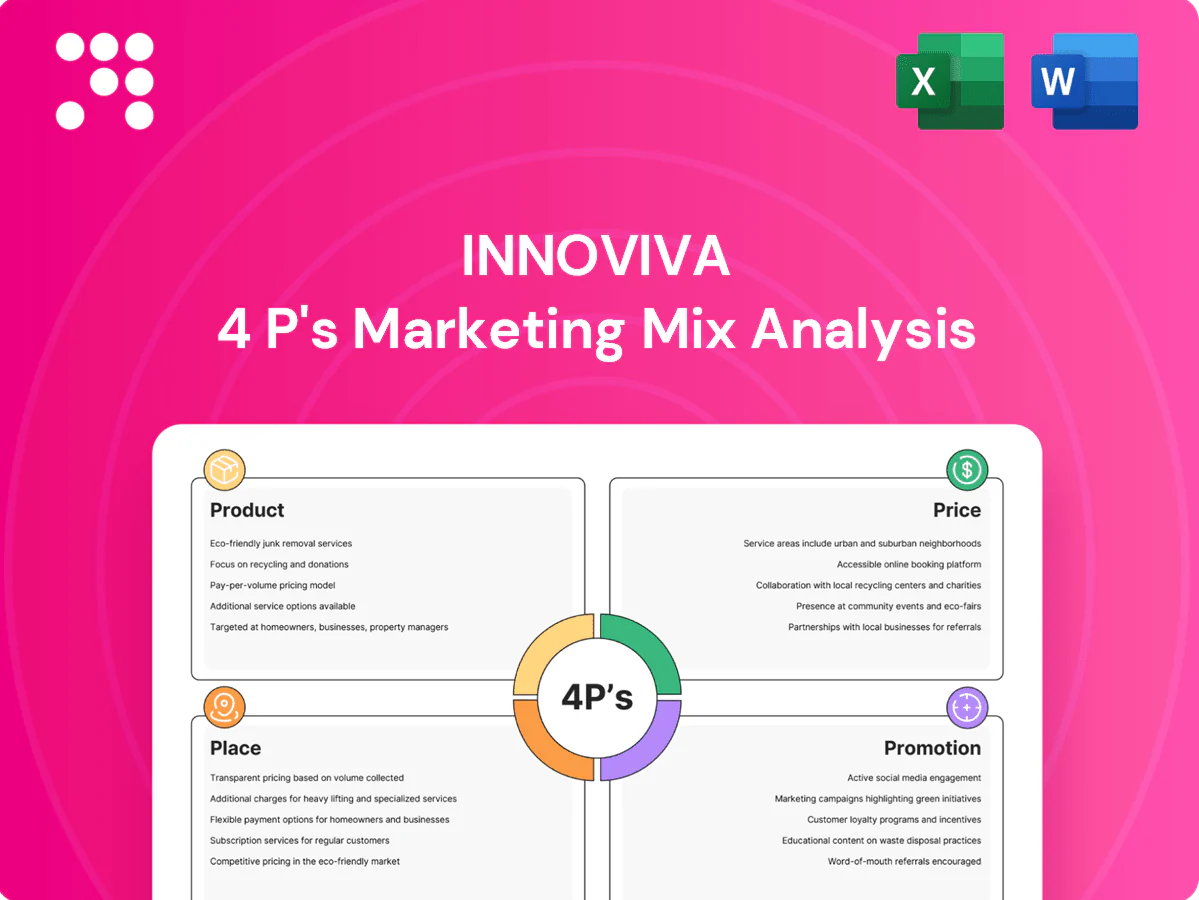
Innoviva Marketing Mix

Get Inspired by a Complete Brand Strategy
Discover how Innoviva’s product positioning, pricing architecture, distribution channels, and promotional tactics combine to drive market success; this snapshot highlights key strengths and gaps. Purchase the full 4Ps Marketing Mix Analysis for an editable, data-driven report with practical recommendations. Save hours and get presentation-ready insights tailored for business or academic use.
Product

Partnered respiratory portfolio
Innoviva’s core product is a partnered respiratory portfolio focused on COPD (~250 million affected globally) and asthma (~339 million), delivering inhaled medicines via proven drug–device combinations and established platforms; emphasis is on guideline-aligned use (GOLD/GINA) and demonstrated clinical outcomes, supporting multiple lines of therapy and patient segments and contributing material royalty streams to Innoviva’s revenue base.
Royalty and milestone streams
Innoviva monetizes products primarily through contractual royalties and partner-triggered sales milestones, creating a revenue model that smooths cash flows and scales with global uptake. The structure aligns incentives with licensees while minimizing Innoviva’s commercial overhead and fixed costs. Predictable, long-dated agreements support disciplined, long-term capital allocation and portfolio-level risk management.

Lifecycle management and IP
Innoviva supports partners on label expansions, pediatric studies and device enhancements to extend product lifecycle and IP protection; incremental formulation and device improvements help sustain market relevance post-exclusivity. Such strategies can blunt generic erosion, which often cuts prices and share by 70–90% after entry. Data-driven updates preserve clinical differentiation and payer coverage by reinforcing real-world and economic value.

Evidence and health economics
Medical affairs and HEOR drive real-world evidence generation to substantiate value claims; RWE programs have shown up to 30% reductions in exacerbations and adherence-driven improvements that can lower total healthcare costs by ~15–20%. Publications and registry data strengthen payer and guideline positioning, while continuous evidence refresh supports maintenance of premium formulary placement and price protection.
- Real-world evidence: up to 30% exacerbation reduction
- Cost-effectiveness: ~15–20% lower total costs
- Payer traction: sustained premium formulary access
Selective pipeline investments
Selective pipeline investments deploy targeted capital into late-stage or de-risked assets via partnership structures, concentrating on respiratory and adjacent specialty areas to preserve Innoviva’s strategic edge. This approach maintains optionality without absorbing full R&D burden while driving portfolio cash yield and downside protection. Portfolio curation balances risk and yield, aligning with a respiratory market ~55 billion USD (2024) and yield targets near mid-single digits.
- focus: respiratory + adjacent specialty
- stage: late-stage / de-risked via partnerships
- benefit: optionality without full R&D cost
- target: portfolio cash yield ~mid-single digits
- market size: respiratory ~55B USD (2024)
Respiratory drug-device: 30% fewer exac. 15-20% costs
Innoviva’s product is a partnered respiratory portfolio (COPD ~250M, asthma ~339M) delivered via drug–device combos, generating royalty-based revenue and mid-single-digit portfolio cash yield; RWE shows up to 30% fewer exacerbations and 15–20% lower total costs. Lifecycle actions (label, pediatric, device) extend exclusivity and payer access, supporting a respiratory market ~55B USD (2024).
| Metric | Value |
|---|---|
| COPD patients | ~250M |
| Asthma patients | ~339M |
| Respiratory market (2024) | ~55B USD |
| RWE impact | -30% exacerbations; -15–20% costs |
| Yield target | Mid-single digits |
What is included in the product
 Detailed Word Document
Delivers a concise, company-specific deep dive into Innoviva’s Product, Price, Place, and Promotion strategies—grounded in real practices and competitive context—ideal for managers, consultants, and marketers who need a ready-to-use, structured analysis for reports, benchmarking, or strategy workshops.

 Customizable Excel Spreadsheet
Condenses Innoviva’s 4Ps into a one-page, leadership-ready summary that relieves cross-team misalignment and accelerates go-to-market decisions, while remaining easily customizable for presentations, comparisons, or rapid workshop use.
Place

Global partner distribution
Commercial partners handle Innoviva’s worldwide sales, wholesaling and pharmacy channels, enabling coverage across hospital, specialty and retail pharmacies; this model leverages partners’ country affiliates to accelerate market penetration. By relying on established partner footprints, Innoviva accesses global distribution without duplicating local infrastructure and associated capex, preserving cash flow for royalty-based returns.
Formulary and payer access
Market access teams secure listings with national and private payers; tier placement and prior-authorization criteria materially drive prescription volume and adherence. Contracting ensures continuity across plan years, protecting royalty streams. Access breadth directly influences Innoviva royalty performance; Medicare Part D had about 49.9 million enrollees in 2024.

Channel mix optimization
Distribution balances specialty channels and retail to match COPD/asthma therapy needs, shifting ~60% of chronic prescriptions to specialty clinics while retail covers acute demand; the inhaler market CAGR is ~3.8% through 2025. Inhaler logistics prioritize cold-chain avoidance and high availability to lower handling costs and meet compliance. Inventory management initiatives aim to reduce stockouts by about 25% and returns. Seasonal demand forecasting stabilizes supply across peak winter months.

Geographic sequencing
Geographic sequencing times launches to country-specific regulatory approvals and reimbursement windows, prioritizing early entry in large COPD markets—the US has about 16 million diagnosed COPD patients—where faster uptake maximizes ROI. Expansion into emerging markets uses tiered pricing and tender participation and is coordinated with partner capacity and local guidelines to avoid launch bottlenecks.
Digital and remote enablement
Partners leverage e-prescribing (adoption >80% among US clinicians), hub services and tele-detailing to extend HCP reach; patient services streamline onboarding and raise adherence ~10–15%, cutting avoidable costs; data-informed targeting boosts rep call efficiency ~20–25%; remote tools sustain coverage while lowering cost-to-serve up to ~30%.
- e-prescribing >80% adoption
- Adherence lift 10–15%
- Rep efficiency +20–25%
- Cost-to-serve −~30%
Partner-led launches preserve capex; Medicare Part D 49.9M and 16M COPD drive uptake
Partner-led global distribution preserves capex, enabling rapid launches in US/EU5/Japan; Medicare Part D enrollment ~49.9M and US COPD ~16M drive priority sequencing. Market access/tiering and e-prescribing (>80% US) shape uptake; adherence +10–15% and inventory cuts ~25% boost royalties. Specialty retail mix aligns with inhaler CAGR ~3.8% through 2025.
| Metric | Value |
|---|---|
| Medicare Part D (2024) | 49.9M |
| US COPD diagnosed | ~16M |
| e-prescribing US | >80% |
| Adherence lift | 10–15% |
| Inventory reduction target | ~25% |
| Inhaler CAGR | 3.8% (to 2025) |
Full Version Awaits
Innoviva 4P's Marketing Mix Analysis
You're viewing the Innoviva 4P's Marketing Mix analysis—the exact, full document you'll receive immediately after purchase. It covers Product, Price, Place and Promotion with actionable insights and editable content. No sample or teaser—this is the final ready-to-use file.

Get Inspired by a Complete Brand Strategy
Discover how Innoviva’s product positioning, pricing architecture, distribution channels, and promotional tactics combine to drive market success; this snapshot highlights key strengths and gaps. Purchase the full 4Ps Marketing Mix Analysis for an editable, data-driven report with practical recommendations. Save hours and get presentation-ready insights tailored for business or academic use.
Product
Partnered respiratory portfolio
Innoviva’s core product is a partnered respiratory portfolio focused on COPD (~250 million affected globally) and asthma (~339 million), delivering inhaled medicines via proven drug–device combinations and established platforms; emphasis is on guideline-aligned use (GOLD/GINA) and demonstrated clinical outcomes, supporting multiple lines of therapy and patient segments and contributing material royalty streams to Innoviva’s revenue base.
Royalty and milestone streams
Innoviva monetizes products primarily through contractual royalties and partner-triggered sales milestones, creating a revenue model that smooths cash flows and scales with global uptake. The structure aligns incentives with licensees while minimizing Innoviva’s commercial overhead and fixed costs. Predictable, long-dated agreements support disciplined, long-term capital allocation and portfolio-level risk management.
Lifecycle management and IP
Innoviva supports partners on label expansions, pediatric studies and device enhancements to extend product lifecycle and IP protection; incremental formulation and device improvements help sustain market relevance post-exclusivity. Such strategies can blunt generic erosion, which often cuts prices and share by 70–90% after entry. Data-driven updates preserve clinical differentiation and payer coverage by reinforcing real-world and economic value.
Evidence and health economics
Medical affairs and HEOR drive real-world evidence generation to substantiate value claims; RWE programs have shown up to 30% reductions in exacerbations and adherence-driven improvements that can lower total healthcare costs by ~15–20%. Publications and registry data strengthen payer and guideline positioning, while continuous evidence refresh supports maintenance of premium formulary placement and price protection.
- Real-world evidence: up to 30% exacerbation reduction
- Cost-effectiveness: ~15–20% lower total costs
- Payer traction: sustained premium formulary access
Selective pipeline investments
Selective pipeline investments deploy targeted capital into late-stage or de-risked assets via partnership structures, concentrating on respiratory and adjacent specialty areas to preserve Innoviva’s strategic edge. This approach maintains optionality without absorbing full R&D burden while driving portfolio cash yield and downside protection. Portfolio curation balances risk and yield, aligning with a respiratory market ~55 billion USD (2024) and yield targets near mid-single digits.
- focus: respiratory + adjacent specialty
- stage: late-stage / de-risked via partnerships
- benefit: optionality without full R&D cost
- target: portfolio cash yield ~mid-single digits
- market size: respiratory ~55B USD (2024)
Respiratory drug-device: 30% fewer exac. 15-20% costs
Innoviva’s product is a partnered respiratory portfolio (COPD ~250M, asthma ~339M) delivered via drug–device combos, generating royalty-based revenue and mid-single-digit portfolio cash yield; RWE shows up to 30% fewer exacerbations and 15–20% lower total costs. Lifecycle actions (label, pediatric, device) extend exclusivity and payer access, supporting a respiratory market ~55B USD (2024).
| Metric | Value |
|---|---|
| COPD patients | ~250M |
| Asthma patients | ~339M |
| Respiratory market (2024) | ~55B USD |
| RWE impact | -30% exacerbations; -15–20% costs |
| Yield target | Mid-single digits |
What is included in the product
Detailed Word Document
Delivers a concise, company-specific deep dive into Innoviva’s Product, Price, Place, and Promotion strategies—grounded in real practices and competitive context—ideal for managers, consultants, and marketers who need a ready-to-use, structured analysis for reports, benchmarking, or strategy workshops.
Customizable Excel Spreadsheet
Condenses Innoviva’s 4Ps into a one-page, leadership-ready summary that relieves cross-team misalignment and accelerates go-to-market decisions, while remaining easily customizable for presentations, comparisons, or rapid workshop use.
Place
Global partner distribution
Commercial partners handle Innoviva’s worldwide sales, wholesaling and pharmacy channels, enabling coverage across hospital, specialty and retail pharmacies; this model leverages partners’ country affiliates to accelerate market penetration. By relying on established partner footprints, Innoviva accesses global distribution without duplicating local infrastructure and associated capex, preserving cash flow for royalty-based returns.
Formulary and payer access
Market access teams secure listings with national and private payers; tier placement and prior-authorization criteria materially drive prescription volume and adherence. Contracting ensures continuity across plan years, protecting royalty streams. Access breadth directly influences Innoviva royalty performance; Medicare Part D had about 49.9 million enrollees in 2024.
Channel mix optimization
Distribution balances specialty channels and retail to match COPD/asthma therapy needs, shifting ~60% of chronic prescriptions to specialty clinics while retail covers acute demand; the inhaler market CAGR is ~3.8% through 2025. Inhaler logistics prioritize cold-chain avoidance and high availability to lower handling costs and meet compliance. Inventory management initiatives aim to reduce stockouts by about 25% and returns. Seasonal demand forecasting stabilizes supply across peak winter months.
Geographic sequencing
Geographic sequencing times launches to country-specific regulatory approvals and reimbursement windows, prioritizing early entry in large COPD markets—the US has about 16 million diagnosed COPD patients—where faster uptake maximizes ROI. Expansion into emerging markets uses tiered pricing and tender participation and is coordinated with partner capacity and local guidelines to avoid launch bottlenecks.
Digital and remote enablement
Partners leverage e-prescribing (adoption >80% among US clinicians), hub services and tele-detailing to extend HCP reach; patient services streamline onboarding and raise adherence ~10–15%, cutting avoidable costs; data-informed targeting boosts rep call efficiency ~20–25%; remote tools sustain coverage while lowering cost-to-serve up to ~30%.
- e-prescribing >80% adoption
- Adherence lift 10–15%
- Rep efficiency +20–25%
- Cost-to-serve −~30%
Partner-led launches preserve capex; Medicare Part D 49.9M and 16M COPD drive uptake
Partner-led global distribution preserves capex, enabling rapid launches in US/EU5/Japan; Medicare Part D enrollment ~49.9M and US COPD ~16M drive priority sequencing. Market access/tiering and e-prescribing (>80% US) shape uptake; adherence +10–15% and inventory cuts ~25% boost royalties. Specialty retail mix aligns with inhaler CAGR ~3.8% through 2025.
| Metric | Value |
|---|---|
| Medicare Part D (2024) | 49.9M |
| US COPD diagnosed | ~16M |
| e-prescribing US | >80% |
| Adherence lift | 10–15% |
| Inventory reduction target | ~25% |
| Inhaler CAGR | 3.8% (to 2025) |
Full Version Awaits
Innoviva 4P's Marketing Mix Analysis
You're viewing the Innoviva 4P's Marketing Mix analysis—the exact, full document you'll receive immediately after purchase. It covers Product, Price, Place and Promotion with actionable insights and editable content. No sample or teaser—this is the final ready-to-use file.
Original: $10.00
-65%$10.00
$3.50Description
Get Inspired by a Complete Brand Strategy
Discover how Innoviva’s product positioning, pricing architecture, distribution channels, and promotional tactics combine to drive market success; this snapshot highlights key strengths and gaps. Purchase the full 4Ps Marketing Mix Analysis for an editable, data-driven report with practical recommendations. Save hours and get presentation-ready insights tailored for business or academic use.
Product
Partnered respiratory portfolio
Innoviva’s core product is a partnered respiratory portfolio focused on COPD (~250 million affected globally) and asthma (~339 million), delivering inhaled medicines via proven drug–device combinations and established platforms; emphasis is on guideline-aligned use (GOLD/GINA) and demonstrated clinical outcomes, supporting multiple lines of therapy and patient segments and contributing material royalty streams to Innoviva’s revenue base.
Royalty and milestone streams
Innoviva monetizes products primarily through contractual royalties and partner-triggered sales milestones, creating a revenue model that smooths cash flows and scales with global uptake. The structure aligns incentives with licensees while minimizing Innoviva’s commercial overhead and fixed costs. Predictable, long-dated agreements support disciplined, long-term capital allocation and portfolio-level risk management.
Lifecycle management and IP
Innoviva supports partners on label expansions, pediatric studies and device enhancements to extend product lifecycle and IP protection; incremental formulation and device improvements help sustain market relevance post-exclusivity. Such strategies can blunt generic erosion, which often cuts prices and share by 70–90% after entry. Data-driven updates preserve clinical differentiation and payer coverage by reinforcing real-world and economic value.
Evidence and health economics
Medical affairs and HEOR drive real-world evidence generation to substantiate value claims; RWE programs have shown up to 30% reductions in exacerbations and adherence-driven improvements that can lower total healthcare costs by ~15–20%. Publications and registry data strengthen payer and guideline positioning, while continuous evidence refresh supports maintenance of premium formulary placement and price protection.
- Real-world evidence: up to 30% exacerbation reduction
- Cost-effectiveness: ~15–20% lower total costs
- Payer traction: sustained premium formulary access
Selective pipeline investments
Selective pipeline investments deploy targeted capital into late-stage or de-risked assets via partnership structures, concentrating on respiratory and adjacent specialty areas to preserve Innoviva’s strategic edge. This approach maintains optionality without absorbing full R&D burden while driving portfolio cash yield and downside protection. Portfolio curation balances risk and yield, aligning with a respiratory market ~55 billion USD (2024) and yield targets near mid-single digits.
- focus: respiratory + adjacent specialty
- stage: late-stage / de-risked via partnerships
- benefit: optionality without full R&D cost
- target: portfolio cash yield ~mid-single digits
- market size: respiratory ~55B USD (2024)
Respiratory drug-device: 30% fewer exac. 15-20% costs
Innoviva’s product is a partnered respiratory portfolio (COPD ~250M, asthma ~339M) delivered via drug–device combos, generating royalty-based revenue and mid-single-digit portfolio cash yield; RWE shows up to 30% fewer exacerbations and 15–20% lower total costs. Lifecycle actions (label, pediatric, device) extend exclusivity and payer access, supporting a respiratory market ~55B USD (2024).
| Metric | Value |
|---|---|
| COPD patients | ~250M |
| Asthma patients | ~339M |
| Respiratory market (2024) | ~55B USD |
| RWE impact | -30% exacerbations; -15–20% costs |
| Yield target | Mid-single digits |
What is included in the product
Detailed Word Document
Delivers a concise, company-specific deep dive into Innoviva’s Product, Price, Place, and Promotion strategies—grounded in real practices and competitive context—ideal for managers, consultants, and marketers who need a ready-to-use, structured analysis for reports, benchmarking, or strategy workshops.
Customizable Excel Spreadsheet
Condenses Innoviva’s 4Ps into a one-page, leadership-ready summary that relieves cross-team misalignment and accelerates go-to-market decisions, while remaining easily customizable for presentations, comparisons, or rapid workshop use.
Place
Global partner distribution
Commercial partners handle Innoviva’s worldwide sales, wholesaling and pharmacy channels, enabling coverage across hospital, specialty and retail pharmacies; this model leverages partners’ country affiliates to accelerate market penetration. By relying on established partner footprints, Innoviva accesses global distribution without duplicating local infrastructure and associated capex, preserving cash flow for royalty-based returns.
Formulary and payer access
Market access teams secure listings with national and private payers; tier placement and prior-authorization criteria materially drive prescription volume and adherence. Contracting ensures continuity across plan years, protecting royalty streams. Access breadth directly influences Innoviva royalty performance; Medicare Part D had about 49.9 million enrollees in 2024.
Channel mix optimization
Distribution balances specialty channels and retail to match COPD/asthma therapy needs, shifting ~60% of chronic prescriptions to specialty clinics while retail covers acute demand; the inhaler market CAGR is ~3.8% through 2025. Inhaler logistics prioritize cold-chain avoidance and high availability to lower handling costs and meet compliance. Inventory management initiatives aim to reduce stockouts by about 25% and returns. Seasonal demand forecasting stabilizes supply across peak winter months.
Geographic sequencing
Geographic sequencing times launches to country-specific regulatory approvals and reimbursement windows, prioritizing early entry in large COPD markets—the US has about 16 million diagnosed COPD patients—where faster uptake maximizes ROI. Expansion into emerging markets uses tiered pricing and tender participation and is coordinated with partner capacity and local guidelines to avoid launch bottlenecks.
Digital and remote enablement
Partners leverage e-prescribing (adoption >80% among US clinicians), hub services and tele-detailing to extend HCP reach; patient services streamline onboarding and raise adherence ~10–15%, cutting avoidable costs; data-informed targeting boosts rep call efficiency ~20–25%; remote tools sustain coverage while lowering cost-to-serve up to ~30%.
- e-prescribing >80% adoption
- Adherence lift 10–15%
- Rep efficiency +20–25%
- Cost-to-serve −~30%
Partner-led launches preserve capex; Medicare Part D 49.9M and 16M COPD drive uptake
Partner-led global distribution preserves capex, enabling rapid launches in US/EU5/Japan; Medicare Part D enrollment ~49.9M and US COPD ~16M drive priority sequencing. Market access/tiering and e-prescribing (>80% US) shape uptake; adherence +10–15% and inventory cuts ~25% boost royalties. Specialty retail mix aligns with inhaler CAGR ~3.8% through 2025.
| Metric | Value |
|---|---|
| Medicare Part D (2024) | 49.9M |
| US COPD diagnosed | ~16M |
| e-prescribing US | >80% |
| Adherence lift | 10–15% |
| Inventory reduction target | ~25% |
| Inhaler CAGR | 3.8% (to 2025) |
Full Version Awaits
Innoviva 4P's Marketing Mix Analysis
You're viewing the Innoviva 4P's Marketing Mix analysis—the exact, full document you'll receive immediately after purchase. It covers Product, Price, Place and Promotion with actionable insights and editable content. No sample or teaser—this is the final ready-to-use file.











