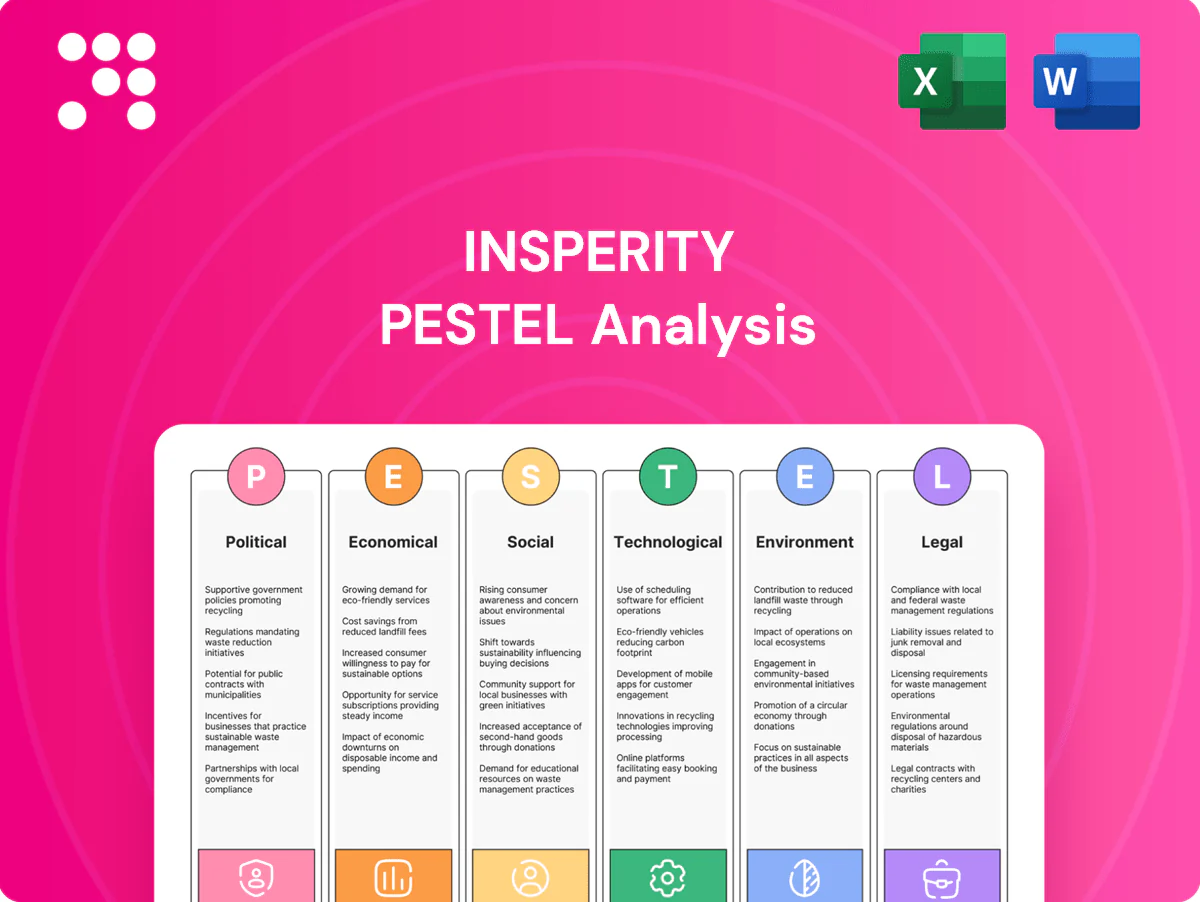
Insperity PESTLE Analysis

Make Smarter Strategic Decisions with a Complete PESTEL View
Our PESTLE Analysis of Insperity reveals how political, economic, social, technological, legal and environmental forces shape its HR services and growth prospects. This concise, evidence-based report highlights regulatory risks, market drivers and tech opportunities you need to know. Buy the full analysis to get actionable insights, editable charts and instant download.
Political factors

Shifts in healthcare policy
Insperity’s benefits administration is highly exposed to federal healthcare reforms that can alter plan design, pricing, and employer mandates; employer-sponsored plans covered about 155 million Americans in 2023, so any ACA enforcement shifts materially affect market demand. Changes to ACA rules or alternative coverage models (marketplace enrollment ~17.6M in 2024) would ripple through client cost structures and offerings, forcing Insperity to adapt plan menus and communications amid heightened political turnover and policy uncertainty.
Labor policy and wage agendas
Minimum wage hikes (federal $7.25 unchanged; 21 states + DC at $15+ by 2025), higher overtime salary thresholds (DOL rule set $844/week in 2024) and dozens of state/local paid‑leave mandates increase payroll and compliance workloads. Pro‑labor priorities raise HR complexity for SMBs and boost demand for outsourced expertise, while deregulatory phases can compress compliance‑driven revenue; Insperity’s value rises with complexity but its costs and systems must keep pace.

State-by-state regulatory divergence
Fragmented rules across 50 states and roughly 89,000 local governments on leave, pay transparency, privacy and payroll taxes force localized compliance for Insperity. Multi-state clients demand uniform service despite variance, pushing Insperity to keep real-time rule engines and localized HR experts. Political shifts in large states like California, Texas and New York strongly shape product roadmaps and prioritization.

Immigration enforcement variability
PEO oversight and licensing
State PEO licensing and certification standards shape Insperity’s operating costs and market credibility; Insperity reported 2024 revenue of about $5.6 billion, underscoring scale benefits versus smaller rivals. Political scrutiny after 2024 employer controversies has tightened oversight in multiple states, raising compliance costs. Consistent compliance supports sales positioning and policy stability aids multi-year pricing and planning.
- State registration: increases operating cost
- 2024 revenue: ~$5.6B
- Compliance = competitive sales edge
- Policy stability enables long-term pricing
Federal reform, state pay rules and E-Verify enforcement fuel demand for HR compliance
Insperity faces material exposure to federal healthcare reforms (155M employer‑covered in 2023; 17.6M marketplace enrollees 2024) and variable state labor rules (federal $7.25; 21 states+DC $15+ by 2025; DOL $844/week OT 2024). Fragmented rules (~89,000 local govts) and I-9/E-Verify enforcement (900,000 employers 2024) drive demand for its ~$5.6B 2024 compliance services.
| Metric | Value |
|---|---|
| Insured by employer (2023) | 155M |
| Marketplace (2024) | 17.6M |
| E-Verify participants (2024) | 900,000+ |
| Insperity revenue (2024) | ~$5.6B |
What is included in the product
 Detailed Word Document
Explores how external macro-environmental factors uniquely affect Insperity across Political, Economic, Social, Technological, Environmental, and Legal dimensions, with data-backed trends, forward-looking scenario insights and industry-specific examples to help executives, consultants, and investors identify risks and opportunities.

 Customizable Excel Spreadsheet
Concise, visually segmented Insperity PESTLE summary for quick reference during meetings or presentations, easily dropped into slides; editable notes let teams adapt insights to their region, business line or strategy for faster alignment on external risks and market positioning.
Economic factors

SMB employment cycles
Client volumes and worksite employees move with small-business formation—new business applications were about 4.6 million in 2023 (Census BFS) and small firms employ roughly 47% of the private workforce (SBA), so hiring trends drive Insperity’s revenues. Slowdowns cut headcount-based fees and benefits premiums, while expansions lift revenue and cross-sell rates. Industry diversification reduces but does not remove cyclicality.
Labor market tightness
Tight labor markets (US unemployment 3.7% in mid‑2025) push employers to enhance benefits and HR support, creating upsell opportunities for Insperity. Wage inflation (average hourly earnings +3.6% YoY, May 2025, BLS) raises payroll throughput and fees tied to compensation. Recruiting and retention advisory demand rises with worker scarcity, while looser markets may reduce urgency but keep compliance services in steady demand.

Interest rates and benefits costs
Rising interest rates (fed funds ~5.25–5.50% mid‑2025) and medical trend (~6% in 2024 industry estimates) raise stop‑loss pricing and increase discount rates used for benefits liabilities, squeezing client budgets and prompting plan redesigns. Insperity must renegotiate carrier terms and optimize funding and stop‑loss structures to contain costs. Even modest rate cuts would lower funding costs, improve affordability and could stimulate hiring.

Cost sensitivity of SMBs
SMBs increasingly scrutinize HR outsourcing ROI during downturns, forcing Insperity to prove bundled value, risk mitigation, and productivity gains; the US market includes about 31.7 million small businesses (SBA, 2023), amplifying scale pressure. Tiered offerings and modular add-ons can defend retention, while transparent pricing builds trust amid tight budgets.
- ROI focus: demonstrate cost-per-employee savings
- Value: bundle risk mitigation and productivity metrics
- Retention: tiered plans + modular add-ons
- Trust: transparent, predictable pricing
Wage and productivity dynamics
Rising wages—average hourly earnings up 4.1% YoY in 2024 (BLS)—push clients toward automation to offset labor costs; integrated productivity tools in HR stacks gain premium value. Insperity can monetize analytics and workflow efficiencies by packaging benchmarks and automated processes, while economic volatility boosts demand for agile workforce planning insights.
- Wage pressure: 4.1% YoY (BLS 2024)
- Automation demand: cost offset
- Monetization: analytics & workflows
- Volatility: higher workforce-planning needs
Federal reform, state pay rules and E-Verify enforcement fuel demand for HR compliance
Tight labor (US unemployment 3.7% mid‑2025) and wage inflation (avg hourly earnings +3.6% May 2025; wages +4.1% 2024) increase demand for HR services and payroll fees, while interest rates (fed funds ~5.25–5.50% mid‑2025) and medical trend (~6% 2024) pressure benefits costs and stop‑loss pricing. SMB scale (31.7M firms, SBA 2023) creates pricing sensitivity; ROI proof and modular offerings defend retention.
| Metric | Value |
|---|---|
| Unemployment | 3.7% (mid‑2025) |
| Avg hourly earnings | +3.6% YoY (May 2025) |
| Fed funds | 5.25–5.50% (mid‑2025) |
| SMBs | 31.7M (2023) |
Preview Before You Purchase
Insperity PESTLE Analysis
The Insperity PESTLE Analysis preview shown here is the exact document you’ll receive after purchase—fully formatted and ready to use. The content, layout, and structure visible in this sample are identical to the downloadable file, with no placeholders or surprises. After checkout you’ll instantly get this same professionally structured report for immediate application.

Make Smarter Strategic Decisions with a Complete PESTEL View
Our PESTLE Analysis of Insperity reveals how political, economic, social, technological, legal and environmental forces shape its HR services and growth prospects. This concise, evidence-based report highlights regulatory risks, market drivers and tech opportunities you need to know. Buy the full analysis to get actionable insights, editable charts and instant download.
Political factors
Shifts in healthcare policy
Insperity’s benefits administration is highly exposed to federal healthcare reforms that can alter plan design, pricing, and employer mandates; employer-sponsored plans covered about 155 million Americans in 2023, so any ACA enforcement shifts materially affect market demand. Changes to ACA rules or alternative coverage models (marketplace enrollment ~17.6M in 2024) would ripple through client cost structures and offerings, forcing Insperity to adapt plan menus and communications amid heightened political turnover and policy uncertainty.
Labor policy and wage agendas
Minimum wage hikes (federal $7.25 unchanged; 21 states + DC at $15+ by 2025), higher overtime salary thresholds (DOL rule set $844/week in 2024) and dozens of state/local paid‑leave mandates increase payroll and compliance workloads. Pro‑labor priorities raise HR complexity for SMBs and boost demand for outsourced expertise, while deregulatory phases can compress compliance‑driven revenue; Insperity’s value rises with complexity but its costs and systems must keep pace.
State-by-state regulatory divergence
Fragmented rules across 50 states and roughly 89,000 local governments on leave, pay transparency, privacy and payroll taxes force localized compliance for Insperity. Multi-state clients demand uniform service despite variance, pushing Insperity to keep real-time rule engines and localized HR experts. Political shifts in large states like California, Texas and New York strongly shape product roadmaps and prioritization.
Immigration enforcement variability
PEO oversight and licensing
State PEO licensing and certification standards shape Insperity’s operating costs and market credibility; Insperity reported 2024 revenue of about $5.6 billion, underscoring scale benefits versus smaller rivals. Political scrutiny after 2024 employer controversies has tightened oversight in multiple states, raising compliance costs. Consistent compliance supports sales positioning and policy stability aids multi-year pricing and planning.
- State registration: increases operating cost
- 2024 revenue: ~$5.6B
- Compliance = competitive sales edge
- Policy stability enables long-term pricing
Federal reform, state pay rules and E-Verify enforcement fuel demand for HR compliance
Insperity faces material exposure to federal healthcare reforms (155M employer‑covered in 2023; 17.6M marketplace enrollees 2024) and variable state labor rules (federal $7.25; 21 states+DC $15+ by 2025; DOL $844/week OT 2024). Fragmented rules (~89,000 local govts) and I-9/E-Verify enforcement (900,000 employers 2024) drive demand for its ~$5.6B 2024 compliance services.
| Metric | Value |
|---|---|
| Insured by employer (2023) | 155M |
| Marketplace (2024) | 17.6M |
| E-Verify participants (2024) | 900,000+ |
| Insperity revenue (2024) | ~$5.6B |
What is included in the product
Detailed Word Document
Explores how external macro-environmental factors uniquely affect Insperity across Political, Economic, Social, Technological, Environmental, and Legal dimensions, with data-backed trends, forward-looking scenario insights and industry-specific examples to help executives, consultants, and investors identify risks and opportunities.
Customizable Excel Spreadsheet
Concise, visually segmented Insperity PESTLE summary for quick reference during meetings or presentations, easily dropped into slides; editable notes let teams adapt insights to their region, business line or strategy for faster alignment on external risks and market positioning.
Economic factors
SMB employment cycles
Client volumes and worksite employees move with small-business formation—new business applications were about 4.6 million in 2023 (Census BFS) and small firms employ roughly 47% of the private workforce (SBA), so hiring trends drive Insperity’s revenues. Slowdowns cut headcount-based fees and benefits premiums, while expansions lift revenue and cross-sell rates. Industry diversification reduces but does not remove cyclicality.
Labor market tightness
Tight labor markets (US unemployment 3.7% in mid‑2025) push employers to enhance benefits and HR support, creating upsell opportunities for Insperity. Wage inflation (average hourly earnings +3.6% YoY, May 2025, BLS) raises payroll throughput and fees tied to compensation. Recruiting and retention advisory demand rises with worker scarcity, while looser markets may reduce urgency but keep compliance services in steady demand.
Interest rates and benefits costs
Rising interest rates (fed funds ~5.25–5.50% mid‑2025) and medical trend (~6% in 2024 industry estimates) raise stop‑loss pricing and increase discount rates used for benefits liabilities, squeezing client budgets and prompting plan redesigns. Insperity must renegotiate carrier terms and optimize funding and stop‑loss structures to contain costs. Even modest rate cuts would lower funding costs, improve affordability and could stimulate hiring.
Cost sensitivity of SMBs
SMBs increasingly scrutinize HR outsourcing ROI during downturns, forcing Insperity to prove bundled value, risk mitigation, and productivity gains; the US market includes about 31.7 million small businesses (SBA, 2023), amplifying scale pressure. Tiered offerings and modular add-ons can defend retention, while transparent pricing builds trust amid tight budgets.
- ROI focus: demonstrate cost-per-employee savings
- Value: bundle risk mitigation and productivity metrics
- Retention: tiered plans + modular add-ons
- Trust: transparent, predictable pricing
Wage and productivity dynamics
Rising wages—average hourly earnings up 4.1% YoY in 2024 (BLS)—push clients toward automation to offset labor costs; integrated productivity tools in HR stacks gain premium value. Insperity can monetize analytics and workflow efficiencies by packaging benchmarks and automated processes, while economic volatility boosts demand for agile workforce planning insights.
- Wage pressure: 4.1% YoY (BLS 2024)
- Automation demand: cost offset
- Monetization: analytics & workflows
- Volatility: higher workforce-planning needs
Federal reform, state pay rules and E-Verify enforcement fuel demand for HR compliance
Tight labor (US unemployment 3.7% mid‑2025) and wage inflation (avg hourly earnings +3.6% May 2025; wages +4.1% 2024) increase demand for HR services and payroll fees, while interest rates (fed funds ~5.25–5.50% mid‑2025) and medical trend (~6% 2024) pressure benefits costs and stop‑loss pricing. SMB scale (31.7M firms, SBA 2023) creates pricing sensitivity; ROI proof and modular offerings defend retention.
| Metric | Value |
|---|---|
| Unemployment | 3.7% (mid‑2025) |
| Avg hourly earnings | +3.6% YoY (May 2025) |
| Fed funds | 5.25–5.50% (mid‑2025) |
| SMBs | 31.7M (2023) |
Preview Before You Purchase
Insperity PESTLE Analysis
The Insperity PESTLE Analysis preview shown here is the exact document you’ll receive after purchase—fully formatted and ready to use. The content, layout, and structure visible in this sample are identical to the downloadable file, with no placeholders or surprises. After checkout you’ll instantly get this same professionally structured report for immediate application.
Original: $10.00
-65%$10.00
$3.50Description
Make Smarter Strategic Decisions with a Complete PESTEL View
Our PESTLE Analysis of Insperity reveals how political, economic, social, technological, legal and environmental forces shape its HR services and growth prospects. This concise, evidence-based report highlights regulatory risks, market drivers and tech opportunities you need to know. Buy the full analysis to get actionable insights, editable charts and instant download.
Political factors
Shifts in healthcare policy
Insperity’s benefits administration is highly exposed to federal healthcare reforms that can alter plan design, pricing, and employer mandates; employer-sponsored plans covered about 155 million Americans in 2023, so any ACA enforcement shifts materially affect market demand. Changes to ACA rules or alternative coverage models (marketplace enrollment ~17.6M in 2024) would ripple through client cost structures and offerings, forcing Insperity to adapt plan menus and communications amid heightened political turnover and policy uncertainty.
Labor policy and wage agendas
Minimum wage hikes (federal $7.25 unchanged; 21 states + DC at $15+ by 2025), higher overtime salary thresholds (DOL rule set $844/week in 2024) and dozens of state/local paid‑leave mandates increase payroll and compliance workloads. Pro‑labor priorities raise HR complexity for SMBs and boost demand for outsourced expertise, while deregulatory phases can compress compliance‑driven revenue; Insperity’s value rises with complexity but its costs and systems must keep pace.
State-by-state regulatory divergence
Fragmented rules across 50 states and roughly 89,000 local governments on leave, pay transparency, privacy and payroll taxes force localized compliance for Insperity. Multi-state clients demand uniform service despite variance, pushing Insperity to keep real-time rule engines and localized HR experts. Political shifts in large states like California, Texas and New York strongly shape product roadmaps and prioritization.
Immigration enforcement variability
PEO oversight and licensing
State PEO licensing and certification standards shape Insperity’s operating costs and market credibility; Insperity reported 2024 revenue of about $5.6 billion, underscoring scale benefits versus smaller rivals. Political scrutiny after 2024 employer controversies has tightened oversight in multiple states, raising compliance costs. Consistent compliance supports sales positioning and policy stability aids multi-year pricing and planning.
- State registration: increases operating cost
- 2024 revenue: ~$5.6B
- Compliance = competitive sales edge
- Policy stability enables long-term pricing
Federal reform, state pay rules and E-Verify enforcement fuel demand for HR compliance
Insperity faces material exposure to federal healthcare reforms (155M employer‑covered in 2023; 17.6M marketplace enrollees 2024) and variable state labor rules (federal $7.25; 21 states+DC $15+ by 2025; DOL $844/week OT 2024). Fragmented rules (~89,000 local govts) and I-9/E-Verify enforcement (900,000 employers 2024) drive demand for its ~$5.6B 2024 compliance services.
| Metric | Value |
|---|---|
| Insured by employer (2023) | 155M |
| Marketplace (2024) | 17.6M |
| E-Verify participants (2024) | 900,000+ |
| Insperity revenue (2024) | ~$5.6B |
What is included in the product
Detailed Word Document
Explores how external macro-environmental factors uniquely affect Insperity across Political, Economic, Social, Technological, Environmental, and Legal dimensions, with data-backed trends, forward-looking scenario insights and industry-specific examples to help executives, consultants, and investors identify risks and opportunities.
Customizable Excel Spreadsheet
Concise, visually segmented Insperity PESTLE summary for quick reference during meetings or presentations, easily dropped into slides; editable notes let teams adapt insights to their region, business line or strategy for faster alignment on external risks and market positioning.
Economic factors
SMB employment cycles
Client volumes and worksite employees move with small-business formation—new business applications were about 4.6 million in 2023 (Census BFS) and small firms employ roughly 47% of the private workforce (SBA), so hiring trends drive Insperity’s revenues. Slowdowns cut headcount-based fees and benefits premiums, while expansions lift revenue and cross-sell rates. Industry diversification reduces but does not remove cyclicality.
Labor market tightness
Tight labor markets (US unemployment 3.7% in mid‑2025) push employers to enhance benefits and HR support, creating upsell opportunities for Insperity. Wage inflation (average hourly earnings +3.6% YoY, May 2025, BLS) raises payroll throughput and fees tied to compensation. Recruiting and retention advisory demand rises with worker scarcity, while looser markets may reduce urgency but keep compliance services in steady demand.
Interest rates and benefits costs
Rising interest rates (fed funds ~5.25–5.50% mid‑2025) and medical trend (~6% in 2024 industry estimates) raise stop‑loss pricing and increase discount rates used for benefits liabilities, squeezing client budgets and prompting plan redesigns. Insperity must renegotiate carrier terms and optimize funding and stop‑loss structures to contain costs. Even modest rate cuts would lower funding costs, improve affordability and could stimulate hiring.
Cost sensitivity of SMBs
SMBs increasingly scrutinize HR outsourcing ROI during downturns, forcing Insperity to prove bundled value, risk mitigation, and productivity gains; the US market includes about 31.7 million small businesses (SBA, 2023), amplifying scale pressure. Tiered offerings and modular add-ons can defend retention, while transparent pricing builds trust amid tight budgets.
- ROI focus: demonstrate cost-per-employee savings
- Value: bundle risk mitigation and productivity metrics
- Retention: tiered plans + modular add-ons
- Trust: transparent, predictable pricing
Wage and productivity dynamics
Rising wages—average hourly earnings up 4.1% YoY in 2024 (BLS)—push clients toward automation to offset labor costs; integrated productivity tools in HR stacks gain premium value. Insperity can monetize analytics and workflow efficiencies by packaging benchmarks and automated processes, while economic volatility boosts demand for agile workforce planning insights.
- Wage pressure: 4.1% YoY (BLS 2024)
- Automation demand: cost offset
- Monetization: analytics & workflows
- Volatility: higher workforce-planning needs
Federal reform, state pay rules and E-Verify enforcement fuel demand for HR compliance
Tight labor (US unemployment 3.7% mid‑2025) and wage inflation (avg hourly earnings +3.6% May 2025; wages +4.1% 2024) increase demand for HR services and payroll fees, while interest rates (fed funds ~5.25–5.50% mid‑2025) and medical trend (~6% 2024) pressure benefits costs and stop‑loss pricing. SMB scale (31.7M firms, SBA 2023) creates pricing sensitivity; ROI proof and modular offerings defend retention.
| Metric | Value |
|---|---|
| Unemployment | 3.7% (mid‑2025) |
| Avg hourly earnings | +3.6% YoY (May 2025) |
| Fed funds | 5.25–5.50% (mid‑2025) |
| SMBs | 31.7M (2023) |
Preview Before You Purchase
Insperity PESTLE Analysis
The Insperity PESTLE Analysis preview shown here is the exact document you’ll receive after purchase—fully formatted and ready to use. The content, layout, and structure visible in this sample are identical to the downloadable file, with no placeholders or surprises. After checkout you’ll instantly get this same professionally structured report for immediate application.











