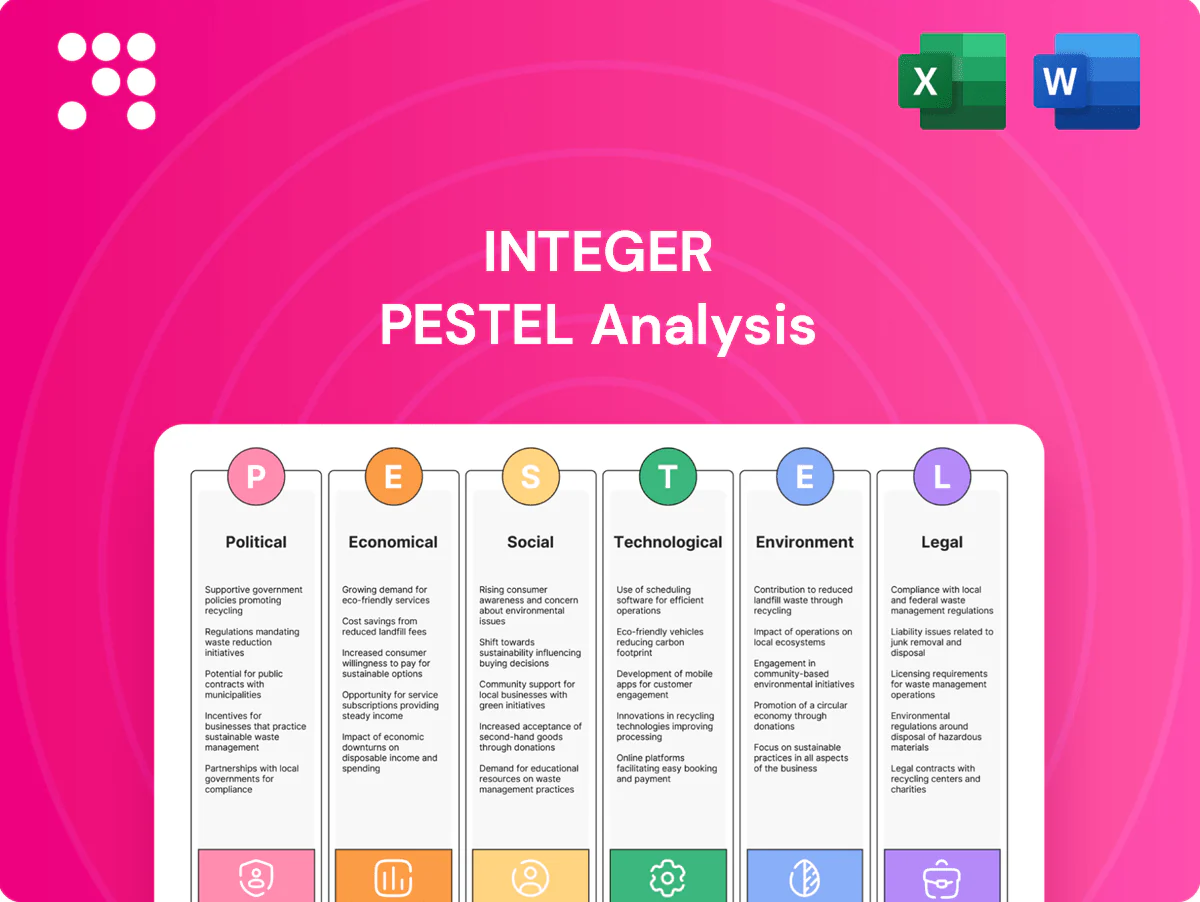
Integer PESTLE Analysis

Plan Smarter. Present Sharper. Compete Stronger.
Unlock strategic clarity with our Integer PESTLE Analysis—three to five concise, evidence-backed sections revealing the political, economic, social, technological, legal and environmental forces shaping Integer’s future. Ideal for investors, advisors, and executives seeking actionable intelligence, this report equips you to forecast risks and seize opportunities. Purchase the full analysis for the complete, ready-to-use insights and downloadable templates.
Political factors

Healthcare policy shifts
Shifts in national healthcare priorities reshape OEM pipelines and outsourced demand as governments reallocate capital; US federal biomedical R&D funding in 2024 was ≈$50B, steering device roadmaps toward funded areas. Policy pushes for value-based care increase preference for cost-efficient MDO partners. Sustained public funding for cardiovascular and neuro programs supports device adoption, while election cycles add timing and budget volatility.
Regulatory harmonization
Divergence between FDA and EMA timelines (FDA standard NDA goal 10 months, priority 6 months; EMA centralized ~210 days) drives higher development time and costs; harmonized standards reduce duplicate filings and speed global launches. Fragmentation raises documentation and validation burdens for CMOs, often adding weeks to timelines and materially increasing compliance costs, so Integer must adapt processes to meet multi‑jurisdictional expectations.

Trade and tariff exposure
Tariffs on metals and inputs — notably US Section 232 levies of 25% on steel and 10% on aluminum — can materially raise BOM costs for medical-device components. Geopolitical tensions have repeatedly disrupted cross-border component flows, increasing lead times and spot-price volatility. Preferential trade agreements such as USMCA and CPTPP lower tariff barriers and can improve cost competitiveness. Integer’s multi-site footprint strategy helps reallocate production to mitigate tariff shocks.

Government procurement and incentives
Public hospital tenders strongly shape OEM pricing and volume, with public procurement representing about 12% of global GDP (OECD/UN data) and concentrating demand in core markets. Grants and tax credits such as the US CHIPS Act ($52 billion) and the EU Horizon Europe budget (€95.5 billion) can fund reshoring and advanced manufacturing capacity. Local-content requirements and national innovation programs accelerate siting decisions and tech adoption.
- Public tenders: concentrated volume, price pressure
- Grants/tax credits: CHIPS $52B, Horizon Europe €95.5B
- Local-content: influences plant location
- Innovation programs: shorten adoption cycles
Pandemic and public-health readiness
Pandemic readiness shifts procurement to critical-care and minimally invasive tech, with the global critical-care devices market ~36B in 2023 and a ~6.5% CAGR to 2030; stockpiling and surge-capacity policies drove procurement spikes ~40% in 2020 and remain ~15% above pre-2020 in 2024, creating order volatility. Regulatory flexibilities (FDA EUAs ~350 by end-2024) can speed approvals; Integer must maintain resilient, auditable supply chains with dual sourcing for >70% of critical components.
- Preparedness: critical-care/minimally invasive focus; market ~36B (2023), CAGR ~6.5%
- Stockpiling: procurement +40% (2020), +15% vs pre-2020 (2024)
- Regulatory: ~350 FDA EUAs by end-2024 accelerate approvals
- Supply chain: resilient, auditable, dual-source >70% critical parts
Public funding $50B, regs diverge; tariffs raise sourcing costs
National health funding (US biomedical R&D ≈$50B 2024) and value‑based care policies shift OEM demand to cost‑efficient MDOs; election cycles add budget volatility. Regulatory divergence (FDA 6–10 months, EMA ≈210 days) raises multi‑jurisdiction costs. Tariffs (US steel 25%, aluminum 10%) and public procurement (~12% GDP) influence sourcing and plant siting.
| Tag | Metric | 2024/25 |
|---|---|---|
| Funding | US biomedical R&D | $50B (2024) |
| Regulatory | FDA/EMA timelines | FDA 6–10m / EMA ~210d |
| Trade | Tariffs | Steel 25%, Al 10% |
| Procurement | Public tenders | ≈12% GDP |
What is included in the product
 Detailed Word Document
Explores how external macro-environmental factors uniquely affect Integer across six dimensions—Political, Economic, Social, Technological, Environmental, and Legal—each backed by relevant data and current trends. Designed for executives and investors to identify threats, opportunities, and forward-looking scenarios.

 Customizable Excel Spreadsheet
A concise, visually segmented Integer PESTLE summary that’s easily editable, shareable and presentation-ready—streamlining external risk discussions, team alignment and decision-making during planning sessions.
Economic factors

Procedure volume cycles
Elective procedure recoveries have driven CRM, EP, and neuro volumes, supporting Integer’s device sales and contributing to Integer’s 2024 revenue of approximately $2.4 billion. Macroeconomic slowdowns have historically delayed implant timing and capital equipment purchases, compressing OEM order cycles and working capital. Shifts in payer mix, including greater government payer share, alter OEM ordering behavior and reimbursement dynamics. Integer’s portfolio spans cyclical elective implants and more defensively insured procedures, dampening overall volatility.
OEM R&D and outsourcing spend
OEM margin pressure—average device-sector gross margins fell ~220 basis points in 2023–24—is pushing firms to outsource to shift fixed costs to variable; medtech VC and strategic funding rose to roughly $14.5bn in 2024, expanding development programs and outsourcing demand. Budget tightening in 2024 deferred several new platform launches, while long-term manufacturing contracts (now >40% of CMO revenue) stabilize utilization and pricing.

Input costs and inflation
Metals, polymers and electronic components saw price volatility—spot swings reached up to 20% in 2024 for base metals and polymers, with component spot premiums near 10–15% as supply/demand imbalances persisted. Wage inflation in high-skill manufacturing ran about 5–7% in 2024, tightening margins. Surcharge mechanisms and 3–6% productivity gains per annum helped offset costs, while strategic sourcing and multi‑supplier contracts reduced supply‑shock exposure.

FX and global footprint
Integer's revenues and costs span multiple currencies, creating translation and transaction risk that affected its reported 2024 results (FY2024 revenue reported at $3.4 billion) as a stronger dollar can erode export competitiveness and compress margins.
Multi-region operations provide natural hedges by matching currency inflows and outflows, while contractual pricing clauses and pass-through mechanisms partially neutralize short-term FX swings.
- FX exposure: translation & transaction risk
- FY2024 revenue: $3.4 billion
- Natural hedging via regional ops
- Pricing clauses mitigate volatility
Interest rates and capital access
Higher policy rates (US federal funds ~5.25–5.50% in July 2025) lift borrowing costs for capacity expansion, automation and M&A, squeezing returns and lengthening payback periods; OEM customers often defer inventory builds under tight credit, while lower rates can quickly reignite pipeline investments; balanced leverage preserves flexibility through cycles.
- Financing cost pressure: policy rate ~5.25–5.50%
- OEM inventory risk: slower builds under tight credit
- Rate tailwinds: lower rates revive capex and automation
- Capital strategy: maintain balanced leverage for optionality
Public funding $50B, regs diverge; tariffs raise sourcing costs
Elective-recovery boosts device sales but macro slowdowns delay implants and OEM capex; Integer reported FY2024 revenue $3.4B. OEM margin compression (~220 bps 2023–24) and higher policy rates (~5.25–5.50% Jul 2025) raise outsourcing and financing importance. Input cost volatility (metals/polymers ±20% in 2024; wages +5–7%) and FX translation risks shape pricing and hedging strategies.
| Metric | Value |
|---|---|
| FY2024 revenue | $3.4B |
| Policy rate Jul 2025 | 5.25–5.50% |
| Medtech VC 2024 | $14.5B |
| Metals/polymers 2024 swing | ±20% |
| Wage inflation 2024 | 5–7% |
Preview Before You Purchase
Integer PESTLE Analysis
The preview shown here is the exact Integer PESTLE Analysis document you’ll receive after purchase—fully formatted and ready to use. It contains the complete political, economic, social, technological, legal and environmental assessment with charts and actionable insights. No placeholders or teasers; what you see is the final, professionally structured file. You can download this exact document immediately after payment.

Plan Smarter. Present Sharper. Compete Stronger.
Unlock strategic clarity with our Integer PESTLE Analysis—three to five concise, evidence-backed sections revealing the political, economic, social, technological, legal and environmental forces shaping Integer’s future. Ideal for investors, advisors, and executives seeking actionable intelligence, this report equips you to forecast risks and seize opportunities. Purchase the full analysis for the complete, ready-to-use insights and downloadable templates.
Political factors
Healthcare policy shifts
Shifts in national healthcare priorities reshape OEM pipelines and outsourced demand as governments reallocate capital; US federal biomedical R&D funding in 2024 was ≈$50B, steering device roadmaps toward funded areas. Policy pushes for value-based care increase preference for cost-efficient MDO partners. Sustained public funding for cardiovascular and neuro programs supports device adoption, while election cycles add timing and budget volatility.
Regulatory harmonization
Divergence between FDA and EMA timelines (FDA standard NDA goal 10 months, priority 6 months; EMA centralized ~210 days) drives higher development time and costs; harmonized standards reduce duplicate filings and speed global launches. Fragmentation raises documentation and validation burdens for CMOs, often adding weeks to timelines and materially increasing compliance costs, so Integer must adapt processes to meet multi‑jurisdictional expectations.
Trade and tariff exposure
Tariffs on metals and inputs — notably US Section 232 levies of 25% on steel and 10% on aluminum — can materially raise BOM costs for medical-device components. Geopolitical tensions have repeatedly disrupted cross-border component flows, increasing lead times and spot-price volatility. Preferential trade agreements such as USMCA and CPTPP lower tariff barriers and can improve cost competitiveness. Integer’s multi-site footprint strategy helps reallocate production to mitigate tariff shocks.
Government procurement and incentives
Public hospital tenders strongly shape OEM pricing and volume, with public procurement representing about 12% of global GDP (OECD/UN data) and concentrating demand in core markets. Grants and tax credits such as the US CHIPS Act ($52 billion) and the EU Horizon Europe budget (€95.5 billion) can fund reshoring and advanced manufacturing capacity. Local-content requirements and national innovation programs accelerate siting decisions and tech adoption.
- Public tenders: concentrated volume, price pressure
- Grants/tax credits: CHIPS $52B, Horizon Europe €95.5B
- Local-content: influences plant location
- Innovation programs: shorten adoption cycles
Pandemic and public-health readiness
Pandemic readiness shifts procurement to critical-care and minimally invasive tech, with the global critical-care devices market ~36B in 2023 and a ~6.5% CAGR to 2030; stockpiling and surge-capacity policies drove procurement spikes ~40% in 2020 and remain ~15% above pre-2020 in 2024, creating order volatility. Regulatory flexibilities (FDA EUAs ~350 by end-2024) can speed approvals; Integer must maintain resilient, auditable supply chains with dual sourcing for >70% of critical components.
- Preparedness: critical-care/minimally invasive focus; market ~36B (2023), CAGR ~6.5%
- Stockpiling: procurement +40% (2020), +15% vs pre-2020 (2024)
- Regulatory: ~350 FDA EUAs by end-2024 accelerate approvals
- Supply chain: resilient, auditable, dual-source >70% critical parts
Public funding $50B, regs diverge; tariffs raise sourcing costs
National health funding (US biomedical R&D ≈$50B 2024) and value‑based care policies shift OEM demand to cost‑efficient MDOs; election cycles add budget volatility. Regulatory divergence (FDA 6–10 months, EMA ≈210 days) raises multi‑jurisdiction costs. Tariffs (US steel 25%, aluminum 10%) and public procurement (~12% GDP) influence sourcing and plant siting.
| Tag | Metric | 2024/25 |
|---|---|---|
| Funding | US biomedical R&D | $50B (2024) |
| Regulatory | FDA/EMA timelines | FDA 6–10m / EMA ~210d |
| Trade | Tariffs | Steel 25%, Al 10% |
| Procurement | Public tenders | ≈12% GDP |
What is included in the product
Detailed Word Document
Explores how external macro-environmental factors uniquely affect Integer across six dimensions—Political, Economic, Social, Technological, Environmental, and Legal—each backed by relevant data and current trends. Designed for executives and investors to identify threats, opportunities, and forward-looking scenarios.
Customizable Excel Spreadsheet
A concise, visually segmented Integer PESTLE summary that’s easily editable, shareable and presentation-ready—streamlining external risk discussions, team alignment and decision-making during planning sessions.
Economic factors
Procedure volume cycles
Elective procedure recoveries have driven CRM, EP, and neuro volumes, supporting Integer’s device sales and contributing to Integer’s 2024 revenue of approximately $2.4 billion. Macroeconomic slowdowns have historically delayed implant timing and capital equipment purchases, compressing OEM order cycles and working capital. Shifts in payer mix, including greater government payer share, alter OEM ordering behavior and reimbursement dynamics. Integer’s portfolio spans cyclical elective implants and more defensively insured procedures, dampening overall volatility.
OEM R&D and outsourcing spend
OEM margin pressure—average device-sector gross margins fell ~220 basis points in 2023–24—is pushing firms to outsource to shift fixed costs to variable; medtech VC and strategic funding rose to roughly $14.5bn in 2024, expanding development programs and outsourcing demand. Budget tightening in 2024 deferred several new platform launches, while long-term manufacturing contracts (now >40% of CMO revenue) stabilize utilization and pricing.
Input costs and inflation
Metals, polymers and electronic components saw price volatility—spot swings reached up to 20% in 2024 for base metals and polymers, with component spot premiums near 10–15% as supply/demand imbalances persisted. Wage inflation in high-skill manufacturing ran about 5–7% in 2024, tightening margins. Surcharge mechanisms and 3–6% productivity gains per annum helped offset costs, while strategic sourcing and multi‑supplier contracts reduced supply‑shock exposure.
FX and global footprint
Integer's revenues and costs span multiple currencies, creating translation and transaction risk that affected its reported 2024 results (FY2024 revenue reported at $3.4 billion) as a stronger dollar can erode export competitiveness and compress margins.
Multi-region operations provide natural hedges by matching currency inflows and outflows, while contractual pricing clauses and pass-through mechanisms partially neutralize short-term FX swings.
- FX exposure: translation & transaction risk
- FY2024 revenue: $3.4 billion
- Natural hedging via regional ops
- Pricing clauses mitigate volatility
Interest rates and capital access
Higher policy rates (US federal funds ~5.25–5.50% in July 2025) lift borrowing costs for capacity expansion, automation and M&A, squeezing returns and lengthening payback periods; OEM customers often defer inventory builds under tight credit, while lower rates can quickly reignite pipeline investments; balanced leverage preserves flexibility through cycles.
- Financing cost pressure: policy rate ~5.25–5.50%
- OEM inventory risk: slower builds under tight credit
- Rate tailwinds: lower rates revive capex and automation
- Capital strategy: maintain balanced leverage for optionality
Public funding $50B, regs diverge; tariffs raise sourcing costs
Elective-recovery boosts device sales but macro slowdowns delay implants and OEM capex; Integer reported FY2024 revenue $3.4B. OEM margin compression (~220 bps 2023–24) and higher policy rates (~5.25–5.50% Jul 2025) raise outsourcing and financing importance. Input cost volatility (metals/polymers ±20% in 2024; wages +5–7%) and FX translation risks shape pricing and hedging strategies.
| Metric | Value |
|---|---|
| FY2024 revenue | $3.4B |
| Policy rate Jul 2025 | 5.25–5.50% |
| Medtech VC 2024 | $14.5B |
| Metals/polymers 2024 swing | ±20% |
| Wage inflation 2024 | 5–7% |
Preview Before You Purchase
Integer PESTLE Analysis
The preview shown here is the exact Integer PESTLE Analysis document you’ll receive after purchase—fully formatted and ready to use. It contains the complete political, economic, social, technological, legal and environmental assessment with charts and actionable insights. No placeholders or teasers; what you see is the final, professionally structured file. You can download this exact document immediately after payment.
Description
Plan Smarter. Present Sharper. Compete Stronger.
Unlock strategic clarity with our Integer PESTLE Analysis—three to five concise, evidence-backed sections revealing the political, economic, social, technological, legal and environmental forces shaping Integer’s future. Ideal for investors, advisors, and executives seeking actionable intelligence, this report equips you to forecast risks and seize opportunities. Purchase the full analysis for the complete, ready-to-use insights and downloadable templates.
Political factors
Healthcare policy shifts
Shifts in national healthcare priorities reshape OEM pipelines and outsourced demand as governments reallocate capital; US federal biomedical R&D funding in 2024 was ≈$50B, steering device roadmaps toward funded areas. Policy pushes for value-based care increase preference for cost-efficient MDO partners. Sustained public funding for cardiovascular and neuro programs supports device adoption, while election cycles add timing and budget volatility.
Regulatory harmonization
Divergence between FDA and EMA timelines (FDA standard NDA goal 10 months, priority 6 months; EMA centralized ~210 days) drives higher development time and costs; harmonized standards reduce duplicate filings and speed global launches. Fragmentation raises documentation and validation burdens for CMOs, often adding weeks to timelines and materially increasing compliance costs, so Integer must adapt processes to meet multi‑jurisdictional expectations.
Trade and tariff exposure
Tariffs on metals and inputs — notably US Section 232 levies of 25% on steel and 10% on aluminum — can materially raise BOM costs for medical-device components. Geopolitical tensions have repeatedly disrupted cross-border component flows, increasing lead times and spot-price volatility. Preferential trade agreements such as USMCA and CPTPP lower tariff barriers and can improve cost competitiveness. Integer’s multi-site footprint strategy helps reallocate production to mitigate tariff shocks.
Government procurement and incentives
Public hospital tenders strongly shape OEM pricing and volume, with public procurement representing about 12% of global GDP (OECD/UN data) and concentrating demand in core markets. Grants and tax credits such as the US CHIPS Act ($52 billion) and the EU Horizon Europe budget (€95.5 billion) can fund reshoring and advanced manufacturing capacity. Local-content requirements and national innovation programs accelerate siting decisions and tech adoption.
- Public tenders: concentrated volume, price pressure
- Grants/tax credits: CHIPS $52B, Horizon Europe €95.5B
- Local-content: influences plant location
- Innovation programs: shorten adoption cycles
Pandemic and public-health readiness
Pandemic readiness shifts procurement to critical-care and minimally invasive tech, with the global critical-care devices market ~36B in 2023 and a ~6.5% CAGR to 2030; stockpiling and surge-capacity policies drove procurement spikes ~40% in 2020 and remain ~15% above pre-2020 in 2024, creating order volatility. Regulatory flexibilities (FDA EUAs ~350 by end-2024) can speed approvals; Integer must maintain resilient, auditable supply chains with dual sourcing for >70% of critical components.
- Preparedness: critical-care/minimally invasive focus; market ~36B (2023), CAGR ~6.5%
- Stockpiling: procurement +40% (2020), +15% vs pre-2020 (2024)
- Regulatory: ~350 FDA EUAs by end-2024 accelerate approvals
- Supply chain: resilient, auditable, dual-source >70% critical parts
Public funding $50B, regs diverge; tariffs raise sourcing costs
National health funding (US biomedical R&D ≈$50B 2024) and value‑based care policies shift OEM demand to cost‑efficient MDOs; election cycles add budget volatility. Regulatory divergence (FDA 6–10 months, EMA ≈210 days) raises multi‑jurisdiction costs. Tariffs (US steel 25%, aluminum 10%) and public procurement (~12% GDP) influence sourcing and plant siting.
| Tag | Metric | 2024/25 |
|---|---|---|
| Funding | US biomedical R&D | $50B (2024) |
| Regulatory | FDA/EMA timelines | FDA 6–10m / EMA ~210d |
| Trade | Tariffs | Steel 25%, Al 10% |
| Procurement | Public tenders | ≈12% GDP |
What is included in the product
Detailed Word Document
Explores how external macro-environmental factors uniquely affect Integer across six dimensions—Political, Economic, Social, Technological, Environmental, and Legal—each backed by relevant data and current trends. Designed for executives and investors to identify threats, opportunities, and forward-looking scenarios.
Customizable Excel Spreadsheet
A concise, visually segmented Integer PESTLE summary that’s easily editable, shareable and presentation-ready—streamlining external risk discussions, team alignment and decision-making during planning sessions.
Economic factors
Procedure volume cycles
Elective procedure recoveries have driven CRM, EP, and neuro volumes, supporting Integer’s device sales and contributing to Integer’s 2024 revenue of approximately $2.4 billion. Macroeconomic slowdowns have historically delayed implant timing and capital equipment purchases, compressing OEM order cycles and working capital. Shifts in payer mix, including greater government payer share, alter OEM ordering behavior and reimbursement dynamics. Integer’s portfolio spans cyclical elective implants and more defensively insured procedures, dampening overall volatility.
OEM R&D and outsourcing spend
OEM margin pressure—average device-sector gross margins fell ~220 basis points in 2023–24—is pushing firms to outsource to shift fixed costs to variable; medtech VC and strategic funding rose to roughly $14.5bn in 2024, expanding development programs and outsourcing demand. Budget tightening in 2024 deferred several new platform launches, while long-term manufacturing contracts (now >40% of CMO revenue) stabilize utilization and pricing.
Input costs and inflation
Metals, polymers and electronic components saw price volatility—spot swings reached up to 20% in 2024 for base metals and polymers, with component spot premiums near 10–15% as supply/demand imbalances persisted. Wage inflation in high-skill manufacturing ran about 5–7% in 2024, tightening margins. Surcharge mechanisms and 3–6% productivity gains per annum helped offset costs, while strategic sourcing and multi‑supplier contracts reduced supply‑shock exposure.
FX and global footprint
Integer's revenues and costs span multiple currencies, creating translation and transaction risk that affected its reported 2024 results (FY2024 revenue reported at $3.4 billion) as a stronger dollar can erode export competitiveness and compress margins.
Multi-region operations provide natural hedges by matching currency inflows and outflows, while contractual pricing clauses and pass-through mechanisms partially neutralize short-term FX swings.
- FX exposure: translation & transaction risk
- FY2024 revenue: $3.4 billion
- Natural hedging via regional ops
- Pricing clauses mitigate volatility
Interest rates and capital access
Higher policy rates (US federal funds ~5.25–5.50% in July 2025) lift borrowing costs for capacity expansion, automation and M&A, squeezing returns and lengthening payback periods; OEM customers often defer inventory builds under tight credit, while lower rates can quickly reignite pipeline investments; balanced leverage preserves flexibility through cycles.
- Financing cost pressure: policy rate ~5.25–5.50%
- OEM inventory risk: slower builds under tight credit
- Rate tailwinds: lower rates revive capex and automation
- Capital strategy: maintain balanced leverage for optionality
Public funding $50B, regs diverge; tariffs raise sourcing costs
Elective-recovery boosts device sales but macro slowdowns delay implants and OEM capex; Integer reported FY2024 revenue $3.4B. OEM margin compression (~220 bps 2023–24) and higher policy rates (~5.25–5.50% Jul 2025) raise outsourcing and financing importance. Input cost volatility (metals/polymers ±20% in 2024; wages +5–7%) and FX translation risks shape pricing and hedging strategies.
| Metric | Value |
|---|---|
| FY2024 revenue | $3.4B |
| Policy rate Jul 2025 | 5.25–5.50% |
| Medtech VC 2024 | $14.5B |
| Metals/polymers 2024 swing | ±20% |
| Wage inflation 2024 | 5–7% |
Preview Before You Purchase
Integer PESTLE Analysis
The preview shown here is the exact Integer PESTLE Analysis document you’ll receive after purchase—fully formatted and ready to use. It contains the complete political, economic, social, technological, legal and environmental assessment with charts and actionable insights. No placeholders or teasers; what you see is the final, professionally structured file. You can download this exact document immediately after payment.











