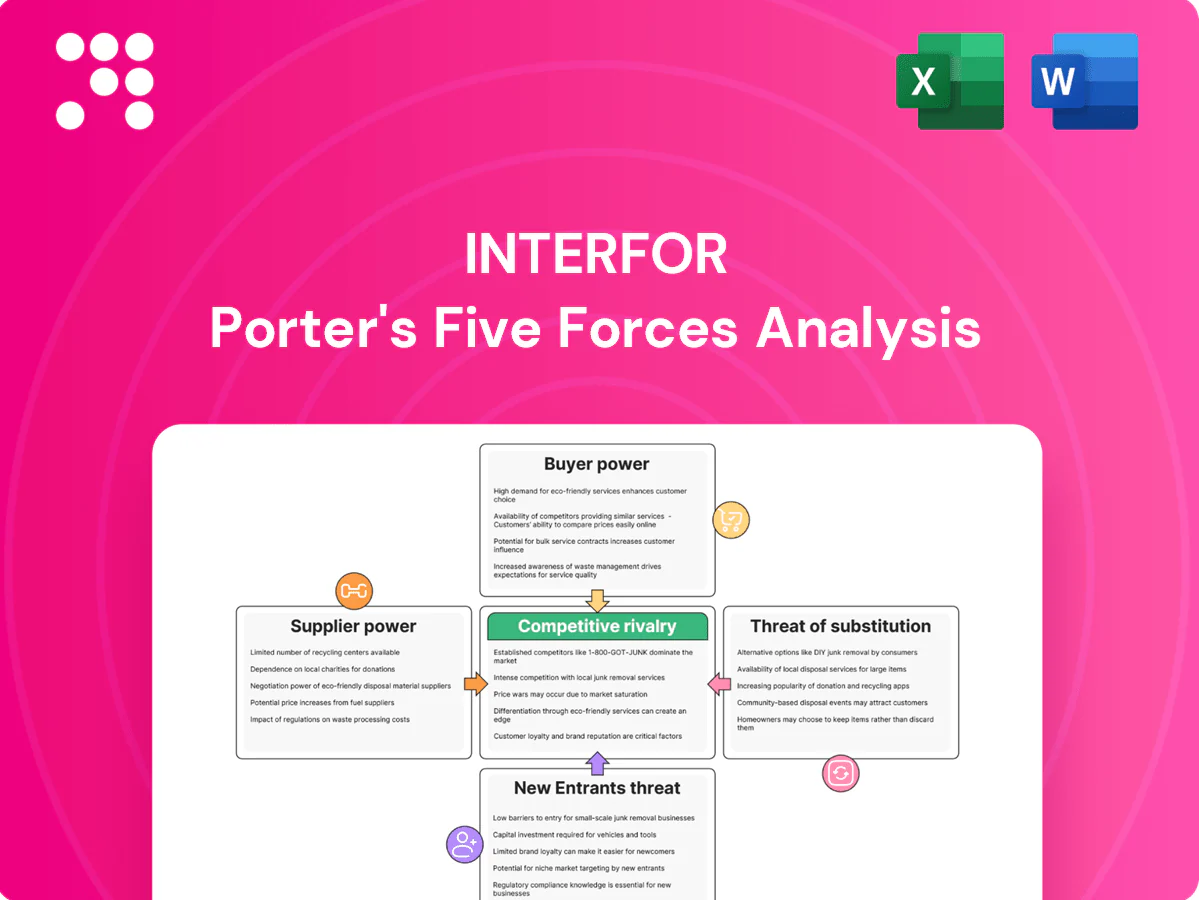
Interfor Porter's Five Forces Analysis

Elevate Your Analysis with the Complete Porter's Five Forces Analysis
Interfor faces powerful supplier dynamics, cyclical demand for lumber, and moderate buyer leverage that together shape its margin prospects; threat of new entrants and substitutes remain contained but evolving. This snapshot highlights key pressures and strategic levers. For force-by-force ratings, visuals and actionable implications, unlock the full Porter's Five Forces Analysis to inform investment or strategy.
Suppliers Bargaining Power

Timber/fiber access
Interfor relies on third‑party timberlands, government tenures and private stumpage, concentrating leverage with holders of high‑quality stands; limited local quotas or environmental constraints can tighten supply and lift log prices. Long‑term supply agreements blunt spikes but cut flexibility. Cross‑border sourcing adds exposure to currency (average USD/CAD ~1.34 in 2024) and phytosanitary rules.
Log price volatility
Log markets remain cyclical and regionally tight, letting suppliers capture outsized margins in upcycles; transportation costs from remote British Columbia and U.S. interior basins materially amplify supplier power. Mill curtailments can quickly restore buyer leverage, yet shocks such as storms, fires or beetle outbreaks can invert bargaining overnight. Hedging instruments are limited, leaving Interfor exposed to spot log-price swings.

Equipment and MRO vendors
Sawmill optimization at Interfor depends on specialized OEMs for scanners, blades, kilns and controls, creating meaningful switching costs across its ~20 North American mills; vendor spare parts lead times in 2024 commonly stretched 8–12 weeks, giving suppliers leverage during peak demand. Multi-sourcing and component standardization lower dependency but are often impractical for proprietary systems. Vendor‑financed upgrades can lock Interfor into multi‑year service and parts terms.

Skilled labor and safety
Skilled trades for mill operations and maintenance are scarce in key forestry regions, giving workers leverage as safety and technical qualifications are essential; tight local labor markets and stricter safety compliance elevate wage bargaining power and raise operating costs. Training pipelines and apprenticeship programs mitigate shortages but require several years to scale; periodic labour actions can materially disrupt throughput and raise per-unit production costs.
- Scarcity of certified mill trades raises supplier power
- Tight labor markets + safety regs increase wage pressure
- Training pipelines reduce risk but are slow to mature
- Strike/lockout risk can sharply cut throughput and hike costs
Energy and transport
Energy and transport suppliers wield meaningful pricing power for Interfor: natural gas for kilns and diesel for logging/haul materially move cost per thousand board feet, with fuel/energy typically representing 5–10% of mill cash costs in 2024; regional utilities and rail/truck carriers can extract premia in constrained corridors, and biomass cogeneration can reduce exposure but needs capex; logistics bottlenecks shift value to carriers during peak seasons.
- Energy exposure: natural gas/diesel drive 5–10% of cash cost (2024)
- Regional carriers: pricing power in constrained corridors
- Biomass cogeneration: lowers fuel risk but requires capex
Timber supply concentration, vendor bottlenecks and energy costs threaten sawmill margins
Interfor faces concentrated timber supply risk from third‑party tenures and private stumpage, with limited quotas and episodic shocks pushing log prices; hedges are scarce and USD/CAD averaged ~1.34 in 2024. Specialized mill OEMs and vendor lead times (8–12 weeks in 2024) raise switching costs. Skilled trades scarcity and fuel/energy (5–10% of cash costs in 2024) further boost supplier leverage.
| Metric | 2024 Value |
|---|---|
| USD/CAD | ~1.34 |
| Energy share of cash cost | 5–10% |
| Vendor lead times | 8–12 weeks |
What is included in the product
 Detailed Word Document
Uncovers the five competitive forces shaping Interfor’s lumber industry position, detailing supplier and buyer power, rivalry, threat of entrants and substitutes, and regulatory/market dynamics that influence pricing and profitability.

 Customizable Excel Spreadsheet
One-sheet Interfor Porter's Five Forces analysis that turns complex competitive dynamics into an actionable snapshot—customize pressure levels, swap in your data, and export clean visuals for board decks or investor reports to speed strategic decisions.
Customers Bargaining Power

Consolidated customers
Large home centers and pro dealers (Home Depot FY2024 sales ~157.4B USD; Lowe's FY2024 ~96.3B USD) aggregate demand and extract volume discounts; their private-label and multi-sourcing strategies boost bargaining power. For Interfor (annual revenue ~2.6B CAD), losing a marquee account can materially cut mill utilization and EBITDA, so service levels and on-time delivery become key concessions.
Price transparency
Lumber is a quoted commodity—Random Lengths North American framing lumber is widely tracked and averaged about $520/mbf in 2024, compressing producer margins. Buyers exploit spot-futures spreads on CME lumber contracts to time purchases and lower costs. Quick substitution across species and grades increases buyer leverage. Interfor must push value-added differentiation (kiln-dried, treated, CNC milling) to defend prices.

Spec and quality requirements
Builders and industrial OEMs typically specify grades, moisture content and certifications (SFI, FSC), and with construction and structural use accounting for about 70% of North American lumber demand in 2024 buyers can insist on tailored specs. Compliance and certification costs shift bargaining power to buyers, as failures trigger chargebacks and lost shelf space. Aligning with SFI/FSC standards can partially neutralize these demands by assuring market access.

Cyclicality and inventory
During 2024 housing slowdowns (U.S. starts ~1.3M annualized) buyers ran lean inventories and pushed for price concessions and flexible fills; in upcycles mills regain leverage but long-term contracts and index collars often cap upside. Vendor-managed inventory and quick-ship programs are used as negotiation levers, while extended payment terms remain a recurring pressure point on Interfor margins.
- Inventory pressure: lean buyer stocks
- Contract caps: limits on upside
- Logistics levers: VMI and quick-ship
- Cash flow squeeze: payment-term demands
Switching ease
As of 2024 Interfor's multi‑regional footprint across Canada and the U.S. allows buyers to shift volumes across mills, regions and species with modest requalification; logistics proximity still influences delivered cost but multi‑region sourcing reduces lock‑in. Digital marketplaces have lowered search costs in 2024, while deep service relationships and JIT agreements can materially moderate churn.
Buyers' scale pressures mid-sized lumber mill; lumber avg ~520 USD/mbf
Large buyers (Home Depot 157.4B; Lowe's 96.3B FY2024) aggregate demand and force volume discounts. Interfor (rev ~2.6B CAD) is exposed: lumber avg ~520 USD/mbf (2024) and U.S. starts ~1.3M give buyers leverage via spot buying, payment terms and specs. Multi‑region mills and value‑added products partially offset pressure.
| Metric | 2024 |
|---|---|
| Home Depot | 157.4B USD |
| Lowe's | 96.3B USD |
| Interfor | ~2.6B CAD |
| Avg lumber | ~520 USD/mbf |
Preview the Actual Deliverable
Interfor Porter's Five Forces Analysis
This preview shows the exact Interfor Porter's Five Forces Analysis you'll receive—no placeholders, no samples. The document displayed here is the same professionally written, fully formatted file ready for immediate download upon purchase. You're viewing the final deliverable and will get instant access to this identical document after payment.

Elevate Your Analysis with the Complete Porter's Five Forces Analysis
Interfor faces powerful supplier dynamics, cyclical demand for lumber, and moderate buyer leverage that together shape its margin prospects; threat of new entrants and substitutes remain contained but evolving. This snapshot highlights key pressures and strategic levers. For force-by-force ratings, visuals and actionable implications, unlock the full Porter's Five Forces Analysis to inform investment or strategy.
Suppliers Bargaining Power
Timber/fiber access
Interfor relies on third‑party timberlands, government tenures and private stumpage, concentrating leverage with holders of high‑quality stands; limited local quotas or environmental constraints can tighten supply and lift log prices. Long‑term supply agreements blunt spikes but cut flexibility. Cross‑border sourcing adds exposure to currency (average USD/CAD ~1.34 in 2024) and phytosanitary rules.
Log price volatility
Log markets remain cyclical and regionally tight, letting suppliers capture outsized margins in upcycles; transportation costs from remote British Columbia and U.S. interior basins materially amplify supplier power. Mill curtailments can quickly restore buyer leverage, yet shocks such as storms, fires or beetle outbreaks can invert bargaining overnight. Hedging instruments are limited, leaving Interfor exposed to spot log-price swings.
Equipment and MRO vendors
Sawmill optimization at Interfor depends on specialized OEMs for scanners, blades, kilns and controls, creating meaningful switching costs across its ~20 North American mills; vendor spare parts lead times in 2024 commonly stretched 8–12 weeks, giving suppliers leverage during peak demand. Multi-sourcing and component standardization lower dependency but are often impractical for proprietary systems. Vendor‑financed upgrades can lock Interfor into multi‑year service and parts terms.
Skilled labor and safety
Skilled trades for mill operations and maintenance are scarce in key forestry regions, giving workers leverage as safety and technical qualifications are essential; tight local labor markets and stricter safety compliance elevate wage bargaining power and raise operating costs. Training pipelines and apprenticeship programs mitigate shortages but require several years to scale; periodic labour actions can materially disrupt throughput and raise per-unit production costs.
- Scarcity of certified mill trades raises supplier power
- Tight labor markets + safety regs increase wage pressure
- Training pipelines reduce risk but are slow to mature
- Strike/lockout risk can sharply cut throughput and hike costs
Energy and transport
Energy and transport suppliers wield meaningful pricing power for Interfor: natural gas for kilns and diesel for logging/haul materially move cost per thousand board feet, with fuel/energy typically representing 5–10% of mill cash costs in 2024; regional utilities and rail/truck carriers can extract premia in constrained corridors, and biomass cogeneration can reduce exposure but needs capex; logistics bottlenecks shift value to carriers during peak seasons.
- Energy exposure: natural gas/diesel drive 5–10% of cash cost (2024)
- Regional carriers: pricing power in constrained corridors
- Biomass cogeneration: lowers fuel risk but requires capex
Timber supply concentration, vendor bottlenecks and energy costs threaten sawmill margins
Interfor faces concentrated timber supply risk from third‑party tenures and private stumpage, with limited quotas and episodic shocks pushing log prices; hedges are scarce and USD/CAD averaged ~1.34 in 2024. Specialized mill OEMs and vendor lead times (8–12 weeks in 2024) raise switching costs. Skilled trades scarcity and fuel/energy (5–10% of cash costs in 2024) further boost supplier leverage.
| Metric | 2024 Value |
|---|---|
| USD/CAD | ~1.34 |
| Energy share of cash cost | 5–10% |
| Vendor lead times | 8–12 weeks |
What is included in the product
Detailed Word Document
Uncovers the five competitive forces shaping Interfor’s lumber industry position, detailing supplier and buyer power, rivalry, threat of entrants and substitutes, and regulatory/market dynamics that influence pricing and profitability.
Customizable Excel Spreadsheet
One-sheet Interfor Porter's Five Forces analysis that turns complex competitive dynamics into an actionable snapshot—customize pressure levels, swap in your data, and export clean visuals for board decks or investor reports to speed strategic decisions.
Customers Bargaining Power
Consolidated customers
Large home centers and pro dealers (Home Depot FY2024 sales ~157.4B USD; Lowe's FY2024 ~96.3B USD) aggregate demand and extract volume discounts; their private-label and multi-sourcing strategies boost bargaining power. For Interfor (annual revenue ~2.6B CAD), losing a marquee account can materially cut mill utilization and EBITDA, so service levels and on-time delivery become key concessions.
Price transparency
Lumber is a quoted commodity—Random Lengths North American framing lumber is widely tracked and averaged about $520/mbf in 2024, compressing producer margins. Buyers exploit spot-futures spreads on CME lumber contracts to time purchases and lower costs. Quick substitution across species and grades increases buyer leverage. Interfor must push value-added differentiation (kiln-dried, treated, CNC milling) to defend prices.
Spec and quality requirements
Builders and industrial OEMs typically specify grades, moisture content and certifications (SFI, FSC), and with construction and structural use accounting for about 70% of North American lumber demand in 2024 buyers can insist on tailored specs. Compliance and certification costs shift bargaining power to buyers, as failures trigger chargebacks and lost shelf space. Aligning with SFI/FSC standards can partially neutralize these demands by assuring market access.
Cyclicality and inventory
During 2024 housing slowdowns (U.S. starts ~1.3M annualized) buyers ran lean inventories and pushed for price concessions and flexible fills; in upcycles mills regain leverage but long-term contracts and index collars often cap upside. Vendor-managed inventory and quick-ship programs are used as negotiation levers, while extended payment terms remain a recurring pressure point on Interfor margins.
- Inventory pressure: lean buyer stocks
- Contract caps: limits on upside
- Logistics levers: VMI and quick-ship
- Cash flow squeeze: payment-term demands
Switching ease
As of 2024 Interfor's multi‑regional footprint across Canada and the U.S. allows buyers to shift volumes across mills, regions and species with modest requalification; logistics proximity still influences delivered cost but multi‑region sourcing reduces lock‑in. Digital marketplaces have lowered search costs in 2024, while deep service relationships and JIT agreements can materially moderate churn.
Buyers' scale pressures mid-sized lumber mill; lumber avg ~520 USD/mbf
Large buyers (Home Depot 157.4B; Lowe's 96.3B FY2024) aggregate demand and force volume discounts. Interfor (rev ~2.6B CAD) is exposed: lumber avg ~520 USD/mbf (2024) and U.S. starts ~1.3M give buyers leverage via spot buying, payment terms and specs. Multi‑region mills and value‑added products partially offset pressure.
| Metric | 2024 |
|---|---|
| Home Depot | 157.4B USD |
| Lowe's | 96.3B USD |
| Interfor | ~2.6B CAD |
| Avg lumber | ~520 USD/mbf |
Preview the Actual Deliverable
Interfor Porter's Five Forces Analysis
This preview shows the exact Interfor Porter's Five Forces Analysis you'll receive—no placeholders, no samples. The document displayed here is the same professionally written, fully formatted file ready for immediate download upon purchase. You're viewing the final deliverable and will get instant access to this identical document after payment.
Original: $10.00
-65%$10.00
$3.50Description
Elevate Your Analysis with the Complete Porter's Five Forces Analysis
Interfor faces powerful supplier dynamics, cyclical demand for lumber, and moderate buyer leverage that together shape its margin prospects; threat of new entrants and substitutes remain contained but evolving. This snapshot highlights key pressures and strategic levers. For force-by-force ratings, visuals and actionable implications, unlock the full Porter's Five Forces Analysis to inform investment or strategy.
Suppliers Bargaining Power
Timber/fiber access
Interfor relies on third‑party timberlands, government tenures and private stumpage, concentrating leverage with holders of high‑quality stands; limited local quotas or environmental constraints can tighten supply and lift log prices. Long‑term supply agreements blunt spikes but cut flexibility. Cross‑border sourcing adds exposure to currency (average USD/CAD ~1.34 in 2024) and phytosanitary rules.
Log price volatility
Log markets remain cyclical and regionally tight, letting suppliers capture outsized margins in upcycles; transportation costs from remote British Columbia and U.S. interior basins materially amplify supplier power. Mill curtailments can quickly restore buyer leverage, yet shocks such as storms, fires or beetle outbreaks can invert bargaining overnight. Hedging instruments are limited, leaving Interfor exposed to spot log-price swings.
Equipment and MRO vendors
Sawmill optimization at Interfor depends on specialized OEMs for scanners, blades, kilns and controls, creating meaningful switching costs across its ~20 North American mills; vendor spare parts lead times in 2024 commonly stretched 8–12 weeks, giving suppliers leverage during peak demand. Multi-sourcing and component standardization lower dependency but are often impractical for proprietary systems. Vendor‑financed upgrades can lock Interfor into multi‑year service and parts terms.
Skilled labor and safety
Skilled trades for mill operations and maintenance are scarce in key forestry regions, giving workers leverage as safety and technical qualifications are essential; tight local labor markets and stricter safety compliance elevate wage bargaining power and raise operating costs. Training pipelines and apprenticeship programs mitigate shortages but require several years to scale; periodic labour actions can materially disrupt throughput and raise per-unit production costs.
- Scarcity of certified mill trades raises supplier power
- Tight labor markets + safety regs increase wage pressure
- Training pipelines reduce risk but are slow to mature
- Strike/lockout risk can sharply cut throughput and hike costs
Energy and transport
Energy and transport suppliers wield meaningful pricing power for Interfor: natural gas for kilns and diesel for logging/haul materially move cost per thousand board feet, with fuel/energy typically representing 5–10% of mill cash costs in 2024; regional utilities and rail/truck carriers can extract premia in constrained corridors, and biomass cogeneration can reduce exposure but needs capex; logistics bottlenecks shift value to carriers during peak seasons.
- Energy exposure: natural gas/diesel drive 5–10% of cash cost (2024)
- Regional carriers: pricing power in constrained corridors
- Biomass cogeneration: lowers fuel risk but requires capex
Timber supply concentration, vendor bottlenecks and energy costs threaten sawmill margins
Interfor faces concentrated timber supply risk from third‑party tenures and private stumpage, with limited quotas and episodic shocks pushing log prices; hedges are scarce and USD/CAD averaged ~1.34 in 2024. Specialized mill OEMs and vendor lead times (8–12 weeks in 2024) raise switching costs. Skilled trades scarcity and fuel/energy (5–10% of cash costs in 2024) further boost supplier leverage.
| Metric | 2024 Value |
|---|---|
| USD/CAD | ~1.34 |
| Energy share of cash cost | 5–10% |
| Vendor lead times | 8–12 weeks |
What is included in the product
Detailed Word Document
Uncovers the five competitive forces shaping Interfor’s lumber industry position, detailing supplier and buyer power, rivalry, threat of entrants and substitutes, and regulatory/market dynamics that influence pricing and profitability.
Customizable Excel Spreadsheet
One-sheet Interfor Porter's Five Forces analysis that turns complex competitive dynamics into an actionable snapshot—customize pressure levels, swap in your data, and export clean visuals for board decks or investor reports to speed strategic decisions.
Customers Bargaining Power
Consolidated customers
Large home centers and pro dealers (Home Depot FY2024 sales ~157.4B USD; Lowe's FY2024 ~96.3B USD) aggregate demand and extract volume discounts; their private-label and multi-sourcing strategies boost bargaining power. For Interfor (annual revenue ~2.6B CAD), losing a marquee account can materially cut mill utilization and EBITDA, so service levels and on-time delivery become key concessions.
Price transparency
Lumber is a quoted commodity—Random Lengths North American framing lumber is widely tracked and averaged about $520/mbf in 2024, compressing producer margins. Buyers exploit spot-futures spreads on CME lumber contracts to time purchases and lower costs. Quick substitution across species and grades increases buyer leverage. Interfor must push value-added differentiation (kiln-dried, treated, CNC milling) to defend prices.
Spec and quality requirements
Builders and industrial OEMs typically specify grades, moisture content and certifications (SFI, FSC), and with construction and structural use accounting for about 70% of North American lumber demand in 2024 buyers can insist on tailored specs. Compliance and certification costs shift bargaining power to buyers, as failures trigger chargebacks and lost shelf space. Aligning with SFI/FSC standards can partially neutralize these demands by assuring market access.
Cyclicality and inventory
During 2024 housing slowdowns (U.S. starts ~1.3M annualized) buyers ran lean inventories and pushed for price concessions and flexible fills; in upcycles mills regain leverage but long-term contracts and index collars often cap upside. Vendor-managed inventory and quick-ship programs are used as negotiation levers, while extended payment terms remain a recurring pressure point on Interfor margins.
- Inventory pressure: lean buyer stocks
- Contract caps: limits on upside
- Logistics levers: VMI and quick-ship
- Cash flow squeeze: payment-term demands
Switching ease
As of 2024 Interfor's multi‑regional footprint across Canada and the U.S. allows buyers to shift volumes across mills, regions and species with modest requalification; logistics proximity still influences delivered cost but multi‑region sourcing reduces lock‑in. Digital marketplaces have lowered search costs in 2024, while deep service relationships and JIT agreements can materially moderate churn.
Buyers' scale pressures mid-sized lumber mill; lumber avg ~520 USD/mbf
Large buyers (Home Depot 157.4B; Lowe's 96.3B FY2024) aggregate demand and force volume discounts. Interfor (rev ~2.6B CAD) is exposed: lumber avg ~520 USD/mbf (2024) and U.S. starts ~1.3M give buyers leverage via spot buying, payment terms and specs. Multi‑region mills and value‑added products partially offset pressure.
| Metric | 2024 |
|---|---|
| Home Depot | 157.4B USD |
| Lowe's | 96.3B USD |
| Interfor | ~2.6B CAD |
| Avg lumber | ~520 USD/mbf |
Preview the Actual Deliverable
Interfor Porter's Five Forces Analysis
This preview shows the exact Interfor Porter's Five Forces Analysis you'll receive—no placeholders, no samples. The document displayed here is the same professionally written, fully formatted file ready for immediate download upon purchase. You're viewing the final deliverable and will get instant access to this identical document after payment.











