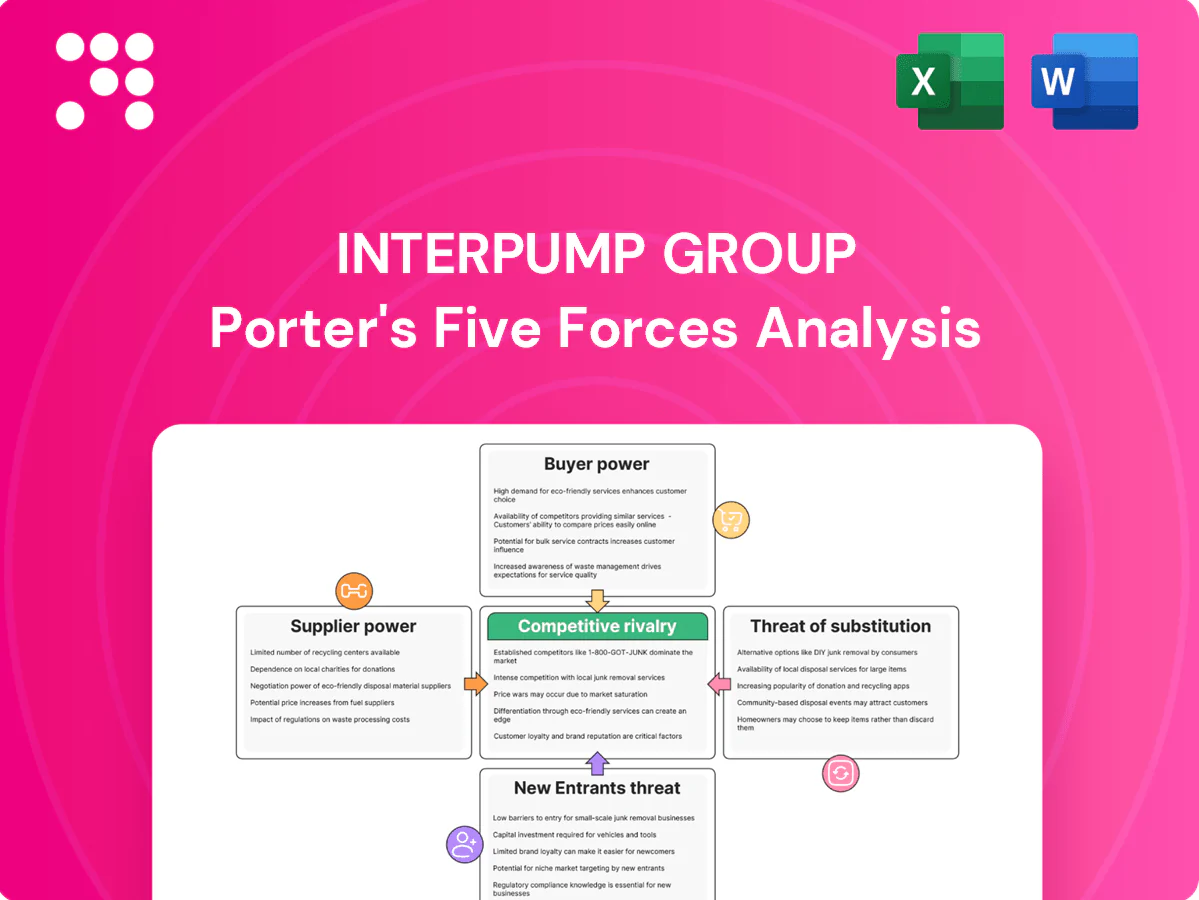
Interpump Group Porter's Five Forces Analysis

A Must-Have Tool for Decision-Makers
Interpump Group faces moderate supplier power, steady buyer negotiation from industrial clients, and evolving substitute risks as electrification and Chinese OEMs pressure margins; rivalry is intense among hydraulic and water-jet segments while entry barriers remain moderate due to scale and technology. This snapshot only scratches the surface—unlock the full Porter’s Five Forces Analysis for force-by-force ratings, visuals, and actionable strategy.
Suppliers Bargaining Power

Specialized component dependency
Interpump depends on specialized seals, valves, forged housings, motors and electronics where qualified suppliers are limited, raising supplier leverage on lead times and pricing; however Interpump’s engineering depth, multisourcing across its global operations and long-term contracts with supplier qualification programs mitigate single‑supplier risk.
Commodity materials breadth
Broad availability of steel, common alloys and standard fittings — global crude steel production reached 1,878 Mt in 2023 with China accounting for ~54% — keeps input substitution feasible for Interpump; global sourcing and diversified vendors lower concentration and price-shock risk, while hedging and inventory policies smooth volatility; commodity suppliers therefore exert limited bargaining power versus specialized component makers.

Quality and certification requirements
Industrial and hydraulic applications require tight tolerances and certified inputs (ISO/CE), which limits switching and modestly raises supplier power; Interpump’s scale—about €2.3bn revenue in 2024—gives it leverage in procurement. The group’s supplier development programs and regular audits have widened the qualified supplier pool, reducing dependence on single sources. Over time this keeps bargaining more balanced.

Scale and vertical capabilities
Interpump’s scale and extensive in-house machining and assembly (group revenue ~€2.36bn in 2023) reduce reliance on external suppliers, lowering bottleneck risk and protecting margins. Backward integration in pumps and hydraulics cuts exposure to component shortages, while consolidated purchasing secures volume discounts, collectively diminishing supplier leverage.
- Scale: revenue ~€2.36bn (2023)
- Vertical: in-house machining/assembly
- Risk: lower bottleneck/margin pressure
- Purchasing: stronger volume discounts
Logistics and geopolitical exposure
Interpump's global supply chain in 2024 faced freight, tariff and regional disruption risks as the Drewry World Container Index fell roughly 75% from 2021 peaks to 2024 levels, yet regional bottlenecks and tariff shifts still created episodic supplier leverage.
- Suppliers in constrained regions: higher leverage during 2024 shocks
- Risk mitigation: dual sourcing and regionalization reduced exposure
- Inventory buffers: long-lead items held to curb supplier power
Specialized supplier power rises; multisourcing and in‑house machining curb risk
Interpump faces higher supplier power for specialized seals, valves and electronics due to limited qualified vendors, but multisourcing, supplier development and in‑house machining (revenue ~€2.36bn in 2023; ~€2.30bn in 2024) reduce dependency. Commodity inputs (steel: 1,878 Mt global production in 2023) limit bargaining power of bulk suppliers. Regional 2024 disruptions raised episodic leverage despite dual sourcing.
| Metric | Value |
|---|---|
| Group revenue | €2.36bn (2023); ~€2.30bn (2024) |
| Global steel | 1,878 Mt (2023) |
| Container index change | -~75% from 2021 peaks to 2024 |
What is included in the product
 Detailed Word Document
Concise Porter's Five Forces analysis tailored to Interpump Group, assessing competitive rivalry, supplier and buyer power, threat of new entrants and substitutes, and identifying disruptive forces that may pressure pricing, margins and market share.

 Customizable Excel Spreadsheet
One-sheet Porter's Five Forces for Interpump Group—visual spider chart and editable pressure sliders that clarify supplier, buyer, rivalry, entrant, and substitute risks for fast strategic decisions and easy slide import.
Customers Bargaining Power

Large OEM negotiation strength
Major OEMs in industrial vehicles, agriculture and cleaning equipment—eg, Deere & Company with ~60 billion USD revenue in FY2024—wield strong price and terms leverage through high volumes and multi‑year sourcing cycles. These buyers run multi‑year contests that can shape supplier capacity and cash flow. Interpump mitigates pressure by delivering tight performance specs, co‑design and integration value, making pure price comparisons less decisive.
Switching costs and compatibility
Pumps and hydraulics from Interpump integrate with brackets, controls and service kits, making vendor changes trigger requalification, redesign and downtime costs that often exceed purchase price; Interpump reported group revenues above €2 billion in 2023, underscoring scale and installed base depth.

Product differentiation and reliability
High-pressure duty cycles and safety make reliability and lifecycle cost critical for Interpump customers, with field uptime targets commonly exceeding 98% and lifecycle cost reductions of 20–30% driving procurement decisions. Clear differentiation in durability, hydraulic efficiency and expanded aftersales (spare parts, service contracts) materially weakens buyer leverage. Premium segments routinely accept value-based pricing premiums of ~10–15% versus lowest-bid sourcing, while certifications and proven MTBF records further insulate pricing.

Channel mix and fragmentation
Interpump serves OEMs, distributors and end-users globally, with channel sales spread across aftermarket and industrial segments; group revenues were about €2.1bn in 2023, framing 2024 strategic exposure.
Distributor fragmentation across regions lowers single-buyer clout, yet top distributors can negotiate rebates and extended credit; balanced channel exposure moderates aggregate buyer power.
- Distributor share: diversified
- Top-distributor leverage: meaningful rebates/credit
- Channel balance: reduces concentrated buyer risk
Price transparency in standard SKUs
For commoditized pumps and components where specs are comparable and prices are visible, buyers can solicit multiple quotes to pressure margins; Interpump reported 2024 revenue of €2.2bn, highlighting scale but exposure to price-led competition. The group defends value through bundled offerings and service SLAs, while higher-margin customization shifts buyer focus away from headline price.
- Price transparency: comparable SKUs enable easy quoting
- Defense: bundles + SLAs protect margins
- Customization: moves negotiation from price to specification
OEM scale and co‑design drive uptime >98% and justify 10–15% premiums
Major OEMs (eg Deere FY2024 rev ~60bn USD) exert strong leverage via volume and multi‑year sourcing; Interpump reported €2.2bn revenue in 2024 and counters with co‑design, reliability and service bundles. Uptime (>98%) and lifecycle savings justify 10–15% premiums in premium segments. Commoditised SKUs face price pressure, offset by distributor diversification.
| Metric | 2024 |
|---|---|
| Group revenue | €2.2bn |
| OEM example (Deere) | $60bn |
| Uptime target | >98% |
| Premium pricing | 10–15% |
Preview Before You Purchase
Interpump Group Porter's Five Forces Analysis
This preview shows the exact Interpump Group Porter's Five Forces Analysis you will receive immediately after purchase—no placeholders or samples. The full document is fully formatted, professionally written and ready for download and use the moment you buy. You're viewing the deliverable in its final form.

A Must-Have Tool for Decision-Makers
Interpump Group faces moderate supplier power, steady buyer negotiation from industrial clients, and evolving substitute risks as electrification and Chinese OEMs pressure margins; rivalry is intense among hydraulic and water-jet segments while entry barriers remain moderate due to scale and technology. This snapshot only scratches the surface—unlock the full Porter’s Five Forces Analysis for force-by-force ratings, visuals, and actionable strategy.
Suppliers Bargaining Power
Specialized component dependency
Interpump depends on specialized seals, valves, forged housings, motors and electronics where qualified suppliers are limited, raising supplier leverage on lead times and pricing; however Interpump’s engineering depth, multisourcing across its global operations and long-term contracts with supplier qualification programs mitigate single‑supplier risk.
Commodity materials breadth
Broad availability of steel, common alloys and standard fittings — global crude steel production reached 1,878 Mt in 2023 with China accounting for ~54% — keeps input substitution feasible for Interpump; global sourcing and diversified vendors lower concentration and price-shock risk, while hedging and inventory policies smooth volatility; commodity suppliers therefore exert limited bargaining power versus specialized component makers.
Quality and certification requirements
Industrial and hydraulic applications require tight tolerances and certified inputs (ISO/CE), which limits switching and modestly raises supplier power; Interpump’s scale—about €2.3bn revenue in 2024—gives it leverage in procurement. The group’s supplier development programs and regular audits have widened the qualified supplier pool, reducing dependence on single sources. Over time this keeps bargaining more balanced.
Scale and vertical capabilities
Interpump’s scale and extensive in-house machining and assembly (group revenue ~€2.36bn in 2023) reduce reliance on external suppliers, lowering bottleneck risk and protecting margins. Backward integration in pumps and hydraulics cuts exposure to component shortages, while consolidated purchasing secures volume discounts, collectively diminishing supplier leverage.
- Scale: revenue ~€2.36bn (2023)
- Vertical: in-house machining/assembly
- Risk: lower bottleneck/margin pressure
- Purchasing: stronger volume discounts
Logistics and geopolitical exposure
Interpump's global supply chain in 2024 faced freight, tariff and regional disruption risks as the Drewry World Container Index fell roughly 75% from 2021 peaks to 2024 levels, yet regional bottlenecks and tariff shifts still created episodic supplier leverage.
- Suppliers in constrained regions: higher leverage during 2024 shocks
- Risk mitigation: dual sourcing and regionalization reduced exposure
- Inventory buffers: long-lead items held to curb supplier power
Specialized supplier power rises; multisourcing and in‑house machining curb risk
Interpump faces higher supplier power for specialized seals, valves and electronics due to limited qualified vendors, but multisourcing, supplier development and in‑house machining (revenue ~€2.36bn in 2023; ~€2.30bn in 2024) reduce dependency. Commodity inputs (steel: 1,878 Mt global production in 2023) limit bargaining power of bulk suppliers. Regional 2024 disruptions raised episodic leverage despite dual sourcing.
| Metric | Value |
|---|---|
| Group revenue | €2.36bn (2023); ~€2.30bn (2024) |
| Global steel | 1,878 Mt (2023) |
| Container index change | -~75% from 2021 peaks to 2024 |
What is included in the product
Detailed Word Document
Concise Porter's Five Forces analysis tailored to Interpump Group, assessing competitive rivalry, supplier and buyer power, threat of new entrants and substitutes, and identifying disruptive forces that may pressure pricing, margins and market share.
Customizable Excel Spreadsheet
One-sheet Porter's Five Forces for Interpump Group—visual spider chart and editable pressure sliders that clarify supplier, buyer, rivalry, entrant, and substitute risks for fast strategic decisions and easy slide import.
Customers Bargaining Power
Large OEM negotiation strength
Major OEMs in industrial vehicles, agriculture and cleaning equipment—eg, Deere & Company with ~60 billion USD revenue in FY2024—wield strong price and terms leverage through high volumes and multi‑year sourcing cycles. These buyers run multi‑year contests that can shape supplier capacity and cash flow. Interpump mitigates pressure by delivering tight performance specs, co‑design and integration value, making pure price comparisons less decisive.
Switching costs and compatibility
Pumps and hydraulics from Interpump integrate with brackets, controls and service kits, making vendor changes trigger requalification, redesign and downtime costs that often exceed purchase price; Interpump reported group revenues above €2 billion in 2023, underscoring scale and installed base depth.
Product differentiation and reliability
High-pressure duty cycles and safety make reliability and lifecycle cost critical for Interpump customers, with field uptime targets commonly exceeding 98% and lifecycle cost reductions of 20–30% driving procurement decisions. Clear differentiation in durability, hydraulic efficiency and expanded aftersales (spare parts, service contracts) materially weakens buyer leverage. Premium segments routinely accept value-based pricing premiums of ~10–15% versus lowest-bid sourcing, while certifications and proven MTBF records further insulate pricing.
Channel mix and fragmentation
Interpump serves OEMs, distributors and end-users globally, with channel sales spread across aftermarket and industrial segments; group revenues were about €2.1bn in 2023, framing 2024 strategic exposure.
Distributor fragmentation across regions lowers single-buyer clout, yet top distributors can negotiate rebates and extended credit; balanced channel exposure moderates aggregate buyer power.
- Distributor share: diversified
- Top-distributor leverage: meaningful rebates/credit
- Channel balance: reduces concentrated buyer risk
Price transparency in standard SKUs
For commoditized pumps and components where specs are comparable and prices are visible, buyers can solicit multiple quotes to pressure margins; Interpump reported 2024 revenue of €2.2bn, highlighting scale but exposure to price-led competition. The group defends value through bundled offerings and service SLAs, while higher-margin customization shifts buyer focus away from headline price.
- Price transparency: comparable SKUs enable easy quoting
- Defense: bundles + SLAs protect margins
- Customization: moves negotiation from price to specification
OEM scale and co‑design drive uptime >98% and justify 10–15% premiums
Major OEMs (eg Deere FY2024 rev ~60bn USD) exert strong leverage via volume and multi‑year sourcing; Interpump reported €2.2bn revenue in 2024 and counters with co‑design, reliability and service bundles. Uptime (>98%) and lifecycle savings justify 10–15% premiums in premium segments. Commoditised SKUs face price pressure, offset by distributor diversification.
| Metric | 2024 |
|---|---|
| Group revenue | €2.2bn |
| OEM example (Deere) | $60bn |
| Uptime target | >98% |
| Premium pricing | 10–15% |
Preview Before You Purchase
Interpump Group Porter's Five Forces Analysis
This preview shows the exact Interpump Group Porter's Five Forces Analysis you will receive immediately after purchase—no placeholders or samples. The full document is fully formatted, professionally written and ready for download and use the moment you buy. You're viewing the deliverable in its final form.
Original: $10.00
-65%$10.00
$3.50Description
A Must-Have Tool for Decision-Makers
Interpump Group faces moderate supplier power, steady buyer negotiation from industrial clients, and evolving substitute risks as electrification and Chinese OEMs pressure margins; rivalry is intense among hydraulic and water-jet segments while entry barriers remain moderate due to scale and technology. This snapshot only scratches the surface—unlock the full Porter’s Five Forces Analysis for force-by-force ratings, visuals, and actionable strategy.
Suppliers Bargaining Power
Specialized component dependency
Interpump depends on specialized seals, valves, forged housings, motors and electronics where qualified suppliers are limited, raising supplier leverage on lead times and pricing; however Interpump’s engineering depth, multisourcing across its global operations and long-term contracts with supplier qualification programs mitigate single‑supplier risk.
Commodity materials breadth
Broad availability of steel, common alloys and standard fittings — global crude steel production reached 1,878 Mt in 2023 with China accounting for ~54% — keeps input substitution feasible for Interpump; global sourcing and diversified vendors lower concentration and price-shock risk, while hedging and inventory policies smooth volatility; commodity suppliers therefore exert limited bargaining power versus specialized component makers.
Quality and certification requirements
Industrial and hydraulic applications require tight tolerances and certified inputs (ISO/CE), which limits switching and modestly raises supplier power; Interpump’s scale—about €2.3bn revenue in 2024—gives it leverage in procurement. The group’s supplier development programs and regular audits have widened the qualified supplier pool, reducing dependence on single sources. Over time this keeps bargaining more balanced.
Scale and vertical capabilities
Interpump’s scale and extensive in-house machining and assembly (group revenue ~€2.36bn in 2023) reduce reliance on external suppliers, lowering bottleneck risk and protecting margins. Backward integration in pumps and hydraulics cuts exposure to component shortages, while consolidated purchasing secures volume discounts, collectively diminishing supplier leverage.
- Scale: revenue ~€2.36bn (2023)
- Vertical: in-house machining/assembly
- Risk: lower bottleneck/margin pressure
- Purchasing: stronger volume discounts
Logistics and geopolitical exposure
Interpump's global supply chain in 2024 faced freight, tariff and regional disruption risks as the Drewry World Container Index fell roughly 75% from 2021 peaks to 2024 levels, yet regional bottlenecks and tariff shifts still created episodic supplier leverage.
- Suppliers in constrained regions: higher leverage during 2024 shocks
- Risk mitigation: dual sourcing and regionalization reduced exposure
- Inventory buffers: long-lead items held to curb supplier power
Specialized supplier power rises; multisourcing and in‑house machining curb risk
Interpump faces higher supplier power for specialized seals, valves and electronics due to limited qualified vendors, but multisourcing, supplier development and in‑house machining (revenue ~€2.36bn in 2023; ~€2.30bn in 2024) reduce dependency. Commodity inputs (steel: 1,878 Mt global production in 2023) limit bargaining power of bulk suppliers. Regional 2024 disruptions raised episodic leverage despite dual sourcing.
| Metric | Value |
|---|---|
| Group revenue | €2.36bn (2023); ~€2.30bn (2024) |
| Global steel | 1,878 Mt (2023) |
| Container index change | -~75% from 2021 peaks to 2024 |
What is included in the product
Detailed Word Document
Concise Porter's Five Forces analysis tailored to Interpump Group, assessing competitive rivalry, supplier and buyer power, threat of new entrants and substitutes, and identifying disruptive forces that may pressure pricing, margins and market share.
Customizable Excel Spreadsheet
One-sheet Porter's Five Forces for Interpump Group—visual spider chart and editable pressure sliders that clarify supplier, buyer, rivalry, entrant, and substitute risks for fast strategic decisions and easy slide import.
Customers Bargaining Power
Large OEM negotiation strength
Major OEMs in industrial vehicles, agriculture and cleaning equipment—eg, Deere & Company with ~60 billion USD revenue in FY2024—wield strong price and terms leverage through high volumes and multi‑year sourcing cycles. These buyers run multi‑year contests that can shape supplier capacity and cash flow. Interpump mitigates pressure by delivering tight performance specs, co‑design and integration value, making pure price comparisons less decisive.
Switching costs and compatibility
Pumps and hydraulics from Interpump integrate with brackets, controls and service kits, making vendor changes trigger requalification, redesign and downtime costs that often exceed purchase price; Interpump reported group revenues above €2 billion in 2023, underscoring scale and installed base depth.
Product differentiation and reliability
High-pressure duty cycles and safety make reliability and lifecycle cost critical for Interpump customers, with field uptime targets commonly exceeding 98% and lifecycle cost reductions of 20–30% driving procurement decisions. Clear differentiation in durability, hydraulic efficiency and expanded aftersales (spare parts, service contracts) materially weakens buyer leverage. Premium segments routinely accept value-based pricing premiums of ~10–15% versus lowest-bid sourcing, while certifications and proven MTBF records further insulate pricing.
Channel mix and fragmentation
Interpump serves OEMs, distributors and end-users globally, with channel sales spread across aftermarket and industrial segments; group revenues were about €2.1bn in 2023, framing 2024 strategic exposure.
Distributor fragmentation across regions lowers single-buyer clout, yet top distributors can negotiate rebates and extended credit; balanced channel exposure moderates aggregate buyer power.
- Distributor share: diversified
- Top-distributor leverage: meaningful rebates/credit
- Channel balance: reduces concentrated buyer risk
Price transparency in standard SKUs
For commoditized pumps and components where specs are comparable and prices are visible, buyers can solicit multiple quotes to pressure margins; Interpump reported 2024 revenue of €2.2bn, highlighting scale but exposure to price-led competition. The group defends value through bundled offerings and service SLAs, while higher-margin customization shifts buyer focus away from headline price.
- Price transparency: comparable SKUs enable easy quoting
- Defense: bundles + SLAs protect margins
- Customization: moves negotiation from price to specification
OEM scale and co‑design drive uptime >98% and justify 10–15% premiums
Major OEMs (eg Deere FY2024 rev ~60bn USD) exert strong leverage via volume and multi‑year sourcing; Interpump reported €2.2bn revenue in 2024 and counters with co‑design, reliability and service bundles. Uptime (>98%) and lifecycle savings justify 10–15% premiums in premium segments. Commoditised SKUs face price pressure, offset by distributor diversification.
| Metric | 2024 |
|---|---|
| Group revenue | €2.2bn |
| OEM example (Deere) | $60bn |
| Uptime target | >98% |
| Premium pricing | 10–15% |
Preview Before You Purchase
Interpump Group Porter's Five Forces Analysis
This preview shows the exact Interpump Group Porter's Five Forces Analysis you will receive immediately after purchase—no placeholders or samples. The full document is fully formatted, professionally written and ready for download and use the moment you buy. You're viewing the deliverable in its final form.











