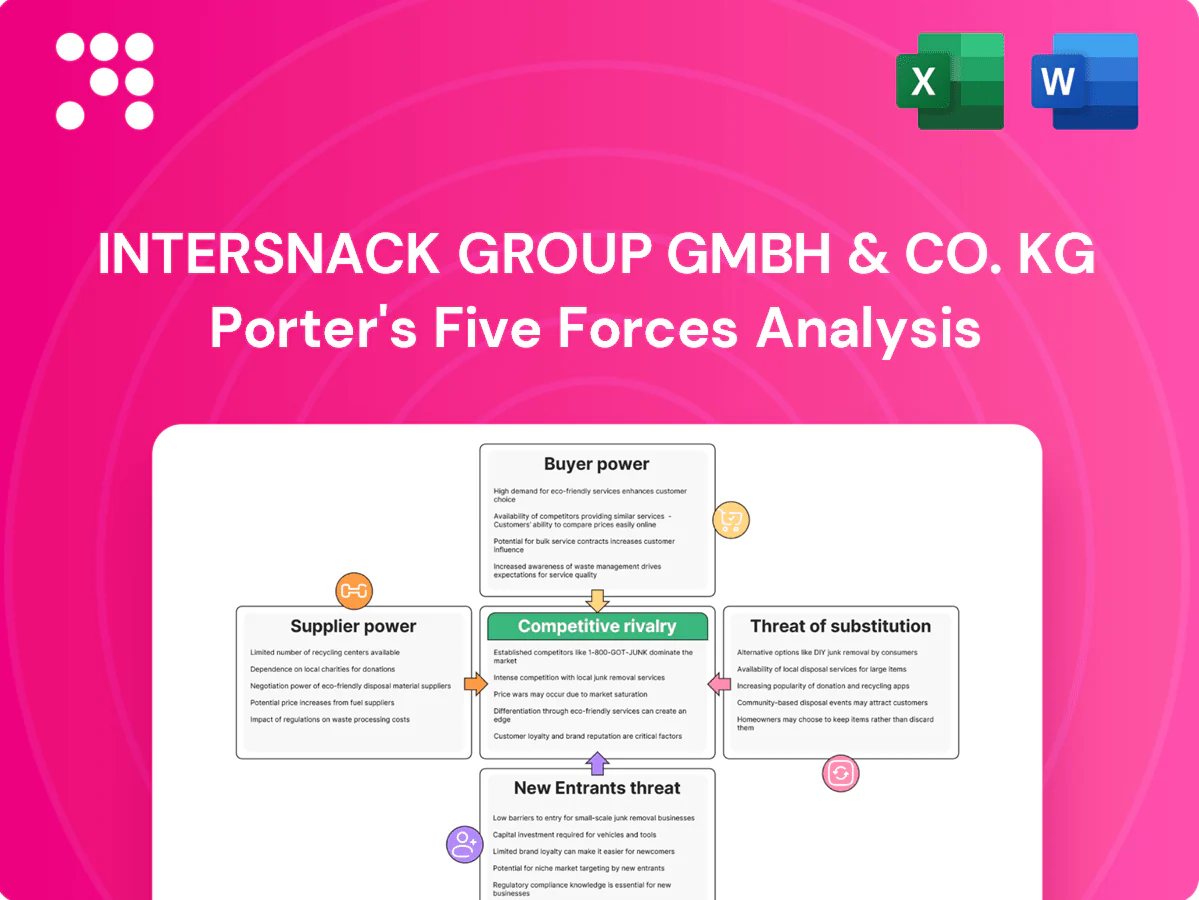
Intersnack Group GmbH & Co. KG Porter's Five Forces Analysis

Go Beyond the Preview—Access the Full Strategic Report
Intersnack navigates strong retail buyer power, intense rivalry among snack brands, and persistent substitute threats from healthier and private-label options, while scale and distribution provide moderate defense against new entrants. Supply-side risks are manageable but subject to commodity swings. This brief snapshot only scratches the surface. Unlock the full Porter's Five Forces Analysis to explore Intersnack Group GmbH & Co. KG’s competitive dynamics, market pressures, and strategic advantages in detail.
Suppliers Bargaining Power

Fragmented agri-input base
Potatoes, corn and nuts are bought from a fragmented base of regional growers, limiting any single farm’s leverage and supporting Intersnack’s purchasing scale (Group net sales ~€3.3bn in 2023). Seasonal variability and climate-driven shocks in 2022–24 have tightened supply at times and driven periodic price spikes in EU crop markets. Intersnack mitigates supplier power via dual-sourcing, origin shifts, long-term contracts and agronomy programs to secure volumes.
Concentrated edible oils and flavors
Refined vegetable oils and specialty seasonings are supplied by a concentrated base—Indonesia and Malaysia account for roughly 80% of global palm oil supply (2023–24)—boosting supplier bargaining power. Price swings in oil markets are frequently passed through via index-linked contracts. Flavor houses face technical switching costs from reformulation and regulatory reapproval. Intersnack mitigates leverage through multi-sourcing and commodity hedging programs.

Packaging films and cans
Packaging films, cartons and nut cans depend on a moderately concentrated base of industrial converters, where scale volumes drive better pricing and priority allocations; Intersnack’s purchasing leverage helps secure terms. Energy and resin volatility (price swings up to circa 30% in 2021–23) transmits to input costs. Qualification of alternative substrates is slow due to shelf-life and machine specs, raising switching costs and lead-times.

Logistics and energy exposure
Freight, warehousing and utilities are critical bottlenecks for Intersnack; episodic tight trucking capacity and energy price spikes historically pushed logistics costs up sharply, increasing supplier power despite Intersnack’s scale. The group’s network optimization and long-term supply contracts cap volatility, while nearshoring reduces dependence on single corridors and shortens lead times.
- Freight exposure: episodic capacity shortages
- Energy: spikes amplify supplier leverage
- Mitigants: long-term contracts, network optimization
- Strategy: nearshoring lowers corridor risk
Quality and compliance requirements
Food safety certifications such as BRC and IFS substantially narrow Intersnack’s eligible supplier pool, increasing the bargaining power of certified suppliers; switching suppliers triggers costly audits and line trials that slow change. Intersnack’s scale creates purchasing leverage that encourages supplier investment to meet standards, while joint QA programs and shared audit costs reduce unilateral supplier power and lock in compliance.
- Certifications: BRC/IFS raise entry barriers
- Switching cost: audits + line trials
- Scale effect: incentivizes supplier investment
- Joint QA: shares burden, lowers supplier leverage
Supplier power mixed: €3.3bn scale, ~80% palm oil
Supplier power is mixed: fragmented growers limit farm-level leverage while Intersnack’s €3.3bn 2023 scale secures buying power. Palm oil concentration (Indonesia/Malaysia ~80% of supply in 2023–24) and packaging converters raise supplier leverage; energy/resin swings (~±30% 2021–23) and freight tightness increase risk. Mitigants: multi-sourcing, hedging, long-term contracts and nearshoring.
| Metric | Value |
|---|---|
| Group sales (2023) | €3.3bn |
| Palm oil share (2023–24) | ~80% |
| Energy/resin volatility | ~30% swings (2021–23) |
What is included in the product
 Detailed Word Document
Tailored Porter’s Five Forces analysis of Intersnack Group GmbH & Co. KG, revealing competitive intensity, buyer/supplier leverage, threat of new entrants and substitutes, and strategic barriers protecting its snack-market position.

 Customizable Excel Spreadsheet
A one-sheet Porter's Five Forces for Intersnack that clarifies supplier, buyer, entrant, substitute and rivalry pressures—ready to drop into decks or board packs; customizable pressure levels and radar visualization make strategic pain points instantly actionable.
Customers Bargaining Power

Dominant European retailers
Major European retailers wield strong bargaining power: Schwarz Group (Lidl/Kaufland) reported roughly €155bn in 2023, and peers like Carrefour, Tesco and Aldi run extensive networks that control shelf space and terms. They push for low prices, high rebates and promotional funding, using annual tenders to reset supply conditions. Growing private‑label capability further amplifies their leverage over suppliers like Intersnack.
Private label bargaining
Intersnack manufactures private-label snacks that are price-sensitive and margin-thin; in 2024 the group reported approximately €4.9bn in sales, with private-label contracts representing a material share of B2B volumes. Retailers can threaten to switch contract manufacturers, pressuring prices, but Intersnack’s operational excellence and consistent quality increase switching costs. Strategic capacity commitments secure volumes yet lock in lower pricing and margin exposure.

Low consumer switching costs
Low switching costs make buyers try alternatives based on price: Intersnack reported group sales of about €3.1bn in 2023, but frequent promo cycles—industry promo uplift around 20–25% in salty snacks in 2024—heighten buyer power; brand loyalty exists but is not absolute, so Intersnack relies on flavor innovation and health credentials (clean-label, reduced salt) to retain consumers.

Data-driven category management
Retailers increasingly leverage scan data to optimize assortments and demand performance-based terms, putting underperforming SKUs at delisting risk; strong category captaincy and proven growth performance can neutralize this pressure. Joint planning and shared KPIs align incentives, reducing unilateral retailer demands and preserving space for promotional investment.
- Scan-data-driven assortment
- Delisting risk for low-velocity SKUs
- Category captaincy offsets pressure
- Joint planning aligns incentives
International customer mix
Intersnack’s international customer mix—presence in 30+ countries—spreads buyer risk, but local markets remain concentrated with a few supermarket chains often controlling 50–80% of retail share per country.
Cross-border retail accounts and centralized procurement teams increase buyer bargaining power by enabling multi-country negotiations; in 2024 Intersnack reported roughly €3.9bn in group sales, allowing it to trade margin for scale in multi-country contracts.
- 30+ countries presence
- Local retail concentration 50–80%
- 2024 group sales ~€3.9bn
- Multi-country contracts = margin for stability
European retail buyer power drives heavy promo pressure and private‑label margin squeeze
Major European retailers (eg Schwarz Group €155bn 2023) exert strong bargaining power, forcing low prices, rebates and promotional funding. Intersnack (2024 sales ~€4.9bn) supplies private‑label volume, raising margin pressure despite operational strengths and multi‑country scale. Frequent promos (promo uplift ~20–25% 2024), scan‑data and delisting risk keep buyer power high.
| Metric | Value |
|---|---|
| Schwarz Group sales | €155bn (2023) |
| Intersnack sales | €4.9bn (2024) |
| Promo uplift | 20–25% (2024) |
| Local retail concentration | 50–80% |
What You See Is What You Get
Intersnack Group GmbH & Co. KG Porter's Five Forces Analysis
This preview shows the exact Porter's Five Forces analysis for Intersnack Group GmbH & Co. KG you'll receive after purchase—no placeholders. The analysis covers supplier and buyer power, competitive rivalry, threat of substitutes, and barriers to entry with actionable insights. Once bought, you’ll get this fully formatted, ready-to-use document instantly.

Go Beyond the Preview—Access the Full Strategic Report
Intersnack navigates strong retail buyer power, intense rivalry among snack brands, and persistent substitute threats from healthier and private-label options, while scale and distribution provide moderate defense against new entrants. Supply-side risks are manageable but subject to commodity swings. This brief snapshot only scratches the surface. Unlock the full Porter's Five Forces Analysis to explore Intersnack Group GmbH & Co. KG’s competitive dynamics, market pressures, and strategic advantages in detail.
Suppliers Bargaining Power
Fragmented agri-input base
Potatoes, corn and nuts are bought from a fragmented base of regional growers, limiting any single farm’s leverage and supporting Intersnack’s purchasing scale (Group net sales ~€3.3bn in 2023). Seasonal variability and climate-driven shocks in 2022–24 have tightened supply at times and driven periodic price spikes in EU crop markets. Intersnack mitigates supplier power via dual-sourcing, origin shifts, long-term contracts and agronomy programs to secure volumes.
Concentrated edible oils and flavors
Refined vegetable oils and specialty seasonings are supplied by a concentrated base—Indonesia and Malaysia account for roughly 80% of global palm oil supply (2023–24)—boosting supplier bargaining power. Price swings in oil markets are frequently passed through via index-linked contracts. Flavor houses face technical switching costs from reformulation and regulatory reapproval. Intersnack mitigates leverage through multi-sourcing and commodity hedging programs.
Packaging films and cans
Packaging films, cartons and nut cans depend on a moderately concentrated base of industrial converters, where scale volumes drive better pricing and priority allocations; Intersnack’s purchasing leverage helps secure terms. Energy and resin volatility (price swings up to circa 30% in 2021–23) transmits to input costs. Qualification of alternative substrates is slow due to shelf-life and machine specs, raising switching costs and lead-times.
Logistics and energy exposure
Freight, warehousing and utilities are critical bottlenecks for Intersnack; episodic tight trucking capacity and energy price spikes historically pushed logistics costs up sharply, increasing supplier power despite Intersnack’s scale. The group’s network optimization and long-term supply contracts cap volatility, while nearshoring reduces dependence on single corridors and shortens lead times.
- Freight exposure: episodic capacity shortages
- Energy: spikes amplify supplier leverage
- Mitigants: long-term contracts, network optimization
- Strategy: nearshoring lowers corridor risk
Quality and compliance requirements
Food safety certifications such as BRC and IFS substantially narrow Intersnack’s eligible supplier pool, increasing the bargaining power of certified suppliers; switching suppliers triggers costly audits and line trials that slow change. Intersnack’s scale creates purchasing leverage that encourages supplier investment to meet standards, while joint QA programs and shared audit costs reduce unilateral supplier power and lock in compliance.
- Certifications: BRC/IFS raise entry barriers
- Switching cost: audits + line trials
- Scale effect: incentivizes supplier investment
- Joint QA: shares burden, lowers supplier leverage
Supplier power mixed: €3.3bn scale, ~80% palm oil
Supplier power is mixed: fragmented growers limit farm-level leverage while Intersnack’s €3.3bn 2023 scale secures buying power. Palm oil concentration (Indonesia/Malaysia ~80% of supply in 2023–24) and packaging converters raise supplier leverage; energy/resin swings (~±30% 2021–23) and freight tightness increase risk. Mitigants: multi-sourcing, hedging, long-term contracts and nearshoring.
| Metric | Value |
|---|---|
| Group sales (2023) | €3.3bn |
| Palm oil share (2023–24) | ~80% |
| Energy/resin volatility | ~30% swings (2021–23) |
What is included in the product
Detailed Word Document
Tailored Porter’s Five Forces analysis of Intersnack Group GmbH & Co. KG, revealing competitive intensity, buyer/supplier leverage, threat of new entrants and substitutes, and strategic barriers protecting its snack-market position.
Customizable Excel Spreadsheet
A one-sheet Porter's Five Forces for Intersnack that clarifies supplier, buyer, entrant, substitute and rivalry pressures—ready to drop into decks or board packs; customizable pressure levels and radar visualization make strategic pain points instantly actionable.
Customers Bargaining Power
Dominant European retailers
Major European retailers wield strong bargaining power: Schwarz Group (Lidl/Kaufland) reported roughly €155bn in 2023, and peers like Carrefour, Tesco and Aldi run extensive networks that control shelf space and terms. They push for low prices, high rebates and promotional funding, using annual tenders to reset supply conditions. Growing private‑label capability further amplifies their leverage over suppliers like Intersnack.
Private label bargaining
Intersnack manufactures private-label snacks that are price-sensitive and margin-thin; in 2024 the group reported approximately €4.9bn in sales, with private-label contracts representing a material share of B2B volumes. Retailers can threaten to switch contract manufacturers, pressuring prices, but Intersnack’s operational excellence and consistent quality increase switching costs. Strategic capacity commitments secure volumes yet lock in lower pricing and margin exposure.
Low consumer switching costs
Low switching costs make buyers try alternatives based on price: Intersnack reported group sales of about €3.1bn in 2023, but frequent promo cycles—industry promo uplift around 20–25% in salty snacks in 2024—heighten buyer power; brand loyalty exists but is not absolute, so Intersnack relies on flavor innovation and health credentials (clean-label, reduced salt) to retain consumers.
Data-driven category management
Retailers increasingly leverage scan data to optimize assortments and demand performance-based terms, putting underperforming SKUs at delisting risk; strong category captaincy and proven growth performance can neutralize this pressure. Joint planning and shared KPIs align incentives, reducing unilateral retailer demands and preserving space for promotional investment.
- Scan-data-driven assortment
- Delisting risk for low-velocity SKUs
- Category captaincy offsets pressure
- Joint planning aligns incentives
International customer mix
Intersnack’s international customer mix—presence in 30+ countries—spreads buyer risk, but local markets remain concentrated with a few supermarket chains often controlling 50–80% of retail share per country.
Cross-border retail accounts and centralized procurement teams increase buyer bargaining power by enabling multi-country negotiations; in 2024 Intersnack reported roughly €3.9bn in group sales, allowing it to trade margin for scale in multi-country contracts.
- 30+ countries presence
- Local retail concentration 50–80%
- 2024 group sales ~€3.9bn
- Multi-country contracts = margin for stability
European retail buyer power drives heavy promo pressure and private‑label margin squeeze
Major European retailers (eg Schwarz Group €155bn 2023) exert strong bargaining power, forcing low prices, rebates and promotional funding. Intersnack (2024 sales ~€4.9bn) supplies private‑label volume, raising margin pressure despite operational strengths and multi‑country scale. Frequent promos (promo uplift ~20–25% 2024), scan‑data and delisting risk keep buyer power high.
| Metric | Value |
|---|---|
| Schwarz Group sales | €155bn (2023) |
| Intersnack sales | €4.9bn (2024) |
| Promo uplift | 20–25% (2024) |
| Local retail concentration | 50–80% |
What You See Is What You Get
Intersnack Group GmbH & Co. KG Porter's Five Forces Analysis
This preview shows the exact Porter's Five Forces analysis for Intersnack Group GmbH & Co. KG you'll receive after purchase—no placeholders. The analysis covers supplier and buyer power, competitive rivalry, threat of substitutes, and barriers to entry with actionable insights. Once bought, you’ll get this fully formatted, ready-to-use document instantly.
Description
Go Beyond the Preview—Access the Full Strategic Report
Intersnack navigates strong retail buyer power, intense rivalry among snack brands, and persistent substitute threats from healthier and private-label options, while scale and distribution provide moderate defense against new entrants. Supply-side risks are manageable but subject to commodity swings. This brief snapshot only scratches the surface. Unlock the full Porter's Five Forces Analysis to explore Intersnack Group GmbH & Co. KG’s competitive dynamics, market pressures, and strategic advantages in detail.
Suppliers Bargaining Power
Fragmented agri-input base
Potatoes, corn and nuts are bought from a fragmented base of regional growers, limiting any single farm’s leverage and supporting Intersnack’s purchasing scale (Group net sales ~€3.3bn in 2023). Seasonal variability and climate-driven shocks in 2022–24 have tightened supply at times and driven periodic price spikes in EU crop markets. Intersnack mitigates supplier power via dual-sourcing, origin shifts, long-term contracts and agronomy programs to secure volumes.
Concentrated edible oils and flavors
Refined vegetable oils and specialty seasonings are supplied by a concentrated base—Indonesia and Malaysia account for roughly 80% of global palm oil supply (2023–24)—boosting supplier bargaining power. Price swings in oil markets are frequently passed through via index-linked contracts. Flavor houses face technical switching costs from reformulation and regulatory reapproval. Intersnack mitigates leverage through multi-sourcing and commodity hedging programs.
Packaging films and cans
Packaging films, cartons and nut cans depend on a moderately concentrated base of industrial converters, where scale volumes drive better pricing and priority allocations; Intersnack’s purchasing leverage helps secure terms. Energy and resin volatility (price swings up to circa 30% in 2021–23) transmits to input costs. Qualification of alternative substrates is slow due to shelf-life and machine specs, raising switching costs and lead-times.
Logistics and energy exposure
Freight, warehousing and utilities are critical bottlenecks for Intersnack; episodic tight trucking capacity and energy price spikes historically pushed logistics costs up sharply, increasing supplier power despite Intersnack’s scale. The group’s network optimization and long-term supply contracts cap volatility, while nearshoring reduces dependence on single corridors and shortens lead times.
- Freight exposure: episodic capacity shortages
- Energy: spikes amplify supplier leverage
- Mitigants: long-term contracts, network optimization
- Strategy: nearshoring lowers corridor risk
Quality and compliance requirements
Food safety certifications such as BRC and IFS substantially narrow Intersnack’s eligible supplier pool, increasing the bargaining power of certified suppliers; switching suppliers triggers costly audits and line trials that slow change. Intersnack’s scale creates purchasing leverage that encourages supplier investment to meet standards, while joint QA programs and shared audit costs reduce unilateral supplier power and lock in compliance.
- Certifications: BRC/IFS raise entry barriers
- Switching cost: audits + line trials
- Scale effect: incentivizes supplier investment
- Joint QA: shares burden, lowers supplier leverage
Supplier power mixed: €3.3bn scale, ~80% palm oil
Supplier power is mixed: fragmented growers limit farm-level leverage while Intersnack’s €3.3bn 2023 scale secures buying power. Palm oil concentration (Indonesia/Malaysia ~80% of supply in 2023–24) and packaging converters raise supplier leverage; energy/resin swings (~±30% 2021–23) and freight tightness increase risk. Mitigants: multi-sourcing, hedging, long-term contracts and nearshoring.
| Metric | Value |
|---|---|
| Group sales (2023) | €3.3bn |
| Palm oil share (2023–24) | ~80% |
| Energy/resin volatility | ~30% swings (2021–23) |
What is included in the product
Detailed Word Document
Tailored Porter’s Five Forces analysis of Intersnack Group GmbH & Co. KG, revealing competitive intensity, buyer/supplier leverage, threat of new entrants and substitutes, and strategic barriers protecting its snack-market position.
Customizable Excel Spreadsheet
A one-sheet Porter's Five Forces for Intersnack that clarifies supplier, buyer, entrant, substitute and rivalry pressures—ready to drop into decks or board packs; customizable pressure levels and radar visualization make strategic pain points instantly actionable.
Customers Bargaining Power
Dominant European retailers
Major European retailers wield strong bargaining power: Schwarz Group (Lidl/Kaufland) reported roughly €155bn in 2023, and peers like Carrefour, Tesco and Aldi run extensive networks that control shelf space and terms. They push for low prices, high rebates and promotional funding, using annual tenders to reset supply conditions. Growing private‑label capability further amplifies their leverage over suppliers like Intersnack.
Private label bargaining
Intersnack manufactures private-label snacks that are price-sensitive and margin-thin; in 2024 the group reported approximately €4.9bn in sales, with private-label contracts representing a material share of B2B volumes. Retailers can threaten to switch contract manufacturers, pressuring prices, but Intersnack’s operational excellence and consistent quality increase switching costs. Strategic capacity commitments secure volumes yet lock in lower pricing and margin exposure.
Low consumer switching costs
Low switching costs make buyers try alternatives based on price: Intersnack reported group sales of about €3.1bn in 2023, but frequent promo cycles—industry promo uplift around 20–25% in salty snacks in 2024—heighten buyer power; brand loyalty exists but is not absolute, so Intersnack relies on flavor innovation and health credentials (clean-label, reduced salt) to retain consumers.
Data-driven category management
Retailers increasingly leverage scan data to optimize assortments and demand performance-based terms, putting underperforming SKUs at delisting risk; strong category captaincy and proven growth performance can neutralize this pressure. Joint planning and shared KPIs align incentives, reducing unilateral retailer demands and preserving space for promotional investment.
- Scan-data-driven assortment
- Delisting risk for low-velocity SKUs
- Category captaincy offsets pressure
- Joint planning aligns incentives
International customer mix
Intersnack’s international customer mix—presence in 30+ countries—spreads buyer risk, but local markets remain concentrated with a few supermarket chains often controlling 50–80% of retail share per country.
Cross-border retail accounts and centralized procurement teams increase buyer bargaining power by enabling multi-country negotiations; in 2024 Intersnack reported roughly €3.9bn in group sales, allowing it to trade margin for scale in multi-country contracts.
- 30+ countries presence
- Local retail concentration 50–80%
- 2024 group sales ~€3.9bn
- Multi-country contracts = margin for stability
European retail buyer power drives heavy promo pressure and private‑label margin squeeze
Major European retailers (eg Schwarz Group €155bn 2023) exert strong bargaining power, forcing low prices, rebates and promotional funding. Intersnack (2024 sales ~€4.9bn) supplies private‑label volume, raising margin pressure despite operational strengths and multi‑country scale. Frequent promos (promo uplift ~20–25% 2024), scan‑data and delisting risk keep buyer power high.
| Metric | Value |
|---|---|
| Schwarz Group sales | €155bn (2023) |
| Intersnack sales | €4.9bn (2024) |
| Promo uplift | 20–25% (2024) |
| Local retail concentration | 50–80% |
What You See Is What You Get
Intersnack Group GmbH & Co. KG Porter's Five Forces Analysis
This preview shows the exact Porter's Five Forces analysis for Intersnack Group GmbH & Co. KG you'll receive after purchase—no placeholders. The analysis covers supplier and buyer power, competitive rivalry, threat of substitutes, and barriers to entry with actionable insights. Once bought, you’ll get this fully formatted, ready-to-use document instantly.











