International Seaways Porter's Five Forces Analysis

Go Beyond the Preview—Access the Full Strategic Report
International Seaways faces moderate supplier power, cyclical buyer demand, and capital-intensive barriers that temper new entrants, while rivalry and substitutes hinge on fuel costs and shipping alternatives. This snapshot outlines key competitive levers but only scratches the surface. The complete Porter's Five Forces Analysis reveals force-by-force ratings, visuals, and strategic implications tailored to International Seaways. Unlock the full report to inform investment and strategy decisions.
Suppliers Bargaining Power

Supplier Power 1
Shipyards and conversion yards remain concentrated in East Asia—China, South Korea and Japan accounted for roughly 90% of newbuild tonnage in 2024—limiting alternatives for INSW. Long lead times (commonly 12–36 months) and cyclic backlogs give yards pricing power during upcycles. INSW can hedge by staggering orders and using secondhand vessels, but 2024 saw tight secondhand availability and higher prices. Diversifying counterparties is possible but often uneconomical.
Supplier Power 2
Marine fuel suppliers of VLSFO/MGO in hubs such as Singapore, Fujairah, Rotterdam and Houston materially influence voyage economics; VLSFO averaged roughly $520/ton in 2024, driving bunker cost volatility. Limited alternatives at some ports give suppliers leverage over timing and terms, which INSW counters with strategic bunkering, route and speed optimization and selective scrubber use. Supply shocks or regional constraints can still compress margins and raise voyage costs sharply.

Supplier Power 3
Original equipment manufacturers and spare-parts providers for engines, propulsion and emissions systems are highly specialized, giving suppliers strong leverage over pricing and lead times; INSW operated a fleet of 33 vessels in 2024, amplifying scale dependence on OEM support. OEM warranties and approved parts create lock-in and pricing rigidity, limiting INSW's ability to source alternatives. INSW uses framework agreements and preventive maintenance to control costs and downtime, while urgent repairs at remote ports can spike supplier power and emergency costs.

Supplier Power 4
Crew management, training and manning agencies materially affect INSW cost and voyage quality as tight skilled labor pools push crewing costs; BIMCO/ICS estimated a 2024 global seafarer shortage of ~47,000 and industry wages rose roughly 7% in 2023–24. Regulatory pressure (STCW, ESG, safety) raises training intensity and wage expectations; INSW scale supports in-house standards and multi-sourcing, but shortages and geopolitical crewing restrictions increase supplier leverage.
- Crew shortage: ~47,000 (BIMCO/ICS 2024)
- Wage pressure: ~+7% (2023–24)
- INSW mitigation: in-house training, multi-sourcing
- Risk: geopolitical nationality constraints raise supplier power
Supplier Power 5
Class societies, P&I and H&M insurers and compliance providers enforce non-negotiable standards; EEXI and CII entered into force in 2023 and continue to drive capex and operational changes, raising owners’ dependence on these gatekeepers. INSW’s strong safety and inspection record helps secure better terms, but baseline pricing power remains with class, insurers and local port service monopolies including pilots.
- Class societies: mandatory audits, EEXI/CII compliance
- Insurers: underwriting gatekeepers for renewals
- Compliance providers: drive capex/ops changes
- Ports/pilots: local monopolistic pricing power
Shipowner faces strong supplier leverage as Asian yards, rising fuel and crew costs squeeze margins
Suppliers hold moderate-to-high bargaining power for INSW: 90% of newbuilds were in China/Korea/Japan in 2024, limiting yard alternatives. VLSFO averaged ~$520/ton in 2024, driving bunker cost exposure. OEMs, class/insurers and crew agencies exert strong leverage amid a ~47,000 seafarer shortage and ~7% wage rise (2023–24); INSW hedges via staggered orders, in-house training and framework agreements.
| Metric | 2024/2023–24 |
|---|---|
| Newbuild share East Asia | ~90% |
| VLSFO price | $520/ton |
| Seafarer shortage | ~47,000 |
| Wage change | +7% |
What is included in the product
 Detailed Word Document
Concise Porter's Five Forces analysis tailored to International Seaways, assessing competitive rivalry, supplier and buyer power, threat of new entrants and substitutes, and identifying strategic risks and opportunities that shape its pricing, margins, and market positioning.

 Customizable Excel Spreadsheet
Concise Porter's Five Forces for International Seaways—one-sheet clarity on competitive, supplier (bunker/shipyards), buyer (charterers), entrant and substitute pressures to speed strategic decisions and risk mitigation.
Customers Bargaining Power

Buyer Power 1
Oil majors, NOCs and large traders are concentrated, sophisticated counterparties with extensive benchmarking data and global fleet optionality that amplifies negotiating leverage; about 80% of global trade by volume moves by sea, reinforcing buyer scale. INSW differentiates through quality, reliability and varied vessel classes to capture premium fixtures. In oversupplied markets buyers can and do pressure dayrates and contract terms.
Buyer Power 2
Spot versus time-charter mix shifts buyer power cyclically: in weak freight markets charterers lock in favorable multi-year rates and protective clauses, while in tight markets INSW can shift capacity back to spot to recapture pricing and mitigate long-term discounting.

Buyer Power 3
Operational and ESG clauses such as vetting, emissions data and IMO CII ratings (in force since 2023) are now routinely embedded in charters, allowing buyers to exclude non‑compliant ships or demand economic concessions. Buyers’ disclosure demands rose through 2024, increasing their bargaining weight and compliance costs. INSW’s modern fleet (average age under 10 years in 2024) supports continued access and potential premiums.

Buyer Power 4
Route flexibility and triangulation let charterers multi-source capacity across basins, increasing buyer leverage; in 2024 AIS transparency (covering over 90% of commercial tankers) and digital broking cut information asymmetry and shortened voyage matching times. INSW leverages commercial pools and partnerships to boost utilization and visibility, yet real-time rate comparables and online platforms keep pricing competitive and favor buyers.
- 2024 AIS coverage >90%
- Digital broking speeds up chartering
- INSW uses pools/partners to raise utilization
- Real-time comparables sustain buyer price power
Buyer Power 5
Counterparty risk preferences and sanctions compliance since 2024 have narrowed acceptable owners, limiting charterers to vetted fleets; strong balance sheets and safety records expand shortlists for preferred owners but do not eliminate rate sensitivity. INSW’s reputation drives repeat business and faster fixture cycles, yet charterers can pivot to alternative owners when rates diverge.
- Reduced owner pool due to sanctions compliance
- Safety/financial strength speeds selection but keeps rate focus
- INSW reputation = higher fixture frequency
Concentrated buyers keep tanker rates tight despite modern fleets and >90% AIS transparency
Large oil majors, NOCs and traders (concentrated buyers) wield strong price and contract leverage; ~80% of global trade by volume moves by sea, amplifying buyer scale. INSW’s modern fleet (avg age <10 years in 2024) and reliability capture premiums but cannot fully neutralize buyer pressure in oversupplied markets. AIS coverage >90% in 2024 and digital broking increase transparency, keeping rates competitive.
| Metric | 2024 |
|---|---|
| Buyer concentration | High (majors/NOCs) |
| AIS coverage | >90% |
| INSW avg fleet age | <10 yrs |
| Global trade by sea | ~80% vol |
Preview the Actual Deliverable
International Seaways Porter's Five Forces Analysis
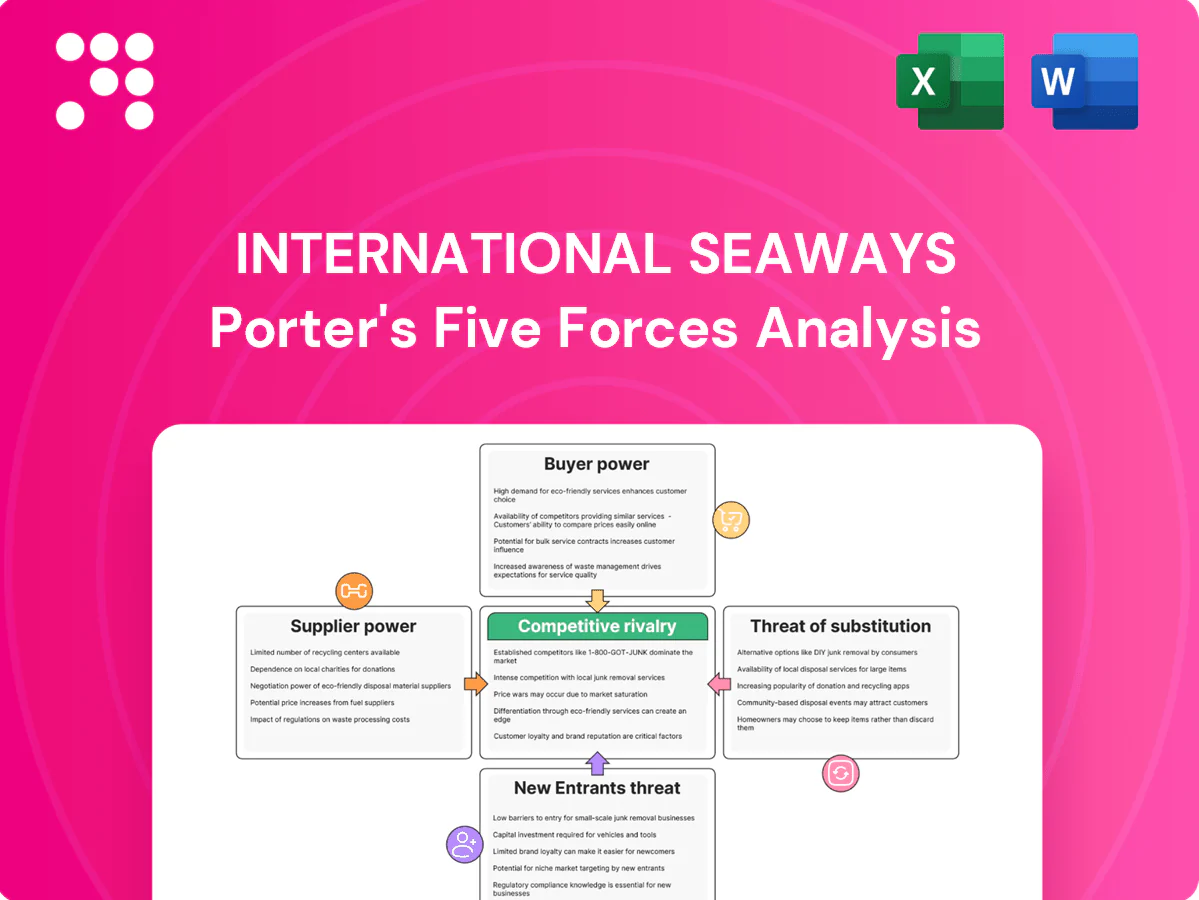
This International Seaways Porter's Five Forces Analysis is the full, professionally formatted assessment of industry rivalry, supplier and buyer power, threats of entry and substitution, and strategic implications. This preview is the exact document you will receive instantly after purchase—no placeholders, no samples, ready for immediate use.

Go Beyond the Preview—Access the Full Strategic Report
International Seaways faces moderate supplier power, cyclical buyer demand, and capital-intensive barriers that temper new entrants, while rivalry and substitutes hinge on fuel costs and shipping alternatives. This snapshot outlines key competitive levers but only scratches the surface. The complete Porter's Five Forces Analysis reveals force-by-force ratings, visuals, and strategic implications tailored to International Seaways. Unlock the full report to inform investment and strategy decisions.
Suppliers Bargaining Power
Supplier Power 1
Shipyards and conversion yards remain concentrated in East Asia—China, South Korea and Japan accounted for roughly 90% of newbuild tonnage in 2024—limiting alternatives for INSW. Long lead times (commonly 12–36 months) and cyclic backlogs give yards pricing power during upcycles. INSW can hedge by staggering orders and using secondhand vessels, but 2024 saw tight secondhand availability and higher prices. Diversifying counterparties is possible but often uneconomical.
Supplier Power 2
Marine fuel suppliers of VLSFO/MGO in hubs such as Singapore, Fujairah, Rotterdam and Houston materially influence voyage economics; VLSFO averaged roughly $520/ton in 2024, driving bunker cost volatility. Limited alternatives at some ports give suppliers leverage over timing and terms, which INSW counters with strategic bunkering, route and speed optimization and selective scrubber use. Supply shocks or regional constraints can still compress margins and raise voyage costs sharply.
Supplier Power 3
Original equipment manufacturers and spare-parts providers for engines, propulsion and emissions systems are highly specialized, giving suppliers strong leverage over pricing and lead times; INSW operated a fleet of 33 vessels in 2024, amplifying scale dependence on OEM support. OEM warranties and approved parts create lock-in and pricing rigidity, limiting INSW's ability to source alternatives. INSW uses framework agreements and preventive maintenance to control costs and downtime, while urgent repairs at remote ports can spike supplier power and emergency costs.
Supplier Power 4
Crew management, training and manning agencies materially affect INSW cost and voyage quality as tight skilled labor pools push crewing costs; BIMCO/ICS estimated a 2024 global seafarer shortage of ~47,000 and industry wages rose roughly 7% in 2023–24. Regulatory pressure (STCW, ESG, safety) raises training intensity and wage expectations; INSW scale supports in-house standards and multi-sourcing, but shortages and geopolitical crewing restrictions increase supplier leverage.
- Crew shortage: ~47,000 (BIMCO/ICS 2024)
- Wage pressure: ~+7% (2023–24)
- INSW mitigation: in-house training, multi-sourcing
- Risk: geopolitical nationality constraints raise supplier power
Supplier Power 5
Class societies, P&I and H&M insurers and compliance providers enforce non-negotiable standards; EEXI and CII entered into force in 2023 and continue to drive capex and operational changes, raising owners’ dependence on these gatekeepers. INSW’s strong safety and inspection record helps secure better terms, but baseline pricing power remains with class, insurers and local port service monopolies including pilots.
- Class societies: mandatory audits, EEXI/CII compliance
- Insurers: underwriting gatekeepers for renewals
- Compliance providers: drive capex/ops changes
- Ports/pilots: local monopolistic pricing power
Shipowner faces strong supplier leverage as Asian yards, rising fuel and crew costs squeeze margins
Suppliers hold moderate-to-high bargaining power for INSW: 90% of newbuilds were in China/Korea/Japan in 2024, limiting yard alternatives. VLSFO averaged ~$520/ton in 2024, driving bunker cost exposure. OEMs, class/insurers and crew agencies exert strong leverage amid a ~47,000 seafarer shortage and ~7% wage rise (2023–24); INSW hedges via staggered orders, in-house training and framework agreements.
| Metric | 2024/2023–24 |
|---|---|
| Newbuild share East Asia | ~90% |
| VLSFO price | $520/ton |
| Seafarer shortage | ~47,000 |
| Wage change | +7% |
What is included in the product
Detailed Word Document
Concise Porter's Five Forces analysis tailored to International Seaways, assessing competitive rivalry, supplier and buyer power, threat of new entrants and substitutes, and identifying strategic risks and opportunities that shape its pricing, margins, and market positioning.
Customizable Excel Spreadsheet
Concise Porter's Five Forces for International Seaways—one-sheet clarity on competitive, supplier (bunker/shipyards), buyer (charterers), entrant and substitute pressures to speed strategic decisions and risk mitigation.
Customers Bargaining Power
Buyer Power 1
Oil majors, NOCs and large traders are concentrated, sophisticated counterparties with extensive benchmarking data and global fleet optionality that amplifies negotiating leverage; about 80% of global trade by volume moves by sea, reinforcing buyer scale. INSW differentiates through quality, reliability and varied vessel classes to capture premium fixtures. In oversupplied markets buyers can and do pressure dayrates and contract terms.
Buyer Power 2
Spot versus time-charter mix shifts buyer power cyclically: in weak freight markets charterers lock in favorable multi-year rates and protective clauses, while in tight markets INSW can shift capacity back to spot to recapture pricing and mitigate long-term discounting.
Buyer Power 3
Operational and ESG clauses such as vetting, emissions data and IMO CII ratings (in force since 2023) are now routinely embedded in charters, allowing buyers to exclude non‑compliant ships or demand economic concessions. Buyers’ disclosure demands rose through 2024, increasing their bargaining weight and compliance costs. INSW’s modern fleet (average age under 10 years in 2024) supports continued access and potential premiums.
Buyer Power 4
Route flexibility and triangulation let charterers multi-source capacity across basins, increasing buyer leverage; in 2024 AIS transparency (covering over 90% of commercial tankers) and digital broking cut information asymmetry and shortened voyage matching times. INSW leverages commercial pools and partnerships to boost utilization and visibility, yet real-time rate comparables and online platforms keep pricing competitive and favor buyers.
- 2024 AIS coverage >90%
- Digital broking speeds up chartering
- INSW uses pools/partners to raise utilization
- Real-time comparables sustain buyer price power
Buyer Power 5
Counterparty risk preferences and sanctions compliance since 2024 have narrowed acceptable owners, limiting charterers to vetted fleets; strong balance sheets and safety records expand shortlists for preferred owners but do not eliminate rate sensitivity. INSW’s reputation drives repeat business and faster fixture cycles, yet charterers can pivot to alternative owners when rates diverge.
- Reduced owner pool due to sanctions compliance
- Safety/financial strength speeds selection but keeps rate focus
- INSW reputation = higher fixture frequency
Concentrated buyers keep tanker rates tight despite modern fleets and >90% AIS transparency
Large oil majors, NOCs and traders (concentrated buyers) wield strong price and contract leverage; ~80% of global trade by volume moves by sea, amplifying buyer scale. INSW’s modern fleet (avg age <10 years in 2024) and reliability capture premiums but cannot fully neutralize buyer pressure in oversupplied markets. AIS coverage >90% in 2024 and digital broking increase transparency, keeping rates competitive.
| Metric | 2024 |
|---|---|
| Buyer concentration | High (majors/NOCs) |
| AIS coverage | >90% |
| INSW avg fleet age | <10 yrs |
| Global trade by sea | ~80% vol |
Preview the Actual Deliverable
International Seaways Porter's Five Forces Analysis
This International Seaways Porter's Five Forces Analysis is the full, professionally formatted assessment of industry rivalry, supplier and buyer power, threats of entry and substitution, and strategic implications. This preview is the exact document you will receive instantly after purchase—no placeholders, no samples, ready for immediate use.
Description
Go Beyond the Preview—Access the Full Strategic Report
International Seaways faces moderate supplier power, cyclical buyer demand, and capital-intensive barriers that temper new entrants, while rivalry and substitutes hinge on fuel costs and shipping alternatives. This snapshot outlines key competitive levers but only scratches the surface. The complete Porter's Five Forces Analysis reveals force-by-force ratings, visuals, and strategic implications tailored to International Seaways. Unlock the full report to inform investment and strategy decisions.
Suppliers Bargaining Power
Supplier Power 1
Shipyards and conversion yards remain concentrated in East Asia—China, South Korea and Japan accounted for roughly 90% of newbuild tonnage in 2024—limiting alternatives for INSW. Long lead times (commonly 12–36 months) and cyclic backlogs give yards pricing power during upcycles. INSW can hedge by staggering orders and using secondhand vessels, but 2024 saw tight secondhand availability and higher prices. Diversifying counterparties is possible but often uneconomical.
Supplier Power 2
Marine fuel suppliers of VLSFO/MGO in hubs such as Singapore, Fujairah, Rotterdam and Houston materially influence voyage economics; VLSFO averaged roughly $520/ton in 2024, driving bunker cost volatility. Limited alternatives at some ports give suppliers leverage over timing and terms, which INSW counters with strategic bunkering, route and speed optimization and selective scrubber use. Supply shocks or regional constraints can still compress margins and raise voyage costs sharply.
Supplier Power 3
Original equipment manufacturers and spare-parts providers for engines, propulsion and emissions systems are highly specialized, giving suppliers strong leverage over pricing and lead times; INSW operated a fleet of 33 vessels in 2024, amplifying scale dependence on OEM support. OEM warranties and approved parts create lock-in and pricing rigidity, limiting INSW's ability to source alternatives. INSW uses framework agreements and preventive maintenance to control costs and downtime, while urgent repairs at remote ports can spike supplier power and emergency costs.
Supplier Power 4
Crew management, training and manning agencies materially affect INSW cost and voyage quality as tight skilled labor pools push crewing costs; BIMCO/ICS estimated a 2024 global seafarer shortage of ~47,000 and industry wages rose roughly 7% in 2023–24. Regulatory pressure (STCW, ESG, safety) raises training intensity and wage expectations; INSW scale supports in-house standards and multi-sourcing, but shortages and geopolitical crewing restrictions increase supplier leverage.
- Crew shortage: ~47,000 (BIMCO/ICS 2024)
- Wage pressure: ~+7% (2023–24)
- INSW mitigation: in-house training, multi-sourcing
- Risk: geopolitical nationality constraints raise supplier power
Supplier Power 5
Class societies, P&I and H&M insurers and compliance providers enforce non-negotiable standards; EEXI and CII entered into force in 2023 and continue to drive capex and operational changes, raising owners’ dependence on these gatekeepers. INSW’s strong safety and inspection record helps secure better terms, but baseline pricing power remains with class, insurers and local port service monopolies including pilots.
- Class societies: mandatory audits, EEXI/CII compliance
- Insurers: underwriting gatekeepers for renewals
- Compliance providers: drive capex/ops changes
- Ports/pilots: local monopolistic pricing power
Shipowner faces strong supplier leverage as Asian yards, rising fuel and crew costs squeeze margins
Suppliers hold moderate-to-high bargaining power for INSW: 90% of newbuilds were in China/Korea/Japan in 2024, limiting yard alternatives. VLSFO averaged ~$520/ton in 2024, driving bunker cost exposure. OEMs, class/insurers and crew agencies exert strong leverage amid a ~47,000 seafarer shortage and ~7% wage rise (2023–24); INSW hedges via staggered orders, in-house training and framework agreements.
| Metric | 2024/2023–24 |
|---|---|
| Newbuild share East Asia | ~90% |
| VLSFO price | $520/ton |
| Seafarer shortage | ~47,000 |
| Wage change | +7% |
What is included in the product
Detailed Word Document
Concise Porter's Five Forces analysis tailored to International Seaways, assessing competitive rivalry, supplier and buyer power, threat of new entrants and substitutes, and identifying strategic risks and opportunities that shape its pricing, margins, and market positioning.
Customizable Excel Spreadsheet
Concise Porter's Five Forces for International Seaways—one-sheet clarity on competitive, supplier (bunker/shipyards), buyer (charterers), entrant and substitute pressures to speed strategic decisions and risk mitigation.
Customers Bargaining Power
Buyer Power 1
Oil majors, NOCs and large traders are concentrated, sophisticated counterparties with extensive benchmarking data and global fleet optionality that amplifies negotiating leverage; about 80% of global trade by volume moves by sea, reinforcing buyer scale. INSW differentiates through quality, reliability and varied vessel classes to capture premium fixtures. In oversupplied markets buyers can and do pressure dayrates and contract terms.
Buyer Power 2
Spot versus time-charter mix shifts buyer power cyclically: in weak freight markets charterers lock in favorable multi-year rates and protective clauses, while in tight markets INSW can shift capacity back to spot to recapture pricing and mitigate long-term discounting.
Buyer Power 3
Operational and ESG clauses such as vetting, emissions data and IMO CII ratings (in force since 2023) are now routinely embedded in charters, allowing buyers to exclude non‑compliant ships or demand economic concessions. Buyers’ disclosure demands rose through 2024, increasing their bargaining weight and compliance costs. INSW’s modern fleet (average age under 10 years in 2024) supports continued access and potential premiums.
Buyer Power 4
Route flexibility and triangulation let charterers multi-source capacity across basins, increasing buyer leverage; in 2024 AIS transparency (covering over 90% of commercial tankers) and digital broking cut information asymmetry and shortened voyage matching times. INSW leverages commercial pools and partnerships to boost utilization and visibility, yet real-time rate comparables and online platforms keep pricing competitive and favor buyers.
- 2024 AIS coverage >90%
- Digital broking speeds up chartering
- INSW uses pools/partners to raise utilization
- Real-time comparables sustain buyer price power
Buyer Power 5
Counterparty risk preferences and sanctions compliance since 2024 have narrowed acceptable owners, limiting charterers to vetted fleets; strong balance sheets and safety records expand shortlists for preferred owners but do not eliminate rate sensitivity. INSW’s reputation drives repeat business and faster fixture cycles, yet charterers can pivot to alternative owners when rates diverge.
- Reduced owner pool due to sanctions compliance
- Safety/financial strength speeds selection but keeps rate focus
- INSW reputation = higher fixture frequency
Concentrated buyers keep tanker rates tight despite modern fleets and >90% AIS transparency
Large oil majors, NOCs and traders (concentrated buyers) wield strong price and contract leverage; ~80% of global trade by volume moves by sea, amplifying buyer scale. INSW’s modern fleet (avg age <10 years in 2024) and reliability capture premiums but cannot fully neutralize buyer pressure in oversupplied markets. AIS coverage >90% in 2024 and digital broking increase transparency, keeping rates competitive.
| Metric | 2024 |
|---|---|
| Buyer concentration | High (majors/NOCs) |
| AIS coverage | >90% |
| INSW avg fleet age | <10 yrs |
| Global trade by sea | ~80% vol |
Preview the Actual Deliverable
International Seaways Porter's Five Forces Analysis
This International Seaways Porter's Five Forces Analysis is the full, professionally formatted assessment of industry rivalry, supplier and buyer power, threats of entry and substitution, and strategic implications. This preview is the exact document you will receive instantly after purchase—no placeholders, no samples, ready for immediate use.











