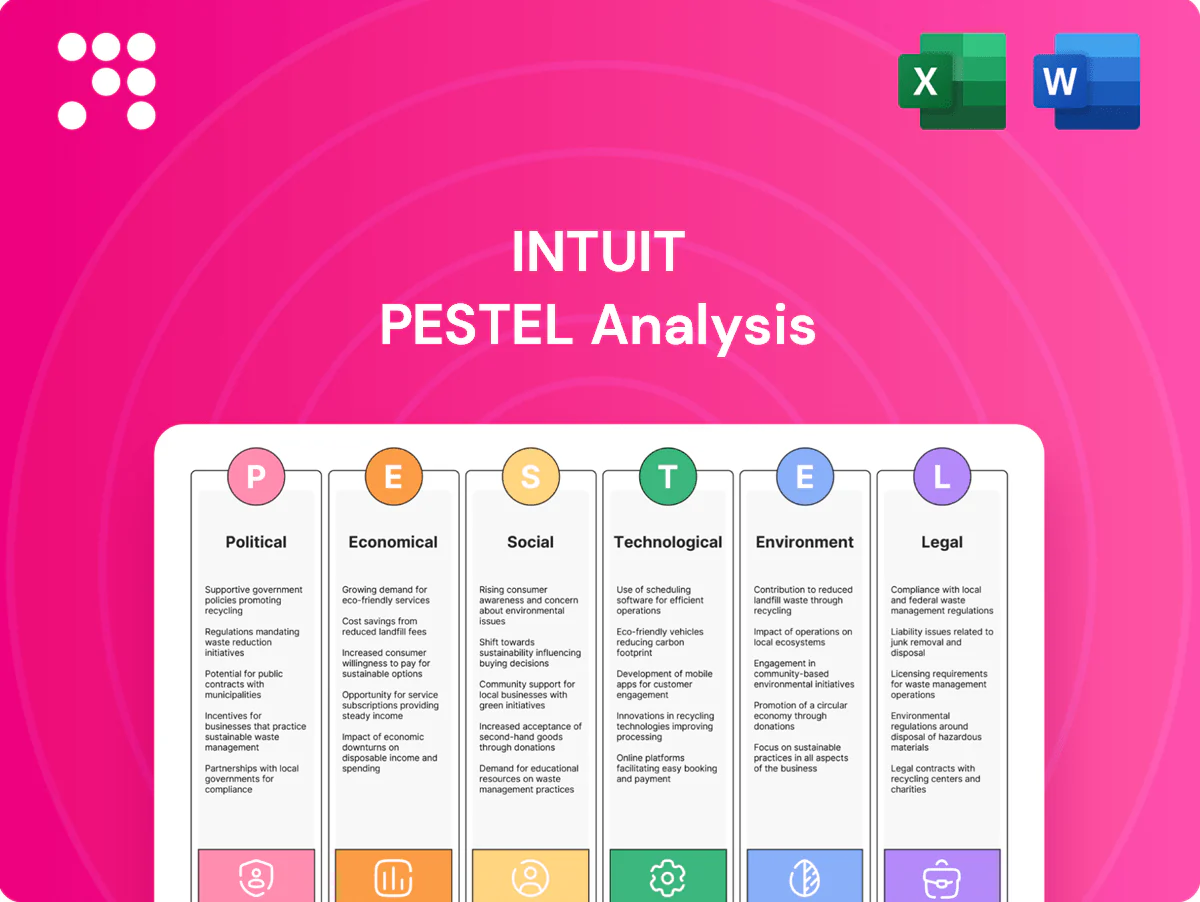
Intuit PESTLE Analysis

Your Competitive Advantage Starts with This Report
Uncover how political, economic, social, technological, legal and environmental forces are reshaping Intuit’s strategic path in our concise PESTLE overview. Perfect for investors, strategists and advisors, this snapshot highlights key risks and opportunities. Buy the full PESTLE for detailed, actionable insights and downloadable charts to power your decisions.
Political factors

Tax policy shifts
Frequent US tax-code changes force TurboTax updates and advisory content, increasing product maintenance and compliance costs for Intuit. Election cycles raise uncertainty around credits, deductions and filing deadlines, complicating consumer guidance. Intuit reported FY2024 revenue of $15.6 billion, benefiting from complexity but facing higher upkeep. Global tax harmonization efforts could reduce localization needs and reshape international product strategy.
SMB policy and incentives
Small business grants, limited payroll subsidies and compliance relief materially shape QuickBooks demand: US business applications peaked at 5.4M in 2021 and remained elevated at roughly 4.7M in 2023 (US Census), boosting SMB software uptake. Pro-SMB agendas that sustain formation rates expand addressable market, while stricter reporting regimes such as EU B2G e-invoicing rollouts by 2025 increase compliance burden and feature demand. Intuit must align lobbying, timely education and product timelines with policy rollouts to capture growth.

Data sovereignty agendas
Governments increasingly push data localization and cross-border controls, with over 80 countries enforcing some form of restriction, directly constraining Credit Karma credit-data flows and Mailchimp marketing analytics. Meeting country-specific hosting and residency rules raises infrastructure and compliance costs—material for Intuit after its $7.1B Credit Karma and $12B Mailchimp investments. Partnering with compliant cloud regions (30+ global regions among major providers) helps mitigate friction and reduce latency.

Antitrust and platform scrutiny
Intuit’s integrated ecosystem—TurboTax, QuickBooks, Credit Karma (acquired for 7.1 billion USD), and Mailchimp—faces rising antitrust scrutiny as regulators tighten rules on bundling and data advantages; the EU Digital Markets Act took effect March 2024 imposing gatekeeper interoperability and data‑sharing duties. Clear third‑party access and proactive disclosure can lower regulatory risk and preserve M&A optionality.
- DMA effective Mar 2024 raises interoperability expectations
- Credit Karma acquisition: 7.1 billion USD
- Transparency + clear APIs = reduced enforcement risk
- Proactive disclosure preserves strategic M&A flexibility
Public sector digitization
The IRS processes roughly 150 million individual returns annually, and recent government efforts to modernize e-file and explore direct-file pilots are shifting the filing landscape and expanding public-sector filing options.
Government-provided filing could compress TurboTax’s mass-market segment—Free File uptake has remained under 2% of eligible taxpayers—pushing Intuit toward premium advice, complex-scenario offerings, and practice-management tools for accountants.
Strategic collaboration via secure APIs with tax agencies can sustain Intuit’s relevance by integrating ecosystem workflows and preserving high-value customer segments; Intuit already serves ~100 million customers across products as of 2024.
- IRS ~150M returns/year
- Free File uptake <2%
- Intuit ~100M customers (2024)
- Shift to premium/advisory and APIs
Tax-code churn and global data rules drive platforms to premium advisory and APIs
Frequent US tax-code changes and election cycles raise compliance costs and product updates for TurboTax, contributing to FY2024 revenue of 15.6B USD but higher upkeep. Data localization in 80+ countries and the EU DMA (effective Mar 2024) increase infrastructure and interoperability needs after Credit Karma (7.1B USD) and Mailchimp (12B USD) deals. IRS ~150M returns/yr and Free File <2% push Intuit toward premium advisory, APIs and agency collaboration; Intuit ~100M customers (2024).
| Metric | Value |
|---|---|
| FY2024 Revenue | 15.6B USD |
| IRS returns/yr | ~150M |
| Free File uptake | <2% |
What is included in the product
 Detailed Word Document
Explores how macro-environmental factors uniquely affect Intuit across Political, Economic, Social, Technological, Environmental, and Legal dimensions, with data‑backed trends and forward‑looking insights to help executives, consultants, and investors identify risks, opportunities, and strategic responses.

 Customizable Excel Spreadsheet
A concise, visually segmented PESTLE summary of Intuit that’s easily shareable and editable, enabling quick alignment in meetings, slide decks, and client reports while supporting discussions on external risks and market positioning.
Economic factors

SMB formation cycles
Business births drive adoption of QuickBooks, payroll, and payments—US business applications surged to a record 5.4 million in 2021 and stayed elevated above 4 million through 2023 (Census BDS), boosting Intuit onboarding. Recessions reduce new accounts but raise demand for cash‑flow tools and payroll relief. Sector mix (services vs retail) shifts feature needs, and Intuit’s freemium plus tiered pricing smooths revenue volatility.
Interest rates and credit
Higher policy rates (federal funds ~5.25–5.50% through 2024) tighten consumer credit and SMB borrowing, while average credit card APRs rose to about 20.9% (May 2024), pressuring demand. Credit Karma engagement increasingly centers on credit improvement and monitoring. Payments volumes and financing attach rates vary with rate paths, and Intuit uses scenario pricing and lender partnerships to hedge swings.

Labor markets and incomes
Rising gig participation — about 59 million US freelancers in 2023 — increases filing complexity and shifts demand toward TurboTax Live and QuickBooks Self‑Employed. Wage growth and larger average refunds (IRS average refund ≈ $3,120 in 2023) change filing timing and product mix. Upselling advisory and bookkeeping can capture higher ARPU, supporting Intuit’s scale (FY2024 revenue ≈ $14.8B).

Ad spend and SMB marketing
Mailchimp, acquired by Intuit for 12 billion in 2021, closely tracks SMB marketing budgets and ecommerce activity: slower economic periods see customers downshift tiers or churn, while strong retail seasons and DTC growth raise ARPU. Intuit leverages bundled accounting-plus-marketing value to defend retention and reduce churn among price-sensitive SMBs.
- Mailchimp acquisition: 12 billion (2021)
- Downshifts/churn in slowdowns
- Retail/DTC seasons boost ARPU
- Bundled accounting+marketing defends retention
FX and international growth
Global expansion adds currency exposure and pricing dilemmas for Intuit as IMF projects 2024 global growth at about 3.0%, constraining discretionary spend in some markets; local purchasing power forces tiered packaging and feature sets. Hedging and regional pricing have proven to stabilize margins, while local partnerships accelerate market entry and customer acquisition.
- IMF global growth 2024 ~3.0%
- Tiered packaging tied to local purchasing power
- Hedging + regional pricing = margin stability
- Local partners speed market entry
Tax-code churn and global data rules drive platforms to premium advisory and APIs
Intuit benefits from strong SMB formation (5.4M business applications in 2021; >4M 2022–23), resilient FY2024 revenue ~$14.8B, and rising gig economy (≈59M freelancers 2023) driving TurboTax/QuickBooks demand. Higher rates (fed ~5.25–5.50% 2024) and credit card APRs (~20.9% May 2024) tighten SMB credit; IMF global growth ~3.0% (2024) shapes international pricing and hedging.
| Metric | Value |
|---|---|
| FY2024 Revenue | $14.8B |
| Business apps (2021) | 5.4M |
| Freelancers (2023) | ≈59M |
| Avg credit APR (May 2024) | 20.9% |
Same Document Delivered
Intuit PESTLE Analysis
The Intuit PESTLE Analysis preview shown here is the exact document you’ll receive after purchase—fully formatted and ready to use. This is a real screenshot of the product you’re buying and the content and structure match the downloadable file. No placeholders or teasers—what you see is the finished, professionally structured report.

Your Competitive Advantage Starts with This Report
Uncover how political, economic, social, technological, legal and environmental forces are reshaping Intuit’s strategic path in our concise PESTLE overview. Perfect for investors, strategists and advisors, this snapshot highlights key risks and opportunities. Buy the full PESTLE for detailed, actionable insights and downloadable charts to power your decisions.
Political factors
Tax policy shifts
Frequent US tax-code changes force TurboTax updates and advisory content, increasing product maintenance and compliance costs for Intuit. Election cycles raise uncertainty around credits, deductions and filing deadlines, complicating consumer guidance. Intuit reported FY2024 revenue of $15.6 billion, benefiting from complexity but facing higher upkeep. Global tax harmonization efforts could reduce localization needs and reshape international product strategy.
SMB policy and incentives
Small business grants, limited payroll subsidies and compliance relief materially shape QuickBooks demand: US business applications peaked at 5.4M in 2021 and remained elevated at roughly 4.7M in 2023 (US Census), boosting SMB software uptake. Pro-SMB agendas that sustain formation rates expand addressable market, while stricter reporting regimes such as EU B2G e-invoicing rollouts by 2025 increase compliance burden and feature demand. Intuit must align lobbying, timely education and product timelines with policy rollouts to capture growth.
Data sovereignty agendas
Governments increasingly push data localization and cross-border controls, with over 80 countries enforcing some form of restriction, directly constraining Credit Karma credit-data flows and Mailchimp marketing analytics. Meeting country-specific hosting and residency rules raises infrastructure and compliance costs—material for Intuit after its $7.1B Credit Karma and $12B Mailchimp investments. Partnering with compliant cloud regions (30+ global regions among major providers) helps mitigate friction and reduce latency.
Antitrust and platform scrutiny
Intuit’s integrated ecosystem—TurboTax, QuickBooks, Credit Karma (acquired for 7.1 billion USD), and Mailchimp—faces rising antitrust scrutiny as regulators tighten rules on bundling and data advantages; the EU Digital Markets Act took effect March 2024 imposing gatekeeper interoperability and data‑sharing duties. Clear third‑party access and proactive disclosure can lower regulatory risk and preserve M&A optionality.
- DMA effective Mar 2024 raises interoperability expectations
- Credit Karma acquisition: 7.1 billion USD
- Transparency + clear APIs = reduced enforcement risk
- Proactive disclosure preserves strategic M&A flexibility
Public sector digitization
The IRS processes roughly 150 million individual returns annually, and recent government efforts to modernize e-file and explore direct-file pilots are shifting the filing landscape and expanding public-sector filing options.
Government-provided filing could compress TurboTax’s mass-market segment—Free File uptake has remained under 2% of eligible taxpayers—pushing Intuit toward premium advice, complex-scenario offerings, and practice-management tools for accountants.
Strategic collaboration via secure APIs with tax agencies can sustain Intuit’s relevance by integrating ecosystem workflows and preserving high-value customer segments; Intuit already serves ~100 million customers across products as of 2024.
- IRS ~150M returns/year
- Free File uptake <2%
- Intuit ~100M customers (2024)
- Shift to premium/advisory and APIs
Tax-code churn and global data rules drive platforms to premium advisory and APIs
Frequent US tax-code changes and election cycles raise compliance costs and product updates for TurboTax, contributing to FY2024 revenue of 15.6B USD but higher upkeep. Data localization in 80+ countries and the EU DMA (effective Mar 2024) increase infrastructure and interoperability needs after Credit Karma (7.1B USD) and Mailchimp (12B USD) deals. IRS ~150M returns/yr and Free File <2% push Intuit toward premium advisory, APIs and agency collaboration; Intuit ~100M customers (2024).
| Metric | Value |
|---|---|
| FY2024 Revenue | 15.6B USD |
| IRS returns/yr | ~150M |
| Free File uptake | <2% |
What is included in the product
Detailed Word Document
Explores how macro-environmental factors uniquely affect Intuit across Political, Economic, Social, Technological, Environmental, and Legal dimensions, with data‑backed trends and forward‑looking insights to help executives, consultants, and investors identify risks, opportunities, and strategic responses.
Customizable Excel Spreadsheet
A concise, visually segmented PESTLE summary of Intuit that’s easily shareable and editable, enabling quick alignment in meetings, slide decks, and client reports while supporting discussions on external risks and market positioning.
Economic factors
SMB formation cycles
Business births drive adoption of QuickBooks, payroll, and payments—US business applications surged to a record 5.4 million in 2021 and stayed elevated above 4 million through 2023 (Census BDS), boosting Intuit onboarding. Recessions reduce new accounts but raise demand for cash‑flow tools and payroll relief. Sector mix (services vs retail) shifts feature needs, and Intuit’s freemium plus tiered pricing smooths revenue volatility.
Interest rates and credit
Higher policy rates (federal funds ~5.25–5.50% through 2024) tighten consumer credit and SMB borrowing, while average credit card APRs rose to about 20.9% (May 2024), pressuring demand. Credit Karma engagement increasingly centers on credit improvement and monitoring. Payments volumes and financing attach rates vary with rate paths, and Intuit uses scenario pricing and lender partnerships to hedge swings.
Labor markets and incomes
Rising gig participation — about 59 million US freelancers in 2023 — increases filing complexity and shifts demand toward TurboTax Live and QuickBooks Self‑Employed. Wage growth and larger average refunds (IRS average refund ≈ $3,120 in 2023) change filing timing and product mix. Upselling advisory and bookkeeping can capture higher ARPU, supporting Intuit’s scale (FY2024 revenue ≈ $14.8B).
Ad spend and SMB marketing
Mailchimp, acquired by Intuit for 12 billion in 2021, closely tracks SMB marketing budgets and ecommerce activity: slower economic periods see customers downshift tiers or churn, while strong retail seasons and DTC growth raise ARPU. Intuit leverages bundled accounting-plus-marketing value to defend retention and reduce churn among price-sensitive SMBs.
- Mailchimp acquisition: 12 billion (2021)
- Downshifts/churn in slowdowns
- Retail/DTC seasons boost ARPU
- Bundled accounting+marketing defends retention
FX and international growth
Global expansion adds currency exposure and pricing dilemmas for Intuit as IMF projects 2024 global growth at about 3.0%, constraining discretionary spend in some markets; local purchasing power forces tiered packaging and feature sets. Hedging and regional pricing have proven to stabilize margins, while local partnerships accelerate market entry and customer acquisition.
- IMF global growth 2024 ~3.0%
- Tiered packaging tied to local purchasing power
- Hedging + regional pricing = margin stability
- Local partners speed market entry
Tax-code churn and global data rules drive platforms to premium advisory and APIs
Intuit benefits from strong SMB formation (5.4M business applications in 2021; >4M 2022–23), resilient FY2024 revenue ~$14.8B, and rising gig economy (≈59M freelancers 2023) driving TurboTax/QuickBooks demand. Higher rates (fed ~5.25–5.50% 2024) and credit card APRs (~20.9% May 2024) tighten SMB credit; IMF global growth ~3.0% (2024) shapes international pricing and hedging.
| Metric | Value |
|---|---|
| FY2024 Revenue | $14.8B |
| Business apps (2021) | 5.4M |
| Freelancers (2023) | ≈59M |
| Avg credit APR (May 2024) | 20.9% |
Same Document Delivered
Intuit PESTLE Analysis
The Intuit PESTLE Analysis preview shown here is the exact document you’ll receive after purchase—fully formatted and ready to use. This is a real screenshot of the product you’re buying and the content and structure match the downloadable file. No placeholders or teasers—what you see is the finished, professionally structured report.
Description
Your Competitive Advantage Starts with This Report
Uncover how political, economic, social, technological, legal and environmental forces are reshaping Intuit’s strategic path in our concise PESTLE overview. Perfect for investors, strategists and advisors, this snapshot highlights key risks and opportunities. Buy the full PESTLE for detailed, actionable insights and downloadable charts to power your decisions.
Political factors
Tax policy shifts
Frequent US tax-code changes force TurboTax updates and advisory content, increasing product maintenance and compliance costs for Intuit. Election cycles raise uncertainty around credits, deductions and filing deadlines, complicating consumer guidance. Intuit reported FY2024 revenue of $15.6 billion, benefiting from complexity but facing higher upkeep. Global tax harmonization efforts could reduce localization needs and reshape international product strategy.
SMB policy and incentives
Small business grants, limited payroll subsidies and compliance relief materially shape QuickBooks demand: US business applications peaked at 5.4M in 2021 and remained elevated at roughly 4.7M in 2023 (US Census), boosting SMB software uptake. Pro-SMB agendas that sustain formation rates expand addressable market, while stricter reporting regimes such as EU B2G e-invoicing rollouts by 2025 increase compliance burden and feature demand. Intuit must align lobbying, timely education and product timelines with policy rollouts to capture growth.
Data sovereignty agendas
Governments increasingly push data localization and cross-border controls, with over 80 countries enforcing some form of restriction, directly constraining Credit Karma credit-data flows and Mailchimp marketing analytics. Meeting country-specific hosting and residency rules raises infrastructure and compliance costs—material for Intuit after its $7.1B Credit Karma and $12B Mailchimp investments. Partnering with compliant cloud regions (30+ global regions among major providers) helps mitigate friction and reduce latency.
Antitrust and platform scrutiny
Intuit’s integrated ecosystem—TurboTax, QuickBooks, Credit Karma (acquired for 7.1 billion USD), and Mailchimp—faces rising antitrust scrutiny as regulators tighten rules on bundling and data advantages; the EU Digital Markets Act took effect March 2024 imposing gatekeeper interoperability and data‑sharing duties. Clear third‑party access and proactive disclosure can lower regulatory risk and preserve M&A optionality.
- DMA effective Mar 2024 raises interoperability expectations
- Credit Karma acquisition: 7.1 billion USD
- Transparency + clear APIs = reduced enforcement risk
- Proactive disclosure preserves strategic M&A flexibility
Public sector digitization
The IRS processes roughly 150 million individual returns annually, and recent government efforts to modernize e-file and explore direct-file pilots are shifting the filing landscape and expanding public-sector filing options.
Government-provided filing could compress TurboTax’s mass-market segment—Free File uptake has remained under 2% of eligible taxpayers—pushing Intuit toward premium advice, complex-scenario offerings, and practice-management tools for accountants.
Strategic collaboration via secure APIs with tax agencies can sustain Intuit’s relevance by integrating ecosystem workflows and preserving high-value customer segments; Intuit already serves ~100 million customers across products as of 2024.
- IRS ~150M returns/year
- Free File uptake <2%
- Intuit ~100M customers (2024)
- Shift to premium/advisory and APIs
Tax-code churn and global data rules drive platforms to premium advisory and APIs
Frequent US tax-code changes and election cycles raise compliance costs and product updates for TurboTax, contributing to FY2024 revenue of 15.6B USD but higher upkeep. Data localization in 80+ countries and the EU DMA (effective Mar 2024) increase infrastructure and interoperability needs after Credit Karma (7.1B USD) and Mailchimp (12B USD) deals. IRS ~150M returns/yr and Free File <2% push Intuit toward premium advisory, APIs and agency collaboration; Intuit ~100M customers (2024).
| Metric | Value |
|---|---|
| FY2024 Revenue | 15.6B USD |
| IRS returns/yr | ~150M |
| Free File uptake | <2% |
What is included in the product
Detailed Word Document
Explores how macro-environmental factors uniquely affect Intuit across Political, Economic, Social, Technological, Environmental, and Legal dimensions, with data‑backed trends and forward‑looking insights to help executives, consultants, and investors identify risks, opportunities, and strategic responses.
Customizable Excel Spreadsheet
A concise, visually segmented PESTLE summary of Intuit that’s easily shareable and editable, enabling quick alignment in meetings, slide decks, and client reports while supporting discussions on external risks and market positioning.
Economic factors
SMB formation cycles
Business births drive adoption of QuickBooks, payroll, and payments—US business applications surged to a record 5.4 million in 2021 and stayed elevated above 4 million through 2023 (Census BDS), boosting Intuit onboarding. Recessions reduce new accounts but raise demand for cash‑flow tools and payroll relief. Sector mix (services vs retail) shifts feature needs, and Intuit’s freemium plus tiered pricing smooths revenue volatility.
Interest rates and credit
Higher policy rates (federal funds ~5.25–5.50% through 2024) tighten consumer credit and SMB borrowing, while average credit card APRs rose to about 20.9% (May 2024), pressuring demand. Credit Karma engagement increasingly centers on credit improvement and monitoring. Payments volumes and financing attach rates vary with rate paths, and Intuit uses scenario pricing and lender partnerships to hedge swings.
Labor markets and incomes
Rising gig participation — about 59 million US freelancers in 2023 — increases filing complexity and shifts demand toward TurboTax Live and QuickBooks Self‑Employed. Wage growth and larger average refunds (IRS average refund ≈ $3,120 in 2023) change filing timing and product mix. Upselling advisory and bookkeeping can capture higher ARPU, supporting Intuit’s scale (FY2024 revenue ≈ $14.8B).
Ad spend and SMB marketing
Mailchimp, acquired by Intuit for 12 billion in 2021, closely tracks SMB marketing budgets and ecommerce activity: slower economic periods see customers downshift tiers or churn, while strong retail seasons and DTC growth raise ARPU. Intuit leverages bundled accounting-plus-marketing value to defend retention and reduce churn among price-sensitive SMBs.
- Mailchimp acquisition: 12 billion (2021)
- Downshifts/churn in slowdowns
- Retail/DTC seasons boost ARPU
- Bundled accounting+marketing defends retention
FX and international growth
Global expansion adds currency exposure and pricing dilemmas for Intuit as IMF projects 2024 global growth at about 3.0%, constraining discretionary spend in some markets; local purchasing power forces tiered packaging and feature sets. Hedging and regional pricing have proven to stabilize margins, while local partnerships accelerate market entry and customer acquisition.
- IMF global growth 2024 ~3.0%
- Tiered packaging tied to local purchasing power
- Hedging + regional pricing = margin stability
- Local partners speed market entry
Tax-code churn and global data rules drive platforms to premium advisory and APIs
Intuit benefits from strong SMB formation (5.4M business applications in 2021; >4M 2022–23), resilient FY2024 revenue ~$14.8B, and rising gig economy (≈59M freelancers 2023) driving TurboTax/QuickBooks demand. Higher rates (fed ~5.25–5.50% 2024) and credit card APRs (~20.9% May 2024) tighten SMB credit; IMF global growth ~3.0% (2024) shapes international pricing and hedging.
| Metric | Value |
|---|---|
| FY2024 Revenue | $14.8B |
| Business apps (2021) | 5.4M |
| Freelancers (2023) | ≈59M |
| Avg credit APR (May 2024) | 20.9% |
Same Document Delivered
Intuit PESTLE Analysis
The Intuit PESTLE Analysis preview shown here is the exact document you’ll receive after purchase—fully formatted and ready to use. This is a real screenshot of the product you’re buying and the content and structure match the downloadable file. No placeholders or teasers—what you see is the finished, professionally structured report.











