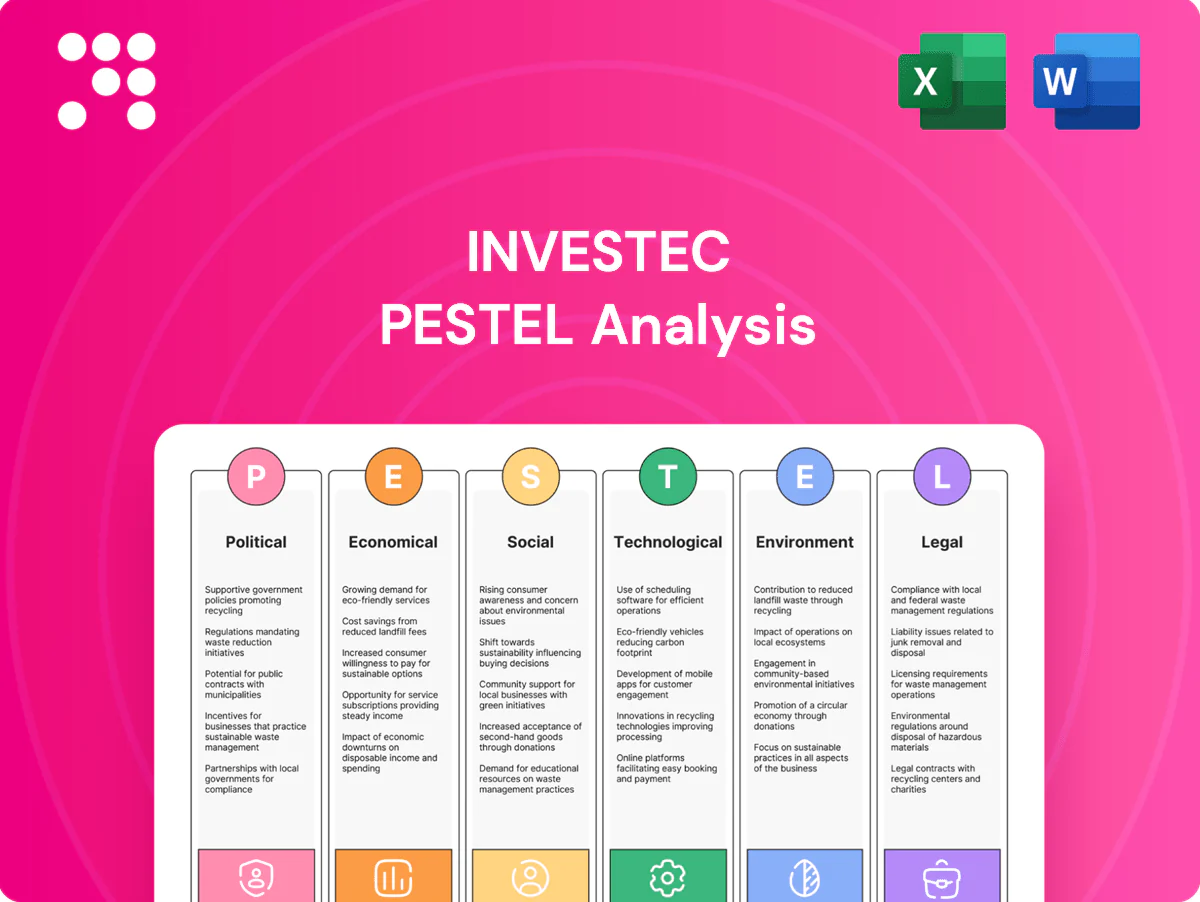
Investec PESTLE Analysis

Your Shortcut to Market Insight Starts Here
Unlock strategic clarity with our Investec PESTLE Analysis—three to five key external forces decoded to reveal risks and growth opportunities for investors and strategists. This concise briefing highlights regulatory, economic, and technological impacts; buy the full version for the complete, actionable breakdown.
Political factors

UK–SA policy stability and elections
Investec’s dual footprint hinges on predictable UK and South African policy, with South Africa’s May 2024 election cutting the ANC to roughly 40% and prompting shifts in fiscal and infrastructure priorities. Election cycles in both markets can rapidly change fiscal stances, state spending and financial-sector regulation, affecting credit demand and capital requirements. Leadership changes may reframe public–private collaboration and investment incentives, altering deal pipelines. Robust scenario planning and stress tests help buffer the group against abrupt policy pivots.
Regulatory direction from Treasury/BoE and SA authorities
Macroprudential direction from the BoE/PRA and South Africa's SARB/Prudential Authority shapes lending growth, capital buffers and liquidity; UK Bank Rate at 5.25% and SARB repo at 8.25% (2024) raise funding costs and constrain lending. Changes in prudential rules alter balance-sheet optimisation and risk appetite, while coordinated central bank guidance drives asset–liability management. Regulatory clarity supports specialist product development and niche lending.

Geopolitical risk and sanctions exposure
Sanctions regimes in over 100 jurisdictions drive higher compliance costs and constrain cross-border flows, raising due-diligence spend for banks like Investec, which serves clients across South Africa, the UK and Australia.
Multi-jurisdictional client exposure increases screening complexity and false positives, requiring transaction-monitoring systems with real-time sanctions updates; lists change weekly. Geopolitical shifts also re-route trade and investment patterns critical to client advisory and risk management.

Public-sector infrastructure and reform agendas
Reforms in energy, logistics and SOEs — including a R1.2 trillion government infrastructure pipeline and Eskom debt near R400 billion (2024) — reshape Investec’s credit risk and deal flow, with reform-linked opportunities in power, ports and freight corridors. Government-led pipelines can catalyze project finance and advisory, though execution risk and governance oversight remain critical. Investec’s specialist banking can align capital and structuring to viable reform projects.
Trade and investment treaties post-Brexit
Post-Brexit UK trade policy (Trade and Cooperation Agreement 2020) and CPTPP accession in 2023 shape capital and services access; passporting for EU clients ended in 2021, forcing reliance on third‑country equivalence and local licences. Divergence from EU rules creates regulatory friction but opens niche arbitrage for Investec in cross‑border private banking and asset management. Strategic structuring reduces fragmentation costs through subsidiaries, QI/MIAs and recognition regimes.
- TCA 2020; passporting ended 2021
- CPTPP accession 2023
- Reliance on equivalence, local licences, and recognition regimes
- Mitigation via subsidiaries, QI/MIAs and strategic structuring
SA–UK banking exposed to policy volatility, higher rates and R1.2tn infra credit risk
Investec faces policy volatility after South Africa’s May 2024 election (ANC ~40%), shifting fiscal/infrastructure priorities and changing credit demand across its dual UK–SA footprint. Macroprudential settings (UK Bank Rate 5.25% 2024; SARB repo 8.25% 2024) raise funding costs and capital requirements. Large SOE and infrastructure dynamics (R1.2tn pipeline; Eskom ~R400bn debt 2024) shape project finance opportunity and credit risk.
| Item | Value |
|---|---|
| UK Bank Rate | 5.25% (2024) |
| SARB repo | 8.25% (2024) |
| SA infra pipeline | R1.2tn |
| Eskom debt | ~R400bn (2024) |
What is included in the product
 Detailed Word Document
Explores how external macro-environmental factors uniquely affect Investec across six dimensions—Political, Economic, Social, Technological, Environmental and Legal—backed by relevant data and current trends to highlight region- and industry-specific risks and opportunities. Designed for executives, consultants and investors, it includes forward-looking insights to support scenario planning and strategy.

 Customizable Excel Spreadsheet
A clean, summarized Investec PESTLE that’s visually segmented by category for quick interpretation at a glance. Easily shareable and editable so teams can drop it into presentations, add regional notes, and align on external risks during planning sessions.
Economic factors

Interest-rate cycles (BoE, SARB) and NIM
Rate paths set by the BoE (base rate 5.25%) and SARB (repo 8.25%) directly drive Investec’s net interest margins and client credit demand; higher rates can widen NIM but raise default risk and compress asset valuations. A transition to cuts shifts volumes toward refinancing and faster asset re-pricing, compressing short-term margins. Balance-sheet duration positioning is pivotal to hedge repricing and capital volatility.
FX volatility (GBP/ZAR) and earnings translation
GBP/ZAR averaged about 22.0 in 2024 with 12-month realized volatility near 18%, so currency swings materially affect Investec’s reported results, regulatory capital ratios and client hedging demand. Divergent inflation (UK ~4.0% vs SA ~5.2% in 2024) and rate gaps (BoE ~5.25% vs SARB ~8.25%) amplify volatility. Hedging cuts P&L noise but imposes costs that compress margins. Geographic diversification across UK/SA helps smooth earnings cycles.

Growth, inflation, and unemployment dynamics
Slower South African growth (around 1% in 2024) and sticky inflation (roughly 5–6%) constrain credit formation and margin expansion; UK growth moderation (near 0.5% in 2024) weighs on fee income and AUM flows. High South African unemployment (~33%) drives wage pressure volatility and limits household wealth accumulation. Scenario-driven provisioning increases reserve buffers to protect asset quality.

Capital markets cycles and AUM sensitivity
Wealth and investment revenues for Investec closely track market performance — e.g., S&P 500 total return +26.3% in 2023 — while bond market moves and rate shifts drive fixed-income fees; risk-off episodes reduce deal flow, IPOs and advisory activity, but diversified fee streams (wealth, lending, advisory) cushion revenue swings and client rebalancing generates advisory/flows opportunities.
- Market sensitivity: revenues track equities/bonds
- Risk-off: lower M&A/IPOs, fewer mandates
- Diversification: multiple fee streams reduce volatility
- Rebalancing: advisory inflows/opportunity
Credit cycle and asset quality
Rising interest rates and subdued GDP growth heighten household and SME stress, increasing delinquencies across mortgage and business lending and forcing Investec to tighten underwriting and deploy early-warning analytics to detect sector-specific deterioration.
- Household/SME stress: tighter underwriting, early-warning models
- Sectoral exposures: active monitoring and concentration limits
- Collateral: revaluations affect recovery timelines
- Provisioning: dynamic reserves to absorb cyclical shocks
SA–UK banking exposed to policy volatility, higher rates and R1.2tn infra credit risk
Rate gaps (BoE 5.25%, SARB 8.25%) drive NIM and credit risk; GBP/ZAR ~22.0 (2024 avg, 12m vol ~18%) affects reported results. SA GDP ~1% (2024), UK ~0.5%; inflation UK ~4.0%, SA ~5.2%; SA unemployment ~33% pressures household/SME credit; S&P 500 TR +26.3% (2023).
| Metric | Value |
|---|---|
| BoE / SARB | 5.25% / 8.25% |
| GBP/ZAR (2024) | ~22.0 (12m vol ~18%) |
| GDP (2024) | UK ~0.5%, SA ~1% |
| Inflation (2024) | UK ~4.0%, SA ~5.2% |
| SA unemployment | ~33% |
| S&P 500 TR (2023) | +26.3% |
Preview the Actual Deliverable
Investec PESTLE Analysis
The preview shown here is the exact document you’ll receive after purchase—fully formatted and ready to use. This Investec PESTLE Analysis screenshot reflects the full, final report with complete content and professional structure. No placeholders or surprises; you’ll download this same file immediately after payment.

Your Shortcut to Market Insight Starts Here
Unlock strategic clarity with our Investec PESTLE Analysis—three to five key external forces decoded to reveal risks and growth opportunities for investors and strategists. This concise briefing highlights regulatory, economic, and technological impacts; buy the full version for the complete, actionable breakdown.
Political factors
UK–SA policy stability and elections
Investec’s dual footprint hinges on predictable UK and South African policy, with South Africa’s May 2024 election cutting the ANC to roughly 40% and prompting shifts in fiscal and infrastructure priorities. Election cycles in both markets can rapidly change fiscal stances, state spending and financial-sector regulation, affecting credit demand and capital requirements. Leadership changes may reframe public–private collaboration and investment incentives, altering deal pipelines. Robust scenario planning and stress tests help buffer the group against abrupt policy pivots.
Regulatory direction from Treasury/BoE and SA authorities
Macroprudential direction from the BoE/PRA and South Africa's SARB/Prudential Authority shapes lending growth, capital buffers and liquidity; UK Bank Rate at 5.25% and SARB repo at 8.25% (2024) raise funding costs and constrain lending. Changes in prudential rules alter balance-sheet optimisation and risk appetite, while coordinated central bank guidance drives asset–liability management. Regulatory clarity supports specialist product development and niche lending.
Geopolitical risk and sanctions exposure
Sanctions regimes in over 100 jurisdictions drive higher compliance costs and constrain cross-border flows, raising due-diligence spend for banks like Investec, which serves clients across South Africa, the UK and Australia.
Multi-jurisdictional client exposure increases screening complexity and false positives, requiring transaction-monitoring systems with real-time sanctions updates; lists change weekly. Geopolitical shifts also re-route trade and investment patterns critical to client advisory and risk management.
Public-sector infrastructure and reform agendas
Reforms in energy, logistics and SOEs — including a R1.2 trillion government infrastructure pipeline and Eskom debt near R400 billion (2024) — reshape Investec’s credit risk and deal flow, with reform-linked opportunities in power, ports and freight corridors. Government-led pipelines can catalyze project finance and advisory, though execution risk and governance oversight remain critical. Investec’s specialist banking can align capital and structuring to viable reform projects.
Trade and investment treaties post-Brexit
Post-Brexit UK trade policy (Trade and Cooperation Agreement 2020) and CPTPP accession in 2023 shape capital and services access; passporting for EU clients ended in 2021, forcing reliance on third‑country equivalence and local licences. Divergence from EU rules creates regulatory friction but opens niche arbitrage for Investec in cross‑border private banking and asset management. Strategic structuring reduces fragmentation costs through subsidiaries, QI/MIAs and recognition regimes.
- TCA 2020; passporting ended 2021
- CPTPP accession 2023
- Reliance on equivalence, local licences, and recognition regimes
- Mitigation via subsidiaries, QI/MIAs and strategic structuring
SA–UK banking exposed to policy volatility, higher rates and R1.2tn infra credit risk
Investec faces policy volatility after South Africa’s May 2024 election (ANC ~40%), shifting fiscal/infrastructure priorities and changing credit demand across its dual UK–SA footprint. Macroprudential settings (UK Bank Rate 5.25% 2024; SARB repo 8.25% 2024) raise funding costs and capital requirements. Large SOE and infrastructure dynamics (R1.2tn pipeline; Eskom ~R400bn debt 2024) shape project finance opportunity and credit risk.
| Item | Value |
|---|---|
| UK Bank Rate | 5.25% (2024) |
| SARB repo | 8.25% (2024) |
| SA infra pipeline | R1.2tn |
| Eskom debt | ~R400bn (2024) |
What is included in the product
Detailed Word Document
Explores how external macro-environmental factors uniquely affect Investec across six dimensions—Political, Economic, Social, Technological, Environmental and Legal—backed by relevant data and current trends to highlight region- and industry-specific risks and opportunities. Designed for executives, consultants and investors, it includes forward-looking insights to support scenario planning and strategy.
Customizable Excel Spreadsheet
A clean, summarized Investec PESTLE that’s visually segmented by category for quick interpretation at a glance. Easily shareable and editable so teams can drop it into presentations, add regional notes, and align on external risks during planning sessions.
Economic factors
Interest-rate cycles (BoE, SARB) and NIM
Rate paths set by the BoE (base rate 5.25%) and SARB (repo 8.25%) directly drive Investec’s net interest margins and client credit demand; higher rates can widen NIM but raise default risk and compress asset valuations. A transition to cuts shifts volumes toward refinancing and faster asset re-pricing, compressing short-term margins. Balance-sheet duration positioning is pivotal to hedge repricing and capital volatility.
FX volatility (GBP/ZAR) and earnings translation
GBP/ZAR averaged about 22.0 in 2024 with 12-month realized volatility near 18%, so currency swings materially affect Investec’s reported results, regulatory capital ratios and client hedging demand. Divergent inflation (UK ~4.0% vs SA ~5.2% in 2024) and rate gaps (BoE ~5.25% vs SARB ~8.25%) amplify volatility. Hedging cuts P&L noise but imposes costs that compress margins. Geographic diversification across UK/SA helps smooth earnings cycles.
Growth, inflation, and unemployment dynamics
Slower South African growth (around 1% in 2024) and sticky inflation (roughly 5–6%) constrain credit formation and margin expansion; UK growth moderation (near 0.5% in 2024) weighs on fee income and AUM flows. High South African unemployment (~33%) drives wage pressure volatility and limits household wealth accumulation. Scenario-driven provisioning increases reserve buffers to protect asset quality.
Capital markets cycles and AUM sensitivity
Wealth and investment revenues for Investec closely track market performance — e.g., S&P 500 total return +26.3% in 2023 — while bond market moves and rate shifts drive fixed-income fees; risk-off episodes reduce deal flow, IPOs and advisory activity, but diversified fee streams (wealth, lending, advisory) cushion revenue swings and client rebalancing generates advisory/flows opportunities.
- Market sensitivity: revenues track equities/bonds
- Risk-off: lower M&A/IPOs, fewer mandates
- Diversification: multiple fee streams reduce volatility
- Rebalancing: advisory inflows/opportunity
Credit cycle and asset quality
Rising interest rates and subdued GDP growth heighten household and SME stress, increasing delinquencies across mortgage and business lending and forcing Investec to tighten underwriting and deploy early-warning analytics to detect sector-specific deterioration.
- Household/SME stress: tighter underwriting, early-warning models
- Sectoral exposures: active monitoring and concentration limits
- Collateral: revaluations affect recovery timelines
- Provisioning: dynamic reserves to absorb cyclical shocks
SA–UK banking exposed to policy volatility, higher rates and R1.2tn infra credit risk
Rate gaps (BoE 5.25%, SARB 8.25%) drive NIM and credit risk; GBP/ZAR ~22.0 (2024 avg, 12m vol ~18%) affects reported results. SA GDP ~1% (2024), UK ~0.5%; inflation UK ~4.0%, SA ~5.2%; SA unemployment ~33% pressures household/SME credit; S&P 500 TR +26.3% (2023).
| Metric | Value |
|---|---|
| BoE / SARB | 5.25% / 8.25% |
| GBP/ZAR (2024) | ~22.0 (12m vol ~18%) |
| GDP (2024) | UK ~0.5%, SA ~1% |
| Inflation (2024) | UK ~4.0%, SA ~5.2% |
| SA unemployment | ~33% |
| S&P 500 TR (2023) | +26.3% |
Preview the Actual Deliverable
Investec PESTLE Analysis
The preview shown here is the exact document you’ll receive after purchase—fully formatted and ready to use. This Investec PESTLE Analysis screenshot reflects the full, final report with complete content and professional structure. No placeholders or surprises; you’ll download this same file immediately after payment.
Original: $10.00
-65%$10.00
$3.50Description
Your Shortcut to Market Insight Starts Here
Unlock strategic clarity with our Investec PESTLE Analysis—three to five key external forces decoded to reveal risks and growth opportunities for investors and strategists. This concise briefing highlights regulatory, economic, and technological impacts; buy the full version for the complete, actionable breakdown.
Political factors
UK–SA policy stability and elections
Investec’s dual footprint hinges on predictable UK and South African policy, with South Africa’s May 2024 election cutting the ANC to roughly 40% and prompting shifts in fiscal and infrastructure priorities. Election cycles in both markets can rapidly change fiscal stances, state spending and financial-sector regulation, affecting credit demand and capital requirements. Leadership changes may reframe public–private collaboration and investment incentives, altering deal pipelines. Robust scenario planning and stress tests help buffer the group against abrupt policy pivots.
Regulatory direction from Treasury/BoE and SA authorities
Macroprudential direction from the BoE/PRA and South Africa's SARB/Prudential Authority shapes lending growth, capital buffers and liquidity; UK Bank Rate at 5.25% and SARB repo at 8.25% (2024) raise funding costs and constrain lending. Changes in prudential rules alter balance-sheet optimisation and risk appetite, while coordinated central bank guidance drives asset–liability management. Regulatory clarity supports specialist product development and niche lending.
Geopolitical risk and sanctions exposure
Sanctions regimes in over 100 jurisdictions drive higher compliance costs and constrain cross-border flows, raising due-diligence spend for banks like Investec, which serves clients across South Africa, the UK and Australia.
Multi-jurisdictional client exposure increases screening complexity and false positives, requiring transaction-monitoring systems with real-time sanctions updates; lists change weekly. Geopolitical shifts also re-route trade and investment patterns critical to client advisory and risk management.
Public-sector infrastructure and reform agendas
Reforms in energy, logistics and SOEs — including a R1.2 trillion government infrastructure pipeline and Eskom debt near R400 billion (2024) — reshape Investec’s credit risk and deal flow, with reform-linked opportunities in power, ports and freight corridors. Government-led pipelines can catalyze project finance and advisory, though execution risk and governance oversight remain critical. Investec’s specialist banking can align capital and structuring to viable reform projects.
Trade and investment treaties post-Brexit
Post-Brexit UK trade policy (Trade and Cooperation Agreement 2020) and CPTPP accession in 2023 shape capital and services access; passporting for EU clients ended in 2021, forcing reliance on third‑country equivalence and local licences. Divergence from EU rules creates regulatory friction but opens niche arbitrage for Investec in cross‑border private banking and asset management. Strategic structuring reduces fragmentation costs through subsidiaries, QI/MIAs and recognition regimes.
- TCA 2020; passporting ended 2021
- CPTPP accession 2023
- Reliance on equivalence, local licences, and recognition regimes
- Mitigation via subsidiaries, QI/MIAs and strategic structuring
SA–UK banking exposed to policy volatility, higher rates and R1.2tn infra credit risk
Investec faces policy volatility after South Africa’s May 2024 election (ANC ~40%), shifting fiscal/infrastructure priorities and changing credit demand across its dual UK–SA footprint. Macroprudential settings (UK Bank Rate 5.25% 2024; SARB repo 8.25% 2024) raise funding costs and capital requirements. Large SOE and infrastructure dynamics (R1.2tn pipeline; Eskom ~R400bn debt 2024) shape project finance opportunity and credit risk.
| Item | Value |
|---|---|
| UK Bank Rate | 5.25% (2024) |
| SARB repo | 8.25% (2024) |
| SA infra pipeline | R1.2tn |
| Eskom debt | ~R400bn (2024) |
What is included in the product
Detailed Word Document
Explores how external macro-environmental factors uniquely affect Investec across six dimensions—Political, Economic, Social, Technological, Environmental and Legal—backed by relevant data and current trends to highlight region- and industry-specific risks and opportunities. Designed for executives, consultants and investors, it includes forward-looking insights to support scenario planning and strategy.
Customizable Excel Spreadsheet
A clean, summarized Investec PESTLE that’s visually segmented by category for quick interpretation at a glance. Easily shareable and editable so teams can drop it into presentations, add regional notes, and align on external risks during planning sessions.
Economic factors
Interest-rate cycles (BoE, SARB) and NIM
Rate paths set by the BoE (base rate 5.25%) and SARB (repo 8.25%) directly drive Investec’s net interest margins and client credit demand; higher rates can widen NIM but raise default risk and compress asset valuations. A transition to cuts shifts volumes toward refinancing and faster asset re-pricing, compressing short-term margins. Balance-sheet duration positioning is pivotal to hedge repricing and capital volatility.
FX volatility (GBP/ZAR) and earnings translation
GBP/ZAR averaged about 22.0 in 2024 with 12-month realized volatility near 18%, so currency swings materially affect Investec’s reported results, regulatory capital ratios and client hedging demand. Divergent inflation (UK ~4.0% vs SA ~5.2% in 2024) and rate gaps (BoE ~5.25% vs SARB ~8.25%) amplify volatility. Hedging cuts P&L noise but imposes costs that compress margins. Geographic diversification across UK/SA helps smooth earnings cycles.
Growth, inflation, and unemployment dynamics
Slower South African growth (around 1% in 2024) and sticky inflation (roughly 5–6%) constrain credit formation and margin expansion; UK growth moderation (near 0.5% in 2024) weighs on fee income and AUM flows. High South African unemployment (~33%) drives wage pressure volatility and limits household wealth accumulation. Scenario-driven provisioning increases reserve buffers to protect asset quality.
Capital markets cycles and AUM sensitivity
Wealth and investment revenues for Investec closely track market performance — e.g., S&P 500 total return +26.3% in 2023 — while bond market moves and rate shifts drive fixed-income fees; risk-off episodes reduce deal flow, IPOs and advisory activity, but diversified fee streams (wealth, lending, advisory) cushion revenue swings and client rebalancing generates advisory/flows opportunities.
- Market sensitivity: revenues track equities/bonds
- Risk-off: lower M&A/IPOs, fewer mandates
- Diversification: multiple fee streams reduce volatility
- Rebalancing: advisory inflows/opportunity
Credit cycle and asset quality
Rising interest rates and subdued GDP growth heighten household and SME stress, increasing delinquencies across mortgage and business lending and forcing Investec to tighten underwriting and deploy early-warning analytics to detect sector-specific deterioration.
- Household/SME stress: tighter underwriting, early-warning models
- Sectoral exposures: active monitoring and concentration limits
- Collateral: revaluations affect recovery timelines
- Provisioning: dynamic reserves to absorb cyclical shocks
SA–UK banking exposed to policy volatility, higher rates and R1.2tn infra credit risk
Rate gaps (BoE 5.25%, SARB 8.25%) drive NIM and credit risk; GBP/ZAR ~22.0 (2024 avg, 12m vol ~18%) affects reported results. SA GDP ~1% (2024), UK ~0.5%; inflation UK ~4.0%, SA ~5.2%; SA unemployment ~33% pressures household/SME credit; S&P 500 TR +26.3% (2023).
| Metric | Value |
|---|---|
| BoE / SARB | 5.25% / 8.25% |
| GBP/ZAR (2024) | ~22.0 (12m vol ~18%) |
| GDP (2024) | UK ~0.5%, SA ~1% |
| Inflation (2024) | UK ~4.0%, SA ~5.2% |
| SA unemployment | ~33% |
| S&P 500 TR (2023) | +26.3% |
Preview the Actual Deliverable
Investec PESTLE Analysis
The preview shown here is the exact document you’ll receive after purchase—fully formatted and ready to use. This Investec PESTLE Analysis screenshot reflects the full, final report with complete content and professional structure. No placeholders or surprises; you’ll download this same file immediately after payment.











