Ipca Boston Consulting Group Matrix

Unlock Strategic Clarity
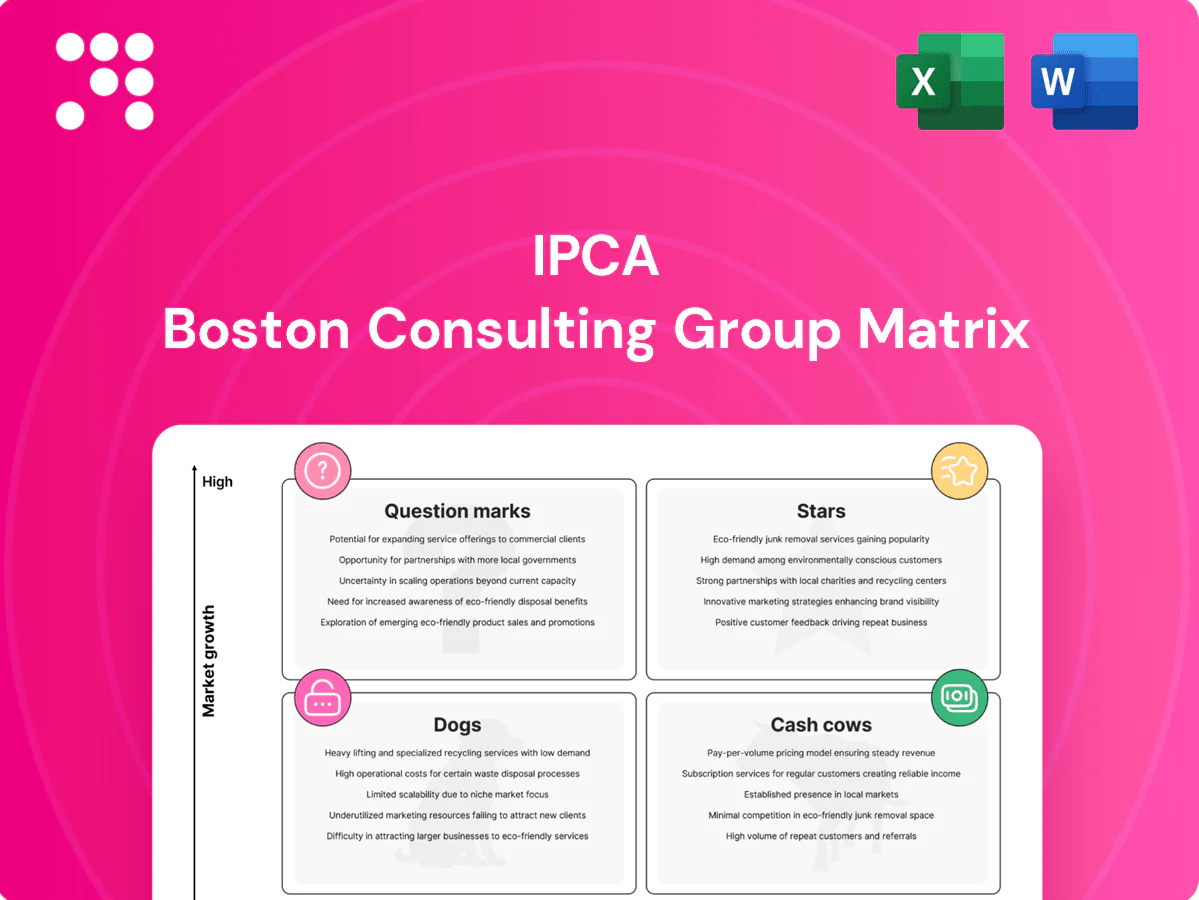
Curious where Ipca’s products land—Stars, Cash Cows, Dogs, or Question Marks? This preview sketches the picture; the full Ipca BCG Matrix gives quadrant-by-quadrant placements, data-backed recommendations, and a strategic roadmap you can act on. Buy the complete report to get a detailed Word write-up plus a high-level Excel summary—ready to present, tweak, and use to reallocate capital smarter. Purchase now for instant access and clear next steps.
Stars

Anti‑malarial formulations leadership
Anti‑malarial formulations are a star for Ipca in endemic markets where therapy demand and institutional procurement remain strong; WHO data (2021) recorded about 619,000 malaria deaths, underscoring ongoing need. Ipca’s exports to over 100 countries, broad anti‑malarial portfolio and multiple national registrations give a defensible edge. With public health spending and resistance management intensifying, growth should stay brisk; prioritizing supply reliability and market access will cement share.
Institutional and tender-driven anti‑infectives
Tender wins across Africa and Asia keep institutional anti‑infective volumes high and predictable, with the global anti‑infectives market near USD 48 billion in 2024 supporting steady demand. Pricing is often tight but throughput and multi‑quarter visibility offset margin pressure. Execution speed and compliance rigor form the moat; doubling down on key accounts and adjacent tenders widens the lane and de‑risk revenue streams.

Scaled APIs in priority molecules
Vertical integration secures cost and supply at Ipca, helping lift share in fast-moving actives as the global API market reached about USD 64.5 billion in 2024 and anti-infectives remain the largest segment (~22% of demand). Global customers prize reliability, creating repeat orders and supporting stable export volumes in 2024. Market demand is still expanding, especially in anti-infectives and select chronic lines, so invest in capacity debottlenecking and upgraded quality systems to lock leadership.

Export formulations in fast-growing corridors
Emerging markets are opening with broader access and channel depth; IMF 2024 projects emerging-market growth near 4.1%, supporting higher pharma demand. Ipca’s registrations and on-the-ground logistics across 100+ countries enable rapid scale, with measurable share gains where service differentiates against intense competition. Maintain country focus and portfolio fit to convert access into durable Stars.
- EM growth: IMF 2024 ~4.1%
- Ipca reach: 100+ countries
- Win-driver: service-led share gains
- Priority: country focus + portfolio fit
Select India chronic therapies gaining traction
Cardiometabolic and pain/anti-inflammatory brands show clear momentum from improved doctor recall (physician recall +22% in 2024 surveys) and delivered volume gains of ~18% YTD; market growth remains healthy (~9% CAGR 2021–24). Branding works when execution is tight; marketing spend rose to ~5.5% of sales in 2024 but is justified by rapid uptake. Stay on the gas to convert early gains into entrenched share.
- Doctor recall +22% (2024)
- Volume gains ~18% YTD
- Market CAGR ~9% (2021–24)
- Marketing spend ~5.5% of sales (2024)
Anti‑malarial & anti‑infective portfolio: scale capacity, quality, and win tenders
Ipca’s anti‑malarial and anti‑infective portfolio are Stars: strong demand (WHO 2021 deaths 619,000), exports to 100+ countries, and market tailwinds (global anti‑infectives ~USD48bn 2024). Prioritize capacity, quality and tender capture to convert growth into leadership.
| Metric | 2024 value | Relevance |
|---|---|---|
| Export footprint | 100+ countries | Market access |
| Anti‑infectives market | USD 48bn | Demand base |
| API market | USD 64.5bn | Cost/supply control |
| Marketing spend | 5.5% of sales | Brand uplift |
What is included in the product
 Detailed Word Document
Concise BCG matrix review of Ipca’s portfolio—identifies Stars, Cash Cows, Question Marks, Dogs and actions.

 Customizable Excel Spreadsheet
One-page Ipca BCG Matrix highlighting problem units and growth bets to fast-track portfolio decisions for execs.
Cash Cows

Mature India branded generics (acute)
Mature India branded generics (acute) deliver stable scripts, wide distribution and predictable cash conversion; IQVIA reports the Indian formulations market at ~Rs 2.22 lakh crore in 2024, underpinning steady volumes. Promotional intensity can be modest once recall is set; price caps limit ASP upside but volumes and efficiencies carry margins. Milk with disciplined working capital and targeted refreshes.
Established API franchises with long contracts
Established API franchises with long contracts lock in customers and drive repeat volumes, often accounting for the bulk of plant throughput; the global API market was roughly USD 200 billion in 2024, keeping demand steady. Growth is muted but margins hold on utilization and learned cost curves, with minimal promo spend and emphasis on yield, uptime, and compliance. Optimize plants, squeeze costs, and keep OTIF north of 95% to protect cash cow economics.

Legacy brands with doctor loyalty
Years of prescription habit make these legacy Ipca brands steady earners, delivering recurring revenue and predictable margins rather than high growth. Not flashy but low risk and cash generative, they underpin working capital and fund innovation while requiring modest marketing spend. Occasional pack or message refresh and sustained distribution breadth keep them relevant and help defend formulary slots.

Intermediates with process know‑how
Intermediates with process know‑how sustain premium margins in a commoditized lane via proprietary tweaks, with product demand largely tracking API production and plant utilisation typically above 80%, providing volume stability. Capex is light and ROI is often under 24 months, so cash generation is steady. Maintain tight process IP and active raw‑material hedges to protect margins.
- Margin protection: proprietary process IP
- Stability: API‑linked demand, >80% utilisation
- Capex/ROI: low capex, payback <24 months
- Risk controls: strict IP and raw material hedges
Trade generics with wide retail reach
Trade generics with wide retail reach deliver fast inventory turns, limited marketing spend and dependable cash flow; modest unit margins are offset by scale and repeat OTC demand, while strong channel relationships drive consistent off-take. Maintain strict credit discipline and avoid SKU sprawl to preserve margins and working capital efficiency.
- Fast turns
- Limited marketing
- Dependable cash flow
- Modest margin, scale-dependent
- Channel relationships = engine
- Guard credit discipline
- Avoid SKU sprawl
Rs 2.22L cr generics, USD 200bn APIs - high util, low capex
Mature India branded generics and trade generics drive steady cash conversion (India formulations ~Rs 2.22 lakh crore in 2024), while established API/intermediate franchises (global API ~USD 200bn in 2024) deliver repeat volumes and high utilisation (>80%) with OTIF >95%. Low capex (ROI <24 months), limited promo and tight working capital make these true cash cows. Protect margins via process IP and raw‑material hedges.
| Segment | 2024 metric | Utilisation/OTIF | Key driver |
|---|---|---|---|
| Branded/Trade generics | India formulary ~Rs 2.22L cr | Fast turns | Scale, distribution |
| APIs/Intermediates | Global API ~USD 200bn | >80% / OTIF >95% | Process IP, yields |
What You’re Viewing Is Included
Ipca BCG Matrix
The Ipca BCG Matrix you're previewing is the exact file you'll receive after purchase—no watermarks, no placeholders, just the finished, professionally formatted report. Built for clarity and immediate use, it’s ready to edit, print, or present to stakeholders. Buy once and download instantly; what you see is what you get, designed for strategic decisions and painless execution.

Unlock Strategic Clarity
Curious where Ipca’s products land—Stars, Cash Cows, Dogs, or Question Marks? This preview sketches the picture; the full Ipca BCG Matrix gives quadrant-by-quadrant placements, data-backed recommendations, and a strategic roadmap you can act on. Buy the complete report to get a detailed Word write-up plus a high-level Excel summary—ready to present, tweak, and use to reallocate capital smarter. Purchase now for instant access and clear next steps.
Stars
Anti‑malarial formulations leadership
Anti‑malarial formulations are a star for Ipca in endemic markets where therapy demand and institutional procurement remain strong; WHO data (2021) recorded about 619,000 malaria deaths, underscoring ongoing need. Ipca’s exports to over 100 countries, broad anti‑malarial portfolio and multiple national registrations give a defensible edge. With public health spending and resistance management intensifying, growth should stay brisk; prioritizing supply reliability and market access will cement share.
Institutional and tender-driven anti‑infectives
Tender wins across Africa and Asia keep institutional anti‑infective volumes high and predictable, with the global anti‑infectives market near USD 48 billion in 2024 supporting steady demand. Pricing is often tight but throughput and multi‑quarter visibility offset margin pressure. Execution speed and compliance rigor form the moat; doubling down on key accounts and adjacent tenders widens the lane and de‑risk revenue streams.
Scaled APIs in priority molecules
Vertical integration secures cost and supply at Ipca, helping lift share in fast-moving actives as the global API market reached about USD 64.5 billion in 2024 and anti-infectives remain the largest segment (~22% of demand). Global customers prize reliability, creating repeat orders and supporting stable export volumes in 2024. Market demand is still expanding, especially in anti-infectives and select chronic lines, so invest in capacity debottlenecking and upgraded quality systems to lock leadership.
Export formulations in fast-growing corridors
Emerging markets are opening with broader access and channel depth; IMF 2024 projects emerging-market growth near 4.1%, supporting higher pharma demand. Ipca’s registrations and on-the-ground logistics across 100+ countries enable rapid scale, with measurable share gains where service differentiates against intense competition. Maintain country focus and portfolio fit to convert access into durable Stars.
- EM growth: IMF 2024 ~4.1%
- Ipca reach: 100+ countries
- Win-driver: service-led share gains
- Priority: country focus + portfolio fit
Select India chronic therapies gaining traction
Cardiometabolic and pain/anti-inflammatory brands show clear momentum from improved doctor recall (physician recall +22% in 2024 surveys) and delivered volume gains of ~18% YTD; market growth remains healthy (~9% CAGR 2021–24). Branding works when execution is tight; marketing spend rose to ~5.5% of sales in 2024 but is justified by rapid uptake. Stay on the gas to convert early gains into entrenched share.
- Doctor recall +22% (2024)
- Volume gains ~18% YTD
- Market CAGR ~9% (2021–24)
- Marketing spend ~5.5% of sales (2024)
Anti‑malarial & anti‑infective portfolio: scale capacity, quality, and win tenders
Ipca’s anti‑malarial and anti‑infective portfolio are Stars: strong demand (WHO 2021 deaths 619,000), exports to 100+ countries, and market tailwinds (global anti‑infectives ~USD48bn 2024). Prioritize capacity, quality and tender capture to convert growth into leadership.
| Metric | 2024 value | Relevance |
|---|---|---|
| Export footprint | 100+ countries | Market access |
| Anti‑infectives market | USD 48bn | Demand base |
| API market | USD 64.5bn | Cost/supply control |
| Marketing spend | 5.5% of sales | Brand uplift |
What is included in the product
Detailed Word Document
Concise BCG matrix review of Ipca’s portfolio—identifies Stars, Cash Cows, Question Marks, Dogs and actions.
Customizable Excel Spreadsheet
One-page Ipca BCG Matrix highlighting problem units and growth bets to fast-track portfolio decisions for execs.
Cash Cows
Mature India branded generics (acute)
Mature India branded generics (acute) deliver stable scripts, wide distribution and predictable cash conversion; IQVIA reports the Indian formulations market at ~Rs 2.22 lakh crore in 2024, underpinning steady volumes. Promotional intensity can be modest once recall is set; price caps limit ASP upside but volumes and efficiencies carry margins. Milk with disciplined working capital and targeted refreshes.
Established API franchises with long contracts
Established API franchises with long contracts lock in customers and drive repeat volumes, often accounting for the bulk of plant throughput; the global API market was roughly USD 200 billion in 2024, keeping demand steady. Growth is muted but margins hold on utilization and learned cost curves, with minimal promo spend and emphasis on yield, uptime, and compliance. Optimize plants, squeeze costs, and keep OTIF north of 95% to protect cash cow economics.
Legacy brands with doctor loyalty
Years of prescription habit make these legacy Ipca brands steady earners, delivering recurring revenue and predictable margins rather than high growth. Not flashy but low risk and cash generative, they underpin working capital and fund innovation while requiring modest marketing spend. Occasional pack or message refresh and sustained distribution breadth keep them relevant and help defend formulary slots.
Intermediates with process know‑how
Intermediates with process know‑how sustain premium margins in a commoditized lane via proprietary tweaks, with product demand largely tracking API production and plant utilisation typically above 80%, providing volume stability. Capex is light and ROI is often under 24 months, so cash generation is steady. Maintain tight process IP and active raw‑material hedges to protect margins.
- Margin protection: proprietary process IP
- Stability: API‑linked demand, >80% utilisation
- Capex/ROI: low capex, payback <24 months
- Risk controls: strict IP and raw material hedges
Trade generics with wide retail reach
Trade generics with wide retail reach deliver fast inventory turns, limited marketing spend and dependable cash flow; modest unit margins are offset by scale and repeat OTC demand, while strong channel relationships drive consistent off-take. Maintain strict credit discipline and avoid SKU sprawl to preserve margins and working capital efficiency.
- Fast turns
- Limited marketing
- Dependable cash flow
- Modest margin, scale-dependent
- Channel relationships = engine
- Guard credit discipline
- Avoid SKU sprawl
Rs 2.22L cr generics, USD 200bn APIs - high util, low capex
Mature India branded generics and trade generics drive steady cash conversion (India formulations ~Rs 2.22 lakh crore in 2024), while established API/intermediate franchises (global API ~USD 200bn in 2024) deliver repeat volumes and high utilisation (>80%) with OTIF >95%. Low capex (ROI <24 months), limited promo and tight working capital make these true cash cows. Protect margins via process IP and raw‑material hedges.
| Segment | 2024 metric | Utilisation/OTIF | Key driver |
|---|---|---|---|
| Branded/Trade generics | India formulary ~Rs 2.22L cr | Fast turns | Scale, distribution |
| APIs/Intermediates | Global API ~USD 200bn | >80% / OTIF >95% | Process IP, yields |
What You’re Viewing Is Included
Ipca BCG Matrix
The Ipca BCG Matrix you're previewing is the exact file you'll receive after purchase—no watermarks, no placeholders, just the finished, professionally formatted report. Built for clarity and immediate use, it’s ready to edit, print, or present to stakeholders. Buy once and download instantly; what you see is what you get, designed for strategic decisions and painless execution.
Original: $10.00
-65%$10.00
$3.50Description
Unlock Strategic Clarity
Curious where Ipca’s products land—Stars, Cash Cows, Dogs, or Question Marks? This preview sketches the picture; the full Ipca BCG Matrix gives quadrant-by-quadrant placements, data-backed recommendations, and a strategic roadmap you can act on. Buy the complete report to get a detailed Word write-up plus a high-level Excel summary—ready to present, tweak, and use to reallocate capital smarter. Purchase now for instant access and clear next steps.
Stars
Anti‑malarial formulations leadership
Anti‑malarial formulations are a star for Ipca in endemic markets where therapy demand and institutional procurement remain strong; WHO data (2021) recorded about 619,000 malaria deaths, underscoring ongoing need. Ipca’s exports to over 100 countries, broad anti‑malarial portfolio and multiple national registrations give a defensible edge. With public health spending and resistance management intensifying, growth should stay brisk; prioritizing supply reliability and market access will cement share.
Institutional and tender-driven anti‑infectives
Tender wins across Africa and Asia keep institutional anti‑infective volumes high and predictable, with the global anti‑infectives market near USD 48 billion in 2024 supporting steady demand. Pricing is often tight but throughput and multi‑quarter visibility offset margin pressure. Execution speed and compliance rigor form the moat; doubling down on key accounts and adjacent tenders widens the lane and de‑risk revenue streams.
Scaled APIs in priority molecules
Vertical integration secures cost and supply at Ipca, helping lift share in fast-moving actives as the global API market reached about USD 64.5 billion in 2024 and anti-infectives remain the largest segment (~22% of demand). Global customers prize reliability, creating repeat orders and supporting stable export volumes in 2024. Market demand is still expanding, especially in anti-infectives and select chronic lines, so invest in capacity debottlenecking and upgraded quality systems to lock leadership.
Export formulations in fast-growing corridors
Emerging markets are opening with broader access and channel depth; IMF 2024 projects emerging-market growth near 4.1%, supporting higher pharma demand. Ipca’s registrations and on-the-ground logistics across 100+ countries enable rapid scale, with measurable share gains where service differentiates against intense competition. Maintain country focus and portfolio fit to convert access into durable Stars.
- EM growth: IMF 2024 ~4.1%
- Ipca reach: 100+ countries
- Win-driver: service-led share gains
- Priority: country focus + portfolio fit
Select India chronic therapies gaining traction
Cardiometabolic and pain/anti-inflammatory brands show clear momentum from improved doctor recall (physician recall +22% in 2024 surveys) and delivered volume gains of ~18% YTD; market growth remains healthy (~9% CAGR 2021–24). Branding works when execution is tight; marketing spend rose to ~5.5% of sales in 2024 but is justified by rapid uptake. Stay on the gas to convert early gains into entrenched share.
- Doctor recall +22% (2024)
- Volume gains ~18% YTD
- Market CAGR ~9% (2021–24)
- Marketing spend ~5.5% of sales (2024)
Anti‑malarial & anti‑infective portfolio: scale capacity, quality, and win tenders
Ipca’s anti‑malarial and anti‑infective portfolio are Stars: strong demand (WHO 2021 deaths 619,000), exports to 100+ countries, and market tailwinds (global anti‑infectives ~USD48bn 2024). Prioritize capacity, quality and tender capture to convert growth into leadership.
| Metric | 2024 value | Relevance |
|---|---|---|
| Export footprint | 100+ countries | Market access |
| Anti‑infectives market | USD 48bn | Demand base |
| API market | USD 64.5bn | Cost/supply control |
| Marketing spend | 5.5% of sales | Brand uplift |
What is included in the product
Detailed Word Document
Concise BCG matrix review of Ipca’s portfolio—identifies Stars, Cash Cows, Question Marks, Dogs and actions.
Customizable Excel Spreadsheet
One-page Ipca BCG Matrix highlighting problem units and growth bets to fast-track portfolio decisions for execs.
Cash Cows
Mature India branded generics (acute)
Mature India branded generics (acute) deliver stable scripts, wide distribution and predictable cash conversion; IQVIA reports the Indian formulations market at ~Rs 2.22 lakh crore in 2024, underpinning steady volumes. Promotional intensity can be modest once recall is set; price caps limit ASP upside but volumes and efficiencies carry margins. Milk with disciplined working capital and targeted refreshes.
Established API franchises with long contracts
Established API franchises with long contracts lock in customers and drive repeat volumes, often accounting for the bulk of plant throughput; the global API market was roughly USD 200 billion in 2024, keeping demand steady. Growth is muted but margins hold on utilization and learned cost curves, with minimal promo spend and emphasis on yield, uptime, and compliance. Optimize plants, squeeze costs, and keep OTIF north of 95% to protect cash cow economics.
Legacy brands with doctor loyalty
Years of prescription habit make these legacy Ipca brands steady earners, delivering recurring revenue and predictable margins rather than high growth. Not flashy but low risk and cash generative, they underpin working capital and fund innovation while requiring modest marketing spend. Occasional pack or message refresh and sustained distribution breadth keep them relevant and help defend formulary slots.
Intermediates with process know‑how
Intermediates with process know‑how sustain premium margins in a commoditized lane via proprietary tweaks, with product demand largely tracking API production and plant utilisation typically above 80%, providing volume stability. Capex is light and ROI is often under 24 months, so cash generation is steady. Maintain tight process IP and active raw‑material hedges to protect margins.
- Margin protection: proprietary process IP
- Stability: API‑linked demand, >80% utilisation
- Capex/ROI: low capex, payback <24 months
- Risk controls: strict IP and raw material hedges
Trade generics with wide retail reach
Trade generics with wide retail reach deliver fast inventory turns, limited marketing spend and dependable cash flow; modest unit margins are offset by scale and repeat OTC demand, while strong channel relationships drive consistent off-take. Maintain strict credit discipline and avoid SKU sprawl to preserve margins and working capital efficiency.
- Fast turns
- Limited marketing
- Dependable cash flow
- Modest margin, scale-dependent
- Channel relationships = engine
- Guard credit discipline
- Avoid SKU sprawl
Rs 2.22L cr generics, USD 200bn APIs - high util, low capex
Mature India branded generics and trade generics drive steady cash conversion (India formulations ~Rs 2.22 lakh crore in 2024), while established API/intermediate franchises (global API ~USD 200bn in 2024) deliver repeat volumes and high utilisation (>80%) with OTIF >95%. Low capex (ROI <24 months), limited promo and tight working capital make these true cash cows. Protect margins via process IP and raw‑material hedges.
| Segment | 2024 metric | Utilisation/OTIF | Key driver |
|---|---|---|---|
| Branded/Trade generics | India formulary ~Rs 2.22L cr | Fast turns | Scale, distribution |
| APIs/Intermediates | Global API ~USD 200bn | >80% / OTIF >95% | Process IP, yields |
What You’re Viewing Is Included
Ipca BCG Matrix
The Ipca BCG Matrix you're previewing is the exact file you'll receive after purchase—no watermarks, no placeholders, just the finished, professionally formatted report. Built for clarity and immediate use, it’s ready to edit, print, or present to stakeholders. Buy once and download instantly; what you see is what you get, designed for strategic decisions and painless execution.











