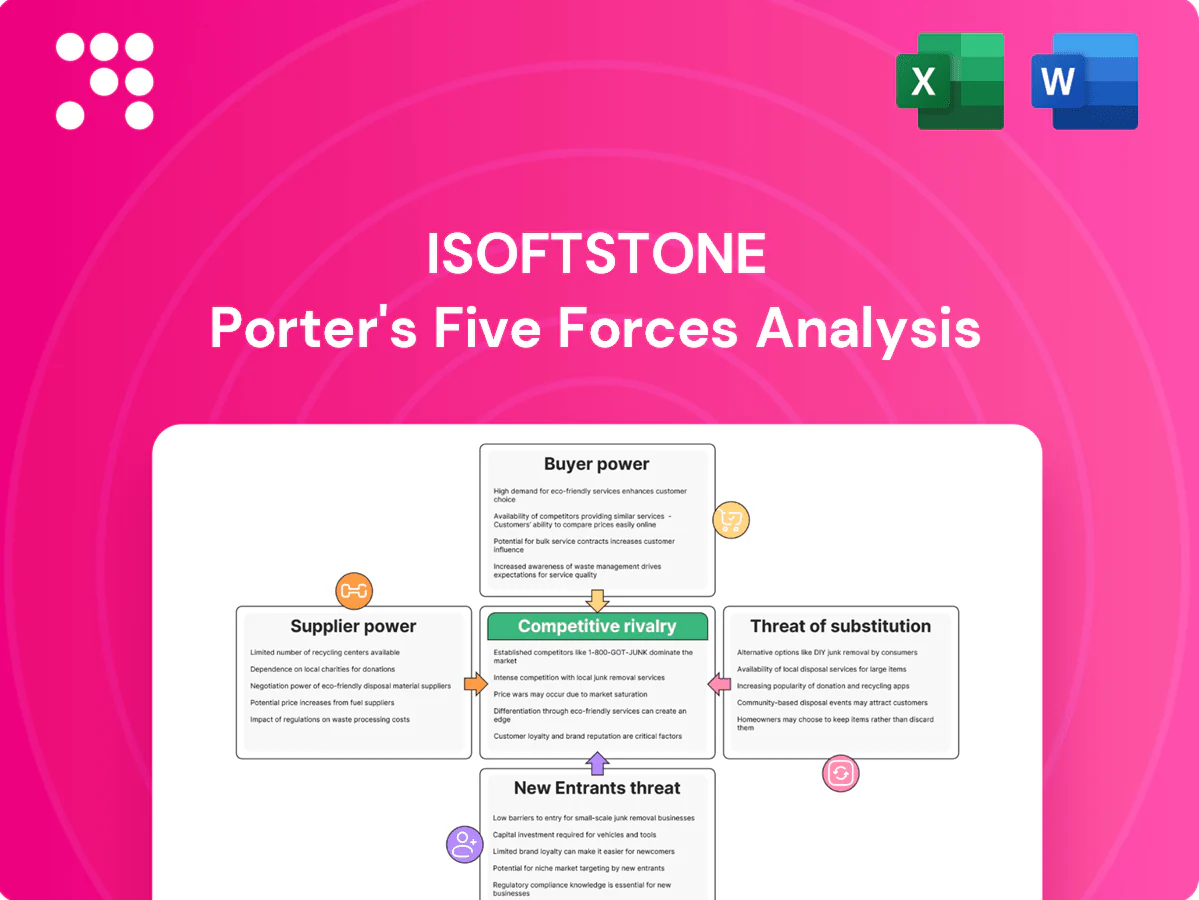
iSoftStone Porter's Five Forces Analysis

A Must-Have Tool for Decision-Makers
iSoftStone faces nuanced competitive pressures—from concentrated buyers and evolving tech substitutes to supplier leverage and the steady threat of new entrants—shaping its strategic choices and margin outlook. This snapshot highlights key tension points and strategic levers but omits force-by-force ratings, visuals, and actionable tactics. Unlock the full Porter's Five Forces Analysis for a consultant-grade breakdown to guide investment or strategy decisions.
Suppliers Bargaining Power

Hyperscaler dependence
Hyperscalers (AWS ~33%, Microsoft Azure ~23%, Google Cloud ~11%, Alibaba ~6% in 2024, Canalys) are critical inputs whose pricing, partner tiers and roadmap shifts can materially alter project economics; iSoftStone reduces risk via multi‑cloud architectures and diversified alliances, but certifications, proprietary tooling and partner tiers create switching frictions that preserve supplier leverage.
Scarce digital talent
AI, data engineering and cloud-native skills remain scarce—demand for AI/cloud roles rose about 30% YoY in 2024, pushing cloud-engineer median pay toward roughly $140k and driving wage inflation that raises delivery costs and project risk by an estimated 8–12%. Strong campuses, continuous upskilling programs and global-delivery centers help iSoftStone soften cost pressure and fill capacity gaps. Still, niche-expertise suppliers retain leverage on critical timelines, preserving supplier bargaining power.

Software/IP vendors
Enterprise software/IP licensing materially raises iSoftStone solution costs, while co-sell incentives and MDF programs can meaningfully boost margins but remain vulnerable to abrupt quota-driven policy shifts. Open-source stacks cut vendor dependency—Linux Foundation 2024 found over 90% of enterprises use OSS—yet integration lock-ins persist because cloud/platform concentration (Synergy Research 2024: AWS ~31.7%, Microsoft Azure ~23.7%) sustains vendor negotiating weight.

Specialist subcontractors
Specialist subcontractors fill UX, cybersecurity and sector-compliance gaps, and on short-duration spikes their rates can run up to 30% premium versus staff bill rates in 2024; this raises supplier bargaining power for niche skills. Building internal benches and reusable IP reduced external spend by ~40% in comparable firms, while multi-vendor frameworks enable rebids and cap rate escalations.
- Skills: niche UX/cyber/compliance
- Cost: up to 30% premium (2024)
- Mitigation: internal benches, reusable assets (~40% spend reduction)
- Procurement: multi-vendor frameworks to rebid and cap escalation
Data and infrastructure providers
Data and infrastructure providers (network, colocation, curated data) are foundational for AI and enterprise projects; in 2024 hyperscalers hold ~66% cloud IaaS share (AWS ~33%, Azure ~23%, GCP ~10%), giving suppliers pricing leverage via volume discounts and SLAs; vendor consolidation and M&A raise switching costs, while flexible contracts, multi-cloud and open-data sources limit absolute power.
- Network/colocation dependence
- 66% hyperscaler concentration (2024)
- SLAs/volume shape cost
- Consolidation increases leverage
- Multi-cloud/alt data reduce risk
Hyperscalers leverage and 30% talent surge push cloud costs up; IP trims external spend
Hyperscalers (AWS 33%, Azure 23%, GCP 11% in 2024) and enterprise software licensors exert material pricing and roadmap leverage, raising switching costs despite iSoftStone's multi‑cloud and alliance strategies. Talent scarcity lifted AI/cloud role demand ~30% YoY in 2024, pushing median cloud-engineer pay to ~$140k and delivery cost pressure ~8–12%. Specialist subcontractors command up to 30% premium; internal benches and reusable IP cut external spend ~40%.
| Factor | 2024 Metric |
|---|---|
| Hyperscaler share | AWS 33% / Azure 23% / GCP 11% |
| Talent demand | +30% YoY; median pay ~$140k |
| Subcontractor premium | Up to 30% |
| Internal spend reduction | ~40% |
What is included in the product
 Detailed Word Document
Tailored Porter's Five Forces for iSoftStone revealing competitive intensity, buyer/supplier leverage, threat of substitutes and new entrants, plus emerging disruptors and strategic levers to protect margins and market share.

 Customizable Excel Spreadsheet
A clear one-sheet summary of iSoftStone's five forces—quickly surface competitive pressures and strategic levers for fast, board-ready decisions.
Customers Bargaining Power

Enterprise procurement rigor
Large clients run competitive RFPs demanding rate cards and outcome SLAs, compressing margins and extending sales cycles to roughly 9–15 months in 2024; margin pressure commonly ranges 100–300 basis points. Strong case studies and domain IP can justify 10–20% premium pricing, while multi-year frameworks (covering ~30–50% of bookings) offset price pressure with volume visibility.
Switching costs moderate
Process knowledge and embedded iSoftStone teams create real switching friction, but standardized cloud stacks and containerized architectures make vendor moves easier than in legacy eras; industry surveys in 2024 show over 90% enterprise cloud adoption. Strong governance and thorough documentation materially reduce buyer fear of lock-in, while renewals increasingly hinge on measurable value delivery, with roughly 70% of buyers citing ROI metrics as the primary renewal driver.

Vendor consolidation
Clients increasingly seek fewer strategic partners for end-to-end transformation, with 2024 surveys showing supplier consolidation cited by 63% of CIOs as a top priority, raising stakes on both performance and pricing.
Winning prime-vendor status often doubles project volumes but pressures margins as prime contracts invite aggressive discounts and longer payment cycles.
Cross-sell across cloud, data, and AI—areas with 20%+ annual spend growth in 2024—boosts client stickiness and lifetime value, offsetting some pricing pressure.

Insourcing alternatives
Digital-native and regulated clients increasingly build in-house squads for control; 2024 industry surveys estimate ~40% of large enterprises expanded internal cloud/devops teams to absorb run and some build work.
iSoftStone must therefore position for complex, accelerated or multi-cloud initiatives where insourcing struggles, emphasizing managed services and co-creation models that blunt the insourcing pull and capture higher-margin engagements.
- Strategic focus: complex, accelerated, multi-cloud
- Value play: managed services, co-creation to retain accounts
- Risk metric: ~40% shift to internal squads (2024 industry estimate)
Outcome-based expectations
Buyers demand outcome-based KPIs tied to cost savings, uptime (commonly 99.9% = ~8.8 hours/year or 99.99% = ~53 minutes/year) and growth, pushing iSoftStone toward risk-sharing contracts that increase delivery discipline. With industry cloud waste around 32% (Flexera 2024), strong observability and FinOps are essential to prove ROI and reclaim spend. Clear baselines and continuous value tracking protect margins under performance-linked pricing.
- KPIs: cost, uptime, growth
- Risk-sharing: raises delivery rigor
- Observability+FinOps: prove ROI, cut waste (~32%)
- Baselines & tracking: preserve margins
Long RFPs and FinOps pain shift deals to outcome-based risk-sharing as cloud insourcing rises
Buyers wield strong price leverage via RFPs and longer sales cycles (9–15 months) compressing margins 100–300 bps; 30–50% of bookings come from multi-year frameworks that stabilize revenue. Embedded teams and case studies raise switching costs but 90% enterprise cloud adoption and 40% insourcing trend (2024) increase buyer options. Outcome KPIs (ROI, uptime) and FinOps (32% cloud waste) drive risk-sharing contracts.
| Metric | 2024 |
|---|---|
| Sales cycle | 9–15 months |
| Margin pressure | 100–300 bps |
| Enterprise cloud adoption | ~90% |
| Insourcing rate | ~40% |
| Cloud waste | ~32% |
Full Version Awaits
iSoftStone Porter's Five Forces Analysis
This preview shows the exact iSoftStone Porter’s Five Forces analysis you’ll receive immediately after purchase—no placeholders or mockups. The document is fully formatted, professionally written, and ready for immediate download and use. No surprises, just the final deliverable.

A Must-Have Tool for Decision-Makers
iSoftStone faces nuanced competitive pressures—from concentrated buyers and evolving tech substitutes to supplier leverage and the steady threat of new entrants—shaping its strategic choices and margin outlook. This snapshot highlights key tension points and strategic levers but omits force-by-force ratings, visuals, and actionable tactics. Unlock the full Porter's Five Forces Analysis for a consultant-grade breakdown to guide investment or strategy decisions.
Suppliers Bargaining Power
Hyperscaler dependence
Hyperscalers (AWS ~33%, Microsoft Azure ~23%, Google Cloud ~11%, Alibaba ~6% in 2024, Canalys) are critical inputs whose pricing, partner tiers and roadmap shifts can materially alter project economics; iSoftStone reduces risk via multi‑cloud architectures and diversified alliances, but certifications, proprietary tooling and partner tiers create switching frictions that preserve supplier leverage.
Scarce digital talent
AI, data engineering and cloud-native skills remain scarce—demand for AI/cloud roles rose about 30% YoY in 2024, pushing cloud-engineer median pay toward roughly $140k and driving wage inflation that raises delivery costs and project risk by an estimated 8–12%. Strong campuses, continuous upskilling programs and global-delivery centers help iSoftStone soften cost pressure and fill capacity gaps. Still, niche-expertise suppliers retain leverage on critical timelines, preserving supplier bargaining power.
Software/IP vendors
Enterprise software/IP licensing materially raises iSoftStone solution costs, while co-sell incentives and MDF programs can meaningfully boost margins but remain vulnerable to abrupt quota-driven policy shifts. Open-source stacks cut vendor dependency—Linux Foundation 2024 found over 90% of enterprises use OSS—yet integration lock-ins persist because cloud/platform concentration (Synergy Research 2024: AWS ~31.7%, Microsoft Azure ~23.7%) sustains vendor negotiating weight.
Specialist subcontractors
Specialist subcontractors fill UX, cybersecurity and sector-compliance gaps, and on short-duration spikes their rates can run up to 30% premium versus staff bill rates in 2024; this raises supplier bargaining power for niche skills. Building internal benches and reusable IP reduced external spend by ~40% in comparable firms, while multi-vendor frameworks enable rebids and cap rate escalations.
- Skills: niche UX/cyber/compliance
- Cost: up to 30% premium (2024)
- Mitigation: internal benches, reusable assets (~40% spend reduction)
- Procurement: multi-vendor frameworks to rebid and cap escalation
Data and infrastructure providers
Data and infrastructure providers (network, colocation, curated data) are foundational for AI and enterprise projects; in 2024 hyperscalers hold ~66% cloud IaaS share (AWS ~33%, Azure ~23%, GCP ~10%), giving suppliers pricing leverage via volume discounts and SLAs; vendor consolidation and M&A raise switching costs, while flexible contracts, multi-cloud and open-data sources limit absolute power.
- Network/colocation dependence
- 66% hyperscaler concentration (2024)
- SLAs/volume shape cost
- Consolidation increases leverage
- Multi-cloud/alt data reduce risk
Hyperscalers leverage and 30% talent surge push cloud costs up; IP trims external spend
Hyperscalers (AWS 33%, Azure 23%, GCP 11% in 2024) and enterprise software licensors exert material pricing and roadmap leverage, raising switching costs despite iSoftStone's multi‑cloud and alliance strategies. Talent scarcity lifted AI/cloud role demand ~30% YoY in 2024, pushing median cloud-engineer pay to ~$140k and delivery cost pressure ~8–12%. Specialist subcontractors command up to 30% premium; internal benches and reusable IP cut external spend ~40%.
| Factor | 2024 Metric |
|---|---|
| Hyperscaler share | AWS 33% / Azure 23% / GCP 11% |
| Talent demand | +30% YoY; median pay ~$140k |
| Subcontractor premium | Up to 30% |
| Internal spend reduction | ~40% |
What is included in the product
Detailed Word Document
Tailored Porter's Five Forces for iSoftStone revealing competitive intensity, buyer/supplier leverage, threat of substitutes and new entrants, plus emerging disruptors and strategic levers to protect margins and market share.
Customizable Excel Spreadsheet
A clear one-sheet summary of iSoftStone's five forces—quickly surface competitive pressures and strategic levers for fast, board-ready decisions.
Customers Bargaining Power
Enterprise procurement rigor
Large clients run competitive RFPs demanding rate cards and outcome SLAs, compressing margins and extending sales cycles to roughly 9–15 months in 2024; margin pressure commonly ranges 100–300 basis points. Strong case studies and domain IP can justify 10–20% premium pricing, while multi-year frameworks (covering ~30–50% of bookings) offset price pressure with volume visibility.
Switching costs moderate
Process knowledge and embedded iSoftStone teams create real switching friction, but standardized cloud stacks and containerized architectures make vendor moves easier than in legacy eras; industry surveys in 2024 show over 90% enterprise cloud adoption. Strong governance and thorough documentation materially reduce buyer fear of lock-in, while renewals increasingly hinge on measurable value delivery, with roughly 70% of buyers citing ROI metrics as the primary renewal driver.
Vendor consolidation
Clients increasingly seek fewer strategic partners for end-to-end transformation, with 2024 surveys showing supplier consolidation cited by 63% of CIOs as a top priority, raising stakes on both performance and pricing.
Winning prime-vendor status often doubles project volumes but pressures margins as prime contracts invite aggressive discounts and longer payment cycles.
Cross-sell across cloud, data, and AI—areas with 20%+ annual spend growth in 2024—boosts client stickiness and lifetime value, offsetting some pricing pressure.
Insourcing alternatives
Digital-native and regulated clients increasingly build in-house squads for control; 2024 industry surveys estimate ~40% of large enterprises expanded internal cloud/devops teams to absorb run and some build work.
iSoftStone must therefore position for complex, accelerated or multi-cloud initiatives where insourcing struggles, emphasizing managed services and co-creation models that blunt the insourcing pull and capture higher-margin engagements.
- Strategic focus: complex, accelerated, multi-cloud
- Value play: managed services, co-creation to retain accounts
- Risk metric: ~40% shift to internal squads (2024 industry estimate)
Outcome-based expectations
Buyers demand outcome-based KPIs tied to cost savings, uptime (commonly 99.9% = ~8.8 hours/year or 99.99% = ~53 minutes/year) and growth, pushing iSoftStone toward risk-sharing contracts that increase delivery discipline. With industry cloud waste around 32% (Flexera 2024), strong observability and FinOps are essential to prove ROI and reclaim spend. Clear baselines and continuous value tracking protect margins under performance-linked pricing.
- KPIs: cost, uptime, growth
- Risk-sharing: raises delivery rigor
- Observability+FinOps: prove ROI, cut waste (~32%)
- Baselines & tracking: preserve margins
Long RFPs and FinOps pain shift deals to outcome-based risk-sharing as cloud insourcing rises
Buyers wield strong price leverage via RFPs and longer sales cycles (9–15 months) compressing margins 100–300 bps; 30–50% of bookings come from multi-year frameworks that stabilize revenue. Embedded teams and case studies raise switching costs but 90% enterprise cloud adoption and 40% insourcing trend (2024) increase buyer options. Outcome KPIs (ROI, uptime) and FinOps (32% cloud waste) drive risk-sharing contracts.
| Metric | 2024 |
|---|---|
| Sales cycle | 9–15 months |
| Margin pressure | 100–300 bps |
| Enterprise cloud adoption | ~90% |
| Insourcing rate | ~40% |
| Cloud waste | ~32% |
Full Version Awaits
iSoftStone Porter's Five Forces Analysis
This preview shows the exact iSoftStone Porter’s Five Forces analysis you’ll receive immediately after purchase—no placeholders or mockups. The document is fully formatted, professionally written, and ready for immediate download and use. No surprises, just the final deliverable.
Original: $10.00
-65%$10.00
$3.50Description
A Must-Have Tool for Decision-Makers
iSoftStone faces nuanced competitive pressures—from concentrated buyers and evolving tech substitutes to supplier leverage and the steady threat of new entrants—shaping its strategic choices and margin outlook. This snapshot highlights key tension points and strategic levers but omits force-by-force ratings, visuals, and actionable tactics. Unlock the full Porter's Five Forces Analysis for a consultant-grade breakdown to guide investment or strategy decisions.
Suppliers Bargaining Power
Hyperscaler dependence
Hyperscalers (AWS ~33%, Microsoft Azure ~23%, Google Cloud ~11%, Alibaba ~6% in 2024, Canalys) are critical inputs whose pricing, partner tiers and roadmap shifts can materially alter project economics; iSoftStone reduces risk via multi‑cloud architectures and diversified alliances, but certifications, proprietary tooling and partner tiers create switching frictions that preserve supplier leverage.
Scarce digital talent
AI, data engineering and cloud-native skills remain scarce—demand for AI/cloud roles rose about 30% YoY in 2024, pushing cloud-engineer median pay toward roughly $140k and driving wage inflation that raises delivery costs and project risk by an estimated 8–12%. Strong campuses, continuous upskilling programs and global-delivery centers help iSoftStone soften cost pressure and fill capacity gaps. Still, niche-expertise suppliers retain leverage on critical timelines, preserving supplier bargaining power.
Software/IP vendors
Enterprise software/IP licensing materially raises iSoftStone solution costs, while co-sell incentives and MDF programs can meaningfully boost margins but remain vulnerable to abrupt quota-driven policy shifts. Open-source stacks cut vendor dependency—Linux Foundation 2024 found over 90% of enterprises use OSS—yet integration lock-ins persist because cloud/platform concentration (Synergy Research 2024: AWS ~31.7%, Microsoft Azure ~23.7%) sustains vendor negotiating weight.
Specialist subcontractors
Specialist subcontractors fill UX, cybersecurity and sector-compliance gaps, and on short-duration spikes their rates can run up to 30% premium versus staff bill rates in 2024; this raises supplier bargaining power for niche skills. Building internal benches and reusable IP reduced external spend by ~40% in comparable firms, while multi-vendor frameworks enable rebids and cap rate escalations.
- Skills: niche UX/cyber/compliance
- Cost: up to 30% premium (2024)
- Mitigation: internal benches, reusable assets (~40% spend reduction)
- Procurement: multi-vendor frameworks to rebid and cap escalation
Data and infrastructure providers
Data and infrastructure providers (network, colocation, curated data) are foundational for AI and enterprise projects; in 2024 hyperscalers hold ~66% cloud IaaS share (AWS ~33%, Azure ~23%, GCP ~10%), giving suppliers pricing leverage via volume discounts and SLAs; vendor consolidation and M&A raise switching costs, while flexible contracts, multi-cloud and open-data sources limit absolute power.
- Network/colocation dependence
- 66% hyperscaler concentration (2024)
- SLAs/volume shape cost
- Consolidation increases leverage
- Multi-cloud/alt data reduce risk
Hyperscalers leverage and 30% talent surge push cloud costs up; IP trims external spend
Hyperscalers (AWS 33%, Azure 23%, GCP 11% in 2024) and enterprise software licensors exert material pricing and roadmap leverage, raising switching costs despite iSoftStone's multi‑cloud and alliance strategies. Talent scarcity lifted AI/cloud role demand ~30% YoY in 2024, pushing median cloud-engineer pay to ~$140k and delivery cost pressure ~8–12%. Specialist subcontractors command up to 30% premium; internal benches and reusable IP cut external spend ~40%.
| Factor | 2024 Metric |
|---|---|
| Hyperscaler share | AWS 33% / Azure 23% / GCP 11% |
| Talent demand | +30% YoY; median pay ~$140k |
| Subcontractor premium | Up to 30% |
| Internal spend reduction | ~40% |
What is included in the product
Detailed Word Document
Tailored Porter's Five Forces for iSoftStone revealing competitive intensity, buyer/supplier leverage, threat of substitutes and new entrants, plus emerging disruptors and strategic levers to protect margins and market share.
Customizable Excel Spreadsheet
A clear one-sheet summary of iSoftStone's five forces—quickly surface competitive pressures and strategic levers for fast, board-ready decisions.
Customers Bargaining Power
Enterprise procurement rigor
Large clients run competitive RFPs demanding rate cards and outcome SLAs, compressing margins and extending sales cycles to roughly 9–15 months in 2024; margin pressure commonly ranges 100–300 basis points. Strong case studies and domain IP can justify 10–20% premium pricing, while multi-year frameworks (covering ~30–50% of bookings) offset price pressure with volume visibility.
Switching costs moderate
Process knowledge and embedded iSoftStone teams create real switching friction, but standardized cloud stacks and containerized architectures make vendor moves easier than in legacy eras; industry surveys in 2024 show over 90% enterprise cloud adoption. Strong governance and thorough documentation materially reduce buyer fear of lock-in, while renewals increasingly hinge on measurable value delivery, with roughly 70% of buyers citing ROI metrics as the primary renewal driver.
Vendor consolidation
Clients increasingly seek fewer strategic partners for end-to-end transformation, with 2024 surveys showing supplier consolidation cited by 63% of CIOs as a top priority, raising stakes on both performance and pricing.
Winning prime-vendor status often doubles project volumes but pressures margins as prime contracts invite aggressive discounts and longer payment cycles.
Cross-sell across cloud, data, and AI—areas with 20%+ annual spend growth in 2024—boosts client stickiness and lifetime value, offsetting some pricing pressure.
Insourcing alternatives
Digital-native and regulated clients increasingly build in-house squads for control; 2024 industry surveys estimate ~40% of large enterprises expanded internal cloud/devops teams to absorb run and some build work.
iSoftStone must therefore position for complex, accelerated or multi-cloud initiatives where insourcing struggles, emphasizing managed services and co-creation models that blunt the insourcing pull and capture higher-margin engagements.
- Strategic focus: complex, accelerated, multi-cloud
- Value play: managed services, co-creation to retain accounts
- Risk metric: ~40% shift to internal squads (2024 industry estimate)
Outcome-based expectations
Buyers demand outcome-based KPIs tied to cost savings, uptime (commonly 99.9% = ~8.8 hours/year or 99.99% = ~53 minutes/year) and growth, pushing iSoftStone toward risk-sharing contracts that increase delivery discipline. With industry cloud waste around 32% (Flexera 2024), strong observability and FinOps are essential to prove ROI and reclaim spend. Clear baselines and continuous value tracking protect margins under performance-linked pricing.
- KPIs: cost, uptime, growth
- Risk-sharing: raises delivery rigor
- Observability+FinOps: prove ROI, cut waste (~32%)
- Baselines & tracking: preserve margins
Long RFPs and FinOps pain shift deals to outcome-based risk-sharing as cloud insourcing rises
Buyers wield strong price leverage via RFPs and longer sales cycles (9–15 months) compressing margins 100–300 bps; 30–50% of bookings come from multi-year frameworks that stabilize revenue. Embedded teams and case studies raise switching costs but 90% enterprise cloud adoption and 40% insourcing trend (2024) increase buyer options. Outcome KPIs (ROI, uptime) and FinOps (32% cloud waste) drive risk-sharing contracts.
| Metric | 2024 |
|---|---|
| Sales cycle | 9–15 months |
| Margin pressure | 100–300 bps |
| Enterprise cloud adoption | ~90% |
| Insourcing rate | ~40% |
| Cloud waste | ~32% |
Full Version Awaits
iSoftStone Porter's Five Forces Analysis
This preview shows the exact iSoftStone Porter’s Five Forces analysis you’ll receive immediately after purchase—no placeholders or mockups. The document is fully formatted, professionally written, and ready for immediate download and use. No surprises, just the final deliverable.











