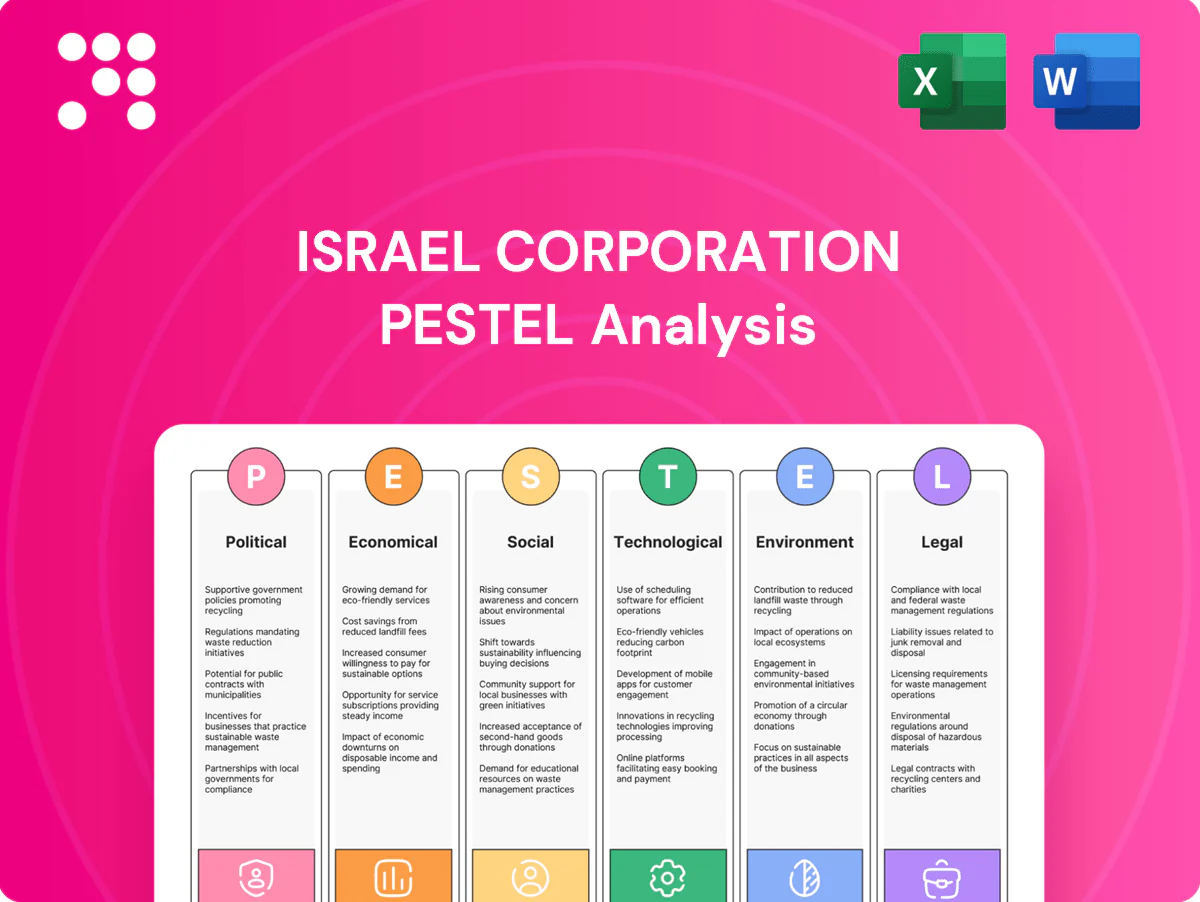
Israel Corporation PESTLE Analysis

Your Competitive Advantage Starts with This Report
Discover how political shifts, economic cycles, social trends, technological advances, environmental pressures, and regulatory changes are shaping Israel Corporation's strategic outlook. This concise PESTLE snapshot pinpoints key external risks and opportunities. Purchase the full analysis to access actionable insights and detailed forecasts for investment or strategic planning.
Political factors

Geopolitical instability and security
Regional conflicts (eg. Oct 2023 attacks that prompted temporary closure of Ashdod port for weeks) have disrupted operations, logistics and workforce continuity; insurers reported war‑risk premiums for Red Sea transits roughly doubled and freight rates surged, forcing contingency inventory and rerouted shipping; robust business continuity planning and diversified routes are critical as investor risk premiums and sovereign spreads widened during flare‑ups.
Government concessions and royalties
ICL’s Dead Sea and phosphate resource rights are held under state concessions and subject to government royalty schemes; changes in profit-sharing, tax policy or renewal conditions can materially compress margins. Transparent engagement with regulators and strict compliance preserve ICL’s licence to operate. Clear, long-dated renewal visibility reduces valuation overhang for Israel Corporation investors.

Trade policy and market access
Tariffs, antidumping measures and non-tariff barriers materially shape flows of fertilizers and bromine, affecting Israel Corporation’s export routes and margins. Access to the EU, US, China and India determines pricing power and volume stability for its chemical and fertilizer units. Diversified sales channels across regions hedge single-market policy shocks. Origin labeling rules can shift buyer preferences and procurement contracts.

Maritime route disruptions
Maritime route disruptions through the Red Sea and Suez have elevated transit times and pushed spot freight rates—industry reports in late 2023–2024 showed rerouting spikes up to 50% and added transit time of roughly 10–14 days via the Cape of Good Hope, increasing lead times and Israel Corporation’s working capital needs. Contract revisions now commonly add force majeure and freight escalation clauses; establishing near-customer inventory hubs reduces service risk and buffer days.
- Red Sea/Suez risk: freight rates +up to 50%
- Reroute impact: +10–14 days lead time
- Contract action: force majeure & freight escalation clauses
- Mitigation: near-customer inventory hubs to lower service risk
Public policy on food security
- Priority: fertilizer availability to curb food inflation
- Stockpiles/subsidies: support demand in downturns
- Export shocks: ~40% potash dependency reroutes buyers
- Coordination: concentrates seasonal buying pre-planting
Red Sea war-risk premiums ~2x, freight spikes +50%
Regional conflicts (Oct 2023) raised war-risk premiums ~2x for Red Sea transits, pushed freight up to +50% and added ~10–14 days transit; state concessions govern Dead Sea/phosphate royalties, creating policy risk; export controls (Russia/Belarus ~40% potash pre-2024) and fertilizer strategic stockpiles (global nutrient use ~185Mt in 2022) drive demand management and subsidy policies.
| Metric | Value |
|---|---|
| War-risk premium | ~2x (2023–24) |
| Freight spike | up to +50% |
| Lead time | +10–14 days |
| Potash share | ~40% |
| Fertilizer use (2022) | ~185 Mt nutrients |
What is included in the product
 Detailed Word Document
Explores how macro-environmental factors uniquely affect Israel Corporation across Political, Economic, Social, Technological, Environmental and Legal dimensions, with each section backed by current data and trends. Designed for executives and investors, the analysis provides detailed sub-points and forward-looking insights to identify threats and opportunities.

 Customizable Excel Spreadsheet
Concise Israel Corporation PESTLE that distills external risks and opportunities into visually segmented categories for quick meeting reference and decision-making; easily editable and shareable so teams can annotate region- or business-specific notes and drop directly into presentations.
Economic factors

Fertilizer price cyclicality
Potash and phosphate prices remain highly cyclic: global potash/phosphate benchmarks fell roughly 40–50% from 2022 peaks into 2024, tracking crop prices and farmer incomes, which directly affects Israel Corporation/ICL revenue, inventory valuations and capex timing. Flexible production, forward hedging and trading reduced realized earnings volatility, while higher‑margin specialty grades—often commanding 20–30% premiums—help cushion commodity downcycles.
Energy and logistics costs
Process heat, electricity and ocean freight are major cost drivers for Israel Corporation; Brent averaged about 83 USD/bbl in 2024 and power/LNG costs rose materially that year, compressing margins in commodity segments. Long-term supply contracts and efficiency CAPEX (typical savings 5–10%) provide cost stability. Freight-market tightness in 2024 pushed spot rates higher and shifted customer incoterms toward supplier carriage.

FX exposure and inflation
Revenues are largely USD-linked while significant costs remain in ILS and EUR, so USD/ILS moves — which averaged about 3.7 in 2024 — materially affect reported earnings and international competitiveness.
Inflation in Israel (annual CPI ~3.3% in 2024) raises wages, maintenance and consumables, compressing margins unless offset.
Active hedging programs and contractual pricing clauses have been used to preserve unit economics and mitigate currency and inflation pass-through risks.

Global ag demand and acreage
Planting intentions and yield targets drive nutrient demand: global cereal output around 2.8 billion tonnes (2023–24) and acreage signals determine fertilizer volumes; emerging-market diet shifts (China meat ~38 kg/capita/year) plus biofuel mandates (US RFS ~15bn gallons ethanol) support medium-term growth. Weather shocks trigger in-season top-up buying, while channel inventories amplify price swings and cycles for Israel Corporation's agribusiness exposures.
- Planting intentions → fertilizer demand
- 2.8bn t cereals = baseline
- China meat ~38 kg/yr → protein-driven demand
- US ethanol ~15bn gal → biofuel support
- Weather + inventories → volatile buy cycles
Portfolio mix to specialties
Israel Corp's pivot from commodities to performance minerals (via ICL) has strengthened margin resilience, with ICL reporting about $5.7bn revenue in 2023 and growing specialty exposure that supports steadier pricing versus bulk commodities. Value-added bromine and phosphate specialties plus micronutrient-enhanced fertilizers defend pricing power; sustained R&D and application support help capture premiums. Mix upgrades have been shown to lift ROIC through cycles.
- Specialties: higher-margin, less cyclical
- Bromine/phosphate/ferts: pricing defense
- R&D: premium capture
- Mix shift: ROIC resilience
Red Sea war-risk premiums ~2x, freight spikes +50%
Commodity prices (potash/phosphate −40–50% from 2022 peaks into 2024) and crop cycles drive topline volatility; specialties and trading reduce earnings swings. Energy and freight costs (Brent ≈83 USD/bbl in 2024) plus CPI Israel ~3.3% and USD/ILS ≈3.7 materially compress margins. ICL specialty shift (rev ≈5.7bn USD in 2023) enhances ROIC resilience versus bulk exposure.
| Metric | Value |
|---|---|
| Potash/Phosphate move | −40–50% (2022→2024) |
| Brent 2024 | ≈83 USD/bbl |
| USD/ILS 2024 | ≈3.7 |
| Israel CPI 2024 | ≈3.3% |
| ICL revenue 2023 | ≈5.7bn USD |
| Global cereals 23–24 | ≈2.8bn t |
Same Document Delivered
Israel Corporation PESTLE Analysis
The preview shown here is the exact Israel Corporation PESTLE Analysis document you’ll receive after purchase—fully formatted and ready to use. The content, structure and layout match the downloadable file exactly, with no placeholders or surprises. Instantly available after checkout.

Your Competitive Advantage Starts with This Report
Discover how political shifts, economic cycles, social trends, technological advances, environmental pressures, and regulatory changes are shaping Israel Corporation's strategic outlook. This concise PESTLE snapshot pinpoints key external risks and opportunities. Purchase the full analysis to access actionable insights and detailed forecasts for investment or strategic planning.
Political factors
Geopolitical instability and security
Regional conflicts (eg. Oct 2023 attacks that prompted temporary closure of Ashdod port for weeks) have disrupted operations, logistics and workforce continuity; insurers reported war‑risk premiums for Red Sea transits roughly doubled and freight rates surged, forcing contingency inventory and rerouted shipping; robust business continuity planning and diversified routes are critical as investor risk premiums and sovereign spreads widened during flare‑ups.
Government concessions and royalties
ICL’s Dead Sea and phosphate resource rights are held under state concessions and subject to government royalty schemes; changes in profit-sharing, tax policy or renewal conditions can materially compress margins. Transparent engagement with regulators and strict compliance preserve ICL’s licence to operate. Clear, long-dated renewal visibility reduces valuation overhang for Israel Corporation investors.
Trade policy and market access
Tariffs, antidumping measures and non-tariff barriers materially shape flows of fertilizers and bromine, affecting Israel Corporation’s export routes and margins. Access to the EU, US, China and India determines pricing power and volume stability for its chemical and fertilizer units. Diversified sales channels across regions hedge single-market policy shocks. Origin labeling rules can shift buyer preferences and procurement contracts.
Maritime route disruptions
Maritime route disruptions through the Red Sea and Suez have elevated transit times and pushed spot freight rates—industry reports in late 2023–2024 showed rerouting spikes up to 50% and added transit time of roughly 10–14 days via the Cape of Good Hope, increasing lead times and Israel Corporation’s working capital needs. Contract revisions now commonly add force majeure and freight escalation clauses; establishing near-customer inventory hubs reduces service risk and buffer days.
- Red Sea/Suez risk: freight rates +up to 50%
- Reroute impact: +10–14 days lead time
- Contract action: force majeure & freight escalation clauses
- Mitigation: near-customer inventory hubs to lower service risk
Public policy on food security
- Priority: fertilizer availability to curb food inflation
- Stockpiles/subsidies: support demand in downturns
- Export shocks: ~40% potash dependency reroutes buyers
- Coordination: concentrates seasonal buying pre-planting
Red Sea war-risk premiums ~2x, freight spikes +50%
Regional conflicts (Oct 2023) raised war-risk premiums ~2x for Red Sea transits, pushed freight up to +50% and added ~10–14 days transit; state concessions govern Dead Sea/phosphate royalties, creating policy risk; export controls (Russia/Belarus ~40% potash pre-2024) and fertilizer strategic stockpiles (global nutrient use ~185Mt in 2022) drive demand management and subsidy policies.
| Metric | Value |
|---|---|
| War-risk premium | ~2x (2023–24) |
| Freight spike | up to +50% |
| Lead time | +10–14 days |
| Potash share | ~40% |
| Fertilizer use (2022) | ~185 Mt nutrients |
What is included in the product
Detailed Word Document
Explores how macro-environmental factors uniquely affect Israel Corporation across Political, Economic, Social, Technological, Environmental and Legal dimensions, with each section backed by current data and trends. Designed for executives and investors, the analysis provides detailed sub-points and forward-looking insights to identify threats and opportunities.
Customizable Excel Spreadsheet
Concise Israel Corporation PESTLE that distills external risks and opportunities into visually segmented categories for quick meeting reference and decision-making; easily editable and shareable so teams can annotate region- or business-specific notes and drop directly into presentations.
Economic factors
Fertilizer price cyclicality
Potash and phosphate prices remain highly cyclic: global potash/phosphate benchmarks fell roughly 40–50% from 2022 peaks into 2024, tracking crop prices and farmer incomes, which directly affects Israel Corporation/ICL revenue, inventory valuations and capex timing. Flexible production, forward hedging and trading reduced realized earnings volatility, while higher‑margin specialty grades—often commanding 20–30% premiums—help cushion commodity downcycles.
Energy and logistics costs
Process heat, electricity and ocean freight are major cost drivers for Israel Corporation; Brent averaged about 83 USD/bbl in 2024 and power/LNG costs rose materially that year, compressing margins in commodity segments. Long-term supply contracts and efficiency CAPEX (typical savings 5–10%) provide cost stability. Freight-market tightness in 2024 pushed spot rates higher and shifted customer incoterms toward supplier carriage.
FX exposure and inflation
Revenues are largely USD-linked while significant costs remain in ILS and EUR, so USD/ILS moves — which averaged about 3.7 in 2024 — materially affect reported earnings and international competitiveness.
Inflation in Israel (annual CPI ~3.3% in 2024) raises wages, maintenance and consumables, compressing margins unless offset.
Active hedging programs and contractual pricing clauses have been used to preserve unit economics and mitigate currency and inflation pass-through risks.
Global ag demand and acreage
Planting intentions and yield targets drive nutrient demand: global cereal output around 2.8 billion tonnes (2023–24) and acreage signals determine fertilizer volumes; emerging-market diet shifts (China meat ~38 kg/capita/year) plus biofuel mandates (US RFS ~15bn gallons ethanol) support medium-term growth. Weather shocks trigger in-season top-up buying, while channel inventories amplify price swings and cycles for Israel Corporation's agribusiness exposures.
- Planting intentions → fertilizer demand
- 2.8bn t cereals = baseline
- China meat ~38 kg/yr → protein-driven demand
- US ethanol ~15bn gal → biofuel support
- Weather + inventories → volatile buy cycles
Portfolio mix to specialties
Israel Corp's pivot from commodities to performance minerals (via ICL) has strengthened margin resilience, with ICL reporting about $5.7bn revenue in 2023 and growing specialty exposure that supports steadier pricing versus bulk commodities. Value-added bromine and phosphate specialties plus micronutrient-enhanced fertilizers defend pricing power; sustained R&D and application support help capture premiums. Mix upgrades have been shown to lift ROIC through cycles.
- Specialties: higher-margin, less cyclical
- Bromine/phosphate/ferts: pricing defense
- R&D: premium capture
- Mix shift: ROIC resilience
Red Sea war-risk premiums ~2x, freight spikes +50%
Commodity prices (potash/phosphate −40–50% from 2022 peaks into 2024) and crop cycles drive topline volatility; specialties and trading reduce earnings swings. Energy and freight costs (Brent ≈83 USD/bbl in 2024) plus CPI Israel ~3.3% and USD/ILS ≈3.7 materially compress margins. ICL specialty shift (rev ≈5.7bn USD in 2023) enhances ROIC resilience versus bulk exposure.
| Metric | Value |
|---|---|
| Potash/Phosphate move | −40–50% (2022→2024) |
| Brent 2024 | ≈83 USD/bbl |
| USD/ILS 2024 | ≈3.7 |
| Israel CPI 2024 | ≈3.3% |
| ICL revenue 2023 | ≈5.7bn USD |
| Global cereals 23–24 | ≈2.8bn t |
Same Document Delivered
Israel Corporation PESTLE Analysis
The preview shown here is the exact Israel Corporation PESTLE Analysis document you’ll receive after purchase—fully formatted and ready to use. The content, structure and layout match the downloadable file exactly, with no placeholders or surprises. Instantly available after checkout.
Description
Your Competitive Advantage Starts with This Report
Discover how political shifts, economic cycles, social trends, technological advances, environmental pressures, and regulatory changes are shaping Israel Corporation's strategic outlook. This concise PESTLE snapshot pinpoints key external risks and opportunities. Purchase the full analysis to access actionable insights and detailed forecasts for investment or strategic planning.
Political factors
Geopolitical instability and security
Regional conflicts (eg. Oct 2023 attacks that prompted temporary closure of Ashdod port for weeks) have disrupted operations, logistics and workforce continuity; insurers reported war‑risk premiums for Red Sea transits roughly doubled and freight rates surged, forcing contingency inventory and rerouted shipping; robust business continuity planning and diversified routes are critical as investor risk premiums and sovereign spreads widened during flare‑ups.
Government concessions and royalties
ICL’s Dead Sea and phosphate resource rights are held under state concessions and subject to government royalty schemes; changes in profit-sharing, tax policy or renewal conditions can materially compress margins. Transparent engagement with regulators and strict compliance preserve ICL’s licence to operate. Clear, long-dated renewal visibility reduces valuation overhang for Israel Corporation investors.
Trade policy and market access
Tariffs, antidumping measures and non-tariff barriers materially shape flows of fertilizers and bromine, affecting Israel Corporation’s export routes and margins. Access to the EU, US, China and India determines pricing power and volume stability for its chemical and fertilizer units. Diversified sales channels across regions hedge single-market policy shocks. Origin labeling rules can shift buyer preferences and procurement contracts.
Maritime route disruptions
Maritime route disruptions through the Red Sea and Suez have elevated transit times and pushed spot freight rates—industry reports in late 2023–2024 showed rerouting spikes up to 50% and added transit time of roughly 10–14 days via the Cape of Good Hope, increasing lead times and Israel Corporation’s working capital needs. Contract revisions now commonly add force majeure and freight escalation clauses; establishing near-customer inventory hubs reduces service risk and buffer days.
- Red Sea/Suez risk: freight rates +up to 50%
- Reroute impact: +10–14 days lead time
- Contract action: force majeure & freight escalation clauses
- Mitigation: near-customer inventory hubs to lower service risk
Public policy on food security
- Priority: fertilizer availability to curb food inflation
- Stockpiles/subsidies: support demand in downturns
- Export shocks: ~40% potash dependency reroutes buyers
- Coordination: concentrates seasonal buying pre-planting
Red Sea war-risk premiums ~2x, freight spikes +50%
Regional conflicts (Oct 2023) raised war-risk premiums ~2x for Red Sea transits, pushed freight up to +50% and added ~10–14 days transit; state concessions govern Dead Sea/phosphate royalties, creating policy risk; export controls (Russia/Belarus ~40% potash pre-2024) and fertilizer strategic stockpiles (global nutrient use ~185Mt in 2022) drive demand management and subsidy policies.
| Metric | Value |
|---|---|
| War-risk premium | ~2x (2023–24) |
| Freight spike | up to +50% |
| Lead time | +10–14 days |
| Potash share | ~40% |
| Fertilizer use (2022) | ~185 Mt nutrients |
What is included in the product
Detailed Word Document
Explores how macro-environmental factors uniquely affect Israel Corporation across Political, Economic, Social, Technological, Environmental and Legal dimensions, with each section backed by current data and trends. Designed for executives and investors, the analysis provides detailed sub-points and forward-looking insights to identify threats and opportunities.
Customizable Excel Spreadsheet
Concise Israel Corporation PESTLE that distills external risks and opportunities into visually segmented categories for quick meeting reference and decision-making; easily editable and shareable so teams can annotate region- or business-specific notes and drop directly into presentations.
Economic factors
Fertilizer price cyclicality
Potash and phosphate prices remain highly cyclic: global potash/phosphate benchmarks fell roughly 40–50% from 2022 peaks into 2024, tracking crop prices and farmer incomes, which directly affects Israel Corporation/ICL revenue, inventory valuations and capex timing. Flexible production, forward hedging and trading reduced realized earnings volatility, while higher‑margin specialty grades—often commanding 20–30% premiums—help cushion commodity downcycles.
Energy and logistics costs
Process heat, electricity and ocean freight are major cost drivers for Israel Corporation; Brent averaged about 83 USD/bbl in 2024 and power/LNG costs rose materially that year, compressing margins in commodity segments. Long-term supply contracts and efficiency CAPEX (typical savings 5–10%) provide cost stability. Freight-market tightness in 2024 pushed spot rates higher and shifted customer incoterms toward supplier carriage.
FX exposure and inflation
Revenues are largely USD-linked while significant costs remain in ILS and EUR, so USD/ILS moves — which averaged about 3.7 in 2024 — materially affect reported earnings and international competitiveness.
Inflation in Israel (annual CPI ~3.3% in 2024) raises wages, maintenance and consumables, compressing margins unless offset.
Active hedging programs and contractual pricing clauses have been used to preserve unit economics and mitigate currency and inflation pass-through risks.
Global ag demand and acreage
Planting intentions and yield targets drive nutrient demand: global cereal output around 2.8 billion tonnes (2023–24) and acreage signals determine fertilizer volumes; emerging-market diet shifts (China meat ~38 kg/capita/year) plus biofuel mandates (US RFS ~15bn gallons ethanol) support medium-term growth. Weather shocks trigger in-season top-up buying, while channel inventories amplify price swings and cycles for Israel Corporation's agribusiness exposures.
- Planting intentions → fertilizer demand
- 2.8bn t cereals = baseline
- China meat ~38 kg/yr → protein-driven demand
- US ethanol ~15bn gal → biofuel support
- Weather + inventories → volatile buy cycles
Portfolio mix to specialties
Israel Corp's pivot from commodities to performance minerals (via ICL) has strengthened margin resilience, with ICL reporting about $5.7bn revenue in 2023 and growing specialty exposure that supports steadier pricing versus bulk commodities. Value-added bromine and phosphate specialties plus micronutrient-enhanced fertilizers defend pricing power; sustained R&D and application support help capture premiums. Mix upgrades have been shown to lift ROIC through cycles.
- Specialties: higher-margin, less cyclical
- Bromine/phosphate/ferts: pricing defense
- R&D: premium capture
- Mix shift: ROIC resilience
Red Sea war-risk premiums ~2x, freight spikes +50%
Commodity prices (potash/phosphate −40–50% from 2022 peaks into 2024) and crop cycles drive topline volatility; specialties and trading reduce earnings swings. Energy and freight costs (Brent ≈83 USD/bbl in 2024) plus CPI Israel ~3.3% and USD/ILS ≈3.7 materially compress margins. ICL specialty shift (rev ≈5.7bn USD in 2023) enhances ROIC resilience versus bulk exposure.
| Metric | Value |
|---|---|
| Potash/Phosphate move | −40–50% (2022→2024) |
| Brent 2024 | ≈83 USD/bbl |
| USD/ILS 2024 | ≈3.7 |
| Israel CPI 2024 | ≈3.3% |
| ICL revenue 2023 | ≈5.7bn USD |
| Global cereals 23–24 | ≈2.8bn t |
Same Document Delivered
Israel Corporation PESTLE Analysis
The preview shown here is the exact Israel Corporation PESTLE Analysis document you’ll receive after purchase—fully formatted and ready to use. The content, structure and layout match the downloadable file exactly, with no placeholders or surprises. Instantly available after checkout.











