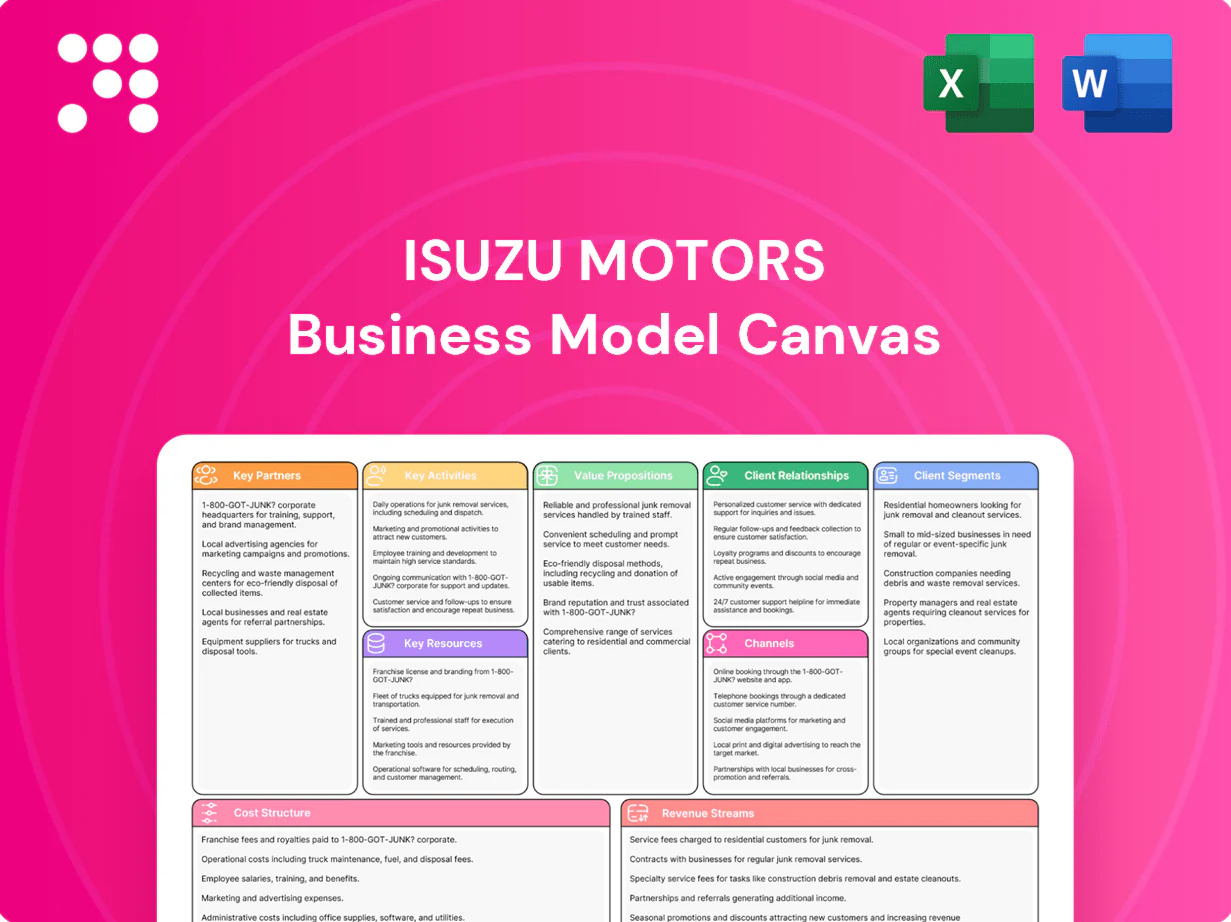
Isuzu Motors Business Model Canvas

Commercial vehicle maker: Business Model Canvas showcasing supply-chain strength and diesel focus
Explore Isuzu Motors’s Business Model Canvas to see how robust supply-chain partnerships, diesel expertise, and commercial vehicle focus drive durable value and steady revenue streams. This concise snapshot highlights customer segments, key activities, and monetization levers that keep the firm competitive across markets. Purchase the full, editable canvas for a section‑by‑section strategic blueprint you can use for benchmarking, planning, or investor presentations.
Partnerships

Tier-1 component suppliers
Partner with global Tier-1 suppliers for powertrain, chassis, electronics and ADAS to ensure quality and scale, supporting Isuzu's ~500,000 global wholesales in 2023. Long-term contracts (typically 3–5 years) lock pricing and supply continuity for high-volume platforms. Joint value engineering programs cut cost and weight while preserving durability. Regional localization partners ensure compliance with local content and regulatory rules.
Dealer and distributor networks
Independent and captive dealers in Isuzu’s network—serving customers in over 100 countries—deliver market coverage, sales execution and aftersales support, while partners fund showrooms, workshops and parts inventory to maintain service levels. Performance agreements align on customer satisfaction and uptime metrics, and co-marketing plus dealer training boost product knowledge and lead conversion.

Bodybuilders and upfitters
Certified upfit partners deliver vocational bodies and equipment across refuse, construction and last-mile delivery, integrating directly with Isuzu chassis. Close technical collaboration ensures chassis integration, safety compliance and preserves manufacturer warranty. Cataloged upfit kits significantly reduce lead times for fleet orders. Co-development with specialists yields niche solutions tailored to specific vocational demands.

Technology and telematics providers
Alliances with ADAS, connectivity and telematics firms accelerate Isuzu’s digital feature rollout; the global telematics market reached about $60.9 billion in 2024, supporting faster integration. Data platforms enable fleet monitoring, predictive maintenance and fuel optimization, cutting downtime and costs. Cybersecurity and OTA partners ensure reliable updates and regulatory compliance, while co-innovation shortens time-to-market for software-defined vehicle capabilities.
- telemetics_market_2024:$60.9B
- fleet_monitoring:predictive_maintenance+fuel_opt
- security:OTA+compliance
- co-innovation:reduced_time-to-market
Financial services and fleet partners
Leasing, insurance and captive finance partners broaden affordability, with commercial-vehicle financing covering roughly 40–60% of transactions in key markets in 2024; structured products help optimize TCO and protect residuals via guaranteed buybacks and lease-end programs. Large fleet partnerships (tens- to hundreds-vehicle contracts) give volume visibility and operational feedback; joint pilots with fleets validate new powertrains and duty-cycle solutions, lowering deployment risk.
- Leasing penetration 40–60% (2024)
- Structured products support residual-value management
- Fleet deals provide volume visibility and feedback loops
- Joint pilots validate powertrains and duty cycles
Commercial vehicle network: Tier-1 suppliers, 100+ markets, telematics and fleet finance
Isuzu relies on Tier‑1 suppliers (supporting ~500,000 wholesales in 2023), global dealer network (100+ countries) and certified upfit partners for vocational builds. Telematics and ADAS alliances (telematics market $60.9B in 2024) plus leasing/finance (40–60% penetration in 2024) enable fleet solutions.
| Partner | Metric |
|---|---|
| Suppliers | 500k wholesales (2023) |
| Dealers | 100+ countries |
| Telematics | $60.9B (2024) |
| Finance | 40–60% penetration (2024) |
What is included in the product
 Detailed Word Document
A concise Business Model Canvas for Isuzu Motors outlining customer segments, value propositions, channels, customer relationships, revenue streams, key resources, key activities, key partnerships, and cost structure, with strategic insights and competitive advantages for investors and planners.

 Customizable Excel Spreadsheet
High-level view of Isuzu Motors’ business model with editable cells, helping teams quickly pinpoint value-chain bottlenecks and operational pain points; perfect for boardroom reviews, fast deliverables, and collaborative adaptation.
Activities

Vehicle and engine R&D
Develop and refine diesel engines, alternative powertrains and modular chassis for light-to-heavy duty cycles, prioritizing durability, fuel efficiency, emissions control and NVH. Validate designs through lab, bench and track testing across diverse climates and load profiles. Maintain regulatory certifications such as Euro VI and EPA compliance across target markets.
Manufacturing and quality control
Operate over 20 global plants for trucks, buses, pickups and engines using lean methodologies; QA includes PPAP and end-of-line testing with 100% inspection on critical systems. Localize components to exceed 60% in key markets to cut cost and tariffs. Continuous improvement targets 5–10% annual gains in takt, yield and safety metrics backed by plant-level KPIs in 2024.

Supply chain and procurement
Source critical components across multi-tier suppliers and dual-source key parts to balance cost, quality and delivery, with contingency stocks and regional hubs to boost resilience. Use digital logistics and inventory platforms in 2024 to monitor lead times, fill rates and supplier risk in real time. Implement sustainability standards and supplier audits aligned with Isuzu’s CO2 neutrality target of 2050.

Sales, aftersales, and service
Execute B2B and retail sales through dealer networks and key corporate accounts, while delivering preventive maintenance, genuine parts and repairs to maximize uptime. Offer extended warranties, service contracts and 24/7 roadside assistance to reduce total cost of ownership. Invest in technician training programs to sustain high first-time-fix rates and improve customer retention.
- Dealer-led B2B and retail sales
- Preventive maintenance, repairs, genuine parts
- Extended warranties, service contracts, roadside assistance
- Technician training for high first-time-fix rates
Market development and compliance
Analyze segments and duty cycles to tailor specs and pricing, engage in regional tenders and homologation, and run demos and pilot programs to drive adoption; ensure emissions, safety and data-privacy compliance with standards such as Euro 6d and UNECE R155 (in force by 2022 and widely applied by 2024).
- Segment/duty-cycle tailoring
- Regional tenders & homologation
- Emissions/safety/UNECE R155
- Marketing, demos, pilots
Modular diesel & alternative powertrains: 20+ plants, >60% local content, 5-10% CI gains
Develop diesel and alternative powertrains, modular chassis and emissions control (Euro VI/EPA/UNECE R155), validated across climates and duty cycles. Operate 20+ global plants, >60% local content in key markets and target 5–10% annual CI gains in 2024. Sell via dealer networks, provide preventive maintenance, extended warranties, 24/7 roadside and technician training; dual-source suppliers and digital logistics in 2024.
| Metric | 2024 value |
|---|---|
| Plants | 20+ |
| Local content | >60% |
| CI target | 5–10% YoY |
| CO2 neutrality | 2050 |
Full Document Unlocks After Purchase
Business Model Canvas
The Isuzu Motors Business Model Canvas you see here is the actual deliverable, not a mockup. When you purchase, you’ll receive this same complete document with all sections included. It’s ready to download, edit, present, and apply—no surprises. The file is delivered in editable formats for immediate use.

Commercial vehicle maker: Business Model Canvas showcasing supply-chain strength and diesel focus
Explore Isuzu Motors’s Business Model Canvas to see how robust supply-chain partnerships, diesel expertise, and commercial vehicle focus drive durable value and steady revenue streams. This concise snapshot highlights customer segments, key activities, and monetization levers that keep the firm competitive across markets. Purchase the full, editable canvas for a section‑by‑section strategic blueprint you can use for benchmarking, planning, or investor presentations.
Partnerships
Tier-1 component suppliers
Partner with global Tier-1 suppliers for powertrain, chassis, electronics and ADAS to ensure quality and scale, supporting Isuzu's ~500,000 global wholesales in 2023. Long-term contracts (typically 3–5 years) lock pricing and supply continuity for high-volume platforms. Joint value engineering programs cut cost and weight while preserving durability. Regional localization partners ensure compliance with local content and regulatory rules.
Dealer and distributor networks
Independent and captive dealers in Isuzu’s network—serving customers in over 100 countries—deliver market coverage, sales execution and aftersales support, while partners fund showrooms, workshops and parts inventory to maintain service levels. Performance agreements align on customer satisfaction and uptime metrics, and co-marketing plus dealer training boost product knowledge and lead conversion.
Bodybuilders and upfitters
Certified upfit partners deliver vocational bodies and equipment across refuse, construction and last-mile delivery, integrating directly with Isuzu chassis. Close technical collaboration ensures chassis integration, safety compliance and preserves manufacturer warranty. Cataloged upfit kits significantly reduce lead times for fleet orders. Co-development with specialists yields niche solutions tailored to specific vocational demands.
Technology and telematics providers
Alliances with ADAS, connectivity and telematics firms accelerate Isuzu’s digital feature rollout; the global telematics market reached about $60.9 billion in 2024, supporting faster integration. Data platforms enable fleet monitoring, predictive maintenance and fuel optimization, cutting downtime and costs. Cybersecurity and OTA partners ensure reliable updates and regulatory compliance, while co-innovation shortens time-to-market for software-defined vehicle capabilities.
- telemetics_market_2024:$60.9B
- fleet_monitoring:predictive_maintenance+fuel_opt
- security:OTA+compliance
- co-innovation:reduced_time-to-market
Financial services and fleet partners
Leasing, insurance and captive finance partners broaden affordability, with commercial-vehicle financing covering roughly 40–60% of transactions in key markets in 2024; structured products help optimize TCO and protect residuals via guaranteed buybacks and lease-end programs. Large fleet partnerships (tens- to hundreds-vehicle contracts) give volume visibility and operational feedback; joint pilots with fleets validate new powertrains and duty-cycle solutions, lowering deployment risk.
- Leasing penetration 40–60% (2024)
- Structured products support residual-value management
- Fleet deals provide volume visibility and feedback loops
- Joint pilots validate powertrains and duty cycles
Commercial vehicle network: Tier-1 suppliers, 100+ markets, telematics and fleet finance
Isuzu relies on Tier‑1 suppliers (supporting ~500,000 wholesales in 2023), global dealer network (100+ countries) and certified upfit partners for vocational builds. Telematics and ADAS alliances (telematics market $60.9B in 2024) plus leasing/finance (40–60% penetration in 2024) enable fleet solutions.
| Partner | Metric |
|---|---|
| Suppliers | 500k wholesales (2023) |
| Dealers | 100+ countries |
| Telematics | $60.9B (2024) |
| Finance | 40–60% penetration (2024) |
What is included in the product
Detailed Word Document
A concise Business Model Canvas for Isuzu Motors outlining customer segments, value propositions, channels, customer relationships, revenue streams, key resources, key activities, key partnerships, and cost structure, with strategic insights and competitive advantages for investors and planners.
Customizable Excel Spreadsheet
High-level view of Isuzu Motors’ business model with editable cells, helping teams quickly pinpoint value-chain bottlenecks and operational pain points; perfect for boardroom reviews, fast deliverables, and collaborative adaptation.
Activities
Vehicle and engine R&D
Develop and refine diesel engines, alternative powertrains and modular chassis for light-to-heavy duty cycles, prioritizing durability, fuel efficiency, emissions control and NVH. Validate designs through lab, bench and track testing across diverse climates and load profiles. Maintain regulatory certifications such as Euro VI and EPA compliance across target markets.
Manufacturing and quality control
Operate over 20 global plants for trucks, buses, pickups and engines using lean methodologies; QA includes PPAP and end-of-line testing with 100% inspection on critical systems. Localize components to exceed 60% in key markets to cut cost and tariffs. Continuous improvement targets 5–10% annual gains in takt, yield and safety metrics backed by plant-level KPIs in 2024.
Supply chain and procurement
Source critical components across multi-tier suppliers and dual-source key parts to balance cost, quality and delivery, with contingency stocks and regional hubs to boost resilience. Use digital logistics and inventory platforms in 2024 to monitor lead times, fill rates and supplier risk in real time. Implement sustainability standards and supplier audits aligned with Isuzu’s CO2 neutrality target of 2050.
Sales, aftersales, and service
Execute B2B and retail sales through dealer networks and key corporate accounts, while delivering preventive maintenance, genuine parts and repairs to maximize uptime. Offer extended warranties, service contracts and 24/7 roadside assistance to reduce total cost of ownership. Invest in technician training programs to sustain high first-time-fix rates and improve customer retention.
- Dealer-led B2B and retail sales
- Preventive maintenance, repairs, genuine parts
- Extended warranties, service contracts, roadside assistance
- Technician training for high first-time-fix rates
Market development and compliance
Analyze segments and duty cycles to tailor specs and pricing, engage in regional tenders and homologation, and run demos and pilot programs to drive adoption; ensure emissions, safety and data-privacy compliance with standards such as Euro 6d and UNECE R155 (in force by 2022 and widely applied by 2024).
- Segment/duty-cycle tailoring
- Regional tenders & homologation
- Emissions/safety/UNECE R155
- Marketing, demos, pilots
Modular diesel & alternative powertrains: 20+ plants, >60% local content, 5-10% CI gains
Develop diesel and alternative powertrains, modular chassis and emissions control (Euro VI/EPA/UNECE R155), validated across climates and duty cycles. Operate 20+ global plants, >60% local content in key markets and target 5–10% annual CI gains in 2024. Sell via dealer networks, provide preventive maintenance, extended warranties, 24/7 roadside and technician training; dual-source suppliers and digital logistics in 2024.
| Metric | 2024 value |
|---|---|
| Plants | 20+ |
| Local content | >60% |
| CI target | 5–10% YoY |
| CO2 neutrality | 2050 |
Full Document Unlocks After Purchase
Business Model Canvas
The Isuzu Motors Business Model Canvas you see here is the actual deliverable, not a mockup. When you purchase, you’ll receive this same complete document with all sections included. It’s ready to download, edit, present, and apply—no surprises. The file is delivered in editable formats for immediate use.
Description
Commercial vehicle maker: Business Model Canvas showcasing supply-chain strength and diesel focus
Explore Isuzu Motors’s Business Model Canvas to see how robust supply-chain partnerships, diesel expertise, and commercial vehicle focus drive durable value and steady revenue streams. This concise snapshot highlights customer segments, key activities, and monetization levers that keep the firm competitive across markets. Purchase the full, editable canvas for a section‑by‑section strategic blueprint you can use for benchmarking, planning, or investor presentations.
Partnerships
Tier-1 component suppliers
Partner with global Tier-1 suppliers for powertrain, chassis, electronics and ADAS to ensure quality and scale, supporting Isuzu's ~500,000 global wholesales in 2023. Long-term contracts (typically 3–5 years) lock pricing and supply continuity for high-volume platforms. Joint value engineering programs cut cost and weight while preserving durability. Regional localization partners ensure compliance with local content and regulatory rules.
Dealer and distributor networks
Independent and captive dealers in Isuzu’s network—serving customers in over 100 countries—deliver market coverage, sales execution and aftersales support, while partners fund showrooms, workshops and parts inventory to maintain service levels. Performance agreements align on customer satisfaction and uptime metrics, and co-marketing plus dealer training boost product knowledge and lead conversion.
Bodybuilders and upfitters
Certified upfit partners deliver vocational bodies and equipment across refuse, construction and last-mile delivery, integrating directly with Isuzu chassis. Close technical collaboration ensures chassis integration, safety compliance and preserves manufacturer warranty. Cataloged upfit kits significantly reduce lead times for fleet orders. Co-development with specialists yields niche solutions tailored to specific vocational demands.
Technology and telematics providers
Alliances with ADAS, connectivity and telematics firms accelerate Isuzu’s digital feature rollout; the global telematics market reached about $60.9 billion in 2024, supporting faster integration. Data platforms enable fleet monitoring, predictive maintenance and fuel optimization, cutting downtime and costs. Cybersecurity and OTA partners ensure reliable updates and regulatory compliance, while co-innovation shortens time-to-market for software-defined vehicle capabilities.
- telemetics_market_2024:$60.9B
- fleet_monitoring:predictive_maintenance+fuel_opt
- security:OTA+compliance
- co-innovation:reduced_time-to-market
Financial services and fleet partners
Leasing, insurance and captive finance partners broaden affordability, with commercial-vehicle financing covering roughly 40–60% of transactions in key markets in 2024; structured products help optimize TCO and protect residuals via guaranteed buybacks and lease-end programs. Large fleet partnerships (tens- to hundreds-vehicle contracts) give volume visibility and operational feedback; joint pilots with fleets validate new powertrains and duty-cycle solutions, lowering deployment risk.
- Leasing penetration 40–60% (2024)
- Structured products support residual-value management
- Fleet deals provide volume visibility and feedback loops
- Joint pilots validate powertrains and duty cycles
Commercial vehicle network: Tier-1 suppliers, 100+ markets, telematics and fleet finance
Isuzu relies on Tier‑1 suppliers (supporting ~500,000 wholesales in 2023), global dealer network (100+ countries) and certified upfit partners for vocational builds. Telematics and ADAS alliances (telematics market $60.9B in 2024) plus leasing/finance (40–60% penetration in 2024) enable fleet solutions.
| Partner | Metric |
|---|---|
| Suppliers | 500k wholesales (2023) |
| Dealers | 100+ countries |
| Telematics | $60.9B (2024) |
| Finance | 40–60% penetration (2024) |
What is included in the product
Detailed Word Document
A concise Business Model Canvas for Isuzu Motors outlining customer segments, value propositions, channels, customer relationships, revenue streams, key resources, key activities, key partnerships, and cost structure, with strategic insights and competitive advantages for investors and planners.
Customizable Excel Spreadsheet
High-level view of Isuzu Motors’ business model with editable cells, helping teams quickly pinpoint value-chain bottlenecks and operational pain points; perfect for boardroom reviews, fast deliverables, and collaborative adaptation.
Activities
Vehicle and engine R&D
Develop and refine diesel engines, alternative powertrains and modular chassis for light-to-heavy duty cycles, prioritizing durability, fuel efficiency, emissions control and NVH. Validate designs through lab, bench and track testing across diverse climates and load profiles. Maintain regulatory certifications such as Euro VI and EPA compliance across target markets.
Manufacturing and quality control
Operate over 20 global plants for trucks, buses, pickups and engines using lean methodologies; QA includes PPAP and end-of-line testing with 100% inspection on critical systems. Localize components to exceed 60% in key markets to cut cost and tariffs. Continuous improvement targets 5–10% annual gains in takt, yield and safety metrics backed by plant-level KPIs in 2024.
Supply chain and procurement
Source critical components across multi-tier suppliers and dual-source key parts to balance cost, quality and delivery, with contingency stocks and regional hubs to boost resilience. Use digital logistics and inventory platforms in 2024 to monitor lead times, fill rates and supplier risk in real time. Implement sustainability standards and supplier audits aligned with Isuzu’s CO2 neutrality target of 2050.
Sales, aftersales, and service
Execute B2B and retail sales through dealer networks and key corporate accounts, while delivering preventive maintenance, genuine parts and repairs to maximize uptime. Offer extended warranties, service contracts and 24/7 roadside assistance to reduce total cost of ownership. Invest in technician training programs to sustain high first-time-fix rates and improve customer retention.
- Dealer-led B2B and retail sales
- Preventive maintenance, repairs, genuine parts
- Extended warranties, service contracts, roadside assistance
- Technician training for high first-time-fix rates
Market development and compliance
Analyze segments and duty cycles to tailor specs and pricing, engage in regional tenders and homologation, and run demos and pilot programs to drive adoption; ensure emissions, safety and data-privacy compliance with standards such as Euro 6d and UNECE R155 (in force by 2022 and widely applied by 2024).
- Segment/duty-cycle tailoring
- Regional tenders & homologation
- Emissions/safety/UNECE R155
- Marketing, demos, pilots
Modular diesel & alternative powertrains: 20+ plants, >60% local content, 5-10% CI gains
Develop diesel and alternative powertrains, modular chassis and emissions control (Euro VI/EPA/UNECE R155), validated across climates and duty cycles. Operate 20+ global plants, >60% local content in key markets and target 5–10% annual CI gains in 2024. Sell via dealer networks, provide preventive maintenance, extended warranties, 24/7 roadside and technician training; dual-source suppliers and digital logistics in 2024.
| Metric | 2024 value |
|---|---|
| Plants | 20+ |
| Local content | >60% |
| CI target | 5–10% YoY |
| CO2 neutrality | 2050 |
Full Document Unlocks After Purchase
Business Model Canvas
The Isuzu Motors Business Model Canvas you see here is the actual deliverable, not a mockup. When you purchase, you’ll receive this same complete document with all sections included. It’s ready to download, edit, present, and apply—no surprises. The file is delivered in editable formats for immediate use.











