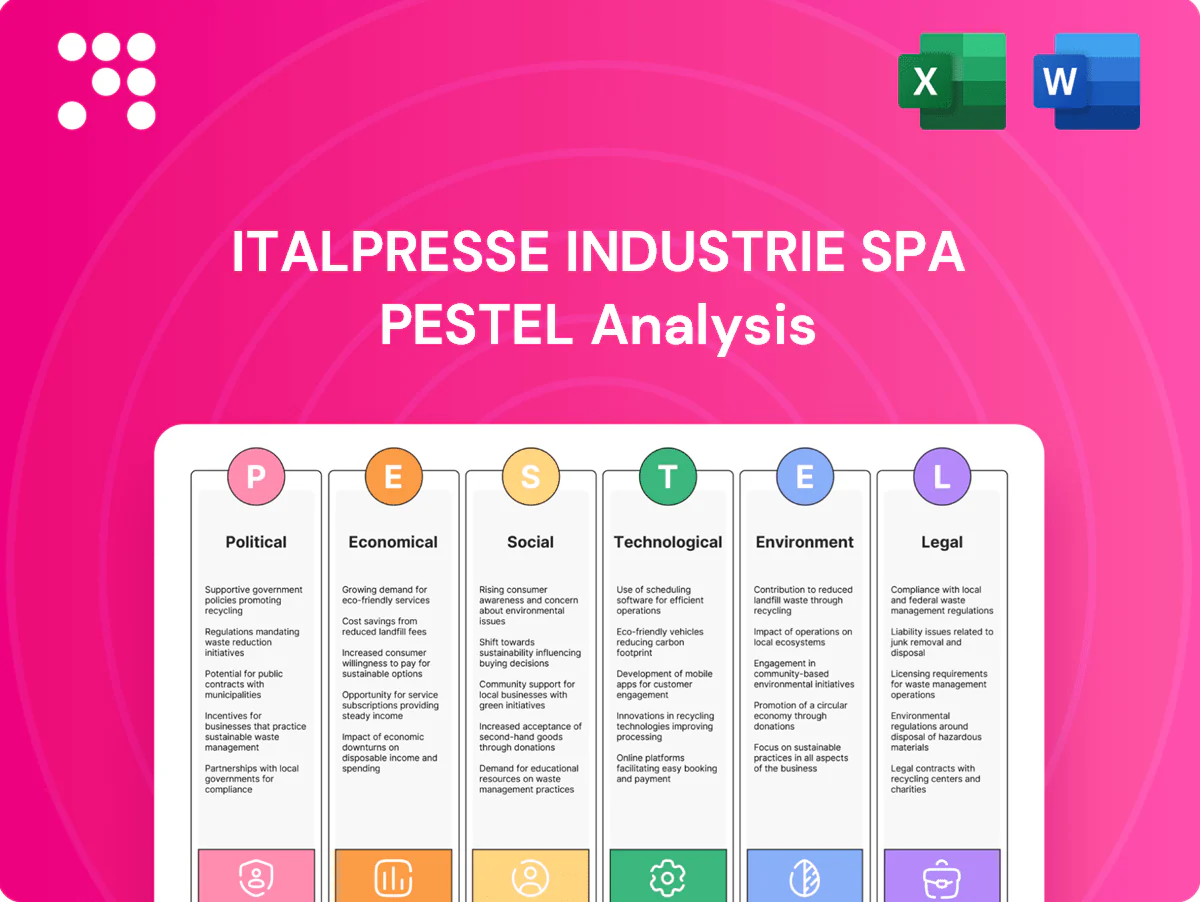
Italpresse Industrie SpA PESTLE Analysis

Your Shortcut to Market Insight Starts Here
Unlock strategic foresight with our PESTLE Analysis of Italpresse Industrie SpA—revealing how political shifts, economic cycles, and technological innovation affect its manufacturing and global supply chains. Ideal for investors and strategists, this concise briefing highlights risks and growth levers. Purchase the full report for detailed, actionable intelligence and downloadable templates.
Political factors

EU industrial and trade policy
As an Italy-based OEM, Italpresse must comply with EU industrial strategy, export rules and state-aid frameworks that shape market access and investment incentives. Shifts in trade agreements or tariffs on machinery, steel and electronics can raise costs and restrict exports. Engagement with EU funds such as the €723.8bn Recovery and Resilience Facility and Horizon Europe (€95.5bn 2021–27) can unlock grants for automation and digitalization. Monitoring geopolitical tensions (eg Russia–Ukraine, China trade frictions) helps manage supply disruptions and price volatility.
Public spending on housing and manufacturing
Government stimulus such as EU NextGenerationEU (€750bn) and Italy’s ~€191.5bn NRRP increases capex appetite for construction, furniture and re-shoring, boosting demand for press lines. National and regional grants fast-track plant upgrades and automation. Austerity or delayed public housing projects can sharply reduce machinery orders. Aligning presses with subsidy-eligible efficiency and safety features raises win rates.

Standards harmonization and market access
Divergent standards between the EU (post‑Brexit since 2020), the UK, North America and emerging markets shape certification roadmaps across markets serving roughly 447 million EU and ~500 million North American consumers. Political choices on mutual recognition directly influence certification complexity and time‑to‑market. Localization policies in several markets and EMs — which represent ~60% of global GDP (PPP) in 2024 — can push assembly or service footprints abroad. Strategic partnerships with local OEMs and test labs mitigate compliance friction.

Energy policy and industrial decarbonization
EU Fit for 55 and industrial decarbonization policies are accelerating demand for energy-efficient presses and heat-recovery systems; EU ETS carbon prices near €90–100/tCO2 in 2024 raise customers’ TCO sensitivity, making low-energy hot-press electrification commercially attractive. Clear, verified energy-performance claims improve competitiveness in public and private tenders.
- Policy: Fit for 55 → higher retrofit demand
- Price: EU ETS ~€95/tCO2 (2024)
- Tech: electrified hot-press favored
- Tender edge: certified energy metrics
Forestry and bioeconomy policy
Policies on sustainable forestry and bioeconomy (EU Forest Strategy 2030) drive downstream investment cycles, with bio-based materials support expanding panel and door capacity; the EU bioeconomy turnover was about €2.4 trillion (2020), signaling demand pull. Stricter import oversight (EUTR) redirects sourcing and can delay plant expansions, while certified wood chains improve access to policy-driven buyers.
- Policy: EU Forest Strategy 2030
- Regulation: EUTR enforcement impacts sourcing
- Market signal: bioeconomy turnover ~€2.4T (2020)
- Strategy: align with certified wood value chains
EU recovery funds, carbon pricing and EM growth reshape industrial capex and market access
Italpresse faces EU rules, trade shifts and state‑aid that affect market access and capex incentives; NextGenerationEU €750bn and Italy NRRP ~€191.5bn boost demand. EU Recovery €723.8bn and Horizon €95.5bn fund automation; EU ETS ≈€95/tCO2 (2024) raises energy‑efficiency demand; EMs ≈60% global GDP (PPP) drive localization risks.
| Policy | 2024/25 Data |
|---|---|
| NextGenerationEU | €750bn |
| NRRP Italy | ~€191.5bn |
| Horizon | €95.5bn (2021–27) |
| EU ETS price | ≈€95/tCO2 (2024) |
What is included in the product
 Detailed Word Document
Explores how macro-environmental factors—Political, Economic, Social, Technological, Environmental and Legal—specifically impact Italpresse Industrie SpA, with data-driven insights and current trends highlighting risks and opportunities; designed to aid executives, consultants and investors in strategic planning and scenario analysis.

 Customizable Excel Spreadsheet
A clean, summarized PESTLE of Italpresse Industrie SpA that is visually segmented for quick interpretation and easily dropped into presentations or strategy packs to align teams fast. It also allows note-taking for regional or product-specific context, helping relieve meeting prep and external risk discussions.
Economic factors

Cyclical demand tied to construction
Demand for Italpresse presses is cyclical and tracks furniture, cabinetry, doors and interior component demand tied to housing starts and renovations; US housing starts averaged about 1.4m units in 2024 (U.S. Census Bureau), so slowdowns reduce orders while upturns compress lead times. Regional diversification across Europe, North America and Asia smooths market volatility, and flexible pricing and financing help sustain the order pipeline through cycles.
Capital intensity and interest rates
High-ticket press lines (typically multi-million-euro investments) depend on customer access to affordable credit; ECB policy rates ran around 4–4.5% in 2024–25, which has lengthened sales cycles and shifted demand toward retrofits over new lines. Offering leasing or vendor financing (common industry practice to cover substantial upfront cost) helps preserve volumes. Demonstrating ROI through throughput gains and 10–30% energy savings shortens payback to 2–5 years, reducing rate sensitivity.

Input costs: steel, electronics, logistics
Volatility in steel and component markets—steel spot prices swung roughly ±25% in 2023–24 while hydraulics, drives, PLCs and semiconductors saw multi-month lead‑time and price shifts—directly compress margins and delay deliveries. Container rates remain ~70% below 2021 peaks, affecting export competitiveness. Dual‑sourcing and design‑to‑cost preserve profitability; transparent surcharges and hedging stabilize order economics.

FX exposure on exports
Euro strength—EUR/USD averaged about 1.09 in 2024—can dampen Italpresse Industrie SpA competitiveness in USD and several emerging markets, while currency volatility directly pressures quoted prices and project margins. Natural hedging from local procurement and service revenues mitigates FX risk. Use of forward contracts is common to secure critical cash flows on long‑lead projects.
- FX rate: EUR/USD ~1.09 (2024 average)
- Exposure: sales to USD/emerging markets reduce price competitiveness
- Risk mitigation: local sourcing + service revenue natural hedge
- Hedge tool: forwards secure long‑lead project cash flows
Aftermarket and service resilience
Installed-base services, retrofits and spare parts act as counter-cyclical revenue for Italpresse, with aftermarket commonly representing about 30% of OEM revenues and up to 50% of profits in metalforming equipment sectors; predictive maintenance can cut unplanned downtime by up to 50% and lift utilization while locking multi-year contracts; service accessibility drives lifetime customer value; bundled service agreements stabilize technical-staff utilization and cash flow.
- Installed base: recurring revenue stream
- Retrofits/spares: higher margins, counter-cyclical
- Predictive maintenance: -up to 50% downtime
- Bundled agreements: staff utilization & contract lock-in
EU recovery funds, carbon pricing and EM growth reshape industrial capex and market access
Demand tracks housing cycles (US starts ~1.4m in 2024); ECB rates ~4–4.5% lengthen sales cycles and favor retrofits; steel prices swung ±25% in 2023–24 compressing margins; EUR/USD ~1.09 in 2024 weakens competitiveness abroad while aftermarket (~30% of revenues) and predictive maintenance (-up to 50% downtime) stabilize cash flow.
| Metric | 2024 Value | Impact |
|---|---|---|
| US housing starts | ~1.4m | Demand driver |
| ECB rate | 4–4.5% | Longer sales cycles |
| Steel volatility | ±25% | Margin pressure |
| EUR/USD | ~1.09 | Price competitiveness |
| Aftermarket | ~30% rev | Counter‑cyclical cash |
Same Document Delivered
Italpresse Industrie SpA PESTLE Analysis
This preview shows the Italpresse Industrie SpA PESTLE Analysis — a concise review of political, economic, social, technological, legal and environmental factors shaping the company. The content and structure shown in the preview is the same document you’ll download after payment. It’s fully formatted and ready to use.

Your Shortcut to Market Insight Starts Here
Unlock strategic foresight with our PESTLE Analysis of Italpresse Industrie SpA—revealing how political shifts, economic cycles, and technological innovation affect its manufacturing and global supply chains. Ideal for investors and strategists, this concise briefing highlights risks and growth levers. Purchase the full report for detailed, actionable intelligence and downloadable templates.
Political factors
EU industrial and trade policy
As an Italy-based OEM, Italpresse must comply with EU industrial strategy, export rules and state-aid frameworks that shape market access and investment incentives. Shifts in trade agreements or tariffs on machinery, steel and electronics can raise costs and restrict exports. Engagement with EU funds such as the €723.8bn Recovery and Resilience Facility and Horizon Europe (€95.5bn 2021–27) can unlock grants for automation and digitalization. Monitoring geopolitical tensions (eg Russia–Ukraine, China trade frictions) helps manage supply disruptions and price volatility.
Public spending on housing and manufacturing
Government stimulus such as EU NextGenerationEU (€750bn) and Italy’s ~€191.5bn NRRP increases capex appetite for construction, furniture and re-shoring, boosting demand for press lines. National and regional grants fast-track plant upgrades and automation. Austerity or delayed public housing projects can sharply reduce machinery orders. Aligning presses with subsidy-eligible efficiency and safety features raises win rates.
Standards harmonization and market access
Divergent standards between the EU (post‑Brexit since 2020), the UK, North America and emerging markets shape certification roadmaps across markets serving roughly 447 million EU and ~500 million North American consumers. Political choices on mutual recognition directly influence certification complexity and time‑to‑market. Localization policies in several markets and EMs — which represent ~60% of global GDP (PPP) in 2024 — can push assembly or service footprints abroad. Strategic partnerships with local OEMs and test labs mitigate compliance friction.
Energy policy and industrial decarbonization
EU Fit for 55 and industrial decarbonization policies are accelerating demand for energy-efficient presses and heat-recovery systems; EU ETS carbon prices near €90–100/tCO2 in 2024 raise customers’ TCO sensitivity, making low-energy hot-press electrification commercially attractive. Clear, verified energy-performance claims improve competitiveness in public and private tenders.
- Policy: Fit for 55 → higher retrofit demand
- Price: EU ETS ~€95/tCO2 (2024)
- Tech: electrified hot-press favored
- Tender edge: certified energy metrics
Forestry and bioeconomy policy
Policies on sustainable forestry and bioeconomy (EU Forest Strategy 2030) drive downstream investment cycles, with bio-based materials support expanding panel and door capacity; the EU bioeconomy turnover was about €2.4 trillion (2020), signaling demand pull. Stricter import oversight (EUTR) redirects sourcing and can delay plant expansions, while certified wood chains improve access to policy-driven buyers.
- Policy: EU Forest Strategy 2030
- Regulation: EUTR enforcement impacts sourcing
- Market signal: bioeconomy turnover ~€2.4T (2020)
- Strategy: align with certified wood value chains
EU recovery funds, carbon pricing and EM growth reshape industrial capex and market access
Italpresse faces EU rules, trade shifts and state‑aid that affect market access and capex incentives; NextGenerationEU €750bn and Italy NRRP ~€191.5bn boost demand. EU Recovery €723.8bn and Horizon €95.5bn fund automation; EU ETS ≈€95/tCO2 (2024) raises energy‑efficiency demand; EMs ≈60% global GDP (PPP) drive localization risks.
| Policy | 2024/25 Data |
|---|---|
| NextGenerationEU | €750bn |
| NRRP Italy | ~€191.5bn |
| Horizon | €95.5bn (2021–27) |
| EU ETS price | ≈€95/tCO2 (2024) |
What is included in the product
Detailed Word Document
Explores how macro-environmental factors—Political, Economic, Social, Technological, Environmental and Legal—specifically impact Italpresse Industrie SpA, with data-driven insights and current trends highlighting risks and opportunities; designed to aid executives, consultants and investors in strategic planning and scenario analysis.
Customizable Excel Spreadsheet
A clean, summarized PESTLE of Italpresse Industrie SpA that is visually segmented for quick interpretation and easily dropped into presentations or strategy packs to align teams fast. It also allows note-taking for regional or product-specific context, helping relieve meeting prep and external risk discussions.
Economic factors
Cyclical demand tied to construction
Demand for Italpresse presses is cyclical and tracks furniture, cabinetry, doors and interior component demand tied to housing starts and renovations; US housing starts averaged about 1.4m units in 2024 (U.S. Census Bureau), so slowdowns reduce orders while upturns compress lead times. Regional diversification across Europe, North America and Asia smooths market volatility, and flexible pricing and financing help sustain the order pipeline through cycles.
Capital intensity and interest rates
High-ticket press lines (typically multi-million-euro investments) depend on customer access to affordable credit; ECB policy rates ran around 4–4.5% in 2024–25, which has lengthened sales cycles and shifted demand toward retrofits over new lines. Offering leasing or vendor financing (common industry practice to cover substantial upfront cost) helps preserve volumes. Demonstrating ROI through throughput gains and 10–30% energy savings shortens payback to 2–5 years, reducing rate sensitivity.
Input costs: steel, electronics, logistics
Volatility in steel and component markets—steel spot prices swung roughly ±25% in 2023–24 while hydraulics, drives, PLCs and semiconductors saw multi-month lead‑time and price shifts—directly compress margins and delay deliveries. Container rates remain ~70% below 2021 peaks, affecting export competitiveness. Dual‑sourcing and design‑to‑cost preserve profitability; transparent surcharges and hedging stabilize order economics.
FX exposure on exports
Euro strength—EUR/USD averaged about 1.09 in 2024—can dampen Italpresse Industrie SpA competitiveness in USD and several emerging markets, while currency volatility directly pressures quoted prices and project margins. Natural hedging from local procurement and service revenues mitigates FX risk. Use of forward contracts is common to secure critical cash flows on long‑lead projects.
- FX rate: EUR/USD ~1.09 (2024 average)
- Exposure: sales to USD/emerging markets reduce price competitiveness
- Risk mitigation: local sourcing + service revenue natural hedge
- Hedge tool: forwards secure long‑lead project cash flows
Aftermarket and service resilience
Installed-base services, retrofits and spare parts act as counter-cyclical revenue for Italpresse, with aftermarket commonly representing about 30% of OEM revenues and up to 50% of profits in metalforming equipment sectors; predictive maintenance can cut unplanned downtime by up to 50% and lift utilization while locking multi-year contracts; service accessibility drives lifetime customer value; bundled service agreements stabilize technical-staff utilization and cash flow.
- Installed base: recurring revenue stream
- Retrofits/spares: higher margins, counter-cyclical
- Predictive maintenance: -up to 50% downtime
- Bundled agreements: staff utilization & contract lock-in
EU recovery funds, carbon pricing and EM growth reshape industrial capex and market access
Demand tracks housing cycles (US starts ~1.4m in 2024); ECB rates ~4–4.5% lengthen sales cycles and favor retrofits; steel prices swung ±25% in 2023–24 compressing margins; EUR/USD ~1.09 in 2024 weakens competitiveness abroad while aftermarket (~30% of revenues) and predictive maintenance (-up to 50% downtime) stabilize cash flow.
| Metric | 2024 Value | Impact |
|---|---|---|
| US housing starts | ~1.4m | Demand driver |
| ECB rate | 4–4.5% | Longer sales cycles |
| Steel volatility | ±25% | Margin pressure |
| EUR/USD | ~1.09 | Price competitiveness |
| Aftermarket | ~30% rev | Counter‑cyclical cash |
Same Document Delivered
Italpresse Industrie SpA PESTLE Analysis
This preview shows the Italpresse Industrie SpA PESTLE Analysis — a concise review of political, economic, social, technological, legal and environmental factors shaping the company. The content and structure shown in the preview is the same document you’ll download after payment. It’s fully formatted and ready to use.
Original: $10.00
-65%$10.00
$3.50Description
Your Shortcut to Market Insight Starts Here
Unlock strategic foresight with our PESTLE Analysis of Italpresse Industrie SpA—revealing how political shifts, economic cycles, and technological innovation affect its manufacturing and global supply chains. Ideal for investors and strategists, this concise briefing highlights risks and growth levers. Purchase the full report for detailed, actionable intelligence and downloadable templates.
Political factors
EU industrial and trade policy
As an Italy-based OEM, Italpresse must comply with EU industrial strategy, export rules and state-aid frameworks that shape market access and investment incentives. Shifts in trade agreements or tariffs on machinery, steel and electronics can raise costs and restrict exports. Engagement with EU funds such as the €723.8bn Recovery and Resilience Facility and Horizon Europe (€95.5bn 2021–27) can unlock grants for automation and digitalization. Monitoring geopolitical tensions (eg Russia–Ukraine, China trade frictions) helps manage supply disruptions and price volatility.
Public spending on housing and manufacturing
Government stimulus such as EU NextGenerationEU (€750bn) and Italy’s ~€191.5bn NRRP increases capex appetite for construction, furniture and re-shoring, boosting demand for press lines. National and regional grants fast-track plant upgrades and automation. Austerity or delayed public housing projects can sharply reduce machinery orders. Aligning presses with subsidy-eligible efficiency and safety features raises win rates.
Standards harmonization and market access
Divergent standards between the EU (post‑Brexit since 2020), the UK, North America and emerging markets shape certification roadmaps across markets serving roughly 447 million EU and ~500 million North American consumers. Political choices on mutual recognition directly influence certification complexity and time‑to‑market. Localization policies in several markets and EMs — which represent ~60% of global GDP (PPP) in 2024 — can push assembly or service footprints abroad. Strategic partnerships with local OEMs and test labs mitigate compliance friction.
Energy policy and industrial decarbonization
EU Fit for 55 and industrial decarbonization policies are accelerating demand for energy-efficient presses and heat-recovery systems; EU ETS carbon prices near €90–100/tCO2 in 2024 raise customers’ TCO sensitivity, making low-energy hot-press electrification commercially attractive. Clear, verified energy-performance claims improve competitiveness in public and private tenders.
- Policy: Fit for 55 → higher retrofit demand
- Price: EU ETS ~€95/tCO2 (2024)
- Tech: electrified hot-press favored
- Tender edge: certified energy metrics
Forestry and bioeconomy policy
Policies on sustainable forestry and bioeconomy (EU Forest Strategy 2030) drive downstream investment cycles, with bio-based materials support expanding panel and door capacity; the EU bioeconomy turnover was about €2.4 trillion (2020), signaling demand pull. Stricter import oversight (EUTR) redirects sourcing and can delay plant expansions, while certified wood chains improve access to policy-driven buyers.
- Policy: EU Forest Strategy 2030
- Regulation: EUTR enforcement impacts sourcing
- Market signal: bioeconomy turnover ~€2.4T (2020)
- Strategy: align with certified wood value chains
EU recovery funds, carbon pricing and EM growth reshape industrial capex and market access
Italpresse faces EU rules, trade shifts and state‑aid that affect market access and capex incentives; NextGenerationEU €750bn and Italy NRRP ~€191.5bn boost demand. EU Recovery €723.8bn and Horizon €95.5bn fund automation; EU ETS ≈€95/tCO2 (2024) raises energy‑efficiency demand; EMs ≈60% global GDP (PPP) drive localization risks.
| Policy | 2024/25 Data |
|---|---|
| NextGenerationEU | €750bn |
| NRRP Italy | ~€191.5bn |
| Horizon | €95.5bn (2021–27) |
| EU ETS price | ≈€95/tCO2 (2024) |
What is included in the product
Detailed Word Document
Explores how macro-environmental factors—Political, Economic, Social, Technological, Environmental and Legal—specifically impact Italpresse Industrie SpA, with data-driven insights and current trends highlighting risks and opportunities; designed to aid executives, consultants and investors in strategic planning and scenario analysis.
Customizable Excel Spreadsheet
A clean, summarized PESTLE of Italpresse Industrie SpA that is visually segmented for quick interpretation and easily dropped into presentations or strategy packs to align teams fast. It also allows note-taking for regional or product-specific context, helping relieve meeting prep and external risk discussions.
Economic factors
Cyclical demand tied to construction
Demand for Italpresse presses is cyclical and tracks furniture, cabinetry, doors and interior component demand tied to housing starts and renovations; US housing starts averaged about 1.4m units in 2024 (U.S. Census Bureau), so slowdowns reduce orders while upturns compress lead times. Regional diversification across Europe, North America and Asia smooths market volatility, and flexible pricing and financing help sustain the order pipeline through cycles.
Capital intensity and interest rates
High-ticket press lines (typically multi-million-euro investments) depend on customer access to affordable credit; ECB policy rates ran around 4–4.5% in 2024–25, which has lengthened sales cycles and shifted demand toward retrofits over new lines. Offering leasing or vendor financing (common industry practice to cover substantial upfront cost) helps preserve volumes. Demonstrating ROI through throughput gains and 10–30% energy savings shortens payback to 2–5 years, reducing rate sensitivity.
Input costs: steel, electronics, logistics
Volatility in steel and component markets—steel spot prices swung roughly ±25% in 2023–24 while hydraulics, drives, PLCs and semiconductors saw multi-month lead‑time and price shifts—directly compress margins and delay deliveries. Container rates remain ~70% below 2021 peaks, affecting export competitiveness. Dual‑sourcing and design‑to‑cost preserve profitability; transparent surcharges and hedging stabilize order economics.
FX exposure on exports
Euro strength—EUR/USD averaged about 1.09 in 2024—can dampen Italpresse Industrie SpA competitiveness in USD and several emerging markets, while currency volatility directly pressures quoted prices and project margins. Natural hedging from local procurement and service revenues mitigates FX risk. Use of forward contracts is common to secure critical cash flows on long‑lead projects.
- FX rate: EUR/USD ~1.09 (2024 average)
- Exposure: sales to USD/emerging markets reduce price competitiveness
- Risk mitigation: local sourcing + service revenue natural hedge
- Hedge tool: forwards secure long‑lead project cash flows
Aftermarket and service resilience
Installed-base services, retrofits and spare parts act as counter-cyclical revenue for Italpresse, with aftermarket commonly representing about 30% of OEM revenues and up to 50% of profits in metalforming equipment sectors; predictive maintenance can cut unplanned downtime by up to 50% and lift utilization while locking multi-year contracts; service accessibility drives lifetime customer value; bundled service agreements stabilize technical-staff utilization and cash flow.
- Installed base: recurring revenue stream
- Retrofits/spares: higher margins, counter-cyclical
- Predictive maintenance: -up to 50% downtime
- Bundled agreements: staff utilization & contract lock-in
EU recovery funds, carbon pricing and EM growth reshape industrial capex and market access
Demand tracks housing cycles (US starts ~1.4m in 2024); ECB rates ~4–4.5% lengthen sales cycles and favor retrofits; steel prices swung ±25% in 2023–24 compressing margins; EUR/USD ~1.09 in 2024 weakens competitiveness abroad while aftermarket (~30% of revenues) and predictive maintenance (-up to 50% downtime) stabilize cash flow.
| Metric | 2024 Value | Impact |
|---|---|---|
| US housing starts | ~1.4m | Demand driver |
| ECB rate | 4–4.5% | Longer sales cycles |
| Steel volatility | ±25% | Margin pressure |
| EUR/USD | ~1.09 | Price competitiveness |
| Aftermarket | ~30% rev | Counter‑cyclical cash |
Same Document Delivered
Italpresse Industrie SpA PESTLE Analysis
This preview shows the Italpresse Industrie SpA PESTLE Analysis — a concise review of political, economic, social, technological, legal and environmental factors shaping the company. The content and structure shown in the preview is the same document you’ll download after payment. It’s fully formatted and ready to use.











