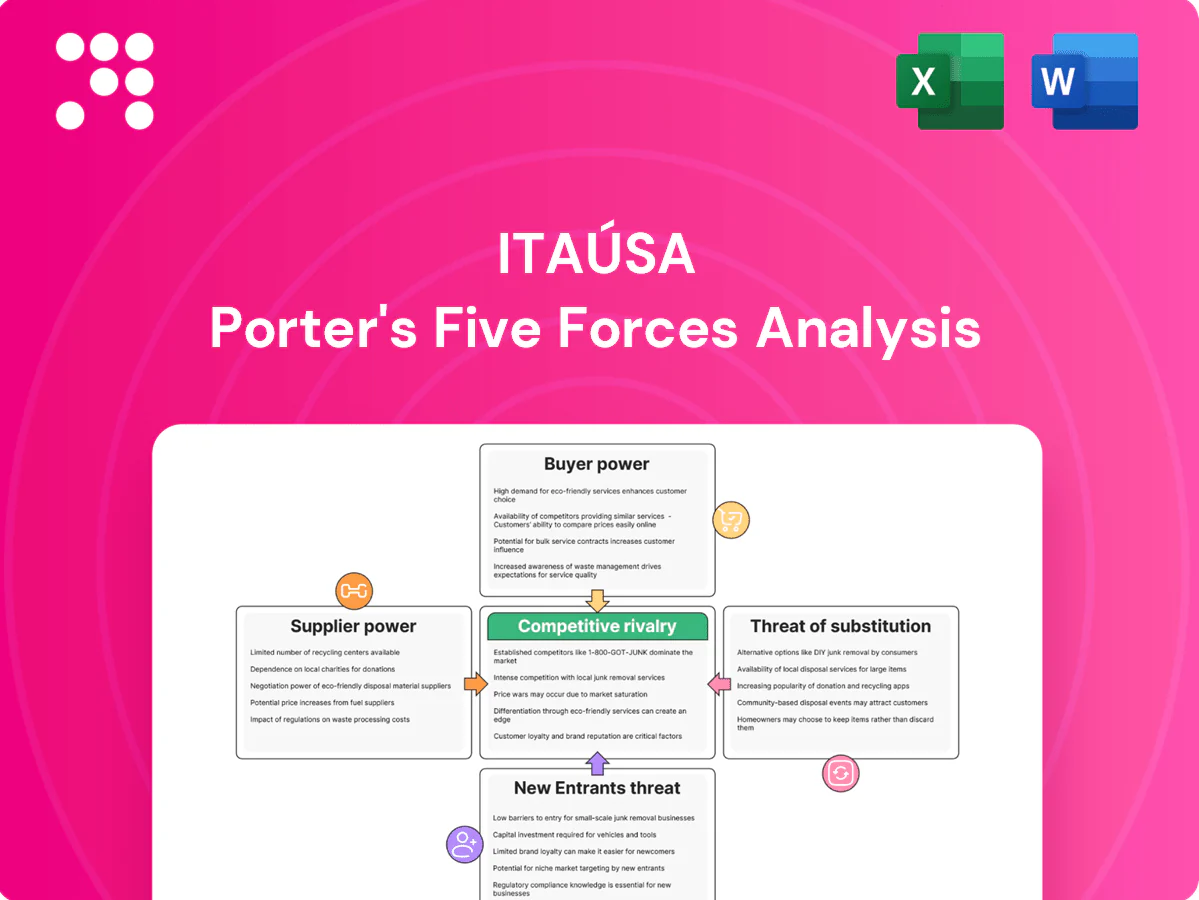
Itaúsa Porter's Five Forces Analysis

A Must-Have Tool for Decision-Makers
Itaúsa's Porter's Five Forces snapshot highlights strong buyer power, moderate supplier influence, high rivalry across diversified holdings, low substitute threat, and barriers limiting new entrants. This concise view outlines competitive levers and strategic risks across its banking, insurance and industrial investments. This brief snapshot only scratches the surface. Unlock the full Porter's Five Forces Analysis to explore Itaúsa’s competitive dynamics, market pressures, and strategic advantages in detail.
Suppliers Bargaining Power

Concentrated capital providers
As a holding listed on B3 (ITSA3/ITSA4), Itaúsa relies on concentrated long-term capital from domestic institutions and foreign funds, allowing large investors to shape cost of capital and governance; in 2024 institutional and foreign holdings remained dominant. Its blue-chip status and average daily liquidity (notably higher than mid-cap peers) broaden the investor base, tempering concentration risk. Diversified portfolio dividends—with a 2024 dividend yield around 5.2%—reduce dependence on any single capital source.
Regulatory and compliance gatekeepers
Banking exposure via Itaú Unibanco subjects Itaúsa to strict prudential rules—Basel III minimum CET1 is 4.5%—whose permissions and licenses act as supplier constraints that can raise compliance costs and slow strategic moves. Itaúsa’s long-standing governance and track record reduce regulatory friction, but episodic rule changes have shifted economics for peers. Multi-sector holdings multiply oversight layers and coordination complexity across different regulators.

Deal flow intermediaries
Investment banks, advisors and legal firms strongly influence access to quality transactions and terms, especially in competitive Brazilian M&A cycles where marquee advisors hold negotiating leverage and often charge 1–3% in advisory fees on larger deals. Itaúsa’s reputation and network typically secure priority placement and fee concessions, while its in-house deal team and internal diligence capabilities increasingly reduce reliance on external pipelines and commissions.

Critical inputs to investees
Portfolio companies face suppliers of commodities, pulp/wood, chemicals and technology; input-price volatility in 2024 pressured margins and dividends to Itaúsa. Long-term contracts and vertical integration in key investees have softened short-term shocks. Diversification across banking, industry and consumer assets spreads supplier risk.
- Exposed inputs: pulp/wood, chemicals, metals, software
- Mitigants: long-term contracts, vertical integration
- Impact 2024: input volatility compressed margins
- Risk spread: sector diversification
Technology and data vendors
Banking and sanitation businesses in Itaúsa depend on resilient IT, cybersecurity and analytics platforms; global cybersecurity spending rose to about $188 billion in 2023 and is forecast above $210 billion in 2024, underpinning vendor pricing power. Leading tech vendors create high switching costs and capture premiums, while scale purchasing and multi‑year contracts materially improve commercial terms. Limited substitutability for cyber and operational resilience sustains vendor leverage.
- Vendor switching costs: high
- Pricing power: premium extraction
- Mitigants: scale buying, multi‑year deals
- Resilience constraint: low substitutability
Institutional concentration boosts investor leverage; 5.2% yield
Itaúsa’s concentrated institutional and foreign capital gives investors bargaining leverage while blue‑chip liquidity and a 2024 dividend yield ~5.2% mitigate some concentration. Prudential regulations and tech/cyber vendors (global cyber spend >$210B in 2024) raise supplier power. Long‑term contracts, vertical integration and in‑house deal capacity materially reduce supplier dependence.
| Metric | 2024 |
|---|---|
| Dividend yield | ~5.2% |
| Cybersecurity spend | >$210B |
| Advisory fees | 1–3% |
| Capital holders | institutional/foreign dominant |
What is included in the product
 Detailed Word Document
Tailored Porter's Five Forces analysis for Itaúsa that uncovers key drivers of competition, buyer and supplier power, and barriers to entry. Identifies substitutes, disruptive threats, and strategic levers that influence Itaúsa’s pricing power and long-term profitability.

 Customizable Excel Spreadsheet
One-sheet Itaúsa Porter’s Five Forces analysis that distills competitive pressure across suppliers, buyers, substitutes, entrants and rivalry—ready for quick board decisions; customizable pressure levels and an instant spider chart let you model scenarios, swap in current data, and drop the clean layout directly into decks or reports.
Customers Bargaining Power

Public equity investors
Public equity investors in Itaúsa (traded on B3 as ITSA4, part of Ibovespa)—both retail and institutional—demand yield, liquidity and stronger governance, pressing management on capital allocation and payout policy. High transparency expectations in 2024 intensified scrutiny of dividend rhythm and disclosures. Deep Brazilian capital markets amplify shareholder voice via voting and price signals. Itaúsa’s diversified dividend streams from finance and industry help satisfy income-focused investors.
Creditors and rating agencies
Debt investors shape Itaúsa’s leverage, covenant structure and refinancing costs, with creditors demanding conservative ratios during 2024 bank-cycle sensitivity; rating agencies’ focus on exposure to banking risks limits capital flexibility. Strong dividend streams and solid asset quality have supported access to favorable funding terms. Prudent liability management preserves refinancing optionality and market confidence.

Banking clients via Itaú
End-customers of Itaú Unibanco exert pricing pressure on fees, loan spreads and deposit rates, forcing competitive pricing even as the bank serves over 60 million clients (2024) and maintains leading market share in Brazil's banking system.
Digital challengers have raised UX and cost expectations, compressing margins — digital channels handled a majority of transactions by 2024, intensifying fee sensitivity.
Scale, brand and cross-sell (insurance, asset management) reduce churn risk, while a diversified customer mix across retail, SME and corporate segments stabilizes fee and interest income.

Industrial and consumer end-markets
Duratex and Alpargatas rely heavily on retail channels and price-sensitive consumers, giving large retailers leverage to demand favorable terms, promotions and inventory support.
Strong brand equity (Havaianas, Deca) and ongoing product innovation reduce buyer power by supporting premium pricing and loyal demand.
Geographic and channel diversification across Brazil and export markets spreads retailer concentration risk and softens single-channel pressure.
- Retailer leverage: bargaining on terms and promotions
- Counterbalance: brand strength and innovation
- Risk mitigation: geographic and channel diversity
Municipal and corporate sanitation clients
Municipal and corporate sanitation clients exert high bargaining power over Aegea because concessions depend on municipal approvals and large-user contracts, with renewals and tariff revisions directly shaping cash flows. Strong operational KPIs and regulatory compliance improve Aegea’s negotiating position, while a diversified concession portfolio reduces exposure to any single client and stabilizes revenue risk.
- Dependence: municipalities and large users
- Drivers: contract renewals, tariff revisions
- Strengths: KPIs, compliance
- Mitigation: concession diversification
Investors squeeze yields as digital scale compresses fees; dividend rhythm under 2024 scrutiny
Public and debt investors (ITSA4, Ibovespa) pressure yield, liquidity and conservative leverage; 2024 scrutiny focused on dividend rhythm. Itaú Unibanco’s >60 million clients (2024) and majority-digital transactions compress fees and spreads. Brands (Havaianas, Deca) and cross-sell diversify income, while large retailers and municipalities retain bargaining leverage.
| Stakeholder | 2024 metric |
|---|---|
| Retail clients | 60m+ clients |
| Digital mix | >50% transactions |
| Investors | High governance/dividend scrutiny |
Same Document Delivered
Itaúsa Porter's Five Forces Analysis
This preview is the exact Itaúsa Porter's Five Forces Analysis you'll receive upon purchase—three to four focused sections covering supplier power, buyer power, competitive rivalry, threats of entry and substitution, with concise implications for strategy and valuation. The file is fully formatted, ready for immediate download and use—no placeholders, no surprises.

A Must-Have Tool for Decision-Makers
Itaúsa's Porter's Five Forces snapshot highlights strong buyer power, moderate supplier influence, high rivalry across diversified holdings, low substitute threat, and barriers limiting new entrants. This concise view outlines competitive levers and strategic risks across its banking, insurance and industrial investments. This brief snapshot only scratches the surface. Unlock the full Porter's Five Forces Analysis to explore Itaúsa’s competitive dynamics, market pressures, and strategic advantages in detail.
Suppliers Bargaining Power
Concentrated capital providers
As a holding listed on B3 (ITSA3/ITSA4), Itaúsa relies on concentrated long-term capital from domestic institutions and foreign funds, allowing large investors to shape cost of capital and governance; in 2024 institutional and foreign holdings remained dominant. Its blue-chip status and average daily liquidity (notably higher than mid-cap peers) broaden the investor base, tempering concentration risk. Diversified portfolio dividends—with a 2024 dividend yield around 5.2%—reduce dependence on any single capital source.
Regulatory and compliance gatekeepers
Banking exposure via Itaú Unibanco subjects Itaúsa to strict prudential rules—Basel III minimum CET1 is 4.5%—whose permissions and licenses act as supplier constraints that can raise compliance costs and slow strategic moves. Itaúsa’s long-standing governance and track record reduce regulatory friction, but episodic rule changes have shifted economics for peers. Multi-sector holdings multiply oversight layers and coordination complexity across different regulators.
Deal flow intermediaries
Investment banks, advisors and legal firms strongly influence access to quality transactions and terms, especially in competitive Brazilian M&A cycles where marquee advisors hold negotiating leverage and often charge 1–3% in advisory fees on larger deals. Itaúsa’s reputation and network typically secure priority placement and fee concessions, while its in-house deal team and internal diligence capabilities increasingly reduce reliance on external pipelines and commissions.
Critical inputs to investees
Portfolio companies face suppliers of commodities, pulp/wood, chemicals and technology; input-price volatility in 2024 pressured margins and dividends to Itaúsa. Long-term contracts and vertical integration in key investees have softened short-term shocks. Diversification across banking, industry and consumer assets spreads supplier risk.
- Exposed inputs: pulp/wood, chemicals, metals, software
- Mitigants: long-term contracts, vertical integration
- Impact 2024: input volatility compressed margins
- Risk spread: sector diversification
Technology and data vendors
Banking and sanitation businesses in Itaúsa depend on resilient IT, cybersecurity and analytics platforms; global cybersecurity spending rose to about $188 billion in 2023 and is forecast above $210 billion in 2024, underpinning vendor pricing power. Leading tech vendors create high switching costs and capture premiums, while scale purchasing and multi‑year contracts materially improve commercial terms. Limited substitutability for cyber and operational resilience sustains vendor leverage.
- Vendor switching costs: high
- Pricing power: premium extraction
- Mitigants: scale buying, multi‑year deals
- Resilience constraint: low substitutability
Institutional concentration boosts investor leverage; 5.2% yield
Itaúsa’s concentrated institutional and foreign capital gives investors bargaining leverage while blue‑chip liquidity and a 2024 dividend yield ~5.2% mitigate some concentration. Prudential regulations and tech/cyber vendors (global cyber spend >$210B in 2024) raise supplier power. Long‑term contracts, vertical integration and in‑house deal capacity materially reduce supplier dependence.
| Metric | 2024 |
|---|---|
| Dividend yield | ~5.2% |
| Cybersecurity spend | >$210B |
| Advisory fees | 1–3% |
| Capital holders | institutional/foreign dominant |
What is included in the product
Detailed Word Document
Tailored Porter's Five Forces analysis for Itaúsa that uncovers key drivers of competition, buyer and supplier power, and barriers to entry. Identifies substitutes, disruptive threats, and strategic levers that influence Itaúsa’s pricing power and long-term profitability.
Customizable Excel Spreadsheet
One-sheet Itaúsa Porter’s Five Forces analysis that distills competitive pressure across suppliers, buyers, substitutes, entrants and rivalry—ready for quick board decisions; customizable pressure levels and an instant spider chart let you model scenarios, swap in current data, and drop the clean layout directly into decks or reports.
Customers Bargaining Power
Public equity investors
Public equity investors in Itaúsa (traded on B3 as ITSA4, part of Ibovespa)—both retail and institutional—demand yield, liquidity and stronger governance, pressing management on capital allocation and payout policy. High transparency expectations in 2024 intensified scrutiny of dividend rhythm and disclosures. Deep Brazilian capital markets amplify shareholder voice via voting and price signals. Itaúsa’s diversified dividend streams from finance and industry help satisfy income-focused investors.
Creditors and rating agencies
Debt investors shape Itaúsa’s leverage, covenant structure and refinancing costs, with creditors demanding conservative ratios during 2024 bank-cycle sensitivity; rating agencies’ focus on exposure to banking risks limits capital flexibility. Strong dividend streams and solid asset quality have supported access to favorable funding terms. Prudent liability management preserves refinancing optionality and market confidence.
Banking clients via Itaú
End-customers of Itaú Unibanco exert pricing pressure on fees, loan spreads and deposit rates, forcing competitive pricing even as the bank serves over 60 million clients (2024) and maintains leading market share in Brazil's banking system.
Digital challengers have raised UX and cost expectations, compressing margins — digital channels handled a majority of transactions by 2024, intensifying fee sensitivity.
Scale, brand and cross-sell (insurance, asset management) reduce churn risk, while a diversified customer mix across retail, SME and corporate segments stabilizes fee and interest income.
Industrial and consumer end-markets
Duratex and Alpargatas rely heavily on retail channels and price-sensitive consumers, giving large retailers leverage to demand favorable terms, promotions and inventory support.
Strong brand equity (Havaianas, Deca) and ongoing product innovation reduce buyer power by supporting premium pricing and loyal demand.
Geographic and channel diversification across Brazil and export markets spreads retailer concentration risk and softens single-channel pressure.
- Retailer leverage: bargaining on terms and promotions
- Counterbalance: brand strength and innovation
- Risk mitigation: geographic and channel diversity
Municipal and corporate sanitation clients
Municipal and corporate sanitation clients exert high bargaining power over Aegea because concessions depend on municipal approvals and large-user contracts, with renewals and tariff revisions directly shaping cash flows. Strong operational KPIs and regulatory compliance improve Aegea’s negotiating position, while a diversified concession portfolio reduces exposure to any single client and stabilizes revenue risk.
- Dependence: municipalities and large users
- Drivers: contract renewals, tariff revisions
- Strengths: KPIs, compliance
- Mitigation: concession diversification
Investors squeeze yields as digital scale compresses fees; dividend rhythm under 2024 scrutiny
Public and debt investors (ITSA4, Ibovespa) pressure yield, liquidity and conservative leverage; 2024 scrutiny focused on dividend rhythm. Itaú Unibanco’s >60 million clients (2024) and majority-digital transactions compress fees and spreads. Brands (Havaianas, Deca) and cross-sell diversify income, while large retailers and municipalities retain bargaining leverage.
| Stakeholder | 2024 metric |
|---|---|
| Retail clients | 60m+ clients |
| Digital mix | >50% transactions |
| Investors | High governance/dividend scrutiny |
Same Document Delivered
Itaúsa Porter's Five Forces Analysis
This preview is the exact Itaúsa Porter's Five Forces Analysis you'll receive upon purchase—three to four focused sections covering supplier power, buyer power, competitive rivalry, threats of entry and substitution, with concise implications for strategy and valuation. The file is fully formatted, ready for immediate download and use—no placeholders, no surprises.
Description
A Must-Have Tool for Decision-Makers
Itaúsa's Porter's Five Forces snapshot highlights strong buyer power, moderate supplier influence, high rivalry across diversified holdings, low substitute threat, and barriers limiting new entrants. This concise view outlines competitive levers and strategic risks across its banking, insurance and industrial investments. This brief snapshot only scratches the surface. Unlock the full Porter's Five Forces Analysis to explore Itaúsa’s competitive dynamics, market pressures, and strategic advantages in detail.
Suppliers Bargaining Power
Concentrated capital providers
As a holding listed on B3 (ITSA3/ITSA4), Itaúsa relies on concentrated long-term capital from domestic institutions and foreign funds, allowing large investors to shape cost of capital and governance; in 2024 institutional and foreign holdings remained dominant. Its blue-chip status and average daily liquidity (notably higher than mid-cap peers) broaden the investor base, tempering concentration risk. Diversified portfolio dividends—with a 2024 dividend yield around 5.2%—reduce dependence on any single capital source.
Regulatory and compliance gatekeepers
Banking exposure via Itaú Unibanco subjects Itaúsa to strict prudential rules—Basel III minimum CET1 is 4.5%—whose permissions and licenses act as supplier constraints that can raise compliance costs and slow strategic moves. Itaúsa’s long-standing governance and track record reduce regulatory friction, but episodic rule changes have shifted economics for peers. Multi-sector holdings multiply oversight layers and coordination complexity across different regulators.
Deal flow intermediaries
Investment banks, advisors and legal firms strongly influence access to quality transactions and terms, especially in competitive Brazilian M&A cycles where marquee advisors hold negotiating leverage and often charge 1–3% in advisory fees on larger deals. Itaúsa’s reputation and network typically secure priority placement and fee concessions, while its in-house deal team and internal diligence capabilities increasingly reduce reliance on external pipelines and commissions.
Critical inputs to investees
Portfolio companies face suppliers of commodities, pulp/wood, chemicals and technology; input-price volatility in 2024 pressured margins and dividends to Itaúsa. Long-term contracts and vertical integration in key investees have softened short-term shocks. Diversification across banking, industry and consumer assets spreads supplier risk.
- Exposed inputs: pulp/wood, chemicals, metals, software
- Mitigants: long-term contracts, vertical integration
- Impact 2024: input volatility compressed margins
- Risk spread: sector diversification
Technology and data vendors
Banking and sanitation businesses in Itaúsa depend on resilient IT, cybersecurity and analytics platforms; global cybersecurity spending rose to about $188 billion in 2023 and is forecast above $210 billion in 2024, underpinning vendor pricing power. Leading tech vendors create high switching costs and capture premiums, while scale purchasing and multi‑year contracts materially improve commercial terms. Limited substitutability for cyber and operational resilience sustains vendor leverage.
- Vendor switching costs: high
- Pricing power: premium extraction
- Mitigants: scale buying, multi‑year deals
- Resilience constraint: low substitutability
Institutional concentration boosts investor leverage; 5.2% yield
Itaúsa’s concentrated institutional and foreign capital gives investors bargaining leverage while blue‑chip liquidity and a 2024 dividend yield ~5.2% mitigate some concentration. Prudential regulations and tech/cyber vendors (global cyber spend >$210B in 2024) raise supplier power. Long‑term contracts, vertical integration and in‑house deal capacity materially reduce supplier dependence.
| Metric | 2024 |
|---|---|
| Dividend yield | ~5.2% |
| Cybersecurity spend | >$210B |
| Advisory fees | 1–3% |
| Capital holders | institutional/foreign dominant |
What is included in the product
Detailed Word Document
Tailored Porter's Five Forces analysis for Itaúsa that uncovers key drivers of competition, buyer and supplier power, and barriers to entry. Identifies substitutes, disruptive threats, and strategic levers that influence Itaúsa’s pricing power and long-term profitability.
Customizable Excel Spreadsheet
One-sheet Itaúsa Porter’s Five Forces analysis that distills competitive pressure across suppliers, buyers, substitutes, entrants and rivalry—ready for quick board decisions; customizable pressure levels and an instant spider chart let you model scenarios, swap in current data, and drop the clean layout directly into decks or reports.
Customers Bargaining Power
Public equity investors
Public equity investors in Itaúsa (traded on B3 as ITSA4, part of Ibovespa)—both retail and institutional—demand yield, liquidity and stronger governance, pressing management on capital allocation and payout policy. High transparency expectations in 2024 intensified scrutiny of dividend rhythm and disclosures. Deep Brazilian capital markets amplify shareholder voice via voting and price signals. Itaúsa’s diversified dividend streams from finance and industry help satisfy income-focused investors.
Creditors and rating agencies
Debt investors shape Itaúsa’s leverage, covenant structure and refinancing costs, with creditors demanding conservative ratios during 2024 bank-cycle sensitivity; rating agencies’ focus on exposure to banking risks limits capital flexibility. Strong dividend streams and solid asset quality have supported access to favorable funding terms. Prudent liability management preserves refinancing optionality and market confidence.
Banking clients via Itaú
End-customers of Itaú Unibanco exert pricing pressure on fees, loan spreads and deposit rates, forcing competitive pricing even as the bank serves over 60 million clients (2024) and maintains leading market share in Brazil's banking system.
Digital challengers have raised UX and cost expectations, compressing margins — digital channels handled a majority of transactions by 2024, intensifying fee sensitivity.
Scale, brand and cross-sell (insurance, asset management) reduce churn risk, while a diversified customer mix across retail, SME and corporate segments stabilizes fee and interest income.
Industrial and consumer end-markets
Duratex and Alpargatas rely heavily on retail channels and price-sensitive consumers, giving large retailers leverage to demand favorable terms, promotions and inventory support.
Strong brand equity (Havaianas, Deca) and ongoing product innovation reduce buyer power by supporting premium pricing and loyal demand.
Geographic and channel diversification across Brazil and export markets spreads retailer concentration risk and softens single-channel pressure.
- Retailer leverage: bargaining on terms and promotions
- Counterbalance: brand strength and innovation
- Risk mitigation: geographic and channel diversity
Municipal and corporate sanitation clients
Municipal and corporate sanitation clients exert high bargaining power over Aegea because concessions depend on municipal approvals and large-user contracts, with renewals and tariff revisions directly shaping cash flows. Strong operational KPIs and regulatory compliance improve Aegea’s negotiating position, while a diversified concession portfolio reduces exposure to any single client and stabilizes revenue risk.
- Dependence: municipalities and large users
- Drivers: contract renewals, tariff revisions
- Strengths: KPIs, compliance
- Mitigation: concession diversification
Investors squeeze yields as digital scale compresses fees; dividend rhythm under 2024 scrutiny
Public and debt investors (ITSA4, Ibovespa) pressure yield, liquidity and conservative leverage; 2024 scrutiny focused on dividend rhythm. Itaú Unibanco’s >60 million clients (2024) and majority-digital transactions compress fees and spreads. Brands (Havaianas, Deca) and cross-sell diversify income, while large retailers and municipalities retain bargaining leverage.
| Stakeholder | 2024 metric |
|---|---|
| Retail clients | 60m+ clients |
| Digital mix | >50% transactions |
| Investors | High governance/dividend scrutiny |
Same Document Delivered
Itaúsa Porter's Five Forces Analysis
This preview is the exact Itaúsa Porter's Five Forces Analysis you'll receive upon purchase—three to four focused sections covering supplier power, buyer power, competitive rivalry, threats of entry and substitution, with concise implications for strategy and valuation. The file is fully formatted, ready for immediate download and use—no placeholders, no surprises.











