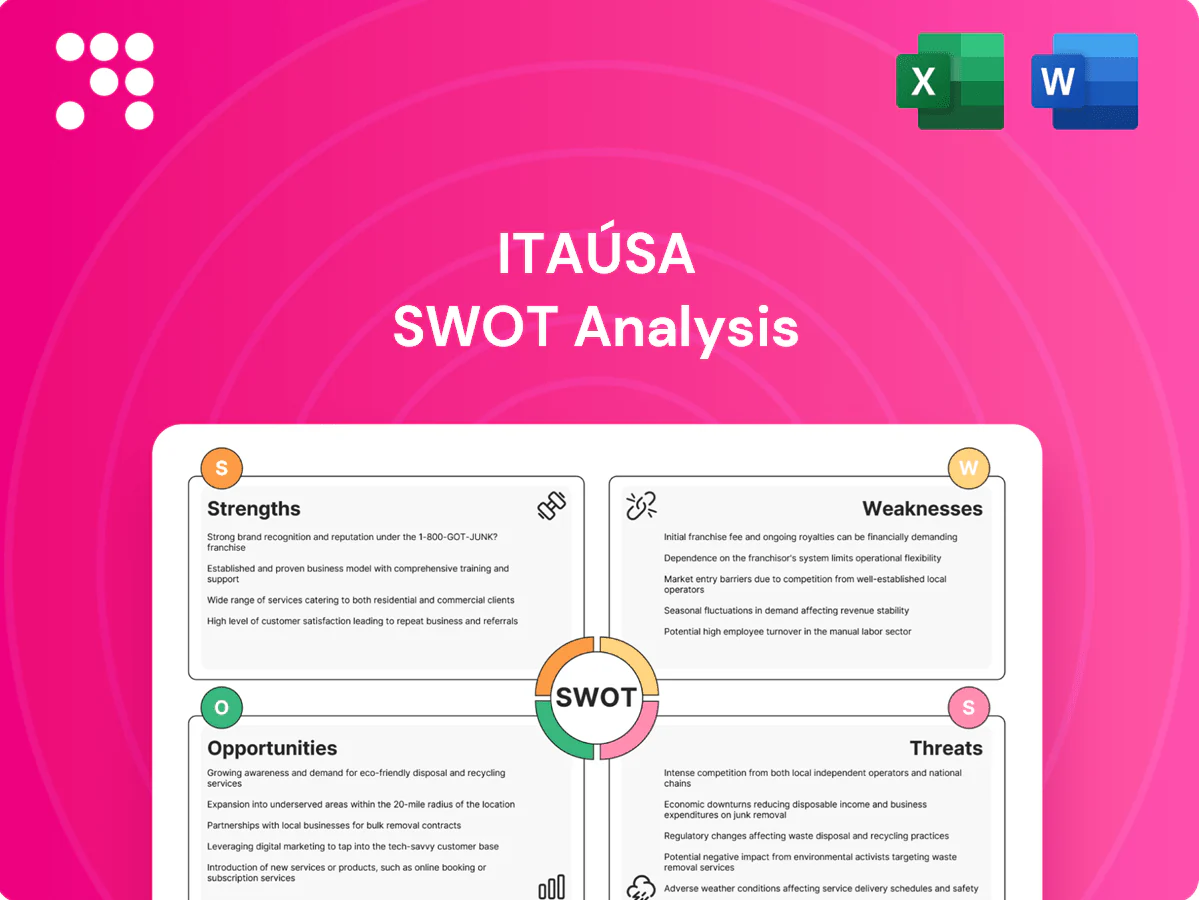
Itaúsa SWOT Analysis

Elevate Your Analysis with the Complete SWOT Report
Itaúsa’s diversified holdings, strong governance and cash-generation underpin resilience, while exposure to Brazilian macro risk and concentrated financial assets present clear vulnerabilities. Opportunities in digital banking and portfolio optimization could drive long-term value. Purchase the full SWOT analysis for a detailed, editable report to inform investing and strategy.
Strengths

Anchor stake in Itaú Unibanco
Itaúsa’s core holding in Itaú Unibanco, one of Latin America’s largest banks with assets above BRL 2 trillion, delivers scale, stable earnings and regular dividends. The bank’s diversified retail, corporate and wealth franchise reduces cyclicality. Strong profitability (ROE around high-teens) and solid capital buffers (CET1 comfortably above minimums) underpin predictable cash flows and bolster investor and counterparty confidence.
Diversified sector exposure
Diversified holdings across four core sectors — banking (Itaú Unibanco), industrials (Duratex/Dexco), consumer (Alpargatas) and sanitation (Aegea) — spread risk and reduce reliance on any single cycle. Different sector dynamics partially offset each other, smoothing consolidated cash generation and supporting resilience through downturns. Exposure to essential services like water enhances defensive cash flow. Diversification also creates optionality for capital rotation between businesses.

Robust governance and stewardship
Itaúsa, one of Brazil's largest investment holdings and the principal shareholder of Itaú Unibanco, demonstrates a track record of active ownership and disciplined capital allocation, directing capital toward high-return opportunities while preserving liquidity. Its board promotes governance best practices across investees, aligning strategy and risk control to support value creation with minimal operational burden. This stewardship mitigates downside risk and sustains long-term compounding for shareholders.

Strong dividend track record
Itaúsa’s large, long-standing stake in Itaú Unibanco and holdings in mature industrial assets deliver recurring dividends, underpinning predictable cash payouts to shareholders; Itaúsa held roughly 38% of Itaú Unibanco and significant Duratex exposure as of mid‑2024.
The group’s balanced dividend policy attracts income-focused investors and helps lower cost of capital, while regular cash returns enforce capital discipline and preserve dry powder for selective reinvestment.
- Recurring dividends from Itaú Unibanco and mature assets
- Balanced policy lowers cost of capital
- Cash returns impose management discipline
- Preserves cash for selective reinvestment
Local market insight and partnerships
Itaúsa leverages a deep Brazilian network—anchored by its strategic stake in Brazil's largest private bank—to source, diligence and influence deals locally, particularly in regulated sectors like sanitation where political and regulatory knowledge is critical. Its co-investment capacity expands deal flow and lets Itaúsa share risk with partners, a model difficult for foreign-only capital to replicate.
- Local sourcing and influence
- Regulatory and political expertise in sanitation
- Co-investment risk-sharing
Holding's 38% stake in Brazil's top bank (>BRL 2tn assets) fuels stable dividends
Itaúsa’s core stake in Itaú Unibanco (assets > BRL 2 trillion) supplies scale, stable earnings and steady dividends. Diversified holdings across banking, industrials, consumer and sanitation reduce cyclicality and enable capital rotation. Active ownership and disciplined allocation support recurring payouts; Itaúsa held roughly 38% of Itaú Unibanco as of mid‑2024.
| Metric | Value |
|---|---|
| Itaú Unibanco assets | > BRL 2 tn |
| Itaúsa stake | ~38% (mid‑2024) |
| CET1 / ROE | ~13.5% / high‑teens |
What is included in the product
 Detailed Word Document
Delivers a strategic overview of Itaúsa’s internal and external business factors, outlining strengths, weaknesses, opportunities, and threats to assess its competitive position and growth prospects.

 Customizable Excel Spreadsheet
Provides a concise, visual SWOT matrix tailored to Itaúsa for rapid strategy alignment and executive briefings; editable format enables quick updates to reflect changing market conditions and portfolio priorities.
Weaknesses

Banking concentration risk
Earnings and dividends remain heavily tied to Itaú Unibanco, Itaúsa’s largest asset, exposing the holding to the bank’s performance. Banking is cyclical and sensitive to credit cycles, interest rates, and regulatory shifts, raising volatility in distributable cash. Stress at the bank would compress Itaúsa’s cash flow and valuation and can overshadow contributions from its industrial and nonbank portfolio.
Minority positions limit control
Itaúsa holds minority stakes (commonly below 50%) in key investees, so it cannot unilaterally impose rapid strategic shifts; execution depends on partner alignment and independent boards. Turnaround timelines therefore tend to be longer than for wholly owned platforms, which can postpone value realization even when investment theses are clear.

Brazil macro and political exposure
Itaúsa’s portfolio remains highly tied to Brazil’s macro cycle—GDP growth (~3% in 2024), inflation and policy moves—raising earnings volatility. Shifts in fiscal stance, tax rules or privatization agendas can materially affect asset valuations and cash flows. Consumer demand and credit quality track employment (unemployment ~7.8% in 2024) and real wages, while country risk (EMBI ~250bp) elevates required returns and valuation discounts.

Conglomerate/holding company discount
FX translation risk
BRL volatility erodes USD/EUR-based investors’ returns—since 2020 BRL has swung roughly 30% versus the dollar, often swamping operating improvements in reported results. Hedging at the holdco level is costly and imperfect, with typical synthetic hedges adding 2–3% annual costs. Currency swings also compress valuation multiples and can raise the cost or limit access to foreign capital.
- FX impact on returns: BRL ±30% since 2020
- Hedging cost: ~2–3% p.a.
- Valuation & capital access: multipliers sensitive to FX
Holding concentrated in major bank — dividends tied to banking cycles, FX and sovereign risk
Itaúsa is highly concentrated in Itaú Unibanco, tying dividends to banking cycles; a stress at the bank would sharply hit cash flow. Minority stakes limit control and delay turnarounds; portfolio is Brazil‑centric (GDP ~3% 2024, unemployment ~7.8%), raising cyclicality and EMBI ~250bp risk. Market discount remains ~30% (2024); BRL ±30% vs USD since 2020; hedging costs ~2–3% p.a.
| Metric | Value |
|---|---|
| Holding discount (2024) | ~30% |
| Brazil GDP (2024) | ~3% |
| Unemployment (2024) | ~7.8% |
| EMBI (2024) | ~250bp |
| BRL vs USD since 2020 | ±30% |
| Hedging cost | 2–3% p.a. |
What You See Is What You Get
Itaúsa SWOT Analysis
This is the actual Itaúsa SWOT analysis document you’ll receive upon purchase—no surprises, just professional quality. The preview below is taken directly from the full SWOT report you'll get, and the complete, editable version is unlocked after checkout. Buy now to access the entire, detailed analysis ready for use.

Elevate Your Analysis with the Complete SWOT Report
Itaúsa’s diversified holdings, strong governance and cash-generation underpin resilience, while exposure to Brazilian macro risk and concentrated financial assets present clear vulnerabilities. Opportunities in digital banking and portfolio optimization could drive long-term value. Purchase the full SWOT analysis for a detailed, editable report to inform investing and strategy.
Strengths
Anchor stake in Itaú Unibanco
Itaúsa’s core holding in Itaú Unibanco, one of Latin America’s largest banks with assets above BRL 2 trillion, delivers scale, stable earnings and regular dividends. The bank’s diversified retail, corporate and wealth franchise reduces cyclicality. Strong profitability (ROE around high-teens) and solid capital buffers (CET1 comfortably above minimums) underpin predictable cash flows and bolster investor and counterparty confidence.
Diversified sector exposure
Diversified holdings across four core sectors — banking (Itaú Unibanco), industrials (Duratex/Dexco), consumer (Alpargatas) and sanitation (Aegea) — spread risk and reduce reliance on any single cycle. Different sector dynamics partially offset each other, smoothing consolidated cash generation and supporting resilience through downturns. Exposure to essential services like water enhances defensive cash flow. Diversification also creates optionality for capital rotation between businesses.
Robust governance and stewardship
Itaúsa, one of Brazil's largest investment holdings and the principal shareholder of Itaú Unibanco, demonstrates a track record of active ownership and disciplined capital allocation, directing capital toward high-return opportunities while preserving liquidity. Its board promotes governance best practices across investees, aligning strategy and risk control to support value creation with minimal operational burden. This stewardship mitigates downside risk and sustains long-term compounding for shareholders.
Strong dividend track record
Itaúsa’s large, long-standing stake in Itaú Unibanco and holdings in mature industrial assets deliver recurring dividends, underpinning predictable cash payouts to shareholders; Itaúsa held roughly 38% of Itaú Unibanco and significant Duratex exposure as of mid‑2024.
The group’s balanced dividend policy attracts income-focused investors and helps lower cost of capital, while regular cash returns enforce capital discipline and preserve dry powder for selective reinvestment.
- Recurring dividends from Itaú Unibanco and mature assets
- Balanced policy lowers cost of capital
- Cash returns impose management discipline
- Preserves cash for selective reinvestment
Local market insight and partnerships
Itaúsa leverages a deep Brazilian network—anchored by its strategic stake in Brazil's largest private bank—to source, diligence and influence deals locally, particularly in regulated sectors like sanitation where political and regulatory knowledge is critical. Its co-investment capacity expands deal flow and lets Itaúsa share risk with partners, a model difficult for foreign-only capital to replicate.
- Local sourcing and influence
- Regulatory and political expertise in sanitation
- Co-investment risk-sharing
Holding's 38% stake in Brazil's top bank (>BRL 2tn assets) fuels stable dividends
Itaúsa’s core stake in Itaú Unibanco (assets > BRL 2 trillion) supplies scale, stable earnings and steady dividends. Diversified holdings across banking, industrials, consumer and sanitation reduce cyclicality and enable capital rotation. Active ownership and disciplined allocation support recurring payouts; Itaúsa held roughly 38% of Itaú Unibanco as of mid‑2024.
| Metric | Value |
|---|---|
| Itaú Unibanco assets | > BRL 2 tn |
| Itaúsa stake | ~38% (mid‑2024) |
| CET1 / ROE | ~13.5% / high‑teens |
What is included in the product
Detailed Word Document
Delivers a strategic overview of Itaúsa’s internal and external business factors, outlining strengths, weaknesses, opportunities, and threats to assess its competitive position and growth prospects.
Customizable Excel Spreadsheet
Provides a concise, visual SWOT matrix tailored to Itaúsa for rapid strategy alignment and executive briefings; editable format enables quick updates to reflect changing market conditions and portfolio priorities.
Weaknesses
Banking concentration risk
Earnings and dividends remain heavily tied to Itaú Unibanco, Itaúsa’s largest asset, exposing the holding to the bank’s performance. Banking is cyclical and sensitive to credit cycles, interest rates, and regulatory shifts, raising volatility in distributable cash. Stress at the bank would compress Itaúsa’s cash flow and valuation and can overshadow contributions from its industrial and nonbank portfolio.
Minority positions limit control
Itaúsa holds minority stakes (commonly below 50%) in key investees, so it cannot unilaterally impose rapid strategic shifts; execution depends on partner alignment and independent boards. Turnaround timelines therefore tend to be longer than for wholly owned platforms, which can postpone value realization even when investment theses are clear.
Brazil macro and political exposure
Itaúsa’s portfolio remains highly tied to Brazil’s macro cycle—GDP growth (~3% in 2024), inflation and policy moves—raising earnings volatility. Shifts in fiscal stance, tax rules or privatization agendas can materially affect asset valuations and cash flows. Consumer demand and credit quality track employment (unemployment ~7.8% in 2024) and real wages, while country risk (EMBI ~250bp) elevates required returns and valuation discounts.
Conglomerate/holding company discount
FX translation risk
BRL volatility erodes USD/EUR-based investors’ returns—since 2020 BRL has swung roughly 30% versus the dollar, often swamping operating improvements in reported results. Hedging at the holdco level is costly and imperfect, with typical synthetic hedges adding 2–3% annual costs. Currency swings also compress valuation multiples and can raise the cost or limit access to foreign capital.
- FX impact on returns: BRL ±30% since 2020
- Hedging cost: ~2–3% p.a.
- Valuation & capital access: multipliers sensitive to FX
Holding concentrated in major bank — dividends tied to banking cycles, FX and sovereign risk
Itaúsa is highly concentrated in Itaú Unibanco, tying dividends to banking cycles; a stress at the bank would sharply hit cash flow. Minority stakes limit control and delay turnarounds; portfolio is Brazil‑centric (GDP ~3% 2024, unemployment ~7.8%), raising cyclicality and EMBI ~250bp risk. Market discount remains ~30% (2024); BRL ±30% vs USD since 2020; hedging costs ~2–3% p.a.
| Metric | Value |
|---|---|
| Holding discount (2024) | ~30% |
| Brazil GDP (2024) | ~3% |
| Unemployment (2024) | ~7.8% |
| EMBI (2024) | ~250bp |
| BRL vs USD since 2020 | ±30% |
| Hedging cost | 2–3% p.a. |
What You See Is What You Get
Itaúsa SWOT Analysis
This is the actual Itaúsa SWOT analysis document you’ll receive upon purchase—no surprises, just professional quality. The preview below is taken directly from the full SWOT report you'll get, and the complete, editable version is unlocked after checkout. Buy now to access the entire, detailed analysis ready for use.
Description
Elevate Your Analysis with the Complete SWOT Report
Itaúsa’s diversified holdings, strong governance and cash-generation underpin resilience, while exposure to Brazilian macro risk and concentrated financial assets present clear vulnerabilities. Opportunities in digital banking and portfolio optimization could drive long-term value. Purchase the full SWOT analysis for a detailed, editable report to inform investing and strategy.
Strengths
Anchor stake in Itaú Unibanco
Itaúsa’s core holding in Itaú Unibanco, one of Latin America’s largest banks with assets above BRL 2 trillion, delivers scale, stable earnings and regular dividends. The bank’s diversified retail, corporate and wealth franchise reduces cyclicality. Strong profitability (ROE around high-teens) and solid capital buffers (CET1 comfortably above minimums) underpin predictable cash flows and bolster investor and counterparty confidence.
Diversified sector exposure
Diversified holdings across four core sectors — banking (Itaú Unibanco), industrials (Duratex/Dexco), consumer (Alpargatas) and sanitation (Aegea) — spread risk and reduce reliance on any single cycle. Different sector dynamics partially offset each other, smoothing consolidated cash generation and supporting resilience through downturns. Exposure to essential services like water enhances defensive cash flow. Diversification also creates optionality for capital rotation between businesses.
Robust governance and stewardship
Itaúsa, one of Brazil's largest investment holdings and the principal shareholder of Itaú Unibanco, demonstrates a track record of active ownership and disciplined capital allocation, directing capital toward high-return opportunities while preserving liquidity. Its board promotes governance best practices across investees, aligning strategy and risk control to support value creation with minimal operational burden. This stewardship mitigates downside risk and sustains long-term compounding for shareholders.
Strong dividend track record
Itaúsa’s large, long-standing stake in Itaú Unibanco and holdings in mature industrial assets deliver recurring dividends, underpinning predictable cash payouts to shareholders; Itaúsa held roughly 38% of Itaú Unibanco and significant Duratex exposure as of mid‑2024.
The group’s balanced dividend policy attracts income-focused investors and helps lower cost of capital, while regular cash returns enforce capital discipline and preserve dry powder for selective reinvestment.
- Recurring dividends from Itaú Unibanco and mature assets
- Balanced policy lowers cost of capital
- Cash returns impose management discipline
- Preserves cash for selective reinvestment
Local market insight and partnerships
Itaúsa leverages a deep Brazilian network—anchored by its strategic stake in Brazil's largest private bank—to source, diligence and influence deals locally, particularly in regulated sectors like sanitation where political and regulatory knowledge is critical. Its co-investment capacity expands deal flow and lets Itaúsa share risk with partners, a model difficult for foreign-only capital to replicate.
- Local sourcing and influence
- Regulatory and political expertise in sanitation
- Co-investment risk-sharing
Holding's 38% stake in Brazil's top bank (>BRL 2tn assets) fuels stable dividends
Itaúsa’s core stake in Itaú Unibanco (assets > BRL 2 trillion) supplies scale, stable earnings and steady dividends. Diversified holdings across banking, industrials, consumer and sanitation reduce cyclicality and enable capital rotation. Active ownership and disciplined allocation support recurring payouts; Itaúsa held roughly 38% of Itaú Unibanco as of mid‑2024.
| Metric | Value |
|---|---|
| Itaú Unibanco assets | > BRL 2 tn |
| Itaúsa stake | ~38% (mid‑2024) |
| CET1 / ROE | ~13.5% / high‑teens |
What is included in the product
Detailed Word Document
Delivers a strategic overview of Itaúsa’s internal and external business factors, outlining strengths, weaknesses, opportunities, and threats to assess its competitive position and growth prospects.
Customizable Excel Spreadsheet
Provides a concise, visual SWOT matrix tailored to Itaúsa for rapid strategy alignment and executive briefings; editable format enables quick updates to reflect changing market conditions and portfolio priorities.
Weaknesses
Banking concentration risk
Earnings and dividends remain heavily tied to Itaú Unibanco, Itaúsa’s largest asset, exposing the holding to the bank’s performance. Banking is cyclical and sensitive to credit cycles, interest rates, and regulatory shifts, raising volatility in distributable cash. Stress at the bank would compress Itaúsa’s cash flow and valuation and can overshadow contributions from its industrial and nonbank portfolio.
Minority positions limit control
Itaúsa holds minority stakes (commonly below 50%) in key investees, so it cannot unilaterally impose rapid strategic shifts; execution depends on partner alignment and independent boards. Turnaround timelines therefore tend to be longer than for wholly owned platforms, which can postpone value realization even when investment theses are clear.
Brazil macro and political exposure
Itaúsa’s portfolio remains highly tied to Brazil’s macro cycle—GDP growth (~3% in 2024), inflation and policy moves—raising earnings volatility. Shifts in fiscal stance, tax rules or privatization agendas can materially affect asset valuations and cash flows. Consumer demand and credit quality track employment (unemployment ~7.8% in 2024) and real wages, while country risk (EMBI ~250bp) elevates required returns and valuation discounts.
Conglomerate/holding company discount
FX translation risk
BRL volatility erodes USD/EUR-based investors’ returns—since 2020 BRL has swung roughly 30% versus the dollar, often swamping operating improvements in reported results. Hedging at the holdco level is costly and imperfect, with typical synthetic hedges adding 2–3% annual costs. Currency swings also compress valuation multiples and can raise the cost or limit access to foreign capital.
- FX impact on returns: BRL ±30% since 2020
- Hedging cost: ~2–3% p.a.
- Valuation & capital access: multipliers sensitive to FX
Holding concentrated in major bank — dividends tied to banking cycles, FX and sovereign risk
Itaúsa is highly concentrated in Itaú Unibanco, tying dividends to banking cycles; a stress at the bank would sharply hit cash flow. Minority stakes limit control and delay turnarounds; portfolio is Brazil‑centric (GDP ~3% 2024, unemployment ~7.8%), raising cyclicality and EMBI ~250bp risk. Market discount remains ~30% (2024); BRL ±30% vs USD since 2020; hedging costs ~2–3% p.a.
| Metric | Value |
|---|---|
| Holding discount (2024) | ~30% |
| Brazil GDP (2024) | ~3% |
| Unemployment (2024) | ~7.8% |
| EMBI (2024) | ~250bp |
| BRL vs USD since 2020 | ±30% |
| Hedging cost | 2–3% p.a. |
What You See Is What You Get
Itaúsa SWOT Analysis
This is the actual Itaúsa SWOT analysis document you’ll receive upon purchase—no surprises, just professional quality. The preview below is taken directly from the full SWOT report you'll get, and the complete, editable version is unlocked after checkout. Buy now to access the entire, detailed analysis ready for use.











