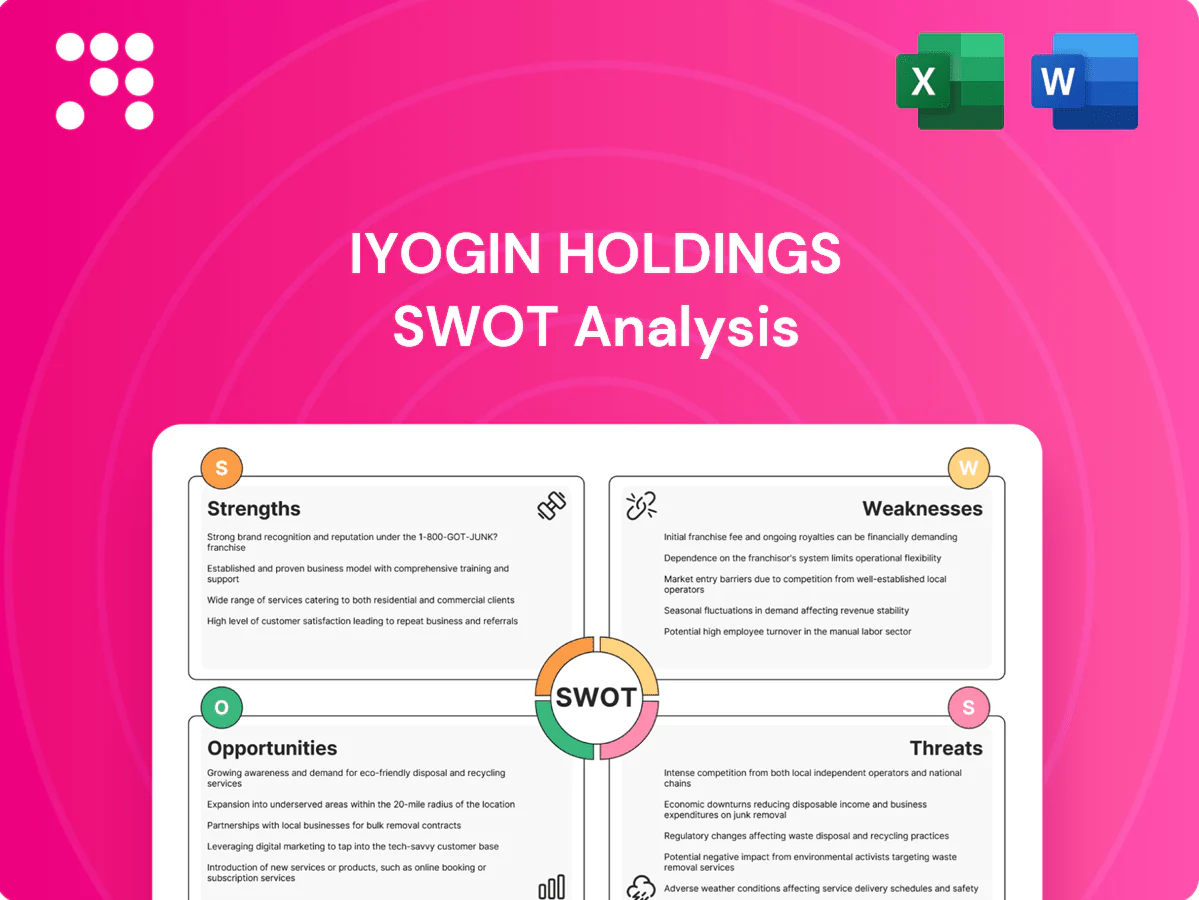
Iyogin Holdings SWOT Analysis

Make Insightful Decisions Backed by Expert Research
Our Iyogin Holdings SWOT snapshot highlights robust core strengths, exposure to market-specific weaknesses, promising growth opportunities, and key external threats shaping strategy. Want deeper, research-backed insights and tactical recommendations? Purchase the full, editable SWOT (Word + Excel) to strategize, pitch, or invest with confidence.
Strengths

Strong regional franchise
Iyo Bank’s deep roots in Ehime and Shikoku generate strong trust and high local brand recognition, driving stable retail and SME deposit flows. Long-standing ties with households and small businesses underpin customer retention and steady referral streams. That embedded position also yields superior insight into regional credit dynamics, improving underwriting and portfolio stability.
Diversified financial services
Diversified financial services across leasing, cards and group solutions complement core banking by creating multiple revenue streams that smooth earnings through cycles. Cross-entity referrals raise wallet share per client, increasing lifetime value and retention. Broad product breadth strengthens local competitive differentiation by meeting varied client needs.

Stable, granular deposit base
Retail and SME customers underpin a low-cost funding profile through steady deposits, while a granular deposit mix reduces reliance on volatile wholesale markets and enhances liquidity resilience under stress, supporting steady loan growth in core segments such as retail and SME lending.

Conservative risk culture
Regional banks in Japan emphasize prudent underwriting, with disciplined credit selection that kept regional NPLs near 0.7% in 2024, limiting severe loss volatility and protecting earnings stability. Well-established risk controls and compliance frameworks—reflected in average CET1-like capital buffers above industry minimums—support capital preservation. This conservative risk culture underpins stakeholder confidence and funding resilience.
- Prudent underwriting
- 0.7% regional NPLs (2024)
- Disciplined credit selection
- Robust risk controls & compliance
Local knowledge and networks
Proximity to customers enables Iyogin Holdings to deliver tailored solutions and faster claim resolution, while deep knowledge of regional industries strengthens underwriting accuracy and advisory services; community ties facilitate public–private initiatives that unlock niche growth opportunities.
Ehime/Shikoku regional bank: stable retail/SME deposits, diversified fees, NPLs 0.7% (2024)
Iyo Bank’s deep regional brand in Ehime/Shikoku drives stable retail and SME deposits and high customer retention. Diversified services (leasing, cards, group solutions) create multiple revenue streams and raise wallet share. Prudent underwriting kept regional NPLs at 0.7% in 2024, supporting earnings stability.
| Metric | Value |
|---|---|
| Regional NPLs (2024) | 0.7% |
What is included in the product
 Detailed Word Document
Provides a concise SWOT overview of Iyogin Holdings, outlining internal strengths and weaknesses alongside external opportunities and threats to assess competitive positioning and strategic risks.

 Customizable Excel Spreadsheet
Provides a concise SWOT matrix that quickly surfaces Iyogin Holdings' strengths, weaknesses, opportunities and threats to relieve strategic uncertainty; editable, visual format enables fast stakeholder alignment and easy integration into reports and presentations.
Weaknesses

Geographic concentration
Revenue and credit exposure are concentrated in Ehime and broader Shikoku (Ehime population ~1.22 million; Shikoku ~3.7 million), so local economic shocks or sector declines can disproportionately affect results. Limited national footprint curtails diversification benefits and heightens dependence on regional cycles and demographic trends.
Thin net interest margins
Japan’s low-rate legacy and gradual BOJ tightening (policy rate near 0.5% by 2024–25) keeps lending spreads thin, with Japanese banks’ average net interest margin around 0.6% in 2024; Iyogin’s profitability must rely on higher loan volumes and fee income to offset slim spreads, constraining reinvestment capacity and heightening sensitivity to shifts in funding mix and rising deposit costs.

Aging customer demographics
An aging client base dampens loan demand as older cohorts borrow less; UN World Population Prospects reports the 65+ population was ~727 million in 2020 and is projected to reach ~1.5 billion by 2050, pressuring growth. Deposit mixes may skew to low-cost but rate-sensitive savings, while wealth decumulation shifts needs toward advisory and drawdown products. This undermines long-term customer lifetime value and cross-sell potential.

Smaller scale vs megabanks
Smaller scale raises unit costs for technology and compliance, squeezing margins versus megabanks; top four US banks hold roughly 45% of domestic deposits (FDIC 2024), highlighting scale advantages. Pricing power is weaker against national competitors, talent attraction in niche markets is harder, and this may slow innovation and product rollout.
Legacy IT constraints
Legacy cores limit agility and time-to-market, slowing releases and hindering advanced analytics and personalization; integration across subsidiaries is complex and costly, and about 60% of enterprise IT budgets go to maintenance (Gartner 2024), crowding out digital investment.
- Older cores reduce release velocity
- Subsidiary integration complexity
- ~60% of IT budget to maintenance (Gartner 2024)
- Limits analytics & personalization
Regional bank risk: Ehime/Shikoku concentration, thin margins, aging base, legacy IT drag
Concentrated revenue in Ehime (pop ~1.22M) and Shikoku (~3.7M) raises regional shock risk. Thin lending spreads (Japan bank NIM ~0.6% in 2024) and rising funding costs constrain profitability. Aging client base (Japan 65+ ~29% in 2024) reduces loan demand and cross-sell. Legacy IT ties up ~60% of budgets (Gartner 2024), slowing innovation.
| Metric | Value |
|---|---|
| Ehime population | ~1.22M |
| Shikoku population | ~3.7M |
| Bank NIM (Japan, 2024) | ~0.6% |
| Japan 65+ (2024) | ~29% |
| IT maintenance (Gartner 2024) | ~60% |
Preview Before You Purchase
Iyogin Holdings SWOT Analysis
This is the actual SWOT analysis document you’ll receive upon purchase—no surprises, just professional quality. The preview below is taken directly from the full SWOT report for Iyogin Holdings; purchase unlocks the complete, editable version. You’re viewing a live excerpt now; the entire, structured file becomes available immediately after checkout.

Make Insightful Decisions Backed by Expert Research
Our Iyogin Holdings SWOT snapshot highlights robust core strengths, exposure to market-specific weaknesses, promising growth opportunities, and key external threats shaping strategy. Want deeper, research-backed insights and tactical recommendations? Purchase the full, editable SWOT (Word + Excel) to strategize, pitch, or invest with confidence.
Strengths
Strong regional franchise
Iyo Bank’s deep roots in Ehime and Shikoku generate strong trust and high local brand recognition, driving stable retail and SME deposit flows. Long-standing ties with households and small businesses underpin customer retention and steady referral streams. That embedded position also yields superior insight into regional credit dynamics, improving underwriting and portfolio stability.
Diversified financial services
Diversified financial services across leasing, cards and group solutions complement core banking by creating multiple revenue streams that smooth earnings through cycles. Cross-entity referrals raise wallet share per client, increasing lifetime value and retention. Broad product breadth strengthens local competitive differentiation by meeting varied client needs.
Stable, granular deposit base
Retail and SME customers underpin a low-cost funding profile through steady deposits, while a granular deposit mix reduces reliance on volatile wholesale markets and enhances liquidity resilience under stress, supporting steady loan growth in core segments such as retail and SME lending.
Conservative risk culture
Regional banks in Japan emphasize prudent underwriting, with disciplined credit selection that kept regional NPLs near 0.7% in 2024, limiting severe loss volatility and protecting earnings stability. Well-established risk controls and compliance frameworks—reflected in average CET1-like capital buffers above industry minimums—support capital preservation. This conservative risk culture underpins stakeholder confidence and funding resilience.
- Prudent underwriting
- 0.7% regional NPLs (2024)
- Disciplined credit selection
- Robust risk controls & compliance
Local knowledge and networks
Proximity to customers enables Iyogin Holdings to deliver tailored solutions and faster claim resolution, while deep knowledge of regional industries strengthens underwriting accuracy and advisory services; community ties facilitate public–private initiatives that unlock niche growth opportunities.
Ehime/Shikoku regional bank: stable retail/SME deposits, diversified fees, NPLs 0.7% (2024)
Iyo Bank’s deep regional brand in Ehime/Shikoku drives stable retail and SME deposits and high customer retention. Diversified services (leasing, cards, group solutions) create multiple revenue streams and raise wallet share. Prudent underwriting kept regional NPLs at 0.7% in 2024, supporting earnings stability.
| Metric | Value |
|---|---|
| Regional NPLs (2024) | 0.7% |
What is included in the product
Detailed Word Document
Provides a concise SWOT overview of Iyogin Holdings, outlining internal strengths and weaknesses alongside external opportunities and threats to assess competitive positioning and strategic risks.
Customizable Excel Spreadsheet
Provides a concise SWOT matrix that quickly surfaces Iyogin Holdings' strengths, weaknesses, opportunities and threats to relieve strategic uncertainty; editable, visual format enables fast stakeholder alignment and easy integration into reports and presentations.
Weaknesses
Geographic concentration
Revenue and credit exposure are concentrated in Ehime and broader Shikoku (Ehime population ~1.22 million; Shikoku ~3.7 million), so local economic shocks or sector declines can disproportionately affect results. Limited national footprint curtails diversification benefits and heightens dependence on regional cycles and demographic trends.
Thin net interest margins
Japan’s low-rate legacy and gradual BOJ tightening (policy rate near 0.5% by 2024–25) keeps lending spreads thin, with Japanese banks’ average net interest margin around 0.6% in 2024; Iyogin’s profitability must rely on higher loan volumes and fee income to offset slim spreads, constraining reinvestment capacity and heightening sensitivity to shifts in funding mix and rising deposit costs.
Aging customer demographics
An aging client base dampens loan demand as older cohorts borrow less; UN World Population Prospects reports the 65+ population was ~727 million in 2020 and is projected to reach ~1.5 billion by 2050, pressuring growth. Deposit mixes may skew to low-cost but rate-sensitive savings, while wealth decumulation shifts needs toward advisory and drawdown products. This undermines long-term customer lifetime value and cross-sell potential.
Smaller scale vs megabanks
Smaller scale raises unit costs for technology and compliance, squeezing margins versus megabanks; top four US banks hold roughly 45% of domestic deposits (FDIC 2024), highlighting scale advantages. Pricing power is weaker against national competitors, talent attraction in niche markets is harder, and this may slow innovation and product rollout.
Legacy IT constraints
Legacy cores limit agility and time-to-market, slowing releases and hindering advanced analytics and personalization; integration across subsidiaries is complex and costly, and about 60% of enterprise IT budgets go to maintenance (Gartner 2024), crowding out digital investment.
- Older cores reduce release velocity
- Subsidiary integration complexity
- ~60% of IT budget to maintenance (Gartner 2024)
- Limits analytics & personalization
Regional bank risk: Ehime/Shikoku concentration, thin margins, aging base, legacy IT drag
Concentrated revenue in Ehime (pop ~1.22M) and Shikoku (~3.7M) raises regional shock risk. Thin lending spreads (Japan bank NIM ~0.6% in 2024) and rising funding costs constrain profitability. Aging client base (Japan 65+ ~29% in 2024) reduces loan demand and cross-sell. Legacy IT ties up ~60% of budgets (Gartner 2024), slowing innovation.
| Metric | Value |
|---|---|
| Ehime population | ~1.22M |
| Shikoku population | ~3.7M |
| Bank NIM (Japan, 2024) | ~0.6% |
| Japan 65+ (2024) | ~29% |
| IT maintenance (Gartner 2024) | ~60% |
Preview Before You Purchase
Iyogin Holdings SWOT Analysis
This is the actual SWOT analysis document you’ll receive upon purchase—no surprises, just professional quality. The preview below is taken directly from the full SWOT report for Iyogin Holdings; purchase unlocks the complete, editable version. You’re viewing a live excerpt now; the entire, structured file becomes available immediately after checkout.
Description
Make Insightful Decisions Backed by Expert Research
Our Iyogin Holdings SWOT snapshot highlights robust core strengths, exposure to market-specific weaknesses, promising growth opportunities, and key external threats shaping strategy. Want deeper, research-backed insights and tactical recommendations? Purchase the full, editable SWOT (Word + Excel) to strategize, pitch, or invest with confidence.
Strengths
Strong regional franchise
Iyo Bank’s deep roots in Ehime and Shikoku generate strong trust and high local brand recognition, driving stable retail and SME deposit flows. Long-standing ties with households and small businesses underpin customer retention and steady referral streams. That embedded position also yields superior insight into regional credit dynamics, improving underwriting and portfolio stability.
Diversified financial services
Diversified financial services across leasing, cards and group solutions complement core banking by creating multiple revenue streams that smooth earnings through cycles. Cross-entity referrals raise wallet share per client, increasing lifetime value and retention. Broad product breadth strengthens local competitive differentiation by meeting varied client needs.
Stable, granular deposit base
Retail and SME customers underpin a low-cost funding profile through steady deposits, while a granular deposit mix reduces reliance on volatile wholesale markets and enhances liquidity resilience under stress, supporting steady loan growth in core segments such as retail and SME lending.
Conservative risk culture
Regional banks in Japan emphasize prudent underwriting, with disciplined credit selection that kept regional NPLs near 0.7% in 2024, limiting severe loss volatility and protecting earnings stability. Well-established risk controls and compliance frameworks—reflected in average CET1-like capital buffers above industry minimums—support capital preservation. This conservative risk culture underpins stakeholder confidence and funding resilience.
- Prudent underwriting
- 0.7% regional NPLs (2024)
- Disciplined credit selection
- Robust risk controls & compliance
Local knowledge and networks
Proximity to customers enables Iyogin Holdings to deliver tailored solutions and faster claim resolution, while deep knowledge of regional industries strengthens underwriting accuracy and advisory services; community ties facilitate public–private initiatives that unlock niche growth opportunities.
Ehime/Shikoku regional bank: stable retail/SME deposits, diversified fees, NPLs 0.7% (2024)
Iyo Bank’s deep regional brand in Ehime/Shikoku drives stable retail and SME deposits and high customer retention. Diversified services (leasing, cards, group solutions) create multiple revenue streams and raise wallet share. Prudent underwriting kept regional NPLs at 0.7% in 2024, supporting earnings stability.
| Metric | Value |
|---|---|
| Regional NPLs (2024) | 0.7% |
What is included in the product
Detailed Word Document
Provides a concise SWOT overview of Iyogin Holdings, outlining internal strengths and weaknesses alongside external opportunities and threats to assess competitive positioning and strategic risks.
Customizable Excel Spreadsheet
Provides a concise SWOT matrix that quickly surfaces Iyogin Holdings' strengths, weaknesses, opportunities and threats to relieve strategic uncertainty; editable, visual format enables fast stakeholder alignment and easy integration into reports and presentations.
Weaknesses
Geographic concentration
Revenue and credit exposure are concentrated in Ehime and broader Shikoku (Ehime population ~1.22 million; Shikoku ~3.7 million), so local economic shocks or sector declines can disproportionately affect results. Limited national footprint curtails diversification benefits and heightens dependence on regional cycles and demographic trends.
Thin net interest margins
Japan’s low-rate legacy and gradual BOJ tightening (policy rate near 0.5% by 2024–25) keeps lending spreads thin, with Japanese banks’ average net interest margin around 0.6% in 2024; Iyogin’s profitability must rely on higher loan volumes and fee income to offset slim spreads, constraining reinvestment capacity and heightening sensitivity to shifts in funding mix and rising deposit costs.
Aging customer demographics
An aging client base dampens loan demand as older cohorts borrow less; UN World Population Prospects reports the 65+ population was ~727 million in 2020 and is projected to reach ~1.5 billion by 2050, pressuring growth. Deposit mixes may skew to low-cost but rate-sensitive savings, while wealth decumulation shifts needs toward advisory and drawdown products. This undermines long-term customer lifetime value and cross-sell potential.
Smaller scale vs megabanks
Smaller scale raises unit costs for technology and compliance, squeezing margins versus megabanks; top four US banks hold roughly 45% of domestic deposits (FDIC 2024), highlighting scale advantages. Pricing power is weaker against national competitors, talent attraction in niche markets is harder, and this may slow innovation and product rollout.
Legacy IT constraints
Legacy cores limit agility and time-to-market, slowing releases and hindering advanced analytics and personalization; integration across subsidiaries is complex and costly, and about 60% of enterprise IT budgets go to maintenance (Gartner 2024), crowding out digital investment.
- Older cores reduce release velocity
- Subsidiary integration complexity
- ~60% of IT budget to maintenance (Gartner 2024)
- Limits analytics & personalization
Regional bank risk: Ehime/Shikoku concentration, thin margins, aging base, legacy IT drag
Concentrated revenue in Ehime (pop ~1.22M) and Shikoku (~3.7M) raises regional shock risk. Thin lending spreads (Japan bank NIM ~0.6% in 2024) and rising funding costs constrain profitability. Aging client base (Japan 65+ ~29% in 2024) reduces loan demand and cross-sell. Legacy IT ties up ~60% of budgets (Gartner 2024), slowing innovation.
| Metric | Value |
|---|---|
| Ehime population | ~1.22M |
| Shikoku population | ~3.7M |
| Bank NIM (Japan, 2024) | ~0.6% |
| Japan 65+ (2024) | ~29% |
| IT maintenance (Gartner 2024) | ~60% |
Preview Before You Purchase
Iyogin Holdings SWOT Analysis
This is the actual SWOT analysis document you’ll receive upon purchase—no surprises, just professional quality. The preview below is taken directly from the full SWOT report for Iyogin Holdings; purchase unlocks the complete, editable version. You’re viewing a live excerpt now; the entire, structured file becomes available immediately after checkout.











