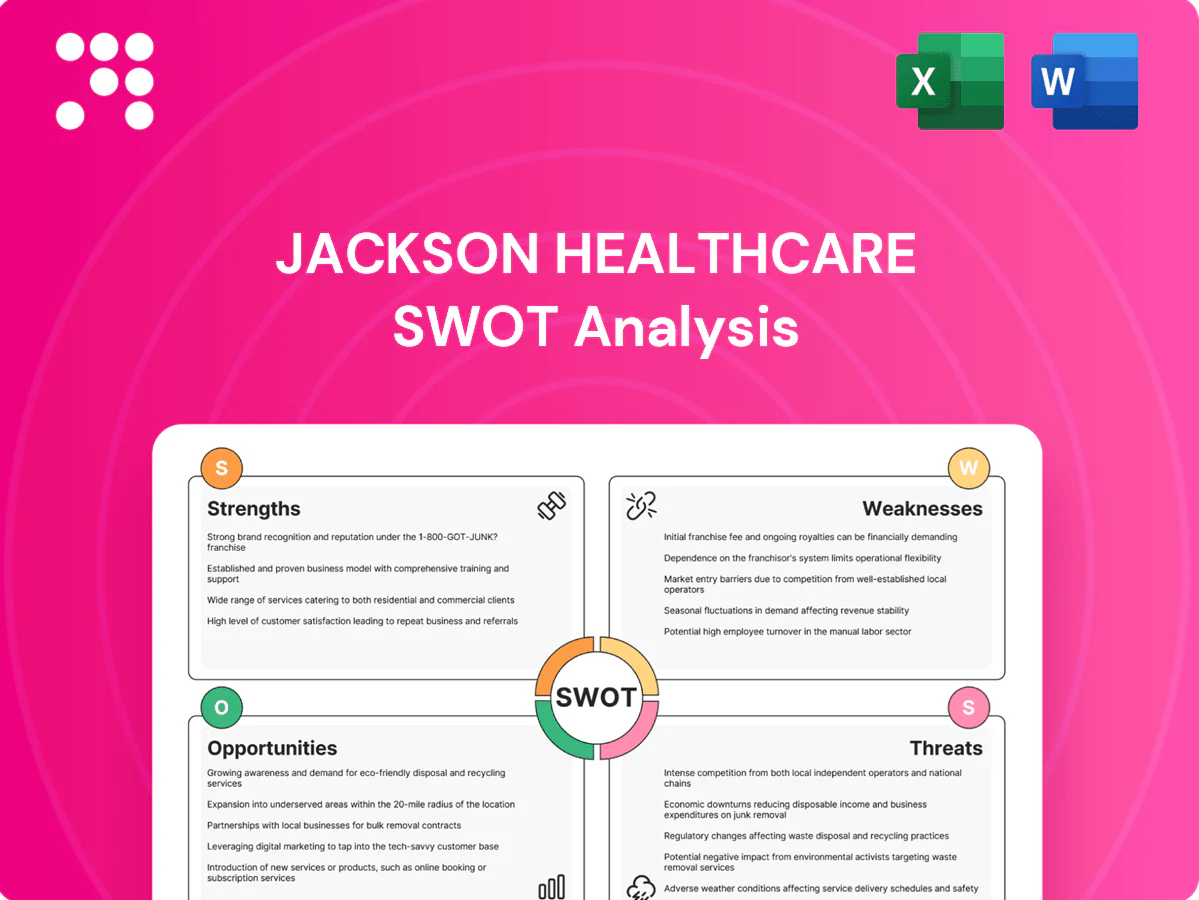
Jackson Healthcare SWOT Analysis

Make Insightful Decisions Backed by Expert Research
Jackson Healthcare's SWOT snapshot highlights a strong market niche in healthcare staffing, tech-enabled services, and steady revenue, but it also faces regulatory challenges, intense competition, and margin pressure. Want deeper strategic, financial, and action-ready insights? Purchase the full SWOT analysis—complete Word and Excel deliverables to plan, pitch, or invest with confidence.
Strengths

Diversified staffing portfolio
Jackson Healthcare’s diversified staffing portfolio spans three talent segments—physicians, nurses, and allied health—reducing dependence on any single labor pool. This breadth enables cross-selling across three main care settings—acute, ambulatory, and long-term—supporting more resilient revenue streams through cycles. Diversification also allows tailored solutions that boost client retention and improve fill rates.
Family of specialized brands
Operating through over 20 specialized brands builds deep domain expertise and credibility across clinician sub-specialties. Specialized units tailor services to clinician and facility needs, improving match quality and retention. This structure enables premium pricing and differentiated positioning. It also accelerates market penetration within sub-specialties.

Integrated tech-enabled solutions
Jackson Healthcare’s in-house technology streamlines sourcing, credentialing and scheduling, supporting over 50,000 clinicians across its platforms. Automation has shortened time-to-fill by about 30% and tightened compliance controls via real-time checks. Rich operational data yields workforce-planning insights that boost clinician engagement and utilization. The tech stack creates meaningful differentiation, raising barriers to entry for competitors.

National client relationships
Jackson Healthcare leverages broad relationships across the US health sector—over 6,000 hospitals and roughly 200,000 ambulatory clinics—creating scale advantages in staffing and services. Enterprise agreements with large health systems produce predictable demand and volume leverage, improving utilization. Strong client references boost RFP win rates, while scale supports deeper candidate pipelines and faster fill times.
- Scale: national coverage
- Predictability: enterprise deals
- Win rates: strong references
- Talent: superior pipelines
Mission-driven culture and reputation
Jackson Healthcare’s healthcare-first ethos builds clinician trust and loyalty, strengthening long-term placements and referral flows. Strong brand equity attracts talent in competitive markets, lowering recruiting friction and time-to-fill. A reputation for clinician-centered service reduces acquisition costs and churn while culture alignment drives higher service quality and improved patient outcomes.
- Clinician trust: increased retention
- Brand equity: competitive hiring edge
- Lower acquisition costs: reduced churn
- Aligned culture: better outcomes
20+ brands manage 50,000+ clinicians; 30% faster fills
Jackson Healthcare scales across over 20 specialized brands and 3 clinician segments, supporting more resilient revenue and premium pricing. Its platforms manage 50,000+ clinicians and serve 6,000+ hospitals and ~200,000 ambulatory clinics, enabling strong pipelines and faster fills. In-house tech cut time-to-fill ~30% and improves compliance and utilization.
| Metric | Value |
|---|---|
| Clinicians managed | 50,000+ |
| Hospitals served | 6,000+ |
| Ambulatory clinics | ~200,000 |
| Brands | 20+ |
| Time-to-fill reduction | ~30% |
What is included in the product
 Detailed Word Document
Delivers a strategic overview of Jackson Healthcare’s internal and external business factors, outlining strengths, weaknesses, opportunities, and threats to assess competitive position, growth drivers, operational gaps, and market risks.

 Customizable Excel Spreadsheet
Provides a focused SWOT matrix for Jackson Healthcare to quickly identify strengths, weaknesses, opportunities, and threats, enabling fast stakeholder alignment and tactical decision-making.
Weaknesses

High exposure to labor cycles
High exposure to labor cycles leaves Jackson Healthcare vulnerable because staffing demand tracks hospital census, budgets and reimbursement; Kaufman Hall reported a median hospital operating margin of -1.6% in 2022, highlighting margin pressure. Volatile demand and seasonal peaks complicate forecasting and can compress utilization and gross margins. Reliance on contingent labor is a structural risk if hospital spending tightens or census falls.
Margin sensitivity to bill-pay spreads
Competitive bidding compresses bill rates while clinician pay has trended upward, so even a 1–3 percentage-point narrowing in bill-pay spread can materially swing operating margin. Overtime, travel stipends and mounting compliance costs add volatility to cost per shift and obscure unit economics. Maintaining price discipline to protect spreads can conflict with fill-rate targets and revenue retention.

Complex compliance burden
Diverse state licensure across 50 states plus DC creates operational friction for Jackson Healthcare, where credentialing and varying clinical requirements increase paperwork and coordination. Errors expose the firm to regulatory penalties and client dissatisfaction. Elevated compliance overhead raises cost-to-serve, while onboarding delays commonly extend time-to-fill by multiple weeks, reducing provider utilization and revenue realization.

Technology investment intensity
Maintaining modern platforms demands continuous capital and specialist talent, yet Jackson Healthcare is privately held so detailed tech CAPEX disclosures are limited. Rapid vendor innovation raises table stakes, forcing frequent platform upgrades. Integrating systems across brands is complex, and legacy processes can cap digital ROI.
- High ongoing capital & talent
- Vendor innovation pressure
- Portfolio integration complexity
- Legacy limits on digital ROI
Talent acquisition bottlenecks
Clinician shortages—AAMC projects a US physician gap of 37,800–124,000 by 2034—limit Jackson Healthcare’s ability to scale even when demand rises.
Candidate sourcing and retention are resource-intensive; AMN and industry surveys show hiring costs and agency spend rose sharply, with clinician wage growth near 5–6% in 2023–24.
High burnout (around 45–50% in recent clinician surveys) and attrition further shrink available supply, compressing fill rates and margin on placements.
- Talent shortage: AAMC 37,800–124,000 by 2034
- Wage pressure: ~5–6% clinician wage growth 2023–24
- Burnout/attrition: ~45–50% clinician burnout rate
- Higher sourcing/retention costs reduce margins
Contingent clinician costs strain margins amid hospital -1.6%, wages +5-6%
Heavy reliance on contingent labor and hospital census ties revenue to volatile margins (median hospital operating margin -1.6% in 2022), while bill-pay spread compression and rising clinician pay (≈5–6% in 2023–24) squeeze margins. Complex multi-state credentialing and compliance raise cost-to-serve and time-to-fill. Clinician supply limits scale (AAMC physician gap 37,800–124,000 by 2034; burnout ~45–50%).
| Metric | Value |
|---|---|
| Hospital margin | -1.6% (2022) |
| Clinician wage growth | ≈5–6% (2023–24) |
| Physician gap | 37,800–124,000 by 2034 (AAMC) |
| Clinician burnout | ≈45–50% |
What You See Is What You Get
Jackson Healthcare SWOT Analysis
This is the actual Jackson Healthcare SWOT analysis document you’ll receive upon purchase—no surprises, just professional quality. The preview below is taken directly from the full SWOT report you'll get, showing real findings and structure. Purchase unlocks the complete, editable in-depth version immediately after checkout.

Make Insightful Decisions Backed by Expert Research
Jackson Healthcare's SWOT snapshot highlights a strong market niche in healthcare staffing, tech-enabled services, and steady revenue, but it also faces regulatory challenges, intense competition, and margin pressure. Want deeper strategic, financial, and action-ready insights? Purchase the full SWOT analysis—complete Word and Excel deliverables to plan, pitch, or invest with confidence.
Strengths
Diversified staffing portfolio
Jackson Healthcare’s diversified staffing portfolio spans three talent segments—physicians, nurses, and allied health—reducing dependence on any single labor pool. This breadth enables cross-selling across three main care settings—acute, ambulatory, and long-term—supporting more resilient revenue streams through cycles. Diversification also allows tailored solutions that boost client retention and improve fill rates.
Family of specialized brands
Operating through over 20 specialized brands builds deep domain expertise and credibility across clinician sub-specialties. Specialized units tailor services to clinician and facility needs, improving match quality and retention. This structure enables premium pricing and differentiated positioning. It also accelerates market penetration within sub-specialties.
Integrated tech-enabled solutions
Jackson Healthcare’s in-house technology streamlines sourcing, credentialing and scheduling, supporting over 50,000 clinicians across its platforms. Automation has shortened time-to-fill by about 30% and tightened compliance controls via real-time checks. Rich operational data yields workforce-planning insights that boost clinician engagement and utilization. The tech stack creates meaningful differentiation, raising barriers to entry for competitors.
National client relationships
Jackson Healthcare leverages broad relationships across the US health sector—over 6,000 hospitals and roughly 200,000 ambulatory clinics—creating scale advantages in staffing and services. Enterprise agreements with large health systems produce predictable demand and volume leverage, improving utilization. Strong client references boost RFP win rates, while scale supports deeper candidate pipelines and faster fill times.
- Scale: national coverage
- Predictability: enterprise deals
- Win rates: strong references
- Talent: superior pipelines
Mission-driven culture and reputation
Jackson Healthcare’s healthcare-first ethos builds clinician trust and loyalty, strengthening long-term placements and referral flows. Strong brand equity attracts talent in competitive markets, lowering recruiting friction and time-to-fill. A reputation for clinician-centered service reduces acquisition costs and churn while culture alignment drives higher service quality and improved patient outcomes.
- Clinician trust: increased retention
- Brand equity: competitive hiring edge
- Lower acquisition costs: reduced churn
- Aligned culture: better outcomes
20+ brands manage 50,000+ clinicians; 30% faster fills
Jackson Healthcare scales across over 20 specialized brands and 3 clinician segments, supporting more resilient revenue and premium pricing. Its platforms manage 50,000+ clinicians and serve 6,000+ hospitals and ~200,000 ambulatory clinics, enabling strong pipelines and faster fills. In-house tech cut time-to-fill ~30% and improves compliance and utilization.
| Metric | Value |
|---|---|
| Clinicians managed | 50,000+ |
| Hospitals served | 6,000+ |
| Ambulatory clinics | ~200,000 |
| Brands | 20+ |
| Time-to-fill reduction | ~30% |
What is included in the product
Detailed Word Document
Delivers a strategic overview of Jackson Healthcare’s internal and external business factors, outlining strengths, weaknesses, opportunities, and threats to assess competitive position, growth drivers, operational gaps, and market risks.
Customizable Excel Spreadsheet
Provides a focused SWOT matrix for Jackson Healthcare to quickly identify strengths, weaknesses, opportunities, and threats, enabling fast stakeholder alignment and tactical decision-making.
Weaknesses
High exposure to labor cycles
High exposure to labor cycles leaves Jackson Healthcare vulnerable because staffing demand tracks hospital census, budgets and reimbursement; Kaufman Hall reported a median hospital operating margin of -1.6% in 2022, highlighting margin pressure. Volatile demand and seasonal peaks complicate forecasting and can compress utilization and gross margins. Reliance on contingent labor is a structural risk if hospital spending tightens or census falls.
Margin sensitivity to bill-pay spreads
Competitive bidding compresses bill rates while clinician pay has trended upward, so even a 1–3 percentage-point narrowing in bill-pay spread can materially swing operating margin. Overtime, travel stipends and mounting compliance costs add volatility to cost per shift and obscure unit economics. Maintaining price discipline to protect spreads can conflict with fill-rate targets and revenue retention.
Complex compliance burden
Diverse state licensure across 50 states plus DC creates operational friction for Jackson Healthcare, where credentialing and varying clinical requirements increase paperwork and coordination. Errors expose the firm to regulatory penalties and client dissatisfaction. Elevated compliance overhead raises cost-to-serve, while onboarding delays commonly extend time-to-fill by multiple weeks, reducing provider utilization and revenue realization.
Technology investment intensity
Maintaining modern platforms demands continuous capital and specialist talent, yet Jackson Healthcare is privately held so detailed tech CAPEX disclosures are limited. Rapid vendor innovation raises table stakes, forcing frequent platform upgrades. Integrating systems across brands is complex, and legacy processes can cap digital ROI.
- High ongoing capital & talent
- Vendor innovation pressure
- Portfolio integration complexity
- Legacy limits on digital ROI
Talent acquisition bottlenecks
Clinician shortages—AAMC projects a US physician gap of 37,800–124,000 by 2034—limit Jackson Healthcare’s ability to scale even when demand rises.
Candidate sourcing and retention are resource-intensive; AMN and industry surveys show hiring costs and agency spend rose sharply, with clinician wage growth near 5–6% in 2023–24.
High burnout (around 45–50% in recent clinician surveys) and attrition further shrink available supply, compressing fill rates and margin on placements.
- Talent shortage: AAMC 37,800–124,000 by 2034
- Wage pressure: ~5–6% clinician wage growth 2023–24
- Burnout/attrition: ~45–50% clinician burnout rate
- Higher sourcing/retention costs reduce margins
Contingent clinician costs strain margins amid hospital -1.6%, wages +5-6%
Heavy reliance on contingent labor and hospital census ties revenue to volatile margins (median hospital operating margin -1.6% in 2022), while bill-pay spread compression and rising clinician pay (≈5–6% in 2023–24) squeeze margins. Complex multi-state credentialing and compliance raise cost-to-serve and time-to-fill. Clinician supply limits scale (AAMC physician gap 37,800–124,000 by 2034; burnout ~45–50%).
| Metric | Value |
|---|---|
| Hospital margin | -1.6% (2022) |
| Clinician wage growth | ≈5–6% (2023–24) |
| Physician gap | 37,800–124,000 by 2034 (AAMC) |
| Clinician burnout | ≈45–50% |
What You See Is What You Get
Jackson Healthcare SWOT Analysis
This is the actual Jackson Healthcare SWOT analysis document you’ll receive upon purchase—no surprises, just professional quality. The preview below is taken directly from the full SWOT report you'll get, showing real findings and structure. Purchase unlocks the complete, editable in-depth version immediately after checkout.
Description
Make Insightful Decisions Backed by Expert Research
Jackson Healthcare's SWOT snapshot highlights a strong market niche in healthcare staffing, tech-enabled services, and steady revenue, but it also faces regulatory challenges, intense competition, and margin pressure. Want deeper strategic, financial, and action-ready insights? Purchase the full SWOT analysis—complete Word and Excel deliverables to plan, pitch, or invest with confidence.
Strengths
Diversified staffing portfolio
Jackson Healthcare’s diversified staffing portfolio spans three talent segments—physicians, nurses, and allied health—reducing dependence on any single labor pool. This breadth enables cross-selling across three main care settings—acute, ambulatory, and long-term—supporting more resilient revenue streams through cycles. Diversification also allows tailored solutions that boost client retention and improve fill rates.
Family of specialized brands
Operating through over 20 specialized brands builds deep domain expertise and credibility across clinician sub-specialties. Specialized units tailor services to clinician and facility needs, improving match quality and retention. This structure enables premium pricing and differentiated positioning. It also accelerates market penetration within sub-specialties.
Integrated tech-enabled solutions
Jackson Healthcare’s in-house technology streamlines sourcing, credentialing and scheduling, supporting over 50,000 clinicians across its platforms. Automation has shortened time-to-fill by about 30% and tightened compliance controls via real-time checks. Rich operational data yields workforce-planning insights that boost clinician engagement and utilization. The tech stack creates meaningful differentiation, raising barriers to entry for competitors.
National client relationships
Jackson Healthcare leverages broad relationships across the US health sector—over 6,000 hospitals and roughly 200,000 ambulatory clinics—creating scale advantages in staffing and services. Enterprise agreements with large health systems produce predictable demand and volume leverage, improving utilization. Strong client references boost RFP win rates, while scale supports deeper candidate pipelines and faster fill times.
- Scale: national coverage
- Predictability: enterprise deals
- Win rates: strong references
- Talent: superior pipelines
Mission-driven culture and reputation
Jackson Healthcare’s healthcare-first ethos builds clinician trust and loyalty, strengthening long-term placements and referral flows. Strong brand equity attracts talent in competitive markets, lowering recruiting friction and time-to-fill. A reputation for clinician-centered service reduces acquisition costs and churn while culture alignment drives higher service quality and improved patient outcomes.
- Clinician trust: increased retention
- Brand equity: competitive hiring edge
- Lower acquisition costs: reduced churn
- Aligned culture: better outcomes
20+ brands manage 50,000+ clinicians; 30% faster fills
Jackson Healthcare scales across over 20 specialized brands and 3 clinician segments, supporting more resilient revenue and premium pricing. Its platforms manage 50,000+ clinicians and serve 6,000+ hospitals and ~200,000 ambulatory clinics, enabling strong pipelines and faster fills. In-house tech cut time-to-fill ~30% and improves compliance and utilization.
| Metric | Value |
|---|---|
| Clinicians managed | 50,000+ |
| Hospitals served | 6,000+ |
| Ambulatory clinics | ~200,000 |
| Brands | 20+ |
| Time-to-fill reduction | ~30% |
What is included in the product
Detailed Word Document
Delivers a strategic overview of Jackson Healthcare’s internal and external business factors, outlining strengths, weaknesses, opportunities, and threats to assess competitive position, growth drivers, operational gaps, and market risks.
Customizable Excel Spreadsheet
Provides a focused SWOT matrix for Jackson Healthcare to quickly identify strengths, weaknesses, opportunities, and threats, enabling fast stakeholder alignment and tactical decision-making.
Weaknesses
High exposure to labor cycles
High exposure to labor cycles leaves Jackson Healthcare vulnerable because staffing demand tracks hospital census, budgets and reimbursement; Kaufman Hall reported a median hospital operating margin of -1.6% in 2022, highlighting margin pressure. Volatile demand and seasonal peaks complicate forecasting and can compress utilization and gross margins. Reliance on contingent labor is a structural risk if hospital spending tightens or census falls.
Margin sensitivity to bill-pay spreads
Competitive bidding compresses bill rates while clinician pay has trended upward, so even a 1–3 percentage-point narrowing in bill-pay spread can materially swing operating margin. Overtime, travel stipends and mounting compliance costs add volatility to cost per shift and obscure unit economics. Maintaining price discipline to protect spreads can conflict with fill-rate targets and revenue retention.
Complex compliance burden
Diverse state licensure across 50 states plus DC creates operational friction for Jackson Healthcare, where credentialing and varying clinical requirements increase paperwork and coordination. Errors expose the firm to regulatory penalties and client dissatisfaction. Elevated compliance overhead raises cost-to-serve, while onboarding delays commonly extend time-to-fill by multiple weeks, reducing provider utilization and revenue realization.
Technology investment intensity
Maintaining modern platforms demands continuous capital and specialist talent, yet Jackson Healthcare is privately held so detailed tech CAPEX disclosures are limited. Rapid vendor innovation raises table stakes, forcing frequent platform upgrades. Integrating systems across brands is complex, and legacy processes can cap digital ROI.
- High ongoing capital & talent
- Vendor innovation pressure
- Portfolio integration complexity
- Legacy limits on digital ROI
Talent acquisition bottlenecks
Clinician shortages—AAMC projects a US physician gap of 37,800–124,000 by 2034—limit Jackson Healthcare’s ability to scale even when demand rises.
Candidate sourcing and retention are resource-intensive; AMN and industry surveys show hiring costs and agency spend rose sharply, with clinician wage growth near 5–6% in 2023–24.
High burnout (around 45–50% in recent clinician surveys) and attrition further shrink available supply, compressing fill rates and margin on placements.
- Talent shortage: AAMC 37,800–124,000 by 2034
- Wage pressure: ~5–6% clinician wage growth 2023–24
- Burnout/attrition: ~45–50% clinician burnout rate
- Higher sourcing/retention costs reduce margins
Contingent clinician costs strain margins amid hospital -1.6%, wages +5-6%
Heavy reliance on contingent labor and hospital census ties revenue to volatile margins (median hospital operating margin -1.6% in 2022), while bill-pay spread compression and rising clinician pay (≈5–6% in 2023–24) squeeze margins. Complex multi-state credentialing and compliance raise cost-to-serve and time-to-fill. Clinician supply limits scale (AAMC physician gap 37,800–124,000 by 2034; burnout ~45–50%).
| Metric | Value |
|---|---|
| Hospital margin | -1.6% (2022) |
| Clinician wage growth | ≈5–6% (2023–24) |
| Physician gap | 37,800–124,000 by 2034 (AAMC) |
| Clinician burnout | ≈45–50% |
What You See Is What You Get
Jackson Healthcare SWOT Analysis
This is the actual Jackson Healthcare SWOT analysis document you’ll receive upon purchase—no surprises, just professional quality. The preview below is taken directly from the full SWOT report you'll get, showing real findings and structure. Purchase unlocks the complete, editable in-depth version immediately after checkout.











