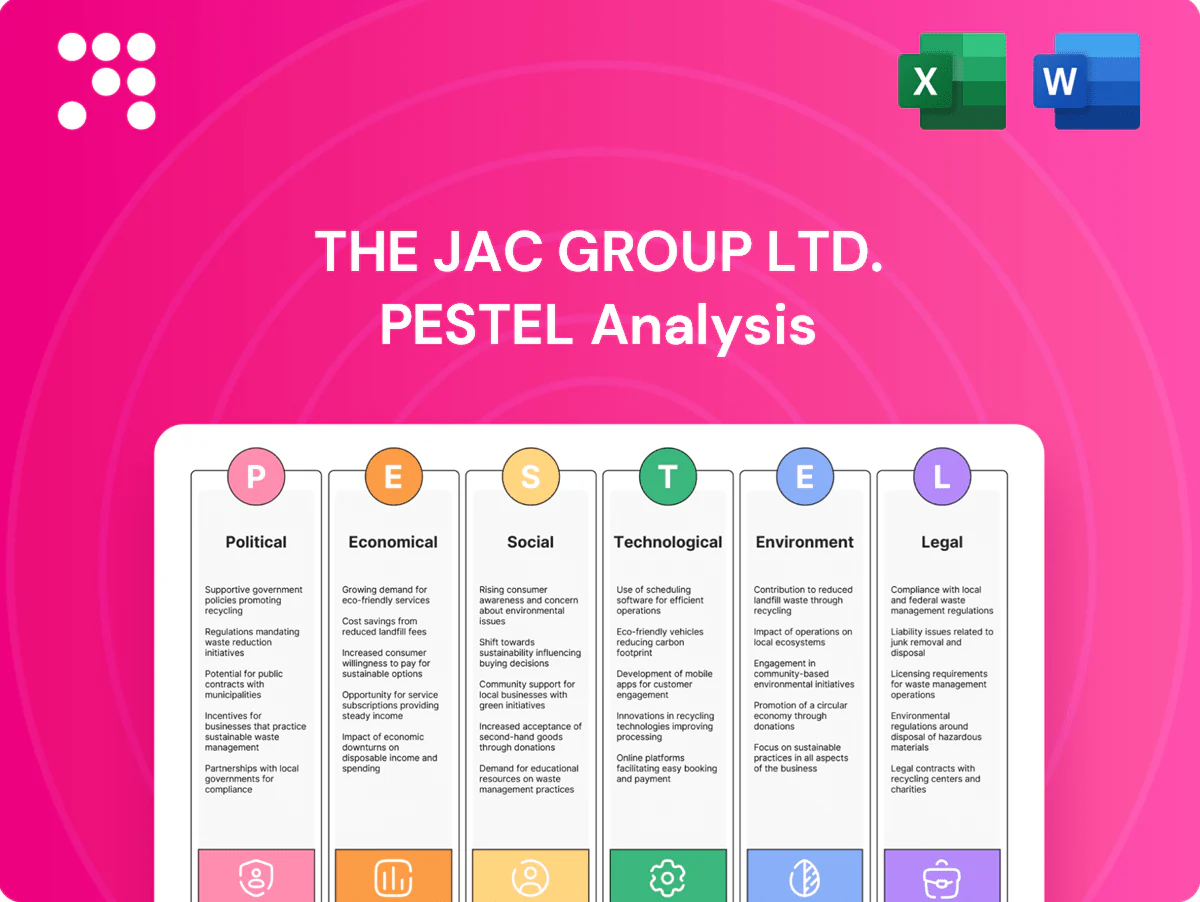
The JAC Group Ltd. PESTLE Analysis

Make Smarter Strategic Decisions with a Complete PESTEL View
Unlock strategic clarity with our PESTLE Analysis of The JAC Group Ltd.—three to five concise sections revealing how political shifts, economic trends, social change, technological advances, legal constraints, and environmental factors will affect performance. Ideal for investors and planners, this report converts external risks into actionable strategy. Purchase the full analysis to download the complete, editable briefing instantly.
Political factors

Visa and migration policies
Workforce mobility in travel, hospitality and retail hinges on visa quotas, seasonal worker schemes and immigration processing times; tightened policies have already narrowed candidate pools and lengthened time-to-fill. Easing rules or bilateral agreements can open access to multilingual, service-oriented talent. JAC must monitor policy shifts and adjust sourcing geographies and client timelines accordingly.
Tourism and hospitality subsidies
Government incentives, recovery grants and destination-marketing budgets drive seasonal hiring across leisure and tourism; UNWTO reported international arrivals recovered to about 88% of 2019 levels in 2023, underscoring rebound-linked recruitment spikes. Subsidies often spur reopenings and expansions, boosting demand for staff, while removal of support can prompt hiring freezes or consolidation. JAC should align pipeline planning with policy calendars and funding windows to capture subsidy-driven vacancies.

Public health directives
Health mandates on travel, events and venues—after WHO ended the COVID-19 PHEIC in May 2023 and UNWTO reporting international arrivals at about 83% of 2019 levels in 2023—still drive shifts in staffing and skill mixes. Rapid rule changes spike demand for compliance, safety and cleaning roles; cross-border asymmetry complicates multinational placements; scenario planning enables JAC to flex capacity and redeploy talent quickly.

Geopolitical stability and security
Conflicts, terrorism alerts and diplomatic tensions depress travel flows and occupancy; UNWTO recorded 1.4 billion international tourist arrivals in 2023 but IATA reported 2024 passenger traffic near 95% of 2019, showing fragility when advisories hit. Sudden route closures shift demand seasonally, clients delay projects or pivot to domestic markets, forcing JAC to diversify regional sourcing and tighten client portfolio resilience.
- Conflicts reduce occupancy and revenues
- Route closures reallocate demand across regions
- Clients postpone or domesticize projects
- Action: diversify sourcing, broaden client base
Local content and employment policies
Several major markets, including Saudi Arabia, UAE, Nigeria and Indonesia, enforce national-hiring rules or quotas for customer-facing roles; non-compliance affects candidate eligibility and local salary benchmarks and can delay hiring timelines.
JAC should map country-specific recruiting strategies, use local-agency partnerships to streamline documentation and auditing, and track regulatory changes quarterly (2024–25).
- local-hiring enforced in 10+ major markets
- use local agencies to reduce compliance burden
- design country-specific recruitment & documentation workflows
Visa rules & local quotas shorten hiring; air travel at 95%
Political shifts — visa rules, national-hiring quotas and travel advisories — materially affect JACs time-to-fill, candidate pools and regional demand; 2023 saw 1.4bn tourist arrivals (UNWTO) and 2024 air traffic ~95% of 2019 (IATA), underscoring volatility. Ten+ markets enforce local-hire quotas; subsidy windows drive seasonal spikes. JAC must quarterly-track regs (2024–25), diversify sourcing and use local partners.
| Issue | Impact | 2023–24 data | Action |
|---|---|---|---|
| Visa/immigration | Longer fill times | 95% air traffic (2024) | Broaden sourcing |
What is included in the product
 Detailed Word Document
Explores how macro-environmental factors uniquely affect The JAC Group Ltd across Political, Economic, Social, Technological, Environmental and Legal dimensions, with data-backed trends and forward-looking insights designed to help executives, investors and entrepreneurs identify risks, opportunities and strategic responses.

 Customizable Excel Spreadsheet
A concise, visually segmented PESTLE summary for The JAC Group Ltd. that clarifies external risks and market drivers for quick meeting use, easy sharing across teams, and simple customization with notes for region- or business-line specific planning.
Economic factors

Consumer confidence and discretionary spend
Leisure, travel and hospitality are cyclical and tied to household sentiment: global international tourist arrivals recovered to about 88% of 2019 levels in 2024 (UNWTO), boosting demand for temporary staff and bookings. Higher consumer confidence and UK unemployment near 3.9% in 2024 raised store traffic and staffing needs, pressuring JAC to supply permanent and contingent hires. Downturns shift mixes toward part-time/temporary roles, so JAC’s revenue closely tracks these cycles and requires flexible fee and contract models.
Inflation and wage pressures
Rising living costs elevate wage expectations in front-of-house and retail roles; UK CPI was 3.9% in Dec 2024 and regular pay growth averaged around 6% in 2024. Clients may face margin compression and slower hiring approvals. Indexing fees and offering salary benchmarking can protect placement value. JAC should advise on total rewards packages to close offers faster.

Labor shortages and skills gaps
Tight markets in culinary, housekeeping and specialist retail have pushed UK vacancies above 1.0 million in 2024 (ONS), lengthening time-to-hire; upskilling and cross-training are now critical to fill roles quickly. Talent pooling and talent communities cut search friction and churn, while JAC can monetize shortages through retained search mandates and project RPO engagements.

Currency volatility and cross-border hiring
Exchange-rate swings influence candidate willingness to relocate and employer compensation bands, with global FX daily turnover ~$7.5 trillion (BIS 2022) magnifying cross-border pay sensitivity; clients may reprice roles or pause hires when conversions shift compensation by 1–5%. Fee revenues in multiple currencies face translation risk that can erode margins; JAC can hedge or denominate contracts to stabilize cash flows and quarterly guidance.
- FX turnover: ~$7.5T (BIS 2022)
- Typical translation swing: 1–5%
- Actions: hedging, contract denomination, pricing clauses
Seasonality and event-driven demand
Peak travel seasons, holidays (Golden Week, New Year, Obon) and major events drove surge hiring—JNTO reported about 23.7 million international visitors in 2024—pushing short‑term demand for hospitality and retail roles.
Off‑peak months force lean delivery models and temp redeployment; accurate forecasting raises recruiter utilization and reduces bench costs.
JAC leverages scalable temp benches and on‑call talent to flex with demand swings, improving fill rates and margin stability.
- Peak surges: driven by Golden Week/Obon/New Year and 2024 tourism ≈23.7M
- Off‑peak: requires lean redeployment
- Forecasting: boosts recruiter utilization
- JAC strength: scalable temps and on‑call pools
Visa rules & local quotas shorten hiring; air travel at 95%
JAC’s revenues closely track leisure/retail cycles as UK unemployment ~3.9% and consumer-facing vacancies >1.0M in 2024 drive demand for temps and contingent hires. Elevated living costs (UK CPI 3.9% Dec 2024; regular pay growth ~6% in 2024) push wage expectations and margin pressure. FX volatility (global turnover ~$7.5T) and 2024 tourism ~23.7M create cross-border pay and seasonal surge risks.
| Indicator | 2024 |
|---|---|
| UK unemployment | 3.9% |
| CPI (Dec) | 3.9% |
| Pay growth | ~6% |
| Vacancies | >1.0M |
| Tourism (Japan) | 23.7M |
| FX turnover | ~$7.5T |
Preview Before You Purchase
The JAC Group Ltd. PESTLE Analysis
The JAC Group Ltd. PESTLE Analysis provided here is a comprehensive, final report covering political, economic, social, technological, legal and environmental factors affecting the company. The preview shown here is the exact document you’ll receive after purchase—fully formatted and ready to use. It contains actionable insights and clear implications for strategy and risk management.

Make Smarter Strategic Decisions with a Complete PESTEL View
Unlock strategic clarity with our PESTLE Analysis of The JAC Group Ltd.—three to five concise sections revealing how political shifts, economic trends, social change, technological advances, legal constraints, and environmental factors will affect performance. Ideal for investors and planners, this report converts external risks into actionable strategy. Purchase the full analysis to download the complete, editable briefing instantly.
Political factors
Visa and migration policies
Workforce mobility in travel, hospitality and retail hinges on visa quotas, seasonal worker schemes and immigration processing times; tightened policies have already narrowed candidate pools and lengthened time-to-fill. Easing rules or bilateral agreements can open access to multilingual, service-oriented talent. JAC must monitor policy shifts and adjust sourcing geographies and client timelines accordingly.
Tourism and hospitality subsidies
Government incentives, recovery grants and destination-marketing budgets drive seasonal hiring across leisure and tourism; UNWTO reported international arrivals recovered to about 88% of 2019 levels in 2023, underscoring rebound-linked recruitment spikes. Subsidies often spur reopenings and expansions, boosting demand for staff, while removal of support can prompt hiring freezes or consolidation. JAC should align pipeline planning with policy calendars and funding windows to capture subsidy-driven vacancies.
Public health directives
Health mandates on travel, events and venues—after WHO ended the COVID-19 PHEIC in May 2023 and UNWTO reporting international arrivals at about 83% of 2019 levels in 2023—still drive shifts in staffing and skill mixes. Rapid rule changes spike demand for compliance, safety and cleaning roles; cross-border asymmetry complicates multinational placements; scenario planning enables JAC to flex capacity and redeploy talent quickly.
Geopolitical stability and security
Conflicts, terrorism alerts and diplomatic tensions depress travel flows and occupancy; UNWTO recorded 1.4 billion international tourist arrivals in 2023 but IATA reported 2024 passenger traffic near 95% of 2019, showing fragility when advisories hit. Sudden route closures shift demand seasonally, clients delay projects or pivot to domestic markets, forcing JAC to diversify regional sourcing and tighten client portfolio resilience.
- Conflicts reduce occupancy and revenues
- Route closures reallocate demand across regions
- Clients postpone or domesticize projects
- Action: diversify sourcing, broaden client base
Local content and employment policies
Several major markets, including Saudi Arabia, UAE, Nigeria and Indonesia, enforce national-hiring rules or quotas for customer-facing roles; non-compliance affects candidate eligibility and local salary benchmarks and can delay hiring timelines.
JAC should map country-specific recruiting strategies, use local-agency partnerships to streamline documentation and auditing, and track regulatory changes quarterly (2024–25).
- local-hiring enforced in 10+ major markets
- use local agencies to reduce compliance burden
- design country-specific recruitment & documentation workflows
Visa rules & local quotas shorten hiring; air travel at 95%
Political shifts — visa rules, national-hiring quotas and travel advisories — materially affect JACs time-to-fill, candidate pools and regional demand; 2023 saw 1.4bn tourist arrivals (UNWTO) and 2024 air traffic ~95% of 2019 (IATA), underscoring volatility. Ten+ markets enforce local-hire quotas; subsidy windows drive seasonal spikes. JAC must quarterly-track regs (2024–25), diversify sourcing and use local partners.
| Issue | Impact | 2023–24 data | Action |
|---|---|---|---|
| Visa/immigration | Longer fill times | 95% air traffic (2024) | Broaden sourcing |
What is included in the product
Detailed Word Document
Explores how macro-environmental factors uniquely affect The JAC Group Ltd across Political, Economic, Social, Technological, Environmental and Legal dimensions, with data-backed trends and forward-looking insights designed to help executives, investors and entrepreneurs identify risks, opportunities and strategic responses.
Customizable Excel Spreadsheet
A concise, visually segmented PESTLE summary for The JAC Group Ltd. that clarifies external risks and market drivers for quick meeting use, easy sharing across teams, and simple customization with notes for region- or business-line specific planning.
Economic factors
Consumer confidence and discretionary spend
Leisure, travel and hospitality are cyclical and tied to household sentiment: global international tourist arrivals recovered to about 88% of 2019 levels in 2024 (UNWTO), boosting demand for temporary staff and bookings. Higher consumer confidence and UK unemployment near 3.9% in 2024 raised store traffic and staffing needs, pressuring JAC to supply permanent and contingent hires. Downturns shift mixes toward part-time/temporary roles, so JAC’s revenue closely tracks these cycles and requires flexible fee and contract models.
Inflation and wage pressures
Rising living costs elevate wage expectations in front-of-house and retail roles; UK CPI was 3.9% in Dec 2024 and regular pay growth averaged around 6% in 2024. Clients may face margin compression and slower hiring approvals. Indexing fees and offering salary benchmarking can protect placement value. JAC should advise on total rewards packages to close offers faster.
Labor shortages and skills gaps
Tight markets in culinary, housekeeping and specialist retail have pushed UK vacancies above 1.0 million in 2024 (ONS), lengthening time-to-hire; upskilling and cross-training are now critical to fill roles quickly. Talent pooling and talent communities cut search friction and churn, while JAC can monetize shortages through retained search mandates and project RPO engagements.
Currency volatility and cross-border hiring
Exchange-rate swings influence candidate willingness to relocate and employer compensation bands, with global FX daily turnover ~$7.5 trillion (BIS 2022) magnifying cross-border pay sensitivity; clients may reprice roles or pause hires when conversions shift compensation by 1–5%. Fee revenues in multiple currencies face translation risk that can erode margins; JAC can hedge or denominate contracts to stabilize cash flows and quarterly guidance.
- FX turnover: ~$7.5T (BIS 2022)
- Typical translation swing: 1–5%
- Actions: hedging, contract denomination, pricing clauses
Seasonality and event-driven demand
Peak travel seasons, holidays (Golden Week, New Year, Obon) and major events drove surge hiring—JNTO reported about 23.7 million international visitors in 2024—pushing short‑term demand for hospitality and retail roles.
Off‑peak months force lean delivery models and temp redeployment; accurate forecasting raises recruiter utilization and reduces bench costs.
JAC leverages scalable temp benches and on‑call talent to flex with demand swings, improving fill rates and margin stability.
- Peak surges: driven by Golden Week/Obon/New Year and 2024 tourism ≈23.7M
- Off‑peak: requires lean redeployment
- Forecasting: boosts recruiter utilization
- JAC strength: scalable temps and on‑call pools
Visa rules & local quotas shorten hiring; air travel at 95%
JAC’s revenues closely track leisure/retail cycles as UK unemployment ~3.9% and consumer-facing vacancies >1.0M in 2024 drive demand for temps and contingent hires. Elevated living costs (UK CPI 3.9% Dec 2024; regular pay growth ~6% in 2024) push wage expectations and margin pressure. FX volatility (global turnover ~$7.5T) and 2024 tourism ~23.7M create cross-border pay and seasonal surge risks.
| Indicator | 2024 |
|---|---|
| UK unemployment | 3.9% |
| CPI (Dec) | 3.9% |
| Pay growth | ~6% |
| Vacancies | >1.0M |
| Tourism (Japan) | 23.7M |
| FX turnover | ~$7.5T |
Preview Before You Purchase
The JAC Group Ltd. PESTLE Analysis
The JAC Group Ltd. PESTLE Analysis provided here is a comprehensive, final report covering political, economic, social, technological, legal and environmental factors affecting the company. The preview shown here is the exact document you’ll receive after purchase—fully formatted and ready to use. It contains actionable insights and clear implications for strategy and risk management.
Description
Make Smarter Strategic Decisions with a Complete PESTEL View
Unlock strategic clarity with our PESTLE Analysis of The JAC Group Ltd.—three to five concise sections revealing how political shifts, economic trends, social change, technological advances, legal constraints, and environmental factors will affect performance. Ideal for investors and planners, this report converts external risks into actionable strategy. Purchase the full analysis to download the complete, editable briefing instantly.
Political factors
Visa and migration policies
Workforce mobility in travel, hospitality and retail hinges on visa quotas, seasonal worker schemes and immigration processing times; tightened policies have already narrowed candidate pools and lengthened time-to-fill. Easing rules or bilateral agreements can open access to multilingual, service-oriented talent. JAC must monitor policy shifts and adjust sourcing geographies and client timelines accordingly.
Tourism and hospitality subsidies
Government incentives, recovery grants and destination-marketing budgets drive seasonal hiring across leisure and tourism; UNWTO reported international arrivals recovered to about 88% of 2019 levels in 2023, underscoring rebound-linked recruitment spikes. Subsidies often spur reopenings and expansions, boosting demand for staff, while removal of support can prompt hiring freezes or consolidation. JAC should align pipeline planning with policy calendars and funding windows to capture subsidy-driven vacancies.
Public health directives
Health mandates on travel, events and venues—after WHO ended the COVID-19 PHEIC in May 2023 and UNWTO reporting international arrivals at about 83% of 2019 levels in 2023—still drive shifts in staffing and skill mixes. Rapid rule changes spike demand for compliance, safety and cleaning roles; cross-border asymmetry complicates multinational placements; scenario planning enables JAC to flex capacity and redeploy talent quickly.
Geopolitical stability and security
Conflicts, terrorism alerts and diplomatic tensions depress travel flows and occupancy; UNWTO recorded 1.4 billion international tourist arrivals in 2023 but IATA reported 2024 passenger traffic near 95% of 2019, showing fragility when advisories hit. Sudden route closures shift demand seasonally, clients delay projects or pivot to domestic markets, forcing JAC to diversify regional sourcing and tighten client portfolio resilience.
- Conflicts reduce occupancy and revenues
- Route closures reallocate demand across regions
- Clients postpone or domesticize projects
- Action: diversify sourcing, broaden client base
Local content and employment policies
Several major markets, including Saudi Arabia, UAE, Nigeria and Indonesia, enforce national-hiring rules or quotas for customer-facing roles; non-compliance affects candidate eligibility and local salary benchmarks and can delay hiring timelines.
JAC should map country-specific recruiting strategies, use local-agency partnerships to streamline documentation and auditing, and track regulatory changes quarterly (2024–25).
- local-hiring enforced in 10+ major markets
- use local agencies to reduce compliance burden
- design country-specific recruitment & documentation workflows
Visa rules & local quotas shorten hiring; air travel at 95%
Political shifts — visa rules, national-hiring quotas and travel advisories — materially affect JACs time-to-fill, candidate pools and regional demand; 2023 saw 1.4bn tourist arrivals (UNWTO) and 2024 air traffic ~95% of 2019 (IATA), underscoring volatility. Ten+ markets enforce local-hire quotas; subsidy windows drive seasonal spikes. JAC must quarterly-track regs (2024–25), diversify sourcing and use local partners.
| Issue | Impact | 2023–24 data | Action |
|---|---|---|---|
| Visa/immigration | Longer fill times | 95% air traffic (2024) | Broaden sourcing |
What is included in the product
Detailed Word Document
Explores how macro-environmental factors uniquely affect The JAC Group Ltd across Political, Economic, Social, Technological, Environmental and Legal dimensions, with data-backed trends and forward-looking insights designed to help executives, investors and entrepreneurs identify risks, opportunities and strategic responses.
Customizable Excel Spreadsheet
A concise, visually segmented PESTLE summary for The JAC Group Ltd. that clarifies external risks and market drivers for quick meeting use, easy sharing across teams, and simple customization with notes for region- or business-line specific planning.
Economic factors
Consumer confidence and discretionary spend
Leisure, travel and hospitality are cyclical and tied to household sentiment: global international tourist arrivals recovered to about 88% of 2019 levels in 2024 (UNWTO), boosting demand for temporary staff and bookings. Higher consumer confidence and UK unemployment near 3.9% in 2024 raised store traffic and staffing needs, pressuring JAC to supply permanent and contingent hires. Downturns shift mixes toward part-time/temporary roles, so JAC’s revenue closely tracks these cycles and requires flexible fee and contract models.
Inflation and wage pressures
Rising living costs elevate wage expectations in front-of-house and retail roles; UK CPI was 3.9% in Dec 2024 and regular pay growth averaged around 6% in 2024. Clients may face margin compression and slower hiring approvals. Indexing fees and offering salary benchmarking can protect placement value. JAC should advise on total rewards packages to close offers faster.
Labor shortages and skills gaps
Tight markets in culinary, housekeeping and specialist retail have pushed UK vacancies above 1.0 million in 2024 (ONS), lengthening time-to-hire; upskilling and cross-training are now critical to fill roles quickly. Talent pooling and talent communities cut search friction and churn, while JAC can monetize shortages through retained search mandates and project RPO engagements.
Currency volatility and cross-border hiring
Exchange-rate swings influence candidate willingness to relocate and employer compensation bands, with global FX daily turnover ~$7.5 trillion (BIS 2022) magnifying cross-border pay sensitivity; clients may reprice roles or pause hires when conversions shift compensation by 1–5%. Fee revenues in multiple currencies face translation risk that can erode margins; JAC can hedge or denominate contracts to stabilize cash flows and quarterly guidance.
- FX turnover: ~$7.5T (BIS 2022)
- Typical translation swing: 1–5%
- Actions: hedging, contract denomination, pricing clauses
Seasonality and event-driven demand
Peak travel seasons, holidays (Golden Week, New Year, Obon) and major events drove surge hiring—JNTO reported about 23.7 million international visitors in 2024—pushing short‑term demand for hospitality and retail roles.
Off‑peak months force lean delivery models and temp redeployment; accurate forecasting raises recruiter utilization and reduces bench costs.
JAC leverages scalable temp benches and on‑call talent to flex with demand swings, improving fill rates and margin stability.
- Peak surges: driven by Golden Week/Obon/New Year and 2024 tourism ≈23.7M
- Off‑peak: requires lean redeployment
- Forecasting: boosts recruiter utilization
- JAC strength: scalable temps and on‑call pools
Visa rules & local quotas shorten hiring; air travel at 95%
JAC’s revenues closely track leisure/retail cycles as UK unemployment ~3.9% and consumer-facing vacancies >1.0M in 2024 drive demand for temps and contingent hires. Elevated living costs (UK CPI 3.9% Dec 2024; regular pay growth ~6% in 2024) push wage expectations and margin pressure. FX volatility (global turnover ~$7.5T) and 2024 tourism ~23.7M create cross-border pay and seasonal surge risks.
| Indicator | 2024 |
|---|---|
| UK unemployment | 3.9% |
| CPI (Dec) | 3.9% |
| Pay growth | ~6% |
| Vacancies | >1.0M |
| Tourism (Japan) | 23.7M |
| FX turnover | ~$7.5T |
Preview Before You Purchase
The JAC Group Ltd. PESTLE Analysis
The JAC Group Ltd. PESTLE Analysis provided here is a comprehensive, final report covering political, economic, social, technological, legal and environmental factors affecting the company. The preview shown here is the exact document you’ll receive after purchase—fully formatted and ready to use. It contains actionable insights and clear implications for strategy and risk management.











