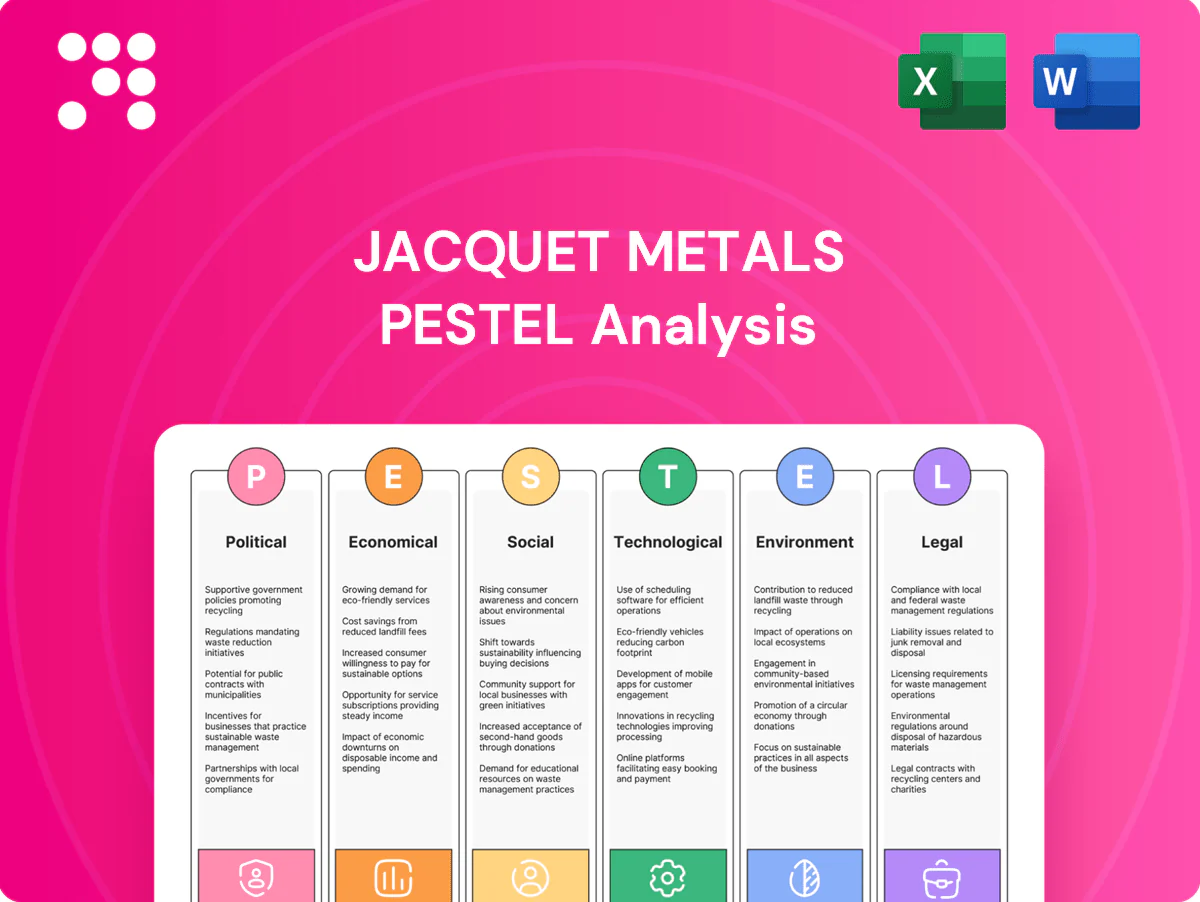
Jacquet Metals PESTLE Analysis

Your Shortcut to Market Insight Starts Here
Uncover how political shifts, market cycles, and sustainability trends shape Jacquet Metals' strategic outlook in our concise PESTLE briefing. This analysis pinpoints risks and growth levers investors and managers need to know. Purchase the full report to access detailed, actionable insights and ready-to-use slides for immediate decision-making.
Political factors

EU trade policy and CBAM
The EU Carbon Border Adjustment Mechanism (transitional reporting 2023–2025, full application from 2026) shifts import cost structures for high‑emission steel by tying levies to the EU ETS price (around €80/tonne in 2024), forcing Jacquet Metals to prioritize suppliers that disclose and cut embedded carbon. Reporting timelines demand data readiness and proactive customer communication; diversifying toward compliant mills reduces political and cost exposure.
Sanctions and geopolitics
Sanctions on Russia and other regions have disrupted specialty-steel supply chains, with Russian seaborne steel exports falling about 20% in 2023 and rerouted logistics increasing reliance on alternative suppliers for stainless and tool grades. Jacquet Metals must secure alternative sources as restricted grades tighten availability and prices. Geopolitical tensions pushed some war-risk freight insurance premia up to 300% and lengthened lead times from ~8 to ~14 weeks, altering inventory strategies. Proactive supplier vetting and dual-sourcing measurably reduce disruption probability.

European industrial policy
EU industrial policy — backed by the EUR 806.9 billion NextGenerationEU and REPowerEU targets such as 10 Mt renewable hydrogen by 2030 — drives support for strategic autonomy, green industry and reindustrialization, benefiting downstream metal users. Jacquet Metals can align products to subsidized sectors like renewables, hydrogen and mobility; policy-driven demand visibility aids processing capacity planning. Public funding increasingly mandates traceability and EU Taxonomy/Green Public Procurement sustainability credentials.

Public procurement standards
Government projects increasingly specify certified sustainable materials and origin rules; EU public procurement is about 14% of GDP (~€2tn/year), so meeting specs can unlock stable infrastructure and defense contracts. Jacquet must maintain certification libraries and mill-test documentation; political shifts in buy-local provisions can change competitiveness.
- Certifications: mill-test reports required
- Opportunity: €2tn EU procurement pool
- Risk: tighter buy-local hurts margins
Taxation and energy policies
Energy taxation and subsidies materially shift Jacquet Metals’ processing cost base for cutting and heat-treatment; European natural gas TTF peaks (~€345/MWh in Aug 2022) exposed processors to outsized input-cost risk, prompting many partners to seek compensation. National relief schemes—e.g., Germany’s 2022 energy package (~€200bn)—temporarily stabilized margins but highlight policy unpredictability. Volatile policy drives the need for energy hedging and flexible pricing clauses, and cross-EU coordination remains critical for multinational operations.
- Energy-price shock: TTF peak ~€345/MWh (Aug 2022)
- National relief example: Germany ~€200bn (2022 package)
- Actions: energy hedging, flexible pricing clauses
- Requirement: coordinated EU policy for multinationals
EU CBAM ties levies to ETS ~€80/t; Russia seaborne cuts raise lead times, premiums
EU CBAM ties levies to ETS (~€80/t in 2024), forcing low‑carbon sourcing and reporting readiness. Russia sanctions cut seaborne steel ~20% (2023), raising lead times and war‑risk premia up to 300%. EU industrial funds (NextGenerationEU €806.9bn) and €2tn public procurement favor certified sustainable supply; energy shocks (TTF peak €345/MWh Aug 2022) drive hedging and flexible pricing.
| Metric | Value |
|---|---|
| EU ETS price 2024 | ~€80/t |
| Seaborne Russia 2023 | -20% |
| NextGenerationEU | €806.9bn |
| EU procurement | ~€2tn/yr |
What is included in the product
 Detailed Word Document
Explores how macro-environmental factors uniquely affect Jacquet Metals across Political, Economic, Social, Technological, Environmental, and Legal dimensions, with data-driven subpoints and forward-looking insights to identify threats, opportunities and inform strategic planning.

 Customizable Excel Spreadsheet
A concise, visually segmented PESTLE summary for Jacquet Metals that’s easily shareable and editable with region- or business-line notes, drop-in ready for presentations, and built to streamline risk discussions and strategic planning.
Economic factors

Cyclical industrial demand
Cyclical demand from machinery, automotive and construction drives sharp volume swings for Jacquet Metals, with industrial orders historically fluctuating by roughly ±20% across cycles; balancing exposure across these sectors can smooth revenue volatility. Flexible inventory policies and rapid quoting support capture of rebounds, shortening lead times by days to weeks. In downturns, strict working-capital discipline and SKU rationalization preserve margins and cash.
Raw material price swings
Nickel surged about 35% in 2024, molybdenum rose roughly 20% and scrap prices increased near 30%, materially driving stainless and tool steel input costs; Jacquet Metals must use dynamic pricing, steel surcharges and active hedging to manage margin risk. Transparent pass-through mechanisms and indexed contracts protect margins while remaining competitive, and proactive customer education reduces disputes during price spikes.

Interest rates and financing
Higher rates raise inventory carrying costs and customer financing risk, with the euro-area policy rate at 4.25% and US fed funds at 5.25–5.50% (July 2025). Optimized days sales outstanding and extended supplier terms preserve liquidity. Asset-light processing investments with sub-12-month paybacks mitigate rate pressure. Scenario planning aligns stock levels with demand signals.

Supply chain and freight costs
Ocean and road freight disruptions continue to widen lead times and inflate landed costs, with container rates down roughly 60% from 2021 peaks but port congestion still adding about 7–10 days to transit in 2024, raising landed-cost volatility for Jacquet Metals. Dual-sourcing and regional stocking have cut service failures and secured availability for customers. Collaborative forecasting with mills secures allocation for critical grades, while digital ETA tracking reduced cancellations and improved on-time pick-up rates in 2024.
- Freight volatility: container rates ~60% below 2021 peaks
- Transit delays: +7–10 days from congestion (2024)
- Mitigants: dual-sourcing, regional inventory
- Execution: mill forecasting collaboration, digital ETA tracking
Reshoring and nearshoring
European reshoring and nearshoring have increased demand for certified specialty steels, cutting typical lead times from 8–12 weeks to about 2–3 weeks and favoring local suppliers like Jacquet Metals; proximity, fast processing and full traceability align with buyers’ priorities. Positioning regional hubs near growth clusters can lower logistics costs by ~15–20% and improved contract structures can secure multi-year volumes with key reshoring clients, supporting Jacquet’s 2024 scale.
- Proximity: market shorter lead times (2–3 weeks)
- Cost: logistics savings ~15–20%
- Capability: certified specialty steels, traceability
- Commercial: multi-year contracts to lock volumes
EU CBAM ties levies to ETS ~€80/t; Russia seaborne cuts raise lead times, premiums
Cyclical demand (machinery/auto/construction) causes ~±20% volume swings; inventory flexibility smooths revenue. Nickel +35%, molybdenum +20%, scrap +30% in 2024, forcing dynamic pricing and hedging. Rates: euro 4.25%, US Fed 5.25–5.50% (Jul 2025), raising carrying costs. Freight delays +7–10 days; reshoring cuts lead times to 2–3 weeks, saving ~15–20% logistics.
| Metric | 2024/Jul2025 |
|---|---|
| Nickel | +35% |
| Molybdenum | +20% |
| Scrap | +30% |
| EU rate | 4.25% |
| US Fed | 5.25–5.50% |
Preview the Actual Deliverable
Jacquet Metals PESTLE Analysis
The Jacquet Metals PESTLE Analysis provides a concise evaluation of political, economic, social, technological, legal and environmental factors affecting the company. The preview shown here is the exact document you’ll receive after purchase—fully formatted and ready to use. It includes actionable insights and structured findings for strategic decision-making.

Your Shortcut to Market Insight Starts Here
Uncover how political shifts, market cycles, and sustainability trends shape Jacquet Metals' strategic outlook in our concise PESTLE briefing. This analysis pinpoints risks and growth levers investors and managers need to know. Purchase the full report to access detailed, actionable insights and ready-to-use slides for immediate decision-making.
Political factors
EU trade policy and CBAM
The EU Carbon Border Adjustment Mechanism (transitional reporting 2023–2025, full application from 2026) shifts import cost structures for high‑emission steel by tying levies to the EU ETS price (around €80/tonne in 2024), forcing Jacquet Metals to prioritize suppliers that disclose and cut embedded carbon. Reporting timelines demand data readiness and proactive customer communication; diversifying toward compliant mills reduces political and cost exposure.
Sanctions and geopolitics
Sanctions on Russia and other regions have disrupted specialty-steel supply chains, with Russian seaborne steel exports falling about 20% in 2023 and rerouted logistics increasing reliance on alternative suppliers for stainless and tool grades. Jacquet Metals must secure alternative sources as restricted grades tighten availability and prices. Geopolitical tensions pushed some war-risk freight insurance premia up to 300% and lengthened lead times from ~8 to ~14 weeks, altering inventory strategies. Proactive supplier vetting and dual-sourcing measurably reduce disruption probability.
European industrial policy
EU industrial policy — backed by the EUR 806.9 billion NextGenerationEU and REPowerEU targets such as 10 Mt renewable hydrogen by 2030 — drives support for strategic autonomy, green industry and reindustrialization, benefiting downstream metal users. Jacquet Metals can align products to subsidized sectors like renewables, hydrogen and mobility; policy-driven demand visibility aids processing capacity planning. Public funding increasingly mandates traceability and EU Taxonomy/Green Public Procurement sustainability credentials.
Public procurement standards
Government projects increasingly specify certified sustainable materials and origin rules; EU public procurement is about 14% of GDP (~€2tn/year), so meeting specs can unlock stable infrastructure and defense contracts. Jacquet must maintain certification libraries and mill-test documentation; political shifts in buy-local provisions can change competitiveness.
- Certifications: mill-test reports required
- Opportunity: €2tn EU procurement pool
- Risk: tighter buy-local hurts margins
Taxation and energy policies
Energy taxation and subsidies materially shift Jacquet Metals’ processing cost base for cutting and heat-treatment; European natural gas TTF peaks (~€345/MWh in Aug 2022) exposed processors to outsized input-cost risk, prompting many partners to seek compensation. National relief schemes—e.g., Germany’s 2022 energy package (~€200bn)—temporarily stabilized margins but highlight policy unpredictability. Volatile policy drives the need for energy hedging and flexible pricing clauses, and cross-EU coordination remains critical for multinational operations.
- Energy-price shock: TTF peak ~€345/MWh (Aug 2022)
- National relief example: Germany ~€200bn (2022 package)
- Actions: energy hedging, flexible pricing clauses
- Requirement: coordinated EU policy for multinationals
EU CBAM ties levies to ETS ~€80/t; Russia seaborne cuts raise lead times, premiums
EU CBAM ties levies to ETS (~€80/t in 2024), forcing low‑carbon sourcing and reporting readiness. Russia sanctions cut seaborne steel ~20% (2023), raising lead times and war‑risk premia up to 300%. EU industrial funds (NextGenerationEU €806.9bn) and €2tn public procurement favor certified sustainable supply; energy shocks (TTF peak €345/MWh Aug 2022) drive hedging and flexible pricing.
| Metric | Value |
|---|---|
| EU ETS price 2024 | ~€80/t |
| Seaborne Russia 2023 | -20% |
| NextGenerationEU | €806.9bn |
| EU procurement | ~€2tn/yr |
What is included in the product
Detailed Word Document
Explores how macro-environmental factors uniquely affect Jacquet Metals across Political, Economic, Social, Technological, Environmental, and Legal dimensions, with data-driven subpoints and forward-looking insights to identify threats, opportunities and inform strategic planning.
Customizable Excel Spreadsheet
A concise, visually segmented PESTLE summary for Jacquet Metals that’s easily shareable and editable with region- or business-line notes, drop-in ready for presentations, and built to streamline risk discussions and strategic planning.
Economic factors
Cyclical industrial demand
Cyclical demand from machinery, automotive and construction drives sharp volume swings for Jacquet Metals, with industrial orders historically fluctuating by roughly ±20% across cycles; balancing exposure across these sectors can smooth revenue volatility. Flexible inventory policies and rapid quoting support capture of rebounds, shortening lead times by days to weeks. In downturns, strict working-capital discipline and SKU rationalization preserve margins and cash.
Raw material price swings
Nickel surged about 35% in 2024, molybdenum rose roughly 20% and scrap prices increased near 30%, materially driving stainless and tool steel input costs; Jacquet Metals must use dynamic pricing, steel surcharges and active hedging to manage margin risk. Transparent pass-through mechanisms and indexed contracts protect margins while remaining competitive, and proactive customer education reduces disputes during price spikes.
Interest rates and financing
Higher rates raise inventory carrying costs and customer financing risk, with the euro-area policy rate at 4.25% and US fed funds at 5.25–5.50% (July 2025). Optimized days sales outstanding and extended supplier terms preserve liquidity. Asset-light processing investments with sub-12-month paybacks mitigate rate pressure. Scenario planning aligns stock levels with demand signals.
Supply chain and freight costs
Ocean and road freight disruptions continue to widen lead times and inflate landed costs, with container rates down roughly 60% from 2021 peaks but port congestion still adding about 7–10 days to transit in 2024, raising landed-cost volatility for Jacquet Metals. Dual-sourcing and regional stocking have cut service failures and secured availability for customers. Collaborative forecasting with mills secures allocation for critical grades, while digital ETA tracking reduced cancellations and improved on-time pick-up rates in 2024.
- Freight volatility: container rates ~60% below 2021 peaks
- Transit delays: +7–10 days from congestion (2024)
- Mitigants: dual-sourcing, regional inventory
- Execution: mill forecasting collaboration, digital ETA tracking
Reshoring and nearshoring
European reshoring and nearshoring have increased demand for certified specialty steels, cutting typical lead times from 8–12 weeks to about 2–3 weeks and favoring local suppliers like Jacquet Metals; proximity, fast processing and full traceability align with buyers’ priorities. Positioning regional hubs near growth clusters can lower logistics costs by ~15–20% and improved contract structures can secure multi-year volumes with key reshoring clients, supporting Jacquet’s 2024 scale.
- Proximity: market shorter lead times (2–3 weeks)
- Cost: logistics savings ~15–20%
- Capability: certified specialty steels, traceability
- Commercial: multi-year contracts to lock volumes
EU CBAM ties levies to ETS ~€80/t; Russia seaborne cuts raise lead times, premiums
Cyclical demand (machinery/auto/construction) causes ~±20% volume swings; inventory flexibility smooths revenue. Nickel +35%, molybdenum +20%, scrap +30% in 2024, forcing dynamic pricing and hedging. Rates: euro 4.25%, US Fed 5.25–5.50% (Jul 2025), raising carrying costs. Freight delays +7–10 days; reshoring cuts lead times to 2–3 weeks, saving ~15–20% logistics.
| Metric | 2024/Jul2025 |
|---|---|
| Nickel | +35% |
| Molybdenum | +20% |
| Scrap | +30% |
| EU rate | 4.25% |
| US Fed | 5.25–5.50% |
Preview the Actual Deliverable
Jacquet Metals PESTLE Analysis
The Jacquet Metals PESTLE Analysis provides a concise evaluation of political, economic, social, technological, legal and environmental factors affecting the company. The preview shown here is the exact document you’ll receive after purchase—fully formatted and ready to use. It includes actionable insights and structured findings for strategic decision-making.
Description
Your Shortcut to Market Insight Starts Here
Uncover how political shifts, market cycles, and sustainability trends shape Jacquet Metals' strategic outlook in our concise PESTLE briefing. This analysis pinpoints risks and growth levers investors and managers need to know. Purchase the full report to access detailed, actionable insights and ready-to-use slides for immediate decision-making.
Political factors
EU trade policy and CBAM
The EU Carbon Border Adjustment Mechanism (transitional reporting 2023–2025, full application from 2026) shifts import cost structures for high‑emission steel by tying levies to the EU ETS price (around €80/tonne in 2024), forcing Jacquet Metals to prioritize suppliers that disclose and cut embedded carbon. Reporting timelines demand data readiness and proactive customer communication; diversifying toward compliant mills reduces political and cost exposure.
Sanctions and geopolitics
Sanctions on Russia and other regions have disrupted specialty-steel supply chains, with Russian seaborne steel exports falling about 20% in 2023 and rerouted logistics increasing reliance on alternative suppliers for stainless and tool grades. Jacquet Metals must secure alternative sources as restricted grades tighten availability and prices. Geopolitical tensions pushed some war-risk freight insurance premia up to 300% and lengthened lead times from ~8 to ~14 weeks, altering inventory strategies. Proactive supplier vetting and dual-sourcing measurably reduce disruption probability.
European industrial policy
EU industrial policy — backed by the EUR 806.9 billion NextGenerationEU and REPowerEU targets such as 10 Mt renewable hydrogen by 2030 — drives support for strategic autonomy, green industry and reindustrialization, benefiting downstream metal users. Jacquet Metals can align products to subsidized sectors like renewables, hydrogen and mobility; policy-driven demand visibility aids processing capacity planning. Public funding increasingly mandates traceability and EU Taxonomy/Green Public Procurement sustainability credentials.
Public procurement standards
Government projects increasingly specify certified sustainable materials and origin rules; EU public procurement is about 14% of GDP (~€2tn/year), so meeting specs can unlock stable infrastructure and defense contracts. Jacquet must maintain certification libraries and mill-test documentation; political shifts in buy-local provisions can change competitiveness.
- Certifications: mill-test reports required
- Opportunity: €2tn EU procurement pool
- Risk: tighter buy-local hurts margins
Taxation and energy policies
Energy taxation and subsidies materially shift Jacquet Metals’ processing cost base for cutting and heat-treatment; European natural gas TTF peaks (~€345/MWh in Aug 2022) exposed processors to outsized input-cost risk, prompting many partners to seek compensation. National relief schemes—e.g., Germany’s 2022 energy package (~€200bn)—temporarily stabilized margins but highlight policy unpredictability. Volatile policy drives the need for energy hedging and flexible pricing clauses, and cross-EU coordination remains critical for multinational operations.
- Energy-price shock: TTF peak ~€345/MWh (Aug 2022)
- National relief example: Germany ~€200bn (2022 package)
- Actions: energy hedging, flexible pricing clauses
- Requirement: coordinated EU policy for multinationals
EU CBAM ties levies to ETS ~€80/t; Russia seaborne cuts raise lead times, premiums
EU CBAM ties levies to ETS (~€80/t in 2024), forcing low‑carbon sourcing and reporting readiness. Russia sanctions cut seaborne steel ~20% (2023), raising lead times and war‑risk premia up to 300%. EU industrial funds (NextGenerationEU €806.9bn) and €2tn public procurement favor certified sustainable supply; energy shocks (TTF peak €345/MWh Aug 2022) drive hedging and flexible pricing.
| Metric | Value |
|---|---|
| EU ETS price 2024 | ~€80/t |
| Seaborne Russia 2023 | -20% |
| NextGenerationEU | €806.9bn |
| EU procurement | ~€2tn/yr |
What is included in the product
Detailed Word Document
Explores how macro-environmental factors uniquely affect Jacquet Metals across Political, Economic, Social, Technological, Environmental, and Legal dimensions, with data-driven subpoints and forward-looking insights to identify threats, opportunities and inform strategic planning.
Customizable Excel Spreadsheet
A concise, visually segmented PESTLE summary for Jacquet Metals that’s easily shareable and editable with region- or business-line notes, drop-in ready for presentations, and built to streamline risk discussions and strategic planning.
Economic factors
Cyclical industrial demand
Cyclical demand from machinery, automotive and construction drives sharp volume swings for Jacquet Metals, with industrial orders historically fluctuating by roughly ±20% across cycles; balancing exposure across these sectors can smooth revenue volatility. Flexible inventory policies and rapid quoting support capture of rebounds, shortening lead times by days to weeks. In downturns, strict working-capital discipline and SKU rationalization preserve margins and cash.
Raw material price swings
Nickel surged about 35% in 2024, molybdenum rose roughly 20% and scrap prices increased near 30%, materially driving stainless and tool steel input costs; Jacquet Metals must use dynamic pricing, steel surcharges and active hedging to manage margin risk. Transparent pass-through mechanisms and indexed contracts protect margins while remaining competitive, and proactive customer education reduces disputes during price spikes.
Interest rates and financing
Higher rates raise inventory carrying costs and customer financing risk, with the euro-area policy rate at 4.25% and US fed funds at 5.25–5.50% (July 2025). Optimized days sales outstanding and extended supplier terms preserve liquidity. Asset-light processing investments with sub-12-month paybacks mitigate rate pressure. Scenario planning aligns stock levels with demand signals.
Supply chain and freight costs
Ocean and road freight disruptions continue to widen lead times and inflate landed costs, with container rates down roughly 60% from 2021 peaks but port congestion still adding about 7–10 days to transit in 2024, raising landed-cost volatility for Jacquet Metals. Dual-sourcing and regional stocking have cut service failures and secured availability for customers. Collaborative forecasting with mills secures allocation for critical grades, while digital ETA tracking reduced cancellations and improved on-time pick-up rates in 2024.
- Freight volatility: container rates ~60% below 2021 peaks
- Transit delays: +7–10 days from congestion (2024)
- Mitigants: dual-sourcing, regional inventory
- Execution: mill forecasting collaboration, digital ETA tracking
Reshoring and nearshoring
European reshoring and nearshoring have increased demand for certified specialty steels, cutting typical lead times from 8–12 weeks to about 2–3 weeks and favoring local suppliers like Jacquet Metals; proximity, fast processing and full traceability align with buyers’ priorities. Positioning regional hubs near growth clusters can lower logistics costs by ~15–20% and improved contract structures can secure multi-year volumes with key reshoring clients, supporting Jacquet’s 2024 scale.
- Proximity: market shorter lead times (2–3 weeks)
- Cost: logistics savings ~15–20%
- Capability: certified specialty steels, traceability
- Commercial: multi-year contracts to lock volumes
EU CBAM ties levies to ETS ~€80/t; Russia seaborne cuts raise lead times, premiums
Cyclical demand (machinery/auto/construction) causes ~±20% volume swings; inventory flexibility smooths revenue. Nickel +35%, molybdenum +20%, scrap +30% in 2024, forcing dynamic pricing and hedging. Rates: euro 4.25%, US Fed 5.25–5.50% (Jul 2025), raising carrying costs. Freight delays +7–10 days; reshoring cuts lead times to 2–3 weeks, saving ~15–20% logistics.
| Metric | 2024/Jul2025 |
|---|---|
| Nickel | +35% |
| Molybdenum | +20% |
| Scrap | +30% |
| EU rate | 4.25% |
| US Fed | 5.25–5.50% |
Preview the Actual Deliverable
Jacquet Metals PESTLE Analysis
The Jacquet Metals PESTLE Analysis provides a concise evaluation of political, economic, social, technological, legal and environmental factors affecting the company. The preview shown here is the exact document you’ll receive after purchase—fully formatted and ready to use. It includes actionable insights and structured findings for strategic decision-making.











