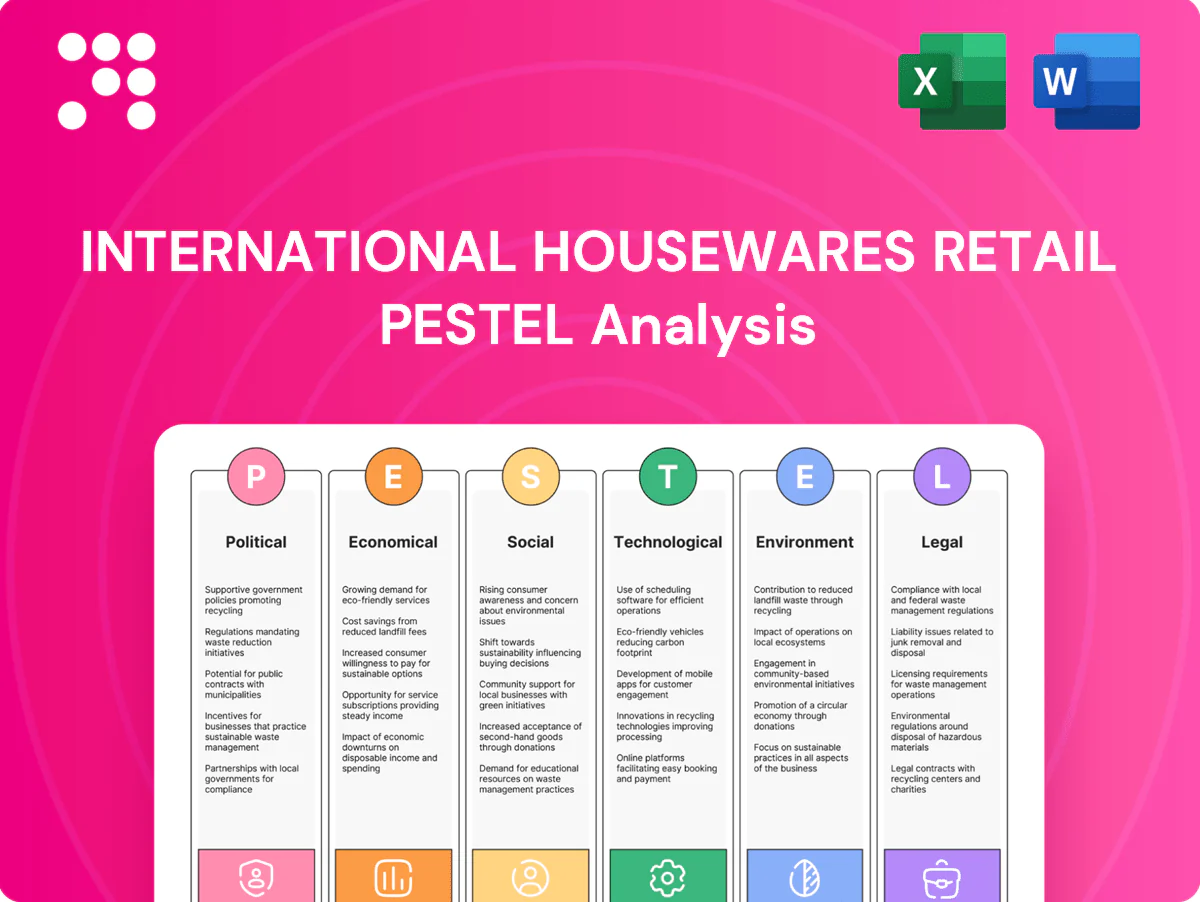
International Housewares Retail PESTLE Analysis

Make Smarter Strategic Decisions with a Complete PESTEL View
Unlock how political, economic and technological trends are reshaping International Housewares Retail—our PESTLE pinpoints risks and growth levers across markets. Ideal for investors, strategists and consultants, it’s fully researched and ready to use. Purchase the full PESTLE to get the complete, editable report and act with confidence.
Political factors

HK-Macau policy stability and governance
One Country, Two Systems (since 1997) ensures government continuity in Hong Kong (population ~7.4m) and Macau (population ~0.68m), shaping retail licensing, opening hours and public-order rules. Policy predictability aids store network planning and lease negotiations. Sudden shifts in public-health or crowd-control measures can rapidly alter footfall and sales. Close monitoring of city-level directives is essential for operational agility.
Mainland China integration and GBA initiatives
Greater Bay Area integration policies can streamline cross-border logistics and expand supplier access; Shenzhen port (≈27.7 million TEU in 2021) and Pearl River Delta hubs shorten transit times and sourcing costs for housewares. Preferential schemes such as CEPA and GBA cross-border pilots lower distribution frictions for goods routed via Shenzhen/PRD. However, regulatory harmonization remains uneven across jurisdictions, so compliance expertise is needed to capture benefits without breaching rules.

Geopolitical tensions and trade policy risk
Geopolitical tensions, notably US-China frictions and regional disputes, raise tariff and sanction risks—US tariffs on many Chinese goods remain as high as 25% and export controls on tech intensified in 2023–24—while US goods imports from China were about $500 billion in 2023, concentrating supplier risk. Retailers sourcing from Japan, Mainland China or Southeast Asia face quota or inspection delays that can add 2–6 weeks to lead times. Reputation risks from geopolitical boycotts have cut sales of targeted-origin goods in past episodes. Scenario planning—buffer inventory and diversified sourcing—reduces disruption exposure.

Public health and emergency measures
Episodic disease-control measures continue to constrain store traffic and hours, with WHO ending the COVID-19 emergency on 5 May 2023 but local outbreaks still triggering short-term caps that reshape merchandising and staffing. Masking, distancing and capacity limits force spaced displays and higher per-shift staff costs; many retailers report sustained uplift in online orders as continuity channel—global e-commerce was about $6.3 trillion in 2023. Playbooks must enable rapid pivot to click-and-collect and courier partnerships to preserve sales.
- Operational risk: episodic caps reduce footfall
- Merchandising: spaced layouts raise SKU handling
- Labor: flexible shifts and PPE add costs
- Continuity: e-commerce $6.3T (2023) — prioritize click-and-collect/courier
Government consumer relief and subsidies
Government relief such as Hong Kong consumption vouchers and Macau utility subsidies historically spike discretionary spending in housewares; Hong Kong retail sales value rose about 12.6% year-on-year in 2024, showing voucher-driven demand surges. Timing promotions to voucher disbursements lifts conversion in cookware, small appliances and bedding. If stimulus tapers, demand can normalize sharply within 4–8 weeks, risking post-relief overstock.
- Timing: align campaigns to voucher dates
- Inventory: cut lead times to avoid stock buildup
- Categories: focus on household discretionary items
- Risk: plan for 4–8 week normalization window
Policy steady HK-Macau vs tariffs and health caps: GBA logistics boost, online retail surges
One Country, Two Systems (HK pop ~7.4m; Macau ~0.68m) yields policy continuity but city-level directives can quickly cut footfall; HK retail sales rose ~12.6% in 2024 after voucher stimulus. GBA logistics (Shenzhen port ~27.7m TEU 2021) and CEPA ease sourcing, yet US-China tariffs (up to 25%) and export controls heighten supplier risk. Disease controls still trigger short-term caps, pushing online growth.
| Political Factor | Metric | Retail Impact |
|---|---|---|
| Governance | HK/Macau continuity | Stable licensing; rapid directive risk |
| GBA integration | Shenzhen 27.7m TEU (2021) | Lower transit costs; regulatory patchiness |
| Geopolitics | US tariffs ~25% | Higher sourcing costs, lead-time delays |
| Health policy | Post-2023 outbreaks | Reduced footfall; online surge |
What is included in the product
 Detailed Word Document
Explores how Political, Economic, Social, Technological, Environmental and Legal factors uniquely affect International Housewares Retail, with data-backed trends, forward-looking insights and actionable implications for executives, investors and strategists to identify risks and growth opportunities.

 Customizable Excel Spreadsheet
A compact, visually segmented PESTLE summary for international housewares retail that clarifies regulatory, economic and consumer trends for quick decision‑making, is editable for local contexts, and can be dropped into presentations or shared across teams for fast alignment.
Economic factors

Tourism recovery and retail footfall
Macau and Hong Kong tourism cycles drive footfall in prime districts, with tourism recovery reaching about 90% of 2019 levels in Macau and ~75% in Hong Kong by 2024, directly affecting store traffic and peak-week variability. Visitor mix (mainland tourists vs regional visitors) shifts basket composition and price sensitivity, lowering average spend during day-tripper surges. Marketing should allocate spend to both tourists and local neighborhoods to smooth volatility, and clustering stores near MTR stations and ferry terminals captures returning flows and transit-driven uplift.
HKD USD peg and FX-driven sourcing costs
The HKD peg (7.75–7.85 per USD) stabilizes local pricing, but import costs shift with JPY, CNY and EUR moves; JPY near 150/USD in 2023–24 cut Japan-sourcing costs helping sharper value offers, while CNY around 7.2–7.4/USD or container freight spikes (peak ~$10,000 in 2021, ~ $2,000 by 2024) compress margins. Use FX hedging and multi-currency supplier contracts to smooth COGS.

Rent and labor cost pressures
High commercial rents in Hong Kong—prime street rents often exceed HKD 2,000 per sq ft annually—squeeze four-wall profitability for housewares retailers. Wage adjustments and a tight labor market pushed nominal wages up about 4.5% in 2024, raising operating expenses. Productivity tools and smaller-format stores can trim labor hours by ~15% and help preserve margins. Lease renegotiations and turnover-based rents, used increasingly in 2024 pilots, can cut occupancy volatility by ~10%.

Consumer sentiment and value orientation
Household goods remain resilient but consumer spending in 2024–25 tracked income expectations and inflation pressures, with many advanced economies seeing inflation near 3–4% in 2024 (IMF) and softer confidence readings versus 2021–22.
- Value assortments and private label captured higher share in 2024, with unit sales up ~15% (NielsenIQ)
- Clear price ladders protect mix and enable upsell to premium SKUs
- Promotions should tie to basket thresholds to avoid margin erosion
Supply chain and freight volatility
Ocean freight and port congestion continue to drive volatility, with transpacific spot rates normalizing since 2022 but episodic delays at key hubs extending lead times; these disruptions make safety stocks and dual-sourcing essential to maintain SKU availability. Allocating safety stock of 15–25% for top SKUs and dual-sourcing can cut out-of-stocks substantially, while nearshoring can shorten replenishment cycles by up to 50% and dynamic demand forecasting limits excess inventory risk.
- Ocean freight: episodic rate spikes and port delays extend lead times
- Safety stock: 15–25% for top SKUs reduces stockouts
- Dual-sourcing: lowers single-point failure risk
- Nearshoring: up to 50% shorter replenishment
- Dynamic forecasting: trims excess inventory
Policy steady HK-Macau vs tariffs and health caps: GBA logistics boost, online retail surges
Tourism-driven footfall recovered to ~90% in Macau and ~75% in Hong Kong by 2024, shifting basket mix and peak-week volatility. FX (HKD peg) stabilizes pricing while JPY ~150/USD and CNY ~7.2–7.4 affect COGS; freight spikes persist. High prime rents (>HKD 2,000/sqft) and wage growth (~4.5% in 2024) compress margins, so hedging, private label and smaller formats are vital.
| Metric | 2024/25 |
|---|---|
| Tourism recovery | Macau 90% · HK 75% |
| Prime rent | >HKD 2,000/sqft |
| Wage growth | +4.5% |
| JPY/CNY | JPY~150/USD · CNY~7.2–7.4 |
| Freight | Normalized; episodic peaks (~$2,000 2024) |
Preview the Actual Deliverable
International Housewares Retail PESTLE Analysis
The preview shown here is the exact International Housewares Retail PESTLE Analysis you’ll receive after purchase—fully formatted and ready to use. The document contains the same content, structure and professional layout visible in this screenshot with no placeholders or edits required. After payment you’ll instantly download this final, ready-to-work file.

Make Smarter Strategic Decisions with a Complete PESTEL View
Unlock how political, economic and technological trends are reshaping International Housewares Retail—our PESTLE pinpoints risks and growth levers across markets. Ideal for investors, strategists and consultants, it’s fully researched and ready to use. Purchase the full PESTLE to get the complete, editable report and act with confidence.
Political factors
HK-Macau policy stability and governance
One Country, Two Systems (since 1997) ensures government continuity in Hong Kong (population ~7.4m) and Macau (population ~0.68m), shaping retail licensing, opening hours and public-order rules. Policy predictability aids store network planning and lease negotiations. Sudden shifts in public-health or crowd-control measures can rapidly alter footfall and sales. Close monitoring of city-level directives is essential for operational agility.
Mainland China integration and GBA initiatives
Greater Bay Area integration policies can streamline cross-border logistics and expand supplier access; Shenzhen port (≈27.7 million TEU in 2021) and Pearl River Delta hubs shorten transit times and sourcing costs for housewares. Preferential schemes such as CEPA and GBA cross-border pilots lower distribution frictions for goods routed via Shenzhen/PRD. However, regulatory harmonization remains uneven across jurisdictions, so compliance expertise is needed to capture benefits without breaching rules.
Geopolitical tensions and trade policy risk
Geopolitical tensions, notably US-China frictions and regional disputes, raise tariff and sanction risks—US tariffs on many Chinese goods remain as high as 25% and export controls on tech intensified in 2023–24—while US goods imports from China were about $500 billion in 2023, concentrating supplier risk. Retailers sourcing from Japan, Mainland China or Southeast Asia face quota or inspection delays that can add 2–6 weeks to lead times. Reputation risks from geopolitical boycotts have cut sales of targeted-origin goods in past episodes. Scenario planning—buffer inventory and diversified sourcing—reduces disruption exposure.
Public health and emergency measures
Episodic disease-control measures continue to constrain store traffic and hours, with WHO ending the COVID-19 emergency on 5 May 2023 but local outbreaks still triggering short-term caps that reshape merchandising and staffing. Masking, distancing and capacity limits force spaced displays and higher per-shift staff costs; many retailers report sustained uplift in online orders as continuity channel—global e-commerce was about $6.3 trillion in 2023. Playbooks must enable rapid pivot to click-and-collect and courier partnerships to preserve sales.
- Operational risk: episodic caps reduce footfall
- Merchandising: spaced layouts raise SKU handling
- Labor: flexible shifts and PPE add costs
- Continuity: e-commerce $6.3T (2023) — prioritize click-and-collect/courier
Government consumer relief and subsidies
Government relief such as Hong Kong consumption vouchers and Macau utility subsidies historically spike discretionary spending in housewares; Hong Kong retail sales value rose about 12.6% year-on-year in 2024, showing voucher-driven demand surges. Timing promotions to voucher disbursements lifts conversion in cookware, small appliances and bedding. If stimulus tapers, demand can normalize sharply within 4–8 weeks, risking post-relief overstock.
- Timing: align campaigns to voucher dates
- Inventory: cut lead times to avoid stock buildup
- Categories: focus on household discretionary items
- Risk: plan for 4–8 week normalization window
Policy steady HK-Macau vs tariffs and health caps: GBA logistics boost, online retail surges
One Country, Two Systems (HK pop ~7.4m; Macau ~0.68m) yields policy continuity but city-level directives can quickly cut footfall; HK retail sales rose ~12.6% in 2024 after voucher stimulus. GBA logistics (Shenzhen port ~27.7m TEU 2021) and CEPA ease sourcing, yet US-China tariffs (up to 25%) and export controls heighten supplier risk. Disease controls still trigger short-term caps, pushing online growth.
| Political Factor | Metric | Retail Impact |
|---|---|---|
| Governance | HK/Macau continuity | Stable licensing; rapid directive risk |
| GBA integration | Shenzhen 27.7m TEU (2021) | Lower transit costs; regulatory patchiness |
| Geopolitics | US tariffs ~25% | Higher sourcing costs, lead-time delays |
| Health policy | Post-2023 outbreaks | Reduced footfall; online surge |
What is included in the product
Detailed Word Document
Explores how Political, Economic, Social, Technological, Environmental and Legal factors uniquely affect International Housewares Retail, with data-backed trends, forward-looking insights and actionable implications for executives, investors and strategists to identify risks and growth opportunities.
Customizable Excel Spreadsheet
A compact, visually segmented PESTLE summary for international housewares retail that clarifies regulatory, economic and consumer trends for quick decision‑making, is editable for local contexts, and can be dropped into presentations or shared across teams for fast alignment.
Economic factors
Tourism recovery and retail footfall
Macau and Hong Kong tourism cycles drive footfall in prime districts, with tourism recovery reaching about 90% of 2019 levels in Macau and ~75% in Hong Kong by 2024, directly affecting store traffic and peak-week variability. Visitor mix (mainland tourists vs regional visitors) shifts basket composition and price sensitivity, lowering average spend during day-tripper surges. Marketing should allocate spend to both tourists and local neighborhoods to smooth volatility, and clustering stores near MTR stations and ferry terminals captures returning flows and transit-driven uplift.
HKD USD peg and FX-driven sourcing costs
The HKD peg (7.75–7.85 per USD) stabilizes local pricing, but import costs shift with JPY, CNY and EUR moves; JPY near 150/USD in 2023–24 cut Japan-sourcing costs helping sharper value offers, while CNY around 7.2–7.4/USD or container freight spikes (peak ~$10,000 in 2021, ~ $2,000 by 2024) compress margins. Use FX hedging and multi-currency supplier contracts to smooth COGS.
Rent and labor cost pressures
High commercial rents in Hong Kong—prime street rents often exceed HKD 2,000 per sq ft annually—squeeze four-wall profitability for housewares retailers. Wage adjustments and a tight labor market pushed nominal wages up about 4.5% in 2024, raising operating expenses. Productivity tools and smaller-format stores can trim labor hours by ~15% and help preserve margins. Lease renegotiations and turnover-based rents, used increasingly in 2024 pilots, can cut occupancy volatility by ~10%.
Consumer sentiment and value orientation
Household goods remain resilient but consumer spending in 2024–25 tracked income expectations and inflation pressures, with many advanced economies seeing inflation near 3–4% in 2024 (IMF) and softer confidence readings versus 2021–22.
- Value assortments and private label captured higher share in 2024, with unit sales up ~15% (NielsenIQ)
- Clear price ladders protect mix and enable upsell to premium SKUs
- Promotions should tie to basket thresholds to avoid margin erosion
Supply chain and freight volatility
Ocean freight and port congestion continue to drive volatility, with transpacific spot rates normalizing since 2022 but episodic delays at key hubs extending lead times; these disruptions make safety stocks and dual-sourcing essential to maintain SKU availability. Allocating safety stock of 15–25% for top SKUs and dual-sourcing can cut out-of-stocks substantially, while nearshoring can shorten replenishment cycles by up to 50% and dynamic demand forecasting limits excess inventory risk.
- Ocean freight: episodic rate spikes and port delays extend lead times
- Safety stock: 15–25% for top SKUs reduces stockouts
- Dual-sourcing: lowers single-point failure risk
- Nearshoring: up to 50% shorter replenishment
- Dynamic forecasting: trims excess inventory
Policy steady HK-Macau vs tariffs and health caps: GBA logistics boost, online retail surges
Tourism-driven footfall recovered to ~90% in Macau and ~75% in Hong Kong by 2024, shifting basket mix and peak-week volatility. FX (HKD peg) stabilizes pricing while JPY ~150/USD and CNY ~7.2–7.4 affect COGS; freight spikes persist. High prime rents (>HKD 2,000/sqft) and wage growth (~4.5% in 2024) compress margins, so hedging, private label and smaller formats are vital.
| Metric | 2024/25 |
|---|---|
| Tourism recovery | Macau 90% · HK 75% |
| Prime rent | >HKD 2,000/sqft |
| Wage growth | +4.5% |
| JPY/CNY | JPY~150/USD · CNY~7.2–7.4 |
| Freight | Normalized; episodic peaks (~$2,000 2024) |
Preview the Actual Deliverable
International Housewares Retail PESTLE Analysis
The preview shown here is the exact International Housewares Retail PESTLE Analysis you’ll receive after purchase—fully formatted and ready to use. The document contains the same content, structure and professional layout visible in this screenshot with no placeholders or edits required. After payment you’ll instantly download this final, ready-to-work file.
Original: $10.00
-65%$10.00
$3.50Description
Make Smarter Strategic Decisions with a Complete PESTEL View
Unlock how political, economic and technological trends are reshaping International Housewares Retail—our PESTLE pinpoints risks and growth levers across markets. Ideal for investors, strategists and consultants, it’s fully researched and ready to use. Purchase the full PESTLE to get the complete, editable report and act with confidence.
Political factors
HK-Macau policy stability and governance
One Country, Two Systems (since 1997) ensures government continuity in Hong Kong (population ~7.4m) and Macau (population ~0.68m), shaping retail licensing, opening hours and public-order rules. Policy predictability aids store network planning and lease negotiations. Sudden shifts in public-health or crowd-control measures can rapidly alter footfall and sales. Close monitoring of city-level directives is essential for operational agility.
Mainland China integration and GBA initiatives
Greater Bay Area integration policies can streamline cross-border logistics and expand supplier access; Shenzhen port (≈27.7 million TEU in 2021) and Pearl River Delta hubs shorten transit times and sourcing costs for housewares. Preferential schemes such as CEPA and GBA cross-border pilots lower distribution frictions for goods routed via Shenzhen/PRD. However, regulatory harmonization remains uneven across jurisdictions, so compliance expertise is needed to capture benefits without breaching rules.
Geopolitical tensions and trade policy risk
Geopolitical tensions, notably US-China frictions and regional disputes, raise tariff and sanction risks—US tariffs on many Chinese goods remain as high as 25% and export controls on tech intensified in 2023–24—while US goods imports from China were about $500 billion in 2023, concentrating supplier risk. Retailers sourcing from Japan, Mainland China or Southeast Asia face quota or inspection delays that can add 2–6 weeks to lead times. Reputation risks from geopolitical boycotts have cut sales of targeted-origin goods in past episodes. Scenario planning—buffer inventory and diversified sourcing—reduces disruption exposure.
Public health and emergency measures
Episodic disease-control measures continue to constrain store traffic and hours, with WHO ending the COVID-19 emergency on 5 May 2023 but local outbreaks still triggering short-term caps that reshape merchandising and staffing. Masking, distancing and capacity limits force spaced displays and higher per-shift staff costs; many retailers report sustained uplift in online orders as continuity channel—global e-commerce was about $6.3 trillion in 2023. Playbooks must enable rapid pivot to click-and-collect and courier partnerships to preserve sales.
- Operational risk: episodic caps reduce footfall
- Merchandising: spaced layouts raise SKU handling
- Labor: flexible shifts and PPE add costs
- Continuity: e-commerce $6.3T (2023) — prioritize click-and-collect/courier
Government consumer relief and subsidies
Government relief such as Hong Kong consumption vouchers and Macau utility subsidies historically spike discretionary spending in housewares; Hong Kong retail sales value rose about 12.6% year-on-year in 2024, showing voucher-driven demand surges. Timing promotions to voucher disbursements lifts conversion in cookware, small appliances and bedding. If stimulus tapers, demand can normalize sharply within 4–8 weeks, risking post-relief overstock.
- Timing: align campaigns to voucher dates
- Inventory: cut lead times to avoid stock buildup
- Categories: focus on household discretionary items
- Risk: plan for 4–8 week normalization window
Policy steady HK-Macau vs tariffs and health caps: GBA logistics boost, online retail surges
One Country, Two Systems (HK pop ~7.4m; Macau ~0.68m) yields policy continuity but city-level directives can quickly cut footfall; HK retail sales rose ~12.6% in 2024 after voucher stimulus. GBA logistics (Shenzhen port ~27.7m TEU 2021) and CEPA ease sourcing, yet US-China tariffs (up to 25%) and export controls heighten supplier risk. Disease controls still trigger short-term caps, pushing online growth.
| Political Factor | Metric | Retail Impact |
|---|---|---|
| Governance | HK/Macau continuity | Stable licensing; rapid directive risk |
| GBA integration | Shenzhen 27.7m TEU (2021) | Lower transit costs; regulatory patchiness |
| Geopolitics | US tariffs ~25% | Higher sourcing costs, lead-time delays |
| Health policy | Post-2023 outbreaks | Reduced footfall; online surge |
What is included in the product
Detailed Word Document
Explores how Political, Economic, Social, Technological, Environmental and Legal factors uniquely affect International Housewares Retail, with data-backed trends, forward-looking insights and actionable implications for executives, investors and strategists to identify risks and growth opportunities.
Customizable Excel Spreadsheet
A compact, visually segmented PESTLE summary for international housewares retail that clarifies regulatory, economic and consumer trends for quick decision‑making, is editable for local contexts, and can be dropped into presentations or shared across teams for fast alignment.
Economic factors
Tourism recovery and retail footfall
Macau and Hong Kong tourism cycles drive footfall in prime districts, with tourism recovery reaching about 90% of 2019 levels in Macau and ~75% in Hong Kong by 2024, directly affecting store traffic and peak-week variability. Visitor mix (mainland tourists vs regional visitors) shifts basket composition and price sensitivity, lowering average spend during day-tripper surges. Marketing should allocate spend to both tourists and local neighborhoods to smooth volatility, and clustering stores near MTR stations and ferry terminals captures returning flows and transit-driven uplift.
HKD USD peg and FX-driven sourcing costs
The HKD peg (7.75–7.85 per USD) stabilizes local pricing, but import costs shift with JPY, CNY and EUR moves; JPY near 150/USD in 2023–24 cut Japan-sourcing costs helping sharper value offers, while CNY around 7.2–7.4/USD or container freight spikes (peak ~$10,000 in 2021, ~ $2,000 by 2024) compress margins. Use FX hedging and multi-currency supplier contracts to smooth COGS.
Rent and labor cost pressures
High commercial rents in Hong Kong—prime street rents often exceed HKD 2,000 per sq ft annually—squeeze four-wall profitability for housewares retailers. Wage adjustments and a tight labor market pushed nominal wages up about 4.5% in 2024, raising operating expenses. Productivity tools and smaller-format stores can trim labor hours by ~15% and help preserve margins. Lease renegotiations and turnover-based rents, used increasingly in 2024 pilots, can cut occupancy volatility by ~10%.
Consumer sentiment and value orientation
Household goods remain resilient but consumer spending in 2024–25 tracked income expectations and inflation pressures, with many advanced economies seeing inflation near 3–4% in 2024 (IMF) and softer confidence readings versus 2021–22.
- Value assortments and private label captured higher share in 2024, with unit sales up ~15% (NielsenIQ)
- Clear price ladders protect mix and enable upsell to premium SKUs
- Promotions should tie to basket thresholds to avoid margin erosion
Supply chain and freight volatility
Ocean freight and port congestion continue to drive volatility, with transpacific spot rates normalizing since 2022 but episodic delays at key hubs extending lead times; these disruptions make safety stocks and dual-sourcing essential to maintain SKU availability. Allocating safety stock of 15–25% for top SKUs and dual-sourcing can cut out-of-stocks substantially, while nearshoring can shorten replenishment cycles by up to 50% and dynamic demand forecasting limits excess inventory risk.
- Ocean freight: episodic rate spikes and port delays extend lead times
- Safety stock: 15–25% for top SKUs reduces stockouts
- Dual-sourcing: lowers single-point failure risk
- Nearshoring: up to 50% shorter replenishment
- Dynamic forecasting: trims excess inventory
Policy steady HK-Macau vs tariffs and health caps: GBA logistics boost, online retail surges
Tourism-driven footfall recovered to ~90% in Macau and ~75% in Hong Kong by 2024, shifting basket mix and peak-week volatility. FX (HKD peg) stabilizes pricing while JPY ~150/USD and CNY ~7.2–7.4 affect COGS; freight spikes persist. High prime rents (>HKD 2,000/sqft) and wage growth (~4.5% in 2024) compress margins, so hedging, private label and smaller formats are vital.
| Metric | 2024/25 |
|---|---|
| Tourism recovery | Macau 90% · HK 75% |
| Prime rent | >HKD 2,000/sqft |
| Wage growth | +4.5% |
| JPY/CNY | JPY~150/USD · CNY~7.2–7.4 |
| Freight | Normalized; episodic peaks (~$2,000 2024) |
Preview the Actual Deliverable
International Housewares Retail PESTLE Analysis
The preview shown here is the exact International Housewares Retail PESTLE Analysis you’ll receive after purchase—fully formatted and ready to use. The document contains the same content, structure and professional layout visible in this screenshot with no placeholders or edits required. After payment you’ll instantly download this final, ready-to-work file.











