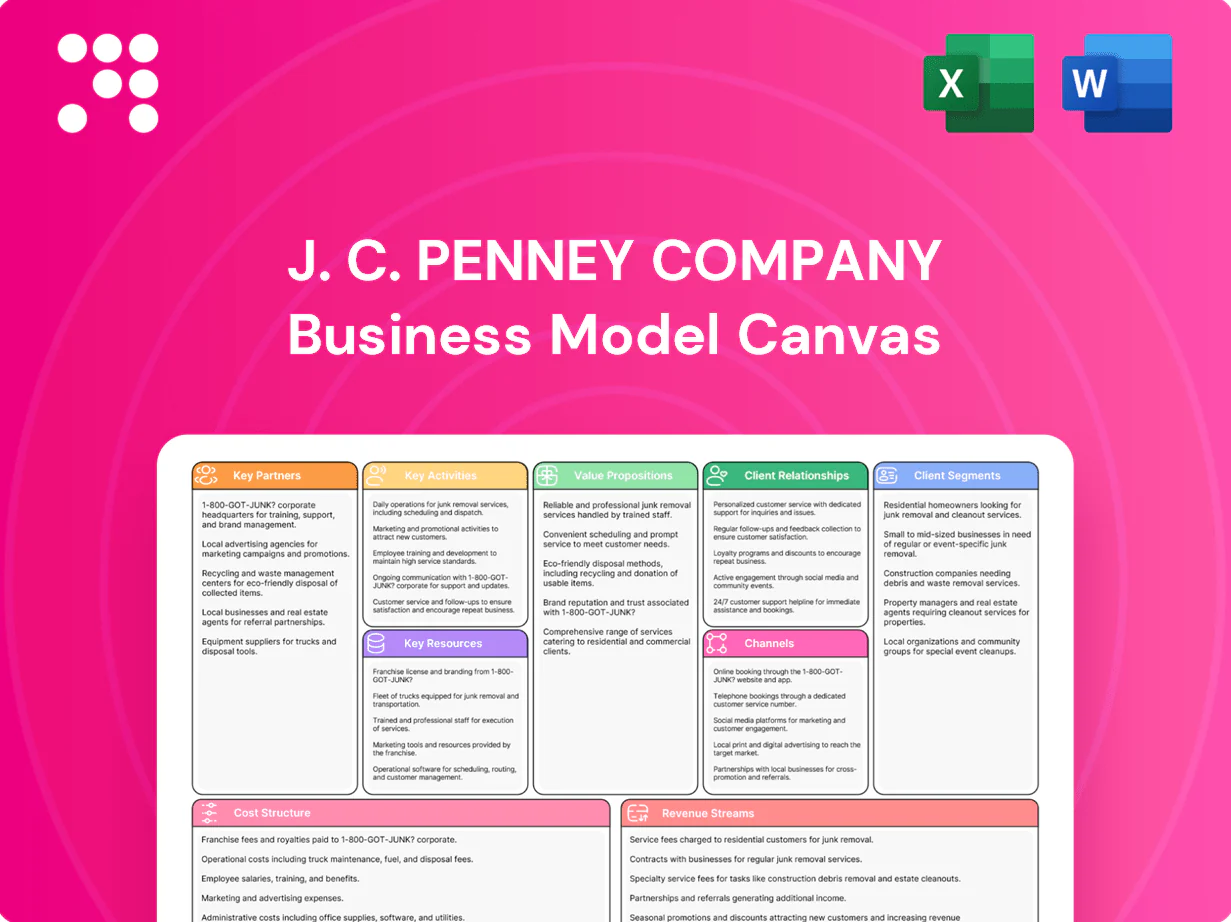
J. C. Penney Company Business Model Canvas

Business Model Canvas: Strategic blueprint for a legacy midmarket department retailer
Unlock the strategic blueprint behind J. C. Penney Company with our Business Model Canvas. This concise analysis maps customer segments, value propositions, channels and revenue streams to reveal competitive levers. Ideal for investors, consultants, and founders seeking actionable insights. Download the full editable canvas for deep analysis.
Partnerships

National and private-label suppliers
Partnerships with national apparel, home, jewelry and beauty suppliers plus private-label brands like Arizona and St. John’s Bay ensure breadth, seasonality and margin mix. Private-label vendors co-develop exclusive lines to differentiate assortment and drive loyalty. Long-term, multi-year vendor agreements secure pricing and allocation. Third-party compliance and quality partners conduct audits to uphold standards across categories.
Logistics and last-mile providers
Third-party carriers, regional couriers and freight forwarders enable J. C. Penney store replenishment and e-commerce delivery, leveraging zone-skipping and cross-docking to cut transit time and cost; last-mile can represent up to 53% of total delivery cost. Returns logistics partners streamline reverse flows, important given e-commerce return rates near 16%. Seasonal capacity contracts cover peak volumes and reduce stockouts.

Financial and payments partners
Banks and card networks enable JCPenney’s credit, debit and BNPL options, crucial as US e-commerce sales hit $1.03 trillion in 2023 (US Census). Co-branded credit partners boost loyalty, basket size and financing offers; revolving consumer credit was about $1.09 trillion in 2023 (Federal Reserve). Fraud-prevention and gateway partners safeguard transactions while gift-card and stored-value platforms expand reach and prepaid revenue.

In-store service operators
In-store optical, salon, and portrait studio partners supply specialized services and generate rental and concession revenue, boosting J. C. Penney’s value-per-visit while vendor-managed operations lower staffing and operational complexity and preserve customer experience. Concessions increase foot traffic and dwell time, and coordinated cross-promotions link services directly to apparel and home merchandise sales.
- Concessions: rental + service revenue
- Vendor-managed: reduced OPEX, consistent service
- Foot traffic: higher dwell time, incremental sales
- Cross-promotions: tie-ins with merchandise
Technology and marketing platforms
Technology and marketing partners power J. C. Penney’s omnichannel: e-commerce, POS, CRM and personalization vendors integrate online and in-store experiences across roughly 600 stores in 2024; ad-tech, social and affiliate networks boost reach and performance marketing; data analytics refine assortment and pricing; cybersecurity firms protect customer and enterprise data.
- E-commerce & POS integration
- CRM & personalization
- Ad-tech, social, affiliate
- Data analytics for pricing
- Cybersecurity protection
Omnichannel partnerships: ~600 stores, last-mile ~53%
Partnerships with national brands and private-label vendors ensure assortment, margins and loyalty. Logistics and returns partners reduce cost and lead time; last-mile can be up to 53% of delivery cost and e-commerce return rates near 16%. Banks, co-branded cards and tech vendors enable payments, loyalty and omnichannel across ~600 stores (2024).
| Partnership | Metric | 2024 |
|---|---|---|
| Stores | Count | ~600 |
| Returns | Rate | ~16% |
| Last-mile | Share of delivery cost | ~53% |
What is included in the product
 Detailed Word Document
A concise, ready-to-use Business Model Canvas for J.C. Penney mapping nine blocks—customer segments (midmarket families, value shoppers), value propositions (affordable apparel, home goods, private labels), channels (stores, e‑commerce, omnichannel services), key partners (brands, landlords), revenue streams, cost structure, key activities and resources, plus linked SWOT and investor-ready insights.

 Customizable Excel Spreadsheet
High-level view of J. C. Penney’s business model with editable cells to quickly identify core retail components and relieve strategic pain points for teams and boards.
Activities

Merchandising and assortment planning
Curate seasonal apparel, home, jewelry and beauty assortments aligned to J. C. Penney value positioning across over 600 stores and digital channels, emphasizing trend-driven basics and giftable categories. Manage private-label versus national-brand mix to boost margin and differentiation, targeting roughly 30% private-label penetration. Use data-driven demand planning and allocation to raise inventory turns and reduce stockouts. Execute disciplined markdown and pricing strategies to clear inventory while protecting gross margin.
Omnichannel retail operations
Operate roughly 600 stores with focused service, visual merchandising and tightened inventory accuracy to reduce stockouts; maintain an e-commerce site and app with digital merchandising to lift conversion. Enable BOPIS, ship-from-store and curbside pickup to shorten fulfillment times, and coordinate cross-channel returns for customer convenience and cost control; digital channels comprised roughly 25% of sales in 2024.

Marketing and loyalty management
Deploy promotions, events and targeted offers to drive in-store and online traffic, aligning with JCPenney’s ~600-store footprint and digital sales representing roughly 30% of revenue in 2024. Manage JCPenney Rewards and co-branded credit incentives to boost AOV and repeat purchase rates. Leverage CRM for tight segmentation and lifecycle campaigns; optimize media mix across digital, social, email and traditional channels to maximize ROAS.

Supply chain and inventory management
Supply chain and inventory management at J. C. Penney focuses on demand forecasting aligned to lead times and vendor capacity, managing distribution centers and store-level replenishment accuracy, enforcing vendor compliance and quality control, and optimizing logistics for cost, speed and peak-season readiness; the chain operates about 600 stores following its 2020 restructuring under Brookfield and Simon (2023).
- Forecasts tied to vendor lead times
- DC and store replenishment accuracy
- Vendor compliance & quality checks
- Logistics cost/speed optimization
In-store services delivery
Operate and coordinate in-store optical, salon, and portrait services across J. C. Penney’s network of over 600 stores to enhance customer experience and drive traffic.
Schedule staffing, maintain equipment and service standards centrally, and integrate service offers with retail promotions to lift basket size by an estimated 10–20%.
Capture transaction-linked feedback and repeat-utilization metrics to iterate offers and improve retention.
- service types: optical, salon, portrait
- store footprint: over 600 locations (2024)
- estimated basket lift: 10–20%
- KPIs: repeat rate, NPS, attach rate
~600 stores, 25–30% digital, 30% PL
Curate seasonal apparel, home and beauty assortments across ~600 stores and omnichannel, targeting ~30% private-label mix to protect margins. Run supply chain, DCs and store replenishment to boost turns and support ~25–30% digital sales (2024), with BOPIS and ship-from-store. Operate optical, salon and portrait services to lift basket ~10–20% and track repeat rate, NPS and attach rate.
| Metric | 2024 |
|---|---|
| Stores | ~600 |
| Digital % of Sales | 25–30% |
| Private-label | ~30% |
| Basket lift (services) | 10–20% |
Delivered as Displayed
Business Model Canvas
The Business Model Canvas for J. C. Penney you see here is the actual, editable deliverable—not a mockup. After purchase you'll receive this same complete document, formatted and ready to edit in Word and Excel, with all sections and content intact.

Business Model Canvas: Strategic blueprint for a legacy midmarket department retailer
Unlock the strategic blueprint behind J. C. Penney Company with our Business Model Canvas. This concise analysis maps customer segments, value propositions, channels and revenue streams to reveal competitive levers. Ideal for investors, consultants, and founders seeking actionable insights. Download the full editable canvas for deep analysis.
Partnerships
National and private-label suppliers
Partnerships with national apparel, home, jewelry and beauty suppliers plus private-label brands like Arizona and St. John’s Bay ensure breadth, seasonality and margin mix. Private-label vendors co-develop exclusive lines to differentiate assortment and drive loyalty. Long-term, multi-year vendor agreements secure pricing and allocation. Third-party compliance and quality partners conduct audits to uphold standards across categories.
Logistics and last-mile providers
Third-party carriers, regional couriers and freight forwarders enable J. C. Penney store replenishment and e-commerce delivery, leveraging zone-skipping and cross-docking to cut transit time and cost; last-mile can represent up to 53% of total delivery cost. Returns logistics partners streamline reverse flows, important given e-commerce return rates near 16%. Seasonal capacity contracts cover peak volumes and reduce stockouts.
Financial and payments partners
Banks and card networks enable JCPenney’s credit, debit and BNPL options, crucial as US e-commerce sales hit $1.03 trillion in 2023 (US Census). Co-branded credit partners boost loyalty, basket size and financing offers; revolving consumer credit was about $1.09 trillion in 2023 (Federal Reserve). Fraud-prevention and gateway partners safeguard transactions while gift-card and stored-value platforms expand reach and prepaid revenue.
In-store service operators
In-store optical, salon, and portrait studio partners supply specialized services and generate rental and concession revenue, boosting J. C. Penney’s value-per-visit while vendor-managed operations lower staffing and operational complexity and preserve customer experience. Concessions increase foot traffic and dwell time, and coordinated cross-promotions link services directly to apparel and home merchandise sales.
- Concessions: rental + service revenue
- Vendor-managed: reduced OPEX, consistent service
- Foot traffic: higher dwell time, incremental sales
- Cross-promotions: tie-ins with merchandise
Technology and marketing platforms
Technology and marketing partners power J. C. Penney’s omnichannel: e-commerce, POS, CRM and personalization vendors integrate online and in-store experiences across roughly 600 stores in 2024; ad-tech, social and affiliate networks boost reach and performance marketing; data analytics refine assortment and pricing; cybersecurity firms protect customer and enterprise data.
- E-commerce & POS integration
- CRM & personalization
- Ad-tech, social, affiliate
- Data analytics for pricing
- Cybersecurity protection
Omnichannel partnerships: ~600 stores, last-mile ~53%
Partnerships with national brands and private-label vendors ensure assortment, margins and loyalty. Logistics and returns partners reduce cost and lead time; last-mile can be up to 53% of delivery cost and e-commerce return rates near 16%. Banks, co-branded cards and tech vendors enable payments, loyalty and omnichannel across ~600 stores (2024).
| Partnership | Metric | 2024 |
|---|---|---|
| Stores | Count | ~600 |
| Returns | Rate | ~16% |
| Last-mile | Share of delivery cost | ~53% |
What is included in the product
Detailed Word Document
A concise, ready-to-use Business Model Canvas for J.C. Penney mapping nine blocks—customer segments (midmarket families, value shoppers), value propositions (affordable apparel, home goods, private labels), channels (stores, e‑commerce, omnichannel services), key partners (brands, landlords), revenue streams, cost structure, key activities and resources, plus linked SWOT and investor-ready insights.
Customizable Excel Spreadsheet
High-level view of J. C. Penney’s business model with editable cells to quickly identify core retail components and relieve strategic pain points for teams and boards.
Activities
Merchandising and assortment planning
Curate seasonal apparel, home, jewelry and beauty assortments aligned to J. C. Penney value positioning across over 600 stores and digital channels, emphasizing trend-driven basics and giftable categories. Manage private-label versus national-brand mix to boost margin and differentiation, targeting roughly 30% private-label penetration. Use data-driven demand planning and allocation to raise inventory turns and reduce stockouts. Execute disciplined markdown and pricing strategies to clear inventory while protecting gross margin.
Omnichannel retail operations
Operate roughly 600 stores with focused service, visual merchandising and tightened inventory accuracy to reduce stockouts; maintain an e-commerce site and app with digital merchandising to lift conversion. Enable BOPIS, ship-from-store and curbside pickup to shorten fulfillment times, and coordinate cross-channel returns for customer convenience and cost control; digital channels comprised roughly 25% of sales in 2024.
Marketing and loyalty management
Deploy promotions, events and targeted offers to drive in-store and online traffic, aligning with JCPenney’s ~600-store footprint and digital sales representing roughly 30% of revenue in 2024. Manage JCPenney Rewards and co-branded credit incentives to boost AOV and repeat purchase rates. Leverage CRM for tight segmentation and lifecycle campaigns; optimize media mix across digital, social, email and traditional channels to maximize ROAS.
Supply chain and inventory management
Supply chain and inventory management at J. C. Penney focuses on demand forecasting aligned to lead times and vendor capacity, managing distribution centers and store-level replenishment accuracy, enforcing vendor compliance and quality control, and optimizing logistics for cost, speed and peak-season readiness; the chain operates about 600 stores following its 2020 restructuring under Brookfield and Simon (2023).
- Forecasts tied to vendor lead times
- DC and store replenishment accuracy
- Vendor compliance & quality checks
- Logistics cost/speed optimization
In-store services delivery
Operate and coordinate in-store optical, salon, and portrait services across J. C. Penney’s network of over 600 stores to enhance customer experience and drive traffic.
Schedule staffing, maintain equipment and service standards centrally, and integrate service offers with retail promotions to lift basket size by an estimated 10–20%.
Capture transaction-linked feedback and repeat-utilization metrics to iterate offers and improve retention.
- service types: optical, salon, portrait
- store footprint: over 600 locations (2024)
- estimated basket lift: 10–20%
- KPIs: repeat rate, NPS, attach rate
~600 stores, 25–30% digital, 30% PL
Curate seasonal apparel, home and beauty assortments across ~600 stores and omnichannel, targeting ~30% private-label mix to protect margins. Run supply chain, DCs and store replenishment to boost turns and support ~25–30% digital sales (2024), with BOPIS and ship-from-store. Operate optical, salon and portrait services to lift basket ~10–20% and track repeat rate, NPS and attach rate.
| Metric | 2024 |
|---|---|
| Stores | ~600 |
| Digital % of Sales | 25–30% |
| Private-label | ~30% |
| Basket lift (services) | 10–20% |
Delivered as Displayed
Business Model Canvas
The Business Model Canvas for J. C. Penney you see here is the actual, editable deliverable—not a mockup. After purchase you'll receive this same complete document, formatted and ready to edit in Word and Excel, with all sections and content intact.
Original: $10.00
-65%$10.00
$3.50Description
Business Model Canvas: Strategic blueprint for a legacy midmarket department retailer
Unlock the strategic blueprint behind J. C. Penney Company with our Business Model Canvas. This concise analysis maps customer segments, value propositions, channels and revenue streams to reveal competitive levers. Ideal for investors, consultants, and founders seeking actionable insights. Download the full editable canvas for deep analysis.
Partnerships
National and private-label suppliers
Partnerships with national apparel, home, jewelry and beauty suppliers plus private-label brands like Arizona and St. John’s Bay ensure breadth, seasonality and margin mix. Private-label vendors co-develop exclusive lines to differentiate assortment and drive loyalty. Long-term, multi-year vendor agreements secure pricing and allocation. Third-party compliance and quality partners conduct audits to uphold standards across categories.
Logistics and last-mile providers
Third-party carriers, regional couriers and freight forwarders enable J. C. Penney store replenishment and e-commerce delivery, leveraging zone-skipping and cross-docking to cut transit time and cost; last-mile can represent up to 53% of total delivery cost. Returns logistics partners streamline reverse flows, important given e-commerce return rates near 16%. Seasonal capacity contracts cover peak volumes and reduce stockouts.
Financial and payments partners
Banks and card networks enable JCPenney’s credit, debit and BNPL options, crucial as US e-commerce sales hit $1.03 trillion in 2023 (US Census). Co-branded credit partners boost loyalty, basket size and financing offers; revolving consumer credit was about $1.09 trillion in 2023 (Federal Reserve). Fraud-prevention and gateway partners safeguard transactions while gift-card and stored-value platforms expand reach and prepaid revenue.
In-store service operators
In-store optical, salon, and portrait studio partners supply specialized services and generate rental and concession revenue, boosting J. C. Penney’s value-per-visit while vendor-managed operations lower staffing and operational complexity and preserve customer experience. Concessions increase foot traffic and dwell time, and coordinated cross-promotions link services directly to apparel and home merchandise sales.
- Concessions: rental + service revenue
- Vendor-managed: reduced OPEX, consistent service
- Foot traffic: higher dwell time, incremental sales
- Cross-promotions: tie-ins with merchandise
Technology and marketing platforms
Technology and marketing partners power J. C. Penney’s omnichannel: e-commerce, POS, CRM and personalization vendors integrate online and in-store experiences across roughly 600 stores in 2024; ad-tech, social and affiliate networks boost reach and performance marketing; data analytics refine assortment and pricing; cybersecurity firms protect customer and enterprise data.
- E-commerce & POS integration
- CRM & personalization
- Ad-tech, social, affiliate
- Data analytics for pricing
- Cybersecurity protection
Omnichannel partnerships: ~600 stores, last-mile ~53%
Partnerships with national brands and private-label vendors ensure assortment, margins and loyalty. Logistics and returns partners reduce cost and lead time; last-mile can be up to 53% of delivery cost and e-commerce return rates near 16%. Banks, co-branded cards and tech vendors enable payments, loyalty and omnichannel across ~600 stores (2024).
| Partnership | Metric | 2024 |
|---|---|---|
| Stores | Count | ~600 |
| Returns | Rate | ~16% |
| Last-mile | Share of delivery cost | ~53% |
What is included in the product
Detailed Word Document
A concise, ready-to-use Business Model Canvas for J.C. Penney mapping nine blocks—customer segments (midmarket families, value shoppers), value propositions (affordable apparel, home goods, private labels), channels (stores, e‑commerce, omnichannel services), key partners (brands, landlords), revenue streams, cost structure, key activities and resources, plus linked SWOT and investor-ready insights.
Customizable Excel Spreadsheet
High-level view of J. C. Penney’s business model with editable cells to quickly identify core retail components and relieve strategic pain points for teams and boards.
Activities
Merchandising and assortment planning
Curate seasonal apparel, home, jewelry and beauty assortments aligned to J. C. Penney value positioning across over 600 stores and digital channels, emphasizing trend-driven basics and giftable categories. Manage private-label versus national-brand mix to boost margin and differentiation, targeting roughly 30% private-label penetration. Use data-driven demand planning and allocation to raise inventory turns and reduce stockouts. Execute disciplined markdown and pricing strategies to clear inventory while protecting gross margin.
Omnichannel retail operations
Operate roughly 600 stores with focused service, visual merchandising and tightened inventory accuracy to reduce stockouts; maintain an e-commerce site and app with digital merchandising to lift conversion. Enable BOPIS, ship-from-store and curbside pickup to shorten fulfillment times, and coordinate cross-channel returns for customer convenience and cost control; digital channels comprised roughly 25% of sales in 2024.
Marketing and loyalty management
Deploy promotions, events and targeted offers to drive in-store and online traffic, aligning with JCPenney’s ~600-store footprint and digital sales representing roughly 30% of revenue in 2024. Manage JCPenney Rewards and co-branded credit incentives to boost AOV and repeat purchase rates. Leverage CRM for tight segmentation and lifecycle campaigns; optimize media mix across digital, social, email and traditional channels to maximize ROAS.
Supply chain and inventory management
Supply chain and inventory management at J. C. Penney focuses on demand forecasting aligned to lead times and vendor capacity, managing distribution centers and store-level replenishment accuracy, enforcing vendor compliance and quality control, and optimizing logistics for cost, speed and peak-season readiness; the chain operates about 600 stores following its 2020 restructuring under Brookfield and Simon (2023).
- Forecasts tied to vendor lead times
- DC and store replenishment accuracy
- Vendor compliance & quality checks
- Logistics cost/speed optimization
In-store services delivery
Operate and coordinate in-store optical, salon, and portrait services across J. C. Penney’s network of over 600 stores to enhance customer experience and drive traffic.
Schedule staffing, maintain equipment and service standards centrally, and integrate service offers with retail promotions to lift basket size by an estimated 10–20%.
Capture transaction-linked feedback and repeat-utilization metrics to iterate offers and improve retention.
- service types: optical, salon, portrait
- store footprint: over 600 locations (2024)
- estimated basket lift: 10–20%
- KPIs: repeat rate, NPS, attach rate
~600 stores, 25–30% digital, 30% PL
Curate seasonal apparel, home and beauty assortments across ~600 stores and omnichannel, targeting ~30% private-label mix to protect margins. Run supply chain, DCs and store replenishment to boost turns and support ~25–30% digital sales (2024), with BOPIS and ship-from-store. Operate optical, salon and portrait services to lift basket ~10–20% and track repeat rate, NPS and attach rate.
| Metric | 2024 |
|---|---|
| Stores | ~600 |
| Digital % of Sales | 25–30% |
| Private-label | ~30% |
| Basket lift (services) | 10–20% |
Delivered as Displayed
Business Model Canvas
The Business Model Canvas for J. C. Penney you see here is the actual, editable deliverable—not a mockup. After purchase you'll receive this same complete document, formatted and ready to edit in Word and Excel, with all sections and content intact.











