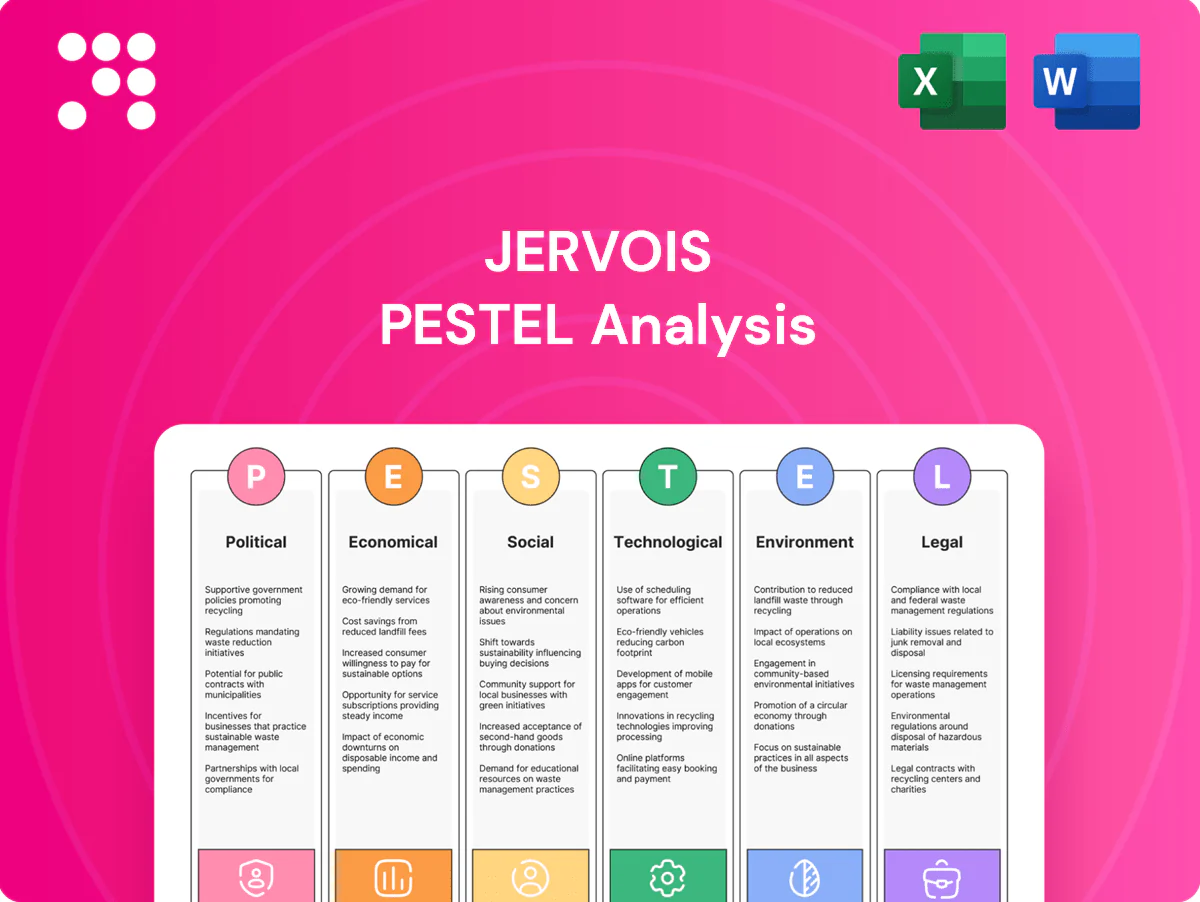
Jervois PESTLE Analysis

Your Shortcut to Market Insight Starts Here
Our PESTLE analysis for Jervois dissects the political, economic, social, technological, legal, and environmental forces shaping its nickel and cobalt business, highlighting regulatory risks, market drivers, and sustainability pressures. Actionable insights reveal opportunities and threats for investors and strategists alike. Purchase the full report for the complete, editable breakdown and make informed decisions with confidence.
Political factors

Critical minerals policy
US Inflation Reduction Act allocates about $369 billion in clean energy tax incentives and favors domestic critical minerals processing, while the EU Critical Raw Materials Act targets by 2030 at least 10% of consumption from domestic extraction, 40% from processing and 15% from recycling; Jervois could win grants, tax credits and priority permitting by locating value-add steps in these jurisdictions. Compliance and reporting requirements rise with subsidies, and post-election policy shifts can rapidly change incentive calculus.
Resource nationalism risk
Resource nationalism risk is rising as host states tighten royalties, local‑content and export rules — Indonesia's 2020 nickel ore export ban is a high‑profile example — and several African and Latin American jurisdictions debated similar measures in 2023–24. Jervois, with projects in the US (Idaho), Brazil (Sao Miguel) and Australia (NiWest), must structure JV, offtake and fiscal terms to hedge policy shifts. Stability agreements and political risk insurance can materially reduce sovereign risk exposure.

Geopolitical tensions
US–China rivalry and Russia-related sanctions have disrupted nickel and cobalt trade flows, with China refining over 80% of cobalt chemicals and accounting for more than 60% of nickel sulfate processing, while Russia historically supplied about 10% of mined nickel. Concentrated refining capacity in a few countries raises supply-security risks for OEMs. Jervois’ diversified footprint across the Americas, Europe and Australasia can serve as a strategic hedge for Western OEMs. Shipping routes, insurance and war-risk premiums remain volatile and unpredictable.

Permitting timelines
Permitting timelines for mining and refining projects commonly span 18–36 months across federal, state and local approvals, creating friction between political pressure for faster energy transition and community/environmental scrutiny. Jervois must front-load stakeholder engagement and baseline studies to de‑risk schedules; delays directly shift project NPV and contract timing.
- 18–36 months typical approvals
- Political push vs community scrutiny
- Front-load engagement & baseline studies
- Delays alter NPV and contract milestones
Government procurement
Public EV fleets and defense procurement increasingly prioritize domestic, ethically sourced critical minerals; US Executive Order 14057 (2021) pushes federal EV acquisition by 2030 and the Inflation Reduction Act (2022) links up to 7,500 USD clean vehicle tax credits to critical-mineral sourcing, improving visibility for approved suppliers. Jervois must deliver traceability and compliance proofs (chain-of-custody, ESG audits) to win tenders. Policy reversals or budget cuts remain a material demand risk.
- domestic preference — federal EO 14057
- IRA incentive — up to 7,500 USD credit
- must provide traceability & compliance proofs
- risk — policy reversals/budget cuts
China refining dominance, IRA subsidies and resource nationalism tighten battery-metals supply
Political drivers: IRA’s ~369bn USD and EU CRMA push subsidies for domestic processing; China refines >80% cobalt chemicals and >60% nickel sulfate, raising supply‑security premiums. Resource nationalism (Indonesia ore ban) and 18–36 month permits increase fiscal and schedule risk for Jervois’ Idaho, Sao Miguel and NiWest assets. Traceability and local‑content rules determine access to EV/defense contracts.
| Metric | Value |
|---|---|
| IRA funding | ~369bn USD |
| China refining | >80% cobalt, >60% nickel sulfate |
| Permitting | 18–36 months |
What is included in the product
 Detailed Word Document
Explores how macro-environmental factors—Political, Economic, Social, Technological, Environmental and Legal—specifically affect Jervois, combining data-driven trends, region- and industry-specific examples, and forward-looking insights to help executives and investors identify risks, opportunities and strategic actions.

 Customizable Excel Spreadsheet
Condenses Jervois's full PESTLE into a clean, shareable summary—visually segmented for quick meetings, editable for region-specific notes and slide-ready use.
Economic factors

Price volatility
Price volatility in cobalt and nickel remains high—EV sales reached about 14 million vehicles in 2024, driving cyclical demand, while Indonesian supply expansion (now supplying over 40% of global nickel) and macro swings amplify swings. Oversupply from new HPAL and NPI-to-matte routes can compress margins; Jervois uses offtakes and hedging to stabilize cash flow, and must tightly manage inventory and working capital to protect margins.
EV demand elasticity
Global EV adoption drives long-run cobalt demand but short-term sales track incentives and consumer confidence; IEA recorded EVs at about 14% of global new car sales in 2023. Battery chemistry shifts from NMC111 toward NMC811 have cut cobalt intensity to roughly 4–5% of cell cathode mass. Jervois should diversify into nickel and specialty metals to smooth cyclical swings, using scenario planning to align capacity with projected uptake.

Cost inflation
Rising energy (+~15% YoY in 2024), sulfuric acid (+~25% in 2023–24), reagent and labor cost inflation (miner wages up ~6–8% in 2024) have materially increased Jervois mining and refining opex. Logistics bottlenecks pushed freight and insurance costs higher (spot freight volatility +10–30% in 2023–24). Jervois can secure renewable PPAs and efficiency CAPEX to lower unit costs. Longer supplier contracts and local sourcing reduce input-price volatility.

Capital intensity
Capital intensity: greenfield mines and refineries require very large upfront capex and multi‑year paybacks, making project economics highly sensitive to financing costs; US policy rates were 5.25–5.50% (July 2025), raising discount rates and financing costs for miners and refiners.
- Strategic partners and prepayment offtakes reduce financing risk
- Staged expansions preserve balance sheet flexibility
- Credit spreads and rates drive project viability
FX exposure
Revenue is largely USD-linked while costs are paid in multiple currencies, so FX swings in 2024 (notably a stronger USD) eroded margins and shifted competitiveness; natural hedges and derivatives can stabilise reported earnings, and treasury policies must align with project cash-flow profiles and timing.
China refining dominance, IRA subsidies and resource nationalism tighten battery-metals supply
Price volatility in cobalt/nickel remains high (EVs ~14M in 2024; Indonesia >40% nickel). Input inflation: energy +15% YoY (2024), sulfuric acid +25% (2023–24), wages +6–8% (2024). US rates 5.25–5.50% (Jul‑2025) raise financing costs; USD strength in 2024 compressed margins; use hedging, offtakes and staged capex to mitigate.
| Metric | Value |
|---|---|
| EVs (2024) | ~14M |
| Indonesia nickel | >40% |
| Energy inflation | +15% (2024) |
| US rates | 5.25–5.50% (Jul‑2025) |
What You See Is What You Get
Jervois PESTLE Analysis
The preview shown here is the exact Jervois PESTLE Analysis document you’ll receive after purchase—fully formatted and ready to use. The layout, content, and structure visible here are exactly what you’ll be able to download immediately after buying. No placeholders, no surprises—this is the real, final file.

Your Shortcut to Market Insight Starts Here
Our PESTLE analysis for Jervois dissects the political, economic, social, technological, legal, and environmental forces shaping its nickel and cobalt business, highlighting regulatory risks, market drivers, and sustainability pressures. Actionable insights reveal opportunities and threats for investors and strategists alike. Purchase the full report for the complete, editable breakdown and make informed decisions with confidence.
Political factors
Critical minerals policy
US Inflation Reduction Act allocates about $369 billion in clean energy tax incentives and favors domestic critical minerals processing, while the EU Critical Raw Materials Act targets by 2030 at least 10% of consumption from domestic extraction, 40% from processing and 15% from recycling; Jervois could win grants, tax credits and priority permitting by locating value-add steps in these jurisdictions. Compliance and reporting requirements rise with subsidies, and post-election policy shifts can rapidly change incentive calculus.
Resource nationalism risk
Resource nationalism risk is rising as host states tighten royalties, local‑content and export rules — Indonesia's 2020 nickel ore export ban is a high‑profile example — and several African and Latin American jurisdictions debated similar measures in 2023–24. Jervois, with projects in the US (Idaho), Brazil (Sao Miguel) and Australia (NiWest), must structure JV, offtake and fiscal terms to hedge policy shifts. Stability agreements and political risk insurance can materially reduce sovereign risk exposure.
Geopolitical tensions
US–China rivalry and Russia-related sanctions have disrupted nickel and cobalt trade flows, with China refining over 80% of cobalt chemicals and accounting for more than 60% of nickel sulfate processing, while Russia historically supplied about 10% of mined nickel. Concentrated refining capacity in a few countries raises supply-security risks for OEMs. Jervois’ diversified footprint across the Americas, Europe and Australasia can serve as a strategic hedge for Western OEMs. Shipping routes, insurance and war-risk premiums remain volatile and unpredictable.
Permitting timelines
Permitting timelines for mining and refining projects commonly span 18–36 months across federal, state and local approvals, creating friction between political pressure for faster energy transition and community/environmental scrutiny. Jervois must front-load stakeholder engagement and baseline studies to de‑risk schedules; delays directly shift project NPV and contract timing.
- 18–36 months typical approvals
- Political push vs community scrutiny
- Front-load engagement & baseline studies
- Delays alter NPV and contract milestones
Government procurement
Public EV fleets and defense procurement increasingly prioritize domestic, ethically sourced critical minerals; US Executive Order 14057 (2021) pushes federal EV acquisition by 2030 and the Inflation Reduction Act (2022) links up to 7,500 USD clean vehicle tax credits to critical-mineral sourcing, improving visibility for approved suppliers. Jervois must deliver traceability and compliance proofs (chain-of-custody, ESG audits) to win tenders. Policy reversals or budget cuts remain a material demand risk.
- domestic preference — federal EO 14057
- IRA incentive — up to 7,500 USD credit
- must provide traceability & compliance proofs
- risk — policy reversals/budget cuts
China refining dominance, IRA subsidies and resource nationalism tighten battery-metals supply
Political drivers: IRA’s ~369bn USD and EU CRMA push subsidies for domestic processing; China refines >80% cobalt chemicals and >60% nickel sulfate, raising supply‑security premiums. Resource nationalism (Indonesia ore ban) and 18–36 month permits increase fiscal and schedule risk for Jervois’ Idaho, Sao Miguel and NiWest assets. Traceability and local‑content rules determine access to EV/defense contracts.
| Metric | Value |
|---|---|
| IRA funding | ~369bn USD |
| China refining | >80% cobalt, >60% nickel sulfate |
| Permitting | 18–36 months |
What is included in the product
Detailed Word Document
Explores how macro-environmental factors—Political, Economic, Social, Technological, Environmental and Legal—specifically affect Jervois, combining data-driven trends, region- and industry-specific examples, and forward-looking insights to help executives and investors identify risks, opportunities and strategic actions.
Customizable Excel Spreadsheet
Condenses Jervois's full PESTLE into a clean, shareable summary—visually segmented for quick meetings, editable for region-specific notes and slide-ready use.
Economic factors
Price volatility
Price volatility in cobalt and nickel remains high—EV sales reached about 14 million vehicles in 2024, driving cyclical demand, while Indonesian supply expansion (now supplying over 40% of global nickel) and macro swings amplify swings. Oversupply from new HPAL and NPI-to-matte routes can compress margins; Jervois uses offtakes and hedging to stabilize cash flow, and must tightly manage inventory and working capital to protect margins.
EV demand elasticity
Global EV adoption drives long-run cobalt demand but short-term sales track incentives and consumer confidence; IEA recorded EVs at about 14% of global new car sales in 2023. Battery chemistry shifts from NMC111 toward NMC811 have cut cobalt intensity to roughly 4–5% of cell cathode mass. Jervois should diversify into nickel and specialty metals to smooth cyclical swings, using scenario planning to align capacity with projected uptake.
Cost inflation
Rising energy (+~15% YoY in 2024), sulfuric acid (+~25% in 2023–24), reagent and labor cost inflation (miner wages up ~6–8% in 2024) have materially increased Jervois mining and refining opex. Logistics bottlenecks pushed freight and insurance costs higher (spot freight volatility +10–30% in 2023–24). Jervois can secure renewable PPAs and efficiency CAPEX to lower unit costs. Longer supplier contracts and local sourcing reduce input-price volatility.
Capital intensity
Capital intensity: greenfield mines and refineries require very large upfront capex and multi‑year paybacks, making project economics highly sensitive to financing costs; US policy rates were 5.25–5.50% (July 2025), raising discount rates and financing costs for miners and refiners.
- Strategic partners and prepayment offtakes reduce financing risk
- Staged expansions preserve balance sheet flexibility
- Credit spreads and rates drive project viability
FX exposure
Revenue is largely USD-linked while costs are paid in multiple currencies, so FX swings in 2024 (notably a stronger USD) eroded margins and shifted competitiveness; natural hedges and derivatives can stabilise reported earnings, and treasury policies must align with project cash-flow profiles and timing.
China refining dominance, IRA subsidies and resource nationalism tighten battery-metals supply
Price volatility in cobalt/nickel remains high (EVs ~14M in 2024; Indonesia >40% nickel). Input inflation: energy +15% YoY (2024), sulfuric acid +25% (2023–24), wages +6–8% (2024). US rates 5.25–5.50% (Jul‑2025) raise financing costs; USD strength in 2024 compressed margins; use hedging, offtakes and staged capex to mitigate.
| Metric | Value |
|---|---|
| EVs (2024) | ~14M |
| Indonesia nickel | >40% |
| Energy inflation | +15% (2024) |
| US rates | 5.25–5.50% (Jul‑2025) |
What You See Is What You Get
Jervois PESTLE Analysis
The preview shown here is the exact Jervois PESTLE Analysis document you’ll receive after purchase—fully formatted and ready to use. The layout, content, and structure visible here are exactly what you’ll be able to download immediately after buying. No placeholders, no surprises—this is the real, final file.
Description
Your Shortcut to Market Insight Starts Here
Our PESTLE analysis for Jervois dissects the political, economic, social, technological, legal, and environmental forces shaping its nickel and cobalt business, highlighting regulatory risks, market drivers, and sustainability pressures. Actionable insights reveal opportunities and threats for investors and strategists alike. Purchase the full report for the complete, editable breakdown and make informed decisions with confidence.
Political factors
Critical minerals policy
US Inflation Reduction Act allocates about $369 billion in clean energy tax incentives and favors domestic critical minerals processing, while the EU Critical Raw Materials Act targets by 2030 at least 10% of consumption from domestic extraction, 40% from processing and 15% from recycling; Jervois could win grants, tax credits and priority permitting by locating value-add steps in these jurisdictions. Compliance and reporting requirements rise with subsidies, and post-election policy shifts can rapidly change incentive calculus.
Resource nationalism risk
Resource nationalism risk is rising as host states tighten royalties, local‑content and export rules — Indonesia's 2020 nickel ore export ban is a high‑profile example — and several African and Latin American jurisdictions debated similar measures in 2023–24. Jervois, with projects in the US (Idaho), Brazil (Sao Miguel) and Australia (NiWest), must structure JV, offtake and fiscal terms to hedge policy shifts. Stability agreements and political risk insurance can materially reduce sovereign risk exposure.
Geopolitical tensions
US–China rivalry and Russia-related sanctions have disrupted nickel and cobalt trade flows, with China refining over 80% of cobalt chemicals and accounting for more than 60% of nickel sulfate processing, while Russia historically supplied about 10% of mined nickel. Concentrated refining capacity in a few countries raises supply-security risks for OEMs. Jervois’ diversified footprint across the Americas, Europe and Australasia can serve as a strategic hedge for Western OEMs. Shipping routes, insurance and war-risk premiums remain volatile and unpredictable.
Permitting timelines
Permitting timelines for mining and refining projects commonly span 18–36 months across federal, state and local approvals, creating friction between political pressure for faster energy transition and community/environmental scrutiny. Jervois must front-load stakeholder engagement and baseline studies to de‑risk schedules; delays directly shift project NPV and contract timing.
- 18–36 months typical approvals
- Political push vs community scrutiny
- Front-load engagement & baseline studies
- Delays alter NPV and contract milestones
Government procurement
Public EV fleets and defense procurement increasingly prioritize domestic, ethically sourced critical minerals; US Executive Order 14057 (2021) pushes federal EV acquisition by 2030 and the Inflation Reduction Act (2022) links up to 7,500 USD clean vehicle tax credits to critical-mineral sourcing, improving visibility for approved suppliers. Jervois must deliver traceability and compliance proofs (chain-of-custody, ESG audits) to win tenders. Policy reversals or budget cuts remain a material demand risk.
- domestic preference — federal EO 14057
- IRA incentive — up to 7,500 USD credit
- must provide traceability & compliance proofs
- risk — policy reversals/budget cuts
China refining dominance, IRA subsidies and resource nationalism tighten battery-metals supply
Political drivers: IRA’s ~369bn USD and EU CRMA push subsidies for domestic processing; China refines >80% cobalt chemicals and >60% nickel sulfate, raising supply‑security premiums. Resource nationalism (Indonesia ore ban) and 18–36 month permits increase fiscal and schedule risk for Jervois’ Idaho, Sao Miguel and NiWest assets. Traceability and local‑content rules determine access to EV/defense contracts.
| Metric | Value |
|---|---|
| IRA funding | ~369bn USD |
| China refining | >80% cobalt, >60% nickel sulfate |
| Permitting | 18–36 months |
What is included in the product
Detailed Word Document
Explores how macro-environmental factors—Political, Economic, Social, Technological, Environmental and Legal—specifically affect Jervois, combining data-driven trends, region- and industry-specific examples, and forward-looking insights to help executives and investors identify risks, opportunities and strategic actions.
Customizable Excel Spreadsheet
Condenses Jervois's full PESTLE into a clean, shareable summary—visually segmented for quick meetings, editable for region-specific notes and slide-ready use.
Economic factors
Price volatility
Price volatility in cobalt and nickel remains high—EV sales reached about 14 million vehicles in 2024, driving cyclical demand, while Indonesian supply expansion (now supplying over 40% of global nickel) and macro swings amplify swings. Oversupply from new HPAL and NPI-to-matte routes can compress margins; Jervois uses offtakes and hedging to stabilize cash flow, and must tightly manage inventory and working capital to protect margins.
EV demand elasticity
Global EV adoption drives long-run cobalt demand but short-term sales track incentives and consumer confidence; IEA recorded EVs at about 14% of global new car sales in 2023. Battery chemistry shifts from NMC111 toward NMC811 have cut cobalt intensity to roughly 4–5% of cell cathode mass. Jervois should diversify into nickel and specialty metals to smooth cyclical swings, using scenario planning to align capacity with projected uptake.
Cost inflation
Rising energy (+~15% YoY in 2024), sulfuric acid (+~25% in 2023–24), reagent and labor cost inflation (miner wages up ~6–8% in 2024) have materially increased Jervois mining and refining opex. Logistics bottlenecks pushed freight and insurance costs higher (spot freight volatility +10–30% in 2023–24). Jervois can secure renewable PPAs and efficiency CAPEX to lower unit costs. Longer supplier contracts and local sourcing reduce input-price volatility.
Capital intensity
Capital intensity: greenfield mines and refineries require very large upfront capex and multi‑year paybacks, making project economics highly sensitive to financing costs; US policy rates were 5.25–5.50% (July 2025), raising discount rates and financing costs for miners and refiners.
- Strategic partners and prepayment offtakes reduce financing risk
- Staged expansions preserve balance sheet flexibility
- Credit spreads and rates drive project viability
FX exposure
Revenue is largely USD-linked while costs are paid in multiple currencies, so FX swings in 2024 (notably a stronger USD) eroded margins and shifted competitiveness; natural hedges and derivatives can stabilise reported earnings, and treasury policies must align with project cash-flow profiles and timing.
China refining dominance, IRA subsidies and resource nationalism tighten battery-metals supply
Price volatility in cobalt/nickel remains high (EVs ~14M in 2024; Indonesia >40% nickel). Input inflation: energy +15% YoY (2024), sulfuric acid +25% (2023–24), wages +6–8% (2024). US rates 5.25–5.50% (Jul‑2025) raise financing costs; USD strength in 2024 compressed margins; use hedging, offtakes and staged capex to mitigate.
| Metric | Value |
|---|---|
| EVs (2024) | ~14M |
| Indonesia nickel | >40% |
| Energy inflation | +15% (2024) |
| US rates | 5.25–5.50% (Jul‑2025) |
What You See Is What You Get
Jervois PESTLE Analysis
The preview shown here is the exact Jervois PESTLE Analysis document you’ll receive after purchase—fully formatted and ready to use. The layout, content, and structure visible here are exactly what you’ll be able to download immediately after buying. No placeholders, no surprises—this is the real, final file.











