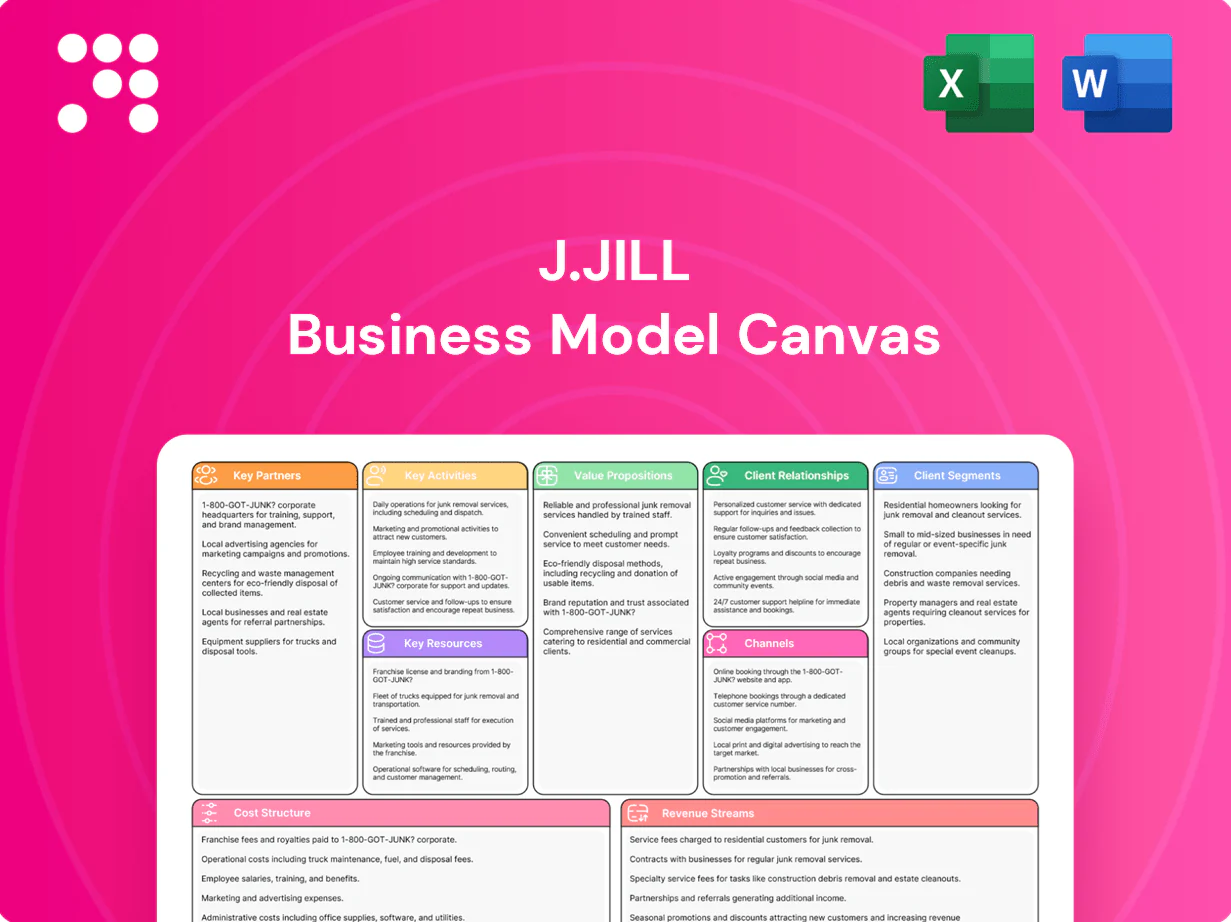
J.Jill Business Model Canvas

Business Model Canvas: Retail Brand Playbook for Investors and Strategists
Discover J.Jill’s strategic playbook in our concise Business Model Canvas—three to five sentences that map customer segments, value propositions, and revenue levers. Dive into the full Canvas for a section-by-section blueprint, editable in Word and Excel, ideal for benchmarking, investor decks, or strategy work. Purchase the complete file to unlock actionable insights and replicate what drives J.Jill’s performance.
Partnerships

Apparel manufacturers
Partner with specialized cut-and-sew factories to ensure consistent fits and fabrics, leveraging partners with 60–90 day lead times common in 2024 softgoods sourcing. Secure flexible capacity for seasonal drops and replenishment, negotiating MOQs around 300–1,000 units to balance speed and margin. Enforce social and ethical compliance via third-party audits and traceability programs. Negotiate staggered lead times and buffer stock to reduce stockouts and margin pressure.
Textile mills & fabric suppliers
Partnering with textile mills and fabric suppliers secures soft, durable, easy-care materials central to J.Jill’s comfort positioning and supports product consistency as the global apparel market topped about 1.6 trillion USD in 2024. Locking fabric programs ensures color continuity across channels and reduces rework across assortments. Co-developing exclusive blends and finishes differentiates collections while long-term contracts and hedging mitigate input-cost volatility.

Logistics, 3PLs & carriers
J.Jill leverages 3PLs and carriers for inbound, warehousing and last-mile delivery, enabling BOPIS, ship-from-store and sub-48-hour e-commerce fulfillment as online sales reached about 18% of US retail in 2024; optimized routing and returns processing target lower unit costs and a 10–20% cut in reverse-logistics spend; strict SLAs with partners ensure capacity and service during peak seasons.

Technology & marketing platforms
J.Jill partners with e-commerce, POS, CRM and analytics vendors to enable an omnichannel experience, integrating ESPs, CDPs and social platforms for targeted campaigns; industry studies show personalization can boost conversion rates by up to 15% and reliable SaaS SLAs target 99.9% uptime to protect revenue and data.
- Omnichannel: e‑commerce + POS + CRM
- Martech: ESPs + CDPs + social for targeting
- Personalization: ~15% conversion lift
- Reliability: 99.9% uptime, strong data security
Retail landlords & catalog printers
Partnering with retail landlords secures high-traffic store locations and negotiable lease terms to control occupancy costs and drive foot traffic.
Coordinate co-marketing and events with shopping centers to boost store visits and conversion during peak seasons.
Work with catalog printers and mail houses to manage production and distribution while optimizing circulation to target lists; catalog response rates typically range 2–5%.
- Lease negotiation
- Co-marketing events
- Printer/mail-house contracts
- Circulation optimization
Cut-and-sew, 3PL sub-48h and martech drive 15% lift; 18% e-comm share
J.Jill relies on cut-and-sew partners (60–90 day lead times, MOQs 300–1,000) and fabric suppliers to protect fit, costs and exclusives; 3PLs enable sub-48h e-comm fulfillment as online sales ≈18% of US retail (2024). Martech and CRM partners drive ~15% personalization lift; catalog/mail yields 2–5% response and SaaS uptime targets 99.9%.
| Partnership | Role | Key metric |
|---|---|---|
| Cut-and-sew | Production | 60–90d lead, MOQ 300–1,000 |
| 3PL | Fulfillment | sub-48h, supports 18% e-comm |
| Martech | Acquisition | ~15% conv lift, 99.9% uptime |
What is included in the product
 Detailed Word Document
A comprehensive, pre-written Business Model Canvas tailored to J.Jill’s strategy, covering customer segments, value propositions, channels, revenue streams, key partners, activities, resources, cost structure and customer relationships across nine classic blocks. Ideal for presentations, investor or bank discussions, strategic analysis and decision-making, it includes competitive advantage insights and linked SWOT considerations grounded in real-world operations.

 Customizable Excel Spreadsheet
High-level view of J.Jill’s business model with editable cells, letting teams quickly identify core components, streamline strategy discussions, and save hours formatting presentations for boardrooms or workshops.
Activities

Design & merchandising
Design and merchandising create collections that embody J.Jill’s relaxed, easy style, delivering four seasonal assortments annually with focused capsule edits. Merchandising curates colors and coordinated capsules, manages line plans and pricing architecture across value to premium tiers, and enforces consistent fits across sizes and categories to reduce returns and strengthen brand loyalty.
Demand planning & buying
Forecast demand across stores, web, and catalog using weekly POS, e-commerce trends, and catalog response rates to set buys and allocations; place in-season reorders to protect full-price sell-through. Balance markdown cadence to limit markdowns to targeted ranges while prioritizing sell-through; control inventory turns (target 4–5 turns) and reduce aged stock under 10% of inventory value.

Omnichannel retail operations
Operate ~200 stores plus e-commerce and a centralized call center to deliver seamless journeys with BOPIS, BORIS and ship-from-store fulfillment; e-commerce accounted for the majority of revenue in 2024. Maintain strict visual standards and service protocols across channels to protect brand experience. Track KPIs: conversion ~2.5%, UPT ~1.4 and AOV ~$120 to drive merchandising and fulfillment decisions.

Brand marketing & CRM
Develop campaigns across catalog, email, social, and paid media to drive traffic and sales while aligning seasonal assortments with customer lifecycle.
Segment audiences and personalize offers using behavioral and RFM data to nurture loyalty, reduce churn, and increase repeat purchase rates.
Track attribution and incrementality across channels—in 2024 digital ad spend exceeded 65% of total media spend—ensuring budget shifts go to measurable ROI.
- Omnichannel campaigns
- Audience segmentation & personalization
- Loyalty & churn reduction
- Attribution & incrementality
Supply chain & quality assurance
J.Jill enforces vendor compliance and rigorous product testing to ensure fit consistency and durability, while centrally managing logistics flows and returns—critical given apparel e-commerce return rates around 20% in recent years. Continuous programs target reduced lead times and lower cost-to-serve through vendor consolidation and DC optimization, preserving margin and customer satisfaction.
- Vendor compliance & testing
- Logistics, returns management
- Lead-time & cost-to-serve improvements
- Durability and fit consistency
Omnichannel retail: e-commerce led, 200 stores, 4-5 turns, ~20% returns, AOV $120
Design, merchandising and vendor compliance deliver four seasonal assortments and capsule edits; inventory ops target 4–5 turns and <10% aged stock. Omnichannel fulfillment (≈200 stores, e‑commerce majority revenue 2024) with BOPIS/ship‑from‑store; returns ~20%. Marketing drives traffic via catalog, email and digital (digital >65% media spend); KPIs: conv ~2.5%, UPT ~1.4, AOV ~$120.
| Metric | Value (2024) |
|---|---|
| Stores | ≈200 |
| E‑comm share | Majority |
| Conversion | ~2.5% |
| UPT | ~1.4 |
| AOV | $120 |
| Inventory turns | 4–5 |
| Returns | ~20% |
| Digital media share | >65% |
What You See Is What You Get
Business Model Canvas
The J.Jill Business Model Canvas preview here is the exact section from the final deliverable, not a mockup. When you purchase, you’ll receive this same complete, editable document ready for use. No surprises—formatted and ready to present or customize.

Business Model Canvas: Retail Brand Playbook for Investors and Strategists
Discover J.Jill’s strategic playbook in our concise Business Model Canvas—three to five sentences that map customer segments, value propositions, and revenue levers. Dive into the full Canvas for a section-by-section blueprint, editable in Word and Excel, ideal for benchmarking, investor decks, or strategy work. Purchase the complete file to unlock actionable insights and replicate what drives J.Jill’s performance.
Partnerships
Apparel manufacturers
Partner with specialized cut-and-sew factories to ensure consistent fits and fabrics, leveraging partners with 60–90 day lead times common in 2024 softgoods sourcing. Secure flexible capacity for seasonal drops and replenishment, negotiating MOQs around 300–1,000 units to balance speed and margin. Enforce social and ethical compliance via third-party audits and traceability programs. Negotiate staggered lead times and buffer stock to reduce stockouts and margin pressure.
Textile mills & fabric suppliers
Partnering with textile mills and fabric suppliers secures soft, durable, easy-care materials central to J.Jill’s comfort positioning and supports product consistency as the global apparel market topped about 1.6 trillion USD in 2024. Locking fabric programs ensures color continuity across channels and reduces rework across assortments. Co-developing exclusive blends and finishes differentiates collections while long-term contracts and hedging mitigate input-cost volatility.
Logistics, 3PLs & carriers
J.Jill leverages 3PLs and carriers for inbound, warehousing and last-mile delivery, enabling BOPIS, ship-from-store and sub-48-hour e-commerce fulfillment as online sales reached about 18% of US retail in 2024; optimized routing and returns processing target lower unit costs and a 10–20% cut in reverse-logistics spend; strict SLAs with partners ensure capacity and service during peak seasons.
Technology & marketing platforms
J.Jill partners with e-commerce, POS, CRM and analytics vendors to enable an omnichannel experience, integrating ESPs, CDPs and social platforms for targeted campaigns; industry studies show personalization can boost conversion rates by up to 15% and reliable SaaS SLAs target 99.9% uptime to protect revenue and data.
- Omnichannel: e‑commerce + POS + CRM
- Martech: ESPs + CDPs + social for targeting
- Personalization: ~15% conversion lift
- Reliability: 99.9% uptime, strong data security
Retail landlords & catalog printers
Partnering with retail landlords secures high-traffic store locations and negotiable lease terms to control occupancy costs and drive foot traffic.
Coordinate co-marketing and events with shopping centers to boost store visits and conversion during peak seasons.
Work with catalog printers and mail houses to manage production and distribution while optimizing circulation to target lists; catalog response rates typically range 2–5%.
- Lease negotiation
- Co-marketing events
- Printer/mail-house contracts
- Circulation optimization
Cut-and-sew, 3PL sub-48h and martech drive 15% lift; 18% e-comm share
J.Jill relies on cut-and-sew partners (60–90 day lead times, MOQs 300–1,000) and fabric suppliers to protect fit, costs and exclusives; 3PLs enable sub-48h e-comm fulfillment as online sales ≈18% of US retail (2024). Martech and CRM partners drive ~15% personalization lift; catalog/mail yields 2–5% response and SaaS uptime targets 99.9%.
| Partnership | Role | Key metric |
|---|---|---|
| Cut-and-sew | Production | 60–90d lead, MOQ 300–1,000 |
| 3PL | Fulfillment | sub-48h, supports 18% e-comm |
| Martech | Acquisition | ~15% conv lift, 99.9% uptime |
What is included in the product
Detailed Word Document
A comprehensive, pre-written Business Model Canvas tailored to J.Jill’s strategy, covering customer segments, value propositions, channels, revenue streams, key partners, activities, resources, cost structure and customer relationships across nine classic blocks. Ideal for presentations, investor or bank discussions, strategic analysis and decision-making, it includes competitive advantage insights and linked SWOT considerations grounded in real-world operations.
Customizable Excel Spreadsheet
High-level view of J.Jill’s business model with editable cells, letting teams quickly identify core components, streamline strategy discussions, and save hours formatting presentations for boardrooms or workshops.
Activities
Design & merchandising
Design and merchandising create collections that embody J.Jill’s relaxed, easy style, delivering four seasonal assortments annually with focused capsule edits. Merchandising curates colors and coordinated capsules, manages line plans and pricing architecture across value to premium tiers, and enforces consistent fits across sizes and categories to reduce returns and strengthen brand loyalty.
Demand planning & buying
Forecast demand across stores, web, and catalog using weekly POS, e-commerce trends, and catalog response rates to set buys and allocations; place in-season reorders to protect full-price sell-through. Balance markdown cadence to limit markdowns to targeted ranges while prioritizing sell-through; control inventory turns (target 4–5 turns) and reduce aged stock under 10% of inventory value.
Omnichannel retail operations
Operate ~200 stores plus e-commerce and a centralized call center to deliver seamless journeys with BOPIS, BORIS and ship-from-store fulfillment; e-commerce accounted for the majority of revenue in 2024. Maintain strict visual standards and service protocols across channels to protect brand experience. Track KPIs: conversion ~2.5%, UPT ~1.4 and AOV ~$120 to drive merchandising and fulfillment decisions.
Brand marketing & CRM
Develop campaigns across catalog, email, social, and paid media to drive traffic and sales while aligning seasonal assortments with customer lifecycle.
Segment audiences and personalize offers using behavioral and RFM data to nurture loyalty, reduce churn, and increase repeat purchase rates.
Track attribution and incrementality across channels—in 2024 digital ad spend exceeded 65% of total media spend—ensuring budget shifts go to measurable ROI.
- Omnichannel campaigns
- Audience segmentation & personalization
- Loyalty & churn reduction
- Attribution & incrementality
Supply chain & quality assurance
J.Jill enforces vendor compliance and rigorous product testing to ensure fit consistency and durability, while centrally managing logistics flows and returns—critical given apparel e-commerce return rates around 20% in recent years. Continuous programs target reduced lead times and lower cost-to-serve through vendor consolidation and DC optimization, preserving margin and customer satisfaction.
- Vendor compliance & testing
- Logistics, returns management
- Lead-time & cost-to-serve improvements
- Durability and fit consistency
Omnichannel retail: e-commerce led, 200 stores, 4-5 turns, ~20% returns, AOV $120
Design, merchandising and vendor compliance deliver four seasonal assortments and capsule edits; inventory ops target 4–5 turns and <10% aged stock. Omnichannel fulfillment (≈200 stores, e‑commerce majority revenue 2024) with BOPIS/ship‑from‑store; returns ~20%. Marketing drives traffic via catalog, email and digital (digital >65% media spend); KPIs: conv ~2.5%, UPT ~1.4, AOV ~$120.
| Metric | Value (2024) |
|---|---|
| Stores | ≈200 |
| E‑comm share | Majority |
| Conversion | ~2.5% |
| UPT | ~1.4 |
| AOV | $120 |
| Inventory turns | 4–5 |
| Returns | ~20% |
| Digital media share | >65% |
What You See Is What You Get
Business Model Canvas
The J.Jill Business Model Canvas preview here is the exact section from the final deliverable, not a mockup. When you purchase, you’ll receive this same complete, editable document ready for use. No surprises—formatted and ready to present or customize.
Description
Business Model Canvas: Retail Brand Playbook for Investors and Strategists
Discover J.Jill’s strategic playbook in our concise Business Model Canvas—three to five sentences that map customer segments, value propositions, and revenue levers. Dive into the full Canvas for a section-by-section blueprint, editable in Word and Excel, ideal for benchmarking, investor decks, or strategy work. Purchase the complete file to unlock actionable insights and replicate what drives J.Jill’s performance.
Partnerships
Apparel manufacturers
Partner with specialized cut-and-sew factories to ensure consistent fits and fabrics, leveraging partners with 60–90 day lead times common in 2024 softgoods sourcing. Secure flexible capacity for seasonal drops and replenishment, negotiating MOQs around 300–1,000 units to balance speed and margin. Enforce social and ethical compliance via third-party audits and traceability programs. Negotiate staggered lead times and buffer stock to reduce stockouts and margin pressure.
Textile mills & fabric suppliers
Partnering with textile mills and fabric suppliers secures soft, durable, easy-care materials central to J.Jill’s comfort positioning and supports product consistency as the global apparel market topped about 1.6 trillion USD in 2024. Locking fabric programs ensures color continuity across channels and reduces rework across assortments. Co-developing exclusive blends and finishes differentiates collections while long-term contracts and hedging mitigate input-cost volatility.
Logistics, 3PLs & carriers
J.Jill leverages 3PLs and carriers for inbound, warehousing and last-mile delivery, enabling BOPIS, ship-from-store and sub-48-hour e-commerce fulfillment as online sales reached about 18% of US retail in 2024; optimized routing and returns processing target lower unit costs and a 10–20% cut in reverse-logistics spend; strict SLAs with partners ensure capacity and service during peak seasons.
Technology & marketing platforms
J.Jill partners with e-commerce, POS, CRM and analytics vendors to enable an omnichannel experience, integrating ESPs, CDPs and social platforms for targeted campaigns; industry studies show personalization can boost conversion rates by up to 15% and reliable SaaS SLAs target 99.9% uptime to protect revenue and data.
- Omnichannel: e‑commerce + POS + CRM
- Martech: ESPs + CDPs + social for targeting
- Personalization: ~15% conversion lift
- Reliability: 99.9% uptime, strong data security
Retail landlords & catalog printers
Partnering with retail landlords secures high-traffic store locations and negotiable lease terms to control occupancy costs and drive foot traffic.
Coordinate co-marketing and events with shopping centers to boost store visits and conversion during peak seasons.
Work with catalog printers and mail houses to manage production and distribution while optimizing circulation to target lists; catalog response rates typically range 2–5%.
- Lease negotiation
- Co-marketing events
- Printer/mail-house contracts
- Circulation optimization
Cut-and-sew, 3PL sub-48h and martech drive 15% lift; 18% e-comm share
J.Jill relies on cut-and-sew partners (60–90 day lead times, MOQs 300–1,000) and fabric suppliers to protect fit, costs and exclusives; 3PLs enable sub-48h e-comm fulfillment as online sales ≈18% of US retail (2024). Martech and CRM partners drive ~15% personalization lift; catalog/mail yields 2–5% response and SaaS uptime targets 99.9%.
| Partnership | Role | Key metric |
|---|---|---|
| Cut-and-sew | Production | 60–90d lead, MOQ 300–1,000 |
| 3PL | Fulfillment | sub-48h, supports 18% e-comm |
| Martech | Acquisition | ~15% conv lift, 99.9% uptime |
What is included in the product
Detailed Word Document
A comprehensive, pre-written Business Model Canvas tailored to J.Jill’s strategy, covering customer segments, value propositions, channels, revenue streams, key partners, activities, resources, cost structure and customer relationships across nine classic blocks. Ideal for presentations, investor or bank discussions, strategic analysis and decision-making, it includes competitive advantage insights and linked SWOT considerations grounded in real-world operations.
Customizable Excel Spreadsheet
High-level view of J.Jill’s business model with editable cells, letting teams quickly identify core components, streamline strategy discussions, and save hours formatting presentations for boardrooms or workshops.
Activities
Design & merchandising
Design and merchandising create collections that embody J.Jill’s relaxed, easy style, delivering four seasonal assortments annually with focused capsule edits. Merchandising curates colors and coordinated capsules, manages line plans and pricing architecture across value to premium tiers, and enforces consistent fits across sizes and categories to reduce returns and strengthen brand loyalty.
Demand planning & buying
Forecast demand across stores, web, and catalog using weekly POS, e-commerce trends, and catalog response rates to set buys and allocations; place in-season reorders to protect full-price sell-through. Balance markdown cadence to limit markdowns to targeted ranges while prioritizing sell-through; control inventory turns (target 4–5 turns) and reduce aged stock under 10% of inventory value.
Omnichannel retail operations
Operate ~200 stores plus e-commerce and a centralized call center to deliver seamless journeys with BOPIS, BORIS and ship-from-store fulfillment; e-commerce accounted for the majority of revenue in 2024. Maintain strict visual standards and service protocols across channels to protect brand experience. Track KPIs: conversion ~2.5%, UPT ~1.4 and AOV ~$120 to drive merchandising and fulfillment decisions.
Brand marketing & CRM
Develop campaigns across catalog, email, social, and paid media to drive traffic and sales while aligning seasonal assortments with customer lifecycle.
Segment audiences and personalize offers using behavioral and RFM data to nurture loyalty, reduce churn, and increase repeat purchase rates.
Track attribution and incrementality across channels—in 2024 digital ad spend exceeded 65% of total media spend—ensuring budget shifts go to measurable ROI.
- Omnichannel campaigns
- Audience segmentation & personalization
- Loyalty & churn reduction
- Attribution & incrementality
Supply chain & quality assurance
J.Jill enforces vendor compliance and rigorous product testing to ensure fit consistency and durability, while centrally managing logistics flows and returns—critical given apparel e-commerce return rates around 20% in recent years. Continuous programs target reduced lead times and lower cost-to-serve through vendor consolidation and DC optimization, preserving margin and customer satisfaction.
- Vendor compliance & testing
- Logistics, returns management
- Lead-time & cost-to-serve improvements
- Durability and fit consistency
Omnichannel retail: e-commerce led, 200 stores, 4-5 turns, ~20% returns, AOV $120
Design, merchandising and vendor compliance deliver four seasonal assortments and capsule edits; inventory ops target 4–5 turns and <10% aged stock. Omnichannel fulfillment (≈200 stores, e‑commerce majority revenue 2024) with BOPIS/ship‑from‑store; returns ~20%. Marketing drives traffic via catalog, email and digital (digital >65% media spend); KPIs: conv ~2.5%, UPT ~1.4, AOV ~$120.
| Metric | Value (2024) |
|---|---|
| Stores | ≈200 |
| E‑comm share | Majority |
| Conversion | ~2.5% |
| UPT | ~1.4 |
| AOV | $120 |
| Inventory turns | 4–5 |
| Returns | ~20% |
| Digital media share | >65% |
What You See Is What You Get
Business Model Canvas
The J.Jill Business Model Canvas preview here is the exact section from the final deliverable, not a mockup. When you purchase, you’ll receive this same complete, editable document ready for use. No surprises—formatted and ready to present or customize.











