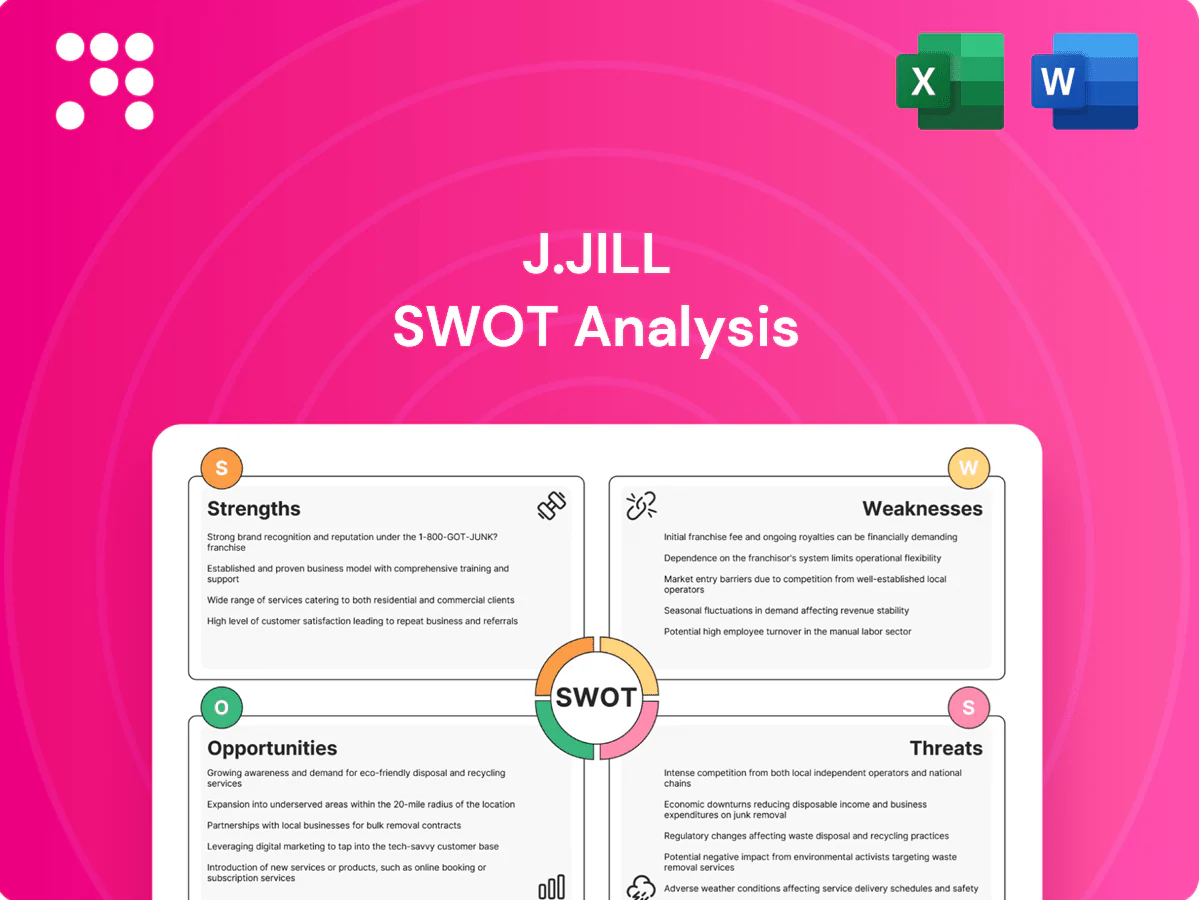
J.Jill SWOT Analysis

Dive Deeper Into the Company’s Strategic Blueprint
J.Jill's SWOT highlights resilient brand strength and loyal customer base but flags margin pressure and digital gaps amid fast-fashion competition. Opportunities in omnichannel expansion contrast with supply-chain and macro risks. Discover the complete picture—purchase the full SWOT analysis for a research-backed, editable report and Excel tools to plan and present with confidence.
Strengths

Clear comfort-first brand
Distinct comfort-first positioning around relaxed, easy style builds strong recognition and preference among J.Jill’s core demographic, simplifying merchandising and marketing with a focused aesthetic that reduces complexity across channels. This focus limits head-to-head pricing battles with trend-driven fast fashion and supports a premium perception. Consistent product language drives repeat purchase and loyalty.
Omnichannel reach (stores, web, catalog)
Integrated stores, e-commerce and catalog channels give J.Jill multiple customer acquisition and conversion paths, supported by over 200 retail locations plus web and direct‑mail programs. Catalog research followed by online purchase and in‑store returns raises convenience and average basket size. Cross‑channel data supports targeted outreach and inventory balancing. Multiple touchpoints hedge traffic volatility in any single channel.

Loyal, repeat customer base
Core customers prioritize fit, comfort, and dependable styling, producing strong repeat purchase behavior that stabilizes revenue. Predictable buying patterns improve demand forecasting and inventory turns, lowering markdown risk. Loyalty supports higher full-price sell-through versus reliance on heavy promotions. Word-of-mouth within the brand’s demographic amplifies efficient, organic growth.

Direct mail and CRM capabilities
J.Jill’s longstanding catalog operations support sophisticated list management and segmentation, enabling targeted reactivation and cross-sell using proprietary customer data and lifetime purchase histories. Rigorous testing of offers, creative and cadence has consistently improved marketing ROI, and those disciplines scale into effective digital retention campaigns across email and social channels. These capabilities strengthen customer lifetime value and reduce acquisition reliance.
- Strength: deep catalog-derived segmentation
- Strength: proprietary data for reactivation/cross-sell
- Strength: testing-driven ROI gains
- Strength: seamless offline-to-digital retention
Fit and sizing expertise
J.Jill’s consistent silhouettes, fabrics and extended size runs reduce fit-related returns in an industry where online apparel return rates often range 15–30%, improving customer satisfaction and repeat purchase rates. Trusted fit increases willingness to buy sight-unseen and across channels, lifting omnichannel conversion. Streamlined patterns cut production complexity and support faster, more efficient supply chains, differentiating the brand versus peers with inconsistent sizing.
- reduces fit returns
- boosts sight-unseen sales
- improves supply-chain efficiency
- differentiates vs competitors
Comfort-first apparel fuels loyalty across channels; >200 stores, returns under 15–30%
J.Jill’s comfort-first, consistent styling drives strong repeat purchase and loyalty, supported by integrated stores, e-commerce and catalog channels that diversify acquisition and raise average basket size. Over 200 retail locations plus catalog expertise enable targeted segmentation and high marketing ROI. Consistent fit and extended sizes cut fit-related returns versus industry online apparel return rates of 15–30%.
| Metric | Value |
|---|---|
| Retail locations | >200 |
| Industry online return rate | 15–30% |
| Channels | Stores, e-commerce, catalog |
What is included in the product
 Detailed Word Document
Provides a concise strategic overview of J.Jill’s internal strengths and weaknesses and external opportunities and threats, mapping market position, growth drivers, operational gaps, and competitive risks to inform strategic decision-making.

 Customizable Excel Spreadsheet
Provides a concise SWOT matrix for J.Jill that quickly aligns strategy and highlights retail pain points; editable format lets teams update insights fast to reflect changing consumer trends and competitive pressures.
Weaknesses

Narrow demographic concentration
J.Jill relies heavily on a core customer cohort—the company reports the majority of its shoppers are aged 55 and older—limiting total addressable market growth and upside. Rapid taste shifts within this cohort can materially depress demand, as seen in industry cyclicality among mature-women apparel brands. Expanding too quickly risks diluting J.Jill’s heritage styling, yet structurally balancing focused appeal with meaningful diversification remains difficult.
Smaller scale vs. national chains
Smaller scale vs national chains reduces J.Jill’s bargaining power with vendors and carriers, raising per-unit costs and logistics fees. Scale disadvantages inflate COGS and fulfillment costs, pressuring gross margins. Higher marketing CPMs hit harder without massive budgets, and limited cash flow constrains technology investments and store renovation cadence.

Catalog cost exposure
Printing and postage inflation squeeze contribution margins—direct-mail unit costs rose materially as USPS first-class stamps reached about 66 cents and industry print prices climbed into the high single digits in recent years; mail reach is also constrained by environmental and privacy pressures as USPS mail volume has fallen roughly 40% since 2000. Performance varies with USPS service levels and seasonality, and over-mailing risks customer fatigue and rising CAC.

Fashion and seasonality risk
- Markdowns ~20% (2023 industry avg)
- Seasonal inventory ties up capital
- Weather-driven demand shifts
- Short SKU lifecycles complicate forecasting
Limited international presence
Limited international presence leaves J.Jill highly exposed to U.S. demand cycles, concentrating macro risk and limiting natural currency and logistics hedges; brand awareness remains weak outside its core domestic markets, constraining expansion options; global sourcing disruptions therefore lack offsetting foreign sales.
- Domestic revenue concentration
- Unrealized currency/logistics diversification
- Low non‑US brand awareness
- Sourcing risk without foreign sales offsets
Older-skewing apparel retailer: narrow TAM, higher fulfillment costs, steep markdowns
J.Jill depends on a majority 55+ shopper base, limiting TAM and making demand vulnerable to cohort taste shifts; smaller scale raises COGS, logistics and marketing CPMs; print/postage inflation and USPS service pressures squeeze margins; seasonal/markdown dynamics (retail markdowns ~20% in 2023) and limited international presence concentrate macro risk.
| Metric | Value |
|---|---|
| Majority customers aged 55+ | Company disclosure |
| Retail markdowns | ~20% (2023) |
| USPS first‑class stamp | ≈$0.66 (2023) |
| USPS mail volume change since 2000 | −~40% |
Same Document Delivered
J.Jill SWOT Analysis
This is the actual J.Jill SWOT analysis document you’ll receive upon purchase—no surprises, just professional quality and structured findings. The preview below is taken directly from the full report; buying unlocks the complete, editable version. You’re viewing a live excerpt of the final file, ready for download after checkout.

Dive Deeper Into the Company’s Strategic Blueprint
J.Jill's SWOT highlights resilient brand strength and loyal customer base but flags margin pressure and digital gaps amid fast-fashion competition. Opportunities in omnichannel expansion contrast with supply-chain and macro risks. Discover the complete picture—purchase the full SWOT analysis for a research-backed, editable report and Excel tools to plan and present with confidence.
Strengths
Clear comfort-first brand
Distinct comfort-first positioning around relaxed, easy style builds strong recognition and preference among J.Jill’s core demographic, simplifying merchandising and marketing with a focused aesthetic that reduces complexity across channels. This focus limits head-to-head pricing battles with trend-driven fast fashion and supports a premium perception. Consistent product language drives repeat purchase and loyalty.
Omnichannel reach (stores, web, catalog)
Integrated stores, e-commerce and catalog channels give J.Jill multiple customer acquisition and conversion paths, supported by over 200 retail locations plus web and direct‑mail programs. Catalog research followed by online purchase and in‑store returns raises convenience and average basket size. Cross‑channel data supports targeted outreach and inventory balancing. Multiple touchpoints hedge traffic volatility in any single channel.
Loyal, repeat customer base
Core customers prioritize fit, comfort, and dependable styling, producing strong repeat purchase behavior that stabilizes revenue. Predictable buying patterns improve demand forecasting and inventory turns, lowering markdown risk. Loyalty supports higher full-price sell-through versus reliance on heavy promotions. Word-of-mouth within the brand’s demographic amplifies efficient, organic growth.
Direct mail and CRM capabilities
J.Jill’s longstanding catalog operations support sophisticated list management and segmentation, enabling targeted reactivation and cross-sell using proprietary customer data and lifetime purchase histories. Rigorous testing of offers, creative and cadence has consistently improved marketing ROI, and those disciplines scale into effective digital retention campaigns across email and social channels. These capabilities strengthen customer lifetime value and reduce acquisition reliance.
- Strength: deep catalog-derived segmentation
- Strength: proprietary data for reactivation/cross-sell
- Strength: testing-driven ROI gains
- Strength: seamless offline-to-digital retention
Fit and sizing expertise
J.Jill’s consistent silhouettes, fabrics and extended size runs reduce fit-related returns in an industry where online apparel return rates often range 15–30%, improving customer satisfaction and repeat purchase rates. Trusted fit increases willingness to buy sight-unseen and across channels, lifting omnichannel conversion. Streamlined patterns cut production complexity and support faster, more efficient supply chains, differentiating the brand versus peers with inconsistent sizing.
- reduces fit returns
- boosts sight-unseen sales
- improves supply-chain efficiency
- differentiates vs competitors
Comfort-first apparel fuels loyalty across channels; >200 stores, returns under 15–30%
J.Jill’s comfort-first, consistent styling drives strong repeat purchase and loyalty, supported by integrated stores, e-commerce and catalog channels that diversify acquisition and raise average basket size. Over 200 retail locations plus catalog expertise enable targeted segmentation and high marketing ROI. Consistent fit and extended sizes cut fit-related returns versus industry online apparel return rates of 15–30%.
| Metric | Value |
|---|---|
| Retail locations | >200 |
| Industry online return rate | 15–30% |
| Channels | Stores, e-commerce, catalog |
What is included in the product
Detailed Word Document
Provides a concise strategic overview of J.Jill’s internal strengths and weaknesses and external opportunities and threats, mapping market position, growth drivers, operational gaps, and competitive risks to inform strategic decision-making.
Customizable Excel Spreadsheet
Provides a concise SWOT matrix for J.Jill that quickly aligns strategy and highlights retail pain points; editable format lets teams update insights fast to reflect changing consumer trends and competitive pressures.
Weaknesses
Narrow demographic concentration
J.Jill relies heavily on a core customer cohort—the company reports the majority of its shoppers are aged 55 and older—limiting total addressable market growth and upside. Rapid taste shifts within this cohort can materially depress demand, as seen in industry cyclicality among mature-women apparel brands. Expanding too quickly risks diluting J.Jill’s heritage styling, yet structurally balancing focused appeal with meaningful diversification remains difficult.
Smaller scale vs. national chains
Smaller scale vs national chains reduces J.Jill’s bargaining power with vendors and carriers, raising per-unit costs and logistics fees. Scale disadvantages inflate COGS and fulfillment costs, pressuring gross margins. Higher marketing CPMs hit harder without massive budgets, and limited cash flow constrains technology investments and store renovation cadence.
Catalog cost exposure
Printing and postage inflation squeeze contribution margins—direct-mail unit costs rose materially as USPS first-class stamps reached about 66 cents and industry print prices climbed into the high single digits in recent years; mail reach is also constrained by environmental and privacy pressures as USPS mail volume has fallen roughly 40% since 2000. Performance varies with USPS service levels and seasonality, and over-mailing risks customer fatigue and rising CAC.
Fashion and seasonality risk
- Markdowns ~20% (2023 industry avg)
- Seasonal inventory ties up capital
- Weather-driven demand shifts
- Short SKU lifecycles complicate forecasting
Limited international presence
Limited international presence leaves J.Jill highly exposed to U.S. demand cycles, concentrating macro risk and limiting natural currency and logistics hedges; brand awareness remains weak outside its core domestic markets, constraining expansion options; global sourcing disruptions therefore lack offsetting foreign sales.
- Domestic revenue concentration
- Unrealized currency/logistics diversification
- Low non‑US brand awareness
- Sourcing risk without foreign sales offsets
Older-skewing apparel retailer: narrow TAM, higher fulfillment costs, steep markdowns
J.Jill depends on a majority 55+ shopper base, limiting TAM and making demand vulnerable to cohort taste shifts; smaller scale raises COGS, logistics and marketing CPMs; print/postage inflation and USPS service pressures squeeze margins; seasonal/markdown dynamics (retail markdowns ~20% in 2023) and limited international presence concentrate macro risk.
| Metric | Value |
|---|---|
| Majority customers aged 55+ | Company disclosure |
| Retail markdowns | ~20% (2023) |
| USPS first‑class stamp | ≈$0.66 (2023) |
| USPS mail volume change since 2000 | −~40% |
Same Document Delivered
J.Jill SWOT Analysis
This is the actual J.Jill SWOT analysis document you’ll receive upon purchase—no surprises, just professional quality and structured findings. The preview below is taken directly from the full report; buying unlocks the complete, editable version. You’re viewing a live excerpt of the final file, ready for download after checkout.
Original: $10.00
-65%$10.00
$3.50Description
Dive Deeper Into the Company’s Strategic Blueprint
J.Jill's SWOT highlights resilient brand strength and loyal customer base but flags margin pressure and digital gaps amid fast-fashion competition. Opportunities in omnichannel expansion contrast with supply-chain and macro risks. Discover the complete picture—purchase the full SWOT analysis for a research-backed, editable report and Excel tools to plan and present with confidence.
Strengths
Clear comfort-first brand
Distinct comfort-first positioning around relaxed, easy style builds strong recognition and preference among J.Jill’s core demographic, simplifying merchandising and marketing with a focused aesthetic that reduces complexity across channels. This focus limits head-to-head pricing battles with trend-driven fast fashion and supports a premium perception. Consistent product language drives repeat purchase and loyalty.
Omnichannel reach (stores, web, catalog)
Integrated stores, e-commerce and catalog channels give J.Jill multiple customer acquisition and conversion paths, supported by over 200 retail locations plus web and direct‑mail programs. Catalog research followed by online purchase and in‑store returns raises convenience and average basket size. Cross‑channel data supports targeted outreach and inventory balancing. Multiple touchpoints hedge traffic volatility in any single channel.
Loyal, repeat customer base
Core customers prioritize fit, comfort, and dependable styling, producing strong repeat purchase behavior that stabilizes revenue. Predictable buying patterns improve demand forecasting and inventory turns, lowering markdown risk. Loyalty supports higher full-price sell-through versus reliance on heavy promotions. Word-of-mouth within the brand’s demographic amplifies efficient, organic growth.
Direct mail and CRM capabilities
J.Jill’s longstanding catalog operations support sophisticated list management and segmentation, enabling targeted reactivation and cross-sell using proprietary customer data and lifetime purchase histories. Rigorous testing of offers, creative and cadence has consistently improved marketing ROI, and those disciplines scale into effective digital retention campaigns across email and social channels. These capabilities strengthen customer lifetime value and reduce acquisition reliance.
- Strength: deep catalog-derived segmentation
- Strength: proprietary data for reactivation/cross-sell
- Strength: testing-driven ROI gains
- Strength: seamless offline-to-digital retention
Fit and sizing expertise
J.Jill’s consistent silhouettes, fabrics and extended size runs reduce fit-related returns in an industry where online apparel return rates often range 15–30%, improving customer satisfaction and repeat purchase rates. Trusted fit increases willingness to buy sight-unseen and across channels, lifting omnichannel conversion. Streamlined patterns cut production complexity and support faster, more efficient supply chains, differentiating the brand versus peers with inconsistent sizing.
- reduces fit returns
- boosts sight-unseen sales
- improves supply-chain efficiency
- differentiates vs competitors
Comfort-first apparel fuels loyalty across channels; >200 stores, returns under 15–30%
J.Jill’s comfort-first, consistent styling drives strong repeat purchase and loyalty, supported by integrated stores, e-commerce and catalog channels that diversify acquisition and raise average basket size. Over 200 retail locations plus catalog expertise enable targeted segmentation and high marketing ROI. Consistent fit and extended sizes cut fit-related returns versus industry online apparel return rates of 15–30%.
| Metric | Value |
|---|---|
| Retail locations | >200 |
| Industry online return rate | 15–30% |
| Channels | Stores, e-commerce, catalog |
What is included in the product
Detailed Word Document
Provides a concise strategic overview of J.Jill’s internal strengths and weaknesses and external opportunities and threats, mapping market position, growth drivers, operational gaps, and competitive risks to inform strategic decision-making.
Customizable Excel Spreadsheet
Provides a concise SWOT matrix for J.Jill that quickly aligns strategy and highlights retail pain points; editable format lets teams update insights fast to reflect changing consumer trends and competitive pressures.
Weaknesses
Narrow demographic concentration
J.Jill relies heavily on a core customer cohort—the company reports the majority of its shoppers are aged 55 and older—limiting total addressable market growth and upside. Rapid taste shifts within this cohort can materially depress demand, as seen in industry cyclicality among mature-women apparel brands. Expanding too quickly risks diluting J.Jill’s heritage styling, yet structurally balancing focused appeal with meaningful diversification remains difficult.
Smaller scale vs. national chains
Smaller scale vs national chains reduces J.Jill’s bargaining power with vendors and carriers, raising per-unit costs and logistics fees. Scale disadvantages inflate COGS and fulfillment costs, pressuring gross margins. Higher marketing CPMs hit harder without massive budgets, and limited cash flow constrains technology investments and store renovation cadence.
Catalog cost exposure
Printing and postage inflation squeeze contribution margins—direct-mail unit costs rose materially as USPS first-class stamps reached about 66 cents and industry print prices climbed into the high single digits in recent years; mail reach is also constrained by environmental and privacy pressures as USPS mail volume has fallen roughly 40% since 2000. Performance varies with USPS service levels and seasonality, and over-mailing risks customer fatigue and rising CAC.
Fashion and seasonality risk
- Markdowns ~20% (2023 industry avg)
- Seasonal inventory ties up capital
- Weather-driven demand shifts
- Short SKU lifecycles complicate forecasting
Limited international presence
Limited international presence leaves J.Jill highly exposed to U.S. demand cycles, concentrating macro risk and limiting natural currency and logistics hedges; brand awareness remains weak outside its core domestic markets, constraining expansion options; global sourcing disruptions therefore lack offsetting foreign sales.
- Domestic revenue concentration
- Unrealized currency/logistics diversification
- Low non‑US brand awareness
- Sourcing risk without foreign sales offsets
Older-skewing apparel retailer: narrow TAM, higher fulfillment costs, steep markdowns
J.Jill depends on a majority 55+ shopper base, limiting TAM and making demand vulnerable to cohort taste shifts; smaller scale raises COGS, logistics and marketing CPMs; print/postage inflation and USPS service pressures squeeze margins; seasonal/markdown dynamics (retail markdowns ~20% in 2023) and limited international presence concentrate macro risk.
| Metric | Value |
|---|---|
| Majority customers aged 55+ | Company disclosure |
| Retail markdowns | ~20% (2023) |
| USPS first‑class stamp | ≈$0.66 (2023) |
| USPS mail volume change since 2000 | −~40% |
Same Document Delivered
J.Jill SWOT Analysis
This is the actual J.Jill SWOT analysis document you’ll receive upon purchase—no surprises, just professional quality and structured findings. The preview below is taken directly from the full report; buying unlocks the complete, editable version. You’re viewing a live excerpt of the final file, ready for download after checkout.











