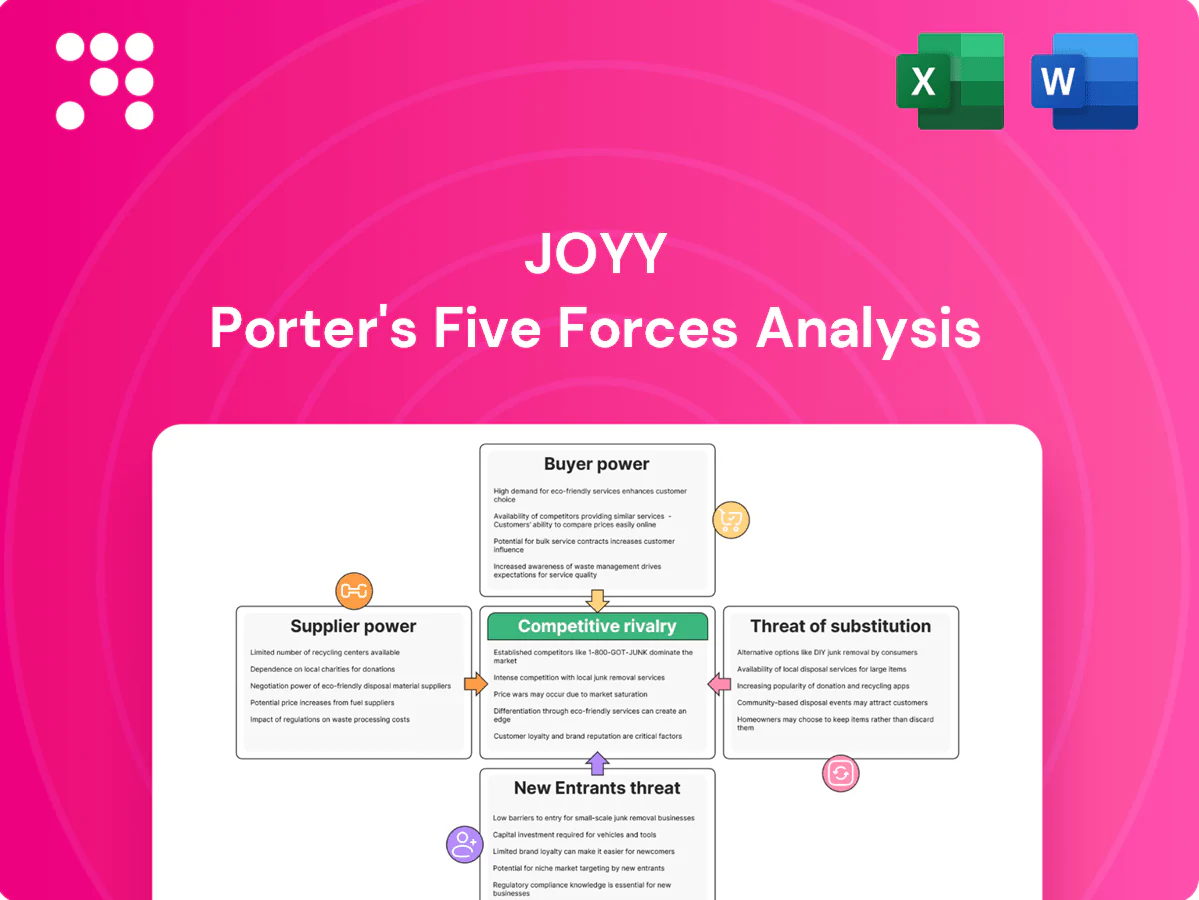
JOYY Porter's Five Forces Analysis

Don't Miss the Bigger Picture
JOYY faces intense platform rivalry, moderating buyer power and rising substitute threats from short‑form apps, while supplier influence and regulatory headwinds create uneven margins; our snapshot highlights these pressures and strategic levers. This brief only scratches the surface—unlock the full Porter's Five Forces Analysis to explore force‑by‑force ratings, visuals, and actionable recommendations. Purchase the complete report for a consultant‑grade, data‑driven view of JOYY’s competitive landscape.
Suppliers Bargaining Power

Dependence on cloud and app stores
JOYY depends on hyperscale clouds (AWS ~32%, Azure ~22%, GCP ~11% market share in 2023) and app stores for hosting, distribution and billing, concentrating supplier leverage. App stores' standard 30% commission (15% under small‑business thresholds) and policy enforcement on content/payments can compress margins and disrupt monetization. Multi‑cloud setups and direct web distribution partially mitigate but do not eliminate this exposure.
Creators as content suppliers
Streamers and short-video creators supply JOYY’s core product—engaging live and short-form content—giving them direct bargaining power over monetization. Top creators can multi-home and often command better revenue shares, bonuses and promotional support, concentrating views as short-video apps collectively reached over 3 billion users by 2024. Retention requires competitive payouts, creator tooling and safety features; heavy dependence on star creators heightens volatility in content quality and revenue.

Payment processors and virtual goods
Payment gateways and local wallets dictate take rates (typically 1.5–3% for cards, higher for some wallets) and settlement timing, exposing JOYY to chargeback costs (~0.5–1% dispute rates) and compliance shifts that can raise costs; regional fragmentation (wallet penetration 60–70% in SEA, lower elsewhere) complicates pricing and promotions, so diversifying processor partners and driving wallet top-ups reduces fee pressure and settlement risk.

Music/licensing and third‑party IP
Short-form video on JOYY relies heavily on licensed music and effects, giving labels and rights holders substantial leverage; in 2024 the Big Three labels still controlled about 70% of recorded music market share. Takedowns or sudden fee hikes can reduce creator engagement and disrupt workflow, while bundled platform deals and in-app creator libraries help cap costs. Rights management complexity rises across JOYY’s multi-market footprint, increasing compliance and royalty admin burdens.
- licenses: centralized leverage by major labels (~70% market share)
- risk: takedowns/fee hikes harm engagement
- mitigation: bundled deals, creator libraries
- complexity: multi-market rights & royalty admin
Safety, moderation, and ad-tech vendors
Trust-and-safety tools, CDNs and ad-tech partners directly shape JOYYs scalability and monetization; vendor lock-in or performance lapses can worsen UX and ad revenue over time.
Regulatory shifts such as the EU Digital Services Act and Digital Markets Act (applicable in 2024) can force rapid tooling changes and raise switching costs.
Investing in in-house AI moderation reduces dependence on vendors but requires sustained R&D and infra spend.
- Vendors: trust & safety, CDNs, ad-tech
- Risks: lock-in, performance → revenue impact
- Regulation: DSA/DMA 2024 → higher switching costs
- Mitigation: in-house AI moderation (higher capex/Opex)
Supplier power: Clouds AWS32%/Azure22%/GCP11%, app stores 30%, labels 70%
Suppliers exert high bargaining power: hyperscale clouds (AWS ~32%, Azure ~22%, GCP ~11% in 2023), app stores (30% default cut), top creators (platform multi‑homing) and music labels (~70% market share) concentrate leverage; payment processors and CDNs add fee/settlement risk. JOYY mitigates via multi‑cloud, direct web, bundled music deals and in‑house moderation but faces higher capex/Opex and regulatory costs.
| Supplier | Leverage | Mitigation |
|---|---|---|
| Clouds | AWS32%/Azure22%/GCP11% | Multi‑cloud |
| App stores | 30% fee | Direct web |
| Creators/Labels | Top creators; labels70% | Bundled deals |
What is included in the product
 Detailed Word Document
Tailored Porter's Five Forces analysis for JOYY that uncovers competitive drivers, buyer/supplier power, entry barriers, substitutes, and rivalry shaping its livestreaming and social media ecosystem. Includes strategic insights on disruptive threats, monetization pressure, and defensive levers to protect market share and profitability.

 Customizable Excel Spreadsheet
A concise one-sheet Porter's Five Forces for JOYY that pinpoints key competitive pressures and actionable relief strategies for quick decision-making; customizable force levels and a ready-to-use spider chart make it slide-ready for decks and boardrooms.
Customers Bargaining Power

End users with low switching costs
End users face low switching costs and can move between TikTok (~1.1B MAU), Instagram (~2B MAU) and YouTube (~2.5B MAU), making demand highly elastic to novelty, UX and creator presence. Negative press or safety issues cause rapid churn, so continuous feature velocity and deep personalization are critical to lessen buyer power.
Creators demanding monetization
Creators, acting as both suppliers and customers of monetization and promotion, leverage multi‑homing and community size to push for higher revenue shares and incentives; the creator economy was estimated at about $250B in 2024, increasing their bargaining leverage. Transparent analytics, tipping features and streamlined sponsorship access have been shown to reduce churn and boost lifetime value, while exclusive contracts raise acquisition costs but can stabilize supply.

Advertisers and brand partners
Advertisers compare ROAS across platforms and push pricing down; global digital ad spend was about $732B in 2024, concentrating leverage with high-ROAS channels. Brand safety, viewability and targeting fidelity now drive budget allocation, with viewability standards affecting contract terms. Recessions amplify consolidation to proven platforms, while first-party data and performance formats helped defend CPMs in 2024 by improving measurability.

Paying users of virtual gifts
Paying users of virtual gifts exert high bargaining power as whales and mid‑tier spenders drive a disproportionate share of revenue, with industry analyses showing the top 1% of users often generating over 50% of gift income; this concentrates negotiation leverage. Price sensitivity to take rates and gifting mechanics directly affects ARPPU, while gamified economies must balance sink rates with satisfaction to avoid drop‑off. Regional pricing and loyalty tiers can moderate churn and stabilize spend patterns.
- Top‑1% revenue concentration: >50%
- ARPPU sensitive to take‑rate changes
- Sink rate vs satisfaction critical to retention
- Regional pricing and tiers reduce churn
Developers and community organizers
Developers and community organizers drive engagement via mini‑apps, games and events but require revenue shares and promotion; app‑store fees stayed near 30% in 2024, anchoring negotiation benchmarks. Poor terms can push creators to rival ecosystems; strong SDKs and discovery raise retention and monetization, while clear policies and incentives cut their bargaining leverage.
- rev-share expectations: anchored by ~30% platform fee (2024)
- SDK/discovery: key retention levers
- policy + incentives: reduce churn to rivals
Low switching costs and creator power make social video monetization hyper-competitive
End users have low switching costs across TikTok (≈1.1B MAU), Instagram (≈2B MAU) and YouTube (≈2.5B MAU), making demand elastic to UX and creator presence. Creators (creator economy ≈$250B in 2024) and top 1% spenders (>50% gift revenue) exert outsized leverage over monetization. Advertisers (global digital ad spend ≈$732B in 2024) and app‑store fee norms (~30%) anchor pricing and rev‑share negotiations.
| Metric | 2024 Value |
|---|---|
| TikTok MAU | ≈1.1B |
| Instagram MAU | ≈2B |
| YouTube MAU | ≈2.5B |
| Digital ad spend | $732B |
| Creator economy | $250B |
| Top‑1% gift share | >50% |
| App‑store fee | ≈30% |
Preview Before You Purchase
JOYY Porter's Five Forces Analysis
This preview shows the exact JOYY Porter’s Five Forces Analysis document you'll receive immediately after purchase—no placeholders or samples. The file is fully formatted, professionally written, and ready to download and use the moment you buy. You're viewing the final deliverable and will get instant access to this same file upon payment.

Don't Miss the Bigger Picture
JOYY faces intense platform rivalry, moderating buyer power and rising substitute threats from short‑form apps, while supplier influence and regulatory headwinds create uneven margins; our snapshot highlights these pressures and strategic levers. This brief only scratches the surface—unlock the full Porter's Five Forces Analysis to explore force‑by‑force ratings, visuals, and actionable recommendations. Purchase the complete report for a consultant‑grade, data‑driven view of JOYY’s competitive landscape.
Suppliers Bargaining Power
Dependence on cloud and app stores
JOYY depends on hyperscale clouds (AWS ~32%, Azure ~22%, GCP ~11% market share in 2023) and app stores for hosting, distribution and billing, concentrating supplier leverage. App stores' standard 30% commission (15% under small‑business thresholds) and policy enforcement on content/payments can compress margins and disrupt monetization. Multi‑cloud setups and direct web distribution partially mitigate but do not eliminate this exposure.
Creators as content suppliers
Streamers and short-video creators supply JOYY’s core product—engaging live and short-form content—giving them direct bargaining power over monetization. Top creators can multi-home and often command better revenue shares, bonuses and promotional support, concentrating views as short-video apps collectively reached over 3 billion users by 2024. Retention requires competitive payouts, creator tooling and safety features; heavy dependence on star creators heightens volatility in content quality and revenue.
Payment processors and virtual goods
Payment gateways and local wallets dictate take rates (typically 1.5–3% for cards, higher for some wallets) and settlement timing, exposing JOYY to chargeback costs (~0.5–1% dispute rates) and compliance shifts that can raise costs; regional fragmentation (wallet penetration 60–70% in SEA, lower elsewhere) complicates pricing and promotions, so diversifying processor partners and driving wallet top-ups reduces fee pressure and settlement risk.
Music/licensing and third‑party IP
Short-form video on JOYY relies heavily on licensed music and effects, giving labels and rights holders substantial leverage; in 2024 the Big Three labels still controlled about 70% of recorded music market share. Takedowns or sudden fee hikes can reduce creator engagement and disrupt workflow, while bundled platform deals and in-app creator libraries help cap costs. Rights management complexity rises across JOYY’s multi-market footprint, increasing compliance and royalty admin burdens.
- licenses: centralized leverage by major labels (~70% market share)
- risk: takedowns/fee hikes harm engagement
- mitigation: bundled deals, creator libraries
- complexity: multi-market rights & royalty admin
Safety, moderation, and ad-tech vendors
Trust-and-safety tools, CDNs and ad-tech partners directly shape JOYYs scalability and monetization; vendor lock-in or performance lapses can worsen UX and ad revenue over time.
Regulatory shifts such as the EU Digital Services Act and Digital Markets Act (applicable in 2024) can force rapid tooling changes and raise switching costs.
Investing in in-house AI moderation reduces dependence on vendors but requires sustained R&D and infra spend.
- Vendors: trust & safety, CDNs, ad-tech
- Risks: lock-in, performance → revenue impact
- Regulation: DSA/DMA 2024 → higher switching costs
- Mitigation: in-house AI moderation (higher capex/Opex)
Supplier power: Clouds AWS32%/Azure22%/GCP11%, app stores 30%, labels 70%
Suppliers exert high bargaining power: hyperscale clouds (AWS ~32%, Azure ~22%, GCP ~11% in 2023), app stores (30% default cut), top creators (platform multi‑homing) and music labels (~70% market share) concentrate leverage; payment processors and CDNs add fee/settlement risk. JOYY mitigates via multi‑cloud, direct web, bundled music deals and in‑house moderation but faces higher capex/Opex and regulatory costs.
| Supplier | Leverage | Mitigation |
|---|---|---|
| Clouds | AWS32%/Azure22%/GCP11% | Multi‑cloud |
| App stores | 30% fee | Direct web |
| Creators/Labels | Top creators; labels70% | Bundled deals |
What is included in the product
Detailed Word Document
Tailored Porter's Five Forces analysis for JOYY that uncovers competitive drivers, buyer/supplier power, entry barriers, substitutes, and rivalry shaping its livestreaming and social media ecosystem. Includes strategic insights on disruptive threats, monetization pressure, and defensive levers to protect market share and profitability.
Customizable Excel Spreadsheet
A concise one-sheet Porter's Five Forces for JOYY that pinpoints key competitive pressures and actionable relief strategies for quick decision-making; customizable force levels and a ready-to-use spider chart make it slide-ready for decks and boardrooms.
Customers Bargaining Power
End users with low switching costs
End users face low switching costs and can move between TikTok (~1.1B MAU), Instagram (~2B MAU) and YouTube (~2.5B MAU), making demand highly elastic to novelty, UX and creator presence. Negative press or safety issues cause rapid churn, so continuous feature velocity and deep personalization are critical to lessen buyer power.
Creators demanding monetization
Creators, acting as both suppliers and customers of monetization and promotion, leverage multi‑homing and community size to push for higher revenue shares and incentives; the creator economy was estimated at about $250B in 2024, increasing their bargaining leverage. Transparent analytics, tipping features and streamlined sponsorship access have been shown to reduce churn and boost lifetime value, while exclusive contracts raise acquisition costs but can stabilize supply.
Advertisers and brand partners
Advertisers compare ROAS across platforms and push pricing down; global digital ad spend was about $732B in 2024, concentrating leverage with high-ROAS channels. Brand safety, viewability and targeting fidelity now drive budget allocation, with viewability standards affecting contract terms. Recessions amplify consolidation to proven platforms, while first-party data and performance formats helped defend CPMs in 2024 by improving measurability.
Paying users of virtual gifts
Paying users of virtual gifts exert high bargaining power as whales and mid‑tier spenders drive a disproportionate share of revenue, with industry analyses showing the top 1% of users often generating over 50% of gift income; this concentrates negotiation leverage. Price sensitivity to take rates and gifting mechanics directly affects ARPPU, while gamified economies must balance sink rates with satisfaction to avoid drop‑off. Regional pricing and loyalty tiers can moderate churn and stabilize spend patterns.
- Top‑1% revenue concentration: >50%
- ARPPU sensitive to take‑rate changes
- Sink rate vs satisfaction critical to retention
- Regional pricing and tiers reduce churn
Developers and community organizers
Developers and community organizers drive engagement via mini‑apps, games and events but require revenue shares and promotion; app‑store fees stayed near 30% in 2024, anchoring negotiation benchmarks. Poor terms can push creators to rival ecosystems; strong SDKs and discovery raise retention and monetization, while clear policies and incentives cut their bargaining leverage.
- rev-share expectations: anchored by ~30% platform fee (2024)
- SDK/discovery: key retention levers
- policy + incentives: reduce churn to rivals
Low switching costs and creator power make social video monetization hyper-competitive
End users have low switching costs across TikTok (≈1.1B MAU), Instagram (≈2B MAU) and YouTube (≈2.5B MAU), making demand elastic to UX and creator presence. Creators (creator economy ≈$250B in 2024) and top 1% spenders (>50% gift revenue) exert outsized leverage over monetization. Advertisers (global digital ad spend ≈$732B in 2024) and app‑store fee norms (~30%) anchor pricing and rev‑share negotiations.
| Metric | 2024 Value |
|---|---|
| TikTok MAU | ≈1.1B |
| Instagram MAU | ≈2B |
| YouTube MAU | ≈2.5B |
| Digital ad spend | $732B |
| Creator economy | $250B |
| Top‑1% gift share | >50% |
| App‑store fee | ≈30% |
Preview Before You Purchase
JOYY Porter's Five Forces Analysis
This preview shows the exact JOYY Porter’s Five Forces Analysis document you'll receive immediately after purchase—no placeholders or samples. The file is fully formatted, professionally written, and ready to download and use the moment you buy. You're viewing the final deliverable and will get instant access to this same file upon payment.
Original: $10.00
-65%$10.00
$3.50Description
Don't Miss the Bigger Picture
JOYY faces intense platform rivalry, moderating buyer power and rising substitute threats from short‑form apps, while supplier influence and regulatory headwinds create uneven margins; our snapshot highlights these pressures and strategic levers. This brief only scratches the surface—unlock the full Porter's Five Forces Analysis to explore force‑by‑force ratings, visuals, and actionable recommendations. Purchase the complete report for a consultant‑grade, data‑driven view of JOYY’s competitive landscape.
Suppliers Bargaining Power
Dependence on cloud and app stores
JOYY depends on hyperscale clouds (AWS ~32%, Azure ~22%, GCP ~11% market share in 2023) and app stores for hosting, distribution and billing, concentrating supplier leverage. App stores' standard 30% commission (15% under small‑business thresholds) and policy enforcement on content/payments can compress margins and disrupt monetization. Multi‑cloud setups and direct web distribution partially mitigate but do not eliminate this exposure.
Creators as content suppliers
Streamers and short-video creators supply JOYY’s core product—engaging live and short-form content—giving them direct bargaining power over monetization. Top creators can multi-home and often command better revenue shares, bonuses and promotional support, concentrating views as short-video apps collectively reached over 3 billion users by 2024. Retention requires competitive payouts, creator tooling and safety features; heavy dependence on star creators heightens volatility in content quality and revenue.
Payment processors and virtual goods
Payment gateways and local wallets dictate take rates (typically 1.5–3% for cards, higher for some wallets) and settlement timing, exposing JOYY to chargeback costs (~0.5–1% dispute rates) and compliance shifts that can raise costs; regional fragmentation (wallet penetration 60–70% in SEA, lower elsewhere) complicates pricing and promotions, so diversifying processor partners and driving wallet top-ups reduces fee pressure and settlement risk.
Music/licensing and third‑party IP
Short-form video on JOYY relies heavily on licensed music and effects, giving labels and rights holders substantial leverage; in 2024 the Big Three labels still controlled about 70% of recorded music market share. Takedowns or sudden fee hikes can reduce creator engagement and disrupt workflow, while bundled platform deals and in-app creator libraries help cap costs. Rights management complexity rises across JOYY’s multi-market footprint, increasing compliance and royalty admin burdens.
- licenses: centralized leverage by major labels (~70% market share)
- risk: takedowns/fee hikes harm engagement
- mitigation: bundled deals, creator libraries
- complexity: multi-market rights & royalty admin
Safety, moderation, and ad-tech vendors
Trust-and-safety tools, CDNs and ad-tech partners directly shape JOYYs scalability and monetization; vendor lock-in or performance lapses can worsen UX and ad revenue over time.
Regulatory shifts such as the EU Digital Services Act and Digital Markets Act (applicable in 2024) can force rapid tooling changes and raise switching costs.
Investing in in-house AI moderation reduces dependence on vendors but requires sustained R&D and infra spend.
- Vendors: trust & safety, CDNs, ad-tech
- Risks: lock-in, performance → revenue impact
- Regulation: DSA/DMA 2024 → higher switching costs
- Mitigation: in-house AI moderation (higher capex/Opex)
Supplier power: Clouds AWS32%/Azure22%/GCP11%, app stores 30%, labels 70%
Suppliers exert high bargaining power: hyperscale clouds (AWS ~32%, Azure ~22%, GCP ~11% in 2023), app stores (30% default cut), top creators (platform multi‑homing) and music labels (~70% market share) concentrate leverage; payment processors and CDNs add fee/settlement risk. JOYY mitigates via multi‑cloud, direct web, bundled music deals and in‑house moderation but faces higher capex/Opex and regulatory costs.
| Supplier | Leverage | Mitigation |
|---|---|---|
| Clouds | AWS32%/Azure22%/GCP11% | Multi‑cloud |
| App stores | 30% fee | Direct web |
| Creators/Labels | Top creators; labels70% | Bundled deals |
What is included in the product
Detailed Word Document
Tailored Porter's Five Forces analysis for JOYY that uncovers competitive drivers, buyer/supplier power, entry barriers, substitutes, and rivalry shaping its livestreaming and social media ecosystem. Includes strategic insights on disruptive threats, monetization pressure, and defensive levers to protect market share and profitability.
Customizable Excel Spreadsheet
A concise one-sheet Porter's Five Forces for JOYY that pinpoints key competitive pressures and actionable relief strategies for quick decision-making; customizable force levels and a ready-to-use spider chart make it slide-ready for decks and boardrooms.
Customers Bargaining Power
End users with low switching costs
End users face low switching costs and can move between TikTok (~1.1B MAU), Instagram (~2B MAU) and YouTube (~2.5B MAU), making demand highly elastic to novelty, UX and creator presence. Negative press or safety issues cause rapid churn, so continuous feature velocity and deep personalization are critical to lessen buyer power.
Creators demanding monetization
Creators, acting as both suppliers and customers of monetization and promotion, leverage multi‑homing and community size to push for higher revenue shares and incentives; the creator economy was estimated at about $250B in 2024, increasing their bargaining leverage. Transparent analytics, tipping features and streamlined sponsorship access have been shown to reduce churn and boost lifetime value, while exclusive contracts raise acquisition costs but can stabilize supply.
Advertisers and brand partners
Advertisers compare ROAS across platforms and push pricing down; global digital ad spend was about $732B in 2024, concentrating leverage with high-ROAS channels. Brand safety, viewability and targeting fidelity now drive budget allocation, with viewability standards affecting contract terms. Recessions amplify consolidation to proven platforms, while first-party data and performance formats helped defend CPMs in 2024 by improving measurability.
Paying users of virtual gifts
Paying users of virtual gifts exert high bargaining power as whales and mid‑tier spenders drive a disproportionate share of revenue, with industry analyses showing the top 1% of users often generating over 50% of gift income; this concentrates negotiation leverage. Price sensitivity to take rates and gifting mechanics directly affects ARPPU, while gamified economies must balance sink rates with satisfaction to avoid drop‑off. Regional pricing and loyalty tiers can moderate churn and stabilize spend patterns.
- Top‑1% revenue concentration: >50%
- ARPPU sensitive to take‑rate changes
- Sink rate vs satisfaction critical to retention
- Regional pricing and tiers reduce churn
Developers and community organizers
Developers and community organizers drive engagement via mini‑apps, games and events but require revenue shares and promotion; app‑store fees stayed near 30% in 2024, anchoring negotiation benchmarks. Poor terms can push creators to rival ecosystems; strong SDKs and discovery raise retention and monetization, while clear policies and incentives cut their bargaining leverage.
- rev-share expectations: anchored by ~30% platform fee (2024)
- SDK/discovery: key retention levers
- policy + incentives: reduce churn to rivals
Low switching costs and creator power make social video monetization hyper-competitive
End users have low switching costs across TikTok (≈1.1B MAU), Instagram (≈2B MAU) and YouTube (≈2.5B MAU), making demand elastic to UX and creator presence. Creators (creator economy ≈$250B in 2024) and top 1% spenders (>50% gift revenue) exert outsized leverage over monetization. Advertisers (global digital ad spend ≈$732B in 2024) and app‑store fee norms (~30%) anchor pricing and rev‑share negotiations.
| Metric | 2024 Value |
|---|---|
| TikTok MAU | ≈1.1B |
| Instagram MAU | ≈2B |
| YouTube MAU | ≈2.5B |
| Digital ad spend | $732B |
| Creator economy | $250B |
| Top‑1% gift share | >50% |
| App‑store fee | ≈30% |
Preview Before You Purchase
JOYY Porter's Five Forces Analysis
This preview shows the exact JOYY Porter’s Five Forces Analysis document you'll receive immediately after purchase—no placeholders or samples. The file is fully formatted, professionally written, and ready to download and use the moment you buy. You're viewing the final deliverable and will get instant access to this same file upon payment.











