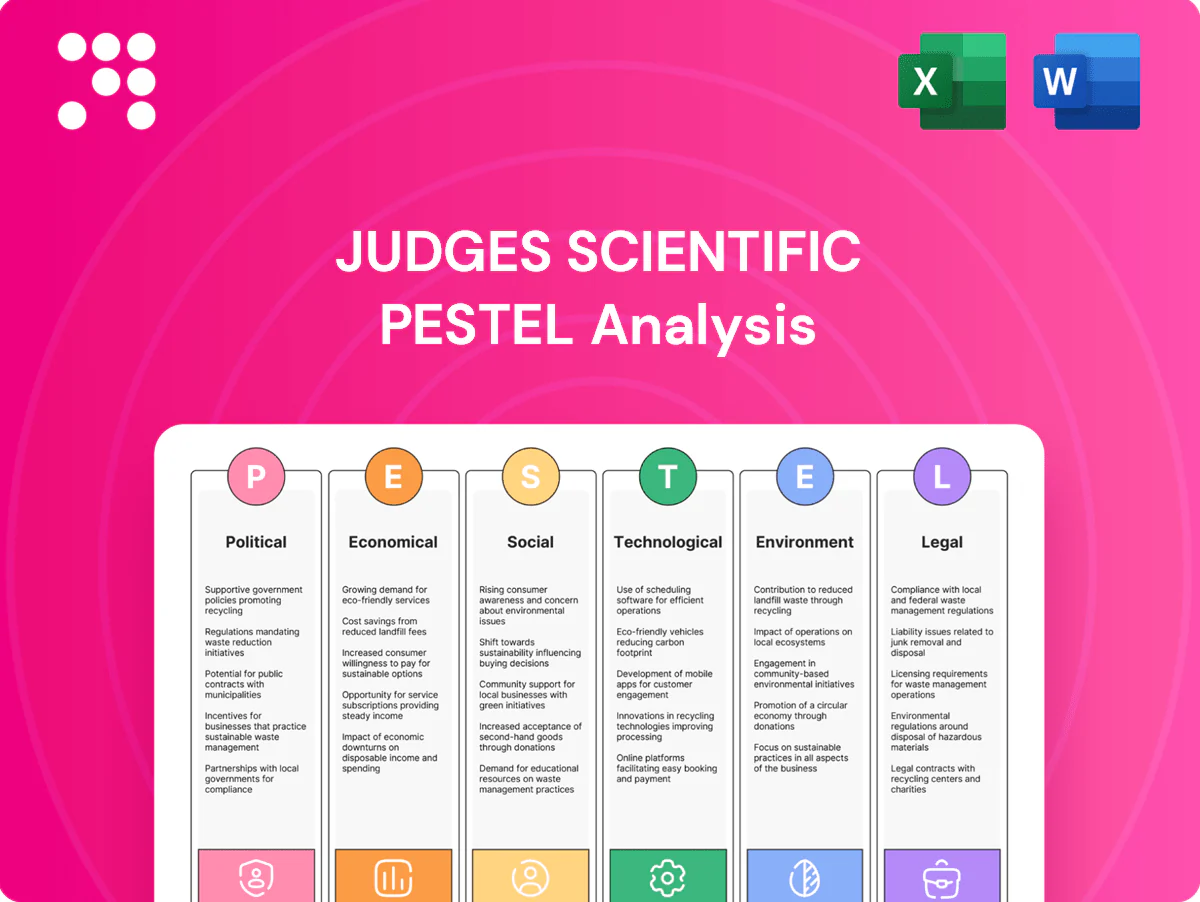
Judges Scientific PESTLE Analysis

Make Smarter Strategic Decisions with a Complete PESTEL View
Gain a competitive edge with our PESTLE Analysis of Judges Scientific—concise, research-driven insights into political, economic, social, technological, legal, and environmental forces shaping the company. Ideal for investors and strategists; purchase the full report to access the complete, actionable breakdown instantly.
Political factors

UK industrial policy shifts
UK government R&D funding remains around £20bn (public 2022–23 ONS), while defence and health budgets (~£50bn and ~£170bn respectively) compete for allocations, and the science superpower agenda drives targeted lab grants and manufacturing incentives. Post-election shifts can reallocate funds between academia, healthcare and defence, altering demand for lab instrumentation. Judges Scientific must align product roadmaps to these policy themes to access subsidies and partnerships and maintain agency engagement to anticipate procurement pipelines.
Trade and tariff dynamics
Brexit introduced customs frictions and rules of origin under the UK-EU Trade and Cooperation Agreement, affecting import of components and export of finished instruments; the EU remained ~43% of UK goods trade in 2023 (ONS), underscoring exposure. Tariff outcomes and mutual recognition agreements alter landed duties and lead times, shifting pricing models. Diversifying manufacturing footprint and using bonded warehousing reduces border delays and duty cashflow. Accurate landed-cost modeling is essential for competitive, reliable bids.

Geopolitical supply risks
Tensions among China, the US and the EU threaten availability of semiconductors, precision optics and specialty materials, amplified by US export controls and the CHIPS Act $52bn industrial push; EU measures mobilize roughly €43bn. Sanctions and restrictions can squeeze end-markets such as advanced research and defence. Judges Scientific mitigates risk via contingency sourcing, inventory buffers and scenario-based acquisition screening.

Public research budgets
- Tag: grants drive capex cycles
- Tag: life sciences/net zero/quantum tailwinds
- Tag: align sales to funded disciplines
- Tag: advocacy influences funding calls
Regional development incentives
Local authorities often offer business rates relief (sometimes up to 100% for up to 5 years), discretionary capital grants and R&D tax support (RDEC headline credit ~20%), which can materially lower post‑acquisition integration costs for manufacturing and R&D sites.
- Location impacts access to engineering/talent hubs and proximity to ports/air freight for exports
- Incentives can cover 30–50% of eligible capex in some schemes
- Proactive negotiation boosts ROI on capex
Political shifts, Brexit and export controls raise capital-equipment and landed-cost risk
Political shifts (UK public R&D ~£20bn 2022–23; Horizon Europe €95.5bn 2021–27; CHIPS Act $52bn) reallocate capital-equipment demand across life sciences, defence and net‑zero, affecting Judges Scientific order pipelines and subsidy access. Brexit (EU ≈43% of UK goods trade 2023) and US/EU export controls raise landed-cost and lead-time risk. Active policy engagement and diversified sourcing reduce disruption and unlock incentives.
| Tag | Key figure |
|---|---|
| R&D funding | UK £20bn; Horizon €95.5bn |
| Trade exposure | EU ≈43% (2023) |
What is included in the product
 Detailed Word Document
Explores how macro-environmental factors uniquely affect Judges Scientific across Political, Economic, Social, Technological, Environmental and Legal dimensions, with data-driven trends and industry-specific examples. Designed for executives and investors to identify risks, opportunities and inform strategic planning.

 Customizable Excel Spreadsheet
A concise, visually segmented PESTLE summary of Judges Scientific that’s easily editable and shareable for presentations, helping teams quickly align on external risks and strategic positioning.
Economic factors

Academic and pharma capex cycles
Instrument demand closely tracks academic grant cycles, pharma R&D spending and bioprocess capital investments, so downturns typically delay purchases while expansion phases pull forward upgrades. Judges Scientifics balanced exposure across academia, pharma and bioprocessing smooths revenue volatility. Recurring service contracts and consumables revenue provide stabilizing cash flow and higher margin predictability.
FX volatility (GBP, USD, EUR)
Judges Scientific’s globally diversified revenue base exposes it to FX moves: 2024 average rates were ~GBP/USD 1.27 and GBP/EUR 1.16, while a portion of operating costs remain sterling‑denominated, so currency swings can compress margins and change acquisition valuations in sterling terms. Robust hedging policies and exploiting natural currency offsets in sourcing/sales are required to protect EBIT. Contractual pricing clauses with distributors can pass part of FX risk downstream.

Inflation and input costs
Precision components, energy and freight inflation continue to pressure Judges Scientific gross margins; container freight rates are now well below 2022 peaks (down over 70%) but input cost volatility persists, and UK inflation eased to mid-single digits in 2024–25. Value engineering and vendor consolidation are used to offset costs, while selective price increases and product tiering preserve competitiveness. Long‑term supply agreements secure availability and cap pricing.

Cost of capital and M&A
Interest rates set acquisition affordability and hurdle rates: mid‑2025 UK base rate ~5.25% and 10‑yr gilt ~4.3% increase financing costs and compress deal multiples, while higher corporate bond yields raise cost of leverage. Strong internal cash generation supports a disciplined roll‑up approach and flexible structures such as earn‑outs align buyer–seller risk.
- UK base rate ~5.25% (mid‑2025)
- 10‑yr gilt ~4.3% (mid‑2025)
- Earn‑outs align payments with post‑acquisition performance
Global growth dispersion
US and Asia often outpace Europe in research investment—global R&D exceeded 2.6 trillion USD in 2023, with the US ~800bn and China ~600bn—shifting Judges Scientifics sales mix toward faster-investing markets. Emerging markets offer higher growth (Emerging Asia ~4.7% 2024 IMF) but demand channel development. Macroeconomic shocks can freeze procurement cycles; a diversified geographic footprint reduces revenue volatility.
- R&D: global >2.6T, US ~800bn, CN ~600bn
- Growth dispersion: US 2.5% vs EU 0.8% vs EM Asia 4.7% (2024 IMF)
- Emerging markets require channel build
- Diversification cuts procurement-driven volatility
Political shifts, Brexit and export controls raise capital-equipment and landed-cost risk
Instrument demand follows grant cycles and pharma/bioprocess capex so downturns delay buys while expansions accelerate upgrades; recurring consumables/service sales stabilize cash flow. FX (GBP/USD ~1.27, GBP/EUR ~1.16 in 2024) and input inflation compress margins; hedging, value engineering and selective pricing mitigate. Higher rates (UK base ~5.25%, 10y gilt ~4.3% mid‑2025) raise deal hurdles but cash generation supports earn‑outs.
| Metric | Value |
|---|---|
| UK base rate (mid‑2025) | 5.25% |
| 10y gilt (mid‑2025) | 4.3% |
| Global R&D (2023) | >2.6T USD |
| US / China R&D | ~800B / ~600B USD |
| Freight vs 2022 | ↓ >70% |
What You See Is What You Get
Judges Scientific PESTLE Analysis
The preview of the Judges Scientific PESTLE Analysis shown here is the exact document you’ll receive after purchase—fully formatted, professionally structured, and ready to use. This is the final version with complete content and no placeholders or teasers. After checkout you’ll instantly download the same file displayed in the preview.

Make Smarter Strategic Decisions with a Complete PESTEL View
Gain a competitive edge with our PESTLE Analysis of Judges Scientific—concise, research-driven insights into political, economic, social, technological, legal, and environmental forces shaping the company. Ideal for investors and strategists; purchase the full report to access the complete, actionable breakdown instantly.
Political factors
UK industrial policy shifts
UK government R&D funding remains around £20bn (public 2022–23 ONS), while defence and health budgets (~£50bn and ~£170bn respectively) compete for allocations, and the science superpower agenda drives targeted lab grants and manufacturing incentives. Post-election shifts can reallocate funds between academia, healthcare and defence, altering demand for lab instrumentation. Judges Scientific must align product roadmaps to these policy themes to access subsidies and partnerships and maintain agency engagement to anticipate procurement pipelines.
Trade and tariff dynamics
Brexit introduced customs frictions and rules of origin under the UK-EU Trade and Cooperation Agreement, affecting import of components and export of finished instruments; the EU remained ~43% of UK goods trade in 2023 (ONS), underscoring exposure. Tariff outcomes and mutual recognition agreements alter landed duties and lead times, shifting pricing models. Diversifying manufacturing footprint and using bonded warehousing reduces border delays and duty cashflow. Accurate landed-cost modeling is essential for competitive, reliable bids.
Geopolitical supply risks
Tensions among China, the US and the EU threaten availability of semiconductors, precision optics and specialty materials, amplified by US export controls and the CHIPS Act $52bn industrial push; EU measures mobilize roughly €43bn. Sanctions and restrictions can squeeze end-markets such as advanced research and defence. Judges Scientific mitigates risk via contingency sourcing, inventory buffers and scenario-based acquisition screening.
Public research budgets
- Tag: grants drive capex cycles
- Tag: life sciences/net zero/quantum tailwinds
- Tag: align sales to funded disciplines
- Tag: advocacy influences funding calls
Regional development incentives
Local authorities often offer business rates relief (sometimes up to 100% for up to 5 years), discretionary capital grants and R&D tax support (RDEC headline credit ~20%), which can materially lower post‑acquisition integration costs for manufacturing and R&D sites.
- Location impacts access to engineering/talent hubs and proximity to ports/air freight for exports
- Incentives can cover 30–50% of eligible capex in some schemes
- Proactive negotiation boosts ROI on capex
Political shifts, Brexit and export controls raise capital-equipment and landed-cost risk
Political shifts (UK public R&D ~£20bn 2022–23; Horizon Europe €95.5bn 2021–27; CHIPS Act $52bn) reallocate capital-equipment demand across life sciences, defence and net‑zero, affecting Judges Scientific order pipelines and subsidy access. Brexit (EU ≈43% of UK goods trade 2023) and US/EU export controls raise landed-cost and lead-time risk. Active policy engagement and diversified sourcing reduce disruption and unlock incentives.
| Tag | Key figure |
|---|---|
| R&D funding | UK £20bn; Horizon €95.5bn |
| Trade exposure | EU ≈43% (2023) |
What is included in the product
Detailed Word Document
Explores how macro-environmental factors uniquely affect Judges Scientific across Political, Economic, Social, Technological, Environmental and Legal dimensions, with data-driven trends and industry-specific examples. Designed for executives and investors to identify risks, opportunities and inform strategic planning.
Customizable Excel Spreadsheet
A concise, visually segmented PESTLE summary of Judges Scientific that’s easily editable and shareable for presentations, helping teams quickly align on external risks and strategic positioning.
Economic factors
Academic and pharma capex cycles
Instrument demand closely tracks academic grant cycles, pharma R&D spending and bioprocess capital investments, so downturns typically delay purchases while expansion phases pull forward upgrades. Judges Scientifics balanced exposure across academia, pharma and bioprocessing smooths revenue volatility. Recurring service contracts and consumables revenue provide stabilizing cash flow and higher margin predictability.
FX volatility (GBP, USD, EUR)
Judges Scientific’s globally diversified revenue base exposes it to FX moves: 2024 average rates were ~GBP/USD 1.27 and GBP/EUR 1.16, while a portion of operating costs remain sterling‑denominated, so currency swings can compress margins and change acquisition valuations in sterling terms. Robust hedging policies and exploiting natural currency offsets in sourcing/sales are required to protect EBIT. Contractual pricing clauses with distributors can pass part of FX risk downstream.
Inflation and input costs
Precision components, energy and freight inflation continue to pressure Judges Scientific gross margins; container freight rates are now well below 2022 peaks (down over 70%) but input cost volatility persists, and UK inflation eased to mid-single digits in 2024–25. Value engineering and vendor consolidation are used to offset costs, while selective price increases and product tiering preserve competitiveness. Long‑term supply agreements secure availability and cap pricing.
Cost of capital and M&A
Interest rates set acquisition affordability and hurdle rates: mid‑2025 UK base rate ~5.25% and 10‑yr gilt ~4.3% increase financing costs and compress deal multiples, while higher corporate bond yields raise cost of leverage. Strong internal cash generation supports a disciplined roll‑up approach and flexible structures such as earn‑outs align buyer–seller risk.
- UK base rate ~5.25% (mid‑2025)
- 10‑yr gilt ~4.3% (mid‑2025)
- Earn‑outs align payments with post‑acquisition performance
Global growth dispersion
US and Asia often outpace Europe in research investment—global R&D exceeded 2.6 trillion USD in 2023, with the US ~800bn and China ~600bn—shifting Judges Scientifics sales mix toward faster-investing markets. Emerging markets offer higher growth (Emerging Asia ~4.7% 2024 IMF) but demand channel development. Macroeconomic shocks can freeze procurement cycles; a diversified geographic footprint reduces revenue volatility.
- R&D: global >2.6T, US ~800bn, CN ~600bn
- Growth dispersion: US 2.5% vs EU 0.8% vs EM Asia 4.7% (2024 IMF)
- Emerging markets require channel build
- Diversification cuts procurement-driven volatility
Political shifts, Brexit and export controls raise capital-equipment and landed-cost risk
Instrument demand follows grant cycles and pharma/bioprocess capex so downturns delay buys while expansions accelerate upgrades; recurring consumables/service sales stabilize cash flow. FX (GBP/USD ~1.27, GBP/EUR ~1.16 in 2024) and input inflation compress margins; hedging, value engineering and selective pricing mitigate. Higher rates (UK base ~5.25%, 10y gilt ~4.3% mid‑2025) raise deal hurdles but cash generation supports earn‑outs.
| Metric | Value |
|---|---|
| UK base rate (mid‑2025) | 5.25% |
| 10y gilt (mid‑2025) | 4.3% |
| Global R&D (2023) | >2.6T USD |
| US / China R&D | ~800B / ~600B USD |
| Freight vs 2022 | ↓ >70% |
What You See Is What You Get
Judges Scientific PESTLE Analysis
The preview of the Judges Scientific PESTLE Analysis shown here is the exact document you’ll receive after purchase—fully formatted, professionally structured, and ready to use. This is the final version with complete content and no placeholders or teasers. After checkout you’ll instantly download the same file displayed in the preview.
Original: $10.00
-65%$10.00
$3.50Description
Make Smarter Strategic Decisions with a Complete PESTEL View
Gain a competitive edge with our PESTLE Analysis of Judges Scientific—concise, research-driven insights into political, economic, social, technological, legal, and environmental forces shaping the company. Ideal for investors and strategists; purchase the full report to access the complete, actionable breakdown instantly.
Political factors
UK industrial policy shifts
UK government R&D funding remains around £20bn (public 2022–23 ONS), while defence and health budgets (~£50bn and ~£170bn respectively) compete for allocations, and the science superpower agenda drives targeted lab grants and manufacturing incentives. Post-election shifts can reallocate funds between academia, healthcare and defence, altering demand for lab instrumentation. Judges Scientific must align product roadmaps to these policy themes to access subsidies and partnerships and maintain agency engagement to anticipate procurement pipelines.
Trade and tariff dynamics
Brexit introduced customs frictions and rules of origin under the UK-EU Trade and Cooperation Agreement, affecting import of components and export of finished instruments; the EU remained ~43% of UK goods trade in 2023 (ONS), underscoring exposure. Tariff outcomes and mutual recognition agreements alter landed duties and lead times, shifting pricing models. Diversifying manufacturing footprint and using bonded warehousing reduces border delays and duty cashflow. Accurate landed-cost modeling is essential for competitive, reliable bids.
Geopolitical supply risks
Tensions among China, the US and the EU threaten availability of semiconductors, precision optics and specialty materials, amplified by US export controls and the CHIPS Act $52bn industrial push; EU measures mobilize roughly €43bn. Sanctions and restrictions can squeeze end-markets such as advanced research and defence. Judges Scientific mitigates risk via contingency sourcing, inventory buffers and scenario-based acquisition screening.
Public research budgets
- Tag: grants drive capex cycles
- Tag: life sciences/net zero/quantum tailwinds
- Tag: align sales to funded disciplines
- Tag: advocacy influences funding calls
Regional development incentives
Local authorities often offer business rates relief (sometimes up to 100% for up to 5 years), discretionary capital grants and R&D tax support (RDEC headline credit ~20%), which can materially lower post‑acquisition integration costs for manufacturing and R&D sites.
- Location impacts access to engineering/talent hubs and proximity to ports/air freight for exports
- Incentives can cover 30–50% of eligible capex in some schemes
- Proactive negotiation boosts ROI on capex
Political shifts, Brexit and export controls raise capital-equipment and landed-cost risk
Political shifts (UK public R&D ~£20bn 2022–23; Horizon Europe €95.5bn 2021–27; CHIPS Act $52bn) reallocate capital-equipment demand across life sciences, defence and net‑zero, affecting Judges Scientific order pipelines and subsidy access. Brexit (EU ≈43% of UK goods trade 2023) and US/EU export controls raise landed-cost and lead-time risk. Active policy engagement and diversified sourcing reduce disruption and unlock incentives.
| Tag | Key figure |
|---|---|
| R&D funding | UK £20bn; Horizon €95.5bn |
| Trade exposure | EU ≈43% (2023) |
What is included in the product
Detailed Word Document
Explores how macro-environmental factors uniquely affect Judges Scientific across Political, Economic, Social, Technological, Environmental and Legal dimensions, with data-driven trends and industry-specific examples. Designed for executives and investors to identify risks, opportunities and inform strategic planning.
Customizable Excel Spreadsheet
A concise, visually segmented PESTLE summary of Judges Scientific that’s easily editable and shareable for presentations, helping teams quickly align on external risks and strategic positioning.
Economic factors
Academic and pharma capex cycles
Instrument demand closely tracks academic grant cycles, pharma R&D spending and bioprocess capital investments, so downturns typically delay purchases while expansion phases pull forward upgrades. Judges Scientifics balanced exposure across academia, pharma and bioprocessing smooths revenue volatility. Recurring service contracts and consumables revenue provide stabilizing cash flow and higher margin predictability.
FX volatility (GBP, USD, EUR)
Judges Scientific’s globally diversified revenue base exposes it to FX moves: 2024 average rates were ~GBP/USD 1.27 and GBP/EUR 1.16, while a portion of operating costs remain sterling‑denominated, so currency swings can compress margins and change acquisition valuations in sterling terms. Robust hedging policies and exploiting natural currency offsets in sourcing/sales are required to protect EBIT. Contractual pricing clauses with distributors can pass part of FX risk downstream.
Inflation and input costs
Precision components, energy and freight inflation continue to pressure Judges Scientific gross margins; container freight rates are now well below 2022 peaks (down over 70%) but input cost volatility persists, and UK inflation eased to mid-single digits in 2024–25. Value engineering and vendor consolidation are used to offset costs, while selective price increases and product tiering preserve competitiveness. Long‑term supply agreements secure availability and cap pricing.
Cost of capital and M&A
Interest rates set acquisition affordability and hurdle rates: mid‑2025 UK base rate ~5.25% and 10‑yr gilt ~4.3% increase financing costs and compress deal multiples, while higher corporate bond yields raise cost of leverage. Strong internal cash generation supports a disciplined roll‑up approach and flexible structures such as earn‑outs align buyer–seller risk.
- UK base rate ~5.25% (mid‑2025)
- 10‑yr gilt ~4.3% (mid‑2025)
- Earn‑outs align payments with post‑acquisition performance
Global growth dispersion
US and Asia often outpace Europe in research investment—global R&D exceeded 2.6 trillion USD in 2023, with the US ~800bn and China ~600bn—shifting Judges Scientifics sales mix toward faster-investing markets. Emerging markets offer higher growth (Emerging Asia ~4.7% 2024 IMF) but demand channel development. Macroeconomic shocks can freeze procurement cycles; a diversified geographic footprint reduces revenue volatility.
- R&D: global >2.6T, US ~800bn, CN ~600bn
- Growth dispersion: US 2.5% vs EU 0.8% vs EM Asia 4.7% (2024 IMF)
- Emerging markets require channel build
- Diversification cuts procurement-driven volatility
Political shifts, Brexit and export controls raise capital-equipment and landed-cost risk
Instrument demand follows grant cycles and pharma/bioprocess capex so downturns delay buys while expansions accelerate upgrades; recurring consumables/service sales stabilize cash flow. FX (GBP/USD ~1.27, GBP/EUR ~1.16 in 2024) and input inflation compress margins; hedging, value engineering and selective pricing mitigate. Higher rates (UK base ~5.25%, 10y gilt ~4.3% mid‑2025) raise deal hurdles but cash generation supports earn‑outs.
| Metric | Value |
|---|---|
| UK base rate (mid‑2025) | 5.25% |
| 10y gilt (mid‑2025) | 4.3% |
| Global R&D (2023) | >2.6T USD |
| US / China R&D | ~800B / ~600B USD |
| Freight vs 2022 | ↓ >70% |
What You See Is What You Get
Judges Scientific PESTLE Analysis
The preview of the Judges Scientific PESTLE Analysis shown here is the exact document you’ll receive after purchase—fully formatted, professionally structured, and ready to use. This is the final version with complete content and no placeholders or teasers. After checkout you’ll instantly download the same file displayed in the preview.











