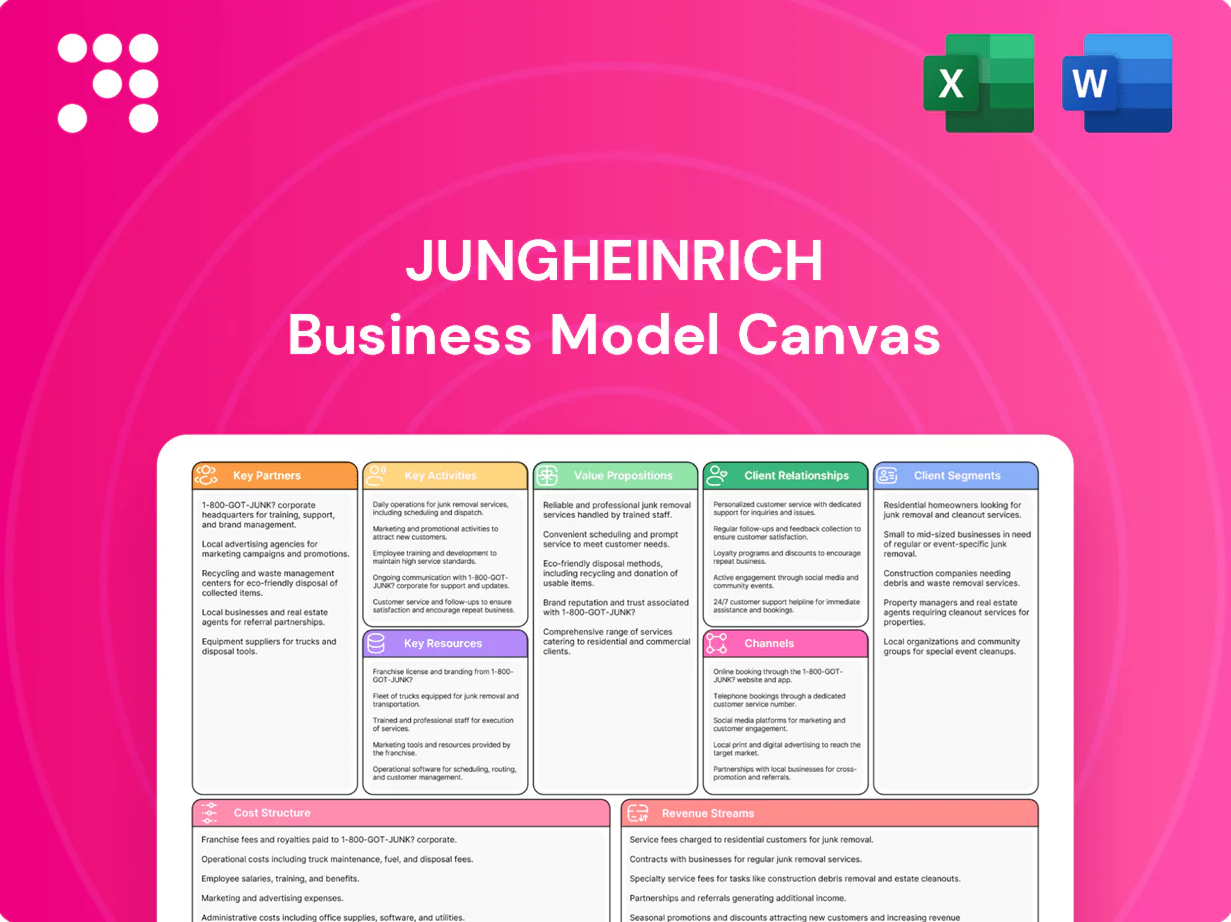
Jungheinrich Business Model Canvas

Concise Business Model Canvas: strategic playbook for industrial material-handling leaders
Discover the strategic engine behind Jungheinrich with our concise Business Model Canvas—three-to-five-sentence insights that map value propositions, key partners, and revenue streams to real-world outcomes. Perfect for investors, consultants, and founders, the full downloadable Canvas in Word and Excel delivers a section-by-section playbook to benchmark, adapt, and scale—grab it to turn analysis into action.
Partnerships

Strategic Component Suppliers
Jungheinrich partners with tier-1 suppliers for batteries, powertrains, hydraulics, sensors and safety systems to ensure performance, compliance and cost stability across product lines; co-development with suppliers accelerates innovation in energy systems and safety. Multi-sourcing reduces supply risk and supports global availability; Jungheinrich employed about 19,000 people in 2024 to support these global operations.
Automation & Robotics Technology Partners
Alliances with AGV/AMR providers, robotics firms and vision/SLAM specialists expanded Jungheinrichs automation stack and tapped into a global AMR market worth about $4.3bn in 2024. Joint roadmaps enable seamless vehicle, navigation and safety integration, cutting time-to-market by up to 30%. Shared pilots in 2024 delivered ROI within 12–18 months and demonstrated scalable throughput gains for customers.

Software & IoT Ecosystem Alliances
Collaborations with WMS, ERP and leading cloud providers enable Jungheinrich to achieve seamless data interoperability across fleets and sites, supporting integration into a global warehouse automation market that exceeded $25bn in 2024. API partnerships deliver real-time fleet, energy and warehouse orchestration for predictive uptime and efficiency gains. Cybersecurity and data governance agreements build trust while co-selling with software partners expands reach into digital-first intralogistics programs.

Dealers, Service Partners & System Integrators
Authorized dealers extend Jungheinrichs sales reach and provide local service capacity, enabling faster uptime and regional spare-parts availability; system integrators consolidate racking, conveyors and IT into turnkey solutions for complex projects. Joint bids with dealers and integrators win greenfield and retrofit warehouses, while shared training and global standards maintain consistent service and installation quality across markets.
- Authorized dealers: local sales & service
- System integrators: racking + conveyors + IT turnkey
- Joint bids: greenfield & retrofit wins
- Shared training: consistent global standards
Financial Institutions & Leasing Partners
Banking and Jungheinrich captive-finance partnerships enable leasing, rental and pay-per-use options that convert capex into opex and accelerate adoption; industry reports in 2024 showed OEM financing penetration in material handling near 30% of transactions. Flexible funding can cut upfront customer capex substantially and faster fleet renewals improve utilization and uptime. Risk-sharing structures and portfolio management enhance ROE for financiers and lower credit friction for customers, supporting large-scale rollouts via integrated procurement and single-invoice solutions.
- Leasing penetration ~30% (2024 industry reports)
- Capex-to-opex shift enables faster adoption
- Risk-sharing improves portfolio economics
- Integrated finance simplifies procurement for fleet rollouts
Tier-1 sourcing + AMR partners scale warehouse automation, ~30% leasing
Jungheinrich leverages tier-1 suppliers and multi-sourcing to secure batteries, sensors and hydraulics, supporting global production with ~19,000 employees (2024). Partnerships with AMR/robotics and software vendors expanded automation into a $4.3bn AMR and $25bn+ warehouse automation market (2024). Captive and bank finance enabled ~30% leasing penetration, shifting capex to opex for faster fleet rollouts.
| Partner type | Role | 2024 metric |
|---|---|---|
| Tier-1 suppliers | Components & co‑dev | 19,000 employees |
| AMR/robotics | Automation stack | $4.3bn AMR |
| Software/cloud | Integration/API | $25bn+ market |
| Finance | Leasing/rental | ~30% penetration |
What is included in the product
 Detailed Word Document
A comprehensive, pre-written business model tailored to Jungheinrich’s intralogistics strategy, covering all 9 BMC blocks with detailed customer segments, channels, value propositions, revenue streams and cost structure; includes competitive advantage analysis, SWOT-linked insights and a polished design for presentations and investor discussions.

 Customizable Excel Spreadsheet
Condenses Jungheinrich’s intralogistics strategy into a clean one-page Business Model Canvas that saves hours of formatting and structuring your own model. Shareable and editable for fast team collaboration, comparison, and executive-ready summaries.
Activities

R&D in Vehicles, Energy, and Automation
Continuous engineering of forklifts, pallet trucks and AGVs yields measurable performance gains across cycles, supported by Jungheinrich’s global R&D teams and around 19,000 employees (2023). Battery systems, charging infrastructure and energy management are optimized to cut TCO and extend duty cycles. Autonomy, safety and software stacks advance through iterative pilots, while targeted IP filings protect differentiation in core platforms.
Manufacturing & Quality Assurance
Global Jungheinrich plants produce trucks, components and racking at scale, supported by around 19,000 employees (2024). Lean operations and coordinated suppliers cut costs and shorten lead times. Rigorous testing programs uphold safety and reliability standards across product lines. Product localization adapts designs to regional regulations and customer requirements.

Systems Design & Integration
End-to-end warehouse solutions are engineered from layout to commissioning, aligning site design with equipment specs and safety standards. WMS, fleet management and controls are tightly integrated with forklifts and conveyors to enable synchronized operations. Dedicated project management secures delivery on time and on budget while continuous improvement programs tune throughput after go-live.

After-Sales Service & Parts Logistics
After-sales service combines preventive maintenance, repairs and SLAs to sustain uptime, with mobile technicians and regional parts hubs minimizing mean time to repair; 2024 industry studies show predictive maintenance can reduce unplanned downtime by up to 30%. Telemetry-driven analytics optimize spare inventory and trigger predictive interventions, while warranty and overhaul programs extend asset life and lower total cost of ownership.
- Preventive maintenance
- Mobile technicians & parts hubs
- Telemetry for predictive interventions
- Warranty & overhaul programs
Rental, Leasing & Fleet Optimization
Jungheinrich uses short- and long-term rental fleets to cover demand spikes and pilot projects, while flexible leasing aligns payments to usage and cash flow; in 2024 the company emphasized service-led growth with expanded rental offerings across key markets. Data-driven fleet analytics improve mix, utilization and energy efficiency, and systematic end-of-term remarketing preserves residual values and accelerates fleet turnover.
- 2024 focus: expanded rental capacity
- Leasing: usage-linked payment structures
- Analytics: utilization & energy optimization
- Remarketing: sustain asset values
Telemetry cuts downtime up to 30%, boosting rental-led growth
Continuous R&D for forklifts, batteries and autonomy, global plants and lean supply reduce lead times; ~19,000 employees (2024) support production and service. Telemetry-driven predictive maintenance cuts unplanned downtime up to 30%; expanded 2024 rental/leasing offerings boost service-led growth and fleet remarketing.
| Metric | Value | Impact |
|---|---|---|
| Employees (2024) | ~19,000 | Production & service capacity |
| Downtime reduction | Up to 30% | Lower TCO |
| 2024 focus | Expanded rental | Service-led growth |
What You See Is What You Get
Business Model Canvas
The document you're previewing is the exact Jungheinrich Business Model Canvas you'll receive after purchase. It’s not a mockup—this is a live excerpt from the final file. Upon purchase you’ll get the complete, editable document formatted as shown, ready for presentation and analysis.

Concise Business Model Canvas: strategic playbook for industrial material-handling leaders
Discover the strategic engine behind Jungheinrich with our concise Business Model Canvas—three-to-five-sentence insights that map value propositions, key partners, and revenue streams to real-world outcomes. Perfect for investors, consultants, and founders, the full downloadable Canvas in Word and Excel delivers a section-by-section playbook to benchmark, adapt, and scale—grab it to turn analysis into action.
Partnerships
Strategic Component Suppliers
Jungheinrich partners with tier-1 suppliers for batteries, powertrains, hydraulics, sensors and safety systems to ensure performance, compliance and cost stability across product lines; co-development with suppliers accelerates innovation in energy systems and safety. Multi-sourcing reduces supply risk and supports global availability; Jungheinrich employed about 19,000 people in 2024 to support these global operations.
Automation & Robotics Technology Partners
Alliances with AGV/AMR providers, robotics firms and vision/SLAM specialists expanded Jungheinrichs automation stack and tapped into a global AMR market worth about $4.3bn in 2024. Joint roadmaps enable seamless vehicle, navigation and safety integration, cutting time-to-market by up to 30%. Shared pilots in 2024 delivered ROI within 12–18 months and demonstrated scalable throughput gains for customers.
Software & IoT Ecosystem Alliances
Collaborations with WMS, ERP and leading cloud providers enable Jungheinrich to achieve seamless data interoperability across fleets and sites, supporting integration into a global warehouse automation market that exceeded $25bn in 2024. API partnerships deliver real-time fleet, energy and warehouse orchestration for predictive uptime and efficiency gains. Cybersecurity and data governance agreements build trust while co-selling with software partners expands reach into digital-first intralogistics programs.
Dealers, Service Partners & System Integrators
Authorized dealers extend Jungheinrichs sales reach and provide local service capacity, enabling faster uptime and regional spare-parts availability; system integrators consolidate racking, conveyors and IT into turnkey solutions for complex projects. Joint bids with dealers and integrators win greenfield and retrofit warehouses, while shared training and global standards maintain consistent service and installation quality across markets.
- Authorized dealers: local sales & service
- System integrators: racking + conveyors + IT turnkey
- Joint bids: greenfield & retrofit wins
- Shared training: consistent global standards
Financial Institutions & Leasing Partners
Banking and Jungheinrich captive-finance partnerships enable leasing, rental and pay-per-use options that convert capex into opex and accelerate adoption; industry reports in 2024 showed OEM financing penetration in material handling near 30% of transactions. Flexible funding can cut upfront customer capex substantially and faster fleet renewals improve utilization and uptime. Risk-sharing structures and portfolio management enhance ROE for financiers and lower credit friction for customers, supporting large-scale rollouts via integrated procurement and single-invoice solutions.
- Leasing penetration ~30% (2024 industry reports)
- Capex-to-opex shift enables faster adoption
- Risk-sharing improves portfolio economics
- Integrated finance simplifies procurement for fleet rollouts
Tier-1 sourcing + AMR partners scale warehouse automation, ~30% leasing
Jungheinrich leverages tier-1 suppliers and multi-sourcing to secure batteries, sensors and hydraulics, supporting global production with ~19,000 employees (2024). Partnerships with AMR/robotics and software vendors expanded automation into a $4.3bn AMR and $25bn+ warehouse automation market (2024). Captive and bank finance enabled ~30% leasing penetration, shifting capex to opex for faster fleet rollouts.
| Partner type | Role | 2024 metric |
|---|---|---|
| Tier-1 suppliers | Components & co‑dev | 19,000 employees |
| AMR/robotics | Automation stack | $4.3bn AMR |
| Software/cloud | Integration/API | $25bn+ market |
| Finance | Leasing/rental | ~30% penetration |
What is included in the product
Detailed Word Document
A comprehensive, pre-written business model tailored to Jungheinrich’s intralogistics strategy, covering all 9 BMC blocks with detailed customer segments, channels, value propositions, revenue streams and cost structure; includes competitive advantage analysis, SWOT-linked insights and a polished design for presentations and investor discussions.
Customizable Excel Spreadsheet
Condenses Jungheinrich’s intralogistics strategy into a clean one-page Business Model Canvas that saves hours of formatting and structuring your own model. Shareable and editable for fast team collaboration, comparison, and executive-ready summaries.
Activities
R&D in Vehicles, Energy, and Automation
Continuous engineering of forklifts, pallet trucks and AGVs yields measurable performance gains across cycles, supported by Jungheinrich’s global R&D teams and around 19,000 employees (2023). Battery systems, charging infrastructure and energy management are optimized to cut TCO and extend duty cycles. Autonomy, safety and software stacks advance through iterative pilots, while targeted IP filings protect differentiation in core platforms.
Manufacturing & Quality Assurance
Global Jungheinrich plants produce trucks, components and racking at scale, supported by around 19,000 employees (2024). Lean operations and coordinated suppliers cut costs and shorten lead times. Rigorous testing programs uphold safety and reliability standards across product lines. Product localization adapts designs to regional regulations and customer requirements.
Systems Design & Integration
End-to-end warehouse solutions are engineered from layout to commissioning, aligning site design with equipment specs and safety standards. WMS, fleet management and controls are tightly integrated with forklifts and conveyors to enable synchronized operations. Dedicated project management secures delivery on time and on budget while continuous improvement programs tune throughput after go-live.
After-Sales Service & Parts Logistics
After-sales service combines preventive maintenance, repairs and SLAs to sustain uptime, with mobile technicians and regional parts hubs minimizing mean time to repair; 2024 industry studies show predictive maintenance can reduce unplanned downtime by up to 30%. Telemetry-driven analytics optimize spare inventory and trigger predictive interventions, while warranty and overhaul programs extend asset life and lower total cost of ownership.
- Preventive maintenance
- Mobile technicians & parts hubs
- Telemetry for predictive interventions
- Warranty & overhaul programs
Rental, Leasing & Fleet Optimization
Jungheinrich uses short- and long-term rental fleets to cover demand spikes and pilot projects, while flexible leasing aligns payments to usage and cash flow; in 2024 the company emphasized service-led growth with expanded rental offerings across key markets. Data-driven fleet analytics improve mix, utilization and energy efficiency, and systematic end-of-term remarketing preserves residual values and accelerates fleet turnover.
- 2024 focus: expanded rental capacity
- Leasing: usage-linked payment structures
- Analytics: utilization & energy optimization
- Remarketing: sustain asset values
Telemetry cuts downtime up to 30%, boosting rental-led growth
Continuous R&D for forklifts, batteries and autonomy, global plants and lean supply reduce lead times; ~19,000 employees (2024) support production and service. Telemetry-driven predictive maintenance cuts unplanned downtime up to 30%; expanded 2024 rental/leasing offerings boost service-led growth and fleet remarketing.
| Metric | Value | Impact |
|---|---|---|
| Employees (2024) | ~19,000 | Production & service capacity |
| Downtime reduction | Up to 30% | Lower TCO |
| 2024 focus | Expanded rental | Service-led growth |
What You See Is What You Get
Business Model Canvas
The document you're previewing is the exact Jungheinrich Business Model Canvas you'll receive after purchase. It’s not a mockup—this is a live excerpt from the final file. Upon purchase you’ll get the complete, editable document formatted as shown, ready for presentation and analysis.
Description
Concise Business Model Canvas: strategic playbook for industrial material-handling leaders
Discover the strategic engine behind Jungheinrich with our concise Business Model Canvas—three-to-five-sentence insights that map value propositions, key partners, and revenue streams to real-world outcomes. Perfect for investors, consultants, and founders, the full downloadable Canvas in Word and Excel delivers a section-by-section playbook to benchmark, adapt, and scale—grab it to turn analysis into action.
Partnerships
Strategic Component Suppliers
Jungheinrich partners with tier-1 suppliers for batteries, powertrains, hydraulics, sensors and safety systems to ensure performance, compliance and cost stability across product lines; co-development with suppliers accelerates innovation in energy systems and safety. Multi-sourcing reduces supply risk and supports global availability; Jungheinrich employed about 19,000 people in 2024 to support these global operations.
Automation & Robotics Technology Partners
Alliances with AGV/AMR providers, robotics firms and vision/SLAM specialists expanded Jungheinrichs automation stack and tapped into a global AMR market worth about $4.3bn in 2024. Joint roadmaps enable seamless vehicle, navigation and safety integration, cutting time-to-market by up to 30%. Shared pilots in 2024 delivered ROI within 12–18 months and demonstrated scalable throughput gains for customers.
Software & IoT Ecosystem Alliances
Collaborations with WMS, ERP and leading cloud providers enable Jungheinrich to achieve seamless data interoperability across fleets and sites, supporting integration into a global warehouse automation market that exceeded $25bn in 2024. API partnerships deliver real-time fleet, energy and warehouse orchestration for predictive uptime and efficiency gains. Cybersecurity and data governance agreements build trust while co-selling with software partners expands reach into digital-first intralogistics programs.
Dealers, Service Partners & System Integrators
Authorized dealers extend Jungheinrichs sales reach and provide local service capacity, enabling faster uptime and regional spare-parts availability; system integrators consolidate racking, conveyors and IT into turnkey solutions for complex projects. Joint bids with dealers and integrators win greenfield and retrofit warehouses, while shared training and global standards maintain consistent service and installation quality across markets.
- Authorized dealers: local sales & service
- System integrators: racking + conveyors + IT turnkey
- Joint bids: greenfield & retrofit wins
- Shared training: consistent global standards
Financial Institutions & Leasing Partners
Banking and Jungheinrich captive-finance partnerships enable leasing, rental and pay-per-use options that convert capex into opex and accelerate adoption; industry reports in 2024 showed OEM financing penetration in material handling near 30% of transactions. Flexible funding can cut upfront customer capex substantially and faster fleet renewals improve utilization and uptime. Risk-sharing structures and portfolio management enhance ROE for financiers and lower credit friction for customers, supporting large-scale rollouts via integrated procurement and single-invoice solutions.
- Leasing penetration ~30% (2024 industry reports)
- Capex-to-opex shift enables faster adoption
- Risk-sharing improves portfolio economics
- Integrated finance simplifies procurement for fleet rollouts
Tier-1 sourcing + AMR partners scale warehouse automation, ~30% leasing
Jungheinrich leverages tier-1 suppliers and multi-sourcing to secure batteries, sensors and hydraulics, supporting global production with ~19,000 employees (2024). Partnerships with AMR/robotics and software vendors expanded automation into a $4.3bn AMR and $25bn+ warehouse automation market (2024). Captive and bank finance enabled ~30% leasing penetration, shifting capex to opex for faster fleet rollouts.
| Partner type | Role | 2024 metric |
|---|---|---|
| Tier-1 suppliers | Components & co‑dev | 19,000 employees |
| AMR/robotics | Automation stack | $4.3bn AMR |
| Software/cloud | Integration/API | $25bn+ market |
| Finance | Leasing/rental | ~30% penetration |
What is included in the product
Detailed Word Document
A comprehensive, pre-written business model tailored to Jungheinrich’s intralogistics strategy, covering all 9 BMC blocks with detailed customer segments, channels, value propositions, revenue streams and cost structure; includes competitive advantage analysis, SWOT-linked insights and a polished design for presentations and investor discussions.
Customizable Excel Spreadsheet
Condenses Jungheinrich’s intralogistics strategy into a clean one-page Business Model Canvas that saves hours of formatting and structuring your own model. Shareable and editable for fast team collaboration, comparison, and executive-ready summaries.
Activities
R&D in Vehicles, Energy, and Automation
Continuous engineering of forklifts, pallet trucks and AGVs yields measurable performance gains across cycles, supported by Jungheinrich’s global R&D teams and around 19,000 employees (2023). Battery systems, charging infrastructure and energy management are optimized to cut TCO and extend duty cycles. Autonomy, safety and software stacks advance through iterative pilots, while targeted IP filings protect differentiation in core platforms.
Manufacturing & Quality Assurance
Global Jungheinrich plants produce trucks, components and racking at scale, supported by around 19,000 employees (2024). Lean operations and coordinated suppliers cut costs and shorten lead times. Rigorous testing programs uphold safety and reliability standards across product lines. Product localization adapts designs to regional regulations and customer requirements.
Systems Design & Integration
End-to-end warehouse solutions are engineered from layout to commissioning, aligning site design with equipment specs and safety standards. WMS, fleet management and controls are tightly integrated with forklifts and conveyors to enable synchronized operations. Dedicated project management secures delivery on time and on budget while continuous improvement programs tune throughput after go-live.
After-Sales Service & Parts Logistics
After-sales service combines preventive maintenance, repairs and SLAs to sustain uptime, with mobile technicians and regional parts hubs minimizing mean time to repair; 2024 industry studies show predictive maintenance can reduce unplanned downtime by up to 30%. Telemetry-driven analytics optimize spare inventory and trigger predictive interventions, while warranty and overhaul programs extend asset life and lower total cost of ownership.
- Preventive maintenance
- Mobile technicians & parts hubs
- Telemetry for predictive interventions
- Warranty & overhaul programs
Rental, Leasing & Fleet Optimization
Jungheinrich uses short- and long-term rental fleets to cover demand spikes and pilot projects, while flexible leasing aligns payments to usage and cash flow; in 2024 the company emphasized service-led growth with expanded rental offerings across key markets. Data-driven fleet analytics improve mix, utilization and energy efficiency, and systematic end-of-term remarketing preserves residual values and accelerates fleet turnover.
- 2024 focus: expanded rental capacity
- Leasing: usage-linked payment structures
- Analytics: utilization & energy optimization
- Remarketing: sustain asset values
Telemetry cuts downtime up to 30%, boosting rental-led growth
Continuous R&D for forklifts, batteries and autonomy, global plants and lean supply reduce lead times; ~19,000 employees (2024) support production and service. Telemetry-driven predictive maintenance cuts unplanned downtime up to 30%; expanded 2024 rental/leasing offerings boost service-led growth and fleet remarketing.
| Metric | Value | Impact |
|---|---|---|
| Employees (2024) | ~19,000 | Production & service capacity |
| Downtime reduction | Up to 30% | Lower TCO |
| 2024 focus | Expanded rental | Service-led growth |
What You See Is What You Get
Business Model Canvas
The document you're previewing is the exact Jungheinrich Business Model Canvas you'll receive after purchase. It’s not a mockup—this is a live excerpt from the final file. Upon purchase you’ll get the complete, editable document formatted as shown, ready for presentation and analysis.











