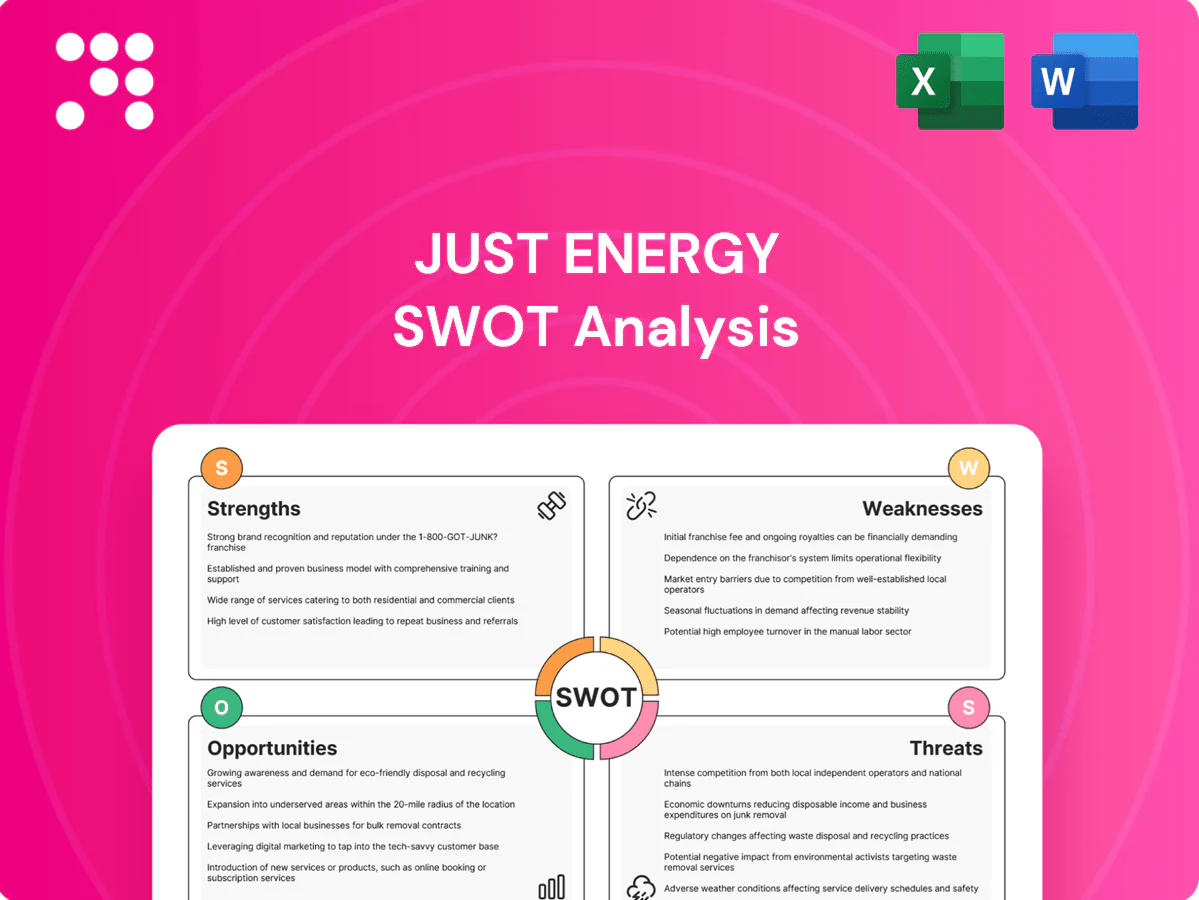
Just Energy SWOT Analysis

Make Insightful Decisions Backed by Expert Research
Discover strengths, weaknesses, opportunities and threats shaping Just Energy’s competitive stance. Our snapshot highlights regulatory exposure, customer-base volatility, and potential growth in renewable offerings. Want the full strategic view and editable tools? Purchase the complete SWOT report — Word and Excel deliverables to plan and pitch with confidence.
Strengths

Established presence in deregulated markets
Operates across multiple deregulated U.S. states and Canadian provinces that offer retail choice, providing access to large, competitive customer pools. The multi-jurisdictional footprint spreads regulatory and demand risk across markets with differing seasonality and rules. Local market know-how enables targeted pricing and acquisition tactics, while scale strengthens supplier relationships and risk-pooling capacity.
Diverse product mix and pricing options
Just Energy offers fixed, variable and green plans to match different risk and sustainability preferences, with fixed-rate contracts typically spanning 12–36 months to stabilize revenue and improve forecasting. Product flexibility enables targeted upselling and customer segmentation across usage profiles and price sensitivity. Green options enhance brand appeal to ESG-minded customers and support acquisition in sustainability-driven segments.

Wholesale procurement and hedging capabilities
Just Energy's experience purchasing power and gas in bulk and hedging exposures helps manage commodity volatility, informed by its 2021 restructuring after roughly CAD 1.9 billion of liabilities.
Structured supply deals and firm hedges enable locked-in margins and protect EBITDA, while formal risk-management processes support more predictable cash flows.
Balancing the portfolio across geographies and contract terms reduces earnings variance and short-term spot exposure.

Direct-to-consumer sales and brand recognition
Direct-to-consumer channels give Just Energy control over pricing, promotions and customer experience, supporting faster A/B testing and tailored retention strategies.
Brand familiarity in legacy markets reduces acquisition cost per customer and enables efficient reactivation of churned accounts.
Cross-selling between residential and small commercial segments raises lifetime value while lower reliance on intermediaries can protect gross margins.
- Direct control: pricing, CX
- Brand lift: lower acquisition cost
- Cross-sell: higher LTV
- Fewer intermediaries: margin resilience
Operational scalability and billing infrastructure
Established customer care, billing and CRM systems allow Just Energy to scale with limited incremental costs; historically the platform supported roughly 2.9 million customer accounts, improving unit economics. Aggregated customer data enhances forecasting and retention models, while automation cuts billing errors and working-capital frictions, enabling faster cash conversion. The scalable back-office permits rapid market entry across provinces and states.
- Platform supports ~2.9M accounts
- Improved forecasting from large datasets
- Automation reduces billing errors and DSO
- Scalable back-office enables quick market launches
Multi-jurisdictional retail energy platform: hedged revenue, scalable D2C growth
Just Energy leverages a multi-jurisdictional retail footprint and targeted product mix (fixed, variable, green) to stabilize revenue and lower acquisition cost; platform historically supported ~2.9 million accounts and benefits from structured hedging after the 2021 restructuring tied to ~CAD 1.9 billion liabilities. Scalable D2C channels, CRM and automation raise LTV, cut DSO and protect margins.
| Metric | Value |
|---|---|
| Customer accounts | ~2.9M |
| 2021 liabilities (restructuring) | ~CAD 1.9B |
| Typical fixed contract | 12–36 months |
What is included in the product
 Detailed Word Document
Provides a concise SWOT analysis of Just Energy, outlining internal strengths and weaknesses alongside external opportunities and threats to assess its competitive position, growth drivers, and strategic risks.

 Customizable Excel Spreadsheet
Provides a focused Just Energy SWOT summary for rapid identification of risks and opportunities, enabling fast mitigation and strategic response; editable format lets teams update scenarios and align stakeholder actions quickly.
Weaknesses

Exposure to wholesale price volatility
Exposure to wholesale price volatility is acute: Henry Hub swung from under $2/MMBtu in 2020 to peaks above $9/MMBtu in 2022, and such spikes can compress margins if hedges are imperfect. Load-forecasting errors create mismatch risk that magnifies when real-time prices jump. Variable-rate plans transmit volatility to customers, raising churn, while credit and margin calls surged into the millions for many retailers during stressed 2022 markets.
High customer churn in competitive markets
Retail energy faces high price sensitivity with annual customer churn commonly in the 20–30% range in competitive markets, driving frequent switching; costly acquisition campaigns (CAC often several hundred dollars per residential account) compress unit economics. Limited differentiation beyond price and renewable content undermines loyalty, and large contract cliffs can create pronounced quarterly revenue lumpiness.

Thin margins and working capital intensity
Low per-customer margins (typically below 5% in retail energy) force Just Energy to chase scale and strict cost control to stay profitable. Billing cycles and supplier collateral requirements tie up cash and can require millions of dollars in working capital, creating liquidity strain. Bad debt risk rises in slowdowns as delinquencies can materially increase, and small pricing errors of 1–2% can wipe out already thin profitability.

Regulatory complexity and compliance burden
Regulatory complexity and compliance burden hamper Just Energy: rules vary widely by state and province, raising overhead and complicating pricing and contract terms. Marketing, disclosure and door-to-door restrictions limit customer-acquisition levers and increase compliance monitoring. Penalties and restitution from lapses, plus sudden policy shifts, can quickly erode product attractiveness and margins.
- State/province rule variability
- Marketing and door-to-door limits
- Risk of penalties and restitution
- Policy shifts reduce product appeal
Reputation sensitivity from past disruptions
Market events and prior financial stress have eroded customer trust in Just Energy, with the 2024 Edelman Trust Barometer showing global institutional trust near 54%, amplifying sensitivity to past disruptions. Negative headlines increase scrutiny of contract terms and cancellation penalties, pressuring retention and acquisition. Rebuilding brand equity will require targeted investment, transparent practices and may keep perceived risk—and financing costs—elevated.
- Reputation erosion: higher churn risk
- Headline impact: stronger contract scrutiny
- Remediation cost: marketing + compliance spend
- Financing: sustained higher risk premium
Gas volatility and 20–30% churn compress margins, hike CAC and financing risk
Exposure to wholesale volatility (Henry Hub <2/MMBtu in 2020 → >9/MMBtu in 2022) compresses margins; retail churn 20–30% raises CAC (several hundred $/acct); net margins often <5% with working capital and collateral needs in the millions; reputation hit (Edelman trust ~54% in 2024) increases financing costs and retention risk.
| Weakness | Key metric | 2024/25 |
|---|---|---|
| Price volatility | Henry Hub range | <2 → >9 $/MMBtu |
| Churn/CAC | Churn / CAC | 20–30% / $200–$500 |
| Margins | Net margin | <5% |
| Trust | Edelman trust | 54% |
Full Version Awaits
Just Energy SWOT Analysis
This is the actual SWOT analysis document you’ll receive upon purchase—no surprises, just professional quality. The preview below is taken directly from the full report; purchase unlocks the complete, editable version. You’re viewing a live excerpt of the final file, ready for download after checkout.

Make Insightful Decisions Backed by Expert Research
Discover strengths, weaknesses, opportunities and threats shaping Just Energy’s competitive stance. Our snapshot highlights regulatory exposure, customer-base volatility, and potential growth in renewable offerings. Want the full strategic view and editable tools? Purchase the complete SWOT report — Word and Excel deliverables to plan and pitch with confidence.
Strengths
Established presence in deregulated markets
Operates across multiple deregulated U.S. states and Canadian provinces that offer retail choice, providing access to large, competitive customer pools. The multi-jurisdictional footprint spreads regulatory and demand risk across markets with differing seasonality and rules. Local market know-how enables targeted pricing and acquisition tactics, while scale strengthens supplier relationships and risk-pooling capacity.
Diverse product mix and pricing options
Just Energy offers fixed, variable and green plans to match different risk and sustainability preferences, with fixed-rate contracts typically spanning 12–36 months to stabilize revenue and improve forecasting. Product flexibility enables targeted upselling and customer segmentation across usage profiles and price sensitivity. Green options enhance brand appeal to ESG-minded customers and support acquisition in sustainability-driven segments.
Wholesale procurement and hedging capabilities
Just Energy's experience purchasing power and gas in bulk and hedging exposures helps manage commodity volatility, informed by its 2021 restructuring after roughly CAD 1.9 billion of liabilities.
Structured supply deals and firm hedges enable locked-in margins and protect EBITDA, while formal risk-management processes support more predictable cash flows.
Balancing the portfolio across geographies and contract terms reduces earnings variance and short-term spot exposure.
Direct-to-consumer sales and brand recognition
Direct-to-consumer channels give Just Energy control over pricing, promotions and customer experience, supporting faster A/B testing and tailored retention strategies.
Brand familiarity in legacy markets reduces acquisition cost per customer and enables efficient reactivation of churned accounts.
Cross-selling between residential and small commercial segments raises lifetime value while lower reliance on intermediaries can protect gross margins.
- Direct control: pricing, CX
- Brand lift: lower acquisition cost
- Cross-sell: higher LTV
- Fewer intermediaries: margin resilience
Operational scalability and billing infrastructure
Established customer care, billing and CRM systems allow Just Energy to scale with limited incremental costs; historically the platform supported roughly 2.9 million customer accounts, improving unit economics. Aggregated customer data enhances forecasting and retention models, while automation cuts billing errors and working-capital frictions, enabling faster cash conversion. The scalable back-office permits rapid market entry across provinces and states.
- Platform supports ~2.9M accounts
- Improved forecasting from large datasets
- Automation reduces billing errors and DSO
- Scalable back-office enables quick market launches
Multi-jurisdictional retail energy platform: hedged revenue, scalable D2C growth
Just Energy leverages a multi-jurisdictional retail footprint and targeted product mix (fixed, variable, green) to stabilize revenue and lower acquisition cost; platform historically supported ~2.9 million accounts and benefits from structured hedging after the 2021 restructuring tied to ~CAD 1.9 billion liabilities. Scalable D2C channels, CRM and automation raise LTV, cut DSO and protect margins.
| Metric | Value |
|---|---|
| Customer accounts | ~2.9M |
| 2021 liabilities (restructuring) | ~CAD 1.9B |
| Typical fixed contract | 12–36 months |
What is included in the product
Detailed Word Document
Provides a concise SWOT analysis of Just Energy, outlining internal strengths and weaknesses alongside external opportunities and threats to assess its competitive position, growth drivers, and strategic risks.
Customizable Excel Spreadsheet
Provides a focused Just Energy SWOT summary for rapid identification of risks and opportunities, enabling fast mitigation and strategic response; editable format lets teams update scenarios and align stakeholder actions quickly.
Weaknesses
Exposure to wholesale price volatility
Exposure to wholesale price volatility is acute: Henry Hub swung from under $2/MMBtu in 2020 to peaks above $9/MMBtu in 2022, and such spikes can compress margins if hedges are imperfect. Load-forecasting errors create mismatch risk that magnifies when real-time prices jump. Variable-rate plans transmit volatility to customers, raising churn, while credit and margin calls surged into the millions for many retailers during stressed 2022 markets.
High customer churn in competitive markets
Retail energy faces high price sensitivity with annual customer churn commonly in the 20–30% range in competitive markets, driving frequent switching; costly acquisition campaigns (CAC often several hundred dollars per residential account) compress unit economics. Limited differentiation beyond price and renewable content undermines loyalty, and large contract cliffs can create pronounced quarterly revenue lumpiness.
Thin margins and working capital intensity
Low per-customer margins (typically below 5% in retail energy) force Just Energy to chase scale and strict cost control to stay profitable. Billing cycles and supplier collateral requirements tie up cash and can require millions of dollars in working capital, creating liquidity strain. Bad debt risk rises in slowdowns as delinquencies can materially increase, and small pricing errors of 1–2% can wipe out already thin profitability.
Regulatory complexity and compliance burden
Regulatory complexity and compliance burden hamper Just Energy: rules vary widely by state and province, raising overhead and complicating pricing and contract terms. Marketing, disclosure and door-to-door restrictions limit customer-acquisition levers and increase compliance monitoring. Penalties and restitution from lapses, plus sudden policy shifts, can quickly erode product attractiveness and margins.
- State/province rule variability
- Marketing and door-to-door limits
- Risk of penalties and restitution
- Policy shifts reduce product appeal
Reputation sensitivity from past disruptions
Market events and prior financial stress have eroded customer trust in Just Energy, with the 2024 Edelman Trust Barometer showing global institutional trust near 54%, amplifying sensitivity to past disruptions. Negative headlines increase scrutiny of contract terms and cancellation penalties, pressuring retention and acquisition. Rebuilding brand equity will require targeted investment, transparent practices and may keep perceived risk—and financing costs—elevated.
- Reputation erosion: higher churn risk
- Headline impact: stronger contract scrutiny
- Remediation cost: marketing + compliance spend
- Financing: sustained higher risk premium
Gas volatility and 20–30% churn compress margins, hike CAC and financing risk
Exposure to wholesale volatility (Henry Hub <2/MMBtu in 2020 → >9/MMBtu in 2022) compresses margins; retail churn 20–30% raises CAC (several hundred $/acct); net margins often <5% with working capital and collateral needs in the millions; reputation hit (Edelman trust ~54% in 2024) increases financing costs and retention risk.
| Weakness | Key metric | 2024/25 |
|---|---|---|
| Price volatility | Henry Hub range | <2 → >9 $/MMBtu |
| Churn/CAC | Churn / CAC | 20–30% / $200–$500 |
| Margins | Net margin | <5% |
| Trust | Edelman trust | 54% |
Full Version Awaits
Just Energy SWOT Analysis
This is the actual SWOT analysis document you’ll receive upon purchase—no surprises, just professional quality. The preview below is taken directly from the full report; purchase unlocks the complete, editable version. You’re viewing a live excerpt of the final file, ready for download after checkout.
Original: $10.00
-65%$10.00
$3.50Description
Make Insightful Decisions Backed by Expert Research
Discover strengths, weaknesses, opportunities and threats shaping Just Energy’s competitive stance. Our snapshot highlights regulatory exposure, customer-base volatility, and potential growth in renewable offerings. Want the full strategic view and editable tools? Purchase the complete SWOT report — Word and Excel deliverables to plan and pitch with confidence.
Strengths
Established presence in deregulated markets
Operates across multiple deregulated U.S. states and Canadian provinces that offer retail choice, providing access to large, competitive customer pools. The multi-jurisdictional footprint spreads regulatory and demand risk across markets with differing seasonality and rules. Local market know-how enables targeted pricing and acquisition tactics, while scale strengthens supplier relationships and risk-pooling capacity.
Diverse product mix and pricing options
Just Energy offers fixed, variable and green plans to match different risk and sustainability preferences, with fixed-rate contracts typically spanning 12–36 months to stabilize revenue and improve forecasting. Product flexibility enables targeted upselling and customer segmentation across usage profiles and price sensitivity. Green options enhance brand appeal to ESG-minded customers and support acquisition in sustainability-driven segments.
Wholesale procurement and hedging capabilities
Just Energy's experience purchasing power and gas in bulk and hedging exposures helps manage commodity volatility, informed by its 2021 restructuring after roughly CAD 1.9 billion of liabilities.
Structured supply deals and firm hedges enable locked-in margins and protect EBITDA, while formal risk-management processes support more predictable cash flows.
Balancing the portfolio across geographies and contract terms reduces earnings variance and short-term spot exposure.
Direct-to-consumer sales and brand recognition
Direct-to-consumer channels give Just Energy control over pricing, promotions and customer experience, supporting faster A/B testing and tailored retention strategies.
Brand familiarity in legacy markets reduces acquisition cost per customer and enables efficient reactivation of churned accounts.
Cross-selling between residential and small commercial segments raises lifetime value while lower reliance on intermediaries can protect gross margins.
- Direct control: pricing, CX
- Brand lift: lower acquisition cost
- Cross-sell: higher LTV
- Fewer intermediaries: margin resilience
Operational scalability and billing infrastructure
Established customer care, billing and CRM systems allow Just Energy to scale with limited incremental costs; historically the platform supported roughly 2.9 million customer accounts, improving unit economics. Aggregated customer data enhances forecasting and retention models, while automation cuts billing errors and working-capital frictions, enabling faster cash conversion. The scalable back-office permits rapid market entry across provinces and states.
- Platform supports ~2.9M accounts
- Improved forecasting from large datasets
- Automation reduces billing errors and DSO
- Scalable back-office enables quick market launches
Multi-jurisdictional retail energy platform: hedged revenue, scalable D2C growth
Just Energy leverages a multi-jurisdictional retail footprint and targeted product mix (fixed, variable, green) to stabilize revenue and lower acquisition cost; platform historically supported ~2.9 million accounts and benefits from structured hedging after the 2021 restructuring tied to ~CAD 1.9 billion liabilities. Scalable D2C channels, CRM and automation raise LTV, cut DSO and protect margins.
| Metric | Value |
|---|---|
| Customer accounts | ~2.9M |
| 2021 liabilities (restructuring) | ~CAD 1.9B |
| Typical fixed contract | 12–36 months |
What is included in the product
Detailed Word Document
Provides a concise SWOT analysis of Just Energy, outlining internal strengths and weaknesses alongside external opportunities and threats to assess its competitive position, growth drivers, and strategic risks.
Customizable Excel Spreadsheet
Provides a focused Just Energy SWOT summary for rapid identification of risks and opportunities, enabling fast mitigation and strategic response; editable format lets teams update scenarios and align stakeholder actions quickly.
Weaknesses
Exposure to wholesale price volatility
Exposure to wholesale price volatility is acute: Henry Hub swung from under $2/MMBtu in 2020 to peaks above $9/MMBtu in 2022, and such spikes can compress margins if hedges are imperfect. Load-forecasting errors create mismatch risk that magnifies when real-time prices jump. Variable-rate plans transmit volatility to customers, raising churn, while credit and margin calls surged into the millions for many retailers during stressed 2022 markets.
High customer churn in competitive markets
Retail energy faces high price sensitivity with annual customer churn commonly in the 20–30% range in competitive markets, driving frequent switching; costly acquisition campaigns (CAC often several hundred dollars per residential account) compress unit economics. Limited differentiation beyond price and renewable content undermines loyalty, and large contract cliffs can create pronounced quarterly revenue lumpiness.
Thin margins and working capital intensity
Low per-customer margins (typically below 5% in retail energy) force Just Energy to chase scale and strict cost control to stay profitable. Billing cycles and supplier collateral requirements tie up cash and can require millions of dollars in working capital, creating liquidity strain. Bad debt risk rises in slowdowns as delinquencies can materially increase, and small pricing errors of 1–2% can wipe out already thin profitability.
Regulatory complexity and compliance burden
Regulatory complexity and compliance burden hamper Just Energy: rules vary widely by state and province, raising overhead and complicating pricing and contract terms. Marketing, disclosure and door-to-door restrictions limit customer-acquisition levers and increase compliance monitoring. Penalties and restitution from lapses, plus sudden policy shifts, can quickly erode product attractiveness and margins.
- State/province rule variability
- Marketing and door-to-door limits
- Risk of penalties and restitution
- Policy shifts reduce product appeal
Reputation sensitivity from past disruptions
Market events and prior financial stress have eroded customer trust in Just Energy, with the 2024 Edelman Trust Barometer showing global institutional trust near 54%, amplifying sensitivity to past disruptions. Negative headlines increase scrutiny of contract terms and cancellation penalties, pressuring retention and acquisition. Rebuilding brand equity will require targeted investment, transparent practices and may keep perceived risk—and financing costs—elevated.
- Reputation erosion: higher churn risk
- Headline impact: stronger contract scrutiny
- Remediation cost: marketing + compliance spend
- Financing: sustained higher risk premium
Gas volatility and 20–30% churn compress margins, hike CAC and financing risk
Exposure to wholesale volatility (Henry Hub <2/MMBtu in 2020 → >9/MMBtu in 2022) compresses margins; retail churn 20–30% raises CAC (several hundred $/acct); net margins often <5% with working capital and collateral needs in the millions; reputation hit (Edelman trust ~54% in 2024) increases financing costs and retention risk.
| Weakness | Key metric | 2024/25 |
|---|---|---|
| Price volatility | Henry Hub range | <2 → >9 $/MMBtu |
| Churn/CAC | Churn / CAC | 20–30% / $200–$500 |
| Margins | Net margin | <5% |
| Trust | Edelman trust | 54% |
Full Version Awaits
Just Energy SWOT Analysis
This is the actual SWOT analysis document you’ll receive upon purchase—no surprises, just professional quality. The preview below is taken directly from the full report; purchase unlocks the complete, editable version. You’re viewing a live excerpt of the final file, ready for download after checkout.











