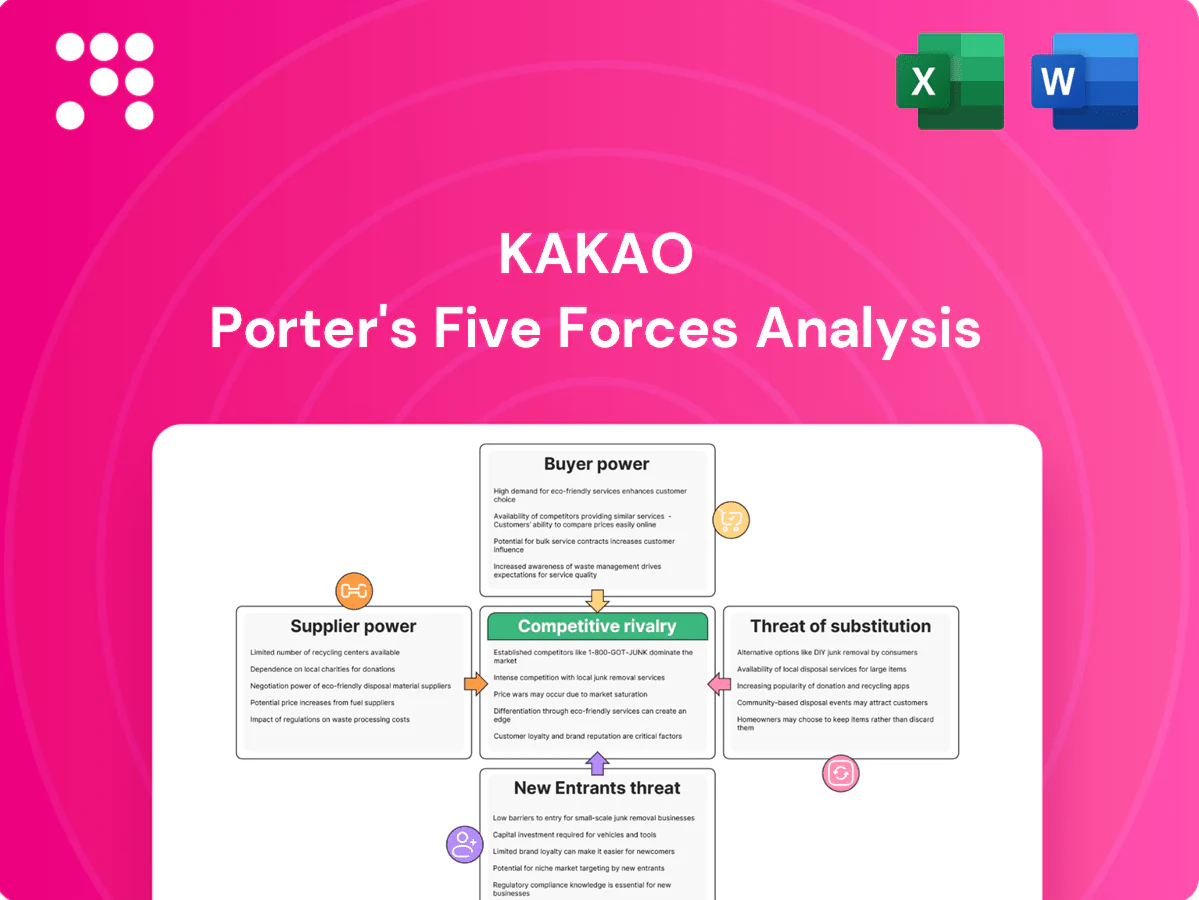
Kakao Porter's Five Forces Analysis

A Must-Have Tool for Decision-Makers
Kakao benefits from strong network effects and service integration that raise switching costs, but faces intensifying rivalry from global tech platforms and regulatory scrutiny that amplify strategic risk; supplier and buyer power vary across its ad, payments, and content units. This brief snapshot only scratches the surface. Unlock the full Porter's Five Forces Analysis to explore Kakao’s competitive dynamics, market pressures, and strategic advantages in detail.
Suppliers Bargaining Power

Platform gatekeepers
Platform gatekeepers like Apple and Google, which impose 15–30% app store fees (15% under small‑business programs vs 30% standard), directly pressure Kakao’s margins and policy compliance; sudden changes to privacy, payments or commission rules can shift unit economics overnight. Kakao offsets exposure through web channels and local partnerships but remains vulnerable. Its negotiation leverage is bolstered by roughly 52 million domestic users yet is not decisive against platform policies.
Content and IP owners
K-pop labels, publishers and independent creators supply must-have IP to Kakao Entertainment, Webtoon and Melon, giving top creators outsized bargaining power and large revenue shares in hit-driven markets. Melon retained roughly 40% share of Korea’s music streaming market in 2024, underscoring supplier leverage. Kakao’s partial vertical integration reduces cost exposure but cannot fully replace external hits; exclusive windows and co-production deals are used to stabilize supply.

Cloud and network infrastructure
Dependence on cloud/CDN, data centers and telecom carriers (SK Telecom, KT, LG U+) makes reliability and pricing critical; global hyperscalers held about 70% of cloud IaaS market in 2024, concentrating bargaining power. Services are somewhat substitutable, but migration costs and latency risks create switching frictions. Volume commitments secure discounts yet lock in spend. Outages can trigger SLA penalties and severe reputational harm.

Financial rails and banks
- Dependence: card networks, issuing banks, regulators
- Revenue impact: interchange and settlement shape take rates
- Mitigation: licenses and proprietary wallets raise fixed costs
- Risk: regulatory changes can immediately increase supplier leverage
Mobility supply base
Platform at risk: app-store fees, top creators, hyperscalers and banks squeeze margins
Kakao faces concentrated supplier power: app stores (15–30% fees) can swing margins; content owners (top creators, Melon tied to ~40% market share in 2024) extract large splits; infrastructure (global hyperscalers ~70% IaaS in 2024) and banks/card networks set critical terms that are costly to replace.
| Supplier | 2024 stat | Impact |
|---|---|---|
| App stores | 15–30% fees | Margin pressure |
| Content creators | Melon ~40% music share | Revenue share |
| Cloud/banks | Hyperscalers ~70% IaaS | Switching cost |
What is included in the product
 Detailed Word Document
Uncovers key drivers of competition, customer influence, and market entry risks tailored to Kakao, evaluating supplier and buyer power, substitutes, rivalry intensity and barriers to entry while identifying disruptive threats and strategic implications.

 Customizable Excel Spreadsheet
A concise Porter's Five Forces snapshot for Kakao—clearly highlights competitive pain points and suggests targeted levers to relieve strategic pressure, ready to drop into pitch decks or operational plans.
Customers Bargaining Power

Mass consumers
Mass consumers multi-home across messaging, media, payments and mobility, increasing price sensitivity despite Kakao’s ≈50 million monthly users and reach to over 90% of Korea’s smartphone base (smartphone penetration ≈96% in 2024). Functional switching is easy, yet KakaoTalk’s network effects and platform integrations create strong inertia. Privacy or UX shifts can trigger rapid churn given alternative apps. Free-to-use models transfer bargaining power from price to user attention and ad engagement metrics.
Advertisers and merchants
Advertisers can reallocate budgets among Naver, Meta, Google and Coupang, increasing negotiation leverage; global digital ad spend in 2024 is estimated at about $610 billion, concentrating power with the largest platforms. Auction dynamics and performance transparency limit Kakao's pricing power, as CPM/CPA benchmarks drive bids. Kakao differentiates through refined targeting, commerce integration and closed-loop measurement; large merchants demand lower fees and direct data access, pressuring margins.

Financial services users
Financial-services users compare fees, rewards and acceptance of Kakao Pay against Toss, Naver Pay, Apple Pay and bank apps, making price and perks decisive. Low switching costs and frequent promotions amplify buyer power, while trust, security and convenience drive retention more than lock-in. South Korea had ~97% smartphone penetration in 2024, and Open Banking rules since 2019 enhance portability, reducing stickiness.

Creators and SMEs
Creators and SMEs wield substantial bargaining power, choosing among multiple distribution and monetization platforms and negotiating revenue shares, data access, and promotion where audience portability exists; Kakao reported about 53 million MAU on KakaoTalk in 2024, so it leverages scale by bundling tools and cross-promotion to retain creators, while top-tier creators command premium terms and bespoke deals.
- Platform choice: multiple rivals
- Negotiation levers: revenue share, data, promotion
- Kakao defense: bundled tools + cross-promo (53M MAU 2024)
Mobility riders
Riders compare price, ETA and reliability across apps and public transit, making promo elasticity high and pressuring Kakao’s take rates; in 2024 discounts and promos reportedly increased platform trips by roughly 20%, squeezing margins. Service breadth (taxis, premium, parcels) diversifies demand but price caps and fee scrutiny limit price-setting. Ratings and service quality (average driver rating ~4.7) strongly drive repeat use.
- Price sensitivity: high
- Promo elasticity: ~20% uplift in 2024
- Service breadth: mitigates but capped
- Quality: avg rating ~4.7
Super-app:~53M MAU, ≈96% pen. ≈20% promo
Customers multi-home across Kakao’s ecosystem despite ~53M MAU and ~90% reach; smartphone penetration in Korea ≈96% (2024), lowering switching costs and heightening price sensitivity.
Advertisers (global digital ad spend ~$610B in 2024) and large merchants push on fees/data; creators and SMEs demand revenue share and access.
Riders and payments users chase promos (≈20% trip uplift 2024) and low fees; avg driver rating ~4.7; Open Banking since 2019 increases portability.
| Metric | 2024 |
|---|---|
| MAU (KakaoTalk) | ~53M |
| Smartphone pen. | ≈96% |
| Global ad spend | $610B |
| Promo uplift (rides) | ≈20% |
| Avg driver rating | ~4.7 |
Preview Before You Purchase
Kakao Porter's Five Forces Analysis
This preview shows the exact Kakao Porter's Five Forces Analysis you'll receive immediately after purchase—no surprises or placeholders. The document is fully formatted, professional, and ready for download and use the moment you buy. You're viewing the complete, final deliverable; purchase grants instant access to this same file.

A Must-Have Tool for Decision-Makers
Kakao benefits from strong network effects and service integration that raise switching costs, but faces intensifying rivalry from global tech platforms and regulatory scrutiny that amplify strategic risk; supplier and buyer power vary across its ad, payments, and content units. This brief snapshot only scratches the surface. Unlock the full Porter's Five Forces Analysis to explore Kakao’s competitive dynamics, market pressures, and strategic advantages in detail.
Suppliers Bargaining Power
Platform gatekeepers
Platform gatekeepers like Apple and Google, which impose 15–30% app store fees (15% under small‑business programs vs 30% standard), directly pressure Kakao’s margins and policy compliance; sudden changes to privacy, payments or commission rules can shift unit economics overnight. Kakao offsets exposure through web channels and local partnerships but remains vulnerable. Its negotiation leverage is bolstered by roughly 52 million domestic users yet is not decisive against platform policies.
Content and IP owners
K-pop labels, publishers and independent creators supply must-have IP to Kakao Entertainment, Webtoon and Melon, giving top creators outsized bargaining power and large revenue shares in hit-driven markets. Melon retained roughly 40% share of Korea’s music streaming market in 2024, underscoring supplier leverage. Kakao’s partial vertical integration reduces cost exposure but cannot fully replace external hits; exclusive windows and co-production deals are used to stabilize supply.
Cloud and network infrastructure
Dependence on cloud/CDN, data centers and telecom carriers (SK Telecom, KT, LG U+) makes reliability and pricing critical; global hyperscalers held about 70% of cloud IaaS market in 2024, concentrating bargaining power. Services are somewhat substitutable, but migration costs and latency risks create switching frictions. Volume commitments secure discounts yet lock in spend. Outages can trigger SLA penalties and severe reputational harm.
Financial rails and banks
- Dependence: card networks, issuing banks, regulators
- Revenue impact: interchange and settlement shape take rates
- Mitigation: licenses and proprietary wallets raise fixed costs
- Risk: regulatory changes can immediately increase supplier leverage
Mobility supply base
Platform at risk: app-store fees, top creators, hyperscalers and banks squeeze margins
Kakao faces concentrated supplier power: app stores (15–30% fees) can swing margins; content owners (top creators, Melon tied to ~40% market share in 2024) extract large splits; infrastructure (global hyperscalers ~70% IaaS in 2024) and banks/card networks set critical terms that are costly to replace.
| Supplier | 2024 stat | Impact |
|---|---|---|
| App stores | 15–30% fees | Margin pressure |
| Content creators | Melon ~40% music share | Revenue share |
| Cloud/banks | Hyperscalers ~70% IaaS | Switching cost |
What is included in the product
Detailed Word Document
Uncovers key drivers of competition, customer influence, and market entry risks tailored to Kakao, evaluating supplier and buyer power, substitutes, rivalry intensity and barriers to entry while identifying disruptive threats and strategic implications.
Customizable Excel Spreadsheet
A concise Porter's Five Forces snapshot for Kakao—clearly highlights competitive pain points and suggests targeted levers to relieve strategic pressure, ready to drop into pitch decks or operational plans.
Customers Bargaining Power
Mass consumers
Mass consumers multi-home across messaging, media, payments and mobility, increasing price sensitivity despite Kakao’s ≈50 million monthly users and reach to over 90% of Korea’s smartphone base (smartphone penetration ≈96% in 2024). Functional switching is easy, yet KakaoTalk’s network effects and platform integrations create strong inertia. Privacy or UX shifts can trigger rapid churn given alternative apps. Free-to-use models transfer bargaining power from price to user attention and ad engagement metrics.
Advertisers and merchants
Advertisers can reallocate budgets among Naver, Meta, Google and Coupang, increasing negotiation leverage; global digital ad spend in 2024 is estimated at about $610 billion, concentrating power with the largest platforms. Auction dynamics and performance transparency limit Kakao's pricing power, as CPM/CPA benchmarks drive bids. Kakao differentiates through refined targeting, commerce integration and closed-loop measurement; large merchants demand lower fees and direct data access, pressuring margins.
Financial services users
Financial-services users compare fees, rewards and acceptance of Kakao Pay against Toss, Naver Pay, Apple Pay and bank apps, making price and perks decisive. Low switching costs and frequent promotions amplify buyer power, while trust, security and convenience drive retention more than lock-in. South Korea had ~97% smartphone penetration in 2024, and Open Banking rules since 2019 enhance portability, reducing stickiness.
Creators and SMEs
Creators and SMEs wield substantial bargaining power, choosing among multiple distribution and monetization platforms and negotiating revenue shares, data access, and promotion where audience portability exists; Kakao reported about 53 million MAU on KakaoTalk in 2024, so it leverages scale by bundling tools and cross-promotion to retain creators, while top-tier creators command premium terms and bespoke deals.
- Platform choice: multiple rivals
- Negotiation levers: revenue share, data, promotion
- Kakao defense: bundled tools + cross-promo (53M MAU 2024)
Mobility riders
Riders compare price, ETA and reliability across apps and public transit, making promo elasticity high and pressuring Kakao’s take rates; in 2024 discounts and promos reportedly increased platform trips by roughly 20%, squeezing margins. Service breadth (taxis, premium, parcels) diversifies demand but price caps and fee scrutiny limit price-setting. Ratings and service quality (average driver rating ~4.7) strongly drive repeat use.
- Price sensitivity: high
- Promo elasticity: ~20% uplift in 2024
- Service breadth: mitigates but capped
- Quality: avg rating ~4.7
Super-app:~53M MAU, ≈96% pen. ≈20% promo
Customers multi-home across Kakao’s ecosystem despite ~53M MAU and ~90% reach; smartphone penetration in Korea ≈96% (2024), lowering switching costs and heightening price sensitivity.
Advertisers (global digital ad spend ~$610B in 2024) and large merchants push on fees/data; creators and SMEs demand revenue share and access.
Riders and payments users chase promos (≈20% trip uplift 2024) and low fees; avg driver rating ~4.7; Open Banking since 2019 increases portability.
| Metric | 2024 |
|---|---|
| MAU (KakaoTalk) | ~53M |
| Smartphone pen. | ≈96% |
| Global ad spend | $610B |
| Promo uplift (rides) | ≈20% |
| Avg driver rating | ~4.7 |
Preview Before You Purchase
Kakao Porter's Five Forces Analysis
This preview shows the exact Kakao Porter's Five Forces Analysis you'll receive immediately after purchase—no surprises or placeholders. The document is fully formatted, professional, and ready for download and use the moment you buy. You're viewing the complete, final deliverable; purchase grants instant access to this same file.
Original: $10.00
-65%$10.00
$3.50Description
A Must-Have Tool for Decision-Makers
Kakao benefits from strong network effects and service integration that raise switching costs, but faces intensifying rivalry from global tech platforms and regulatory scrutiny that amplify strategic risk; supplier and buyer power vary across its ad, payments, and content units. This brief snapshot only scratches the surface. Unlock the full Porter's Five Forces Analysis to explore Kakao’s competitive dynamics, market pressures, and strategic advantages in detail.
Suppliers Bargaining Power
Platform gatekeepers
Platform gatekeepers like Apple and Google, which impose 15–30% app store fees (15% under small‑business programs vs 30% standard), directly pressure Kakao’s margins and policy compliance; sudden changes to privacy, payments or commission rules can shift unit economics overnight. Kakao offsets exposure through web channels and local partnerships but remains vulnerable. Its negotiation leverage is bolstered by roughly 52 million domestic users yet is not decisive against platform policies.
Content and IP owners
K-pop labels, publishers and independent creators supply must-have IP to Kakao Entertainment, Webtoon and Melon, giving top creators outsized bargaining power and large revenue shares in hit-driven markets. Melon retained roughly 40% share of Korea’s music streaming market in 2024, underscoring supplier leverage. Kakao’s partial vertical integration reduces cost exposure but cannot fully replace external hits; exclusive windows and co-production deals are used to stabilize supply.
Cloud and network infrastructure
Dependence on cloud/CDN, data centers and telecom carriers (SK Telecom, KT, LG U+) makes reliability and pricing critical; global hyperscalers held about 70% of cloud IaaS market in 2024, concentrating bargaining power. Services are somewhat substitutable, but migration costs and latency risks create switching frictions. Volume commitments secure discounts yet lock in spend. Outages can trigger SLA penalties and severe reputational harm.
Financial rails and banks
- Dependence: card networks, issuing banks, regulators
- Revenue impact: interchange and settlement shape take rates
- Mitigation: licenses and proprietary wallets raise fixed costs
- Risk: regulatory changes can immediately increase supplier leverage
Mobility supply base
Platform at risk: app-store fees, top creators, hyperscalers and banks squeeze margins
Kakao faces concentrated supplier power: app stores (15–30% fees) can swing margins; content owners (top creators, Melon tied to ~40% market share in 2024) extract large splits; infrastructure (global hyperscalers ~70% IaaS in 2024) and banks/card networks set critical terms that are costly to replace.
| Supplier | 2024 stat | Impact |
|---|---|---|
| App stores | 15–30% fees | Margin pressure |
| Content creators | Melon ~40% music share | Revenue share |
| Cloud/banks | Hyperscalers ~70% IaaS | Switching cost |
What is included in the product
Detailed Word Document
Uncovers key drivers of competition, customer influence, and market entry risks tailored to Kakao, evaluating supplier and buyer power, substitutes, rivalry intensity and barriers to entry while identifying disruptive threats and strategic implications.
Customizable Excel Spreadsheet
A concise Porter's Five Forces snapshot for Kakao—clearly highlights competitive pain points and suggests targeted levers to relieve strategic pressure, ready to drop into pitch decks or operational plans.
Customers Bargaining Power
Mass consumers
Mass consumers multi-home across messaging, media, payments and mobility, increasing price sensitivity despite Kakao’s ≈50 million monthly users and reach to over 90% of Korea’s smartphone base (smartphone penetration ≈96% in 2024). Functional switching is easy, yet KakaoTalk’s network effects and platform integrations create strong inertia. Privacy or UX shifts can trigger rapid churn given alternative apps. Free-to-use models transfer bargaining power from price to user attention and ad engagement metrics.
Advertisers and merchants
Advertisers can reallocate budgets among Naver, Meta, Google and Coupang, increasing negotiation leverage; global digital ad spend in 2024 is estimated at about $610 billion, concentrating power with the largest platforms. Auction dynamics and performance transparency limit Kakao's pricing power, as CPM/CPA benchmarks drive bids. Kakao differentiates through refined targeting, commerce integration and closed-loop measurement; large merchants demand lower fees and direct data access, pressuring margins.
Financial services users
Financial-services users compare fees, rewards and acceptance of Kakao Pay against Toss, Naver Pay, Apple Pay and bank apps, making price and perks decisive. Low switching costs and frequent promotions amplify buyer power, while trust, security and convenience drive retention more than lock-in. South Korea had ~97% smartphone penetration in 2024, and Open Banking rules since 2019 enhance portability, reducing stickiness.
Creators and SMEs
Creators and SMEs wield substantial bargaining power, choosing among multiple distribution and monetization platforms and negotiating revenue shares, data access, and promotion where audience portability exists; Kakao reported about 53 million MAU on KakaoTalk in 2024, so it leverages scale by bundling tools and cross-promotion to retain creators, while top-tier creators command premium terms and bespoke deals.
- Platform choice: multiple rivals
- Negotiation levers: revenue share, data, promotion
- Kakao defense: bundled tools + cross-promo (53M MAU 2024)
Mobility riders
Riders compare price, ETA and reliability across apps and public transit, making promo elasticity high and pressuring Kakao’s take rates; in 2024 discounts and promos reportedly increased platform trips by roughly 20%, squeezing margins. Service breadth (taxis, premium, parcels) diversifies demand but price caps and fee scrutiny limit price-setting. Ratings and service quality (average driver rating ~4.7) strongly drive repeat use.
- Price sensitivity: high
- Promo elasticity: ~20% uplift in 2024
- Service breadth: mitigates but capped
- Quality: avg rating ~4.7
Super-app:~53M MAU, ≈96% pen. ≈20% promo
Customers multi-home across Kakao’s ecosystem despite ~53M MAU and ~90% reach; smartphone penetration in Korea ≈96% (2024), lowering switching costs and heightening price sensitivity.
Advertisers (global digital ad spend ~$610B in 2024) and large merchants push on fees/data; creators and SMEs demand revenue share and access.
Riders and payments users chase promos (≈20% trip uplift 2024) and low fees; avg driver rating ~4.7; Open Banking since 2019 increases portability.
| Metric | 2024 |
|---|---|
| MAU (KakaoTalk) | ~53M |
| Smartphone pen. | ≈96% |
| Global ad spend | $610B |
| Promo uplift (rides) | ≈20% |
| Avg driver rating | ~4.7 |
Preview Before You Purchase
Kakao Porter's Five Forces Analysis
This preview shows the exact Kakao Porter's Five Forces Analysis you'll receive immediately after purchase—no surprises or placeholders. The document is fully formatted, professional, and ready for download and use the moment you buy. You're viewing the complete, final deliverable; purchase grants instant access to this same file.











