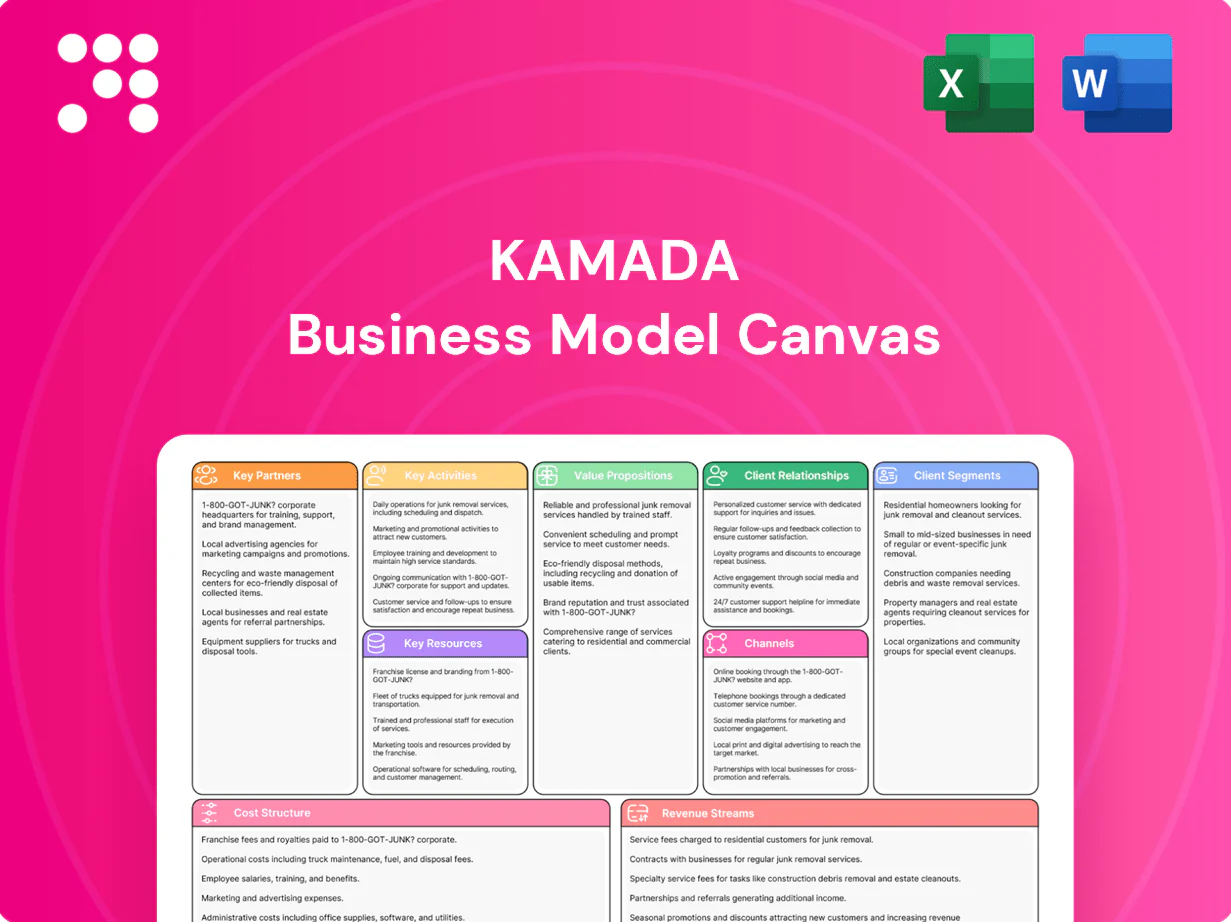
Kamada Business Model Canvas

Unlock the strategic playbook: concise Business Model Canvas for investors and founders
Unlock Kamada’s strategic playbook with our concise Business Model Canvas: four key advantages, nine building blocks, and clear pathways to revenue and scale. This focused snapshot reveals customer segments, partnerships, and cost drivers to inform investor decisions or strategic pivots. Ideal for founders, analysts, and advisors seeking actionable, ready-to-use insights. Download the full Word/Excel canvas for deeper analysis and benchmarking.
Partnerships

Plasma collection networks and blood centers
Access to high-quality human plasma underpins all Kamada production; the global plasma-derived therapeutics market surpassed USD 40 billion in 2024, highlighting raw-material importance. Partnerships with collection networks secure steady volumes, donor screening and GxP compliance. Long-term agreements reduce supply risk and cost volatility, while geographic diversification mitigates regulatory or donor disruptions.
Fill-finish, logistics, and cold-chain providers
Specialized fill-finish, logistics, and cold-chain partners provide sterile filling, packaging, and temperature-controlled distribution that preserve Kamada’s biologics integrity and enable on-time global delivery. Capacity alignment with these partners supports launch ramps and demand peaks, allowing scalable batch throughput and rapid commercial supply. Rigorous quality agreements, site audits, and cGMP oversight ensure regulatory compliance across the supply chain.

Global distributors and licensing partners
Regional distributors extend Kamadas market reach where direct presence is limited, enabling access to over 60 countries via partners and local networks. They navigate complex local regulations, reimbursement and tender processes, crucial in markets where plasma-derived therapeutics face stringent approval timelines. Co-promotion and licensing accelerate uptake in priority markets, supporting sales growth within a global plasma market estimated at about 47 billion USD in 2024. Performance-based terms align incentives and improve demand forecasting through shared KPIs and revenue-linked milestones.

CROs, academic centers, and KOL networks
CROs accelerate trial timelines and evidence generation by outsourcing logistics and monitoring; academic centers enable access to rare-disease cohorts (rare diseases affect ~300 million people globally, WHO). KOL networks drive guideline inclusion and physician uptake through advocacy and education, while data partnerships reinforce real-world outcomes and post-marketing value.
- CRO: trial speed, evidence
- Academic: rare-disease recruitment
- KOL: guidelines & education
- Data partners: RWE documentation
Patient advocacy groups and payer/HTA stakeholders
Collaboration with patient advocacy groups improves disease awareness and diagnosis, critical for rare indications that affect an estimated 300 million people globally in 2024, and helps identify eligible patients earlier. Early alignment with payers and HTA bodies supports robust value dossiers and faster access; joint initiatives enhance adherence and outcomes tracking. Continuous feedback loops inform pricing, support services, and adaptive study design.
- Advocacy partnerships: earlier diagnosis, larger registries
- Payer/HTA alignment: stronger value dossier, smoother reimbursement
- Joint programs: adherence, RWE collection, iterative pricing
Plasma partnerships and cold-chain logistics secure supply and access in 47B USD
Kamada depends on plasma collection networks (global plasma-derived market ~47B USD in 2024) for raw-material security, long-term contracts and geographic diversification to cut supply risk. Fill-finish, cold-chain and logistics partners ensure cGMP sterile supply and scalable throughput for launches. CROs, KOLs, distributors and payer/advocacy alliances accelerate trials, market access and reimbursement across >60 countries.
| Tag | Partner | Role | KPI |
|---|---|---|---|
| Supply | Collection networks | Plasma volume/GxP | Volume, price stability |
| Manufacture | Fill-finish | Sterile supply | Batch yield, lead time |
| Go‑to‑Mkt | Distributors/CROs | Access & trials | Countries served, TAT |
What is included in the product
 Detailed Word Document
A comprehensive, pre-written Kamada Business Model Canvas detailing customer segments, channels, value propositions, revenue streams, key activities and partners, and cost structure; includes SWOT-linked insights, competitive advantages, and polished narratives ideal for presentations, investor discussions, and strategic decision-making.

 Customizable Excel Spreadsheet
Clear, shareable Kamada Business Model Canvas that saves hours of structuring while highlighting core components for quick decision-making and collaborative strategy alignment.
Activities

Plasma sourcing and fractionation
Securing, testing and fractionating plasma is core to production; in 2024 the US supplied roughly 70% of global plasma collections, underpinning global supply chains. Process optimization (continuous yield improvements) raises target protein recovery and lowers cost per gram. Strict traceability and GMP-aligned testing ensure safety and regulatory compliance. Active supply balancing aligns inventory with clinical and commercial demand.
cGMP manufacturing and quality management
Kamada, founded 1990, operates cGMP manufacturing in Israel with end-to-end production covering purification, viral inactivation and fill-finish oversight. Robust QC/QA systems validate every batch and continuous process verification sustains FDA/EMA regulatory compliance. Ongoing tech transfers and scale-ups support commercial growth and portfolio expansion.

R&D, clinical development, and lifecycle management
Pipeline work advances new indications and formulations for Glassia and specialty biologics, driving regulatory filings and label expansions. Clinical trials generate efficacy, safety, and head-to-head comparative data to support reimbursement and market access. Post-approval studies and real-world evidence programs strengthen value propositions with payers and clinicians. CMC optimizations reduce production costs and improve stability, enabling broader distribution.

Regulatory affairs and pharmacovigilance
Kamada, an Israeli biopharma known for plasma‑derived Glassia (FDA‑approved), manages global submissions to secure approvals and labeling, maintains continuous safety monitoring to meet pharmacovigilance obligations, and runs ongoing inspections readiness with remediation programs; regulatory dossiers are regularly updated to reflect manufacturing or clinical changes.
- Global submissions: FDA‑approved Glassia
- PV: continuous safety monitoring and reporting
- Inspections: readiness plus remediation programs
- Dossier updates: align with manufacturing/clinical changes
Commercialization and contract manufacturing services
Commercialization focuses on market access, pricing and tender participation to drive uptake, supported by targeted medical education for prescribers and treatment centers; Kamada (NASDAQ/TASE: KMDA) uses these levers to expand product adoption. Contract manufacturing monetizes spare capacity and know-how, while dedicated account management preserves strategic payer and partner relationships.
- Market access: tenders & pricing
- Medical education: prescriber support
- CMO: spare-capacity monetization
- Account management: strategic retention
Plasma biologics: US plasma ~70%, Israel cGMP, label expansions & CMO revenue
Core activities: plasma sourcing/fractionation (US ~70% of collections in 2024), cGMP manufacturing in Israel, batch-level QC/QA and GMP-aligned testing. Ongoing CMC, tech transfers and clinical programs support label expansions for Glassia (FDA-approved) and specialty biologics. Commercial efforts target tenders, pricing, medical education and CMO services to monetize excess capacity.
| Metric | 2024/Status |
|---|---|
| US plasma share | ~70% |
| Facility | cGMP Israel |
| Ticker | NASDAQ/TASE: KMDA |
What You See Is What You Get
Business Model Canvas
The document you're previewing is the actual Kamada Business Model Canvas you'll receive after purchase. This live preview shows the exact structure, content, and layout—no mockups or placeholders. Upon buying, you'll download the identical file ready for editing, presenting, and implementing.

Unlock the strategic playbook: concise Business Model Canvas for investors and founders
Unlock Kamada’s strategic playbook with our concise Business Model Canvas: four key advantages, nine building blocks, and clear pathways to revenue and scale. This focused snapshot reveals customer segments, partnerships, and cost drivers to inform investor decisions or strategic pivots. Ideal for founders, analysts, and advisors seeking actionable, ready-to-use insights. Download the full Word/Excel canvas for deeper analysis and benchmarking.
Partnerships
Plasma collection networks and blood centers
Access to high-quality human plasma underpins all Kamada production; the global plasma-derived therapeutics market surpassed USD 40 billion in 2024, highlighting raw-material importance. Partnerships with collection networks secure steady volumes, donor screening and GxP compliance. Long-term agreements reduce supply risk and cost volatility, while geographic diversification mitigates regulatory or donor disruptions.
Fill-finish, logistics, and cold-chain providers
Specialized fill-finish, logistics, and cold-chain partners provide sterile filling, packaging, and temperature-controlled distribution that preserve Kamada’s biologics integrity and enable on-time global delivery. Capacity alignment with these partners supports launch ramps and demand peaks, allowing scalable batch throughput and rapid commercial supply. Rigorous quality agreements, site audits, and cGMP oversight ensure regulatory compliance across the supply chain.
Global distributors and licensing partners
Regional distributors extend Kamadas market reach where direct presence is limited, enabling access to over 60 countries via partners and local networks. They navigate complex local regulations, reimbursement and tender processes, crucial in markets where plasma-derived therapeutics face stringent approval timelines. Co-promotion and licensing accelerate uptake in priority markets, supporting sales growth within a global plasma market estimated at about 47 billion USD in 2024. Performance-based terms align incentives and improve demand forecasting through shared KPIs and revenue-linked milestones.
CROs, academic centers, and KOL networks
CROs accelerate trial timelines and evidence generation by outsourcing logistics and monitoring; academic centers enable access to rare-disease cohorts (rare diseases affect ~300 million people globally, WHO). KOL networks drive guideline inclusion and physician uptake through advocacy and education, while data partnerships reinforce real-world outcomes and post-marketing value.
- CRO: trial speed, evidence
- Academic: rare-disease recruitment
- KOL: guidelines & education
- Data partners: RWE documentation
Patient advocacy groups and payer/HTA stakeholders
Collaboration with patient advocacy groups improves disease awareness and diagnosis, critical for rare indications that affect an estimated 300 million people globally in 2024, and helps identify eligible patients earlier. Early alignment with payers and HTA bodies supports robust value dossiers and faster access; joint initiatives enhance adherence and outcomes tracking. Continuous feedback loops inform pricing, support services, and adaptive study design.
- Advocacy partnerships: earlier diagnosis, larger registries
- Payer/HTA alignment: stronger value dossier, smoother reimbursement
- Joint programs: adherence, RWE collection, iterative pricing
Plasma partnerships and cold-chain logistics secure supply and access in 47B USD
Kamada depends on plasma collection networks (global plasma-derived market ~47B USD in 2024) for raw-material security, long-term contracts and geographic diversification to cut supply risk. Fill-finish, cold-chain and logistics partners ensure cGMP sterile supply and scalable throughput for launches. CROs, KOLs, distributors and payer/advocacy alliances accelerate trials, market access and reimbursement across >60 countries.
| Tag | Partner | Role | KPI |
|---|---|---|---|
| Supply | Collection networks | Plasma volume/GxP | Volume, price stability |
| Manufacture | Fill-finish | Sterile supply | Batch yield, lead time |
| Go‑to‑Mkt | Distributors/CROs | Access & trials | Countries served, TAT |
What is included in the product
Detailed Word Document
A comprehensive, pre-written Kamada Business Model Canvas detailing customer segments, channels, value propositions, revenue streams, key activities and partners, and cost structure; includes SWOT-linked insights, competitive advantages, and polished narratives ideal for presentations, investor discussions, and strategic decision-making.
Customizable Excel Spreadsheet
Clear, shareable Kamada Business Model Canvas that saves hours of structuring while highlighting core components for quick decision-making and collaborative strategy alignment.
Activities
Plasma sourcing and fractionation
Securing, testing and fractionating plasma is core to production; in 2024 the US supplied roughly 70% of global plasma collections, underpinning global supply chains. Process optimization (continuous yield improvements) raises target protein recovery and lowers cost per gram. Strict traceability and GMP-aligned testing ensure safety and regulatory compliance. Active supply balancing aligns inventory with clinical and commercial demand.
cGMP manufacturing and quality management
Kamada, founded 1990, operates cGMP manufacturing in Israel with end-to-end production covering purification, viral inactivation and fill-finish oversight. Robust QC/QA systems validate every batch and continuous process verification sustains FDA/EMA regulatory compliance. Ongoing tech transfers and scale-ups support commercial growth and portfolio expansion.
R&D, clinical development, and lifecycle management
Pipeline work advances new indications and formulations for Glassia and specialty biologics, driving regulatory filings and label expansions. Clinical trials generate efficacy, safety, and head-to-head comparative data to support reimbursement and market access. Post-approval studies and real-world evidence programs strengthen value propositions with payers and clinicians. CMC optimizations reduce production costs and improve stability, enabling broader distribution.
Regulatory affairs and pharmacovigilance
Kamada, an Israeli biopharma known for plasma‑derived Glassia (FDA‑approved), manages global submissions to secure approvals and labeling, maintains continuous safety monitoring to meet pharmacovigilance obligations, and runs ongoing inspections readiness with remediation programs; regulatory dossiers are regularly updated to reflect manufacturing or clinical changes.
- Global submissions: FDA‑approved Glassia
- PV: continuous safety monitoring and reporting
- Inspections: readiness plus remediation programs
- Dossier updates: align with manufacturing/clinical changes
Commercialization and contract manufacturing services
Commercialization focuses on market access, pricing and tender participation to drive uptake, supported by targeted medical education for prescribers and treatment centers; Kamada (NASDAQ/TASE: KMDA) uses these levers to expand product adoption. Contract manufacturing monetizes spare capacity and know-how, while dedicated account management preserves strategic payer and partner relationships.
- Market access: tenders & pricing
- Medical education: prescriber support
- CMO: spare-capacity monetization
- Account management: strategic retention
Plasma biologics: US plasma ~70%, Israel cGMP, label expansions & CMO revenue
Core activities: plasma sourcing/fractionation (US ~70% of collections in 2024), cGMP manufacturing in Israel, batch-level QC/QA and GMP-aligned testing. Ongoing CMC, tech transfers and clinical programs support label expansions for Glassia (FDA-approved) and specialty biologics. Commercial efforts target tenders, pricing, medical education and CMO services to monetize excess capacity.
| Metric | 2024/Status |
|---|---|
| US plasma share | ~70% |
| Facility | cGMP Israel |
| Ticker | NASDAQ/TASE: KMDA |
What You See Is What You Get
Business Model Canvas
The document you're previewing is the actual Kamada Business Model Canvas you'll receive after purchase. This live preview shows the exact structure, content, and layout—no mockups or placeholders. Upon buying, you'll download the identical file ready for editing, presenting, and implementing.
Description
Unlock the strategic playbook: concise Business Model Canvas for investors and founders
Unlock Kamada’s strategic playbook with our concise Business Model Canvas: four key advantages, nine building blocks, and clear pathways to revenue and scale. This focused snapshot reveals customer segments, partnerships, and cost drivers to inform investor decisions or strategic pivots. Ideal for founders, analysts, and advisors seeking actionable, ready-to-use insights. Download the full Word/Excel canvas for deeper analysis and benchmarking.
Partnerships
Plasma collection networks and blood centers
Access to high-quality human plasma underpins all Kamada production; the global plasma-derived therapeutics market surpassed USD 40 billion in 2024, highlighting raw-material importance. Partnerships with collection networks secure steady volumes, donor screening and GxP compliance. Long-term agreements reduce supply risk and cost volatility, while geographic diversification mitigates regulatory or donor disruptions.
Fill-finish, logistics, and cold-chain providers
Specialized fill-finish, logistics, and cold-chain partners provide sterile filling, packaging, and temperature-controlled distribution that preserve Kamada’s biologics integrity and enable on-time global delivery. Capacity alignment with these partners supports launch ramps and demand peaks, allowing scalable batch throughput and rapid commercial supply. Rigorous quality agreements, site audits, and cGMP oversight ensure regulatory compliance across the supply chain.
Global distributors and licensing partners
Regional distributors extend Kamadas market reach where direct presence is limited, enabling access to over 60 countries via partners and local networks. They navigate complex local regulations, reimbursement and tender processes, crucial in markets where plasma-derived therapeutics face stringent approval timelines. Co-promotion and licensing accelerate uptake in priority markets, supporting sales growth within a global plasma market estimated at about 47 billion USD in 2024. Performance-based terms align incentives and improve demand forecasting through shared KPIs and revenue-linked milestones.
CROs, academic centers, and KOL networks
CROs accelerate trial timelines and evidence generation by outsourcing logistics and monitoring; academic centers enable access to rare-disease cohorts (rare diseases affect ~300 million people globally, WHO). KOL networks drive guideline inclusion and physician uptake through advocacy and education, while data partnerships reinforce real-world outcomes and post-marketing value.
- CRO: trial speed, evidence
- Academic: rare-disease recruitment
- KOL: guidelines & education
- Data partners: RWE documentation
Patient advocacy groups and payer/HTA stakeholders
Collaboration with patient advocacy groups improves disease awareness and diagnosis, critical for rare indications that affect an estimated 300 million people globally in 2024, and helps identify eligible patients earlier. Early alignment with payers and HTA bodies supports robust value dossiers and faster access; joint initiatives enhance adherence and outcomes tracking. Continuous feedback loops inform pricing, support services, and adaptive study design.
- Advocacy partnerships: earlier diagnosis, larger registries
- Payer/HTA alignment: stronger value dossier, smoother reimbursement
- Joint programs: adherence, RWE collection, iterative pricing
Plasma partnerships and cold-chain logistics secure supply and access in 47B USD
Kamada depends on plasma collection networks (global plasma-derived market ~47B USD in 2024) for raw-material security, long-term contracts and geographic diversification to cut supply risk. Fill-finish, cold-chain and logistics partners ensure cGMP sterile supply and scalable throughput for launches. CROs, KOLs, distributors and payer/advocacy alliances accelerate trials, market access and reimbursement across >60 countries.
| Tag | Partner | Role | KPI |
|---|---|---|---|
| Supply | Collection networks | Plasma volume/GxP | Volume, price stability |
| Manufacture | Fill-finish | Sterile supply | Batch yield, lead time |
| Go‑to‑Mkt | Distributors/CROs | Access & trials | Countries served, TAT |
What is included in the product
Detailed Word Document
A comprehensive, pre-written Kamada Business Model Canvas detailing customer segments, channels, value propositions, revenue streams, key activities and partners, and cost structure; includes SWOT-linked insights, competitive advantages, and polished narratives ideal for presentations, investor discussions, and strategic decision-making.
Customizable Excel Spreadsheet
Clear, shareable Kamada Business Model Canvas that saves hours of structuring while highlighting core components for quick decision-making and collaborative strategy alignment.
Activities
Plasma sourcing and fractionation
Securing, testing and fractionating plasma is core to production; in 2024 the US supplied roughly 70% of global plasma collections, underpinning global supply chains. Process optimization (continuous yield improvements) raises target protein recovery and lowers cost per gram. Strict traceability and GMP-aligned testing ensure safety and regulatory compliance. Active supply balancing aligns inventory with clinical and commercial demand.
cGMP manufacturing and quality management
Kamada, founded 1990, operates cGMP manufacturing in Israel with end-to-end production covering purification, viral inactivation and fill-finish oversight. Robust QC/QA systems validate every batch and continuous process verification sustains FDA/EMA regulatory compliance. Ongoing tech transfers and scale-ups support commercial growth and portfolio expansion.
R&D, clinical development, and lifecycle management
Pipeline work advances new indications and formulations for Glassia and specialty biologics, driving regulatory filings and label expansions. Clinical trials generate efficacy, safety, and head-to-head comparative data to support reimbursement and market access. Post-approval studies and real-world evidence programs strengthen value propositions with payers and clinicians. CMC optimizations reduce production costs and improve stability, enabling broader distribution.
Regulatory affairs and pharmacovigilance
Kamada, an Israeli biopharma known for plasma‑derived Glassia (FDA‑approved), manages global submissions to secure approvals and labeling, maintains continuous safety monitoring to meet pharmacovigilance obligations, and runs ongoing inspections readiness with remediation programs; regulatory dossiers are regularly updated to reflect manufacturing or clinical changes.
- Global submissions: FDA‑approved Glassia
- PV: continuous safety monitoring and reporting
- Inspections: readiness plus remediation programs
- Dossier updates: align with manufacturing/clinical changes
Commercialization and contract manufacturing services
Commercialization focuses on market access, pricing and tender participation to drive uptake, supported by targeted medical education for prescribers and treatment centers; Kamada (NASDAQ/TASE: KMDA) uses these levers to expand product adoption. Contract manufacturing monetizes spare capacity and know-how, while dedicated account management preserves strategic payer and partner relationships.
- Market access: tenders & pricing
- Medical education: prescriber support
- CMO: spare-capacity monetization
- Account management: strategic retention
Plasma biologics: US plasma ~70%, Israel cGMP, label expansions & CMO revenue
Core activities: plasma sourcing/fractionation (US ~70% of collections in 2024), cGMP manufacturing in Israel, batch-level QC/QA and GMP-aligned testing. Ongoing CMC, tech transfers and clinical programs support label expansions for Glassia (FDA-approved) and specialty biologics. Commercial efforts target tenders, pricing, medical education and CMO services to monetize excess capacity.
| Metric | 2024/Status |
|---|---|
| US plasma share | ~70% |
| Facility | cGMP Israel |
| Ticker | NASDAQ/TASE: KMDA |
What You See Is What You Get
Business Model Canvas
The document you're previewing is the actual Kamada Business Model Canvas you'll receive after purchase. This live preview shows the exact structure, content, and layout—no mockups or placeholders. Upon buying, you'll download the identical file ready for editing, presenting, and implementing.











