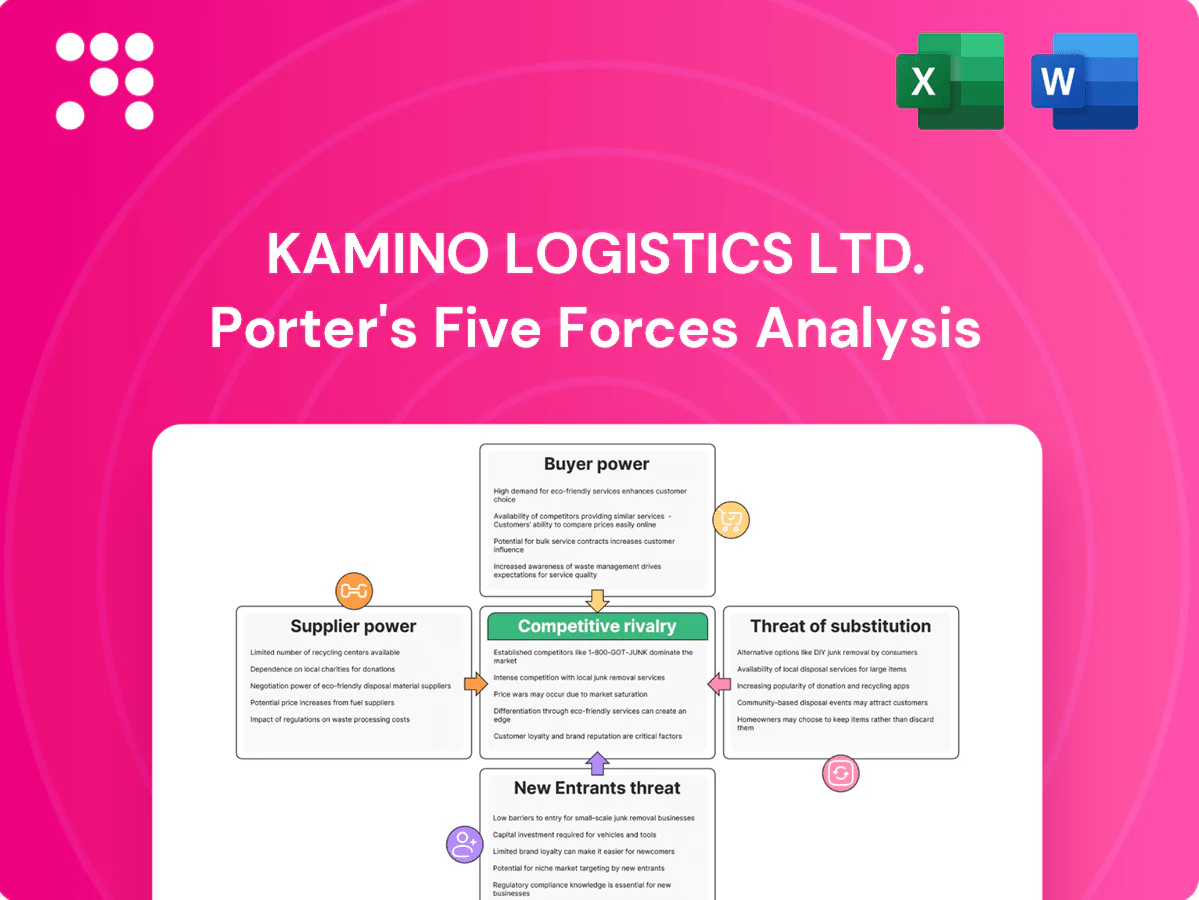
Kamino Logistics Ltd. Porter's Five Forces Analysis

Don't Miss the Bigger Picture
Kamino Logistics Ltd. faces moderate supplier power, rising buyer expectations, and intensifying rivalry as digital freight platforms lower entry hurdles, while substitutes and regulatory shifts reshape margins. This snapshot highlights key pressures but omits force-by-force ratings and tailored implications. Unlock the full Porter's Five Forces Analysis to get detailed ratings, visuals, and actionable strategy to guide investment or operational decisions.
Suppliers Bargaining Power

Carrier capacity concentration
Airlines, ocean liners and major trucking firms—with the top 10 container carriers controlling over 80% of global containership capacity (Alphaliner)—hold critical capacity on UK-EU and Asia-Europe lanes. Alliance scheduling and blank sailings have repeatedly tightened supply and pushed spot rates higher, notably during 2020–22. Kamino must diversify carriers and commit volume to secure space; peak-season surcharges amplify supplier leverage.
Fuel and surcharges
Fuel price volatility (Brent averaged ~USD 84/barrel in 2024) flows directly through BAF/FAF and carrier surcharges, limiting Kamino’s cost control since non-asset forwarders have limited hedging ability; transparent pass-throughs mitigate exposure but timing gaps and 30–60 day billing lags can squeeze margins. Operational measures — route optimization and consolidation — can reduce fuel-related costs by an estimated 5–10%.

Port and terminal dependencies
UK and EU port congestion—exacerbated by repeated labor actions—has increased terminal leverage over shippers, with the top 10 carriers holding roughly 80% of container slot capacity in 2024 and terminals using slot allocations to prioritize customers. Limited alternatives on key corridors raise switching frictions, often forcing shippers into premium priority handling or long‑term commitments that can add up to around 20–25% in logistics spend. Strong local agent networks, however, have reduced dwell and reroute costs for some clients, softening supplier power in critical bottlenecks.

Specialized services scarcity
Cold-chain, hazardous-goods and oversized-cargo providers remain scarce and 20–40% pricier in 2024, while ATP/ADR/IMO certifications and specialized equipment raise supplier leverage; Kamino’s multi-vendor roster preserves optionality. Active collaboration and demand-forecast sharing have secured >75% booked capacity in recent contracts.
- Specialists <15% of carriers
- Price premium 20–40%
- Forecasting secures >75% capacity
Tech and data platforms
Tech and data platforms give suppliers leverage through deep TMS, visibility and customs integrations that can be sticky and costly to replace; as of 2024 integration timelines commonly exceed 3–9 months. API fees and restrictive data access clauses materially raise switching costs, while vendor diversification and selective in‑house tooling lower dependency. Explicit data portability clauses improve Kamino Logistics Ltd.’s negotiating stance.
Top-10 carriers control >80% capacity; premiums 20–40%; Brent ~USD 84/bbl
Supplier power is high: top 10 container carriers control >80% global capacity (2024), enabling space scarcity and premium pricing. Fuel volatility (Brent ~USD 84/bbl in 2024) and port congestion push surcharges and 20–25% premium costs. Specialists charge 20–40% more; tech integrations take 3–9 months, raising switching costs; forecasting has secured >75% capacity.
| Metric | 2024 value |
|---|---|
| Top-10 carrier share | >80% |
| Brent | ~USD 84/bbl |
| Port/priority premium | 20–25% |
| Specialist premium | 20–40% |
| Integration time | 3–9 months |
| Capacity secured via forecasting | >75% |
What is included in the product
 Detailed Word Document
Tailored Porter's Five Forces for Kamino Logistics Ltd. uncover competitive intensity, buyer/supplier bargaining power, threat of entrants and substitutes, and industry rivalry—highlighting disruptive tech, pricing pressures, and barriers that shape profitability and strategic options.

 Customizable Excel Spreadsheet
A clear, one-sheet Porter's Five Forces summary for Kamino Logistics—perfect for quick strategic decisions. Customize pressure levels to reflect shipping route shifts, regulatory changes, or new competitor entries for immediate, board-ready insights.
Customers Bargaining Power

Many alternatives for shippers
UK shippers can choose global integrators, large forwarders and niche specialists, giving buyers strong leverage; tendering and spot platforms have increased price transparency and accelerated re-sourcing. Kamino faces pressure to differentiate on reliability and service as buyers multi-source, raising churn risk and compressing margins.
Large accounts negotiate hard
Large accounts demand rate freezes, KPI SLAs and rebates; in 2024 industry data showed top shippers can secure carrier discounts up to 20% and rebates of 2–6%, with top 10 clients often representing ~50% of revenue, compressing Kamino’s margins; strategic account management, bundled services and performance analytics strengthen renewal cases and defend yield.

Low-moderate switching costs
Standard freight remains easy to move between forwarders, keeping switching costs low and enabling price-driven churn; digital freight platforms captured roughly 10% of bookings in 2024, intensifying provider comparability. Complex customs set-ups and integrated warehousing increase stickiness, where embedding EDI, value-added services and control-tower functionality materially boosts retention. Quality failures drive rapid switching, so Kamino must prioritize reliability to prevent churn.

Service reliability over price
Time-sensitive and regulated cargo forces buyers to prioritize OTIF and compliance over lowest cost, with shippers paying premiums for guaranteed space and end-to-end visibility; Kamino can trade price for stronger SLAs in these segments and leverage post-Brexit customs expertise to shift value perception toward reliability.
- OTIF-driven demand
- Premiums for capacity & visibility
- SLA as negotiable currency
- Post-Brexit customs advantage
Demand volatility and seasonality
Promotions, e-commerce peaks and 2024 macro shocks drove buyer volumes swings of roughly 25–50%, forcing customers to demand flexible, non‑committal capacity; this volume variability raises per‑unit costing and procurement risk for Kamino Logistics Ltd. Dynamic pricing and sellable capacity blocks can better align carrier incentives and customer flexibility while smoothing utilization.
- 2024 promo uplift ~25%
- Peak e‑commerce spikes 30–50%
- Macro shock volume swings 15–30%
- Flexible capacity reduces long‑term lock‑in
Platforms 10%, top 50%, promo 25–50%
Buyers hold high leverage: digital platforms took ~10% bookings in 2024 and top 10 shippers account for ~50% revenue, enabling discounts up to 20% and rebates 2–6%.
Low switching costs for standard freight drive price churn; complex customs and warehousing create stickiness where Kamino can charge premiums.
Promo/e‑commerce swings (25–50% in 2024) force flexible capacity and dynamic pricing to protect margins.
| Metric | 2024 |
|---|---|
| Digital platform share | 10% |
| Top 10 client revenue | ~50% |
| Max carrier discounts | 20% |
| Promo volume swings | 25–50% |
Preview Before You Purchase
Kamino Logistics Ltd. Porter's Five Forces Analysis
This preview shows the exact Porter's Five Forces analysis for Kamino Logistics Ltd. that you will receive immediately after purchase—no placeholders, no samples. The full document is professionally formatted, ready to download and use, and includes industry rivalry, supplier and buyer power, threats of substitution and entry, and actionable implications. You're viewing the final deliverable available instantly upon payment.

Don't Miss the Bigger Picture
Kamino Logistics Ltd. faces moderate supplier power, rising buyer expectations, and intensifying rivalry as digital freight platforms lower entry hurdles, while substitutes and regulatory shifts reshape margins. This snapshot highlights key pressures but omits force-by-force ratings and tailored implications. Unlock the full Porter's Five Forces Analysis to get detailed ratings, visuals, and actionable strategy to guide investment or operational decisions.
Suppliers Bargaining Power
Carrier capacity concentration
Airlines, ocean liners and major trucking firms—with the top 10 container carriers controlling over 80% of global containership capacity (Alphaliner)—hold critical capacity on UK-EU and Asia-Europe lanes. Alliance scheduling and blank sailings have repeatedly tightened supply and pushed spot rates higher, notably during 2020–22. Kamino must diversify carriers and commit volume to secure space; peak-season surcharges amplify supplier leverage.
Fuel and surcharges
Fuel price volatility (Brent averaged ~USD 84/barrel in 2024) flows directly through BAF/FAF and carrier surcharges, limiting Kamino’s cost control since non-asset forwarders have limited hedging ability; transparent pass-throughs mitigate exposure but timing gaps and 30–60 day billing lags can squeeze margins. Operational measures — route optimization and consolidation — can reduce fuel-related costs by an estimated 5–10%.
Port and terminal dependencies
UK and EU port congestion—exacerbated by repeated labor actions—has increased terminal leverage over shippers, with the top 10 carriers holding roughly 80% of container slot capacity in 2024 and terminals using slot allocations to prioritize customers. Limited alternatives on key corridors raise switching frictions, often forcing shippers into premium priority handling or long‑term commitments that can add up to around 20–25% in logistics spend. Strong local agent networks, however, have reduced dwell and reroute costs for some clients, softening supplier power in critical bottlenecks.
Specialized services scarcity
Cold-chain, hazardous-goods and oversized-cargo providers remain scarce and 20–40% pricier in 2024, while ATP/ADR/IMO certifications and specialized equipment raise supplier leverage; Kamino’s multi-vendor roster preserves optionality. Active collaboration and demand-forecast sharing have secured >75% booked capacity in recent contracts.
- Specialists <15% of carriers
- Price premium 20–40%
- Forecasting secures >75% capacity
Tech and data platforms
Tech and data platforms give suppliers leverage through deep TMS, visibility and customs integrations that can be sticky and costly to replace; as of 2024 integration timelines commonly exceed 3–9 months. API fees and restrictive data access clauses materially raise switching costs, while vendor diversification and selective in‑house tooling lower dependency. Explicit data portability clauses improve Kamino Logistics Ltd.’s negotiating stance.
Top-10 carriers control >80% capacity; premiums 20–40%; Brent ~USD 84/bbl
Supplier power is high: top 10 container carriers control >80% global capacity (2024), enabling space scarcity and premium pricing. Fuel volatility (Brent ~USD 84/bbl in 2024) and port congestion push surcharges and 20–25% premium costs. Specialists charge 20–40% more; tech integrations take 3–9 months, raising switching costs; forecasting has secured >75% capacity.
| Metric | 2024 value |
|---|---|
| Top-10 carrier share | >80% |
| Brent | ~USD 84/bbl |
| Port/priority premium | 20–25% |
| Specialist premium | 20–40% |
| Integration time | 3–9 months |
| Capacity secured via forecasting | >75% |
What is included in the product
Detailed Word Document
Tailored Porter's Five Forces for Kamino Logistics Ltd. uncover competitive intensity, buyer/supplier bargaining power, threat of entrants and substitutes, and industry rivalry—highlighting disruptive tech, pricing pressures, and barriers that shape profitability and strategic options.
Customizable Excel Spreadsheet
A clear, one-sheet Porter's Five Forces summary for Kamino Logistics—perfect for quick strategic decisions. Customize pressure levels to reflect shipping route shifts, regulatory changes, or new competitor entries for immediate, board-ready insights.
Customers Bargaining Power
Many alternatives for shippers
UK shippers can choose global integrators, large forwarders and niche specialists, giving buyers strong leverage; tendering and spot platforms have increased price transparency and accelerated re-sourcing. Kamino faces pressure to differentiate on reliability and service as buyers multi-source, raising churn risk and compressing margins.
Large accounts negotiate hard
Large accounts demand rate freezes, KPI SLAs and rebates; in 2024 industry data showed top shippers can secure carrier discounts up to 20% and rebates of 2–6%, with top 10 clients often representing ~50% of revenue, compressing Kamino’s margins; strategic account management, bundled services and performance analytics strengthen renewal cases and defend yield.
Low-moderate switching costs
Standard freight remains easy to move between forwarders, keeping switching costs low and enabling price-driven churn; digital freight platforms captured roughly 10% of bookings in 2024, intensifying provider comparability. Complex customs set-ups and integrated warehousing increase stickiness, where embedding EDI, value-added services and control-tower functionality materially boosts retention. Quality failures drive rapid switching, so Kamino must prioritize reliability to prevent churn.
Service reliability over price
Time-sensitive and regulated cargo forces buyers to prioritize OTIF and compliance over lowest cost, with shippers paying premiums for guaranteed space and end-to-end visibility; Kamino can trade price for stronger SLAs in these segments and leverage post-Brexit customs expertise to shift value perception toward reliability.
- OTIF-driven demand
- Premiums for capacity & visibility
- SLA as negotiable currency
- Post-Brexit customs advantage
Demand volatility and seasonality
Promotions, e-commerce peaks and 2024 macro shocks drove buyer volumes swings of roughly 25–50%, forcing customers to demand flexible, non‑committal capacity; this volume variability raises per‑unit costing and procurement risk for Kamino Logistics Ltd. Dynamic pricing and sellable capacity blocks can better align carrier incentives and customer flexibility while smoothing utilization.
- 2024 promo uplift ~25%
- Peak e‑commerce spikes 30–50%
- Macro shock volume swings 15–30%
- Flexible capacity reduces long‑term lock‑in
Platforms 10%, top 50%, promo 25–50%
Buyers hold high leverage: digital platforms took ~10% bookings in 2024 and top 10 shippers account for ~50% revenue, enabling discounts up to 20% and rebates 2–6%.
Low switching costs for standard freight drive price churn; complex customs and warehousing create stickiness where Kamino can charge premiums.
Promo/e‑commerce swings (25–50% in 2024) force flexible capacity and dynamic pricing to protect margins.
| Metric | 2024 |
|---|---|
| Digital platform share | 10% |
| Top 10 client revenue | ~50% |
| Max carrier discounts | 20% |
| Promo volume swings | 25–50% |
Preview Before You Purchase
Kamino Logistics Ltd. Porter's Five Forces Analysis
This preview shows the exact Porter's Five Forces analysis for Kamino Logistics Ltd. that you will receive immediately after purchase—no placeholders, no samples. The full document is professionally formatted, ready to download and use, and includes industry rivalry, supplier and buyer power, threats of substitution and entry, and actionable implications. You're viewing the final deliverable available instantly upon payment.
Original: $10.00
-65%$10.00
$3.50Description
Don't Miss the Bigger Picture
Kamino Logistics Ltd. faces moderate supplier power, rising buyer expectations, and intensifying rivalry as digital freight platforms lower entry hurdles, while substitutes and regulatory shifts reshape margins. This snapshot highlights key pressures but omits force-by-force ratings and tailored implications. Unlock the full Porter's Five Forces Analysis to get detailed ratings, visuals, and actionable strategy to guide investment or operational decisions.
Suppliers Bargaining Power
Carrier capacity concentration
Airlines, ocean liners and major trucking firms—with the top 10 container carriers controlling over 80% of global containership capacity (Alphaliner)—hold critical capacity on UK-EU and Asia-Europe lanes. Alliance scheduling and blank sailings have repeatedly tightened supply and pushed spot rates higher, notably during 2020–22. Kamino must diversify carriers and commit volume to secure space; peak-season surcharges amplify supplier leverage.
Fuel and surcharges
Fuel price volatility (Brent averaged ~USD 84/barrel in 2024) flows directly through BAF/FAF and carrier surcharges, limiting Kamino’s cost control since non-asset forwarders have limited hedging ability; transparent pass-throughs mitigate exposure but timing gaps and 30–60 day billing lags can squeeze margins. Operational measures — route optimization and consolidation — can reduce fuel-related costs by an estimated 5–10%.
Port and terminal dependencies
UK and EU port congestion—exacerbated by repeated labor actions—has increased terminal leverage over shippers, with the top 10 carriers holding roughly 80% of container slot capacity in 2024 and terminals using slot allocations to prioritize customers. Limited alternatives on key corridors raise switching frictions, often forcing shippers into premium priority handling or long‑term commitments that can add up to around 20–25% in logistics spend. Strong local agent networks, however, have reduced dwell and reroute costs for some clients, softening supplier power in critical bottlenecks.
Specialized services scarcity
Cold-chain, hazardous-goods and oversized-cargo providers remain scarce and 20–40% pricier in 2024, while ATP/ADR/IMO certifications and specialized equipment raise supplier leverage; Kamino’s multi-vendor roster preserves optionality. Active collaboration and demand-forecast sharing have secured >75% booked capacity in recent contracts.
- Specialists <15% of carriers
- Price premium 20–40%
- Forecasting secures >75% capacity
Tech and data platforms
Tech and data platforms give suppliers leverage through deep TMS, visibility and customs integrations that can be sticky and costly to replace; as of 2024 integration timelines commonly exceed 3–9 months. API fees and restrictive data access clauses materially raise switching costs, while vendor diversification and selective in‑house tooling lower dependency. Explicit data portability clauses improve Kamino Logistics Ltd.’s negotiating stance.
Top-10 carriers control >80% capacity; premiums 20–40%; Brent ~USD 84/bbl
Supplier power is high: top 10 container carriers control >80% global capacity (2024), enabling space scarcity and premium pricing. Fuel volatility (Brent ~USD 84/bbl in 2024) and port congestion push surcharges and 20–25% premium costs. Specialists charge 20–40% more; tech integrations take 3–9 months, raising switching costs; forecasting has secured >75% capacity.
| Metric | 2024 value |
|---|---|
| Top-10 carrier share | >80% |
| Brent | ~USD 84/bbl |
| Port/priority premium | 20–25% |
| Specialist premium | 20–40% |
| Integration time | 3–9 months |
| Capacity secured via forecasting | >75% |
What is included in the product
Detailed Word Document
Tailored Porter's Five Forces for Kamino Logistics Ltd. uncover competitive intensity, buyer/supplier bargaining power, threat of entrants and substitutes, and industry rivalry—highlighting disruptive tech, pricing pressures, and barriers that shape profitability and strategic options.
Customizable Excel Spreadsheet
A clear, one-sheet Porter's Five Forces summary for Kamino Logistics—perfect for quick strategic decisions. Customize pressure levels to reflect shipping route shifts, regulatory changes, or new competitor entries for immediate, board-ready insights.
Customers Bargaining Power
Many alternatives for shippers
UK shippers can choose global integrators, large forwarders and niche specialists, giving buyers strong leverage; tendering and spot platforms have increased price transparency and accelerated re-sourcing. Kamino faces pressure to differentiate on reliability and service as buyers multi-source, raising churn risk and compressing margins.
Large accounts negotiate hard
Large accounts demand rate freezes, KPI SLAs and rebates; in 2024 industry data showed top shippers can secure carrier discounts up to 20% and rebates of 2–6%, with top 10 clients often representing ~50% of revenue, compressing Kamino’s margins; strategic account management, bundled services and performance analytics strengthen renewal cases and defend yield.
Low-moderate switching costs
Standard freight remains easy to move between forwarders, keeping switching costs low and enabling price-driven churn; digital freight platforms captured roughly 10% of bookings in 2024, intensifying provider comparability. Complex customs set-ups and integrated warehousing increase stickiness, where embedding EDI, value-added services and control-tower functionality materially boosts retention. Quality failures drive rapid switching, so Kamino must prioritize reliability to prevent churn.
Service reliability over price
Time-sensitive and regulated cargo forces buyers to prioritize OTIF and compliance over lowest cost, with shippers paying premiums for guaranteed space and end-to-end visibility; Kamino can trade price for stronger SLAs in these segments and leverage post-Brexit customs expertise to shift value perception toward reliability.
- OTIF-driven demand
- Premiums for capacity & visibility
- SLA as negotiable currency
- Post-Brexit customs advantage
Demand volatility and seasonality
Promotions, e-commerce peaks and 2024 macro shocks drove buyer volumes swings of roughly 25–50%, forcing customers to demand flexible, non‑committal capacity; this volume variability raises per‑unit costing and procurement risk for Kamino Logistics Ltd. Dynamic pricing and sellable capacity blocks can better align carrier incentives and customer flexibility while smoothing utilization.
- 2024 promo uplift ~25%
- Peak e‑commerce spikes 30–50%
- Macro shock volume swings 15–30%
- Flexible capacity reduces long‑term lock‑in
Platforms 10%, top 50%, promo 25–50%
Buyers hold high leverage: digital platforms took ~10% bookings in 2024 and top 10 shippers account for ~50% revenue, enabling discounts up to 20% and rebates 2–6%.
Low switching costs for standard freight drive price churn; complex customs and warehousing create stickiness where Kamino can charge premiums.
Promo/e‑commerce swings (25–50% in 2024) force flexible capacity and dynamic pricing to protect margins.
| Metric | 2024 |
|---|---|
| Digital platform share | 10% |
| Top 10 client revenue | ~50% |
| Max carrier discounts | 20% |
| Promo volume swings | 25–50% |
Preview Before You Purchase
Kamino Logistics Ltd. Porter's Five Forces Analysis
This preview shows the exact Porter's Five Forces analysis for Kamino Logistics Ltd. that you will receive immediately after purchase—no placeholders, no samples. The full document is professionally formatted, ready to download and use, and includes industry rivalry, supplier and buyer power, threats of substitution and entry, and actionable implications. You're viewing the final deliverable available instantly upon payment.











