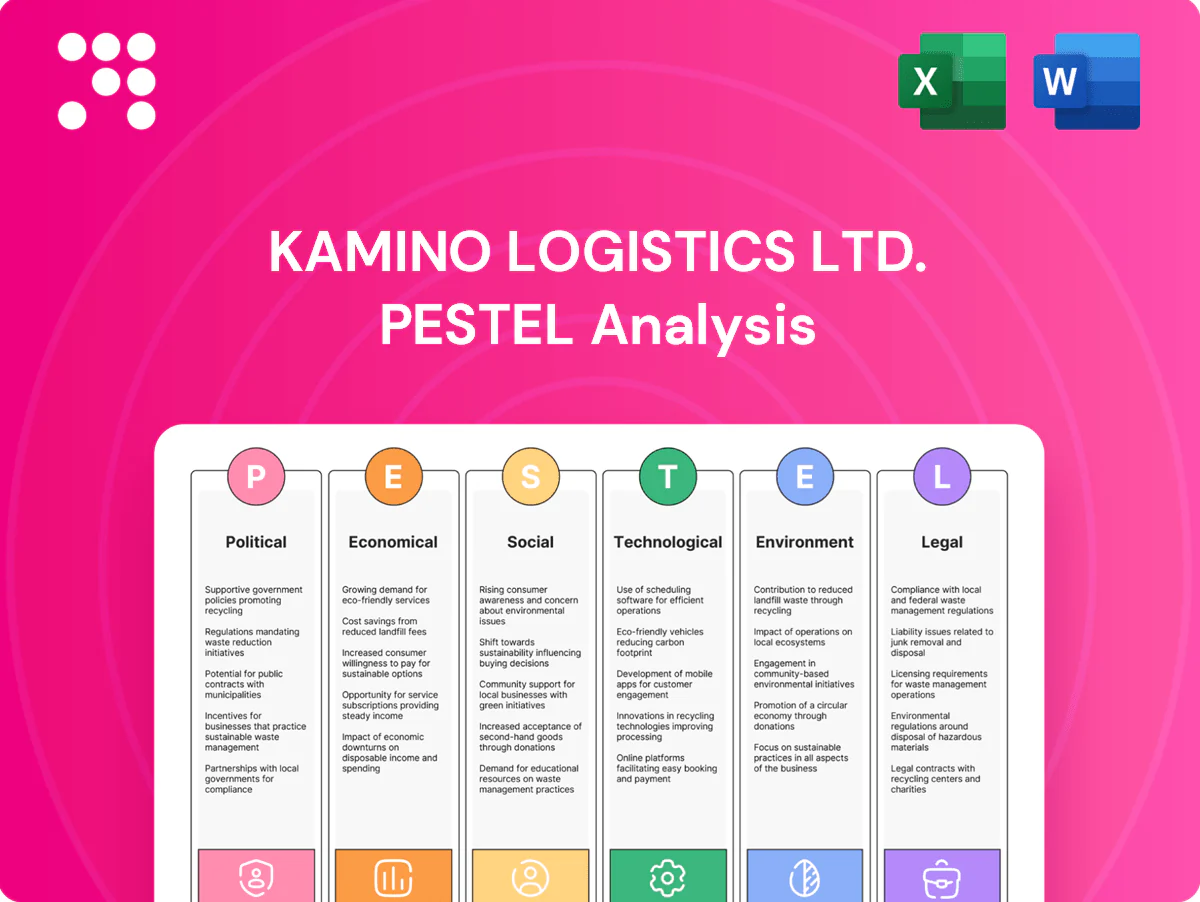
Kamino Logistics Ltd. PESTLE Analysis

Skip the Research. Get the Strategy.
Our PESTLE overview for Kamino Logistics Ltd. highlights how regulatory shifts, trade dynamics, technological innovation, and sustainability trends are reshaping its operational risk and growth corridors. These concise insights reveal strategic vulnerabilities and opportunities for investors and managers. Purchase the full PESTLE to access the complete, actionable analysis and downloadable tools.
Political factors

Post-Brexit customs and trade policy
UK–EU border rules shape lead times, clearance costs and route choices; ONS data show UK goods exports to the EU fell about 21% in 2021 versus 2019, highlighting ongoing frictions. Shifts in HMRC’s Border Target Operating Model through 2024–25 alter documentation and inspection burdens. Kamino must maintain agile brokerage, contingency routings and active engagement with HMRC guidance and trade bodies to cut disruption risk.
Free trade agreements and tariffs
New or revised FTAs such as USMCA (3 parties) and CPTPP (11 parties) directly alter duty rates and market access, often reducing eligible tariffs to 0% for qualifying goods. Preferential origin administration can add complexity and paperwork, including origin certification and record retention often required for up to 5 years, while lowering total landed cost. Kamino can advise on origin structuring and duty mitigation strategies. Continuous monitoring of tariff schedules enables optimized routings and modal choices to minimize duty exposure.

Infrastructure and public investment
UK capital allocations to transport shape transit reliability: the Road Investment Strategy 2 commits about £27.4bn to major roads (2020–25) and a £200m Port Infrastructure Fund has targeted port resilience, while eight UK freeports were active by 2024, creating localized throughput opportunities. Kamino can site capacity alongside funded corridors and freeport zones to capture volume and resilience gains. Active advocacy for removing bottlenecks—road, rail or port—supports contracted service levels and OTP targets.

Geopolitical tensions and sanctions
Conflict zones and Red Sea disruptions are forcing sea-to-air reroutes and longer voyages, with seaborne trade still carrying about 80% of global merchandise by volume and Suez Canal transits near 18,500 in 2023; sanctions increasingly reshape routing and carrier choice. Mandatory compliance screening now extends across parties, goods and destinations, driving Kamino to deploy dynamic network reconfiguration and live risk dashboards. Alternative gateways and modal shifts (road/rail/air) preserve flows while adding cost and complexity.
- Conflict-driven reroutes
- Mandatory end-to-end screening
- Dynamic network + risk dashboards
- Alternative gateways & modal shifts
Regulatory and political stability
Changes in government priorities can quickly alter transport policy and subsidies, impacting operating costs; fleet and warehouse capex planning must account for typical asset lives of 5–8 years. Stability enables long-term investments, while Kamino should scenario-plan across 3–5 policy paths to stress-test ROI. Active stakeholder engagement helps anticipate roadmap shifts such as the EU Fit for 55 target of 55% GHG reduction by 2030.
- asset life: 5–8 years
- scenario planning: 3–5 paths
- policy target example: 55% GHG cut by 2030 (EU Fit for 55)
Border checks raise costs; UK-EU exports -21%; roads/ports/freeports aid reroutes
UK–EU border rules and HMRC Border TOM (2024–25) raise clearance costs; UK exports to EU fell ~21% (2021 vs 2019). Road Investment Strategy 2 (£27.4bn) and a £200m Port Fund plus eight freeports (2024) offer routing/resilience options. Red Sea/sanctions risks (Suez ~18.5k transits 2023) require reroutes and end-to-end screening.
| Metric | Value |
|---|---|
| UK–EU exports | −21% |
| Road fund | £27.4bn |
What is included in the product
 Detailed Word Document
Explores how Political, Economic, Social, Technological, Environmental and Legal forces uniquely affect Kamino Logistics Ltd., with data-backed, region- and industry-specific insights, forward-looking scenarios and clear subpoints to help executives, investors and strategists identify risks, opportunities and actionable responses.

 Customizable Excel Spreadsheet
A concise, visually segmented Kamino Logistics Ltd. PESTLE summary that distills external risks and opportunities into an easily shareable slide or note, enabling quick alignment across teams and informed discussion during planning or client presentations.
Economic factors

Fuel and energy price volatility
Fuel and energy price volatility—Brent crude averaged about $82/barrel in 2024—drives diesel, marine bunker and jet-fuel surcharges that materially affect Kamino Logistics’ route economics. Hedging programs and investments in fuel-efficient fleets and slow-steaming cut exposure, protecting margins. Transparent pass-through surcharge mechanisms (index-linked) sustain client trust, while a diversified modal mix (road/rail/sea/air) buffers against sector-specific spikes.
GDP, trade volumes, and sector cycles
UK import-export volumes represent roughly 60% of GDP, so fluctuations in UK and global growth (IMF/WTO estimates: global merchandise trade growth ~3% in 2024) directly change Kamino’s throughput and revenue.
Cyclical sectors such as retail and manufacturing, which account for large shares of freight demand, drive quarterly swings in capacity needs—e.g., UK retail sales volatility of ±2–3% month-to-month during peak seasons.
Kamino should scale flexibly across sea, air, and road and invest in demand forecasting systems, since improved forecast accuracy by 10–15% can lift utilization and cut empty-leg costs materially.

Inflation and interest rates
Rising cost inflation — US CPI 12‑month 3.3% (June 2025) — lifts labor, warehousing and equipment expenses, with logistics wages up ~5–7% in 2024–25 in many markets. Higher policy rates (US fed funds 5.25–5.50% mid‑2025) increase financing costs for fleet and inventory, widening capex hurdle rates. Kamino should prioritize yield management and indexation clauses in contracts, and time capex to the prevailing rate outlook.

Currency movements (GBP)
GBP swings affect international carriage, port fees and client costs; sterling traded around 1.25–1.30 USD in H1 2025 with implied volatility near 12% in 2024, raising cost uncertainty; Kamino mitigates exposure via multi-currency pricing, currency-matched expenses as a natural hedge and FX pass-through clauses to stabilize contracts.
- Impact: international carriage, port fees, client pricing
- Data: GBP ~1.25–1.30 USD (H1 2025), implied vol ~12% (2024)
- Mitigants: multi-currency pricing, natural hedging, FX clauses
Capacity and carrier market dynamics
Capacity and carrier market dynamics drive Kamino Logistics portfolio: ocean spot rates from Asia to North America fell roughly 70% from 2022 peaks into 2024, while airfreight demand tightened in H1 2025 pushing premium transpacific air rates up ~15% versus 2023. Blank sailings and reduced belly capacity continue to disrupt reliability, so Kamino leverages diversified carrier relationships and weekly space procurement refreshes to secure service continuity.
- Spot vs contract: rapid swings since 2022
- Blank sailings: recurring 2023–2025 reliability risk
- Air belly: +15% transpacific premium (H1 2025)
- Mitigation: diversified carriers, rolling space buys
Border checks raise costs; UK-EU exports -21%; roads/ports/freeports aid reroutes
Fuel volatility (Brent ~$82/bbl in 2024) and GBP 1.25–1.30 (H1 2025) drive cost swings; global trade ~3% (2024) and US CPI 3.3% (Jun 2025) pressure volumes and costs, with logistics wages +5–7% (2024–25). Capacity swings (ocean down from 2022, air +15% transpacific H1 2025) require modal diversification and index‑linked contracts.
| Metric | Value | Impact |
|---|---|---|
| Brent | $82/bbl (2024) | Fuel surcharges |
| GBPUSD | 1.25–1.30 (H1 2025) | FX cost risk |
| Trade growth | ~3% (2024) | Throughput |
| CPI | 3.3% (Jun 2025) | Opex |
What You See Is What You Get
Kamino Logistics Ltd. PESTLE Analysis
The preview shown here is the exact Kamino Logistics Ltd. PESTLE Analysis you’ll receive after purchase—fully formatted and ready to use. It covers Political, Economic, Social, Technological, Legal and Environmental factors in the same structure as the downloadable file. No placeholders, no surprises.

Skip the Research. Get the Strategy.
Our PESTLE overview for Kamino Logistics Ltd. highlights how regulatory shifts, trade dynamics, technological innovation, and sustainability trends are reshaping its operational risk and growth corridors. These concise insights reveal strategic vulnerabilities and opportunities for investors and managers. Purchase the full PESTLE to access the complete, actionable analysis and downloadable tools.
Political factors
Post-Brexit customs and trade policy
UK–EU border rules shape lead times, clearance costs and route choices; ONS data show UK goods exports to the EU fell about 21% in 2021 versus 2019, highlighting ongoing frictions. Shifts in HMRC’s Border Target Operating Model through 2024–25 alter documentation and inspection burdens. Kamino must maintain agile brokerage, contingency routings and active engagement with HMRC guidance and trade bodies to cut disruption risk.
Free trade agreements and tariffs
New or revised FTAs such as USMCA (3 parties) and CPTPP (11 parties) directly alter duty rates and market access, often reducing eligible tariffs to 0% for qualifying goods. Preferential origin administration can add complexity and paperwork, including origin certification and record retention often required for up to 5 years, while lowering total landed cost. Kamino can advise on origin structuring and duty mitigation strategies. Continuous monitoring of tariff schedules enables optimized routings and modal choices to minimize duty exposure.
Infrastructure and public investment
UK capital allocations to transport shape transit reliability: the Road Investment Strategy 2 commits about £27.4bn to major roads (2020–25) and a £200m Port Infrastructure Fund has targeted port resilience, while eight UK freeports were active by 2024, creating localized throughput opportunities. Kamino can site capacity alongside funded corridors and freeport zones to capture volume and resilience gains. Active advocacy for removing bottlenecks—road, rail or port—supports contracted service levels and OTP targets.
Geopolitical tensions and sanctions
Conflict zones and Red Sea disruptions are forcing sea-to-air reroutes and longer voyages, with seaborne trade still carrying about 80% of global merchandise by volume and Suez Canal transits near 18,500 in 2023; sanctions increasingly reshape routing and carrier choice. Mandatory compliance screening now extends across parties, goods and destinations, driving Kamino to deploy dynamic network reconfiguration and live risk dashboards. Alternative gateways and modal shifts (road/rail/air) preserve flows while adding cost and complexity.
- Conflict-driven reroutes
- Mandatory end-to-end screening
- Dynamic network + risk dashboards
- Alternative gateways & modal shifts
Regulatory and political stability
Changes in government priorities can quickly alter transport policy and subsidies, impacting operating costs; fleet and warehouse capex planning must account for typical asset lives of 5–8 years. Stability enables long-term investments, while Kamino should scenario-plan across 3–5 policy paths to stress-test ROI. Active stakeholder engagement helps anticipate roadmap shifts such as the EU Fit for 55 target of 55% GHG reduction by 2030.
- asset life: 5–8 years
- scenario planning: 3–5 paths
- policy target example: 55% GHG cut by 2030 (EU Fit for 55)
Border checks raise costs; UK-EU exports -21%; roads/ports/freeports aid reroutes
UK–EU border rules and HMRC Border TOM (2024–25) raise clearance costs; UK exports to EU fell ~21% (2021 vs 2019). Road Investment Strategy 2 (£27.4bn) and a £200m Port Fund plus eight freeports (2024) offer routing/resilience options. Red Sea/sanctions risks (Suez ~18.5k transits 2023) require reroutes and end-to-end screening.
| Metric | Value |
|---|---|
| UK–EU exports | −21% |
| Road fund | £27.4bn |
What is included in the product
Detailed Word Document
Explores how Political, Economic, Social, Technological, Environmental and Legal forces uniquely affect Kamino Logistics Ltd., with data-backed, region- and industry-specific insights, forward-looking scenarios and clear subpoints to help executives, investors and strategists identify risks, opportunities and actionable responses.
Customizable Excel Spreadsheet
A concise, visually segmented Kamino Logistics Ltd. PESTLE summary that distills external risks and opportunities into an easily shareable slide or note, enabling quick alignment across teams and informed discussion during planning or client presentations.
Economic factors
Fuel and energy price volatility
Fuel and energy price volatility—Brent crude averaged about $82/barrel in 2024—drives diesel, marine bunker and jet-fuel surcharges that materially affect Kamino Logistics’ route economics. Hedging programs and investments in fuel-efficient fleets and slow-steaming cut exposure, protecting margins. Transparent pass-through surcharge mechanisms (index-linked) sustain client trust, while a diversified modal mix (road/rail/sea/air) buffers against sector-specific spikes.
GDP, trade volumes, and sector cycles
UK import-export volumes represent roughly 60% of GDP, so fluctuations in UK and global growth (IMF/WTO estimates: global merchandise trade growth ~3% in 2024) directly change Kamino’s throughput and revenue.
Cyclical sectors such as retail and manufacturing, which account for large shares of freight demand, drive quarterly swings in capacity needs—e.g., UK retail sales volatility of ±2–3% month-to-month during peak seasons.
Kamino should scale flexibly across sea, air, and road and invest in demand forecasting systems, since improved forecast accuracy by 10–15% can lift utilization and cut empty-leg costs materially.
Inflation and interest rates
Rising cost inflation — US CPI 12‑month 3.3% (June 2025) — lifts labor, warehousing and equipment expenses, with logistics wages up ~5–7% in 2024–25 in many markets. Higher policy rates (US fed funds 5.25–5.50% mid‑2025) increase financing costs for fleet and inventory, widening capex hurdle rates. Kamino should prioritize yield management and indexation clauses in contracts, and time capex to the prevailing rate outlook.
Currency movements (GBP)
GBP swings affect international carriage, port fees and client costs; sterling traded around 1.25–1.30 USD in H1 2025 with implied volatility near 12% in 2024, raising cost uncertainty; Kamino mitigates exposure via multi-currency pricing, currency-matched expenses as a natural hedge and FX pass-through clauses to stabilize contracts.
- Impact: international carriage, port fees, client pricing
- Data: GBP ~1.25–1.30 USD (H1 2025), implied vol ~12% (2024)
- Mitigants: multi-currency pricing, natural hedging, FX clauses
Capacity and carrier market dynamics
Capacity and carrier market dynamics drive Kamino Logistics portfolio: ocean spot rates from Asia to North America fell roughly 70% from 2022 peaks into 2024, while airfreight demand tightened in H1 2025 pushing premium transpacific air rates up ~15% versus 2023. Blank sailings and reduced belly capacity continue to disrupt reliability, so Kamino leverages diversified carrier relationships and weekly space procurement refreshes to secure service continuity.
- Spot vs contract: rapid swings since 2022
- Blank sailings: recurring 2023–2025 reliability risk
- Air belly: +15% transpacific premium (H1 2025)
- Mitigation: diversified carriers, rolling space buys
Border checks raise costs; UK-EU exports -21%; roads/ports/freeports aid reroutes
Fuel volatility (Brent ~$82/bbl in 2024) and GBP 1.25–1.30 (H1 2025) drive cost swings; global trade ~3% (2024) and US CPI 3.3% (Jun 2025) pressure volumes and costs, with logistics wages +5–7% (2024–25). Capacity swings (ocean down from 2022, air +15% transpacific H1 2025) require modal diversification and index‑linked contracts.
| Metric | Value | Impact |
|---|---|---|
| Brent | $82/bbl (2024) | Fuel surcharges |
| GBPUSD | 1.25–1.30 (H1 2025) | FX cost risk |
| Trade growth | ~3% (2024) | Throughput |
| CPI | 3.3% (Jun 2025) | Opex |
What You See Is What You Get
Kamino Logistics Ltd. PESTLE Analysis
The preview shown here is the exact Kamino Logistics Ltd. PESTLE Analysis you’ll receive after purchase—fully formatted and ready to use. It covers Political, Economic, Social, Technological, Legal and Environmental factors in the same structure as the downloadable file. No placeholders, no surprises.
Original: $10.00
-65%$10.00
$3.50Description
Skip the Research. Get the Strategy.
Our PESTLE overview for Kamino Logistics Ltd. highlights how regulatory shifts, trade dynamics, technological innovation, and sustainability trends are reshaping its operational risk and growth corridors. These concise insights reveal strategic vulnerabilities and opportunities for investors and managers. Purchase the full PESTLE to access the complete, actionable analysis and downloadable tools.
Political factors
Post-Brexit customs and trade policy
UK–EU border rules shape lead times, clearance costs and route choices; ONS data show UK goods exports to the EU fell about 21% in 2021 versus 2019, highlighting ongoing frictions. Shifts in HMRC’s Border Target Operating Model through 2024–25 alter documentation and inspection burdens. Kamino must maintain agile brokerage, contingency routings and active engagement with HMRC guidance and trade bodies to cut disruption risk.
Free trade agreements and tariffs
New or revised FTAs such as USMCA (3 parties) and CPTPP (11 parties) directly alter duty rates and market access, often reducing eligible tariffs to 0% for qualifying goods. Preferential origin administration can add complexity and paperwork, including origin certification and record retention often required for up to 5 years, while lowering total landed cost. Kamino can advise on origin structuring and duty mitigation strategies. Continuous monitoring of tariff schedules enables optimized routings and modal choices to minimize duty exposure.
Infrastructure and public investment
UK capital allocations to transport shape transit reliability: the Road Investment Strategy 2 commits about £27.4bn to major roads (2020–25) and a £200m Port Infrastructure Fund has targeted port resilience, while eight UK freeports were active by 2024, creating localized throughput opportunities. Kamino can site capacity alongside funded corridors and freeport zones to capture volume and resilience gains. Active advocacy for removing bottlenecks—road, rail or port—supports contracted service levels and OTP targets.
Geopolitical tensions and sanctions
Conflict zones and Red Sea disruptions are forcing sea-to-air reroutes and longer voyages, with seaborne trade still carrying about 80% of global merchandise by volume and Suez Canal transits near 18,500 in 2023; sanctions increasingly reshape routing and carrier choice. Mandatory compliance screening now extends across parties, goods and destinations, driving Kamino to deploy dynamic network reconfiguration and live risk dashboards. Alternative gateways and modal shifts (road/rail/air) preserve flows while adding cost and complexity.
- Conflict-driven reroutes
- Mandatory end-to-end screening
- Dynamic network + risk dashboards
- Alternative gateways & modal shifts
Regulatory and political stability
Changes in government priorities can quickly alter transport policy and subsidies, impacting operating costs; fleet and warehouse capex planning must account for typical asset lives of 5–8 years. Stability enables long-term investments, while Kamino should scenario-plan across 3–5 policy paths to stress-test ROI. Active stakeholder engagement helps anticipate roadmap shifts such as the EU Fit for 55 target of 55% GHG reduction by 2030.
- asset life: 5–8 years
- scenario planning: 3–5 paths
- policy target example: 55% GHG cut by 2030 (EU Fit for 55)
Border checks raise costs; UK-EU exports -21%; roads/ports/freeports aid reroutes
UK–EU border rules and HMRC Border TOM (2024–25) raise clearance costs; UK exports to EU fell ~21% (2021 vs 2019). Road Investment Strategy 2 (£27.4bn) and a £200m Port Fund plus eight freeports (2024) offer routing/resilience options. Red Sea/sanctions risks (Suez ~18.5k transits 2023) require reroutes and end-to-end screening.
| Metric | Value |
|---|---|
| UK–EU exports | −21% |
| Road fund | £27.4bn |
What is included in the product
Detailed Word Document
Explores how Political, Economic, Social, Technological, Environmental and Legal forces uniquely affect Kamino Logistics Ltd., with data-backed, region- and industry-specific insights, forward-looking scenarios and clear subpoints to help executives, investors and strategists identify risks, opportunities and actionable responses.
Customizable Excel Spreadsheet
A concise, visually segmented Kamino Logistics Ltd. PESTLE summary that distills external risks and opportunities into an easily shareable slide or note, enabling quick alignment across teams and informed discussion during planning or client presentations.
Economic factors
Fuel and energy price volatility
Fuel and energy price volatility—Brent crude averaged about $82/barrel in 2024—drives diesel, marine bunker and jet-fuel surcharges that materially affect Kamino Logistics’ route economics. Hedging programs and investments in fuel-efficient fleets and slow-steaming cut exposure, protecting margins. Transparent pass-through surcharge mechanisms (index-linked) sustain client trust, while a diversified modal mix (road/rail/sea/air) buffers against sector-specific spikes.
GDP, trade volumes, and sector cycles
UK import-export volumes represent roughly 60% of GDP, so fluctuations in UK and global growth (IMF/WTO estimates: global merchandise trade growth ~3% in 2024) directly change Kamino’s throughput and revenue.
Cyclical sectors such as retail and manufacturing, which account for large shares of freight demand, drive quarterly swings in capacity needs—e.g., UK retail sales volatility of ±2–3% month-to-month during peak seasons.
Kamino should scale flexibly across sea, air, and road and invest in demand forecasting systems, since improved forecast accuracy by 10–15% can lift utilization and cut empty-leg costs materially.
Inflation and interest rates
Rising cost inflation — US CPI 12‑month 3.3% (June 2025) — lifts labor, warehousing and equipment expenses, with logistics wages up ~5–7% in 2024–25 in many markets. Higher policy rates (US fed funds 5.25–5.50% mid‑2025) increase financing costs for fleet and inventory, widening capex hurdle rates. Kamino should prioritize yield management and indexation clauses in contracts, and time capex to the prevailing rate outlook.
Currency movements (GBP)
GBP swings affect international carriage, port fees and client costs; sterling traded around 1.25–1.30 USD in H1 2025 with implied volatility near 12% in 2024, raising cost uncertainty; Kamino mitigates exposure via multi-currency pricing, currency-matched expenses as a natural hedge and FX pass-through clauses to stabilize contracts.
- Impact: international carriage, port fees, client pricing
- Data: GBP ~1.25–1.30 USD (H1 2025), implied vol ~12% (2024)
- Mitigants: multi-currency pricing, natural hedging, FX clauses
Capacity and carrier market dynamics
Capacity and carrier market dynamics drive Kamino Logistics portfolio: ocean spot rates from Asia to North America fell roughly 70% from 2022 peaks into 2024, while airfreight demand tightened in H1 2025 pushing premium transpacific air rates up ~15% versus 2023. Blank sailings and reduced belly capacity continue to disrupt reliability, so Kamino leverages diversified carrier relationships and weekly space procurement refreshes to secure service continuity.
- Spot vs contract: rapid swings since 2022
- Blank sailings: recurring 2023–2025 reliability risk
- Air belly: +15% transpacific premium (H1 2025)
- Mitigation: diversified carriers, rolling space buys
Border checks raise costs; UK-EU exports -21%; roads/ports/freeports aid reroutes
Fuel volatility (Brent ~$82/bbl in 2024) and GBP 1.25–1.30 (H1 2025) drive cost swings; global trade ~3% (2024) and US CPI 3.3% (Jun 2025) pressure volumes and costs, with logistics wages +5–7% (2024–25). Capacity swings (ocean down from 2022, air +15% transpacific H1 2025) require modal diversification and index‑linked contracts.
| Metric | Value | Impact |
|---|---|---|
| Brent | $82/bbl (2024) | Fuel surcharges |
| GBPUSD | 1.25–1.30 (H1 2025) | FX cost risk |
| Trade growth | ~3% (2024) | Throughput |
| CPI | 3.3% (Jun 2025) | Opex |
What You See Is What You Get
Kamino Logistics Ltd. PESTLE Analysis
The preview shown here is the exact Kamino Logistics Ltd. PESTLE Analysis you’ll receive after purchase—fully formatted and ready to use. It covers Political, Economic, Social, Technological, Legal and Environmental factors in the same structure as the downloadable file. No placeholders, no surprises.











