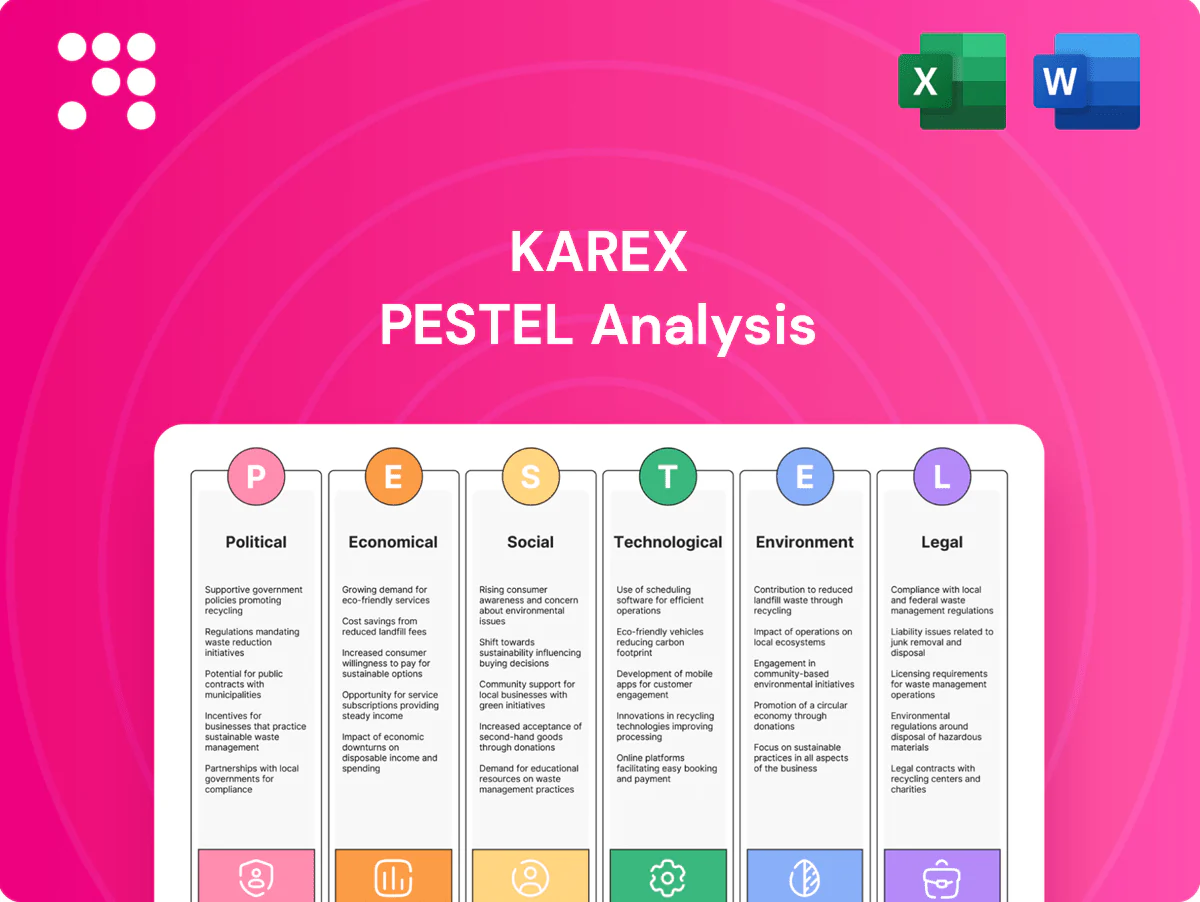
Karex PESTLE Analysis

Your Shortcut to Market Insight Starts Here
Gain a competitive edge with our PESTLE analysis of Karex—uncover how political shifts, economic trends, social attitudes, tech advances, legal risks, and environmental pressures will shape its future. Ideal for investors and strategists, the full report delivers actionable, ready-to-use insights. Purchase now for the complete breakdown and immediate download.
Political factors

Trade policies and tariffs
Karex exports to 140+ countries, exposing it to shifting import duties on medical devices and latex goods; regional tariffs range from near-zero in many US/EU lines to double-digit rates in parts of Africa. Preferential trade agreements (ASEAN, RCEP, bilateral deals) can cut landed costs and improve margins, while tariff hikes directly erode OEM pricing power. Continuous monitoring of ASEAN, US, EU and African tariff schedules and diversifying production/routing mitigates trade shocks.
Public health priorities
Government STI/HIV prevention programs—driven by UNAIDS targets for roughly 39 million people living with HIV globally—remain the main source of bulk condom demand through public tenders, making policy shifts critical to volumes.
Policy emphasis on family planning and reproductive health raises tender sizes, while funding cuts from major donors can sharply reduce orders; alignment with WHO/UNFPA specs and UNFPA supply relationships (covering ~150 countries) boosts grant eligibility.
Karex’s broad portfolio across condoms, lubricants and catheters positions it well for multi-product public tenders and bundled procurement opportunities.

Geopolitical disruptions
Geopolitical conflicts and sanctions disrupt shipping lanes, push up insurance and logistics costs, and interrupt currency flows, forcing OEM clients to re-source and lowering plant utilization for contract manufacturers like Karex. Karex must hold contingency inventory and secure alternative ports and carriers to maintain service levels amid rerouted cargo and higher lead times. Political instability in destination markets increases receivables and credit risk, requiring tighter payment terms and country limits.

Host-country incentives
Malaysia and regional governments provide manufacturing incentives—notably MIDA programs like Pioneer Status (tax exemption up to 5 years) and Investment Tax Allowance—plus grants and training support that lower unit costs for medical and automated production. Post-2020 pandemic policy has prioritized healthcare resilience, driving public support for capacity investments through 2024. Proactive engagement with agencies speeds permitting and access to infrastructure support.
- Tax relief: Pioneer Status (up to 5 years)
- Capital support: Investment Tax Allowance programs
- Grants/training: workforce upskilling subsidies
- Permitting: agency engagement eases approvals
Procurement and price controls
Procurement and price controls: public channels in several markets set ceiling prices and tender rules that prioritize lowest-cost suppliers, which constrains Karex’s ability to sell premium-feature condoms and lubricants and compresses margins on public-volume SKUs.
- Public tenders favor lowest bid, limiting premium SKUs
- Karex must keep cost leadership for tender eligibility
- Policy shifts can change public/private mix and margin profile
140+ markets; WHO/UNFPA reach ~150 countries; ≈39M PLHIV; tariff & supply risk
Karex’s 140+ market footprint exposes it to shifting tariffs (near-zero in US/EU to double-digit in parts of Africa) and geopolitical supply‑chain risk; public HIV/STI programs (≈39 million people living with HIV) drive bulk tender volumes. Alignment with WHO/UNFPA (supply to ~150 countries) and Malaysian incentives (Pioneer Status up to 5 years) preserve margins and tender access.
| Metric | Value |
|---|---|
| Markets exported | 140+ |
| People living with HIV (UNAIDS) | ≈39M |
| UNFPA supply reach | ~150 countries |
| Pioneer Status | Tax relief up to 5 years |
What is included in the product
 Detailed Word Document
Explores how external macro-environmental factors uniquely affect Karex across six dimensions—Political, Economic, Social, Technological, Environmental, and Legal—each backed by relevant data and current trends to reveal risks and opportunities. Designed for executives, advisors, and investors, it offers forward-looking insights and practical examples tailored to Karex’s industry and regional dynamics for strategy and funding decisions.

 Customizable Excel Spreadsheet
A concise, visually segmented Karex PESTLE summary that’s easily dropped into presentations, editable for region or business line, shareable across teams, and written in clear language to streamline risk discussions, support client reports, and align planning sessions.
Economic factors

Latex and input costs
Natural rubber price volatility—with swings exceeding 40% in recent years—directly lifts COGS for Karex’s latex condoms and catheters, pressuring gross margins. Energy, chemicals and packaging inflation during 2021–24 spikes amplified margin compression across manufacturing sites. Long-term supplier contracts and hedging programs have materially dampened monthly cost volatility. A diversified material mix (polyisoprene, polyurethane) provides partial insulation versus rubber price shocks.
FX and currency swings
Karex earns a majority of sales in US dollars and euros while a large portion of costs remain in Malaysian ringgit and regional currencies; USD strength in 2024 boosted reported sales but pressured OEM margins. Hedging programs and natural currency offsets (local sourcing and regional sales) are critical to stabilize earnings, with management noting hedges covering rolling 6–12 months. Contractual pricing clauses with major OEM clients allow partial pass-through of FX shifts, helping protect margins.

Global demand cycles
Condom demand is relatively resilient but not recession-proof; premium brands see greater elasticity while value segments hold steady. Karex, the world’s largest condom maker producing over 5 billion condoms annually, benefits when public-sector orders rise countercyclically during health aid surges. Private retail mirrors consumer confidence and discretionary spend, and lubricants plus catheters diversify revenue across cycles.

Scale and utilization
High fixed-cost manufacturing forces Karex to optimize capacity utilization to protect margins. Karex operates capacity of over 5.5 billion condoms per year, with OEM volumes supplying baseline throughput while own brands improve mix and ASP. Automation has raised yields and cut labor sensitivity, and cross-plant network planning reduces bottlenecks and logistics costs.
- Capacity: >5.5bn p.a.
- OEM baseline throughput; own brands drive mix uplift
- Automation → higher yield, lower labor exposure
- Network planning minimizes bottlenecks & logistics costs
Logistics and freight
Ocean freight rates and container availability drive landed cost and delivery reliability for Karex; rates fell roughly 60% from 2022 peaks to 2024, improving predictability and easing working capital pressure. Route diversification and near-port warehousing cut disruption risk and shorten transit variance. Branded SKUs need 4–8 week inventory buffers as customers demand faster lead times; freight normalization can deliver 1–3 ppt margin tailwinds.
- Rates down ~60% since 2022
- 4–8 week buffer for branded SKUs
- 1–3 ppt potential margin upside from normalization
140+ markets; WHO/UNFPA reach ~150 countries; ≈39M PLHIV; tariff & supply risk
Natural rubber swings >40% since 2021 raised COGS and pressured margins; material diversification and hedges (rolling 6–12 months) partially mitigate. USD strength in 2024 lifted reported sales but squeezed OEM margins; freight normalization (rates down ~60% vs 2022) eased landed costs. High fixed costs and >5.5bn p.a. capacity make utilization and mix critical to profitability.
| Metric | Value |
|---|---|
| Capacity | >5.5bn p.a. |
| Production | >5bn (latest) |
| Rubber volatility | >40% |
| Freight change | -60% vs 2022 |
| Hedge horizon | 6–12 months |
Same Document Delivered
Karex PESTLE Analysis
The preview shown here is the exact Karex PESTLE Analysis document you’ll receive after purchase—fully formatted, professionally structured, and ready to use. No placeholders or teasers; the content and layout match the downloadable file. You’ll get this final version instantly after payment.

Your Shortcut to Market Insight Starts Here
Gain a competitive edge with our PESTLE analysis of Karex—uncover how political shifts, economic trends, social attitudes, tech advances, legal risks, and environmental pressures will shape its future. Ideal for investors and strategists, the full report delivers actionable, ready-to-use insights. Purchase now for the complete breakdown and immediate download.
Political factors
Trade policies and tariffs
Karex exports to 140+ countries, exposing it to shifting import duties on medical devices and latex goods; regional tariffs range from near-zero in many US/EU lines to double-digit rates in parts of Africa. Preferential trade agreements (ASEAN, RCEP, bilateral deals) can cut landed costs and improve margins, while tariff hikes directly erode OEM pricing power. Continuous monitoring of ASEAN, US, EU and African tariff schedules and diversifying production/routing mitigates trade shocks.
Public health priorities
Government STI/HIV prevention programs—driven by UNAIDS targets for roughly 39 million people living with HIV globally—remain the main source of bulk condom demand through public tenders, making policy shifts critical to volumes.
Policy emphasis on family planning and reproductive health raises tender sizes, while funding cuts from major donors can sharply reduce orders; alignment with WHO/UNFPA specs and UNFPA supply relationships (covering ~150 countries) boosts grant eligibility.
Karex’s broad portfolio across condoms, lubricants and catheters positions it well for multi-product public tenders and bundled procurement opportunities.
Geopolitical disruptions
Geopolitical conflicts and sanctions disrupt shipping lanes, push up insurance and logistics costs, and interrupt currency flows, forcing OEM clients to re-source and lowering plant utilization for contract manufacturers like Karex. Karex must hold contingency inventory and secure alternative ports and carriers to maintain service levels amid rerouted cargo and higher lead times. Political instability in destination markets increases receivables and credit risk, requiring tighter payment terms and country limits.
Host-country incentives
Malaysia and regional governments provide manufacturing incentives—notably MIDA programs like Pioneer Status (tax exemption up to 5 years) and Investment Tax Allowance—plus grants and training support that lower unit costs for medical and automated production. Post-2020 pandemic policy has prioritized healthcare resilience, driving public support for capacity investments through 2024. Proactive engagement with agencies speeds permitting and access to infrastructure support.
- Tax relief: Pioneer Status (up to 5 years)
- Capital support: Investment Tax Allowance programs
- Grants/training: workforce upskilling subsidies
- Permitting: agency engagement eases approvals
Procurement and price controls
Procurement and price controls: public channels in several markets set ceiling prices and tender rules that prioritize lowest-cost suppliers, which constrains Karex’s ability to sell premium-feature condoms and lubricants and compresses margins on public-volume SKUs.
- Public tenders favor lowest bid, limiting premium SKUs
- Karex must keep cost leadership for tender eligibility
- Policy shifts can change public/private mix and margin profile
140+ markets; WHO/UNFPA reach ~150 countries; ≈39M PLHIV; tariff & supply risk
Karex’s 140+ market footprint exposes it to shifting tariffs (near-zero in US/EU to double-digit in parts of Africa) and geopolitical supply‑chain risk; public HIV/STI programs (≈39 million people living with HIV) drive bulk tender volumes. Alignment with WHO/UNFPA (supply to ~150 countries) and Malaysian incentives (Pioneer Status up to 5 years) preserve margins and tender access.
| Metric | Value |
|---|---|
| Markets exported | 140+ |
| People living with HIV (UNAIDS) | ≈39M |
| UNFPA supply reach | ~150 countries |
| Pioneer Status | Tax relief up to 5 years |
What is included in the product
Detailed Word Document
Explores how external macro-environmental factors uniquely affect Karex across six dimensions—Political, Economic, Social, Technological, Environmental, and Legal—each backed by relevant data and current trends to reveal risks and opportunities. Designed for executives, advisors, and investors, it offers forward-looking insights and practical examples tailored to Karex’s industry and regional dynamics for strategy and funding decisions.
Customizable Excel Spreadsheet
A concise, visually segmented Karex PESTLE summary that’s easily dropped into presentations, editable for region or business line, shareable across teams, and written in clear language to streamline risk discussions, support client reports, and align planning sessions.
Economic factors
Latex and input costs
Natural rubber price volatility—with swings exceeding 40% in recent years—directly lifts COGS for Karex’s latex condoms and catheters, pressuring gross margins. Energy, chemicals and packaging inflation during 2021–24 spikes amplified margin compression across manufacturing sites. Long-term supplier contracts and hedging programs have materially dampened monthly cost volatility. A diversified material mix (polyisoprene, polyurethane) provides partial insulation versus rubber price shocks.
FX and currency swings
Karex earns a majority of sales in US dollars and euros while a large portion of costs remain in Malaysian ringgit and regional currencies; USD strength in 2024 boosted reported sales but pressured OEM margins. Hedging programs and natural currency offsets (local sourcing and regional sales) are critical to stabilize earnings, with management noting hedges covering rolling 6–12 months. Contractual pricing clauses with major OEM clients allow partial pass-through of FX shifts, helping protect margins.
Global demand cycles
Condom demand is relatively resilient but not recession-proof; premium brands see greater elasticity while value segments hold steady. Karex, the world’s largest condom maker producing over 5 billion condoms annually, benefits when public-sector orders rise countercyclically during health aid surges. Private retail mirrors consumer confidence and discretionary spend, and lubricants plus catheters diversify revenue across cycles.
Scale and utilization
High fixed-cost manufacturing forces Karex to optimize capacity utilization to protect margins. Karex operates capacity of over 5.5 billion condoms per year, with OEM volumes supplying baseline throughput while own brands improve mix and ASP. Automation has raised yields and cut labor sensitivity, and cross-plant network planning reduces bottlenecks and logistics costs.
- Capacity: >5.5bn p.a.
- OEM baseline throughput; own brands drive mix uplift
- Automation → higher yield, lower labor exposure
- Network planning minimizes bottlenecks & logistics costs
Logistics and freight
Ocean freight rates and container availability drive landed cost and delivery reliability for Karex; rates fell roughly 60% from 2022 peaks to 2024, improving predictability and easing working capital pressure. Route diversification and near-port warehousing cut disruption risk and shorten transit variance. Branded SKUs need 4–8 week inventory buffers as customers demand faster lead times; freight normalization can deliver 1–3 ppt margin tailwinds.
- Rates down ~60% since 2022
- 4–8 week buffer for branded SKUs
- 1–3 ppt potential margin upside from normalization
140+ markets; WHO/UNFPA reach ~150 countries; ≈39M PLHIV; tariff & supply risk
Natural rubber swings >40% since 2021 raised COGS and pressured margins; material diversification and hedges (rolling 6–12 months) partially mitigate. USD strength in 2024 lifted reported sales but squeezed OEM margins; freight normalization (rates down ~60% vs 2022) eased landed costs. High fixed costs and >5.5bn p.a. capacity make utilization and mix critical to profitability.
| Metric | Value |
|---|---|
| Capacity | >5.5bn p.a. |
| Production | >5bn (latest) |
| Rubber volatility | >40% |
| Freight change | -60% vs 2022 |
| Hedge horizon | 6–12 months |
Same Document Delivered
Karex PESTLE Analysis
The preview shown here is the exact Karex PESTLE Analysis document you’ll receive after purchase—fully formatted, professionally structured, and ready to use. No placeholders or teasers; the content and layout match the downloadable file. You’ll get this final version instantly after payment.
Description
Your Shortcut to Market Insight Starts Here
Gain a competitive edge with our PESTLE analysis of Karex—uncover how political shifts, economic trends, social attitudes, tech advances, legal risks, and environmental pressures will shape its future. Ideal for investors and strategists, the full report delivers actionable, ready-to-use insights. Purchase now for the complete breakdown and immediate download.
Political factors
Trade policies and tariffs
Karex exports to 140+ countries, exposing it to shifting import duties on medical devices and latex goods; regional tariffs range from near-zero in many US/EU lines to double-digit rates in parts of Africa. Preferential trade agreements (ASEAN, RCEP, bilateral deals) can cut landed costs and improve margins, while tariff hikes directly erode OEM pricing power. Continuous monitoring of ASEAN, US, EU and African tariff schedules and diversifying production/routing mitigates trade shocks.
Public health priorities
Government STI/HIV prevention programs—driven by UNAIDS targets for roughly 39 million people living with HIV globally—remain the main source of bulk condom demand through public tenders, making policy shifts critical to volumes.
Policy emphasis on family planning and reproductive health raises tender sizes, while funding cuts from major donors can sharply reduce orders; alignment with WHO/UNFPA specs and UNFPA supply relationships (covering ~150 countries) boosts grant eligibility.
Karex’s broad portfolio across condoms, lubricants and catheters positions it well for multi-product public tenders and bundled procurement opportunities.
Geopolitical disruptions
Geopolitical conflicts and sanctions disrupt shipping lanes, push up insurance and logistics costs, and interrupt currency flows, forcing OEM clients to re-source and lowering plant utilization for contract manufacturers like Karex. Karex must hold contingency inventory and secure alternative ports and carriers to maintain service levels amid rerouted cargo and higher lead times. Political instability in destination markets increases receivables and credit risk, requiring tighter payment terms and country limits.
Host-country incentives
Malaysia and regional governments provide manufacturing incentives—notably MIDA programs like Pioneer Status (tax exemption up to 5 years) and Investment Tax Allowance—plus grants and training support that lower unit costs for medical and automated production. Post-2020 pandemic policy has prioritized healthcare resilience, driving public support for capacity investments through 2024. Proactive engagement with agencies speeds permitting and access to infrastructure support.
- Tax relief: Pioneer Status (up to 5 years)
- Capital support: Investment Tax Allowance programs
- Grants/training: workforce upskilling subsidies
- Permitting: agency engagement eases approvals
Procurement and price controls
Procurement and price controls: public channels in several markets set ceiling prices and tender rules that prioritize lowest-cost suppliers, which constrains Karex’s ability to sell premium-feature condoms and lubricants and compresses margins on public-volume SKUs.
- Public tenders favor lowest bid, limiting premium SKUs
- Karex must keep cost leadership for tender eligibility
- Policy shifts can change public/private mix and margin profile
140+ markets; WHO/UNFPA reach ~150 countries; ≈39M PLHIV; tariff & supply risk
Karex’s 140+ market footprint exposes it to shifting tariffs (near-zero in US/EU to double-digit in parts of Africa) and geopolitical supply‑chain risk; public HIV/STI programs (≈39 million people living with HIV) drive bulk tender volumes. Alignment with WHO/UNFPA (supply to ~150 countries) and Malaysian incentives (Pioneer Status up to 5 years) preserve margins and tender access.
| Metric | Value |
|---|---|
| Markets exported | 140+ |
| People living with HIV (UNAIDS) | ≈39M |
| UNFPA supply reach | ~150 countries |
| Pioneer Status | Tax relief up to 5 years |
What is included in the product
Detailed Word Document
Explores how external macro-environmental factors uniquely affect Karex across six dimensions—Political, Economic, Social, Technological, Environmental, and Legal—each backed by relevant data and current trends to reveal risks and opportunities. Designed for executives, advisors, and investors, it offers forward-looking insights and practical examples tailored to Karex’s industry and regional dynamics for strategy and funding decisions.
Customizable Excel Spreadsheet
A concise, visually segmented Karex PESTLE summary that’s easily dropped into presentations, editable for region or business line, shareable across teams, and written in clear language to streamline risk discussions, support client reports, and align planning sessions.
Economic factors
Latex and input costs
Natural rubber price volatility—with swings exceeding 40% in recent years—directly lifts COGS for Karex’s latex condoms and catheters, pressuring gross margins. Energy, chemicals and packaging inflation during 2021–24 spikes amplified margin compression across manufacturing sites. Long-term supplier contracts and hedging programs have materially dampened monthly cost volatility. A diversified material mix (polyisoprene, polyurethane) provides partial insulation versus rubber price shocks.
FX and currency swings
Karex earns a majority of sales in US dollars and euros while a large portion of costs remain in Malaysian ringgit and regional currencies; USD strength in 2024 boosted reported sales but pressured OEM margins. Hedging programs and natural currency offsets (local sourcing and regional sales) are critical to stabilize earnings, with management noting hedges covering rolling 6–12 months. Contractual pricing clauses with major OEM clients allow partial pass-through of FX shifts, helping protect margins.
Global demand cycles
Condom demand is relatively resilient but not recession-proof; premium brands see greater elasticity while value segments hold steady. Karex, the world’s largest condom maker producing over 5 billion condoms annually, benefits when public-sector orders rise countercyclically during health aid surges. Private retail mirrors consumer confidence and discretionary spend, and lubricants plus catheters diversify revenue across cycles.
Scale and utilization
High fixed-cost manufacturing forces Karex to optimize capacity utilization to protect margins. Karex operates capacity of over 5.5 billion condoms per year, with OEM volumes supplying baseline throughput while own brands improve mix and ASP. Automation has raised yields and cut labor sensitivity, and cross-plant network planning reduces bottlenecks and logistics costs.
- Capacity: >5.5bn p.a.
- OEM baseline throughput; own brands drive mix uplift
- Automation → higher yield, lower labor exposure
- Network planning minimizes bottlenecks & logistics costs
Logistics and freight
Ocean freight rates and container availability drive landed cost and delivery reliability for Karex; rates fell roughly 60% from 2022 peaks to 2024, improving predictability and easing working capital pressure. Route diversification and near-port warehousing cut disruption risk and shorten transit variance. Branded SKUs need 4–8 week inventory buffers as customers demand faster lead times; freight normalization can deliver 1–3 ppt margin tailwinds.
- Rates down ~60% since 2022
- 4–8 week buffer for branded SKUs
- 1–3 ppt potential margin upside from normalization
140+ markets; WHO/UNFPA reach ~150 countries; ≈39M PLHIV; tariff & supply risk
Natural rubber swings >40% since 2021 raised COGS and pressured margins; material diversification and hedges (rolling 6–12 months) partially mitigate. USD strength in 2024 lifted reported sales but squeezed OEM margins; freight normalization (rates down ~60% vs 2022) eased landed costs. High fixed costs and >5.5bn p.a. capacity make utilization and mix critical to profitability.
| Metric | Value |
|---|---|
| Capacity | >5.5bn p.a. |
| Production | >5bn (latest) |
| Rubber volatility | >40% |
| Freight change | -60% vs 2022 |
| Hedge horizon | 6–12 months |
Same Document Delivered
Karex PESTLE Analysis
The preview shown here is the exact Karex PESTLE Analysis document you’ll receive after purchase—fully formatted, professionally structured, and ready to use. No placeholders or teasers; the content and layout match the downloadable file. You’ll get this final version instantly after payment.











