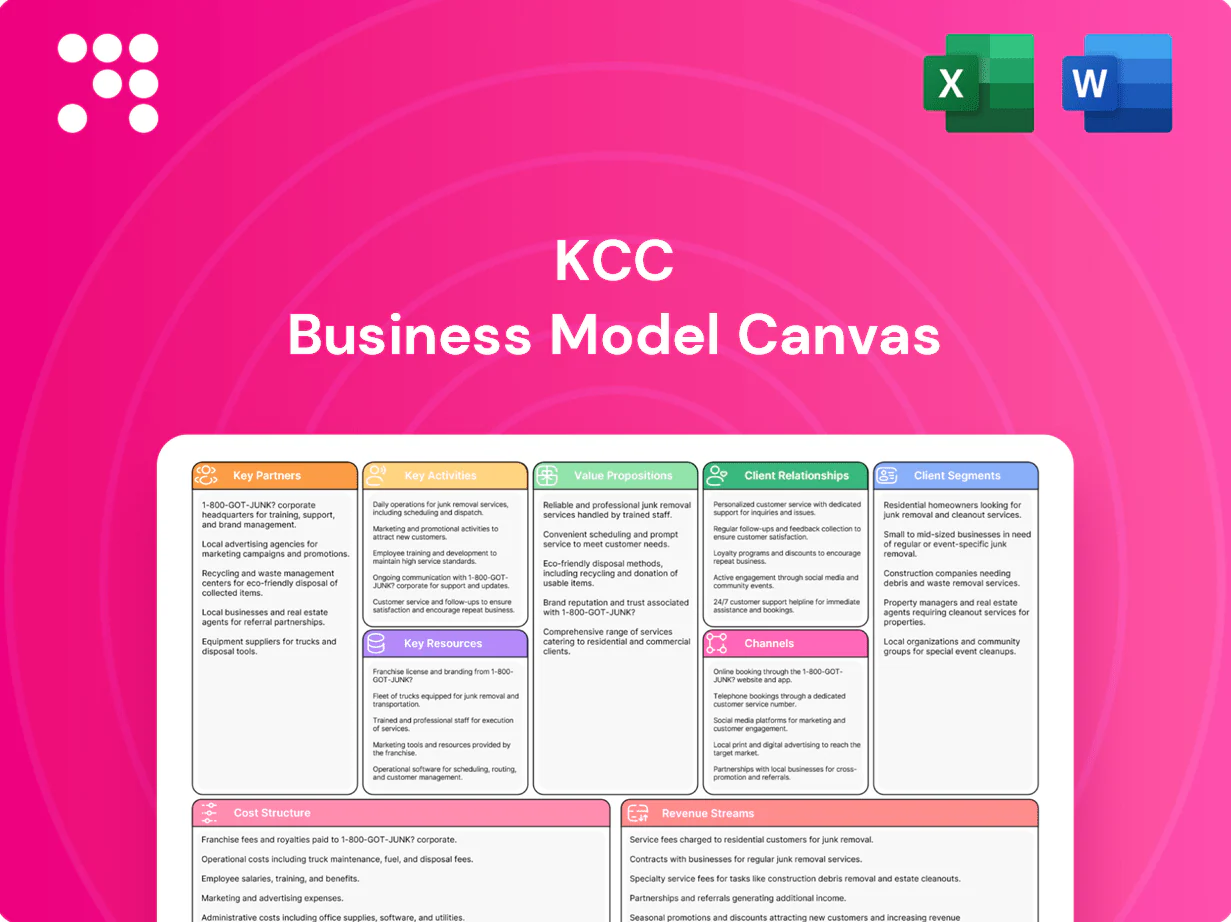
KCC Business Model Canvas

Complete Business Model Canvas: Editable Word & Excel Blueprint for Investors
Unlock the full strategic blueprint behind KCC’s business model with our complete Business Model Canvas—three to five pages of company-specific insight that reveal how KCC creates value, scales revenue, and sustains competitive advantage. Ideal for investors, consultants, and founders, this downloadable, editable canvas in Word and Excel accelerates benchmarking and strategic planning. Purchase the full file to turn insight into action.
Partnerships

Global raw material suppliers
Partner with petrochemical, resin, pigment and additive suppliers to secure consistent quality and volume, focusing on multi-year agreements signed in 2024 to lock capacity. Long-term contracts stabilize pricing and reduce exposure to raw-material volatility. Joint qualification programs ensure compatibility with stringent performance specs. Diversified sourcing mitigates geopolitical and supply risks.
OEMs in auto and electronics
Co-develop coatings and materials tailored to OEM process windows and durability standards, aligning with automotive platform lifecycles of 5–7 years and electronics product cycles of 18–24 months. Early design-in secures multi-year platforms and volumes. Joint testing accelerates approvals and reduces failures. Data-sharing of telemetry and lab results improves quality and continuous improvement.

Construction firms and developers
Partnering with builders, EPCs and façade specialists lets KCC specify materials at design stage, tapping into the $13.6 trillion global construction market in 2024. Value-engineering partnerships typically trim project costs 8–15% while optimizing performance-cost tradeoffs. Site-level coordination ensures on-time delivery and application support, reducing schedule risk. Demonstrated reference projects materially strengthen bid credibility.

Distribution and dealer networks
Regional distributors extend KCC’s reach to contractors and SMEs, covering local channels and adding scale; the global construction chemicals market reached about USD 51.2 billion in 2024, increasing demand for localized distribution.
Inventory pooling across distributor hubs improves availability and can cut lead times and stockouts substantially, while co-marketing programs drive local demand and loyalty through joint promotions.
Distributor training elevates application quality and reduces claims, lowering warranty costs and improving NPS among trade customers.
- Regional reach: localized contractor/SME access
- Inventory pooling: faster lead times, higher fill rates
- Co-marketing: boosts local sales and loyalty
- Training: fewer application claims, better quality
Universities and R&D institutes
KCC partners with universities and R&D institutes to co-develop advanced polymers, eco-friendly resins and functional materials, leveraging global R&D investment (OECD ~2.6 trillion USD in 2023) and public programs; access to cutting-edge labs accelerates prototyping and shortens innovation cycles, while joint IP and peer-reviewed publications bolster market credibility. Horizon Europe (2021–2027) budget: 95.5 billion EUR helps de-risk precompetitive research.
- Horizon Europe: 95.5bn EUR
- Global R&D scale: ~2.6T USD (2023)
- Joint IP/publications increase credibility
Lock supply, co-develop OEMs, access $51.2B construction chemicals
Partner with petrochemical/resin/pigment suppliers via multi-year 2024 contracts to lock capacity and stabilize pricing.
Co-develop with OEMs for 5–7yr automotive and 18–24mo electronics platforms to secure design-in and volumes.
Leverage distributors, EPCs and R&D partners to access $13.6T construction market and $51.2B construction chemicals (2024); Horizon Europe 95.5bn EUR aids precompetitive R&D.
| Partnership | 2024 metric |
|---|---|
| Construction market | $13.6T |
| Construction chemicals | $51.2B |
| Horizon Europe | 95.5bn EUR |
What is included in the product
 Detailed Word Document
A concise, pre-written Business Model Canvas for KCC that maps customer segments, value propositions, channels, revenue streams and key partners, aligned with the company’s real-world operations and growth plans; includes SWOT-linked insights and competitive advantages to support presentations, funding discussions, and strategic decision-making.

 Customizable Excel Spreadsheet
One-page, editable Business Model Canvas that eliminates time wasted formatting and aligning strategy, letting teams focus on insights and decisions. Shareable and adaptable for fast deliverables, board-ready presentations, or side-by-side comparisons.
Activities

Formulation R&D and testing
Develop high-performance coatings, sealants and insulating materials tailored for automotive, construction and industrial markets. Conduct accelerated weathering (ASTM G154, e.g., 1,000 h equivalence), corrosion (ASTM B117) and thermal cycling tests to meet global standards. Iterate formulations to achieve low-VOC targets (often <50 g/L) and regulatory compliance. Protect innovations via patents and trade secrets.
Scaled manufacturing operations
Run batch and continuous production for paints, chemicals and building materials using PLC/SCADA process control to improve consistency and yield; maintain ISO 9001, ISO 14001 and ISO 45001 safety and environmental systems across plants; optimize capacity utilization with a target near 85% to balance demand swings and reduce per-unit cost volatility.

Quality assurance and certifications
Certify products to global standards—ISO 9001 (quality), IATF 16949 (auto, ~75,000 certificates globally), IPC-A-610 and EN construction standards—ensuring market access. In-line and final inspections cut defects and rework through process control. Serialized traceability enables rapid root-cause analysis and supports customer audits with robust, timestamped documentation.

Supply chain and logistics
Manage inbound raw materials and outbound finished goods across global lanes, using S&OP and demand planning to cut stockouts by up to 30% and reduce inventory carrying costs by 10–20% (industry benchmarks 2024). Temperature and moisture controls sustain product integrity for sensitive SKUs; strategic warehousing enables rapid project deployments and shorter lead times.
- Global inbound/outbound orchestration
- S&OP-driven demand planning (2024 benchmarks)
- Temperature & moisture control
- Strategic warehousing for fast deployment
Specification sales and technical service
Specification sales and technical service engage architects, engineers and OEMs to win design-in decisions, providing color-matching, substrate trials and on-site application support; in 2024 specification-led projects represented ~30% of institutional coatings inquiries. Training applicators reduces failures and improves finish quality, while after-sales troubleshooting preserves client relationships and repeat business.
- Engage: architects, engineers, OEMs
- Support: color-matching, substrate trials, on-site
- Train: applicators to cut failures
- Preserve: after-sales troubleshooting
Low-VOC (<50 g/L) coatings, ASTM-tested; PLC/SCADA plants at 85%, S&OP cuts stockouts ~30%
R&D develops low-VOC coatings (<50 g/L) and secures IP; lab testing (ASTM G154, B117) ensures durability. Plants run PLC/SCADA, target 85% capacity and ISO 9001/14001/45001. S&OP cuts stockouts ~30% and inventory costs 10–20% (2024 benchmarks); specification sales drive ~30% institutional inquiries.
| KPI | 2024 |
|---|---|
| Low-VOC target | <50 g/L |
| Capacity utilization | ~85% |
| Stockout reduction | ≈30% |
| Spec-led inquiries | ≈30% |
Full Version Awaits
Business Model Canvas
The KCC Business Model Canvas you see here is the actual deliverable, not a mockup; it’s a direct snapshot of the file you’ll receive after purchase. When you order, you’ll get this same complete, editable document—formatted and ready—in Word and Excel with all content and pages included.

Complete Business Model Canvas: Editable Word & Excel Blueprint for Investors
Unlock the full strategic blueprint behind KCC’s business model with our complete Business Model Canvas—three to five pages of company-specific insight that reveal how KCC creates value, scales revenue, and sustains competitive advantage. Ideal for investors, consultants, and founders, this downloadable, editable canvas in Word and Excel accelerates benchmarking and strategic planning. Purchase the full file to turn insight into action.
Partnerships
Global raw material suppliers
Partner with petrochemical, resin, pigment and additive suppliers to secure consistent quality and volume, focusing on multi-year agreements signed in 2024 to lock capacity. Long-term contracts stabilize pricing and reduce exposure to raw-material volatility. Joint qualification programs ensure compatibility with stringent performance specs. Diversified sourcing mitigates geopolitical and supply risks.
OEMs in auto and electronics
Co-develop coatings and materials tailored to OEM process windows and durability standards, aligning with automotive platform lifecycles of 5–7 years and electronics product cycles of 18–24 months. Early design-in secures multi-year platforms and volumes. Joint testing accelerates approvals and reduces failures. Data-sharing of telemetry and lab results improves quality and continuous improvement.
Construction firms and developers
Partnering with builders, EPCs and façade specialists lets KCC specify materials at design stage, tapping into the $13.6 trillion global construction market in 2024. Value-engineering partnerships typically trim project costs 8–15% while optimizing performance-cost tradeoffs. Site-level coordination ensures on-time delivery and application support, reducing schedule risk. Demonstrated reference projects materially strengthen bid credibility.
Distribution and dealer networks
Regional distributors extend KCC’s reach to contractors and SMEs, covering local channels and adding scale; the global construction chemicals market reached about USD 51.2 billion in 2024, increasing demand for localized distribution.
Inventory pooling across distributor hubs improves availability and can cut lead times and stockouts substantially, while co-marketing programs drive local demand and loyalty through joint promotions.
Distributor training elevates application quality and reduces claims, lowering warranty costs and improving NPS among trade customers.
- Regional reach: localized contractor/SME access
- Inventory pooling: faster lead times, higher fill rates
- Co-marketing: boosts local sales and loyalty
- Training: fewer application claims, better quality
Universities and R&D institutes
KCC partners with universities and R&D institutes to co-develop advanced polymers, eco-friendly resins and functional materials, leveraging global R&D investment (OECD ~2.6 trillion USD in 2023) and public programs; access to cutting-edge labs accelerates prototyping and shortens innovation cycles, while joint IP and peer-reviewed publications bolster market credibility. Horizon Europe (2021–2027) budget: 95.5 billion EUR helps de-risk precompetitive research.
- Horizon Europe: 95.5bn EUR
- Global R&D scale: ~2.6T USD (2023)
- Joint IP/publications increase credibility
Lock supply, co-develop OEMs, access $51.2B construction chemicals
Partner with petrochemical/resin/pigment suppliers via multi-year 2024 contracts to lock capacity and stabilize pricing.
Co-develop with OEMs for 5–7yr automotive and 18–24mo electronics platforms to secure design-in and volumes.
Leverage distributors, EPCs and R&D partners to access $13.6T construction market and $51.2B construction chemicals (2024); Horizon Europe 95.5bn EUR aids precompetitive R&D.
| Partnership | 2024 metric |
|---|---|
| Construction market | $13.6T |
| Construction chemicals | $51.2B |
| Horizon Europe | 95.5bn EUR |
What is included in the product
Detailed Word Document
A concise, pre-written Business Model Canvas for KCC that maps customer segments, value propositions, channels, revenue streams and key partners, aligned with the company’s real-world operations and growth plans; includes SWOT-linked insights and competitive advantages to support presentations, funding discussions, and strategic decision-making.
Customizable Excel Spreadsheet
One-page, editable Business Model Canvas that eliminates time wasted formatting and aligning strategy, letting teams focus on insights and decisions. Shareable and adaptable for fast deliverables, board-ready presentations, or side-by-side comparisons.
Activities
Formulation R&D and testing
Develop high-performance coatings, sealants and insulating materials tailored for automotive, construction and industrial markets. Conduct accelerated weathering (ASTM G154, e.g., 1,000 h equivalence), corrosion (ASTM B117) and thermal cycling tests to meet global standards. Iterate formulations to achieve low-VOC targets (often <50 g/L) and regulatory compliance. Protect innovations via patents and trade secrets.
Scaled manufacturing operations
Run batch and continuous production for paints, chemicals and building materials using PLC/SCADA process control to improve consistency and yield; maintain ISO 9001, ISO 14001 and ISO 45001 safety and environmental systems across plants; optimize capacity utilization with a target near 85% to balance demand swings and reduce per-unit cost volatility.
Quality assurance and certifications
Certify products to global standards—ISO 9001 (quality), IATF 16949 (auto, ~75,000 certificates globally), IPC-A-610 and EN construction standards—ensuring market access. In-line and final inspections cut defects and rework through process control. Serialized traceability enables rapid root-cause analysis and supports customer audits with robust, timestamped documentation.
Supply chain and logistics
Manage inbound raw materials and outbound finished goods across global lanes, using S&OP and demand planning to cut stockouts by up to 30% and reduce inventory carrying costs by 10–20% (industry benchmarks 2024). Temperature and moisture controls sustain product integrity for sensitive SKUs; strategic warehousing enables rapid project deployments and shorter lead times.
- Global inbound/outbound orchestration
- S&OP-driven demand planning (2024 benchmarks)
- Temperature & moisture control
- Strategic warehousing for fast deployment
Specification sales and technical service
Specification sales and technical service engage architects, engineers and OEMs to win design-in decisions, providing color-matching, substrate trials and on-site application support; in 2024 specification-led projects represented ~30% of institutional coatings inquiries. Training applicators reduces failures and improves finish quality, while after-sales troubleshooting preserves client relationships and repeat business.
- Engage: architects, engineers, OEMs
- Support: color-matching, substrate trials, on-site
- Train: applicators to cut failures
- Preserve: after-sales troubleshooting
Low-VOC (<50 g/L) coatings, ASTM-tested; PLC/SCADA plants at 85%, S&OP cuts stockouts ~30%
R&D develops low-VOC coatings (<50 g/L) and secures IP; lab testing (ASTM G154, B117) ensures durability. Plants run PLC/SCADA, target 85% capacity and ISO 9001/14001/45001. S&OP cuts stockouts ~30% and inventory costs 10–20% (2024 benchmarks); specification sales drive ~30% institutional inquiries.
| KPI | 2024 |
|---|---|
| Low-VOC target | <50 g/L |
| Capacity utilization | ~85% |
| Stockout reduction | ≈30% |
| Spec-led inquiries | ≈30% |
Full Version Awaits
Business Model Canvas
The KCC Business Model Canvas you see here is the actual deliverable, not a mockup; it’s a direct snapshot of the file you’ll receive after purchase. When you order, you’ll get this same complete, editable document—formatted and ready—in Word and Excel with all content and pages included.
Original: $10.00
-65%$10.00
$3.50Description
Complete Business Model Canvas: Editable Word & Excel Blueprint for Investors
Unlock the full strategic blueprint behind KCC’s business model with our complete Business Model Canvas—three to five pages of company-specific insight that reveal how KCC creates value, scales revenue, and sustains competitive advantage. Ideal for investors, consultants, and founders, this downloadable, editable canvas in Word and Excel accelerates benchmarking and strategic planning. Purchase the full file to turn insight into action.
Partnerships
Global raw material suppliers
Partner with petrochemical, resin, pigment and additive suppliers to secure consistent quality and volume, focusing on multi-year agreements signed in 2024 to lock capacity. Long-term contracts stabilize pricing and reduce exposure to raw-material volatility. Joint qualification programs ensure compatibility with stringent performance specs. Diversified sourcing mitigates geopolitical and supply risks.
OEMs in auto and electronics
Co-develop coatings and materials tailored to OEM process windows and durability standards, aligning with automotive platform lifecycles of 5–7 years and electronics product cycles of 18–24 months. Early design-in secures multi-year platforms and volumes. Joint testing accelerates approvals and reduces failures. Data-sharing of telemetry and lab results improves quality and continuous improvement.
Construction firms and developers
Partnering with builders, EPCs and façade specialists lets KCC specify materials at design stage, tapping into the $13.6 trillion global construction market in 2024. Value-engineering partnerships typically trim project costs 8–15% while optimizing performance-cost tradeoffs. Site-level coordination ensures on-time delivery and application support, reducing schedule risk. Demonstrated reference projects materially strengthen bid credibility.
Distribution and dealer networks
Regional distributors extend KCC’s reach to contractors and SMEs, covering local channels and adding scale; the global construction chemicals market reached about USD 51.2 billion in 2024, increasing demand for localized distribution.
Inventory pooling across distributor hubs improves availability and can cut lead times and stockouts substantially, while co-marketing programs drive local demand and loyalty through joint promotions.
Distributor training elevates application quality and reduces claims, lowering warranty costs and improving NPS among trade customers.
- Regional reach: localized contractor/SME access
- Inventory pooling: faster lead times, higher fill rates
- Co-marketing: boosts local sales and loyalty
- Training: fewer application claims, better quality
Universities and R&D institutes
KCC partners with universities and R&D institutes to co-develop advanced polymers, eco-friendly resins and functional materials, leveraging global R&D investment (OECD ~2.6 trillion USD in 2023) and public programs; access to cutting-edge labs accelerates prototyping and shortens innovation cycles, while joint IP and peer-reviewed publications bolster market credibility. Horizon Europe (2021–2027) budget: 95.5 billion EUR helps de-risk precompetitive research.
- Horizon Europe: 95.5bn EUR
- Global R&D scale: ~2.6T USD (2023)
- Joint IP/publications increase credibility
Lock supply, co-develop OEMs, access $51.2B construction chemicals
Partner with petrochemical/resin/pigment suppliers via multi-year 2024 contracts to lock capacity and stabilize pricing.
Co-develop with OEMs for 5–7yr automotive and 18–24mo electronics platforms to secure design-in and volumes.
Leverage distributors, EPCs and R&D partners to access $13.6T construction market and $51.2B construction chemicals (2024); Horizon Europe 95.5bn EUR aids precompetitive R&D.
| Partnership | 2024 metric |
|---|---|
| Construction market | $13.6T |
| Construction chemicals | $51.2B |
| Horizon Europe | 95.5bn EUR |
What is included in the product
Detailed Word Document
A concise, pre-written Business Model Canvas for KCC that maps customer segments, value propositions, channels, revenue streams and key partners, aligned with the company’s real-world operations and growth plans; includes SWOT-linked insights and competitive advantages to support presentations, funding discussions, and strategic decision-making.
Customizable Excel Spreadsheet
One-page, editable Business Model Canvas that eliminates time wasted formatting and aligning strategy, letting teams focus on insights and decisions. Shareable and adaptable for fast deliverables, board-ready presentations, or side-by-side comparisons.
Activities
Formulation R&D and testing
Develop high-performance coatings, sealants and insulating materials tailored for automotive, construction and industrial markets. Conduct accelerated weathering (ASTM G154, e.g., 1,000 h equivalence), corrosion (ASTM B117) and thermal cycling tests to meet global standards. Iterate formulations to achieve low-VOC targets (often <50 g/L) and regulatory compliance. Protect innovations via patents and trade secrets.
Scaled manufacturing operations
Run batch and continuous production for paints, chemicals and building materials using PLC/SCADA process control to improve consistency and yield; maintain ISO 9001, ISO 14001 and ISO 45001 safety and environmental systems across plants; optimize capacity utilization with a target near 85% to balance demand swings and reduce per-unit cost volatility.
Quality assurance and certifications
Certify products to global standards—ISO 9001 (quality), IATF 16949 (auto, ~75,000 certificates globally), IPC-A-610 and EN construction standards—ensuring market access. In-line and final inspections cut defects and rework through process control. Serialized traceability enables rapid root-cause analysis and supports customer audits with robust, timestamped documentation.
Supply chain and logistics
Manage inbound raw materials and outbound finished goods across global lanes, using S&OP and demand planning to cut stockouts by up to 30% and reduce inventory carrying costs by 10–20% (industry benchmarks 2024). Temperature and moisture controls sustain product integrity for sensitive SKUs; strategic warehousing enables rapid project deployments and shorter lead times.
- Global inbound/outbound orchestration
- S&OP-driven demand planning (2024 benchmarks)
- Temperature & moisture control
- Strategic warehousing for fast deployment
Specification sales and technical service
Specification sales and technical service engage architects, engineers and OEMs to win design-in decisions, providing color-matching, substrate trials and on-site application support; in 2024 specification-led projects represented ~30% of institutional coatings inquiries. Training applicators reduces failures and improves finish quality, while after-sales troubleshooting preserves client relationships and repeat business.
- Engage: architects, engineers, OEMs
- Support: color-matching, substrate trials, on-site
- Train: applicators to cut failures
- Preserve: after-sales troubleshooting
Low-VOC (<50 g/L) coatings, ASTM-tested; PLC/SCADA plants at 85%, S&OP cuts stockouts ~30%
R&D develops low-VOC coatings (<50 g/L) and secures IP; lab testing (ASTM G154, B117) ensures durability. Plants run PLC/SCADA, target 85% capacity and ISO 9001/14001/45001. S&OP cuts stockouts ~30% and inventory costs 10–20% (2024 benchmarks); specification sales drive ~30% institutional inquiries.
| KPI | 2024 |
|---|---|
| Low-VOC target | <50 g/L |
| Capacity utilization | ~85% |
| Stockout reduction | ≈30% |
| Spec-led inquiries | ≈30% |
Full Version Awaits
Business Model Canvas
The KCC Business Model Canvas you see here is the actual deliverable, not a mockup; it’s a direct snapshot of the file you’ll receive after purchase. When you order, you’ll get this same complete, editable document—formatted and ready—in Word and Excel with all content and pages included.











