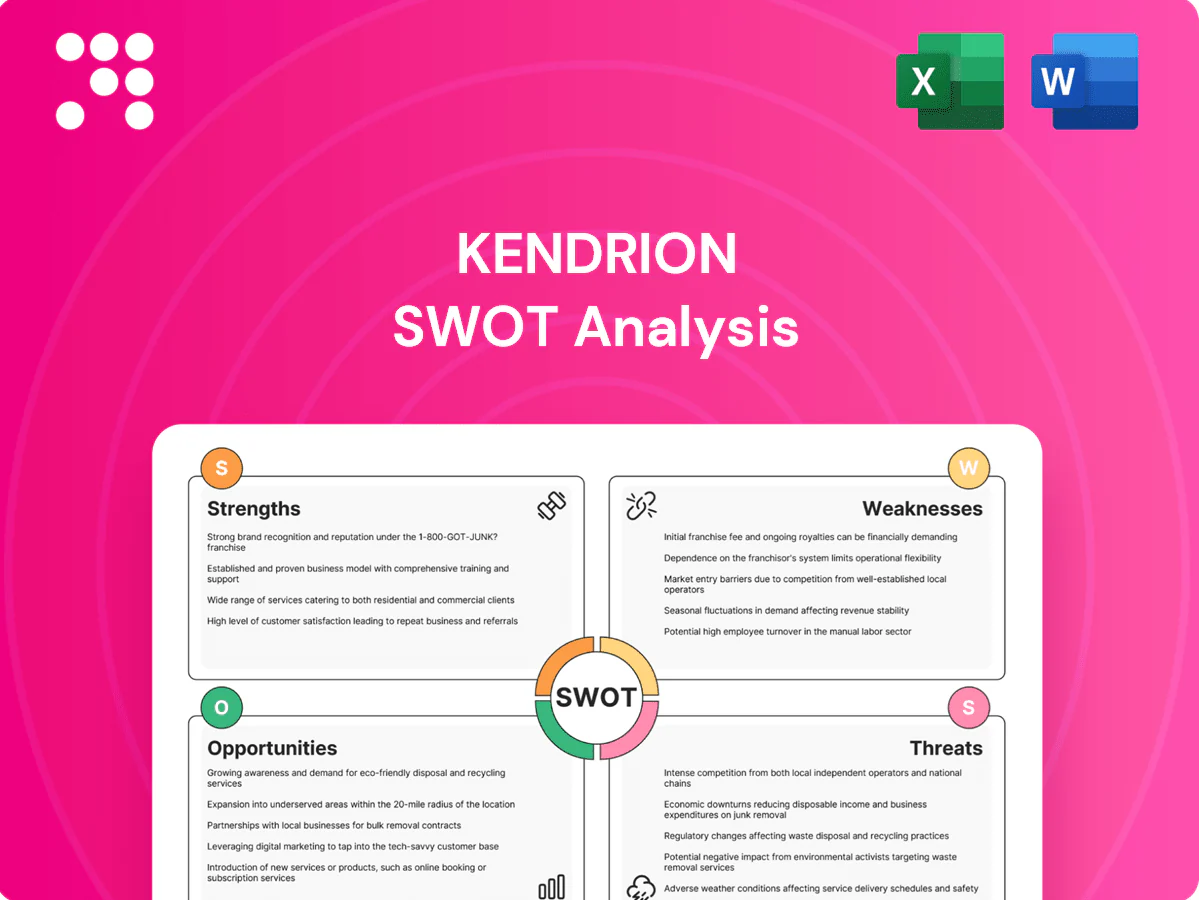
Kendrion SWOT Analysis

Elevate Your Analysis with the Complete SWOT Report
Kendrion’s snapshot reveals tech-driven strengths and niche market exposure, but deeper risks and growth levers remain hidden—unlock actionable clarity with our full SWOT. Purchase the complete, research-backed report (Word + editable Excel) to inform investment, strategy, or pitch materials and plan with confidence.
Strengths

Deep electromagnetic and mechatronic expertise
Decades of specialization underpin Kendrion's electromagnetic and mechatronic engineering, enabling application-specific designs that solve complex motion and control challenges with precision. This expertise shortens development cycles and improves performance-to-cost ratios, supported by a portfolio of proprietary technologies and patents. As a listed company on Euronext Amsterdam (KEND), Kendrion leverages defensible IP and lasting customer relationships.
Diversified industrial end-markets
Serving automotive, commercial vehicles, industrial automation and medical reduces Kendrion's dependency on any single sector, with FY2024 group revenue of about €410m spread across these markets. Offset demand cycles help smooth revenues as weaknesses in one end-market can be balanced by strength in another. This diversification broadens opportunities for new product introductions across segments. It also enhances resilience against sector-specific shocks.

Customization and customer intimacy
Kendrion excels at tailor-made solutions aligned to OEM requirements, leveraging its 2024 focus on customized mechatronic components. Close collaboration embeds components early in customer designs, raising switching costs and deepening customer intimacy. Design-in positions yield multi-year revenue streams over product lifecycles, strengthening margins and improving revenue visibility, as highlighted in Kendrion’s 2024 reporting.

Strong niche in Industrial Brakes
Specialization in safety-critical brake systems for automation and machinery gives Kendrion a defensible niche, with deep expertise in high-performance, reliability-driven components that large OEMs prefer. Rigorous certification and in-house testing capabilities create meaningful barriers to entry and lower supplier churn. These strengths enable premium pricing and steady repeat business from industrial and automation clients.
- Defensible niche: safety-critical industrial brakes
- Competitive moat: certification and testing capabilities
- Commercial impact: premium pricing and repeat orders
Quality, reliability, and compliance capabilities
Operating in medical and automotive applications forces Kendrion to maintain rigorous quality systems such as ISO 13485 and IATF 16949, ensuring component traceability and regulatory compliance across supply chains. These certifications and documented traceability improve market access and OEM trust, while field-proven reliability cuts warranty exposure and strengthens Kendrion’s competitiveness in tender evaluations.
- ISO 13485, IATF 16949 compliance
- End-to-end traceability
- Lower OEM warranty risk
- Competitive differentiation in bids
ISO-certified mechatronics OEM, safety-brake niche, FY2024 €410m
Kendrion's decades-long electromagnetic and mechatronic expertise enables application-specific, high-reliability solutions and design-ins with multi-year OEM revenues. FY2024 group revenue ~€410m and listing on Euronext Amsterdam (KEND) support scale and access to capital. ISO 13485 and IATF 16949 certification plus a safety-critical brake niche create barriers and enable premium pricing.
| Metric | Value |
|---|---|
| FY2024 revenue | €410m |
| Exchange | Euronext Amsterdam (KEND) |
| Certifications | ISO 13485, IATF 16949 |
What is included in the product
 Detailed Word Document
Delivers a strategic overview of Kendrion’s internal and external business factors, outlining strengths, weaknesses, opportunities, and threats to assess its competitive position and future risks.

 Customizable Excel Spreadsheet
Provides a concise SWOT summary of Kendrion to quickly align strategy and remove decision-making bottlenecks for executives and teams.
Weaknesses

Exposure to cyclical capital goods demand
Kendrion faces exposure to cyclical capital goods demand as industrial automation and machinery orders swing with macro cycles; Eurozone manufacturing PMI averaged 47.8 in 2024, signaling persistent contraction and softer order books. Downturns can rapidly cut order intake and capacity utilization, often by double-digit percentages, while high fixed-cost structures compress margins during slow periods. Volatile customer capex plans make short-term forecasting unreliable and elevate working-capital and production-planning risks.
Scale disadvantage versus larger competitors
Bigger rivals such as Robert Bosch (2023 revenue ~€88.1bn) leverage broader portfolios and purchasing power, squeezing margins for Kendrion. Price pressure intensifies in commoditizing subsegments, while limited scale reduces bargaining power for raw materials and logistics. Scale also constrains global service coverage versus multinationals.

Customer concentration in OEM programs
Design-in wins have concentrated revenue in a few large OEM programs, making Kendrion vulnerable when program cancellations or delays occur and causing material swings in quarterly results. Major OEMs typically hold the negotiating power, pressuring pricing and extending payment terms, which compresses margins and cash conversion. Recent cycle disruptions in automotive supply chains have amplified these risks for Kendrion.

High R&D and tooling intensity
High R&D and tooling intensity forces Kendrion into significant upfront engineering, prototyping and validation investments, with payback contingent on multi-year series production; elevated NRE and capex pressure near-term margins and cash flow, increasing operational risk. To prevent product-line fragmentation, disciplined portfolio pruning is required to focus resources on scalable platforms and higher-volume programs.
- Upfront engineering burden
- Payback depends on series ramp
- Higher NRE and capex drain margins
- Need for portfolio pruning
Supply chain sensitivity to specialty materials
Rare earth magnets, copper and precision steel components drive input cost volatility; China accounts for roughly 70% of rare-earth processing and LME copper averaged about $9,500/t in 2024, amplifying margin risk. Geopolitical or logistics shocks can push lead times beyond 20 weeks; dual-sourcing engineered parts requires 6–12 months of qualification, and cost pass-through often lags by 2–4 quarters.
- Rare-earth concentration ~70%
- LME copper ~ $9,500/t (2024)
- Lead times >20 weeks after disruption
- Dual-sourcing takes 6–12 months
- Pass-through lag 2–4 quarters
Cyclical Eurozone demand, margin squeeze vs large rivals, input volatility and OEM concentration
Kendrion is exposed to cyclical industrial demand (Eurozone PMI 47.8 in 2024), faces margin pressure from larger rivals (Robert Bosch revenue ~€88.1bn in 2023) and concentrated OEM program risk, while high R&D/tooling and input volatility (rare-earth processing ~70% in China; LME copper ~$9,500/t in 2024) strain cash flow and forecasting.
| Metric | Value |
|---|---|
| Eurozone PMI (2024) | 47.8 |
| Bosch revenue (2023) | €88.1bn |
| Rare-earth processing | ~70% China |
| LME copper (2024) | $9,500/t |
| Lead times after shock | >20 weeks |
What You See Is What You Get
Kendrion SWOT Analysis
This is a real excerpt from the complete Kendrion SWOT analysis document you’ll receive upon purchase—no surprises, just professional quality. The preview below is taken directly from the full report and reflects the final structure and findings. Buy to unlock the editable, in-depth version with all supporting details.

Elevate Your Analysis with the Complete SWOT Report
Kendrion’s snapshot reveals tech-driven strengths and niche market exposure, but deeper risks and growth levers remain hidden—unlock actionable clarity with our full SWOT. Purchase the complete, research-backed report (Word + editable Excel) to inform investment, strategy, or pitch materials and plan with confidence.
Strengths
Deep electromagnetic and mechatronic expertise
Decades of specialization underpin Kendrion's electromagnetic and mechatronic engineering, enabling application-specific designs that solve complex motion and control challenges with precision. This expertise shortens development cycles and improves performance-to-cost ratios, supported by a portfolio of proprietary technologies and patents. As a listed company on Euronext Amsterdam (KEND), Kendrion leverages defensible IP and lasting customer relationships.
Diversified industrial end-markets
Serving automotive, commercial vehicles, industrial automation and medical reduces Kendrion's dependency on any single sector, with FY2024 group revenue of about €410m spread across these markets. Offset demand cycles help smooth revenues as weaknesses in one end-market can be balanced by strength in another. This diversification broadens opportunities for new product introductions across segments. It also enhances resilience against sector-specific shocks.
Customization and customer intimacy
Kendrion excels at tailor-made solutions aligned to OEM requirements, leveraging its 2024 focus on customized mechatronic components. Close collaboration embeds components early in customer designs, raising switching costs and deepening customer intimacy. Design-in positions yield multi-year revenue streams over product lifecycles, strengthening margins and improving revenue visibility, as highlighted in Kendrion’s 2024 reporting.
Strong niche in Industrial Brakes
Specialization in safety-critical brake systems for automation and machinery gives Kendrion a defensible niche, with deep expertise in high-performance, reliability-driven components that large OEMs prefer. Rigorous certification and in-house testing capabilities create meaningful barriers to entry and lower supplier churn. These strengths enable premium pricing and steady repeat business from industrial and automation clients.
- Defensible niche: safety-critical industrial brakes
- Competitive moat: certification and testing capabilities
- Commercial impact: premium pricing and repeat orders
Quality, reliability, and compliance capabilities
Operating in medical and automotive applications forces Kendrion to maintain rigorous quality systems such as ISO 13485 and IATF 16949, ensuring component traceability and regulatory compliance across supply chains. These certifications and documented traceability improve market access and OEM trust, while field-proven reliability cuts warranty exposure and strengthens Kendrion’s competitiveness in tender evaluations.
- ISO 13485, IATF 16949 compliance
- End-to-end traceability
- Lower OEM warranty risk
- Competitive differentiation in bids
ISO-certified mechatronics OEM, safety-brake niche, FY2024 €410m
Kendrion's decades-long electromagnetic and mechatronic expertise enables application-specific, high-reliability solutions and design-ins with multi-year OEM revenues. FY2024 group revenue ~€410m and listing on Euronext Amsterdam (KEND) support scale and access to capital. ISO 13485 and IATF 16949 certification plus a safety-critical brake niche create barriers and enable premium pricing.
| Metric | Value |
|---|---|
| FY2024 revenue | €410m |
| Exchange | Euronext Amsterdam (KEND) |
| Certifications | ISO 13485, IATF 16949 |
What is included in the product
Detailed Word Document
Delivers a strategic overview of Kendrion’s internal and external business factors, outlining strengths, weaknesses, opportunities, and threats to assess its competitive position and future risks.
Customizable Excel Spreadsheet
Provides a concise SWOT summary of Kendrion to quickly align strategy and remove decision-making bottlenecks for executives and teams.
Weaknesses
Exposure to cyclical capital goods demand
Kendrion faces exposure to cyclical capital goods demand as industrial automation and machinery orders swing with macro cycles; Eurozone manufacturing PMI averaged 47.8 in 2024, signaling persistent contraction and softer order books. Downturns can rapidly cut order intake and capacity utilization, often by double-digit percentages, while high fixed-cost structures compress margins during slow periods. Volatile customer capex plans make short-term forecasting unreliable and elevate working-capital and production-planning risks.
Scale disadvantage versus larger competitors
Bigger rivals such as Robert Bosch (2023 revenue ~€88.1bn) leverage broader portfolios and purchasing power, squeezing margins for Kendrion. Price pressure intensifies in commoditizing subsegments, while limited scale reduces bargaining power for raw materials and logistics. Scale also constrains global service coverage versus multinationals.
Customer concentration in OEM programs
Design-in wins have concentrated revenue in a few large OEM programs, making Kendrion vulnerable when program cancellations or delays occur and causing material swings in quarterly results. Major OEMs typically hold the negotiating power, pressuring pricing and extending payment terms, which compresses margins and cash conversion. Recent cycle disruptions in automotive supply chains have amplified these risks for Kendrion.
High R&D and tooling intensity
High R&D and tooling intensity forces Kendrion into significant upfront engineering, prototyping and validation investments, with payback contingent on multi-year series production; elevated NRE and capex pressure near-term margins and cash flow, increasing operational risk. To prevent product-line fragmentation, disciplined portfolio pruning is required to focus resources on scalable platforms and higher-volume programs.
- Upfront engineering burden
- Payback depends on series ramp
- Higher NRE and capex drain margins
- Need for portfolio pruning
Supply chain sensitivity to specialty materials
Rare earth magnets, copper and precision steel components drive input cost volatility; China accounts for roughly 70% of rare-earth processing and LME copper averaged about $9,500/t in 2024, amplifying margin risk. Geopolitical or logistics shocks can push lead times beyond 20 weeks; dual-sourcing engineered parts requires 6–12 months of qualification, and cost pass-through often lags by 2–4 quarters.
- Rare-earth concentration ~70%
- LME copper ~ $9,500/t (2024)
- Lead times >20 weeks after disruption
- Dual-sourcing takes 6–12 months
- Pass-through lag 2–4 quarters
Cyclical Eurozone demand, margin squeeze vs large rivals, input volatility and OEM concentration
Kendrion is exposed to cyclical industrial demand (Eurozone PMI 47.8 in 2024), faces margin pressure from larger rivals (Robert Bosch revenue ~€88.1bn in 2023) and concentrated OEM program risk, while high R&D/tooling and input volatility (rare-earth processing ~70% in China; LME copper ~$9,500/t in 2024) strain cash flow and forecasting.
| Metric | Value |
|---|---|
| Eurozone PMI (2024) | 47.8 |
| Bosch revenue (2023) | €88.1bn |
| Rare-earth processing | ~70% China |
| LME copper (2024) | $9,500/t |
| Lead times after shock | >20 weeks |
What You See Is What You Get
Kendrion SWOT Analysis
This is a real excerpt from the complete Kendrion SWOT analysis document you’ll receive upon purchase—no surprises, just professional quality. The preview below is taken directly from the full report and reflects the final structure and findings. Buy to unlock the editable, in-depth version with all supporting details.
Original: $10.00
-65%$10.00
$3.50Description
Elevate Your Analysis with the Complete SWOT Report
Kendrion’s snapshot reveals tech-driven strengths and niche market exposure, but deeper risks and growth levers remain hidden—unlock actionable clarity with our full SWOT. Purchase the complete, research-backed report (Word + editable Excel) to inform investment, strategy, or pitch materials and plan with confidence.
Strengths
Deep electromagnetic and mechatronic expertise
Decades of specialization underpin Kendrion's electromagnetic and mechatronic engineering, enabling application-specific designs that solve complex motion and control challenges with precision. This expertise shortens development cycles and improves performance-to-cost ratios, supported by a portfolio of proprietary technologies and patents. As a listed company on Euronext Amsterdam (KEND), Kendrion leverages defensible IP and lasting customer relationships.
Diversified industrial end-markets
Serving automotive, commercial vehicles, industrial automation and medical reduces Kendrion's dependency on any single sector, with FY2024 group revenue of about €410m spread across these markets. Offset demand cycles help smooth revenues as weaknesses in one end-market can be balanced by strength in another. This diversification broadens opportunities for new product introductions across segments. It also enhances resilience against sector-specific shocks.
Customization and customer intimacy
Kendrion excels at tailor-made solutions aligned to OEM requirements, leveraging its 2024 focus on customized mechatronic components. Close collaboration embeds components early in customer designs, raising switching costs and deepening customer intimacy. Design-in positions yield multi-year revenue streams over product lifecycles, strengthening margins and improving revenue visibility, as highlighted in Kendrion’s 2024 reporting.
Strong niche in Industrial Brakes
Specialization in safety-critical brake systems for automation and machinery gives Kendrion a defensible niche, with deep expertise in high-performance, reliability-driven components that large OEMs prefer. Rigorous certification and in-house testing capabilities create meaningful barriers to entry and lower supplier churn. These strengths enable premium pricing and steady repeat business from industrial and automation clients.
- Defensible niche: safety-critical industrial brakes
- Competitive moat: certification and testing capabilities
- Commercial impact: premium pricing and repeat orders
Quality, reliability, and compliance capabilities
Operating in medical and automotive applications forces Kendrion to maintain rigorous quality systems such as ISO 13485 and IATF 16949, ensuring component traceability and regulatory compliance across supply chains. These certifications and documented traceability improve market access and OEM trust, while field-proven reliability cuts warranty exposure and strengthens Kendrion’s competitiveness in tender evaluations.
- ISO 13485, IATF 16949 compliance
- End-to-end traceability
- Lower OEM warranty risk
- Competitive differentiation in bids
ISO-certified mechatronics OEM, safety-brake niche, FY2024 €410m
Kendrion's decades-long electromagnetic and mechatronic expertise enables application-specific, high-reliability solutions and design-ins with multi-year OEM revenues. FY2024 group revenue ~€410m and listing on Euronext Amsterdam (KEND) support scale and access to capital. ISO 13485 and IATF 16949 certification plus a safety-critical brake niche create barriers and enable premium pricing.
| Metric | Value |
|---|---|
| FY2024 revenue | €410m |
| Exchange | Euronext Amsterdam (KEND) |
| Certifications | ISO 13485, IATF 16949 |
What is included in the product
Detailed Word Document
Delivers a strategic overview of Kendrion’s internal and external business factors, outlining strengths, weaknesses, opportunities, and threats to assess its competitive position and future risks.
Customizable Excel Spreadsheet
Provides a concise SWOT summary of Kendrion to quickly align strategy and remove decision-making bottlenecks for executives and teams.
Weaknesses
Exposure to cyclical capital goods demand
Kendrion faces exposure to cyclical capital goods demand as industrial automation and machinery orders swing with macro cycles; Eurozone manufacturing PMI averaged 47.8 in 2024, signaling persistent contraction and softer order books. Downturns can rapidly cut order intake and capacity utilization, often by double-digit percentages, while high fixed-cost structures compress margins during slow periods. Volatile customer capex plans make short-term forecasting unreliable and elevate working-capital and production-planning risks.
Scale disadvantage versus larger competitors
Bigger rivals such as Robert Bosch (2023 revenue ~€88.1bn) leverage broader portfolios and purchasing power, squeezing margins for Kendrion. Price pressure intensifies in commoditizing subsegments, while limited scale reduces bargaining power for raw materials and logistics. Scale also constrains global service coverage versus multinationals.
Customer concentration in OEM programs
Design-in wins have concentrated revenue in a few large OEM programs, making Kendrion vulnerable when program cancellations or delays occur and causing material swings in quarterly results. Major OEMs typically hold the negotiating power, pressuring pricing and extending payment terms, which compresses margins and cash conversion. Recent cycle disruptions in automotive supply chains have amplified these risks for Kendrion.
High R&D and tooling intensity
High R&D and tooling intensity forces Kendrion into significant upfront engineering, prototyping and validation investments, with payback contingent on multi-year series production; elevated NRE and capex pressure near-term margins and cash flow, increasing operational risk. To prevent product-line fragmentation, disciplined portfolio pruning is required to focus resources on scalable platforms and higher-volume programs.
- Upfront engineering burden
- Payback depends on series ramp
- Higher NRE and capex drain margins
- Need for portfolio pruning
Supply chain sensitivity to specialty materials
Rare earth magnets, copper and precision steel components drive input cost volatility; China accounts for roughly 70% of rare-earth processing and LME copper averaged about $9,500/t in 2024, amplifying margin risk. Geopolitical or logistics shocks can push lead times beyond 20 weeks; dual-sourcing engineered parts requires 6–12 months of qualification, and cost pass-through often lags by 2–4 quarters.
- Rare-earth concentration ~70%
- LME copper ~ $9,500/t (2024)
- Lead times >20 weeks after disruption
- Dual-sourcing takes 6–12 months
- Pass-through lag 2–4 quarters
Cyclical Eurozone demand, margin squeeze vs large rivals, input volatility and OEM concentration
Kendrion is exposed to cyclical industrial demand (Eurozone PMI 47.8 in 2024), faces margin pressure from larger rivals (Robert Bosch revenue ~€88.1bn in 2023) and concentrated OEM program risk, while high R&D/tooling and input volatility (rare-earth processing ~70% in China; LME copper ~$9,500/t in 2024) strain cash flow and forecasting.
| Metric | Value |
|---|---|
| Eurozone PMI (2024) | 47.8 |
| Bosch revenue (2023) | €88.1bn |
| Rare-earth processing | ~70% China |
| LME copper (2024) | $9,500/t |
| Lead times after shock | >20 weeks |
What You See Is What You Get
Kendrion SWOT Analysis
This is a real excerpt from the complete Kendrion SWOT analysis document you’ll receive upon purchase—no surprises, just professional quality. The preview below is taken directly from the full report and reflects the final structure and findings. Buy to unlock the editable, in-depth version with all supporting details.











