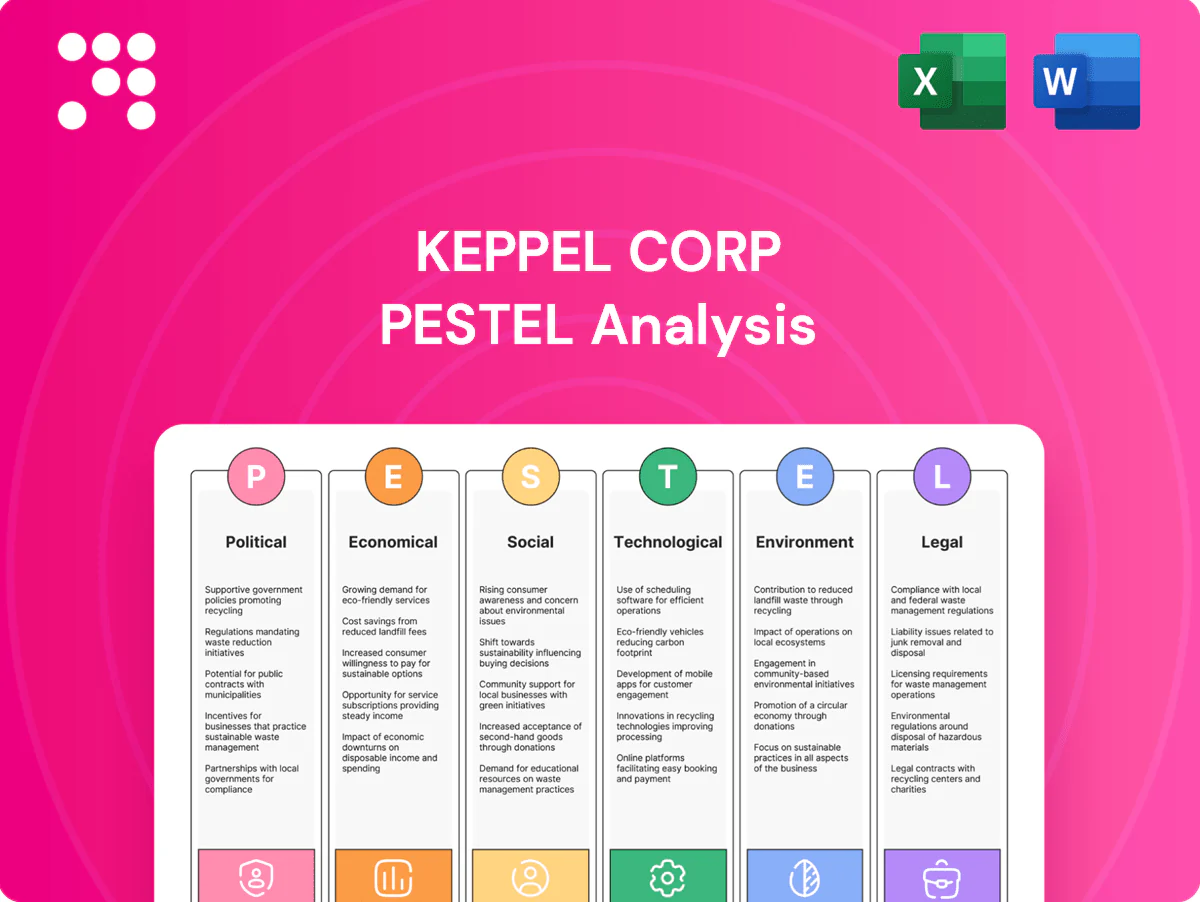
Keppel Corp PESTLE Analysis

Your Shortcut to Market Insight Starts Here
Unlock strategic clarity with our PESTLE Analysis of Keppel Corp—three to five concise, expert-backed perspectives on political, economic, social, technological, legal and environmental pressures shaping its trajectory. Ideal for investors and strategists seeking actionable insights; purchase the full report to access the complete, editable breakdown and immediate download.
Political factors

Singapore policy stability
Keppel benefits from Singapore’s pro-business, infrastructure-forward agendas and long-term planning, with Master Plan updates every five years and HDB housing covering about 80% of resident homes supporting steady project pipelines.
Consistent industrial, housing and digital masterplans lower execution risk across energy, urban development and connectivity, while the Green Plan 2030 and carbon tax at S$25/tonne (from 2024) may reweight capital toward greener assets.
Energy transition incentives
Government subsidies, carbon pricing and green taxonomies shape project economics for Keppel's renewables, waste-to-energy and retrofit pipeline: World Bank reports carbon pricing covers ~25% of global emissions with an average price ~9 USD/tCO2 in 2024, while green bond markets had over 1.6 trillion USD outstanding by 2024, improving access to lower-cost capital. Access to grants and green bond/sustainability-linked loan structures accelerates paybacks; policy reversals or incentive tapering would materially reduce IRRs.

Geopolitical tensions
US–China rivalry and supply‑chain bifurcation, driven by the CHIPS and Science Act’s roughly US$52 billion in semiconductor incentives, disrupt equipment sourcing and can extend project timelines for offshore and infrastructure work.
Cross‑border data and technology restrictions, highlighted by China’s Data Security Law and Personal Information Protection Law (both 2021), constrain digital connectivity ventures and cloud deployments.
Broad sanctions regimes since 2014 and expanded post‑2022 complicate capital flows and counterparties, so Keppel’s diversified footprint must price country risk premiums accordingly.

ASEAN and regional integration
ASEAN integration expands market scope for Keppel as ADB estimates ASEAN needs about US$210 billion annually for infrastructure to 2030, boosting demand for power interconnectivity projects. Robust host-country PPP rules and sovereign guarantees remain critical to project bankability, while political turnover often delays approvals and land acquisition. ADB and AIIB are increasingly catalysing blended finance for sustainable projects.
- ADB: US$210B/yr need to 2030
- PPP frameworks & sovereign guarantees: essential
- Political turnover: approval/land risk
- Regional banks (ADB, AIIB): blended finance catalyst
Urban policy and housing priorities
- City zoning & land release: affects site supply and project scale
- Green mandates: BCA Green Mark (2005), net-zero by 2050
- Procurement: GeBIZ-driven rules influence bid competitiveness
- Local alignment: improves permitting and community acceptance
Low-carbon capex shifts under S$25/t carbon tax; ASEAN infra demand rises
Keppel benefits from Singapore’s pro‑business planning and HDB-driven project pipelines, but Green Plan 2030 and S$25/t carbon tax (from 2024) shift capex to low‑carbon assets. Geopolitical bifurcation (US–China, CHIPS US$52bn) raises supply‑chain and timing risks; ASEAN infrastructure demand (ADB US$210bn/yr to 2030) and ADB/AIIB blended finance expand regional opportunities.
| Item | Key figure |
|---|---|
| Carbon tax (SG) | S$25/t (2024) |
| CHIPS Act | US$52bn |
| ASEAN infra need | US$210bn/yr to 2030 |
| Green bonds outstanding | US$1.6tr (2024) |
What is included in the product
 Detailed Word Document
Explores how Political, Economic, Social, Technological, Environmental and Legal forces uniquely impact Keppel Corp, with data-backed trends and forward-looking insights to help executives, investors and strategists spot risks, opportunities and scenario-driven responses.

 Customizable Excel Spreadsheet
A concise, visually segmented PESTLE summary of Keppel Corporation that can be dropped into presentations, edited with notes for regional or business-line context, and easily shared across teams to streamline external-risk discussions and strategic planning.
Economic factors

Interest rate and credit cycles
High policy rates (US fed funds ~5.25–5.50% through 2024–H1 2025 and SGB 10Y near 3.4% in mid‑2025) pressure project IRRs, lift cap rates and compress DCF valuations across Keppel’s asset base.
Refinancing risk and debt‑service coverage are critical for long‑duration infrastructure portfolios; Keppel’s ability to refinance at stretched yields raises rollover risk.
Rate cuts would likely re‑open capital markets for development and M&A, while hedging and fixed‑rate structures blunt short‑term volatility.
Commodity and energy prices
Power, LNG and raw material price swings—Asian LNG spot ~$14/MMBtu in 2024—raise EPC capex and compress waste‑to‑energy returns, with spikes frequently delaying investments and stressing O&M margins. Long‑term offtake and index‑linked contracts (multi‑year PPA/LNG SPAs) stabilize cash flows and EBITDA visibility. Keppel’s diversification across energy and urban solutions reduces concentration risk and exposure to single‑commodity cycles.

FX fluctuations
Keppel’s multi-market footprint (offshore, infrastructure and property assets across Asia, Americas and Europe) introduces translation and transaction risk, with FX swings directly altering reported returns on overseas assets and cross-border dividends. Natural hedges, local-currency financing and use of FX derivatives are standard tools Keppel employs to damp earnings volatility. Currency controls in markets such as China can constrain cash repatriation and timing of dividend flows.

Infrastructure spending and PPP funding
Government capex cycles and multilateral funding (Global Infrastructure Hub estimates $94 trillion required to 2040) shape Keppel’s project pipeline and timing, while private capital appetite for core-plus and green infrastructure underpins asset recycling and yield-accretive divestments. PPP risk allocation determines bankability and return profiles, and IMF 2024 global growth of ~3.2% means economic slowdowns can defer large urban and energy projects.
- capex cycles: timing driven by public budgets and multilateral finance
- market: strong private demand for core-plus/green supports recycling
- PPP: risk split crucial for bankability
- downside: growth shocks defer big projects
Real estate and data center demand
Cyclical real estate conditions weigh on Keppel Corp’s leasing, sales and development margins, while structural cloud and AI growth is raising data‑center absorption even as power availability tightens. High capital intensity and rising power prices are decisive for competitiveness; yield compression will hinge on investor risk appetite and premiums for green, low‑carbon assets. (IEA: data centres ~1% global electricity use, 2022)
- Cyclical market risk
- Cloud/AI driving demand
- Power constraints critical
- Capex and OPEX pressure
- Yields tied to green premiums
Low-carbon capex shifts under S$25/t carbon tax; ASEAN infra demand rises
High rates (US Fed 5.25–5.50% through H1‑2025; SGB 10Y ~3.4% mid‑2025) compress DCFs and lift cap rates. Refi risk rises for long‑dated assets; hedges and fixed‑rate financing mitigate short‑term stress. Commodity swings (Asian LNG ~$14/MMBtu in 2024) raise EPC costs; multilateral funding and private demand (Global infra need $94tn to 2040) shape pipelines.
| Metric | Value |
|---|---|
| Global growth (IMF 2024) | ~3.2% |
Full Version Awaits
Keppel Corp PESTLE Analysis
This Keppel Corp PESTLE Analysis provides a concise, professionally structured assessment of political, economic, social, technological, legal and environmental factors affecting the company. The preview shown here is the exact document you’ll receive after purchase—fully formatted and ready to use. Use it immediately for strategy, investment or academic work.

Your Shortcut to Market Insight Starts Here
Unlock strategic clarity with our PESTLE Analysis of Keppel Corp—three to five concise, expert-backed perspectives on political, economic, social, technological, legal and environmental pressures shaping its trajectory. Ideal for investors and strategists seeking actionable insights; purchase the full report to access the complete, editable breakdown and immediate download.
Political factors
Singapore policy stability
Keppel benefits from Singapore’s pro-business, infrastructure-forward agendas and long-term planning, with Master Plan updates every five years and HDB housing covering about 80% of resident homes supporting steady project pipelines.
Consistent industrial, housing and digital masterplans lower execution risk across energy, urban development and connectivity, while the Green Plan 2030 and carbon tax at S$25/tonne (from 2024) may reweight capital toward greener assets.
Energy transition incentives
Government subsidies, carbon pricing and green taxonomies shape project economics for Keppel's renewables, waste-to-energy and retrofit pipeline: World Bank reports carbon pricing covers ~25% of global emissions with an average price ~9 USD/tCO2 in 2024, while green bond markets had over 1.6 trillion USD outstanding by 2024, improving access to lower-cost capital. Access to grants and green bond/sustainability-linked loan structures accelerates paybacks; policy reversals or incentive tapering would materially reduce IRRs.
Geopolitical tensions
US–China rivalry and supply‑chain bifurcation, driven by the CHIPS and Science Act’s roughly US$52 billion in semiconductor incentives, disrupt equipment sourcing and can extend project timelines for offshore and infrastructure work.
Cross‑border data and technology restrictions, highlighted by China’s Data Security Law and Personal Information Protection Law (both 2021), constrain digital connectivity ventures and cloud deployments.
Broad sanctions regimes since 2014 and expanded post‑2022 complicate capital flows and counterparties, so Keppel’s diversified footprint must price country risk premiums accordingly.
ASEAN and regional integration
ASEAN integration expands market scope for Keppel as ADB estimates ASEAN needs about US$210 billion annually for infrastructure to 2030, boosting demand for power interconnectivity projects. Robust host-country PPP rules and sovereign guarantees remain critical to project bankability, while political turnover often delays approvals and land acquisition. ADB and AIIB are increasingly catalysing blended finance for sustainable projects.
- ADB: US$210B/yr need to 2030
- PPP frameworks & sovereign guarantees: essential
- Political turnover: approval/land risk
- Regional banks (ADB, AIIB): blended finance catalyst
Urban policy and housing priorities
- City zoning & land release: affects site supply and project scale
- Green mandates: BCA Green Mark (2005), net-zero by 2050
- Procurement: GeBIZ-driven rules influence bid competitiveness
- Local alignment: improves permitting and community acceptance
Low-carbon capex shifts under S$25/t carbon tax; ASEAN infra demand rises
Keppel benefits from Singapore’s pro‑business planning and HDB-driven project pipelines, but Green Plan 2030 and S$25/t carbon tax (from 2024) shift capex to low‑carbon assets. Geopolitical bifurcation (US–China, CHIPS US$52bn) raises supply‑chain and timing risks; ASEAN infrastructure demand (ADB US$210bn/yr to 2030) and ADB/AIIB blended finance expand regional opportunities.
| Item | Key figure |
|---|---|
| Carbon tax (SG) | S$25/t (2024) |
| CHIPS Act | US$52bn |
| ASEAN infra need | US$210bn/yr to 2030 |
| Green bonds outstanding | US$1.6tr (2024) |
What is included in the product
Detailed Word Document
Explores how Political, Economic, Social, Technological, Environmental and Legal forces uniquely impact Keppel Corp, with data-backed trends and forward-looking insights to help executives, investors and strategists spot risks, opportunities and scenario-driven responses.
Customizable Excel Spreadsheet
A concise, visually segmented PESTLE summary of Keppel Corporation that can be dropped into presentations, edited with notes for regional or business-line context, and easily shared across teams to streamline external-risk discussions and strategic planning.
Economic factors
Interest rate and credit cycles
High policy rates (US fed funds ~5.25–5.50% through 2024–H1 2025 and SGB 10Y near 3.4% in mid‑2025) pressure project IRRs, lift cap rates and compress DCF valuations across Keppel’s asset base.
Refinancing risk and debt‑service coverage are critical for long‑duration infrastructure portfolios; Keppel’s ability to refinance at stretched yields raises rollover risk.
Rate cuts would likely re‑open capital markets for development and M&A, while hedging and fixed‑rate structures blunt short‑term volatility.
Commodity and energy prices
Power, LNG and raw material price swings—Asian LNG spot ~$14/MMBtu in 2024—raise EPC capex and compress waste‑to‑energy returns, with spikes frequently delaying investments and stressing O&M margins. Long‑term offtake and index‑linked contracts (multi‑year PPA/LNG SPAs) stabilize cash flows and EBITDA visibility. Keppel’s diversification across energy and urban solutions reduces concentration risk and exposure to single‑commodity cycles.
FX fluctuations
Keppel’s multi-market footprint (offshore, infrastructure and property assets across Asia, Americas and Europe) introduces translation and transaction risk, with FX swings directly altering reported returns on overseas assets and cross-border dividends. Natural hedges, local-currency financing and use of FX derivatives are standard tools Keppel employs to damp earnings volatility. Currency controls in markets such as China can constrain cash repatriation and timing of dividend flows.
Infrastructure spending and PPP funding
Government capex cycles and multilateral funding (Global Infrastructure Hub estimates $94 trillion required to 2040) shape Keppel’s project pipeline and timing, while private capital appetite for core-plus and green infrastructure underpins asset recycling and yield-accretive divestments. PPP risk allocation determines bankability and return profiles, and IMF 2024 global growth of ~3.2% means economic slowdowns can defer large urban and energy projects.
- capex cycles: timing driven by public budgets and multilateral finance
- market: strong private demand for core-plus/green supports recycling
- PPP: risk split crucial for bankability
- downside: growth shocks defer big projects
Real estate and data center demand
Cyclical real estate conditions weigh on Keppel Corp’s leasing, sales and development margins, while structural cloud and AI growth is raising data‑center absorption even as power availability tightens. High capital intensity and rising power prices are decisive for competitiveness; yield compression will hinge on investor risk appetite and premiums for green, low‑carbon assets. (IEA: data centres ~1% global electricity use, 2022)
- Cyclical market risk
- Cloud/AI driving demand
- Power constraints critical
- Capex and OPEX pressure
- Yields tied to green premiums
Low-carbon capex shifts under S$25/t carbon tax; ASEAN infra demand rises
High rates (US Fed 5.25–5.50% through H1‑2025; SGB 10Y ~3.4% mid‑2025) compress DCFs and lift cap rates. Refi risk rises for long‑dated assets; hedges and fixed‑rate financing mitigate short‑term stress. Commodity swings (Asian LNG ~$14/MMBtu in 2024) raise EPC costs; multilateral funding and private demand (Global infra need $94tn to 2040) shape pipelines.
| Metric | Value |
|---|---|
| Global growth (IMF 2024) | ~3.2% |
Full Version Awaits
Keppel Corp PESTLE Analysis
This Keppel Corp PESTLE Analysis provides a concise, professionally structured assessment of political, economic, social, technological, legal and environmental factors affecting the company. The preview shown here is the exact document you’ll receive after purchase—fully formatted and ready to use. Use it immediately for strategy, investment or academic work.
Original: $10.00
-65%$10.00
$3.50Description
Your Shortcut to Market Insight Starts Here
Unlock strategic clarity with our PESTLE Analysis of Keppel Corp—three to five concise, expert-backed perspectives on political, economic, social, technological, legal and environmental pressures shaping its trajectory. Ideal for investors and strategists seeking actionable insights; purchase the full report to access the complete, editable breakdown and immediate download.
Political factors
Singapore policy stability
Keppel benefits from Singapore’s pro-business, infrastructure-forward agendas and long-term planning, with Master Plan updates every five years and HDB housing covering about 80% of resident homes supporting steady project pipelines.
Consistent industrial, housing and digital masterplans lower execution risk across energy, urban development and connectivity, while the Green Plan 2030 and carbon tax at S$25/tonne (from 2024) may reweight capital toward greener assets.
Energy transition incentives
Government subsidies, carbon pricing and green taxonomies shape project economics for Keppel's renewables, waste-to-energy and retrofit pipeline: World Bank reports carbon pricing covers ~25% of global emissions with an average price ~9 USD/tCO2 in 2024, while green bond markets had over 1.6 trillion USD outstanding by 2024, improving access to lower-cost capital. Access to grants and green bond/sustainability-linked loan structures accelerates paybacks; policy reversals or incentive tapering would materially reduce IRRs.
Geopolitical tensions
US–China rivalry and supply‑chain bifurcation, driven by the CHIPS and Science Act’s roughly US$52 billion in semiconductor incentives, disrupt equipment sourcing and can extend project timelines for offshore and infrastructure work.
Cross‑border data and technology restrictions, highlighted by China’s Data Security Law and Personal Information Protection Law (both 2021), constrain digital connectivity ventures and cloud deployments.
Broad sanctions regimes since 2014 and expanded post‑2022 complicate capital flows and counterparties, so Keppel’s diversified footprint must price country risk premiums accordingly.
ASEAN and regional integration
ASEAN integration expands market scope for Keppel as ADB estimates ASEAN needs about US$210 billion annually for infrastructure to 2030, boosting demand for power interconnectivity projects. Robust host-country PPP rules and sovereign guarantees remain critical to project bankability, while political turnover often delays approvals and land acquisition. ADB and AIIB are increasingly catalysing blended finance for sustainable projects.
- ADB: US$210B/yr need to 2030
- PPP frameworks & sovereign guarantees: essential
- Political turnover: approval/land risk
- Regional banks (ADB, AIIB): blended finance catalyst
Urban policy and housing priorities
- City zoning & land release: affects site supply and project scale
- Green mandates: BCA Green Mark (2005), net-zero by 2050
- Procurement: GeBIZ-driven rules influence bid competitiveness
- Local alignment: improves permitting and community acceptance
Low-carbon capex shifts under S$25/t carbon tax; ASEAN infra demand rises
Keppel benefits from Singapore’s pro‑business planning and HDB-driven project pipelines, but Green Plan 2030 and S$25/t carbon tax (from 2024) shift capex to low‑carbon assets. Geopolitical bifurcation (US–China, CHIPS US$52bn) raises supply‑chain and timing risks; ASEAN infrastructure demand (ADB US$210bn/yr to 2030) and ADB/AIIB blended finance expand regional opportunities.
| Item | Key figure |
|---|---|
| Carbon tax (SG) | S$25/t (2024) |
| CHIPS Act | US$52bn |
| ASEAN infra need | US$210bn/yr to 2030 |
| Green bonds outstanding | US$1.6tr (2024) |
What is included in the product
Detailed Word Document
Explores how Political, Economic, Social, Technological, Environmental and Legal forces uniquely impact Keppel Corp, with data-backed trends and forward-looking insights to help executives, investors and strategists spot risks, opportunities and scenario-driven responses.
Customizable Excel Spreadsheet
A concise, visually segmented PESTLE summary of Keppel Corporation that can be dropped into presentations, edited with notes for regional or business-line context, and easily shared across teams to streamline external-risk discussions and strategic planning.
Economic factors
Interest rate and credit cycles
High policy rates (US fed funds ~5.25–5.50% through 2024–H1 2025 and SGB 10Y near 3.4% in mid‑2025) pressure project IRRs, lift cap rates and compress DCF valuations across Keppel’s asset base.
Refinancing risk and debt‑service coverage are critical for long‑duration infrastructure portfolios; Keppel’s ability to refinance at stretched yields raises rollover risk.
Rate cuts would likely re‑open capital markets for development and M&A, while hedging and fixed‑rate structures blunt short‑term volatility.
Commodity and energy prices
Power, LNG and raw material price swings—Asian LNG spot ~$14/MMBtu in 2024—raise EPC capex and compress waste‑to‑energy returns, with spikes frequently delaying investments and stressing O&M margins. Long‑term offtake and index‑linked contracts (multi‑year PPA/LNG SPAs) stabilize cash flows and EBITDA visibility. Keppel’s diversification across energy and urban solutions reduces concentration risk and exposure to single‑commodity cycles.
FX fluctuations
Keppel’s multi-market footprint (offshore, infrastructure and property assets across Asia, Americas and Europe) introduces translation and transaction risk, with FX swings directly altering reported returns on overseas assets and cross-border dividends. Natural hedges, local-currency financing and use of FX derivatives are standard tools Keppel employs to damp earnings volatility. Currency controls in markets such as China can constrain cash repatriation and timing of dividend flows.
Infrastructure spending and PPP funding
Government capex cycles and multilateral funding (Global Infrastructure Hub estimates $94 trillion required to 2040) shape Keppel’s project pipeline and timing, while private capital appetite for core-plus and green infrastructure underpins asset recycling and yield-accretive divestments. PPP risk allocation determines bankability and return profiles, and IMF 2024 global growth of ~3.2% means economic slowdowns can defer large urban and energy projects.
- capex cycles: timing driven by public budgets and multilateral finance
- market: strong private demand for core-plus/green supports recycling
- PPP: risk split crucial for bankability
- downside: growth shocks defer big projects
Real estate and data center demand
Cyclical real estate conditions weigh on Keppel Corp’s leasing, sales and development margins, while structural cloud and AI growth is raising data‑center absorption even as power availability tightens. High capital intensity and rising power prices are decisive for competitiveness; yield compression will hinge on investor risk appetite and premiums for green, low‑carbon assets. (IEA: data centres ~1% global electricity use, 2022)
- Cyclical market risk
- Cloud/AI driving demand
- Power constraints critical
- Capex and OPEX pressure
- Yields tied to green premiums
Low-carbon capex shifts under S$25/t carbon tax; ASEAN infra demand rises
High rates (US Fed 5.25–5.50% through H1‑2025; SGB 10Y ~3.4% mid‑2025) compress DCFs and lift cap rates. Refi risk rises for long‑dated assets; hedges and fixed‑rate financing mitigate short‑term stress. Commodity swings (Asian LNG ~$14/MMBtu in 2024) raise EPC costs; multilateral funding and private demand (Global infra need $94tn to 2040) shape pipelines.
| Metric | Value |
|---|---|
| Global growth (IMF 2024) | ~3.2% |
Full Version Awaits
Keppel Corp PESTLE Analysis
This Keppel Corp PESTLE Analysis provides a concise, professionally structured assessment of political, economic, social, technological, legal and environmental factors affecting the company. The preview shown here is the exact document you’ll receive after purchase—fully formatted and ready to use. Use it immediately for strategy, investment or academic work.











