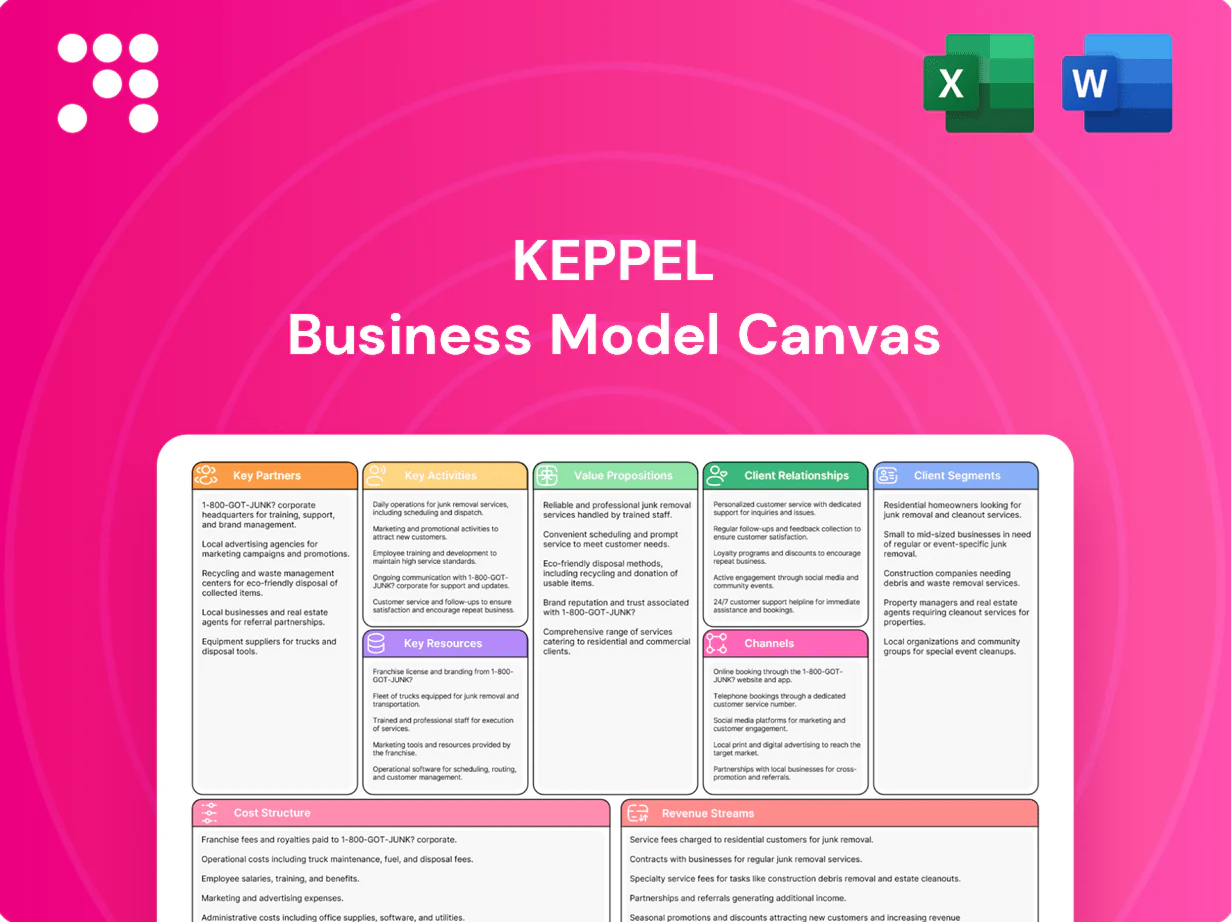
Keppel Business Model Canvas

Unlock a sector-tailored Business Model Canvas for investors and founders
Unlock Keppel's strategic blueprint with our Business Model Canvas — a concise, sector-tailored breakdown of value propositions, key partners, revenue streams and growth levers. Perfect for investors, consultants and founders seeking actionable insights. Purchase the full Canvas in Word/Excel to apply Keppel’s proven strategies.
Partnerships

Government and municipal authorities
Collaborations with city governments enable permits, land access and long-term utility concessions, supporting Keppel’s rollout of district energy, waste and water assets; Singapore targets net-zero emissions by 2050, aligning public policy with these projects. Public-sector partnerships de-risk large-scale urban and environmental investments and enable joint planning to accelerate deployment of integrated solutions.
Utilities and grid operators
Alliances with power and water utilities secure offtake, grid interconnection and balancing services, enabling Keppel to integrate assets into Singapore’s drive for 2 GWp solar by 2030. Coordinated operations optimize renewable and waste-to-energy plants for load balancing. Utility partnerships accelerate scaling of resilient infrastructure and boost reliability and service continuity for urban customers.

Technology and EPC partners
In 2024 Keppel intensified partnerships with OEMs and specialist engineering firms to deploy advanced WtE, renewables and digital systems across Asia-Pacific, enabling turnkey technology transfers and validated performance stacks. EPC alliances compress time-to-market and manage construction risk through fixed-price contracts and integrated project delivery. Co-development with vendors secures performance guarantees and regulatory compliance, while joint technology roadmaps fund lifecycle upgrades and measurable efficiency gains.

Financial institutions and co-investors
Real estate, telecom, and data center operators
Real estate, telecom and data center operators partner to integrate sustainable utilities into urban precincts and digital infrastructure, with Keppel leveraging its utilities and asset management platforms in 2024 to embed low-carbon solutions across developments.
These alliances enable energy-efficient campuses and connectivity hubs, optimizing on-site power, smart microgrids and fiber access to reduce operating costs and carbon intensity.
Joint ventures coordinate occupancy, power demand and cooling requirements, supporting contracted, long-term cash flows and scalable ecosystem growth.
- 2024 focus: integrated low-carbon utilities, smart grids, and connectivity
- Outcome: stable contracted revenues via long-term JV leases
- Benefit: aligned power/cooling design reduces OPEX and supports portfolio resilience
Public-private alliances de-risk urban energy, water and WtE rollouts toward net-zero
Keppel’s key partnerships with city governments, utilities, OEMs and financiers de-risk urban energy, water and WtE rollouts and enable integrated precinct solutions aligned with Singapore’s net-zero by 2050 goal. Utility and EPC alliances secure offtake, grid access and compressed delivery timelines. Financial partners (Keppel Capital AUM > SGD 20bn in 2024) provide project finance and ESG-linked instruments.
| Partner type | Role | 2024 metric/fact |
|---|---|---|
| City governments | Permits, land, concessions | Singapore net-zero by 2050 |
| Financial institutions | Project finance, green bonds | Keppel Capital AUM > SGD 20bn (2024) |
| OEMs/EPCs | Technology transfer, EPC delivery | Increased 2024 co-development activity |
What is included in the product
 Detailed Word Document
A comprehensive Business Model Canvas tailored to Keppel’s strategy, organized into the 9 classic blocks with detailed value propositions, customer segments, channels and revenue streams; reflects real-world operations and plans, includes competitive-advantage analysis plus linked SWOT and is ideal for presentations, investor discussions and internal strategic planning.

 Customizable Excel Spreadsheet
High-level one-page snapshot of Keppel's business model with editable cells, saving hours of formatting and clarifying core components for boardrooms, brainstorming, or team collaboration.
Activities

Origination and asset management
Source, evaluate and structure sustainable infrastructure and urban solutions across energy, environment, urban and digital sectors, leveraging Keppel Capital’s AUM of S$29 billion (2024) and a global project pipeline. Manage portfolio performance with active stewardship, targeting lifecycle return optimization and ESG improvements across more than 200 assets. Optimize capital allocation to lift IRRs and extend asset life through retrofits and digitalization.
Project development and delivery
Design, engineer and build renewables, WtE and urban systems, securing permits, PPAs (typical tenors 15–20 years) and concessions to de‑risk revenue streams; utility‑scale capex averaged about US$0.8–1.2 million/MW in 2024. Coordinate EPC, procurement and commissioning across multidisciplinary teams to ensure on‑time, on‑budget execution. Maintain strict quality and safety standards to protect project returns and workforce.

Operations and maintenance
Run plants, utilities and digital infrastructure to sustain high availability (targeting industry-standard uptimes above 99%), implementing predictive maintenance that McKinsey estimates can cut maintenance costs 10–40% and reduce downtime by up to 50%. Use efficiency upgrades and real-time, data-driven dashboards to monitor OEE, energy and emissions metrics. Ensure compliance with regulatory, environmental and SLA requirements across assets.

Capital raising and investor relations
Keppel raises capital via private vehicles, listed platforms and sustainable finance—Keppel Capital reported about S$45bn AUM in 2024—while using transparent ESG reporting to engage institutional and retail investors. It structures exits, recycling and co-investments to preserve liquidity and aligns management and investor incentives to deliver steady, risk-adjusted returns.
- Private vehicles: targeted sector funds
- Listed platforms: IPOs/SPACs for scale
- Sustainable finance: green/sustainability bonds
- Exits & co-invest: recycle capital, align incentives
Innovation and sustainability management
Keppel deploys energy recovery, storage and smart-system pilots across its urban-solutions and infrastructure assets to boost resilience and operational efficiency while tracking scope 1–3 carbon intensity by asset.
- Energy recovery, storage, smart systems
- Carbon intensity measurement and reduction
- Circular economy integration in urban projects
- ESG certifications and compliance
Scale sustainable infra with S$29bn AUM, 200+ assets and 15–20 yr PPAs
Source and structure sustainable infra across energy, environment, urban and digital sectors, leveraging Keppel Capital AUM S$29bn (2024) and a global pipeline. Active portfolio stewardship across 200+ assets to optimise returns and ESG. Build and operate renewables, WtE and urban systems; typical PPA tenors 15–20 years and utility capex US$0.8–1.2M/MW. Raise capital via private vehicles, listed platforms and sustainable finance.
| Metric | 2024 value |
|---|---|
| Keppel Capital AUM | S$29bn |
| Group AUM | S$45bn |
| Assets under stewardship | 200+ |
| Target uptime | ≈99% |
| Utility capex/MW | US$0.8–1.2M |
What You See Is What You Get
Business Model Canvas
The Keppel Business Model Canvas you see here is a live preview of the exact document you’ll receive after purchase, not a mockup or sample. When you complete your order, you’ll get the same professionally formatted file with all content included, ready for editing and presenting. Files are provided in Word and Excel so you can customize and deploy instantly.

Unlock a sector-tailored Business Model Canvas for investors and founders
Unlock Keppel's strategic blueprint with our Business Model Canvas — a concise, sector-tailored breakdown of value propositions, key partners, revenue streams and growth levers. Perfect for investors, consultants and founders seeking actionable insights. Purchase the full Canvas in Word/Excel to apply Keppel’s proven strategies.
Partnerships
Government and municipal authorities
Collaborations with city governments enable permits, land access and long-term utility concessions, supporting Keppel’s rollout of district energy, waste and water assets; Singapore targets net-zero emissions by 2050, aligning public policy with these projects. Public-sector partnerships de-risk large-scale urban and environmental investments and enable joint planning to accelerate deployment of integrated solutions.
Utilities and grid operators
Alliances with power and water utilities secure offtake, grid interconnection and balancing services, enabling Keppel to integrate assets into Singapore’s drive for 2 GWp solar by 2030. Coordinated operations optimize renewable and waste-to-energy plants for load balancing. Utility partnerships accelerate scaling of resilient infrastructure and boost reliability and service continuity for urban customers.
Technology and EPC partners
In 2024 Keppel intensified partnerships with OEMs and specialist engineering firms to deploy advanced WtE, renewables and digital systems across Asia-Pacific, enabling turnkey technology transfers and validated performance stacks. EPC alliances compress time-to-market and manage construction risk through fixed-price contracts and integrated project delivery. Co-development with vendors secures performance guarantees and regulatory compliance, while joint technology roadmaps fund lifecycle upgrades and measurable efficiency gains.
Financial institutions and co-investors
Real estate, telecom, and data center operators
Real estate, telecom and data center operators partner to integrate sustainable utilities into urban precincts and digital infrastructure, with Keppel leveraging its utilities and asset management platforms in 2024 to embed low-carbon solutions across developments.
These alliances enable energy-efficient campuses and connectivity hubs, optimizing on-site power, smart microgrids and fiber access to reduce operating costs and carbon intensity.
Joint ventures coordinate occupancy, power demand and cooling requirements, supporting contracted, long-term cash flows and scalable ecosystem growth.
- 2024 focus: integrated low-carbon utilities, smart grids, and connectivity
- Outcome: stable contracted revenues via long-term JV leases
- Benefit: aligned power/cooling design reduces OPEX and supports portfolio resilience
Public-private alliances de-risk urban energy, water and WtE rollouts toward net-zero
Keppel’s key partnerships with city governments, utilities, OEMs and financiers de-risk urban energy, water and WtE rollouts and enable integrated precinct solutions aligned with Singapore’s net-zero by 2050 goal. Utility and EPC alliances secure offtake, grid access and compressed delivery timelines. Financial partners (Keppel Capital AUM > SGD 20bn in 2024) provide project finance and ESG-linked instruments.
| Partner type | Role | 2024 metric/fact |
|---|---|---|
| City governments | Permits, land, concessions | Singapore net-zero by 2050 |
| Financial institutions | Project finance, green bonds | Keppel Capital AUM > SGD 20bn (2024) |
| OEMs/EPCs | Technology transfer, EPC delivery | Increased 2024 co-development activity |
What is included in the product
Detailed Word Document
A comprehensive Business Model Canvas tailored to Keppel’s strategy, organized into the 9 classic blocks with detailed value propositions, customer segments, channels and revenue streams; reflects real-world operations and plans, includes competitive-advantage analysis plus linked SWOT and is ideal for presentations, investor discussions and internal strategic planning.
Customizable Excel Spreadsheet
High-level one-page snapshot of Keppel's business model with editable cells, saving hours of formatting and clarifying core components for boardrooms, brainstorming, or team collaboration.
Activities
Origination and asset management
Source, evaluate and structure sustainable infrastructure and urban solutions across energy, environment, urban and digital sectors, leveraging Keppel Capital’s AUM of S$29 billion (2024) and a global project pipeline. Manage portfolio performance with active stewardship, targeting lifecycle return optimization and ESG improvements across more than 200 assets. Optimize capital allocation to lift IRRs and extend asset life through retrofits and digitalization.
Project development and delivery
Design, engineer and build renewables, WtE and urban systems, securing permits, PPAs (typical tenors 15–20 years) and concessions to de‑risk revenue streams; utility‑scale capex averaged about US$0.8–1.2 million/MW in 2024. Coordinate EPC, procurement and commissioning across multidisciplinary teams to ensure on‑time, on‑budget execution. Maintain strict quality and safety standards to protect project returns and workforce.
Operations and maintenance
Run plants, utilities and digital infrastructure to sustain high availability (targeting industry-standard uptimes above 99%), implementing predictive maintenance that McKinsey estimates can cut maintenance costs 10–40% and reduce downtime by up to 50%. Use efficiency upgrades and real-time, data-driven dashboards to monitor OEE, energy and emissions metrics. Ensure compliance with regulatory, environmental and SLA requirements across assets.
Capital raising and investor relations
Keppel raises capital via private vehicles, listed platforms and sustainable finance—Keppel Capital reported about S$45bn AUM in 2024—while using transparent ESG reporting to engage institutional and retail investors. It structures exits, recycling and co-investments to preserve liquidity and aligns management and investor incentives to deliver steady, risk-adjusted returns.
- Private vehicles: targeted sector funds
- Listed platforms: IPOs/SPACs for scale
- Sustainable finance: green/sustainability bonds
- Exits & co-invest: recycle capital, align incentives
Innovation and sustainability management
Keppel deploys energy recovery, storage and smart-system pilots across its urban-solutions and infrastructure assets to boost resilience and operational efficiency while tracking scope 1–3 carbon intensity by asset.
- Energy recovery, storage, smart systems
- Carbon intensity measurement and reduction
- Circular economy integration in urban projects
- ESG certifications and compliance
Scale sustainable infra with S$29bn AUM, 200+ assets and 15–20 yr PPAs
Source and structure sustainable infra across energy, environment, urban and digital sectors, leveraging Keppel Capital AUM S$29bn (2024) and a global pipeline. Active portfolio stewardship across 200+ assets to optimise returns and ESG. Build and operate renewables, WtE and urban systems; typical PPA tenors 15–20 years and utility capex US$0.8–1.2M/MW. Raise capital via private vehicles, listed platforms and sustainable finance.
| Metric | 2024 value |
|---|---|
| Keppel Capital AUM | S$29bn |
| Group AUM | S$45bn |
| Assets under stewardship | 200+ |
| Target uptime | ≈99% |
| Utility capex/MW | US$0.8–1.2M |
What You See Is What You Get
Business Model Canvas
The Keppel Business Model Canvas you see here is a live preview of the exact document you’ll receive after purchase, not a mockup or sample. When you complete your order, you’ll get the same professionally formatted file with all content included, ready for editing and presenting. Files are provided in Word and Excel so you can customize and deploy instantly.
Description
Unlock a sector-tailored Business Model Canvas for investors and founders
Unlock Keppel's strategic blueprint with our Business Model Canvas — a concise, sector-tailored breakdown of value propositions, key partners, revenue streams and growth levers. Perfect for investors, consultants and founders seeking actionable insights. Purchase the full Canvas in Word/Excel to apply Keppel’s proven strategies.
Partnerships
Government and municipal authorities
Collaborations with city governments enable permits, land access and long-term utility concessions, supporting Keppel’s rollout of district energy, waste and water assets; Singapore targets net-zero emissions by 2050, aligning public policy with these projects. Public-sector partnerships de-risk large-scale urban and environmental investments and enable joint planning to accelerate deployment of integrated solutions.
Utilities and grid operators
Alliances with power and water utilities secure offtake, grid interconnection and balancing services, enabling Keppel to integrate assets into Singapore’s drive for 2 GWp solar by 2030. Coordinated operations optimize renewable and waste-to-energy plants for load balancing. Utility partnerships accelerate scaling of resilient infrastructure and boost reliability and service continuity for urban customers.
Technology and EPC partners
In 2024 Keppel intensified partnerships with OEMs and specialist engineering firms to deploy advanced WtE, renewables and digital systems across Asia-Pacific, enabling turnkey technology transfers and validated performance stacks. EPC alliances compress time-to-market and manage construction risk through fixed-price contracts and integrated project delivery. Co-development with vendors secures performance guarantees and regulatory compliance, while joint technology roadmaps fund lifecycle upgrades and measurable efficiency gains.
Financial institutions and co-investors
Real estate, telecom, and data center operators
Real estate, telecom and data center operators partner to integrate sustainable utilities into urban precincts and digital infrastructure, with Keppel leveraging its utilities and asset management platforms in 2024 to embed low-carbon solutions across developments.
These alliances enable energy-efficient campuses and connectivity hubs, optimizing on-site power, smart microgrids and fiber access to reduce operating costs and carbon intensity.
Joint ventures coordinate occupancy, power demand and cooling requirements, supporting contracted, long-term cash flows and scalable ecosystem growth.
- 2024 focus: integrated low-carbon utilities, smart grids, and connectivity
- Outcome: stable contracted revenues via long-term JV leases
- Benefit: aligned power/cooling design reduces OPEX and supports portfolio resilience
Public-private alliances de-risk urban energy, water and WtE rollouts toward net-zero
Keppel’s key partnerships with city governments, utilities, OEMs and financiers de-risk urban energy, water and WtE rollouts and enable integrated precinct solutions aligned with Singapore’s net-zero by 2050 goal. Utility and EPC alliances secure offtake, grid access and compressed delivery timelines. Financial partners (Keppel Capital AUM > SGD 20bn in 2024) provide project finance and ESG-linked instruments.
| Partner type | Role | 2024 metric/fact |
|---|---|---|
| City governments | Permits, land, concessions | Singapore net-zero by 2050 |
| Financial institutions | Project finance, green bonds | Keppel Capital AUM > SGD 20bn (2024) |
| OEMs/EPCs | Technology transfer, EPC delivery | Increased 2024 co-development activity |
What is included in the product
Detailed Word Document
A comprehensive Business Model Canvas tailored to Keppel’s strategy, organized into the 9 classic blocks with detailed value propositions, customer segments, channels and revenue streams; reflects real-world operations and plans, includes competitive-advantage analysis plus linked SWOT and is ideal for presentations, investor discussions and internal strategic planning.
Customizable Excel Spreadsheet
High-level one-page snapshot of Keppel's business model with editable cells, saving hours of formatting and clarifying core components for boardrooms, brainstorming, or team collaboration.
Activities
Origination and asset management
Source, evaluate and structure sustainable infrastructure and urban solutions across energy, environment, urban and digital sectors, leveraging Keppel Capital’s AUM of S$29 billion (2024) and a global project pipeline. Manage portfolio performance with active stewardship, targeting lifecycle return optimization and ESG improvements across more than 200 assets. Optimize capital allocation to lift IRRs and extend asset life through retrofits and digitalization.
Project development and delivery
Design, engineer and build renewables, WtE and urban systems, securing permits, PPAs (typical tenors 15–20 years) and concessions to de‑risk revenue streams; utility‑scale capex averaged about US$0.8–1.2 million/MW in 2024. Coordinate EPC, procurement and commissioning across multidisciplinary teams to ensure on‑time, on‑budget execution. Maintain strict quality and safety standards to protect project returns and workforce.
Operations and maintenance
Run plants, utilities and digital infrastructure to sustain high availability (targeting industry-standard uptimes above 99%), implementing predictive maintenance that McKinsey estimates can cut maintenance costs 10–40% and reduce downtime by up to 50%. Use efficiency upgrades and real-time, data-driven dashboards to monitor OEE, energy and emissions metrics. Ensure compliance with regulatory, environmental and SLA requirements across assets.
Capital raising and investor relations
Keppel raises capital via private vehicles, listed platforms and sustainable finance—Keppel Capital reported about S$45bn AUM in 2024—while using transparent ESG reporting to engage institutional and retail investors. It structures exits, recycling and co-investments to preserve liquidity and aligns management and investor incentives to deliver steady, risk-adjusted returns.
- Private vehicles: targeted sector funds
- Listed platforms: IPOs/SPACs for scale
- Sustainable finance: green/sustainability bonds
- Exits & co-invest: recycle capital, align incentives
Innovation and sustainability management
Keppel deploys energy recovery, storage and smart-system pilots across its urban-solutions and infrastructure assets to boost resilience and operational efficiency while tracking scope 1–3 carbon intensity by asset.
- Energy recovery, storage, smart systems
- Carbon intensity measurement and reduction
- Circular economy integration in urban projects
- ESG certifications and compliance
Scale sustainable infra with S$29bn AUM, 200+ assets and 15–20 yr PPAs
Source and structure sustainable infra across energy, environment, urban and digital sectors, leveraging Keppel Capital AUM S$29bn (2024) and a global pipeline. Active portfolio stewardship across 200+ assets to optimise returns and ESG. Build and operate renewables, WtE and urban systems; typical PPA tenors 15–20 years and utility capex US$0.8–1.2M/MW. Raise capital via private vehicles, listed platforms and sustainable finance.
| Metric | 2024 value |
|---|---|
| Keppel Capital AUM | S$29bn |
| Group AUM | S$45bn |
| Assets under stewardship | 200+ |
| Target uptime | ≈99% |
| Utility capex/MW | US$0.8–1.2M |
What You See Is What You Get
Business Model Canvas
The Keppel Business Model Canvas you see here is a live preview of the exact document you’ll receive after purchase, not a mockup or sample. When you complete your order, you’ll get the same professionally formatted file with all content included, ready for editing and presenting. Files are provided in Word and Excel so you can customize and deploy instantly.











