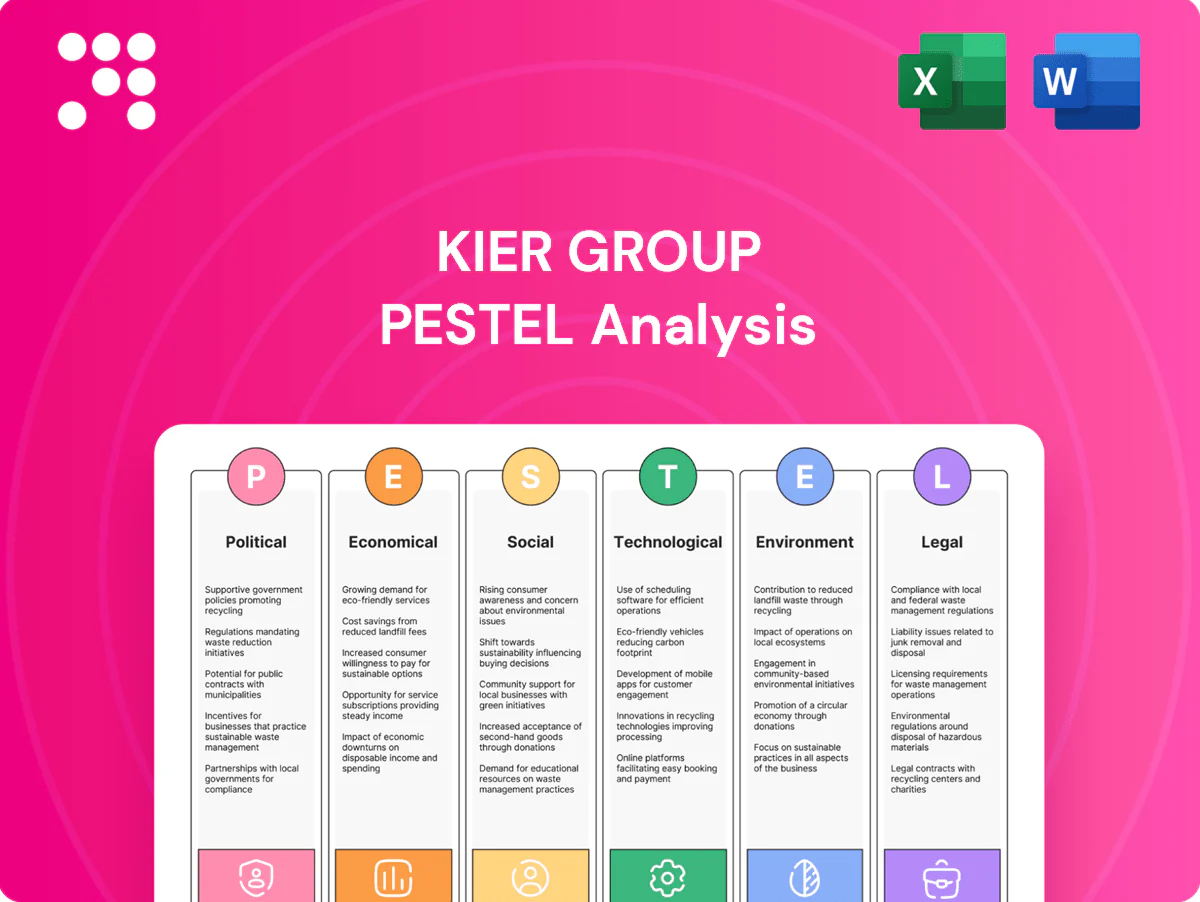
Kier Group PESTLE Analysis

Skip the Research. Get the Strategy.
Discover how political shifts, economic headwinds, social trends, technological advances, legal pressures, and environmental priorities are shaping Kier Group’s outlook in our concise PESTLE summary. This snapshot highlights key risks and opportunities to inform strategy and investment decisions. Purchase the full PESTLE for detailed, actionable analysis and ready-to-use insights.
Political factors

UK infrastructure policy shifts
Government priorities in road maintenance, rail upgrades and school/health estates continue to shape Kier’s pipeline and margins, with public-sector contracts dominating its order book exposure. The October 2023 HS2 scope reduction — freeing roughly £36bn for regional transport — rebalance workload toward local projects. Devolution deals and mayoral commissioning expand tender routes and require Kier to align bids with evolving national and local strategic plans.
Public procurement reforms
The UK Procurement Act modernises rules on transparency, value and SME engagement across a public procurement market worth about £290bn annually, with SMEs accounting for roughly 99.9% of UK firms. Greater emphasis on social value and whole-life costing shifts bid scoring and favours measurable community and carbon outcomes. Faster procedures improve pipeline visibility but compress bid timetables. Kier must deploy robust compliance tools and distinctive social-value propositions to win tenders.

Fiscal stance and budgets
Public sector capex for Kier hinges on UK fiscal policy, deficit targets and borrowing costs, with gilt yields around 4–5% in 2024 tightening funding costs and constraining delivery. Spending reviews and departmental settlements (DfT, DfE, DHSC, MoJ) directly set demand in Kier’s markets; any austerity tilt can delay projects while fiscal stimulus accelerates frameworks. Active stakeholder engagement helps protect priority schemes and secure pipeline visibility.

Planning and levelling-up agenda
Planning reforms and Levelling Up funding (total pooled at £4.8bn across rounds) drive regional project starts for Kier, with streamlined consents able to cut pre-construction by months and improve near-term cash flow; conversely consent delays can stall contract receipts and margins. Bids must align to local regeneration targets and measurable community outcomes to win funding and de-risk delivery. Early planning risk management reduces cost creep and protects EBITDA.
- Funding: £4.8bn Levelling Up rounds
- Impact: shorter consents = faster cash conversion
- Bid focus: local regeneration & community KPIs
- Mitigation: early planning risk reduces cost overrun
Geopolitics and supply security
Geopolitical tensions and sanctions have tightened supply of steel, aggregates and electrical components, contributing to UK construction input prices rising about 10% year‑on‑year in 2024 (ONS), while enhanced import checks and border policies have extended lead times across key routes. Government resilience drives (UK supplier preference) increase onshore sourcing incentives; Kier should dual‑source and hold strategic inventories for critical items to reduce disruption risk.
- Trade frictions: reduced export flows for metal/electrical supplies
- Border checks: longer lead times, higher logistics costs
- Policy: UK resilience favours domestic sourcing
- Action: dual‑source + strategic inventory
Government pipeline shifts to regional projects; HS2 frees £36bn; public market £290bn
Government road, rail and estates priorities drive Kier’s pipeline with public-sector contracts dominant; HS2 scope cut freed c.£36bn for regional projects. The UK Procurement Act affects a c.£290bn annual public market and boosts social‑value scoring; SMEs remain ~99.9% of firms. Fiscal settings (gilts ~4–5% in 2024) and input inflation (~+10% YoY 2024) constrain capex and margins.
| Metric | Value |
|---|---|
| Public procurement market | £290bn pa |
| HS2 reallocated | £36bn |
| Levelling Up funds | £4.8bn |
| Construction input inflation (2024) | +10% YoY |
| Gilt yields (2024) | 4–5% |
What is included in the product
 Detailed Word Document
Explores how macro-environmental forces uniquely affect the Kier Group across Political, Economic, Social, Technological, Environmental and Legal dimensions, with data-backed, region- and industry-specific insights and forward-looking scenarios designed to help executives, consultants and investors identify risks, opportunities and strategic actions.

 Customizable Excel Spreadsheet
A concise, visually segmented PESTLE summary for Kier Group that's easily dropped into presentations, editable for region or business-line notes, and shareable across teams to streamline external risk discussions and strategic planning.
Economic factors

Construction inflation and input costs
Volatility in labour, materials and energy has stressed fixed-price contracts, with UK construction input inflation moderating to around 6% y/y in 2024 after earlier spikes. Index-linked clauses (BCIS/RPI) and NEC pain/gain mechanisms are used to share cost moves and protect margins. Strong procurement, forward buying and hedging have reduced variability for Kier. Accurate cost escalation assumptions in bids remain vital to avoid margin erosion.
Interest rates and client affordability
Higher rates have compressed private development appraisals and deferred starts; the Bank of England base rate peaked at 5.25% in 2023 and stayed elevated around mid-single digits into 2024–25, while commercial mortgage pricing commonly ranged 5–7%, squeezing margins. Public bodies face higher financing costs (PWLB and gilts-linked borrowing), curbing scope and phasing of projects. As rates ease, framework activity should accelerate; Kier must balance stable public frameworks with selective private schemes to optimize returns.

Labour market and productivity
Skilled trade shortages are driving wage inflation and schedule risk for Kier, with UK construction labour inflation running at mid-single digits (about 5–7%) recently; apprenticeship schemes and supply‑chain partnerships (scaling to hundreds of trainees) help stabilise capacity. Productivity in construction remains ~20% below the UK average; MMC and digital methods can cut unit costs by up to 20%, so proactive workforce planning is central to margin protection.

Economic growth and regional demand
UK GDP growth slowed in 2024 (OBR ~0.6%), directly affecting commercial demand and local-authority revenues; counter-cyclical maintenance such as highways and facilities contracts (DfT/local maintenance funding ~£2.6bn in 2024) cushions new-build downturns. Regional growth corridors (Northern Powerhouse, Midlands Engine) sustain resilient pipelines; Kier should blend essential services with exposure to growth sectors to stabilise revenue.
- GDP: OBR 2024 ~0.6%
- Local maintenance funding: ~£2.6bn (2024)
- Regional pipelines: Northern Powerhouse/Midlands Engine ongoing
- Portfolio: mix essential services + growth sectors
Client solvency and payment cycles
Contractor insolvencies and tight client cash elevate Kier Group’s bad-debt risk, making robust credit checks and milestone payment structures essential to protect cash flow. Prompt payment performance preserves supply-chain loyalty, while disciplined working capital underpins on-time delivery and contract performance.
- Credit checks
- Milestone payments
- Prompt payment
- Working capital discipline
Government pipeline shifts to regional projects; HS2 frees £36bn; public market £290bn
Volatile materials, energy and labour (construction input inflation ~6% y/y in 2024; labour inflation ~5–7%) pressure fixed‑price contracts, so Kier relies on index links and NEC pain/gain plus strong procurement to protect margins. Elevated rates (BoE peak 5.25% in 2023; mid‑single digits into 2024–25) and weaker GDP (OBR 2024 ~0.6%) slow private schemes while public maintenance (~£2.6bn) cushions volumes. Tight credit and supply‑chain risk make milestone payments and working capital discipline critical.
| Metric | 2024/25 |
|---|---|
| Construction input inflation | ~6% y/y |
| Labour inflation | 5–7% |
| Bank rate | Peak 5.25% (2023); mid‑single digits 24–25 |
| GDP (OBR) | ~0.6% (2024) |
| Local maintenance | ~£2.6bn (2024) |
What You See Is What You Get
Kier Group PESTLE Analysis
The preview shown here is the exact Kier Group PESTLE Analysis you’ll receive after purchase—fully formatted and ready to use. The layout, content, and structure visible in this screenshot are exactly what you’ll download immediately after payment. No placeholders or teasers—this is the final, professionally structured file you’ll own.

Skip the Research. Get the Strategy.
Discover how political shifts, economic headwinds, social trends, technological advances, legal pressures, and environmental priorities are shaping Kier Group’s outlook in our concise PESTLE summary. This snapshot highlights key risks and opportunities to inform strategy and investment decisions. Purchase the full PESTLE for detailed, actionable analysis and ready-to-use insights.
Political factors
UK infrastructure policy shifts
Government priorities in road maintenance, rail upgrades and school/health estates continue to shape Kier’s pipeline and margins, with public-sector contracts dominating its order book exposure. The October 2023 HS2 scope reduction — freeing roughly £36bn for regional transport — rebalance workload toward local projects. Devolution deals and mayoral commissioning expand tender routes and require Kier to align bids with evolving national and local strategic plans.
Public procurement reforms
The UK Procurement Act modernises rules on transparency, value and SME engagement across a public procurement market worth about £290bn annually, with SMEs accounting for roughly 99.9% of UK firms. Greater emphasis on social value and whole-life costing shifts bid scoring and favours measurable community and carbon outcomes. Faster procedures improve pipeline visibility but compress bid timetables. Kier must deploy robust compliance tools and distinctive social-value propositions to win tenders.
Fiscal stance and budgets
Public sector capex for Kier hinges on UK fiscal policy, deficit targets and borrowing costs, with gilt yields around 4–5% in 2024 tightening funding costs and constraining delivery. Spending reviews and departmental settlements (DfT, DfE, DHSC, MoJ) directly set demand in Kier’s markets; any austerity tilt can delay projects while fiscal stimulus accelerates frameworks. Active stakeholder engagement helps protect priority schemes and secure pipeline visibility.
Planning and levelling-up agenda
Planning reforms and Levelling Up funding (total pooled at £4.8bn across rounds) drive regional project starts for Kier, with streamlined consents able to cut pre-construction by months and improve near-term cash flow; conversely consent delays can stall contract receipts and margins. Bids must align to local regeneration targets and measurable community outcomes to win funding and de-risk delivery. Early planning risk management reduces cost creep and protects EBITDA.
- Funding: £4.8bn Levelling Up rounds
- Impact: shorter consents = faster cash conversion
- Bid focus: local regeneration & community KPIs
- Mitigation: early planning risk reduces cost overrun
Geopolitics and supply security
Geopolitical tensions and sanctions have tightened supply of steel, aggregates and electrical components, contributing to UK construction input prices rising about 10% year‑on‑year in 2024 (ONS), while enhanced import checks and border policies have extended lead times across key routes. Government resilience drives (UK supplier preference) increase onshore sourcing incentives; Kier should dual‑source and hold strategic inventories for critical items to reduce disruption risk.
- Trade frictions: reduced export flows for metal/electrical supplies
- Border checks: longer lead times, higher logistics costs
- Policy: UK resilience favours domestic sourcing
- Action: dual‑source + strategic inventory
Government pipeline shifts to regional projects; HS2 frees £36bn; public market £290bn
Government road, rail and estates priorities drive Kier’s pipeline with public-sector contracts dominant; HS2 scope cut freed c.£36bn for regional projects. The UK Procurement Act affects a c.£290bn annual public market and boosts social‑value scoring; SMEs remain ~99.9% of firms. Fiscal settings (gilts ~4–5% in 2024) and input inflation (~+10% YoY 2024) constrain capex and margins.
| Metric | Value |
|---|---|
| Public procurement market | £290bn pa |
| HS2 reallocated | £36bn |
| Levelling Up funds | £4.8bn |
| Construction input inflation (2024) | +10% YoY |
| Gilt yields (2024) | 4–5% |
What is included in the product
Detailed Word Document
Explores how macro-environmental forces uniquely affect the Kier Group across Political, Economic, Social, Technological, Environmental and Legal dimensions, with data-backed, region- and industry-specific insights and forward-looking scenarios designed to help executives, consultants and investors identify risks, opportunities and strategic actions.
Customizable Excel Spreadsheet
A concise, visually segmented PESTLE summary for Kier Group that's easily dropped into presentations, editable for region or business-line notes, and shareable across teams to streamline external risk discussions and strategic planning.
Economic factors
Construction inflation and input costs
Volatility in labour, materials and energy has stressed fixed-price contracts, with UK construction input inflation moderating to around 6% y/y in 2024 after earlier spikes. Index-linked clauses (BCIS/RPI) and NEC pain/gain mechanisms are used to share cost moves and protect margins. Strong procurement, forward buying and hedging have reduced variability for Kier. Accurate cost escalation assumptions in bids remain vital to avoid margin erosion.
Interest rates and client affordability
Higher rates have compressed private development appraisals and deferred starts; the Bank of England base rate peaked at 5.25% in 2023 and stayed elevated around mid-single digits into 2024–25, while commercial mortgage pricing commonly ranged 5–7%, squeezing margins. Public bodies face higher financing costs (PWLB and gilts-linked borrowing), curbing scope and phasing of projects. As rates ease, framework activity should accelerate; Kier must balance stable public frameworks with selective private schemes to optimize returns.
Labour market and productivity
Skilled trade shortages are driving wage inflation and schedule risk for Kier, with UK construction labour inflation running at mid-single digits (about 5–7%) recently; apprenticeship schemes and supply‑chain partnerships (scaling to hundreds of trainees) help stabilise capacity. Productivity in construction remains ~20% below the UK average; MMC and digital methods can cut unit costs by up to 20%, so proactive workforce planning is central to margin protection.
Economic growth and regional demand
UK GDP growth slowed in 2024 (OBR ~0.6%), directly affecting commercial demand and local-authority revenues; counter-cyclical maintenance such as highways and facilities contracts (DfT/local maintenance funding ~£2.6bn in 2024) cushions new-build downturns. Regional growth corridors (Northern Powerhouse, Midlands Engine) sustain resilient pipelines; Kier should blend essential services with exposure to growth sectors to stabilise revenue.
- GDP: OBR 2024 ~0.6%
- Local maintenance funding: ~£2.6bn (2024)
- Regional pipelines: Northern Powerhouse/Midlands Engine ongoing
- Portfolio: mix essential services + growth sectors
Client solvency and payment cycles
Contractor insolvencies and tight client cash elevate Kier Group’s bad-debt risk, making robust credit checks and milestone payment structures essential to protect cash flow. Prompt payment performance preserves supply-chain loyalty, while disciplined working capital underpins on-time delivery and contract performance.
- Credit checks
- Milestone payments
- Prompt payment
- Working capital discipline
Government pipeline shifts to regional projects; HS2 frees £36bn; public market £290bn
Volatile materials, energy and labour (construction input inflation ~6% y/y in 2024; labour inflation ~5–7%) pressure fixed‑price contracts, so Kier relies on index links and NEC pain/gain plus strong procurement to protect margins. Elevated rates (BoE peak 5.25% in 2023; mid‑single digits into 2024–25) and weaker GDP (OBR 2024 ~0.6%) slow private schemes while public maintenance (~£2.6bn) cushions volumes. Tight credit and supply‑chain risk make milestone payments and working capital discipline critical.
| Metric | 2024/25 |
|---|---|
| Construction input inflation | ~6% y/y |
| Labour inflation | 5–7% |
| Bank rate | Peak 5.25% (2023); mid‑single digits 24–25 |
| GDP (OBR) | ~0.6% (2024) |
| Local maintenance | ~£2.6bn (2024) |
What You See Is What You Get
Kier Group PESTLE Analysis
The preview shown here is the exact Kier Group PESTLE Analysis you’ll receive after purchase—fully formatted and ready to use. The layout, content, and structure visible in this screenshot are exactly what you’ll download immediately after payment. No placeholders or teasers—this is the final, professionally structured file you’ll own.
Description
Skip the Research. Get the Strategy.
Discover how political shifts, economic headwinds, social trends, technological advances, legal pressures, and environmental priorities are shaping Kier Group’s outlook in our concise PESTLE summary. This snapshot highlights key risks and opportunities to inform strategy and investment decisions. Purchase the full PESTLE for detailed, actionable analysis and ready-to-use insights.
Political factors
UK infrastructure policy shifts
Government priorities in road maintenance, rail upgrades and school/health estates continue to shape Kier’s pipeline and margins, with public-sector contracts dominating its order book exposure. The October 2023 HS2 scope reduction — freeing roughly £36bn for regional transport — rebalance workload toward local projects. Devolution deals and mayoral commissioning expand tender routes and require Kier to align bids with evolving national and local strategic plans.
Public procurement reforms
The UK Procurement Act modernises rules on transparency, value and SME engagement across a public procurement market worth about £290bn annually, with SMEs accounting for roughly 99.9% of UK firms. Greater emphasis on social value and whole-life costing shifts bid scoring and favours measurable community and carbon outcomes. Faster procedures improve pipeline visibility but compress bid timetables. Kier must deploy robust compliance tools and distinctive social-value propositions to win tenders.
Fiscal stance and budgets
Public sector capex for Kier hinges on UK fiscal policy, deficit targets and borrowing costs, with gilt yields around 4–5% in 2024 tightening funding costs and constraining delivery. Spending reviews and departmental settlements (DfT, DfE, DHSC, MoJ) directly set demand in Kier’s markets; any austerity tilt can delay projects while fiscal stimulus accelerates frameworks. Active stakeholder engagement helps protect priority schemes and secure pipeline visibility.
Planning and levelling-up agenda
Planning reforms and Levelling Up funding (total pooled at £4.8bn across rounds) drive regional project starts for Kier, with streamlined consents able to cut pre-construction by months and improve near-term cash flow; conversely consent delays can stall contract receipts and margins. Bids must align to local regeneration targets and measurable community outcomes to win funding and de-risk delivery. Early planning risk management reduces cost creep and protects EBITDA.
- Funding: £4.8bn Levelling Up rounds
- Impact: shorter consents = faster cash conversion
- Bid focus: local regeneration & community KPIs
- Mitigation: early planning risk reduces cost overrun
Geopolitics and supply security
Geopolitical tensions and sanctions have tightened supply of steel, aggregates and electrical components, contributing to UK construction input prices rising about 10% year‑on‑year in 2024 (ONS), while enhanced import checks and border policies have extended lead times across key routes. Government resilience drives (UK supplier preference) increase onshore sourcing incentives; Kier should dual‑source and hold strategic inventories for critical items to reduce disruption risk.
- Trade frictions: reduced export flows for metal/electrical supplies
- Border checks: longer lead times, higher logistics costs
- Policy: UK resilience favours domestic sourcing
- Action: dual‑source + strategic inventory
Government pipeline shifts to regional projects; HS2 frees £36bn; public market £290bn
Government road, rail and estates priorities drive Kier’s pipeline with public-sector contracts dominant; HS2 scope cut freed c.£36bn for regional projects. The UK Procurement Act affects a c.£290bn annual public market and boosts social‑value scoring; SMEs remain ~99.9% of firms. Fiscal settings (gilts ~4–5% in 2024) and input inflation (~+10% YoY 2024) constrain capex and margins.
| Metric | Value |
|---|---|
| Public procurement market | £290bn pa |
| HS2 reallocated | £36bn |
| Levelling Up funds | £4.8bn |
| Construction input inflation (2024) | +10% YoY |
| Gilt yields (2024) | 4–5% |
What is included in the product
Detailed Word Document
Explores how macro-environmental forces uniquely affect the Kier Group across Political, Economic, Social, Technological, Environmental and Legal dimensions, with data-backed, region- and industry-specific insights and forward-looking scenarios designed to help executives, consultants and investors identify risks, opportunities and strategic actions.
Customizable Excel Spreadsheet
A concise, visually segmented PESTLE summary for Kier Group that's easily dropped into presentations, editable for region or business-line notes, and shareable across teams to streamline external risk discussions and strategic planning.
Economic factors
Construction inflation and input costs
Volatility in labour, materials and energy has stressed fixed-price contracts, with UK construction input inflation moderating to around 6% y/y in 2024 after earlier spikes. Index-linked clauses (BCIS/RPI) and NEC pain/gain mechanisms are used to share cost moves and protect margins. Strong procurement, forward buying and hedging have reduced variability for Kier. Accurate cost escalation assumptions in bids remain vital to avoid margin erosion.
Interest rates and client affordability
Higher rates have compressed private development appraisals and deferred starts; the Bank of England base rate peaked at 5.25% in 2023 and stayed elevated around mid-single digits into 2024–25, while commercial mortgage pricing commonly ranged 5–7%, squeezing margins. Public bodies face higher financing costs (PWLB and gilts-linked borrowing), curbing scope and phasing of projects. As rates ease, framework activity should accelerate; Kier must balance stable public frameworks with selective private schemes to optimize returns.
Labour market and productivity
Skilled trade shortages are driving wage inflation and schedule risk for Kier, with UK construction labour inflation running at mid-single digits (about 5–7%) recently; apprenticeship schemes and supply‑chain partnerships (scaling to hundreds of trainees) help stabilise capacity. Productivity in construction remains ~20% below the UK average; MMC and digital methods can cut unit costs by up to 20%, so proactive workforce planning is central to margin protection.
Economic growth and regional demand
UK GDP growth slowed in 2024 (OBR ~0.6%), directly affecting commercial demand and local-authority revenues; counter-cyclical maintenance such as highways and facilities contracts (DfT/local maintenance funding ~£2.6bn in 2024) cushions new-build downturns. Regional growth corridors (Northern Powerhouse, Midlands Engine) sustain resilient pipelines; Kier should blend essential services with exposure to growth sectors to stabilise revenue.
- GDP: OBR 2024 ~0.6%
- Local maintenance funding: ~£2.6bn (2024)
- Regional pipelines: Northern Powerhouse/Midlands Engine ongoing
- Portfolio: mix essential services + growth sectors
Client solvency and payment cycles
Contractor insolvencies and tight client cash elevate Kier Group’s bad-debt risk, making robust credit checks and milestone payment structures essential to protect cash flow. Prompt payment performance preserves supply-chain loyalty, while disciplined working capital underpins on-time delivery and contract performance.
- Credit checks
- Milestone payments
- Prompt payment
- Working capital discipline
Government pipeline shifts to regional projects; HS2 frees £36bn; public market £290bn
Volatile materials, energy and labour (construction input inflation ~6% y/y in 2024; labour inflation ~5–7%) pressure fixed‑price contracts, so Kier relies on index links and NEC pain/gain plus strong procurement to protect margins. Elevated rates (BoE peak 5.25% in 2023; mid‑single digits into 2024–25) and weaker GDP (OBR 2024 ~0.6%) slow private schemes while public maintenance (~£2.6bn) cushions volumes. Tight credit and supply‑chain risk make milestone payments and working capital discipline critical.
| Metric | 2024/25 |
|---|---|
| Construction input inflation | ~6% y/y |
| Labour inflation | 5–7% |
| Bank rate | Peak 5.25% (2023); mid‑single digits 24–25 |
| GDP (OBR) | ~0.6% (2024) |
| Local maintenance | ~£2.6bn (2024) |
What You See Is What You Get
Kier Group PESTLE Analysis
The preview shown here is the exact Kier Group PESTLE Analysis you’ll receive after purchase—fully formatted and ready to use. The layout, content, and structure visible in this screenshot are exactly what you’ll download immediately after payment. No placeholders or teasers—this is the final, professionally structured file you’ll own.











