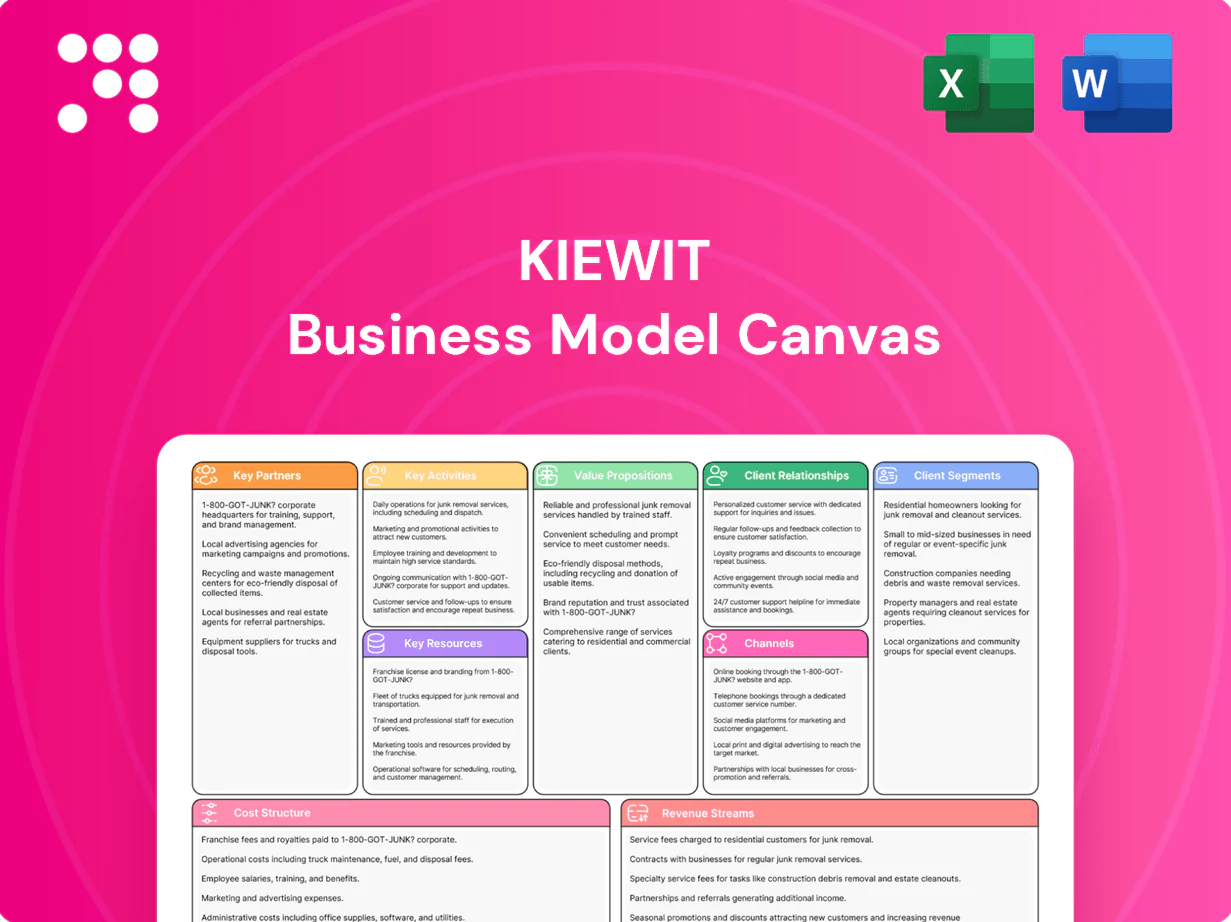
Kiewit Business Model Canvas

Unlock the strategic core with our Business Model Canvas summary—clear, actionable insights
Unlock the strategic core of Kiewit with our Business Model Canvas summary—three to five clear sentences that map value propositions, key partners, and revenue drivers. This concise preview teases actionable insights used by industry leaders. Want the full, editable canvas for benchmarking or presentations? Purchase the complete Word and Excel pack to dive deeper and apply Kiewit’s playbook to your strategy.
Partnerships

Public owners and DOTs
Partnerships with federal, state, and municipal agencies tap the Bipartisan Infrastructure Law's $550 billion in new investments, sustaining a steady pipeline of transportation, water, and civic projects. Early engagement with public owners helps shape scopes, budgets, and delivery models to align with available grant funding. Robust compliance and reporting capabilities sustain trust and secure repeat awards. Multi-year relationships shorten procurement cycles and improve win probability.
Joint ventures and consortium partners
For megaprojects Kiewit forms joint ventures with peers to pool balance sheets, construction capacity, and specialized expertise, and Kiewit remained among ENR’s top 5 contractors in 2024. JV structures spread risk and expand bonding headroom, enabling larger bids and shared performance guarantees. Consortiums unlock access to complex P3 and design‑build opportunities while clear governance and an integrated PMO ensure aligned execution.

OEMs, technology licensors, and EPC vendors
Alliances with turbine, compressor, treatment, and process licensors de-risk design and commissioning by enabling OEM-led integration and joint testing, with typical OEM warranties of 2–5 years supporting performance guarantees. Preferred vendor status historically cuts procurement lead times and can improve pricing by roughly 20–30% in EPC supply chains. Technology partnerships enhance project value across power, oil & gas, and water scopes through shared IP and co-engineering.

Specialty subcontractors and material suppliers
Tier-1 specialty subcontractors supply niche tunneling, electrical and instrumentation expertise, and Kiewit leaned on these partners to deliver complex projects while reporting roughly $12.5 billion revenue in 2023.
Diversified supplier networks and multi-year framework agreements secure capacity during peak demand and blunt price volatility; strict quality and safety prequalification protects project outcomes and schedule certainty.
- Tier-1 subs: tunneling, electrical, instrumentation
- Diversification: mitigates shortages and price swings
- Framework agreements: secure peak capacity
- Prequalification: quality and safety safeguards
Labor unions and workforce training bodies
Union relationships secure skilled craft across regions, with US construction union density ~13% in 2024, enabling rapid mobilization; training partners lift safety, productivity and certification rates, reducing incident rates and rework; apprenticeship pipelines (registered apprentices >600,000 in 2024) support scaling on short notice; stable labor relations cut schedule risk and change-order costs.
- Regional craft access: union density ~13% (2024)
- Training impact: higher certifications, lower incidents
- Apprenticeships: >600,000 registered (2024)
- Labor stability: fewer schedule disruptions
$550B PPP pipeline; unions 13%, >600k
Partnerships with public owners, JVs, OEMs, Tier‑1 subs and unions secure pipeline, capacity and risk sharing; Kiewit reported ~$12.5B revenue (2023). Preferred vendors cut lead times and can improve pricing ~20–30%; OEM warranties 2–5 yrs reduce commissioning risk. Union density ~13% and >600,000 apprentices (2024) support rapid mobilization.
| Metric | Value |
|---|---|
| BIL funding | $550B |
| Kiewit rev (2023) | $12.5B |
| Union density (2024) | 13% |
| Apprentices (2024) | >600,000 |
What is included in the product
 Detailed Word Document
A comprehensive, pre-written business model tailored to Kiewit's strategy, covering customer segments, value propositions, channels, revenue streams and key resources across the 9 BMC blocks with linked competitive analysis and SWOT insights. Designed for presentations, funding discussions and strategic validation to help entrepreneurs and analysts make informed decisions.

 Customizable Excel Spreadsheet
High-level view of Kiewit's project-driven business model with editable cells to map contracts, supply chain, subcontractor relationships, and risk allocation for heavy civil construction.
Activities

Design-build and EPC delivery
Integrated engineering, procurement and construction compress schedules and reduce interfaces, with Kiewit leveraging front-end planning to drive constructability and cost certainty across projects; Kiewit reported roughly $12.5 billion revenue in 2024 and employs over 28,000 people to coordinate multi-discipline design and vendor packages. Commissioning completes handover with performance validation, supporting project delivery and reducing post‑handover defects and delays.
Estimating, bidding, and procurement
Rigorous takeoffs, market intelligence and explicit risk pricing underpin competitive bids, with 2024 industry bid win-rates near 25% and estimating variance targets below 2%. Strategic sourcing locked material and equipment savings of roughly 5–7% in 2024 procurement programs. Vendor vetting and prequalified alternates raised on-time delivery to about 95% and improved value engineering outcomes. Bid/no-bid governance enforces margin targets of 7–9% to protect discipline.

Self-perform construction management
In-house Kiewit crews execute earthworks, concrete, structural steel and mechanical scopes, giving direct control that improves safety, productivity and quality. Integrated schedules and field planning reduce rework and delays. Real-time cost tracking aligns with earned value management to monitor performance. ENR 2024 ranks Kiewit #2 among U.S. contractors.

Safety, quality, and risk management
Behavior-based safety programs target zero incidents through frontline observation and corrective coaching; construction accounted for about 20% of U.S. workplace fatalities in 2023 (BLS), underscoring the focus. Rigorous QA/QC enforces codes, specs and test plans; enterprise risk assessments shape contingencies and contract strategy. Insurance, bonding and compliance protect stakeholders and limit project exposure.
- Behavior-based safety: zero incidents target
- QA/QC: codes, specs, test plans
- Risk assessments: contingency & contract strategy
- Insurance & bonding: stakeholder protection
Operations support and maintenance
Operations support and maintenance extend asset life and deepen client relationships through post-construction services, while mine operations and maintenance create steady recurring revenues. Turnarounds, outages, and upgrades keep facilities optimized and reduce unplanned downtime. Continuous performance monitoring drives data-led improvements in efficiency and safety.
- Post-construction client retention
- Recurring O&M revenues
- Scheduled turnarounds and upgrades
- Performance monitoring for CI
Integrated EPC: $12.5B 2024 revenue, 28,000 staff, 7-9% margins
Integrated EPC compresses schedules and drives constructability; 2024 revenue ~$12.5B, 28,000 staff, ENR rank #2. Rigorous estimating and risk pricing yield ~25% bid win-rate, <2% estimating variance, procurement savings 5–7%, vendor on-time 95%, margin targets 7–9%. In-house crews and behavior-based safety aim zero incidents; O&M and turnarounds deliver recurring revenue and performance monitoring.
| Metric | 2024 |
|---|---|
| Revenue | $12.5B |
| Employees | 28,000 |
| ENR Rank | #2 |
| Bid win-rate | ~25% |
| Estimating variance | <2% |
| Procurement savings | 5–7% |
| Vendor on-time | 95% |
| Target margin | 7–9% |
Preview Before You Purchase
Business Model Canvas
The document you're previewing is the exact Kiewit Business Model Canvas you'll receive after purchase. It's not a mockup or sample; the full deliverable matches this preview in structure and content. After buying, you'll download the same file ready to edit and use.

Unlock the strategic core with our Business Model Canvas summary—clear, actionable insights
Unlock the strategic core of Kiewit with our Business Model Canvas summary—three to five clear sentences that map value propositions, key partners, and revenue drivers. This concise preview teases actionable insights used by industry leaders. Want the full, editable canvas for benchmarking or presentations? Purchase the complete Word and Excel pack to dive deeper and apply Kiewit’s playbook to your strategy.
Partnerships
Public owners and DOTs
Partnerships with federal, state, and municipal agencies tap the Bipartisan Infrastructure Law's $550 billion in new investments, sustaining a steady pipeline of transportation, water, and civic projects. Early engagement with public owners helps shape scopes, budgets, and delivery models to align with available grant funding. Robust compliance and reporting capabilities sustain trust and secure repeat awards. Multi-year relationships shorten procurement cycles and improve win probability.
Joint ventures and consortium partners
For megaprojects Kiewit forms joint ventures with peers to pool balance sheets, construction capacity, and specialized expertise, and Kiewit remained among ENR’s top 5 contractors in 2024. JV structures spread risk and expand bonding headroom, enabling larger bids and shared performance guarantees. Consortiums unlock access to complex P3 and design‑build opportunities while clear governance and an integrated PMO ensure aligned execution.
OEMs, technology licensors, and EPC vendors
Alliances with turbine, compressor, treatment, and process licensors de-risk design and commissioning by enabling OEM-led integration and joint testing, with typical OEM warranties of 2–5 years supporting performance guarantees. Preferred vendor status historically cuts procurement lead times and can improve pricing by roughly 20–30% in EPC supply chains. Technology partnerships enhance project value across power, oil & gas, and water scopes through shared IP and co-engineering.
Specialty subcontractors and material suppliers
Tier-1 specialty subcontractors supply niche tunneling, electrical and instrumentation expertise, and Kiewit leaned on these partners to deliver complex projects while reporting roughly $12.5 billion revenue in 2023.
Diversified supplier networks and multi-year framework agreements secure capacity during peak demand and blunt price volatility; strict quality and safety prequalification protects project outcomes and schedule certainty.
- Tier-1 subs: tunneling, electrical, instrumentation
- Diversification: mitigates shortages and price swings
- Framework agreements: secure peak capacity
- Prequalification: quality and safety safeguards
Labor unions and workforce training bodies
Union relationships secure skilled craft across regions, with US construction union density ~13% in 2024, enabling rapid mobilization; training partners lift safety, productivity and certification rates, reducing incident rates and rework; apprenticeship pipelines (registered apprentices >600,000 in 2024) support scaling on short notice; stable labor relations cut schedule risk and change-order costs.
- Regional craft access: union density ~13% (2024)
- Training impact: higher certifications, lower incidents
- Apprenticeships: >600,000 registered (2024)
- Labor stability: fewer schedule disruptions
$550B PPP pipeline; unions 13%, >600k
Partnerships with public owners, JVs, OEMs, Tier‑1 subs and unions secure pipeline, capacity and risk sharing; Kiewit reported ~$12.5B revenue (2023). Preferred vendors cut lead times and can improve pricing ~20–30%; OEM warranties 2–5 yrs reduce commissioning risk. Union density ~13% and >600,000 apprentices (2024) support rapid mobilization.
| Metric | Value |
|---|---|
| BIL funding | $550B |
| Kiewit rev (2023) | $12.5B |
| Union density (2024) | 13% |
| Apprentices (2024) | >600,000 |
What is included in the product
Detailed Word Document
A comprehensive, pre-written business model tailored to Kiewit's strategy, covering customer segments, value propositions, channels, revenue streams and key resources across the 9 BMC blocks with linked competitive analysis and SWOT insights. Designed for presentations, funding discussions and strategic validation to help entrepreneurs and analysts make informed decisions.
Customizable Excel Spreadsheet
High-level view of Kiewit's project-driven business model with editable cells to map contracts, supply chain, subcontractor relationships, and risk allocation for heavy civil construction.
Activities
Design-build and EPC delivery
Integrated engineering, procurement and construction compress schedules and reduce interfaces, with Kiewit leveraging front-end planning to drive constructability and cost certainty across projects; Kiewit reported roughly $12.5 billion revenue in 2024 and employs over 28,000 people to coordinate multi-discipline design and vendor packages. Commissioning completes handover with performance validation, supporting project delivery and reducing post‑handover defects and delays.
Estimating, bidding, and procurement
Rigorous takeoffs, market intelligence and explicit risk pricing underpin competitive bids, with 2024 industry bid win-rates near 25% and estimating variance targets below 2%. Strategic sourcing locked material and equipment savings of roughly 5–7% in 2024 procurement programs. Vendor vetting and prequalified alternates raised on-time delivery to about 95% and improved value engineering outcomes. Bid/no-bid governance enforces margin targets of 7–9% to protect discipline.
Self-perform construction management
In-house Kiewit crews execute earthworks, concrete, structural steel and mechanical scopes, giving direct control that improves safety, productivity and quality. Integrated schedules and field planning reduce rework and delays. Real-time cost tracking aligns with earned value management to monitor performance. ENR 2024 ranks Kiewit #2 among U.S. contractors.
Safety, quality, and risk management
Behavior-based safety programs target zero incidents through frontline observation and corrective coaching; construction accounted for about 20% of U.S. workplace fatalities in 2023 (BLS), underscoring the focus. Rigorous QA/QC enforces codes, specs and test plans; enterprise risk assessments shape contingencies and contract strategy. Insurance, bonding and compliance protect stakeholders and limit project exposure.
- Behavior-based safety: zero incidents target
- QA/QC: codes, specs, test plans
- Risk assessments: contingency & contract strategy
- Insurance & bonding: stakeholder protection
Operations support and maintenance
Operations support and maintenance extend asset life and deepen client relationships through post-construction services, while mine operations and maintenance create steady recurring revenues. Turnarounds, outages, and upgrades keep facilities optimized and reduce unplanned downtime. Continuous performance monitoring drives data-led improvements in efficiency and safety.
- Post-construction client retention
- Recurring O&M revenues
- Scheduled turnarounds and upgrades
- Performance monitoring for CI
Integrated EPC: $12.5B 2024 revenue, 28,000 staff, 7-9% margins
Integrated EPC compresses schedules and drives constructability; 2024 revenue ~$12.5B, 28,000 staff, ENR rank #2. Rigorous estimating and risk pricing yield ~25% bid win-rate, <2% estimating variance, procurement savings 5–7%, vendor on-time 95%, margin targets 7–9%. In-house crews and behavior-based safety aim zero incidents; O&M and turnarounds deliver recurring revenue and performance monitoring.
| Metric | 2024 |
|---|---|
| Revenue | $12.5B |
| Employees | 28,000 |
| ENR Rank | #2 |
| Bid win-rate | ~25% |
| Estimating variance | <2% |
| Procurement savings | 5–7% |
| Vendor on-time | 95% |
| Target margin | 7–9% |
Preview Before You Purchase
Business Model Canvas
The document you're previewing is the exact Kiewit Business Model Canvas you'll receive after purchase. It's not a mockup or sample; the full deliverable matches this preview in structure and content. After buying, you'll download the same file ready to edit and use.
Original: $10.00
-65%$10.00
$3.50Description
Unlock the strategic core with our Business Model Canvas summary—clear, actionable insights
Unlock the strategic core of Kiewit with our Business Model Canvas summary—three to five clear sentences that map value propositions, key partners, and revenue drivers. This concise preview teases actionable insights used by industry leaders. Want the full, editable canvas for benchmarking or presentations? Purchase the complete Word and Excel pack to dive deeper and apply Kiewit’s playbook to your strategy.
Partnerships
Public owners and DOTs
Partnerships with federal, state, and municipal agencies tap the Bipartisan Infrastructure Law's $550 billion in new investments, sustaining a steady pipeline of transportation, water, and civic projects. Early engagement with public owners helps shape scopes, budgets, and delivery models to align with available grant funding. Robust compliance and reporting capabilities sustain trust and secure repeat awards. Multi-year relationships shorten procurement cycles and improve win probability.
Joint ventures and consortium partners
For megaprojects Kiewit forms joint ventures with peers to pool balance sheets, construction capacity, and specialized expertise, and Kiewit remained among ENR’s top 5 contractors in 2024. JV structures spread risk and expand bonding headroom, enabling larger bids and shared performance guarantees. Consortiums unlock access to complex P3 and design‑build opportunities while clear governance and an integrated PMO ensure aligned execution.
OEMs, technology licensors, and EPC vendors
Alliances with turbine, compressor, treatment, and process licensors de-risk design and commissioning by enabling OEM-led integration and joint testing, with typical OEM warranties of 2–5 years supporting performance guarantees. Preferred vendor status historically cuts procurement lead times and can improve pricing by roughly 20–30% in EPC supply chains. Technology partnerships enhance project value across power, oil & gas, and water scopes through shared IP and co-engineering.
Specialty subcontractors and material suppliers
Tier-1 specialty subcontractors supply niche tunneling, electrical and instrumentation expertise, and Kiewit leaned on these partners to deliver complex projects while reporting roughly $12.5 billion revenue in 2023.
Diversified supplier networks and multi-year framework agreements secure capacity during peak demand and blunt price volatility; strict quality and safety prequalification protects project outcomes and schedule certainty.
- Tier-1 subs: tunneling, electrical, instrumentation
- Diversification: mitigates shortages and price swings
- Framework agreements: secure peak capacity
- Prequalification: quality and safety safeguards
Labor unions and workforce training bodies
Union relationships secure skilled craft across regions, with US construction union density ~13% in 2024, enabling rapid mobilization; training partners lift safety, productivity and certification rates, reducing incident rates and rework; apprenticeship pipelines (registered apprentices >600,000 in 2024) support scaling on short notice; stable labor relations cut schedule risk and change-order costs.
- Regional craft access: union density ~13% (2024)
- Training impact: higher certifications, lower incidents
- Apprenticeships: >600,000 registered (2024)
- Labor stability: fewer schedule disruptions
$550B PPP pipeline; unions 13%, >600k
Partnerships with public owners, JVs, OEMs, Tier‑1 subs and unions secure pipeline, capacity and risk sharing; Kiewit reported ~$12.5B revenue (2023). Preferred vendors cut lead times and can improve pricing ~20–30%; OEM warranties 2–5 yrs reduce commissioning risk. Union density ~13% and >600,000 apprentices (2024) support rapid mobilization.
| Metric | Value |
|---|---|
| BIL funding | $550B |
| Kiewit rev (2023) | $12.5B |
| Union density (2024) | 13% |
| Apprentices (2024) | >600,000 |
What is included in the product
Detailed Word Document
A comprehensive, pre-written business model tailored to Kiewit's strategy, covering customer segments, value propositions, channels, revenue streams and key resources across the 9 BMC blocks with linked competitive analysis and SWOT insights. Designed for presentations, funding discussions and strategic validation to help entrepreneurs and analysts make informed decisions.
Customizable Excel Spreadsheet
High-level view of Kiewit's project-driven business model with editable cells to map contracts, supply chain, subcontractor relationships, and risk allocation for heavy civil construction.
Activities
Design-build and EPC delivery
Integrated engineering, procurement and construction compress schedules and reduce interfaces, with Kiewit leveraging front-end planning to drive constructability and cost certainty across projects; Kiewit reported roughly $12.5 billion revenue in 2024 and employs over 28,000 people to coordinate multi-discipline design and vendor packages. Commissioning completes handover with performance validation, supporting project delivery and reducing post‑handover defects and delays.
Estimating, bidding, and procurement
Rigorous takeoffs, market intelligence and explicit risk pricing underpin competitive bids, with 2024 industry bid win-rates near 25% and estimating variance targets below 2%. Strategic sourcing locked material and equipment savings of roughly 5–7% in 2024 procurement programs. Vendor vetting and prequalified alternates raised on-time delivery to about 95% and improved value engineering outcomes. Bid/no-bid governance enforces margin targets of 7–9% to protect discipline.
Self-perform construction management
In-house Kiewit crews execute earthworks, concrete, structural steel and mechanical scopes, giving direct control that improves safety, productivity and quality. Integrated schedules and field planning reduce rework and delays. Real-time cost tracking aligns with earned value management to monitor performance. ENR 2024 ranks Kiewit #2 among U.S. contractors.
Safety, quality, and risk management
Behavior-based safety programs target zero incidents through frontline observation and corrective coaching; construction accounted for about 20% of U.S. workplace fatalities in 2023 (BLS), underscoring the focus. Rigorous QA/QC enforces codes, specs and test plans; enterprise risk assessments shape contingencies and contract strategy. Insurance, bonding and compliance protect stakeholders and limit project exposure.
- Behavior-based safety: zero incidents target
- QA/QC: codes, specs, test plans
- Risk assessments: contingency & contract strategy
- Insurance & bonding: stakeholder protection
Operations support and maintenance
Operations support and maintenance extend asset life and deepen client relationships through post-construction services, while mine operations and maintenance create steady recurring revenues. Turnarounds, outages, and upgrades keep facilities optimized and reduce unplanned downtime. Continuous performance monitoring drives data-led improvements in efficiency and safety.
- Post-construction client retention
- Recurring O&M revenues
- Scheduled turnarounds and upgrades
- Performance monitoring for CI
Integrated EPC: $12.5B 2024 revenue, 28,000 staff, 7-9% margins
Integrated EPC compresses schedules and drives constructability; 2024 revenue ~$12.5B, 28,000 staff, ENR rank #2. Rigorous estimating and risk pricing yield ~25% bid win-rate, <2% estimating variance, procurement savings 5–7%, vendor on-time 95%, margin targets 7–9%. In-house crews and behavior-based safety aim zero incidents; O&M and turnarounds deliver recurring revenue and performance monitoring.
| Metric | 2024 |
|---|---|
| Revenue | $12.5B |
| Employees | 28,000 |
| ENR Rank | #2 |
| Bid win-rate | ~25% |
| Estimating variance | <2% |
| Procurement savings | 5–7% |
| Vendor on-time | 95% |
| Target margin | 7–9% |
Preview Before You Purchase
Business Model Canvas
The document you're previewing is the exact Kiewit Business Model Canvas you'll receive after purchase. It's not a mockup or sample; the full deliverable matches this preview in structure and content. After buying, you'll download the same file ready to edit and use.











