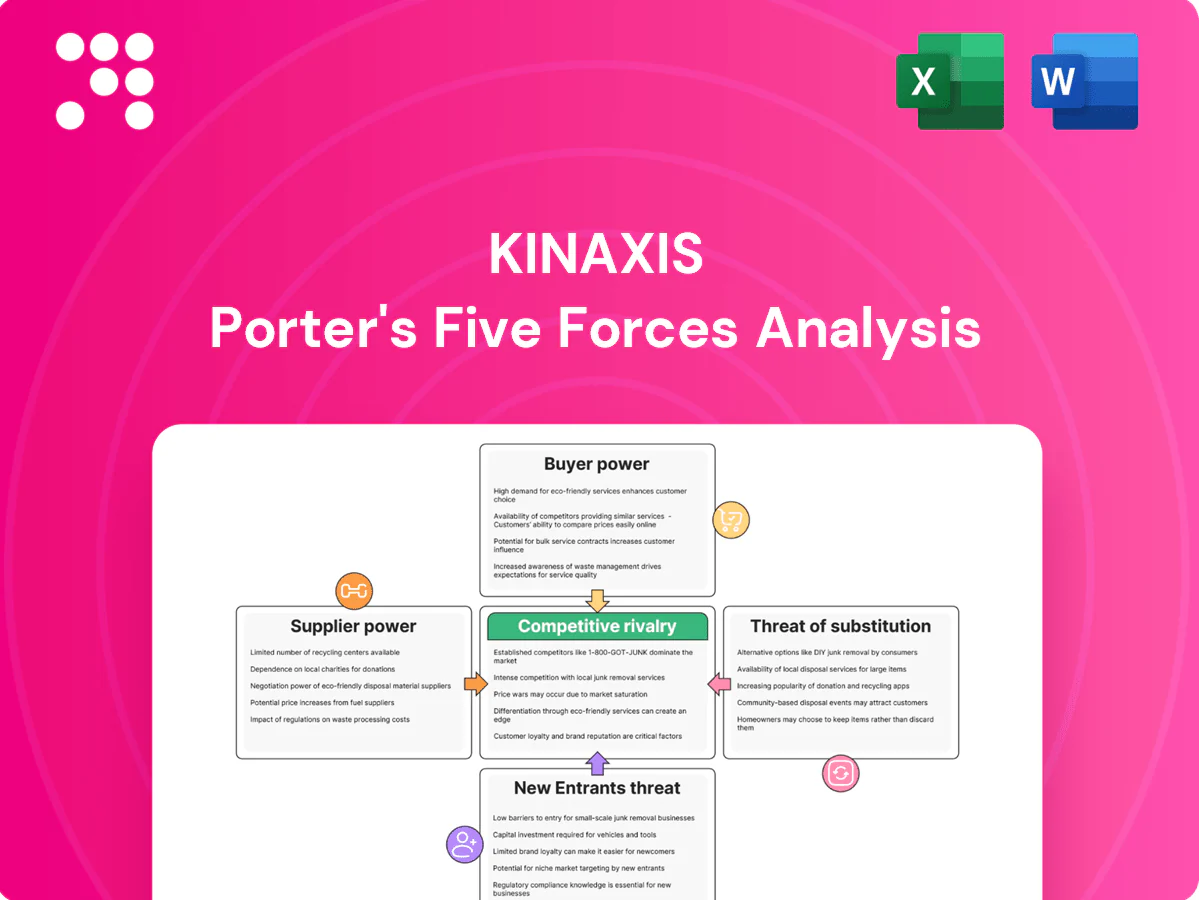
Kinaxis Porter's Five Forces Analysis

From Overview to Strategy Blueprint
Kinaxis faces intense competitive rivalry and shifting buyer expectations, with supplier concentration and technology-driven substitutes shaping margins. Emerging entrants and platform dynamics pose asymmetric threats that demand strategic agility. This snapshot highlights key pressures—unlock the full Porter's Five Forces Analysis to get force-by-force ratings, visuals, and actionable strategy for Kinaxis.
Suppliers Bargaining Power

Dependence on hyperscale clouds
Kinaxis hosts RapidResponse on hyperscalers such as AWS (≈33% market share in 2024), Azure (≈22%) and GCP (≈11%), concentrating supplier power. This concentration gives providers leverage over pricing and contractual terms, while multi-cloud deployments and long-term reserved contracts can mitigate risk. Sudden increases in egress fees or shifts in reserved instance pricing could compress Kinaxis margins.
Specialized talent and IP inputs
Scarcity of AI/ML, optimization and supply‑chain domain engineers elevates supplier power for Kinaxis, with Glassdoor reporting a 2024 median US ML engineer pay around 160,000 USD and tech wage inflation near mid‑teens percent in recent years, pressuring gross margins through higher compensation and retention costs. Remote work enlarges the talent pool but intensifies global competition and bidding, while strategic university partnerships and in‑house training pipelines can partially mitigate dependency on costly external hires.

Third-party data and connectors
Access to ERP, PLM and logistics data via APIs/connectors to SAP, Oracle and Microsoft is critical for Kinaxis; SAP reported over 440,000 customers in 2024, underscoring major data sources. Platform owner gatekeeping and API pricing shifts create switching costs and dependency, raising integration risk. Certification and ISV programs add compliance overhead and cost. Co-marketing agreements can offset these risks with go-to-market benefits.

Open-source and tooling ecosystems
Reliance on open-source databases, orchestration, and analytics frameworks exposes Kinaxis to community-driven change risk; in 2024 about 60% of enterprise analytics stacks incorporate open-source components, amplifying exposure. License shifts (SSPL-style) have historically altered cost and compliance; vendor-backed distributions add support but increase lock-in. Proactive governance and contribution strategies help maintain control.
- Open-source exposure: ~60% of stacks (2024)
- License risk: SSPL-style changes affect TCO/compliance
- Vendor distros: support vs lock-in trade-off
- Mitigation: governance, contributor programs
Security and compliance vendors
SaaS security, identity, and compliance providers directly affect Kinaxis operational resilience and audit readiness; FedRAMP reported over 900 authorizations in 2024, and SOC/ISO recertification cycles can raise vendor costs and implementation spend. Price escalations and vendor consolidation—top five security vendors capture roughly half of enterprise security budgets—can strengthen supplier bargaining. Kinaxis can mitigate by diversifying suppliers and building selective in-house capabilities to rebalance power.
- FedRAMP: >900 authorizations (2024)
- Top-5 vendor share: ~50% of enterprise security spend
- Costs rise with SOC/ISO recertifications and FedRAMP updates
- Mitigation: supplier diversification + in-house controls
Hyperscaler, talent and platform pressure on supply-chain SaaS — AWS 33% Azure 22% GCP 11%
Hyperscaler concentration (AWS≈33%, Azure≈22%, GCP≈11% in 2024) and rising cloud fees increase supplier leverage over Kinaxis. Talent scarcity (median US ML pay ≈160,000 USD in 2024) and ERP/platform gatekeeping (SAP ≈440,000 customers) elevate costs and switching friction. Open-source exposure (~60% of analytics stacks) and security vendor consolidation (top‑5 ≈50% spend; FedRAMP >900 auths) add compliance and price risk.
| Metric | 2024 |
|---|---|
| Hyperscalers | AWS33%/Azure22%/GCP11% |
| ML median pay (US) | ≈160,000 USD |
| SAP customers | ≈440,000 |
| Open-source usage | ≈60% |
| Top‑5 security share | ≈50% |
| FedRAMP | >900 auths |
What is included in the product
 Detailed Word Document
Comprehensive Porter’s Five Forces assessment tailored to Kinaxis that uncovers competitive drivers, supplier and buyer power, substitutes, and entry barriers, highlighting disruptive threats and strategic levers to protect market share.

 Customizable Excel Spreadsheet
Clear one-sheet Porter's Five Forces for Kinaxis that visualizes competitive pressure with an interactive spider chart, lets you customize force levels and notes for changing market conditions, and plugs seamlessly into decks or Excel dashboards—no macros or finance expertise required.
Customers Bargaining Power

Large enterprise concentration
Kinaxis serves global manufacturers with sizable, multi-year contracts and had over 400 customers as of 2024, concentrating revenue in large enterprises that can heavily negotiate pricing, bespoke customizations, and SLAs. Big clients’ bargaining power raises demand for discounts during competitive bake-offs and forces enhanced referenceability, while multi-year deals increase switching costs yet concentrate material revenue risk.
High switching costs, high expectations
Deep integration across S&OP, demand and supply planning creates high replacement friction, while Kinaxis reported 2024 revenue of CAD 273.3 million and sustains >90% customer retention, so buyers still expect measurable ROI, resilience and rapid time-to-value; if outcomes lag, clients can demand concessions or expanded services, but strong onboarding and value-realization programs materially reduce customer leverage.

Procurement sophistication
Enterprise buyers run rigorous RFPs and proofs-of-concept across vendors, benchmarking total cost of ownership, interoperability, and roadmap alignment to drive procurement decisions. This transparency strengthens negotiation leverage on price and contract terms, pressuring margins. Vendors with differentiated features, faster deployment, and clear integration evidence can defend pricing power and win deals despite intense scrutiny.

Alternative options
Presence of credible rivals like SAP, Blue Yonder and Anaplan and adjacent planning platforms gives buyers real walk-away power; hybrid best-of-breed plus ERP suite approaches expand choice and reduce switching cost. Buyers routinely stage deployments to retain leverage, forcing vendors to prove ROI incrementally. Kinaxis must demonstrate superior concurrency and scenario-planning performance to prevail.
- Rivals: SAP, Blue Yonder, Anaplan
- Strategy: hybrid best-of-breed + ERP
- Buyer tactic: staged deployments
- Kinaxis edge needed: concurrency & scenario planning
Outcome-based expectations
Customers now demand outcome-based terms: 99.9%+ uptime, low latency and rapid incident response, with penalty-backed SLAs and formal governance cadences shifting negotiation power to buyers. Transparent KPI tracking and co-innovation reduce perceived implementation risk, while proactive customer success teams lower churn and blunt price pressure.
- SLAs: 99.9%+ uptime
- KPI tracking: reduces adoption risk
- Customer success: lowers churn, limits discounting
S&OP platform: 400+ clients, CAD 273.3m, >90% retention; enterprises hold leverage
Kinaxis serves 400+ customers (2024) with CAD 273.3m revenue and >90% retention, concentrating negotiation power in large enterprises that demand discounts, SLAs and customizations. Deep S&OP integration raises switching costs but strong onboarding reduces leverage. Competing vendors (SAP, Blue Yonder, Anaplan) give buyers walk-away power.
| Metric | Value (2024) |
|---|---|
| Customers | 400+ |
| Revenue | CAD 273.3m |
| Retention | >90% |
| Key rivals | SAP, Blue Yonder, Anaplan |
Full Version Awaits
Kinaxis Porter's Five Forces Analysis
This preview displays the exact Kinaxis Porter's Five Forces analysis you'll receive after purchase—fully written, formatted, and ready to download. It is not a sample or mockup; the file available for instant access upon payment is identical to this preview. Use it immediately for strategic or investment decisions.

From Overview to Strategy Blueprint
Kinaxis faces intense competitive rivalry and shifting buyer expectations, with supplier concentration and technology-driven substitutes shaping margins. Emerging entrants and platform dynamics pose asymmetric threats that demand strategic agility. This snapshot highlights key pressures—unlock the full Porter's Five Forces Analysis to get force-by-force ratings, visuals, and actionable strategy for Kinaxis.
Suppliers Bargaining Power
Dependence on hyperscale clouds
Kinaxis hosts RapidResponse on hyperscalers such as AWS (≈33% market share in 2024), Azure (≈22%) and GCP (≈11%), concentrating supplier power. This concentration gives providers leverage over pricing and contractual terms, while multi-cloud deployments and long-term reserved contracts can mitigate risk. Sudden increases in egress fees or shifts in reserved instance pricing could compress Kinaxis margins.
Specialized talent and IP inputs
Scarcity of AI/ML, optimization and supply‑chain domain engineers elevates supplier power for Kinaxis, with Glassdoor reporting a 2024 median US ML engineer pay around 160,000 USD and tech wage inflation near mid‑teens percent in recent years, pressuring gross margins through higher compensation and retention costs. Remote work enlarges the talent pool but intensifies global competition and bidding, while strategic university partnerships and in‑house training pipelines can partially mitigate dependency on costly external hires.
Third-party data and connectors
Access to ERP, PLM and logistics data via APIs/connectors to SAP, Oracle and Microsoft is critical for Kinaxis; SAP reported over 440,000 customers in 2024, underscoring major data sources. Platform owner gatekeeping and API pricing shifts create switching costs and dependency, raising integration risk. Certification and ISV programs add compliance overhead and cost. Co-marketing agreements can offset these risks with go-to-market benefits.
Open-source and tooling ecosystems
Reliance on open-source databases, orchestration, and analytics frameworks exposes Kinaxis to community-driven change risk; in 2024 about 60% of enterprise analytics stacks incorporate open-source components, amplifying exposure. License shifts (SSPL-style) have historically altered cost and compliance; vendor-backed distributions add support but increase lock-in. Proactive governance and contribution strategies help maintain control.
- Open-source exposure: ~60% of stacks (2024)
- License risk: SSPL-style changes affect TCO/compliance
- Vendor distros: support vs lock-in trade-off
- Mitigation: governance, contributor programs
Security and compliance vendors
SaaS security, identity, and compliance providers directly affect Kinaxis operational resilience and audit readiness; FedRAMP reported over 900 authorizations in 2024, and SOC/ISO recertification cycles can raise vendor costs and implementation spend. Price escalations and vendor consolidation—top five security vendors capture roughly half of enterprise security budgets—can strengthen supplier bargaining. Kinaxis can mitigate by diversifying suppliers and building selective in-house capabilities to rebalance power.
- FedRAMP: >900 authorizations (2024)
- Top-5 vendor share: ~50% of enterprise security spend
- Costs rise with SOC/ISO recertifications and FedRAMP updates
- Mitigation: supplier diversification + in-house controls
Hyperscaler, talent and platform pressure on supply-chain SaaS — AWS 33% Azure 22% GCP 11%
Hyperscaler concentration (AWS≈33%, Azure≈22%, GCP≈11% in 2024) and rising cloud fees increase supplier leverage over Kinaxis. Talent scarcity (median US ML pay ≈160,000 USD in 2024) and ERP/platform gatekeeping (SAP ≈440,000 customers) elevate costs and switching friction. Open-source exposure (~60% of analytics stacks) and security vendor consolidation (top‑5 ≈50% spend; FedRAMP >900 auths) add compliance and price risk.
| Metric | 2024 |
|---|---|
| Hyperscalers | AWS33%/Azure22%/GCP11% |
| ML median pay (US) | ≈160,000 USD |
| SAP customers | ≈440,000 |
| Open-source usage | ≈60% |
| Top‑5 security share | ≈50% |
| FedRAMP | >900 auths |
What is included in the product
Detailed Word Document
Comprehensive Porter’s Five Forces assessment tailored to Kinaxis that uncovers competitive drivers, supplier and buyer power, substitutes, and entry barriers, highlighting disruptive threats and strategic levers to protect market share.
Customizable Excel Spreadsheet
Clear one-sheet Porter's Five Forces for Kinaxis that visualizes competitive pressure with an interactive spider chart, lets you customize force levels and notes for changing market conditions, and plugs seamlessly into decks or Excel dashboards—no macros or finance expertise required.
Customers Bargaining Power
Large enterprise concentration
Kinaxis serves global manufacturers with sizable, multi-year contracts and had over 400 customers as of 2024, concentrating revenue in large enterprises that can heavily negotiate pricing, bespoke customizations, and SLAs. Big clients’ bargaining power raises demand for discounts during competitive bake-offs and forces enhanced referenceability, while multi-year deals increase switching costs yet concentrate material revenue risk.
High switching costs, high expectations
Deep integration across S&OP, demand and supply planning creates high replacement friction, while Kinaxis reported 2024 revenue of CAD 273.3 million and sustains >90% customer retention, so buyers still expect measurable ROI, resilience and rapid time-to-value; if outcomes lag, clients can demand concessions or expanded services, but strong onboarding and value-realization programs materially reduce customer leverage.
Procurement sophistication
Enterprise buyers run rigorous RFPs and proofs-of-concept across vendors, benchmarking total cost of ownership, interoperability, and roadmap alignment to drive procurement decisions. This transparency strengthens negotiation leverage on price and contract terms, pressuring margins. Vendors with differentiated features, faster deployment, and clear integration evidence can defend pricing power and win deals despite intense scrutiny.
Alternative options
Presence of credible rivals like SAP, Blue Yonder and Anaplan and adjacent planning platforms gives buyers real walk-away power; hybrid best-of-breed plus ERP suite approaches expand choice and reduce switching cost. Buyers routinely stage deployments to retain leverage, forcing vendors to prove ROI incrementally. Kinaxis must demonstrate superior concurrency and scenario-planning performance to prevail.
- Rivals: SAP, Blue Yonder, Anaplan
- Strategy: hybrid best-of-breed + ERP
- Buyer tactic: staged deployments
- Kinaxis edge needed: concurrency & scenario planning
Outcome-based expectations
Customers now demand outcome-based terms: 99.9%+ uptime, low latency and rapid incident response, with penalty-backed SLAs and formal governance cadences shifting negotiation power to buyers. Transparent KPI tracking and co-innovation reduce perceived implementation risk, while proactive customer success teams lower churn and blunt price pressure.
- SLAs: 99.9%+ uptime
- KPI tracking: reduces adoption risk
- Customer success: lowers churn, limits discounting
S&OP platform: 400+ clients, CAD 273.3m, >90% retention; enterprises hold leverage
Kinaxis serves 400+ customers (2024) with CAD 273.3m revenue and >90% retention, concentrating negotiation power in large enterprises that demand discounts, SLAs and customizations. Deep S&OP integration raises switching costs but strong onboarding reduces leverage. Competing vendors (SAP, Blue Yonder, Anaplan) give buyers walk-away power.
| Metric | Value (2024) |
|---|---|
| Customers | 400+ |
| Revenue | CAD 273.3m |
| Retention | >90% |
| Key rivals | SAP, Blue Yonder, Anaplan |
Full Version Awaits
Kinaxis Porter's Five Forces Analysis
This preview displays the exact Kinaxis Porter's Five Forces analysis you'll receive after purchase—fully written, formatted, and ready to download. It is not a sample or mockup; the file available for instant access upon payment is identical to this preview. Use it immediately for strategic or investment decisions.
Description
From Overview to Strategy Blueprint
Kinaxis faces intense competitive rivalry and shifting buyer expectations, with supplier concentration and technology-driven substitutes shaping margins. Emerging entrants and platform dynamics pose asymmetric threats that demand strategic agility. This snapshot highlights key pressures—unlock the full Porter's Five Forces Analysis to get force-by-force ratings, visuals, and actionable strategy for Kinaxis.
Suppliers Bargaining Power
Dependence on hyperscale clouds
Kinaxis hosts RapidResponse on hyperscalers such as AWS (≈33% market share in 2024), Azure (≈22%) and GCP (≈11%), concentrating supplier power. This concentration gives providers leverage over pricing and contractual terms, while multi-cloud deployments and long-term reserved contracts can mitigate risk. Sudden increases in egress fees or shifts in reserved instance pricing could compress Kinaxis margins.
Specialized talent and IP inputs
Scarcity of AI/ML, optimization and supply‑chain domain engineers elevates supplier power for Kinaxis, with Glassdoor reporting a 2024 median US ML engineer pay around 160,000 USD and tech wage inflation near mid‑teens percent in recent years, pressuring gross margins through higher compensation and retention costs. Remote work enlarges the talent pool but intensifies global competition and bidding, while strategic university partnerships and in‑house training pipelines can partially mitigate dependency on costly external hires.
Third-party data and connectors
Access to ERP, PLM and logistics data via APIs/connectors to SAP, Oracle and Microsoft is critical for Kinaxis; SAP reported over 440,000 customers in 2024, underscoring major data sources. Platform owner gatekeeping and API pricing shifts create switching costs and dependency, raising integration risk. Certification and ISV programs add compliance overhead and cost. Co-marketing agreements can offset these risks with go-to-market benefits.
Open-source and tooling ecosystems
Reliance on open-source databases, orchestration, and analytics frameworks exposes Kinaxis to community-driven change risk; in 2024 about 60% of enterprise analytics stacks incorporate open-source components, amplifying exposure. License shifts (SSPL-style) have historically altered cost and compliance; vendor-backed distributions add support but increase lock-in. Proactive governance and contribution strategies help maintain control.
- Open-source exposure: ~60% of stacks (2024)
- License risk: SSPL-style changes affect TCO/compliance
- Vendor distros: support vs lock-in trade-off
- Mitigation: governance, contributor programs
Security and compliance vendors
SaaS security, identity, and compliance providers directly affect Kinaxis operational resilience and audit readiness; FedRAMP reported over 900 authorizations in 2024, and SOC/ISO recertification cycles can raise vendor costs and implementation spend. Price escalations and vendor consolidation—top five security vendors capture roughly half of enterprise security budgets—can strengthen supplier bargaining. Kinaxis can mitigate by diversifying suppliers and building selective in-house capabilities to rebalance power.
- FedRAMP: >900 authorizations (2024)
- Top-5 vendor share: ~50% of enterprise security spend
- Costs rise with SOC/ISO recertifications and FedRAMP updates
- Mitigation: supplier diversification + in-house controls
Hyperscaler, talent and platform pressure on supply-chain SaaS — AWS 33% Azure 22% GCP 11%
Hyperscaler concentration (AWS≈33%, Azure≈22%, GCP≈11% in 2024) and rising cloud fees increase supplier leverage over Kinaxis. Talent scarcity (median US ML pay ≈160,000 USD in 2024) and ERP/platform gatekeeping (SAP ≈440,000 customers) elevate costs and switching friction. Open-source exposure (~60% of analytics stacks) and security vendor consolidation (top‑5 ≈50% spend; FedRAMP >900 auths) add compliance and price risk.
| Metric | 2024 |
|---|---|
| Hyperscalers | AWS33%/Azure22%/GCP11% |
| ML median pay (US) | ≈160,000 USD |
| SAP customers | ≈440,000 |
| Open-source usage | ≈60% |
| Top‑5 security share | ≈50% |
| FedRAMP | >900 auths |
What is included in the product
Detailed Word Document
Comprehensive Porter’s Five Forces assessment tailored to Kinaxis that uncovers competitive drivers, supplier and buyer power, substitutes, and entry barriers, highlighting disruptive threats and strategic levers to protect market share.
Customizable Excel Spreadsheet
Clear one-sheet Porter's Five Forces for Kinaxis that visualizes competitive pressure with an interactive spider chart, lets you customize force levels and notes for changing market conditions, and plugs seamlessly into decks or Excel dashboards—no macros or finance expertise required.
Customers Bargaining Power
Large enterprise concentration
Kinaxis serves global manufacturers with sizable, multi-year contracts and had over 400 customers as of 2024, concentrating revenue in large enterprises that can heavily negotiate pricing, bespoke customizations, and SLAs. Big clients’ bargaining power raises demand for discounts during competitive bake-offs and forces enhanced referenceability, while multi-year deals increase switching costs yet concentrate material revenue risk.
High switching costs, high expectations
Deep integration across S&OP, demand and supply planning creates high replacement friction, while Kinaxis reported 2024 revenue of CAD 273.3 million and sustains >90% customer retention, so buyers still expect measurable ROI, resilience and rapid time-to-value; if outcomes lag, clients can demand concessions or expanded services, but strong onboarding and value-realization programs materially reduce customer leverage.
Procurement sophistication
Enterprise buyers run rigorous RFPs and proofs-of-concept across vendors, benchmarking total cost of ownership, interoperability, and roadmap alignment to drive procurement decisions. This transparency strengthens negotiation leverage on price and contract terms, pressuring margins. Vendors with differentiated features, faster deployment, and clear integration evidence can defend pricing power and win deals despite intense scrutiny.
Alternative options
Presence of credible rivals like SAP, Blue Yonder and Anaplan and adjacent planning platforms gives buyers real walk-away power; hybrid best-of-breed plus ERP suite approaches expand choice and reduce switching cost. Buyers routinely stage deployments to retain leverage, forcing vendors to prove ROI incrementally. Kinaxis must demonstrate superior concurrency and scenario-planning performance to prevail.
- Rivals: SAP, Blue Yonder, Anaplan
- Strategy: hybrid best-of-breed + ERP
- Buyer tactic: staged deployments
- Kinaxis edge needed: concurrency & scenario planning
Outcome-based expectations
Customers now demand outcome-based terms: 99.9%+ uptime, low latency and rapid incident response, with penalty-backed SLAs and formal governance cadences shifting negotiation power to buyers. Transparent KPI tracking and co-innovation reduce perceived implementation risk, while proactive customer success teams lower churn and blunt price pressure.
- SLAs: 99.9%+ uptime
- KPI tracking: reduces adoption risk
- Customer success: lowers churn, limits discounting
S&OP platform: 400+ clients, CAD 273.3m, >90% retention; enterprises hold leverage
Kinaxis serves 400+ customers (2024) with CAD 273.3m revenue and >90% retention, concentrating negotiation power in large enterprises that demand discounts, SLAs and customizations. Deep S&OP integration raises switching costs but strong onboarding reduces leverage. Competing vendors (SAP, Blue Yonder, Anaplan) give buyers walk-away power.
| Metric | Value (2024) |
|---|---|
| Customers | 400+ |
| Revenue | CAD 273.3m |
| Retention | >90% |
| Key rivals | SAP, Blue Yonder, Anaplan |
Full Version Awaits
Kinaxis Porter's Five Forces Analysis
This preview displays the exact Kinaxis Porter's Five Forces analysis you'll receive after purchase—fully written, formatted, and ready to download. It is not a sample or mockup; the file available for instant access upon payment is identical to this preview. Use it immediately for strategic or investment decisions.











