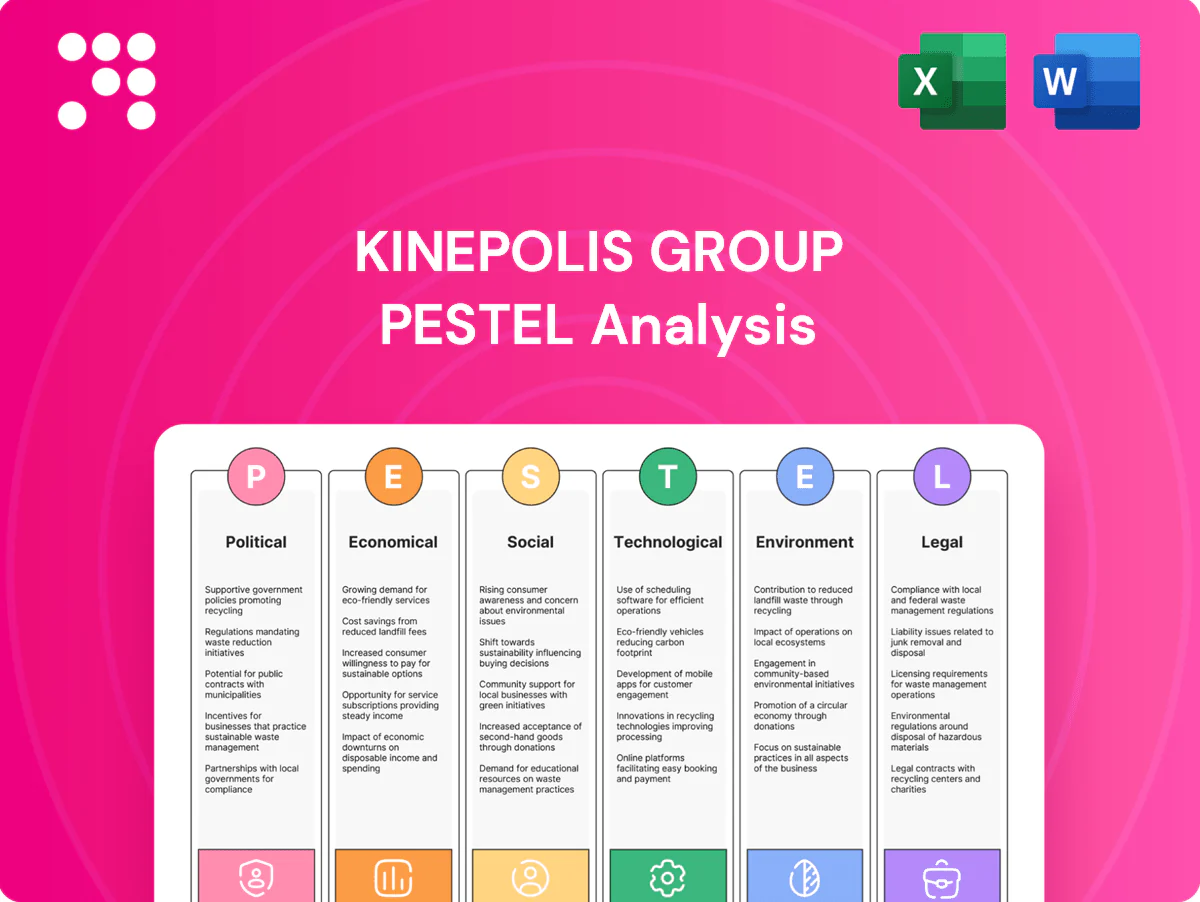
Kinepolis Group PESTLE Analysis

Skip the Research. Get the Strategy.
Unlock strategic clarity with our PESTLE Analysis of Kinepolis Group—examining political, economic, social, technological, legal and environmental forces shaping its cinema and entertainment operations. Ideal for investors and strategists, this concise briefing highlights risks and growth levers. Purchase the full report for detailed, actionable insights and editable charts.
Political factors

Cultural policy and quotas
EU Audiovisual Media Services Directive (2018) lets member states set cultural quotas, which can constrain Kinepolis Groups programming flexibility across its presence in eight countries. Compliance may require sourcing regional films and allocating screen time, affecting occupancy and revenue mix, especially in markets where local films capture significant share. Engagement with national film institutes can unlock subsidies and marketing support. Strategic curation mitigates yield dilution.
Film funding and subsidies
Public grants and tax incentives shape release slates and footfall; for example UK Film Tax Relief offers a payable credit up to 25% of qualifying UK expenditure, boosting local production pipelines that feed cinemas.
Kinepolis benefits indirectly through stronger local content and event partnerships, increasing programming depth and occupancy rates without direct subsidy receipts.
Policy shifts or budget cuts (eg changes to MEDIA/Creative Europe funding, ~€1.5bn for 2021–2027) could reduce content supply and marketing support, while active ties to cultural bodies help stabilize those flows.

Municipal permits and zoning
New Kinepolis sites depend on local approvals, zoning, parking norms and community acceptance across its over 100 sites in about 10 countries; permitting determines project feasibility. Permitting delays, often 6–18 months in Europe, raise carrying costs and defer projected cash flows. Early stakeholder engagement and adaptive designs accelerate approvals. Political turnover can reset priorities mid-project, triggering redesigns or new conditions.

Tax and indirect levies
VAT and sales taxes (EU average VAT 21.4% in 2023) directly shape Kinepolis pricing power and margins on tickets and concessions; lower cultural rates in some markets boost demand while standard rates compress margins. Sugar/excise levies such as the UK soft drinks levy (18p/24p per litre) can cut F&B profitability. Stable tax regimes support budgeting; sudden rate changes force rapid re-pricing and add compliance costs across borders.
- VAT impact on ticket pricing and margins
- Sugar/excise levies reduce F&B margins (UK SDIL: 18p/24p)
- Stable regimes aid planning
- Cross-border compliance increases admin complexity
Public health and safety policy
Government health mandates can force reduced capacity or shorter hours during crises, directly limiting box-office income and concession sales.
Investment in ventilation standards and trained crowd management teams preserves operational continuity and helps secure exemptions through documented safety compliance.
Clear, timely communication with authorities and contingency protocols for ticket refunds and alternative screenings limit revenue shocks and reputational damage.
- capacity-restrictions: immediate revenue impact
- ventilation-compliance: continuity enabler
- authority-engagement: exemption leverage
- contingency-plans: shock absorption
EU AVMS quotas, VAT 21.4%, UK relief 25%, SDIL 18p/24p/l, 6–18m permits
EU AVMS cultural quotas limit programming flexibility across Kinepolis' 10 markets and may shift mix toward local films. VAT average 21.4% (EU 2023) and UK Film Tax Relief up to 25% shape pricing and supply; SDIL (18p/24p/l) squeezes F&B margins. Permitting delays (6–18 months) and MEDIA/Creative Europe budget ~€1.5bn (2021–27) drive capex timing risk.
| Risk | Impact | Data |
|---|---|---|
| Regulatory quotas | Programming limits | EU AVMS 2018 |
| Taxation | Margins/pricing | VAT 21.4% (2023) |
| Permitting | Capex delay | 6–18 months |
What is included in the product
 Detailed Word Document
Explores how Political, Economic, Social, Technological, Environmental and Legal forces specifically impact Kinepolis Group—backed by current market and regulatory trends—to help executives, investors and strategists identify risks, opportunities and actionable, forward-looking responses for planning and financing.

 Customizable Excel Spreadsheet
A compact, visually segmented PESTLE summary for Kinepolis Group that streamlines stakeholder briefings and planning sessions, supports external risk discussions and market positioning, and can be dropped into presentations or shared across teams with editable notes for region- or business-line specifics.
Economic factors

Discretionary spending cycles
Box office and concessions track household real incomes and consumer confidence; global box office recovered to about $28.2bn in 2023, underscoring demand sensitivity to disposable income shifts. Downturns push patrons toward value bundles and off-peak pricing, increasing the importance of targeted promotions. Premium formats and affluent segments often remain resilient, while dynamic pricing helps protect yield by adjusting fares to demand.
Inflation and input costs
Rising wages, utilities and supplies continue to squeeze Kinepolis unit economics, with European wage growth and input inflation remaining elevated post-2022 energy shock. Menu engineering and supplier renegotiation have trimmed F&B COGS by low-single digits, helping margins. Energy-efficiency investments (LEDs, HVAC) reduce volatility after energy prices fell sharply from 2022 peaks. Price elasticity varies by country and format, constraining ticket vs concession pricing.

Exchange rates and footprint
Operations across Europe and North America expose Kinepolis earnings to EUR, CAD and USD fluctuations, impacting reported revenue, film rental costs and capex. FX movements have materially affected quarterly reported growth and margin visibility in recent years. Natural hedges from local debt and local procurement dampen currency swings. A transparent hedging policy and regular FX disclosures reassure investors.

Content slate variability
Quarterly performance at Kinepolis hinges on blockbuster timing and rival releases, with box-office swings amplified across its over 100 cinema sites in 14 countries (2024 footprint). Diversification into event cinema and alternative content reduces seasonality, while strong studio relations secure early windows and premium screens. Marketing spend must flex with slate strength to protect margins and fill premium auditoria.
- Over 100 sites (2024)
- Event/alternative content smooths seasonality
- Studio deals = early windows & premium screens
- Marketing spend flexible by slate strength
Interest rates and financing
Higher interest rates raise lease, capex and refinancing costs for large venues; euro-area policy rates sit around 4.00% (mid-2025), increasing Kinepolis’s cost of capital and extending project hurdle rates and payback periods, slowing expansion; prioritizing high-IRR refurbishments preserves ROIC while maintaining liquidity buffers (cash + undrawn facilities) supports resilience.
- Rate pressure: ECB ~4.00% (mid-2025)
- Higher capex/refi costs
- Longer payback/hurdle rates
- Focus: high-IRR refurbishments
- Maintain liquidity buffers
EU AVMS quotas, VAT 21.4%, UK relief 25%, SDIL 18p/24p/l, 6–18m permits
Box office and concessions track disposable income; global box office ~28.2bn (2023) and demand is income-sensitive. Wage, utilities and input inflation remain elevated post-2022, squeezing unit economics despite small F&B COGS savings. FX and blockbuster timing drive quarter volatility across 100+ sites (2024); ECB policy rate ~4.00% (mid-2025) raises capex/refinancing costs.
| Metric | Value |
|---|---|
| Global box office (2023) | €28.2bn |
| Sites (2024) | 100+ |
| ECB policy rate (mid-2025) | ~4.00% |
Preview the Actual Deliverable
Kinepolis Group PESTLE Analysis
The preview shown here is the exact Kinepolis Group PESTLE Analysis document you’ll receive after purchase—fully formatted and ready to use. This snapshot reflects the final content, layout, and structure with no placeholders or teasers. After payment you’ll instantly download the same professional, ready-to-use file.

Skip the Research. Get the Strategy.
Unlock strategic clarity with our PESTLE Analysis of Kinepolis Group—examining political, economic, social, technological, legal and environmental forces shaping its cinema and entertainment operations. Ideal for investors and strategists, this concise briefing highlights risks and growth levers. Purchase the full report for detailed, actionable insights and editable charts.
Political factors
Cultural policy and quotas
EU Audiovisual Media Services Directive (2018) lets member states set cultural quotas, which can constrain Kinepolis Groups programming flexibility across its presence in eight countries. Compliance may require sourcing regional films and allocating screen time, affecting occupancy and revenue mix, especially in markets where local films capture significant share. Engagement with national film institutes can unlock subsidies and marketing support. Strategic curation mitigates yield dilution.
Film funding and subsidies
Public grants and tax incentives shape release slates and footfall; for example UK Film Tax Relief offers a payable credit up to 25% of qualifying UK expenditure, boosting local production pipelines that feed cinemas.
Kinepolis benefits indirectly through stronger local content and event partnerships, increasing programming depth and occupancy rates without direct subsidy receipts.
Policy shifts or budget cuts (eg changes to MEDIA/Creative Europe funding, ~€1.5bn for 2021–2027) could reduce content supply and marketing support, while active ties to cultural bodies help stabilize those flows.
Municipal permits and zoning
New Kinepolis sites depend on local approvals, zoning, parking norms and community acceptance across its over 100 sites in about 10 countries; permitting determines project feasibility. Permitting delays, often 6–18 months in Europe, raise carrying costs and defer projected cash flows. Early stakeholder engagement and adaptive designs accelerate approvals. Political turnover can reset priorities mid-project, triggering redesigns or new conditions.
Tax and indirect levies
VAT and sales taxes (EU average VAT 21.4% in 2023) directly shape Kinepolis pricing power and margins on tickets and concessions; lower cultural rates in some markets boost demand while standard rates compress margins. Sugar/excise levies such as the UK soft drinks levy (18p/24p per litre) can cut F&B profitability. Stable tax regimes support budgeting; sudden rate changes force rapid re-pricing and add compliance costs across borders.
- VAT impact on ticket pricing and margins
- Sugar/excise levies reduce F&B margins (UK SDIL: 18p/24p)
- Stable regimes aid planning
- Cross-border compliance increases admin complexity
Public health and safety policy
Government health mandates can force reduced capacity or shorter hours during crises, directly limiting box-office income and concession sales.
Investment in ventilation standards and trained crowd management teams preserves operational continuity and helps secure exemptions through documented safety compliance.
Clear, timely communication with authorities and contingency protocols for ticket refunds and alternative screenings limit revenue shocks and reputational damage.
- capacity-restrictions: immediate revenue impact
- ventilation-compliance: continuity enabler
- authority-engagement: exemption leverage
- contingency-plans: shock absorption
EU AVMS quotas, VAT 21.4%, UK relief 25%, SDIL 18p/24p/l, 6–18m permits
EU AVMS cultural quotas limit programming flexibility across Kinepolis' 10 markets and may shift mix toward local films. VAT average 21.4% (EU 2023) and UK Film Tax Relief up to 25% shape pricing and supply; SDIL (18p/24p/l) squeezes F&B margins. Permitting delays (6–18 months) and MEDIA/Creative Europe budget ~€1.5bn (2021–27) drive capex timing risk.
| Risk | Impact | Data |
|---|---|---|
| Regulatory quotas | Programming limits | EU AVMS 2018 |
| Taxation | Margins/pricing | VAT 21.4% (2023) |
| Permitting | Capex delay | 6–18 months |
What is included in the product
Detailed Word Document
Explores how Political, Economic, Social, Technological, Environmental and Legal forces specifically impact Kinepolis Group—backed by current market and regulatory trends—to help executives, investors and strategists identify risks, opportunities and actionable, forward-looking responses for planning and financing.
Customizable Excel Spreadsheet
A compact, visually segmented PESTLE summary for Kinepolis Group that streamlines stakeholder briefings and planning sessions, supports external risk discussions and market positioning, and can be dropped into presentations or shared across teams with editable notes for region- or business-line specifics.
Economic factors
Discretionary spending cycles
Box office and concessions track household real incomes and consumer confidence; global box office recovered to about $28.2bn in 2023, underscoring demand sensitivity to disposable income shifts. Downturns push patrons toward value bundles and off-peak pricing, increasing the importance of targeted promotions. Premium formats and affluent segments often remain resilient, while dynamic pricing helps protect yield by adjusting fares to demand.
Inflation and input costs
Rising wages, utilities and supplies continue to squeeze Kinepolis unit economics, with European wage growth and input inflation remaining elevated post-2022 energy shock. Menu engineering and supplier renegotiation have trimmed F&B COGS by low-single digits, helping margins. Energy-efficiency investments (LEDs, HVAC) reduce volatility after energy prices fell sharply from 2022 peaks. Price elasticity varies by country and format, constraining ticket vs concession pricing.
Exchange rates and footprint
Operations across Europe and North America expose Kinepolis earnings to EUR, CAD and USD fluctuations, impacting reported revenue, film rental costs and capex. FX movements have materially affected quarterly reported growth and margin visibility in recent years. Natural hedges from local debt and local procurement dampen currency swings. A transparent hedging policy and regular FX disclosures reassure investors.
Content slate variability
Quarterly performance at Kinepolis hinges on blockbuster timing and rival releases, with box-office swings amplified across its over 100 cinema sites in 14 countries (2024 footprint). Diversification into event cinema and alternative content reduces seasonality, while strong studio relations secure early windows and premium screens. Marketing spend must flex with slate strength to protect margins and fill premium auditoria.
- Over 100 sites (2024)
- Event/alternative content smooths seasonality
- Studio deals = early windows & premium screens
- Marketing spend flexible by slate strength
Interest rates and financing
Higher interest rates raise lease, capex and refinancing costs for large venues; euro-area policy rates sit around 4.00% (mid-2025), increasing Kinepolis’s cost of capital and extending project hurdle rates and payback periods, slowing expansion; prioritizing high-IRR refurbishments preserves ROIC while maintaining liquidity buffers (cash + undrawn facilities) supports resilience.
- Rate pressure: ECB ~4.00% (mid-2025)
- Higher capex/refi costs
- Longer payback/hurdle rates
- Focus: high-IRR refurbishments
- Maintain liquidity buffers
EU AVMS quotas, VAT 21.4%, UK relief 25%, SDIL 18p/24p/l, 6–18m permits
Box office and concessions track disposable income; global box office ~28.2bn (2023) and demand is income-sensitive. Wage, utilities and input inflation remain elevated post-2022, squeezing unit economics despite small F&B COGS savings. FX and blockbuster timing drive quarter volatility across 100+ sites (2024); ECB policy rate ~4.00% (mid-2025) raises capex/refinancing costs.
| Metric | Value |
|---|---|
| Global box office (2023) | €28.2bn |
| Sites (2024) | 100+ |
| ECB policy rate (mid-2025) | ~4.00% |
Preview the Actual Deliverable
Kinepolis Group PESTLE Analysis
The preview shown here is the exact Kinepolis Group PESTLE Analysis document you’ll receive after purchase—fully formatted and ready to use. This snapshot reflects the final content, layout, and structure with no placeholders or teasers. After payment you’ll instantly download the same professional, ready-to-use file.
Original: $10.00
-65%$10.00
$3.50Description
Skip the Research. Get the Strategy.
Unlock strategic clarity with our PESTLE Analysis of Kinepolis Group—examining political, economic, social, technological, legal and environmental forces shaping its cinema and entertainment operations. Ideal for investors and strategists, this concise briefing highlights risks and growth levers. Purchase the full report for detailed, actionable insights and editable charts.
Political factors
Cultural policy and quotas
EU Audiovisual Media Services Directive (2018) lets member states set cultural quotas, which can constrain Kinepolis Groups programming flexibility across its presence in eight countries. Compliance may require sourcing regional films and allocating screen time, affecting occupancy and revenue mix, especially in markets where local films capture significant share. Engagement with national film institutes can unlock subsidies and marketing support. Strategic curation mitigates yield dilution.
Film funding and subsidies
Public grants and tax incentives shape release slates and footfall; for example UK Film Tax Relief offers a payable credit up to 25% of qualifying UK expenditure, boosting local production pipelines that feed cinemas.
Kinepolis benefits indirectly through stronger local content and event partnerships, increasing programming depth and occupancy rates without direct subsidy receipts.
Policy shifts or budget cuts (eg changes to MEDIA/Creative Europe funding, ~€1.5bn for 2021–2027) could reduce content supply and marketing support, while active ties to cultural bodies help stabilize those flows.
Municipal permits and zoning
New Kinepolis sites depend on local approvals, zoning, parking norms and community acceptance across its over 100 sites in about 10 countries; permitting determines project feasibility. Permitting delays, often 6–18 months in Europe, raise carrying costs and defer projected cash flows. Early stakeholder engagement and adaptive designs accelerate approvals. Political turnover can reset priorities mid-project, triggering redesigns or new conditions.
Tax and indirect levies
VAT and sales taxes (EU average VAT 21.4% in 2023) directly shape Kinepolis pricing power and margins on tickets and concessions; lower cultural rates in some markets boost demand while standard rates compress margins. Sugar/excise levies such as the UK soft drinks levy (18p/24p per litre) can cut F&B profitability. Stable tax regimes support budgeting; sudden rate changes force rapid re-pricing and add compliance costs across borders.
- VAT impact on ticket pricing and margins
- Sugar/excise levies reduce F&B margins (UK SDIL: 18p/24p)
- Stable regimes aid planning
- Cross-border compliance increases admin complexity
Public health and safety policy
Government health mandates can force reduced capacity or shorter hours during crises, directly limiting box-office income and concession sales.
Investment in ventilation standards and trained crowd management teams preserves operational continuity and helps secure exemptions through documented safety compliance.
Clear, timely communication with authorities and contingency protocols for ticket refunds and alternative screenings limit revenue shocks and reputational damage.
- capacity-restrictions: immediate revenue impact
- ventilation-compliance: continuity enabler
- authority-engagement: exemption leverage
- contingency-plans: shock absorption
EU AVMS quotas, VAT 21.4%, UK relief 25%, SDIL 18p/24p/l, 6–18m permits
EU AVMS cultural quotas limit programming flexibility across Kinepolis' 10 markets and may shift mix toward local films. VAT average 21.4% (EU 2023) and UK Film Tax Relief up to 25% shape pricing and supply; SDIL (18p/24p/l) squeezes F&B margins. Permitting delays (6–18 months) and MEDIA/Creative Europe budget ~€1.5bn (2021–27) drive capex timing risk.
| Risk | Impact | Data |
|---|---|---|
| Regulatory quotas | Programming limits | EU AVMS 2018 |
| Taxation | Margins/pricing | VAT 21.4% (2023) |
| Permitting | Capex delay | 6–18 months |
What is included in the product
Detailed Word Document
Explores how Political, Economic, Social, Technological, Environmental and Legal forces specifically impact Kinepolis Group—backed by current market and regulatory trends—to help executives, investors and strategists identify risks, opportunities and actionable, forward-looking responses for planning and financing.
Customizable Excel Spreadsheet
A compact, visually segmented PESTLE summary for Kinepolis Group that streamlines stakeholder briefings and planning sessions, supports external risk discussions and market positioning, and can be dropped into presentations or shared across teams with editable notes for region- or business-line specifics.
Economic factors
Discretionary spending cycles
Box office and concessions track household real incomes and consumer confidence; global box office recovered to about $28.2bn in 2023, underscoring demand sensitivity to disposable income shifts. Downturns push patrons toward value bundles and off-peak pricing, increasing the importance of targeted promotions. Premium formats and affluent segments often remain resilient, while dynamic pricing helps protect yield by adjusting fares to demand.
Inflation and input costs
Rising wages, utilities and supplies continue to squeeze Kinepolis unit economics, with European wage growth and input inflation remaining elevated post-2022 energy shock. Menu engineering and supplier renegotiation have trimmed F&B COGS by low-single digits, helping margins. Energy-efficiency investments (LEDs, HVAC) reduce volatility after energy prices fell sharply from 2022 peaks. Price elasticity varies by country and format, constraining ticket vs concession pricing.
Exchange rates and footprint
Operations across Europe and North America expose Kinepolis earnings to EUR, CAD and USD fluctuations, impacting reported revenue, film rental costs and capex. FX movements have materially affected quarterly reported growth and margin visibility in recent years. Natural hedges from local debt and local procurement dampen currency swings. A transparent hedging policy and regular FX disclosures reassure investors.
Content slate variability
Quarterly performance at Kinepolis hinges on blockbuster timing and rival releases, with box-office swings amplified across its over 100 cinema sites in 14 countries (2024 footprint). Diversification into event cinema and alternative content reduces seasonality, while strong studio relations secure early windows and premium screens. Marketing spend must flex with slate strength to protect margins and fill premium auditoria.
- Over 100 sites (2024)
- Event/alternative content smooths seasonality
- Studio deals = early windows & premium screens
- Marketing spend flexible by slate strength
Interest rates and financing
Higher interest rates raise lease, capex and refinancing costs for large venues; euro-area policy rates sit around 4.00% (mid-2025), increasing Kinepolis’s cost of capital and extending project hurdle rates and payback periods, slowing expansion; prioritizing high-IRR refurbishments preserves ROIC while maintaining liquidity buffers (cash + undrawn facilities) supports resilience.
- Rate pressure: ECB ~4.00% (mid-2025)
- Higher capex/refi costs
- Longer payback/hurdle rates
- Focus: high-IRR refurbishments
- Maintain liquidity buffers
EU AVMS quotas, VAT 21.4%, UK relief 25%, SDIL 18p/24p/l, 6–18m permits
Box office and concessions track disposable income; global box office ~28.2bn (2023) and demand is income-sensitive. Wage, utilities and input inflation remain elevated post-2022, squeezing unit economics despite small F&B COGS savings. FX and blockbuster timing drive quarter volatility across 100+ sites (2024); ECB policy rate ~4.00% (mid-2025) raises capex/refinancing costs.
| Metric | Value |
|---|---|
| Global box office (2023) | €28.2bn |
| Sites (2024) | 100+ |
| ECB policy rate (mid-2025) | ~4.00% |
Preview the Actual Deliverable
Kinepolis Group PESTLE Analysis
The preview shown here is the exact Kinepolis Group PESTLE Analysis document you’ll receive after purchase—fully formatted and ready to use. This snapshot reflects the final content, layout, and structure with no placeholders or teasers. After payment you’ll instantly download the same professional, ready-to-use file.











