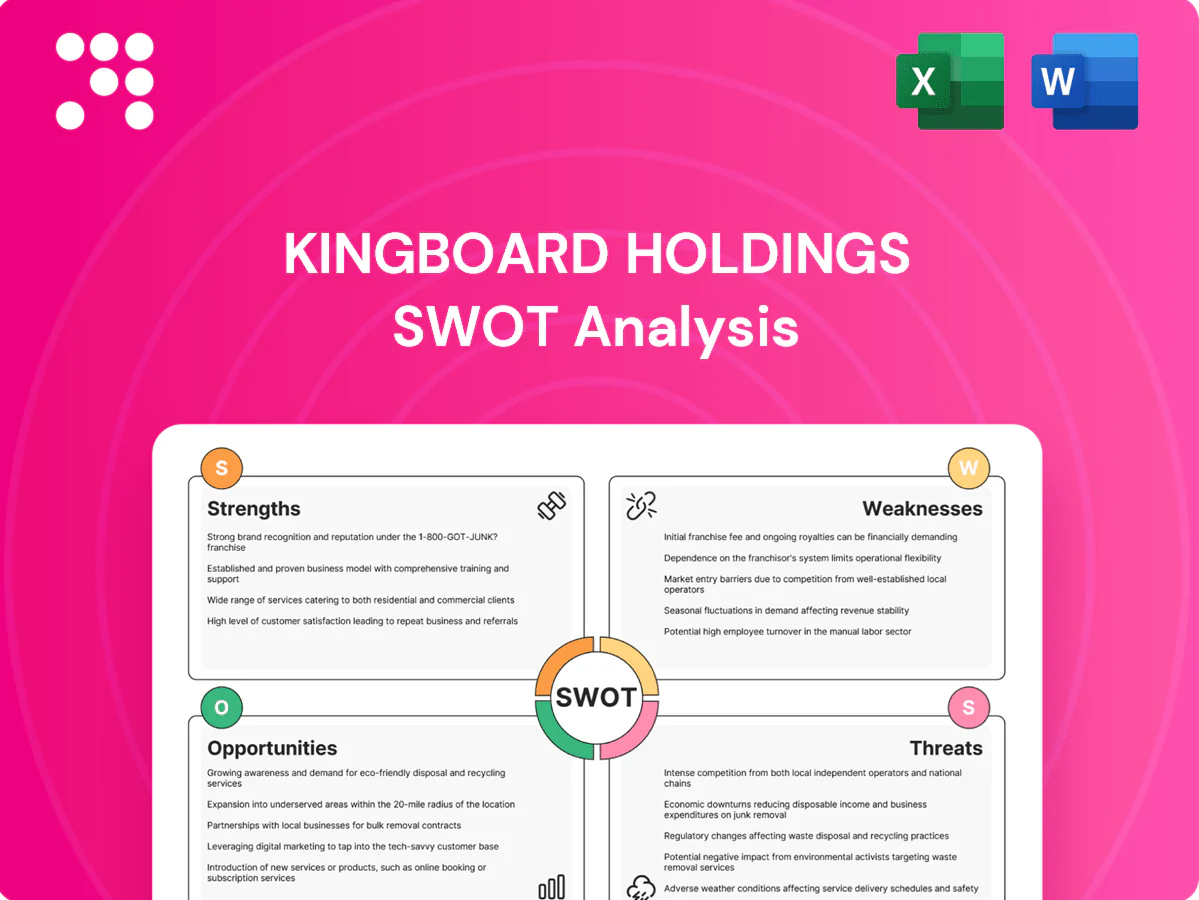
Kingboard Holdings SWOT Analysis

Make Insightful Decisions Backed by Expert Research
Kingboard Holdings shows robust manufacturing scale and diversified chemical-electronics exposure, but faces raw material volatility and tightening margins; our SWOT highlights clear growth drivers in specialty chemicals and downstream integration. Want the full story behind the company’s strengths, risks, and strategic levers? Purchase the complete SWOT analysis to get a professionally written, editable report with financial context and an Excel matrix for planning and pitching.
Strengths

Integrated materials supply
Vertical integration into copper foil and glass fabric secures Kingboard Holdings critical inputs for laminates and PCBs, reducing dependency on external suppliers and mitigating exposure to commodity price swings. It enables tighter quality control and faster lead times across production lines. The upstream structure strengthens bargaining power with downstream customers and suppliers, supporting margin stability and operational resilience.
Diversified revenue streams
Operations span laminates, PCBs, chemicals and property, generating multiple income sources and contributing to FY2024 revenue of HK$81.2 billion. This diversification helped smooth cyclical swings in electronics demand as PCB/laminate downturns were offset by chemical and property margins. Cross-segment synergies lifted asset utilization, improving RoA and supporting resilience across differing industry cycles.

Scale in laminates
Large-scale laminate production—exceeding 1 billion sq ft of annual capacity—underpins cost efficiency and broad market reach for Kingboard, enabling lower unit costs versus smaller rivals. Economies of scale support competitive pricing and margin resilience, contributing to stable gross margins seen across 2023–2024 industry reports. Deep customer relationships drive repeat orders and speed qualification for new electronics applications.

Chemicals capability
Kingboard Holdings' in-house chemicals support core manufacturing and external sales, enabling secure supply of resins and intermediates and reducing procurement risk. Backward linkages allow optimization of formulations for performance and cost, driving differentiated product grades across laminates and coatings. This capability strengthens margin control and market responsiveness.
- In-house supply reduces sourcing risk
- Backward integration optimizes cost-performance
- Enables grade differentiation
- Supports external sales channels
Manufacturing know-how
Kingboard's manufacturing know-how is built on over 35 years of process experience, driving measurable yield improvement and product reliability across laminates and copper foil lines. Deep engineering teams shorten ramp-up time for new specs, while operational excellence sustains consistent on-time delivery to industrial customers. This reputation for consistency helps secure long-cycle contracts and repeat business.
- Yield improvement: process maturity
- Engineering depth: faster spec ramps
- Operational excellence: reliable on-time delivery
- Reputation: attracts long-cycle customers
Vertical integration and scale secure margins and steady growth
Vertical integration into copper foil and glass fabric secures inputs and reduces commodity exposure, supporting margin stability.
Diverse segments—laminates, PCBs, chemicals, property—drove FY2024 revenue of HK$81.2 billion, smoothing cyclicality.
Scale with >1 billion sq ft annual laminate capacity enables cost leadership and broad market reach.
35+ years of process experience yields higher yields, faster ramp-ups and long-cycle customer wins.
| Metric | Value |
|---|---|
| FY2024 revenue | HK$81.2bn |
| Laminate capacity | >1bn sq ft/yr |
| Operating history | 35+ years |
What is included in the product
 Detailed Word Document
Provides a clear SWOT framework that maps Kingboard Holdings’s internal strengths and weaknesses and the external opportunities and threats shaping its competitive position and strategic outlook.

 Customizable Excel Spreadsheet
Provides a concise SWOT matrix for Kingboard Holdings to quickly align strategy and target core pain points like margin pressure and supply‑chain risk, enabling fast stakeholder buy‑in.
Weaknesses

Cyclical end-markets
Exposure to electronics and industrial cycles drives revenue volatility for Kingboard, with end-market demand linked to smartphone shipments (down about 3% in 2023) and PC demand (roughly -15% in 2023), translating to swings in laminates and copper-foil sales. Downturns in consumer or computing demand can push capacity utilization lower by double-digit points, pressuring margins. Inventory corrections amplify swings as customers trim holdings, while forecasting complexity raises working capital risk and can tie up hundreds of millions in cash equivalents.
Capital intensity
Capital intensity is a key weakness: laminates, PCBs and upstream materials demand heavy capex for new lines and raw-material integration, tying up cash. Ongoing maintenance and periodic technology upgrades compress free cash flow in downturns. Long payback periods raise execution risk, and balance-sheet flexibility can narrow sharply during weak markets.

Environmental burden
Chemicals and PCB processes at Kingboard face strict environmental compliance, with waste treatment and emissions control adding recurring costs that industry estimates place at roughly 2–4% of operating expenses annually. Ongoing regulatory tightening in Mainland China and Hong Kong since 2023 requires periodic capital upgrades and monitoring systems, driving further investment. Non-compliance risks fines, production halts and reputational damage that can dent margins.

Product mix sensitivity
Product mix sensitivity weakens margins because profitability hinges on sales of higher-spec laminates versus low-margin commodity grades; price competition in standard products compresses gross margin and risks earnings volatility. Lengthy customer qualification cycles limit rapid mix upgrades, while continual R&D and capex are required to shift toward premium laminates.
- Margins tied to premium vs commodity mix
- Price pressure on standard products
- Slow customer qualification
- Ongoing R&D and capex needs
Customer concentration
Kingboard faces high customer concentration where large OEM/ODM buyers exert significant pricing power, and loss of a key account would materially reduce volumes; lengthy qualification and approval cycles limit quick substitution, while renewal negotiations can compress margins during contract cycles.
- Large OEM/ODM pricing power
- Loss of key account materially impacts volumes
- Qualification barriers slow replacement
- Renewal negotiations compress margins
End-market swings squeeze laminates: smartphones -3%, PCs -15%
Revenue volatility tied to end-market swings (smartphone shipments -3% and PC shipments -15% in 2023) compresses laminates/copper-foil sales and margins. Heavy capex and long paybacks reduce free cash flow in downturns; environmental compliance costs run about 2–4% of operating expenses. High customer concentration gives OEM/ODM buyers material pricing power and replacement is slow.
| Metric | Impact | Note |
|---|---|---|
| Smartphones (2023) | -3% demand | Revenue sensitivity |
| PCs (2023) | -15% demand | Lower laminates sales |
| Env. costs | 2–4% OPEX | Recurring capex |
Full Version Awaits
Kingboard Holdings SWOT Analysis
This is a real excerpt from the Kingboard Holdings SWOT Analysis document you’ll receive upon purchase—no surprises, just professional quality. The preview below is taken directly from the full report; buy now to unlock the complete, editable version. The file shown is the actual analysis included in your download and will be available immediately after checkout.

Make Insightful Decisions Backed by Expert Research
Kingboard Holdings shows robust manufacturing scale and diversified chemical-electronics exposure, but faces raw material volatility and tightening margins; our SWOT highlights clear growth drivers in specialty chemicals and downstream integration. Want the full story behind the company’s strengths, risks, and strategic levers? Purchase the complete SWOT analysis to get a professionally written, editable report with financial context and an Excel matrix for planning and pitching.
Strengths
Integrated materials supply
Vertical integration into copper foil and glass fabric secures Kingboard Holdings critical inputs for laminates and PCBs, reducing dependency on external suppliers and mitigating exposure to commodity price swings. It enables tighter quality control and faster lead times across production lines. The upstream structure strengthens bargaining power with downstream customers and suppliers, supporting margin stability and operational resilience.
Diversified revenue streams
Operations span laminates, PCBs, chemicals and property, generating multiple income sources and contributing to FY2024 revenue of HK$81.2 billion. This diversification helped smooth cyclical swings in electronics demand as PCB/laminate downturns were offset by chemical and property margins. Cross-segment synergies lifted asset utilization, improving RoA and supporting resilience across differing industry cycles.
Scale in laminates
Large-scale laminate production—exceeding 1 billion sq ft of annual capacity—underpins cost efficiency and broad market reach for Kingboard, enabling lower unit costs versus smaller rivals. Economies of scale support competitive pricing and margin resilience, contributing to stable gross margins seen across 2023–2024 industry reports. Deep customer relationships drive repeat orders and speed qualification for new electronics applications.
Chemicals capability
Kingboard Holdings' in-house chemicals support core manufacturing and external sales, enabling secure supply of resins and intermediates and reducing procurement risk. Backward linkages allow optimization of formulations for performance and cost, driving differentiated product grades across laminates and coatings. This capability strengthens margin control and market responsiveness.
- In-house supply reduces sourcing risk
- Backward integration optimizes cost-performance
- Enables grade differentiation
- Supports external sales channels
Manufacturing know-how
Kingboard's manufacturing know-how is built on over 35 years of process experience, driving measurable yield improvement and product reliability across laminates and copper foil lines. Deep engineering teams shorten ramp-up time for new specs, while operational excellence sustains consistent on-time delivery to industrial customers. This reputation for consistency helps secure long-cycle contracts and repeat business.
- Yield improvement: process maturity
- Engineering depth: faster spec ramps
- Operational excellence: reliable on-time delivery
- Reputation: attracts long-cycle customers
Vertical integration and scale secure margins and steady growth
Vertical integration into copper foil and glass fabric secures inputs and reduces commodity exposure, supporting margin stability.
Diverse segments—laminates, PCBs, chemicals, property—drove FY2024 revenue of HK$81.2 billion, smoothing cyclicality.
Scale with >1 billion sq ft annual laminate capacity enables cost leadership and broad market reach.
35+ years of process experience yields higher yields, faster ramp-ups and long-cycle customer wins.
| Metric | Value |
|---|---|
| FY2024 revenue | HK$81.2bn |
| Laminate capacity | >1bn sq ft/yr |
| Operating history | 35+ years |
What is included in the product
Detailed Word Document
Provides a clear SWOT framework that maps Kingboard Holdings’s internal strengths and weaknesses and the external opportunities and threats shaping its competitive position and strategic outlook.
Customizable Excel Spreadsheet
Provides a concise SWOT matrix for Kingboard Holdings to quickly align strategy and target core pain points like margin pressure and supply‑chain risk, enabling fast stakeholder buy‑in.
Weaknesses
Cyclical end-markets
Exposure to electronics and industrial cycles drives revenue volatility for Kingboard, with end-market demand linked to smartphone shipments (down about 3% in 2023) and PC demand (roughly -15% in 2023), translating to swings in laminates and copper-foil sales. Downturns in consumer or computing demand can push capacity utilization lower by double-digit points, pressuring margins. Inventory corrections amplify swings as customers trim holdings, while forecasting complexity raises working capital risk and can tie up hundreds of millions in cash equivalents.
Capital intensity
Capital intensity is a key weakness: laminates, PCBs and upstream materials demand heavy capex for new lines and raw-material integration, tying up cash. Ongoing maintenance and periodic technology upgrades compress free cash flow in downturns. Long payback periods raise execution risk, and balance-sheet flexibility can narrow sharply during weak markets.
Environmental burden
Chemicals and PCB processes at Kingboard face strict environmental compliance, with waste treatment and emissions control adding recurring costs that industry estimates place at roughly 2–4% of operating expenses annually. Ongoing regulatory tightening in Mainland China and Hong Kong since 2023 requires periodic capital upgrades and monitoring systems, driving further investment. Non-compliance risks fines, production halts and reputational damage that can dent margins.
Product mix sensitivity
Product mix sensitivity weakens margins because profitability hinges on sales of higher-spec laminates versus low-margin commodity grades; price competition in standard products compresses gross margin and risks earnings volatility. Lengthy customer qualification cycles limit rapid mix upgrades, while continual R&D and capex are required to shift toward premium laminates.
- Margins tied to premium vs commodity mix
- Price pressure on standard products
- Slow customer qualification
- Ongoing R&D and capex needs
Customer concentration
Kingboard faces high customer concentration where large OEM/ODM buyers exert significant pricing power, and loss of a key account would materially reduce volumes; lengthy qualification and approval cycles limit quick substitution, while renewal negotiations can compress margins during contract cycles.
- Large OEM/ODM pricing power
- Loss of key account materially impacts volumes
- Qualification barriers slow replacement
- Renewal negotiations compress margins
End-market swings squeeze laminates: smartphones -3%, PCs -15%
Revenue volatility tied to end-market swings (smartphone shipments -3% and PC shipments -15% in 2023) compresses laminates/copper-foil sales and margins. Heavy capex and long paybacks reduce free cash flow in downturns; environmental compliance costs run about 2–4% of operating expenses. High customer concentration gives OEM/ODM buyers material pricing power and replacement is slow.
| Metric | Impact | Note |
|---|---|---|
| Smartphones (2023) | -3% demand | Revenue sensitivity |
| PCs (2023) | -15% demand | Lower laminates sales |
| Env. costs | 2–4% OPEX | Recurring capex |
Full Version Awaits
Kingboard Holdings SWOT Analysis
This is a real excerpt from the Kingboard Holdings SWOT Analysis document you’ll receive upon purchase—no surprises, just professional quality. The preview below is taken directly from the full report; buy now to unlock the complete, editable version. The file shown is the actual analysis included in your download and will be available immediately after checkout.
Original: $10.00
-65%$10.00
$3.50Description
Make Insightful Decisions Backed by Expert Research
Kingboard Holdings shows robust manufacturing scale and diversified chemical-electronics exposure, but faces raw material volatility and tightening margins; our SWOT highlights clear growth drivers in specialty chemicals and downstream integration. Want the full story behind the company’s strengths, risks, and strategic levers? Purchase the complete SWOT analysis to get a professionally written, editable report with financial context and an Excel matrix for planning and pitching.
Strengths
Integrated materials supply
Vertical integration into copper foil and glass fabric secures Kingboard Holdings critical inputs for laminates and PCBs, reducing dependency on external suppliers and mitigating exposure to commodity price swings. It enables tighter quality control and faster lead times across production lines. The upstream structure strengthens bargaining power with downstream customers and suppliers, supporting margin stability and operational resilience.
Diversified revenue streams
Operations span laminates, PCBs, chemicals and property, generating multiple income sources and contributing to FY2024 revenue of HK$81.2 billion. This diversification helped smooth cyclical swings in electronics demand as PCB/laminate downturns were offset by chemical and property margins. Cross-segment synergies lifted asset utilization, improving RoA and supporting resilience across differing industry cycles.
Scale in laminates
Large-scale laminate production—exceeding 1 billion sq ft of annual capacity—underpins cost efficiency and broad market reach for Kingboard, enabling lower unit costs versus smaller rivals. Economies of scale support competitive pricing and margin resilience, contributing to stable gross margins seen across 2023–2024 industry reports. Deep customer relationships drive repeat orders and speed qualification for new electronics applications.
Chemicals capability
Kingboard Holdings' in-house chemicals support core manufacturing and external sales, enabling secure supply of resins and intermediates and reducing procurement risk. Backward linkages allow optimization of formulations for performance and cost, driving differentiated product grades across laminates and coatings. This capability strengthens margin control and market responsiveness.
- In-house supply reduces sourcing risk
- Backward integration optimizes cost-performance
- Enables grade differentiation
- Supports external sales channels
Manufacturing know-how
Kingboard's manufacturing know-how is built on over 35 years of process experience, driving measurable yield improvement and product reliability across laminates and copper foil lines. Deep engineering teams shorten ramp-up time for new specs, while operational excellence sustains consistent on-time delivery to industrial customers. This reputation for consistency helps secure long-cycle contracts and repeat business.
- Yield improvement: process maturity
- Engineering depth: faster spec ramps
- Operational excellence: reliable on-time delivery
- Reputation: attracts long-cycle customers
Vertical integration and scale secure margins and steady growth
Vertical integration into copper foil and glass fabric secures inputs and reduces commodity exposure, supporting margin stability.
Diverse segments—laminates, PCBs, chemicals, property—drove FY2024 revenue of HK$81.2 billion, smoothing cyclicality.
Scale with >1 billion sq ft annual laminate capacity enables cost leadership and broad market reach.
35+ years of process experience yields higher yields, faster ramp-ups and long-cycle customer wins.
| Metric | Value |
|---|---|
| FY2024 revenue | HK$81.2bn |
| Laminate capacity | >1bn sq ft/yr |
| Operating history | 35+ years |
What is included in the product
Detailed Word Document
Provides a clear SWOT framework that maps Kingboard Holdings’s internal strengths and weaknesses and the external opportunities and threats shaping its competitive position and strategic outlook.
Customizable Excel Spreadsheet
Provides a concise SWOT matrix for Kingboard Holdings to quickly align strategy and target core pain points like margin pressure and supply‑chain risk, enabling fast stakeholder buy‑in.
Weaknesses
Cyclical end-markets
Exposure to electronics and industrial cycles drives revenue volatility for Kingboard, with end-market demand linked to smartphone shipments (down about 3% in 2023) and PC demand (roughly -15% in 2023), translating to swings in laminates and copper-foil sales. Downturns in consumer or computing demand can push capacity utilization lower by double-digit points, pressuring margins. Inventory corrections amplify swings as customers trim holdings, while forecasting complexity raises working capital risk and can tie up hundreds of millions in cash equivalents.
Capital intensity
Capital intensity is a key weakness: laminates, PCBs and upstream materials demand heavy capex for new lines and raw-material integration, tying up cash. Ongoing maintenance and periodic technology upgrades compress free cash flow in downturns. Long payback periods raise execution risk, and balance-sheet flexibility can narrow sharply during weak markets.
Environmental burden
Chemicals and PCB processes at Kingboard face strict environmental compliance, with waste treatment and emissions control adding recurring costs that industry estimates place at roughly 2–4% of operating expenses annually. Ongoing regulatory tightening in Mainland China and Hong Kong since 2023 requires periodic capital upgrades and monitoring systems, driving further investment. Non-compliance risks fines, production halts and reputational damage that can dent margins.
Product mix sensitivity
Product mix sensitivity weakens margins because profitability hinges on sales of higher-spec laminates versus low-margin commodity grades; price competition in standard products compresses gross margin and risks earnings volatility. Lengthy customer qualification cycles limit rapid mix upgrades, while continual R&D and capex are required to shift toward premium laminates.
- Margins tied to premium vs commodity mix
- Price pressure on standard products
- Slow customer qualification
- Ongoing R&D and capex needs
Customer concentration
Kingboard faces high customer concentration where large OEM/ODM buyers exert significant pricing power, and loss of a key account would materially reduce volumes; lengthy qualification and approval cycles limit quick substitution, while renewal negotiations can compress margins during contract cycles.
- Large OEM/ODM pricing power
- Loss of key account materially impacts volumes
- Qualification barriers slow replacement
- Renewal negotiations compress margins
End-market swings squeeze laminates: smartphones -3%, PCs -15%
Revenue volatility tied to end-market swings (smartphone shipments -3% and PC shipments -15% in 2023) compresses laminates/copper-foil sales and margins. Heavy capex and long paybacks reduce free cash flow in downturns; environmental compliance costs run about 2–4% of operating expenses. High customer concentration gives OEM/ODM buyers material pricing power and replacement is slow.
| Metric | Impact | Note |
|---|---|---|
| Smartphones (2023) | -3% demand | Revenue sensitivity |
| PCs (2023) | -15% demand | Lower laminates sales |
| Env. costs | 2–4% OPEX | Recurring capex |
Full Version Awaits
Kingboard Holdings SWOT Analysis
This is a real excerpt from the Kingboard Holdings SWOT Analysis document you’ll receive upon purchase—no surprises, just professional quality. The preview below is taken directly from the full report; buy now to unlock the complete, editable version. The file shown is the actual analysis included in your download and will be available immediately after checkout.











