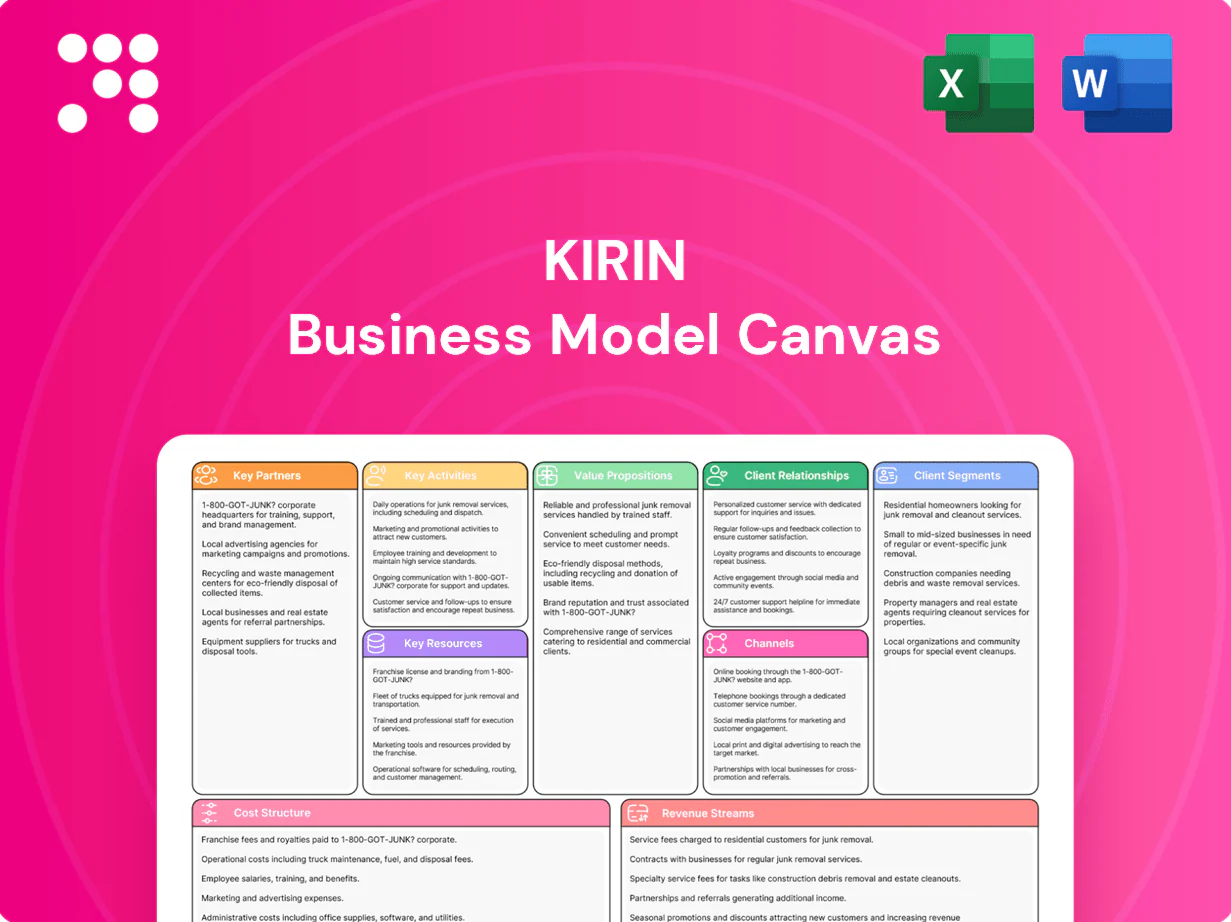
Kirin Business Model Canvas

Unlock a proven Business Model Canvas and strategic playbook, download editable Word & Excel now
Unlock Kirin’s strategic playbook with our concise Business Model Canvas—3–5 sentence snapshot won’t suffice for the depth behind its value propositions, partnerships, and revenue engines. Download the full, editable Canvas in Word and Excel to benchmark, strategize, and apply these proven insights to your business or investment decisions today.
Partnerships

Global ingredient suppliers
Partnerships with barley, hops, sugar, flavors, and functional ingredient vendors secure consistent quality and price stability through long-term supply agreements and joint quality programs.
Distributors and retail chains
Alliances with wholesalers, convenience stores, supermarkets and e-commerce marketplaces secure broad shelf presence and distribution into urban and regional channels; e-commerce represented about 8% of alcohol retail in Japan in 2024, boosting reach. Joint in-store and online promotions drive category growth and brand visibility through coordinated merchandising and co-funded campaigns. Data-sharing agreements with major chains improve demand forecasting and assortment, reducing out-of-stocks and SKU churn. On-premise partners—bars, restaurants and izakaya—expand draft penetration and consumer trial, converting on-premise trials into off-premise loyalty.

On-premise and hospitality partners
Bars, restaurants, hotels and entertainment venues are critical to Kirin’s premium positioning, with on-premise placements driving brand experience and higher price points. Draft systems and staff training improve pour consistency and upsell rates, supporting Kirin’s role as Japan’s second-largest brewer by market share. Co-branded events and menu integrations accelerate sell-through and frequency. Seasonal and limited taps create scarcity and differentiation that boost trial.

R&D and pharma alliances
R&D and pharma alliances with university labs, biotech startups and CROs accelerate discovery in fermentation science and health solutions, leveraging the >$60B global CRO market in 2024 and academic translational pipelines. Licensing and co-development shorten time-to-market versus greenfield paths, when average drug development still spans ~10–12 years. Clinical trial networks generate evidence for regulatory progress while IP-sharing frameworks allocate risk and value capture.
- University labs: translational pipelines
- Biotech startups: agile innovation
- CROs: >$60B market (2024)
- Licensing/co-dev: faster market entry
- IP-sharing: risk/value allocation
Packaging and sustainability partners
Packaging partners for cans, glass, PET and labels work with Kirin to advance lightweighting and recyclability, reflected in Kirin Group’s 2024 ESG report commitments to improve material recovery and design for recycling; logistics and recycling alliances target higher circularity and lower transport emissions through route optimization and reverse logistics pilots. Renewable energy and water-stewardship partnerships support Kirin’s 2050 net-zero aim, while certifications (ISO 14001, eco-labels) signal compliance to consumers and regulators.
- packaging-collab: lightweighting + recyclability (Kirin 2024 ESG)
- logistics-recycling: circularity & transport-emission cuts
- renewables-water: alliances toward 2050 net-zero
- certifications: ISO 14001 and eco-labels for market/regulatory trust
Long-term supply deals + partnerships fuel premium growth; e-commerce 8%, CROs >$60B
Long-term supplier contracts (barley, hops, sugar) secure quality and cost stability; co-development with flavor and ingredient vendors speeds NPD. Distribution alliances (retail, e‑commerce ~8% of alcohol retail in Japan 2024) and on‑premise partners drive reach and premiumization. R&D/CRO/uni partnerships accelerate fermentation and health innovation (global CRO market >$60B 2024); packaging/logistics tie to Kirin 2050 net‑zero goals.
| Partner | Impact | 2024 metric |
|---|---|---|
| Retail & e‑commerce | Reach & promo | e‑commerce 8% alcohol retail JP |
| CROs & universities | Innovation speed | Global CRO market >$60B |
| Packaging & logistics | Circularity | 2050 net‑zero target |
What is included in the product
 Detailed Word Document
A comprehensive, pre-written Business Model Canvas for Kirin detailing customer segments, channels, value propositions and revenue streams across the 9 classic BMC blocks, with competitive advantage analysis, linked SWOT insights and a polished format ideal for presentations, investor discussions and strategic validation.

 Customizable Excel Spreadsheet
High-level one-page snapshot of Kirin’s business model with editable cells to quickly pinpoint value drivers, cost levers, and growth opportunities—ideal for fast strategy reviews, team collaboration, and comparing scenarios side-by-side.
Activities

Brewing and beverage production
Consistent, high-quality brewing across regional plants underpins brand trust; Kirin is Japan's second-largest brewer, leveraging regional networks to maintain product consistency.
R&D and product innovation
R&D and product innovation at Kirin spans beers, RTDs, soft drinks and health-science formulations, leveraging fermentation, flavor science and bioactives research to create clear product differentiation. Rapid prototyping and iterative consumer testing shorten time-to-market and reduce failure risk. A focused IP strategy secures returns from novel strains, formulations and processing methods.

Brand building and marketing
Integrated campaigns sustain equity across flagship and new brands, supporting Kirin’s position as a top-three brewer in Japan with roughly 20% market share; national TV, OOH and seasonal pushes keep brand salience high. Sports, culture and digital activations—including rights deals and influencer partnerships—drive engagement and trial in key demographics. Portfolio architecture segments premium, mainstream and value tiers to protect margins, while data-driven targeting improves campaign ROI and conversion rates.

Supply chain and logistics
Procurement, production planning and a refrigerated distribution network preserve product freshness across Kirin’s beverage portfolio, supporting service levels while targeting logistic cost reductions; industry cold-chain capacity was estimated at roughly $289 billion in 2024, underscoring scale pressures. Network optimization lowers cost-to-serve and emissions, inventory management balances service with working capital, and risk management addresses raw-material shortages and transport disruptions.
- Procurement: centralized sourcing to secure barley, hops and packaging
- Cold-chain: refrigerated transport and warehouses to cut spoilage
- Network optimization: route and DC consolidation to reduce costs/emissions
- Inventory: just-in-time vs safety stock trade-off for working capital
- Risk: dual-sourcing and contingency logistics for disruption resilience
Regulatory and quality compliance
Regulatory and quality compliance covers alcohol laws, ingredient and labeling rules, health-claim substantiation, and pharmacovigilance for Kirin’s biopharma units; in 2024 Kirin operated across 30+ markets and reported roughly JPY 1.5 trillion consolidated revenue, making consistent approvals critical to revenue continuity. Robust documentation, GMP/HACCP-aligned audits and electronic quality records sustain licences and reduce recall exposure. Food and drug safety systems, including batch traceability, limit recall scope and preserve market access.
- compliance areas: alcohol law, labeling, health claims, pharmacovigilance
- controls: GMP/HACCP, audits, e-records
- scale: 30+ markets (2024)
- impact: preserves JPY 1.5T revenue (FY2024)
Quality brewing and cold-chain power JPY 1.5T, ~20% Japan share
High-quality brewing across regional plants ensures product consistency and supports ~20% Japan market share; centralized procurement secures barley/hops and packaging. R&D across beer, RTD, soft drinks and health-science drives new SKUs with IP protection. Cold-chain logistics, network optimization and dual-sourcing maintain freshness and resilience across 30+ markets, backing JPY 1.5T revenue (FY2024).
| Metric | 2024 |
|---|---|
| Revenue | JPY 1.5T |
| Japan share | ~20% |
| Markets | 30+ |
| Cold-chain market | USD 289B |
What You See Is What You Get
Business Model Canvas
The Kirin Business Model Canvas preview on this page is the actual deliverable, not a mockup. When you purchase, you'll receive this exact file—complete, editable, and formatted as shown. Instant download is provided in Word and Excel so you can present, edit, and apply it immediately.

Unlock a proven Business Model Canvas and strategic playbook, download editable Word & Excel now
Unlock Kirin’s strategic playbook with our concise Business Model Canvas—3–5 sentence snapshot won’t suffice for the depth behind its value propositions, partnerships, and revenue engines. Download the full, editable Canvas in Word and Excel to benchmark, strategize, and apply these proven insights to your business or investment decisions today.
Partnerships
Global ingredient suppliers
Partnerships with barley, hops, sugar, flavors, and functional ingredient vendors secure consistent quality and price stability through long-term supply agreements and joint quality programs.
Distributors and retail chains
Alliances with wholesalers, convenience stores, supermarkets and e-commerce marketplaces secure broad shelf presence and distribution into urban and regional channels; e-commerce represented about 8% of alcohol retail in Japan in 2024, boosting reach. Joint in-store and online promotions drive category growth and brand visibility through coordinated merchandising and co-funded campaigns. Data-sharing agreements with major chains improve demand forecasting and assortment, reducing out-of-stocks and SKU churn. On-premise partners—bars, restaurants and izakaya—expand draft penetration and consumer trial, converting on-premise trials into off-premise loyalty.
On-premise and hospitality partners
Bars, restaurants, hotels and entertainment venues are critical to Kirin’s premium positioning, with on-premise placements driving brand experience and higher price points. Draft systems and staff training improve pour consistency and upsell rates, supporting Kirin’s role as Japan’s second-largest brewer by market share. Co-branded events and menu integrations accelerate sell-through and frequency. Seasonal and limited taps create scarcity and differentiation that boost trial.
R&D and pharma alliances
R&D and pharma alliances with university labs, biotech startups and CROs accelerate discovery in fermentation science and health solutions, leveraging the >$60B global CRO market in 2024 and academic translational pipelines. Licensing and co-development shorten time-to-market versus greenfield paths, when average drug development still spans ~10–12 years. Clinical trial networks generate evidence for regulatory progress while IP-sharing frameworks allocate risk and value capture.
- University labs: translational pipelines
- Biotech startups: agile innovation
- CROs: >$60B market (2024)
- Licensing/co-dev: faster market entry
- IP-sharing: risk/value allocation
Packaging and sustainability partners
Packaging partners for cans, glass, PET and labels work with Kirin to advance lightweighting and recyclability, reflected in Kirin Group’s 2024 ESG report commitments to improve material recovery and design for recycling; logistics and recycling alliances target higher circularity and lower transport emissions through route optimization and reverse logistics pilots. Renewable energy and water-stewardship partnerships support Kirin’s 2050 net-zero aim, while certifications (ISO 14001, eco-labels) signal compliance to consumers and regulators.
- packaging-collab: lightweighting + recyclability (Kirin 2024 ESG)
- logistics-recycling: circularity & transport-emission cuts
- renewables-water: alliances toward 2050 net-zero
- certifications: ISO 14001 and eco-labels for market/regulatory trust
Long-term supply deals + partnerships fuel premium growth; e-commerce 8%, CROs >$60B
Long-term supplier contracts (barley, hops, sugar) secure quality and cost stability; co-development with flavor and ingredient vendors speeds NPD. Distribution alliances (retail, e‑commerce ~8% of alcohol retail in Japan 2024) and on‑premise partners drive reach and premiumization. R&D/CRO/uni partnerships accelerate fermentation and health innovation (global CRO market >$60B 2024); packaging/logistics tie to Kirin 2050 net‑zero goals.
| Partner | Impact | 2024 metric |
|---|---|---|
| Retail & e‑commerce | Reach & promo | e‑commerce 8% alcohol retail JP |
| CROs & universities | Innovation speed | Global CRO market >$60B |
| Packaging & logistics | Circularity | 2050 net‑zero target |
What is included in the product
Detailed Word Document
A comprehensive, pre-written Business Model Canvas for Kirin detailing customer segments, channels, value propositions and revenue streams across the 9 classic BMC blocks, with competitive advantage analysis, linked SWOT insights and a polished format ideal for presentations, investor discussions and strategic validation.
Customizable Excel Spreadsheet
High-level one-page snapshot of Kirin’s business model with editable cells to quickly pinpoint value drivers, cost levers, and growth opportunities—ideal for fast strategy reviews, team collaboration, and comparing scenarios side-by-side.
Activities
Brewing and beverage production
Consistent, high-quality brewing across regional plants underpins brand trust; Kirin is Japan's second-largest brewer, leveraging regional networks to maintain product consistency.
R&D and product innovation
R&D and product innovation at Kirin spans beers, RTDs, soft drinks and health-science formulations, leveraging fermentation, flavor science and bioactives research to create clear product differentiation. Rapid prototyping and iterative consumer testing shorten time-to-market and reduce failure risk. A focused IP strategy secures returns from novel strains, formulations and processing methods.
Brand building and marketing
Integrated campaigns sustain equity across flagship and new brands, supporting Kirin’s position as a top-three brewer in Japan with roughly 20% market share; national TV, OOH and seasonal pushes keep brand salience high. Sports, culture and digital activations—including rights deals and influencer partnerships—drive engagement and trial in key demographics. Portfolio architecture segments premium, mainstream and value tiers to protect margins, while data-driven targeting improves campaign ROI and conversion rates.
Supply chain and logistics
Procurement, production planning and a refrigerated distribution network preserve product freshness across Kirin’s beverage portfolio, supporting service levels while targeting logistic cost reductions; industry cold-chain capacity was estimated at roughly $289 billion in 2024, underscoring scale pressures. Network optimization lowers cost-to-serve and emissions, inventory management balances service with working capital, and risk management addresses raw-material shortages and transport disruptions.
- Procurement: centralized sourcing to secure barley, hops and packaging
- Cold-chain: refrigerated transport and warehouses to cut spoilage
- Network optimization: route and DC consolidation to reduce costs/emissions
- Inventory: just-in-time vs safety stock trade-off for working capital
- Risk: dual-sourcing and contingency logistics for disruption resilience
Regulatory and quality compliance
Regulatory and quality compliance covers alcohol laws, ingredient and labeling rules, health-claim substantiation, and pharmacovigilance for Kirin’s biopharma units; in 2024 Kirin operated across 30+ markets and reported roughly JPY 1.5 trillion consolidated revenue, making consistent approvals critical to revenue continuity. Robust documentation, GMP/HACCP-aligned audits and electronic quality records sustain licences and reduce recall exposure. Food and drug safety systems, including batch traceability, limit recall scope and preserve market access.
- compliance areas: alcohol law, labeling, health claims, pharmacovigilance
- controls: GMP/HACCP, audits, e-records
- scale: 30+ markets (2024)
- impact: preserves JPY 1.5T revenue (FY2024)
Quality brewing and cold-chain power JPY 1.5T, ~20% Japan share
High-quality brewing across regional plants ensures product consistency and supports ~20% Japan market share; centralized procurement secures barley/hops and packaging. R&D across beer, RTD, soft drinks and health-science drives new SKUs with IP protection. Cold-chain logistics, network optimization and dual-sourcing maintain freshness and resilience across 30+ markets, backing JPY 1.5T revenue (FY2024).
| Metric | 2024 |
|---|---|
| Revenue | JPY 1.5T |
| Japan share | ~20% |
| Markets | 30+ |
| Cold-chain market | USD 289B |
What You See Is What You Get
Business Model Canvas
The Kirin Business Model Canvas preview on this page is the actual deliverable, not a mockup. When you purchase, you'll receive this exact file—complete, editable, and formatted as shown. Instant download is provided in Word and Excel so you can present, edit, and apply it immediately.
Description
Unlock a proven Business Model Canvas and strategic playbook, download editable Word & Excel now
Unlock Kirin’s strategic playbook with our concise Business Model Canvas—3–5 sentence snapshot won’t suffice for the depth behind its value propositions, partnerships, and revenue engines. Download the full, editable Canvas in Word and Excel to benchmark, strategize, and apply these proven insights to your business or investment decisions today.
Partnerships
Global ingredient suppliers
Partnerships with barley, hops, sugar, flavors, and functional ingredient vendors secure consistent quality and price stability through long-term supply agreements and joint quality programs.
Distributors and retail chains
Alliances with wholesalers, convenience stores, supermarkets and e-commerce marketplaces secure broad shelf presence and distribution into urban and regional channels; e-commerce represented about 8% of alcohol retail in Japan in 2024, boosting reach. Joint in-store and online promotions drive category growth and brand visibility through coordinated merchandising and co-funded campaigns. Data-sharing agreements with major chains improve demand forecasting and assortment, reducing out-of-stocks and SKU churn. On-premise partners—bars, restaurants and izakaya—expand draft penetration and consumer trial, converting on-premise trials into off-premise loyalty.
On-premise and hospitality partners
Bars, restaurants, hotels and entertainment venues are critical to Kirin’s premium positioning, with on-premise placements driving brand experience and higher price points. Draft systems and staff training improve pour consistency and upsell rates, supporting Kirin’s role as Japan’s second-largest brewer by market share. Co-branded events and menu integrations accelerate sell-through and frequency. Seasonal and limited taps create scarcity and differentiation that boost trial.
R&D and pharma alliances
R&D and pharma alliances with university labs, biotech startups and CROs accelerate discovery in fermentation science and health solutions, leveraging the >$60B global CRO market in 2024 and academic translational pipelines. Licensing and co-development shorten time-to-market versus greenfield paths, when average drug development still spans ~10–12 years. Clinical trial networks generate evidence for regulatory progress while IP-sharing frameworks allocate risk and value capture.
- University labs: translational pipelines
- Biotech startups: agile innovation
- CROs: >$60B market (2024)
- Licensing/co-dev: faster market entry
- IP-sharing: risk/value allocation
Packaging and sustainability partners
Packaging partners for cans, glass, PET and labels work with Kirin to advance lightweighting and recyclability, reflected in Kirin Group’s 2024 ESG report commitments to improve material recovery and design for recycling; logistics and recycling alliances target higher circularity and lower transport emissions through route optimization and reverse logistics pilots. Renewable energy and water-stewardship partnerships support Kirin’s 2050 net-zero aim, while certifications (ISO 14001, eco-labels) signal compliance to consumers and regulators.
- packaging-collab: lightweighting + recyclability (Kirin 2024 ESG)
- logistics-recycling: circularity & transport-emission cuts
- renewables-water: alliances toward 2050 net-zero
- certifications: ISO 14001 and eco-labels for market/regulatory trust
Long-term supply deals + partnerships fuel premium growth; e-commerce 8%, CROs >$60B
Long-term supplier contracts (barley, hops, sugar) secure quality and cost stability; co-development with flavor and ingredient vendors speeds NPD. Distribution alliances (retail, e‑commerce ~8% of alcohol retail in Japan 2024) and on‑premise partners drive reach and premiumization. R&D/CRO/uni partnerships accelerate fermentation and health innovation (global CRO market >$60B 2024); packaging/logistics tie to Kirin 2050 net‑zero goals.
| Partner | Impact | 2024 metric |
|---|---|---|
| Retail & e‑commerce | Reach & promo | e‑commerce 8% alcohol retail JP |
| CROs & universities | Innovation speed | Global CRO market >$60B |
| Packaging & logistics | Circularity | 2050 net‑zero target |
What is included in the product
Detailed Word Document
A comprehensive, pre-written Business Model Canvas for Kirin detailing customer segments, channels, value propositions and revenue streams across the 9 classic BMC blocks, with competitive advantage analysis, linked SWOT insights and a polished format ideal for presentations, investor discussions and strategic validation.
Customizable Excel Spreadsheet
High-level one-page snapshot of Kirin’s business model with editable cells to quickly pinpoint value drivers, cost levers, and growth opportunities—ideal for fast strategy reviews, team collaboration, and comparing scenarios side-by-side.
Activities
Brewing and beverage production
Consistent, high-quality brewing across regional plants underpins brand trust; Kirin is Japan's second-largest brewer, leveraging regional networks to maintain product consistency.
R&D and product innovation
R&D and product innovation at Kirin spans beers, RTDs, soft drinks and health-science formulations, leveraging fermentation, flavor science and bioactives research to create clear product differentiation. Rapid prototyping and iterative consumer testing shorten time-to-market and reduce failure risk. A focused IP strategy secures returns from novel strains, formulations and processing methods.
Brand building and marketing
Integrated campaigns sustain equity across flagship and new brands, supporting Kirin’s position as a top-three brewer in Japan with roughly 20% market share; national TV, OOH and seasonal pushes keep brand salience high. Sports, culture and digital activations—including rights deals and influencer partnerships—drive engagement and trial in key demographics. Portfolio architecture segments premium, mainstream and value tiers to protect margins, while data-driven targeting improves campaign ROI and conversion rates.
Supply chain and logistics
Procurement, production planning and a refrigerated distribution network preserve product freshness across Kirin’s beverage portfolio, supporting service levels while targeting logistic cost reductions; industry cold-chain capacity was estimated at roughly $289 billion in 2024, underscoring scale pressures. Network optimization lowers cost-to-serve and emissions, inventory management balances service with working capital, and risk management addresses raw-material shortages and transport disruptions.
- Procurement: centralized sourcing to secure barley, hops and packaging
- Cold-chain: refrigerated transport and warehouses to cut spoilage
- Network optimization: route and DC consolidation to reduce costs/emissions
- Inventory: just-in-time vs safety stock trade-off for working capital
- Risk: dual-sourcing and contingency logistics for disruption resilience
Regulatory and quality compliance
Regulatory and quality compliance covers alcohol laws, ingredient and labeling rules, health-claim substantiation, and pharmacovigilance for Kirin’s biopharma units; in 2024 Kirin operated across 30+ markets and reported roughly JPY 1.5 trillion consolidated revenue, making consistent approvals critical to revenue continuity. Robust documentation, GMP/HACCP-aligned audits and electronic quality records sustain licences and reduce recall exposure. Food and drug safety systems, including batch traceability, limit recall scope and preserve market access.
- compliance areas: alcohol law, labeling, health claims, pharmacovigilance
- controls: GMP/HACCP, audits, e-records
- scale: 30+ markets (2024)
- impact: preserves JPY 1.5T revenue (FY2024)
Quality brewing and cold-chain power JPY 1.5T, ~20% Japan share
High-quality brewing across regional plants ensures product consistency and supports ~20% Japan market share; centralized procurement secures barley/hops and packaging. R&D across beer, RTD, soft drinks and health-science drives new SKUs with IP protection. Cold-chain logistics, network optimization and dual-sourcing maintain freshness and resilience across 30+ markets, backing JPY 1.5T revenue (FY2024).
| Metric | 2024 |
|---|---|
| Revenue | JPY 1.5T |
| Japan share | ~20% |
| Markets | 30+ |
| Cold-chain market | USD 289B |
What You See Is What You Get
Business Model Canvas
The Kirin Business Model Canvas preview on this page is the actual deliverable, not a mockup. When you purchase, you'll receive this exact file—complete, editable, and formatted as shown. Instant download is provided in Word and Excel so you can present, edit, and apply it immediately.











