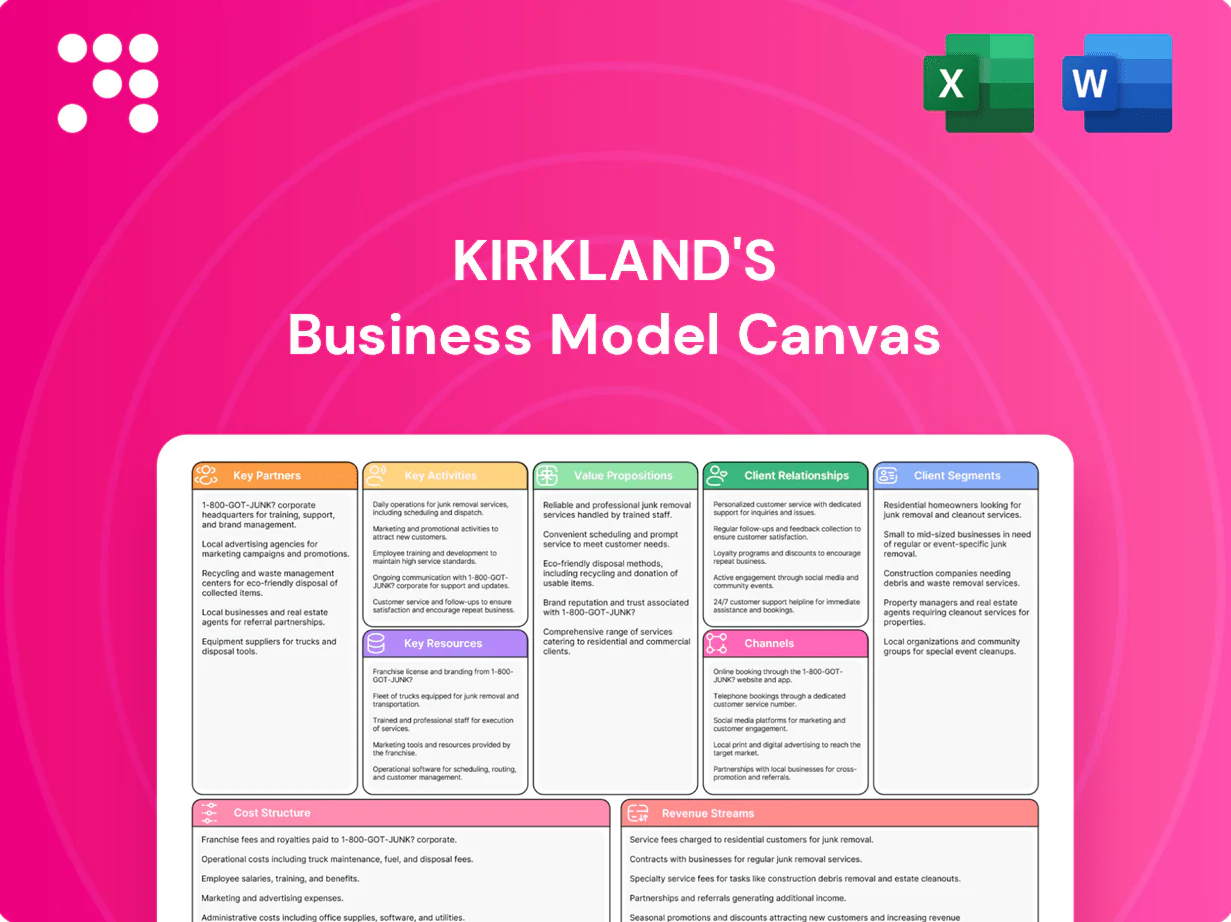
Kirkland's Business Model Canvas

Business Model Canvas: Actionable retail strategies, revenue drivers & customer insights
Unlock the full strategic blueprint behind Kirkland's with our Business Model Canvas—clear, actionable insights into its value propositions, customer segments, and revenue drivers. Ideal for investors, consultants, and founders seeking competitive advantage. Download the complete Word & Excel kit to benchmark and implement proven strategies.
Partnerships

Global home décor manufacturers
Strategic partnerships with global home décor manufacturers secure consistent quality, competitive pricing, and reliable lead times, supporting assortments across Kirkland’s ~400 stores and e-commerce channel. Multi-sourcing lowers stockout risk and provides negotiating leverage, aligning with retail benchmarks that target 95% on-time in-full (OTIF). Co-developing exclusive SKUs differentiates assortments and protects margins, while vendor scorecards track on-time delivery and compliance to drive continuous improvement.
Logistics and last-mile carriers
Freight forwarders and parcel carriers enable timely store replenishment and e-commerce delivery, with last-mile activity accounting for up to 53% of total fulfillment cost as of 2024. Rate agreements balance speed and cost across zones and weights to protect margins while meeting customer expectations. White-glove and oversized partners handle furniture safely, and streamlined returns logistics support a roughly 16% e-commerce return rate for home goods in 2024.

E-commerce, payments, and tech vendors
Platform, hosting, and analytics providers keep Kirkland's site performance tuned for an e-commerce channel that accounted for roughly 17% of US retail sales in 2024, driving traffic and insight. Payment gateways cut friction and fraud while enabling buy-now-pay-later options that grew double digits industry-wide, improving checkout completion. Personalization and search partners deliver 10–15% conversion uplifts, and OMS/WMS integrations cut stockouts and speed fulfillment by up to 30%.

Commercial real estate and mall operators
Landlords give Kirkland's access to high-traffic mall locations and co-tenancy benefits that boost seasonal sales; many partnerships support relocations and right-sizing across the retailer's network (over 300 stores as of 2024). Lease negotiations control base rent, CAM charges, and remodel allowances to protect margins. Flexible store formats enable quick footprint changes while shared mall marketing drives peak-season footfall.
- Landlord access: high-traffic sites
- Lease terms: base rent, CAM, remodel allowances
- Format flexibility: relocations, right-sizing
- Shared marketing: seasonal footfall gains
Marketing, influencers, and affiliate networks
Omnichannel partnerships deliver 95% OTIF, boost e-comm growth and 30% faster fulfillment
Strategic vendor partnerships secure assortments for ~300 stores and e-commerce (e-comm ≈17% of US retail sales in 2024) with target OTIF ~95%. Logistics partners manage last-mile (≈53% fulfillment cost) and 16% e-commerce return rates. Tech and marketing partners drive 10–15% conversion uplifts, 30% faster fulfillment, influencer ROI ~5.78:1 and affiliates 12–15% of e-comm revenue.
| Metric | 2024 Value |
|---|---|
| Stores | ~300 |
| E-comm share | ~17% |
| OTIF target | 95% |
| Last-mile cost | ≈53% |
| Return rate | ≈16% |
| Personalization uplift | 10–15% |
| Fulfillment speed | up to 30% |
| Influencer ROI | 5.78:1 |
| Affiliate revenue | 12–15% |
What is included in the product
 Detailed Word Document
A comprehensive pre-written Business Model Canvas tailored to Kirkland's specialty home décor retail strategy, covering the 9 BMC blocks—customer segments, channels, value propositions, customer relationships, revenue streams, key resources, key activities, key partners, and cost structure—with competitive advantages, SWOT-linked insights and a polished narrative for presentations, investor discussions, and strategic decision-making.

 Customizable Excel Spreadsheet
High-level view of Kirkland's business model with editable cells, condensing merchandising, store operations, and omnichannel strategy into a one-page snapshot that saves hours of structuring and enables fast stakeholder alignment.
Activities

Merchandising and assortment planning
Trend scouting drives Kirkland's seasonal collections and core basics, aligning assortments to US home furnishings demand (retail sales ≈$134B in 2023, US Census Bureau) and local store profiles across roughly 300 stores. SKU rationalization balances breadth, depth and GMROI, trimming low-velocity SKUs to lift overall margin contribution. Pricing ladders preserve perceived value while targeting margin goals; visual storytelling ties SKUs into cohesive room vignettes.
Sourcing and vendor management
Forecasting and buy plans align demand with production cycles to sync seasonal assortments for a retailer founded in 1966; plans map across a 52-week retail calendar. Negotiations secure MOQs, favorable payment terms, and exclusivity to protect margins and assortment. Quality assurance and compliance checks reduce defects and returns through vendor scorecards and inspections. Calendar management sequences launches to keep newness flowing year-round.

Omnichannel operations and fulfillment
Kirkland's omnichannel operations leverage DCs and roughly 360 stores (2024) to support ship-from-store and BOPIS, enabling faster fulfillment and local inventory flow. Real-time inventory visibility reduces cancellations and split shipments by improving allocation and pick accuracy. Standardized packaging lowers damage rates across channels, while SLA monitoring sustains delivery promises and customer trust.

Marketing and promotions
Always-on digital campaigns drive traffic to site and stores, feeding a weekend- and holiday-focused promotional cadence that captures peak shopping moments. Creative merchandising highlights accessible style to lift basket size while preserving perceived value. Loyalty offers are structured to increase visit frequency without eroding margin.
- Digital campaigns year-round
- Weekend and holiday promos
- Creative to boost basket value
- Loyalty to increase frequency
Customer service and returns management
Omnichannel support resolves inquiries across phone, chat, and store, aligning with research that omnichannel customers spend roughly 3x more than single-channel shoppers.
Clear, communicated return policies build trust and reduce friction, lowering return-related costs and improving conversion.
Refurbish-and-resell pathways and feedback loops recover value from returns and feed product improvements and merchandising decisions.
- Omnichannel: higher spend
- Clear policies: less friction
- Refurb/resell: recovery
- Feedback: product iteration
Optimize assortments and omnichannel fulfillment to boost margins and GMROI
Trend-led assortments, SKU rationalization and pricing ladders drive margin and GMROI; forecasting aligns buys to a 52-week calendar. Omnichannel fulfillment (≈360 stores in 2024) and real-time inventory enable BOPIS/ship-from-store, cutting cancellations. Marketing, loyalty and clear returns lift frequency and recover value via refurbish/resell.
| Metric | Value |
|---|---|
| Stores (2024) | ≈360 |
| US home furnishings (2023) | $134B |
| Omnichannel spend | ≈3x single-channel |
| Retail calendar | 52 weeks |
Full Version Awaits
Business Model Canvas
The Kirkland's Business Model Canvas previewed here is the actual deliverable—not a mockup or sample—and shows the exact structure and content you’ll receive after purchase. When you buy, you’ll get this same document in its complete form, ready to download and edit. The file is delivered in professional, editable formats so you can present, adapt, and apply the canvas immediately.

Business Model Canvas: Actionable retail strategies, revenue drivers & customer insights
Unlock the full strategic blueprint behind Kirkland's with our Business Model Canvas—clear, actionable insights into its value propositions, customer segments, and revenue drivers. Ideal for investors, consultants, and founders seeking competitive advantage. Download the complete Word & Excel kit to benchmark and implement proven strategies.
Partnerships
Global home décor manufacturers
Strategic partnerships with global home décor manufacturers secure consistent quality, competitive pricing, and reliable lead times, supporting assortments across Kirkland’s ~400 stores and e-commerce channel. Multi-sourcing lowers stockout risk and provides negotiating leverage, aligning with retail benchmarks that target 95% on-time in-full (OTIF). Co-developing exclusive SKUs differentiates assortments and protects margins, while vendor scorecards track on-time delivery and compliance to drive continuous improvement.
Logistics and last-mile carriers
Freight forwarders and parcel carriers enable timely store replenishment and e-commerce delivery, with last-mile activity accounting for up to 53% of total fulfillment cost as of 2024. Rate agreements balance speed and cost across zones and weights to protect margins while meeting customer expectations. White-glove and oversized partners handle furniture safely, and streamlined returns logistics support a roughly 16% e-commerce return rate for home goods in 2024.
E-commerce, payments, and tech vendors
Platform, hosting, and analytics providers keep Kirkland's site performance tuned for an e-commerce channel that accounted for roughly 17% of US retail sales in 2024, driving traffic and insight. Payment gateways cut friction and fraud while enabling buy-now-pay-later options that grew double digits industry-wide, improving checkout completion. Personalization and search partners deliver 10–15% conversion uplifts, and OMS/WMS integrations cut stockouts and speed fulfillment by up to 30%.
Commercial real estate and mall operators
Landlords give Kirkland's access to high-traffic mall locations and co-tenancy benefits that boost seasonal sales; many partnerships support relocations and right-sizing across the retailer's network (over 300 stores as of 2024). Lease negotiations control base rent, CAM charges, and remodel allowances to protect margins. Flexible store formats enable quick footprint changes while shared mall marketing drives peak-season footfall.
- Landlord access: high-traffic sites
- Lease terms: base rent, CAM, remodel allowances
- Format flexibility: relocations, right-sizing
- Shared marketing: seasonal footfall gains
Marketing, influencers, and affiliate networks
Omnichannel partnerships deliver 95% OTIF, boost e-comm growth and 30% faster fulfillment
Strategic vendor partnerships secure assortments for ~300 stores and e-commerce (e-comm ≈17% of US retail sales in 2024) with target OTIF ~95%. Logistics partners manage last-mile (≈53% fulfillment cost) and 16% e-commerce return rates. Tech and marketing partners drive 10–15% conversion uplifts, 30% faster fulfillment, influencer ROI ~5.78:1 and affiliates 12–15% of e-comm revenue.
| Metric | 2024 Value |
|---|---|
| Stores | ~300 |
| E-comm share | ~17% |
| OTIF target | 95% |
| Last-mile cost | ≈53% |
| Return rate | ≈16% |
| Personalization uplift | 10–15% |
| Fulfillment speed | up to 30% |
| Influencer ROI | 5.78:1 |
| Affiliate revenue | 12–15% |
What is included in the product
Detailed Word Document
A comprehensive pre-written Business Model Canvas tailored to Kirkland's specialty home décor retail strategy, covering the 9 BMC blocks—customer segments, channels, value propositions, customer relationships, revenue streams, key resources, key activities, key partners, and cost structure—with competitive advantages, SWOT-linked insights and a polished narrative for presentations, investor discussions, and strategic decision-making.
Customizable Excel Spreadsheet
High-level view of Kirkland's business model with editable cells, condensing merchandising, store operations, and omnichannel strategy into a one-page snapshot that saves hours of structuring and enables fast stakeholder alignment.
Activities
Merchandising and assortment planning
Trend scouting drives Kirkland's seasonal collections and core basics, aligning assortments to US home furnishings demand (retail sales ≈$134B in 2023, US Census Bureau) and local store profiles across roughly 300 stores. SKU rationalization balances breadth, depth and GMROI, trimming low-velocity SKUs to lift overall margin contribution. Pricing ladders preserve perceived value while targeting margin goals; visual storytelling ties SKUs into cohesive room vignettes.
Sourcing and vendor management
Forecasting and buy plans align demand with production cycles to sync seasonal assortments for a retailer founded in 1966; plans map across a 52-week retail calendar. Negotiations secure MOQs, favorable payment terms, and exclusivity to protect margins and assortment. Quality assurance and compliance checks reduce defects and returns through vendor scorecards and inspections. Calendar management sequences launches to keep newness flowing year-round.
Omnichannel operations and fulfillment
Kirkland's omnichannel operations leverage DCs and roughly 360 stores (2024) to support ship-from-store and BOPIS, enabling faster fulfillment and local inventory flow. Real-time inventory visibility reduces cancellations and split shipments by improving allocation and pick accuracy. Standardized packaging lowers damage rates across channels, while SLA monitoring sustains delivery promises and customer trust.
Marketing and promotions
Always-on digital campaigns drive traffic to site and stores, feeding a weekend- and holiday-focused promotional cadence that captures peak shopping moments. Creative merchandising highlights accessible style to lift basket size while preserving perceived value. Loyalty offers are structured to increase visit frequency without eroding margin.
- Digital campaigns year-round
- Weekend and holiday promos
- Creative to boost basket value
- Loyalty to increase frequency
Customer service and returns management
Omnichannel support resolves inquiries across phone, chat, and store, aligning with research that omnichannel customers spend roughly 3x more than single-channel shoppers.
Clear, communicated return policies build trust and reduce friction, lowering return-related costs and improving conversion.
Refurbish-and-resell pathways and feedback loops recover value from returns and feed product improvements and merchandising decisions.
- Omnichannel: higher spend
- Clear policies: less friction
- Refurb/resell: recovery
- Feedback: product iteration
Optimize assortments and omnichannel fulfillment to boost margins and GMROI
Trend-led assortments, SKU rationalization and pricing ladders drive margin and GMROI; forecasting aligns buys to a 52-week calendar. Omnichannel fulfillment (≈360 stores in 2024) and real-time inventory enable BOPIS/ship-from-store, cutting cancellations. Marketing, loyalty and clear returns lift frequency and recover value via refurbish/resell.
| Metric | Value |
|---|---|
| Stores (2024) | ≈360 |
| US home furnishings (2023) | $134B |
| Omnichannel spend | ≈3x single-channel |
| Retail calendar | 52 weeks |
Full Version Awaits
Business Model Canvas
The Kirkland's Business Model Canvas previewed here is the actual deliverable—not a mockup or sample—and shows the exact structure and content you’ll receive after purchase. When you buy, you’ll get this same document in its complete form, ready to download and edit. The file is delivered in professional, editable formats so you can present, adapt, and apply the canvas immediately.
Original: $10.00
-65%$10.00
$3.50Description
Business Model Canvas: Actionable retail strategies, revenue drivers & customer insights
Unlock the full strategic blueprint behind Kirkland's with our Business Model Canvas—clear, actionable insights into its value propositions, customer segments, and revenue drivers. Ideal for investors, consultants, and founders seeking competitive advantage. Download the complete Word & Excel kit to benchmark and implement proven strategies.
Partnerships
Global home décor manufacturers
Strategic partnerships with global home décor manufacturers secure consistent quality, competitive pricing, and reliable lead times, supporting assortments across Kirkland’s ~400 stores and e-commerce channel. Multi-sourcing lowers stockout risk and provides negotiating leverage, aligning with retail benchmarks that target 95% on-time in-full (OTIF). Co-developing exclusive SKUs differentiates assortments and protects margins, while vendor scorecards track on-time delivery and compliance to drive continuous improvement.
Logistics and last-mile carriers
Freight forwarders and parcel carriers enable timely store replenishment and e-commerce delivery, with last-mile activity accounting for up to 53% of total fulfillment cost as of 2024. Rate agreements balance speed and cost across zones and weights to protect margins while meeting customer expectations. White-glove and oversized partners handle furniture safely, and streamlined returns logistics support a roughly 16% e-commerce return rate for home goods in 2024.
E-commerce, payments, and tech vendors
Platform, hosting, and analytics providers keep Kirkland's site performance tuned for an e-commerce channel that accounted for roughly 17% of US retail sales in 2024, driving traffic and insight. Payment gateways cut friction and fraud while enabling buy-now-pay-later options that grew double digits industry-wide, improving checkout completion. Personalization and search partners deliver 10–15% conversion uplifts, and OMS/WMS integrations cut stockouts and speed fulfillment by up to 30%.
Commercial real estate and mall operators
Landlords give Kirkland's access to high-traffic mall locations and co-tenancy benefits that boost seasonal sales; many partnerships support relocations and right-sizing across the retailer's network (over 300 stores as of 2024). Lease negotiations control base rent, CAM charges, and remodel allowances to protect margins. Flexible store formats enable quick footprint changes while shared mall marketing drives peak-season footfall.
- Landlord access: high-traffic sites
- Lease terms: base rent, CAM, remodel allowances
- Format flexibility: relocations, right-sizing
- Shared marketing: seasonal footfall gains
Marketing, influencers, and affiliate networks
Omnichannel partnerships deliver 95% OTIF, boost e-comm growth and 30% faster fulfillment
Strategic vendor partnerships secure assortments for ~300 stores and e-commerce (e-comm ≈17% of US retail sales in 2024) with target OTIF ~95%. Logistics partners manage last-mile (≈53% fulfillment cost) and 16% e-commerce return rates. Tech and marketing partners drive 10–15% conversion uplifts, 30% faster fulfillment, influencer ROI ~5.78:1 and affiliates 12–15% of e-comm revenue.
| Metric | 2024 Value |
|---|---|
| Stores | ~300 |
| E-comm share | ~17% |
| OTIF target | 95% |
| Last-mile cost | ≈53% |
| Return rate | ≈16% |
| Personalization uplift | 10–15% |
| Fulfillment speed | up to 30% |
| Influencer ROI | 5.78:1 |
| Affiliate revenue | 12–15% |
What is included in the product
Detailed Word Document
A comprehensive pre-written Business Model Canvas tailored to Kirkland's specialty home décor retail strategy, covering the 9 BMC blocks—customer segments, channels, value propositions, customer relationships, revenue streams, key resources, key activities, key partners, and cost structure—with competitive advantages, SWOT-linked insights and a polished narrative for presentations, investor discussions, and strategic decision-making.
Customizable Excel Spreadsheet
High-level view of Kirkland's business model with editable cells, condensing merchandising, store operations, and omnichannel strategy into a one-page snapshot that saves hours of structuring and enables fast stakeholder alignment.
Activities
Merchandising and assortment planning
Trend scouting drives Kirkland's seasonal collections and core basics, aligning assortments to US home furnishings demand (retail sales ≈$134B in 2023, US Census Bureau) and local store profiles across roughly 300 stores. SKU rationalization balances breadth, depth and GMROI, trimming low-velocity SKUs to lift overall margin contribution. Pricing ladders preserve perceived value while targeting margin goals; visual storytelling ties SKUs into cohesive room vignettes.
Sourcing and vendor management
Forecasting and buy plans align demand with production cycles to sync seasonal assortments for a retailer founded in 1966; plans map across a 52-week retail calendar. Negotiations secure MOQs, favorable payment terms, and exclusivity to protect margins and assortment. Quality assurance and compliance checks reduce defects and returns through vendor scorecards and inspections. Calendar management sequences launches to keep newness flowing year-round.
Omnichannel operations and fulfillment
Kirkland's omnichannel operations leverage DCs and roughly 360 stores (2024) to support ship-from-store and BOPIS, enabling faster fulfillment and local inventory flow. Real-time inventory visibility reduces cancellations and split shipments by improving allocation and pick accuracy. Standardized packaging lowers damage rates across channels, while SLA monitoring sustains delivery promises and customer trust.
Marketing and promotions
Always-on digital campaigns drive traffic to site and stores, feeding a weekend- and holiday-focused promotional cadence that captures peak shopping moments. Creative merchandising highlights accessible style to lift basket size while preserving perceived value. Loyalty offers are structured to increase visit frequency without eroding margin.
- Digital campaigns year-round
- Weekend and holiday promos
- Creative to boost basket value
- Loyalty to increase frequency
Customer service and returns management
Omnichannel support resolves inquiries across phone, chat, and store, aligning with research that omnichannel customers spend roughly 3x more than single-channel shoppers.
Clear, communicated return policies build trust and reduce friction, lowering return-related costs and improving conversion.
Refurbish-and-resell pathways and feedback loops recover value from returns and feed product improvements and merchandising decisions.
- Omnichannel: higher spend
- Clear policies: less friction
- Refurb/resell: recovery
- Feedback: product iteration
Optimize assortments and omnichannel fulfillment to boost margins and GMROI
Trend-led assortments, SKU rationalization and pricing ladders drive margin and GMROI; forecasting aligns buys to a 52-week calendar. Omnichannel fulfillment (≈360 stores in 2024) and real-time inventory enable BOPIS/ship-from-store, cutting cancellations. Marketing, loyalty and clear returns lift frequency and recover value via refurbish/resell.
| Metric | Value |
|---|---|
| Stores (2024) | ≈360 |
| US home furnishings (2023) | $134B |
| Omnichannel spend | ≈3x single-channel |
| Retail calendar | 52 weeks |
Full Version Awaits
Business Model Canvas
The Kirkland's Business Model Canvas previewed here is the actual deliverable—not a mockup or sample—and shows the exact structure and content you’ll receive after purchase. When you buy, you’ll get this same document in its complete form, ready to download and edit. The file is delivered in professional, editable formats so you can present, adapt, and apply the canvas immediately.











