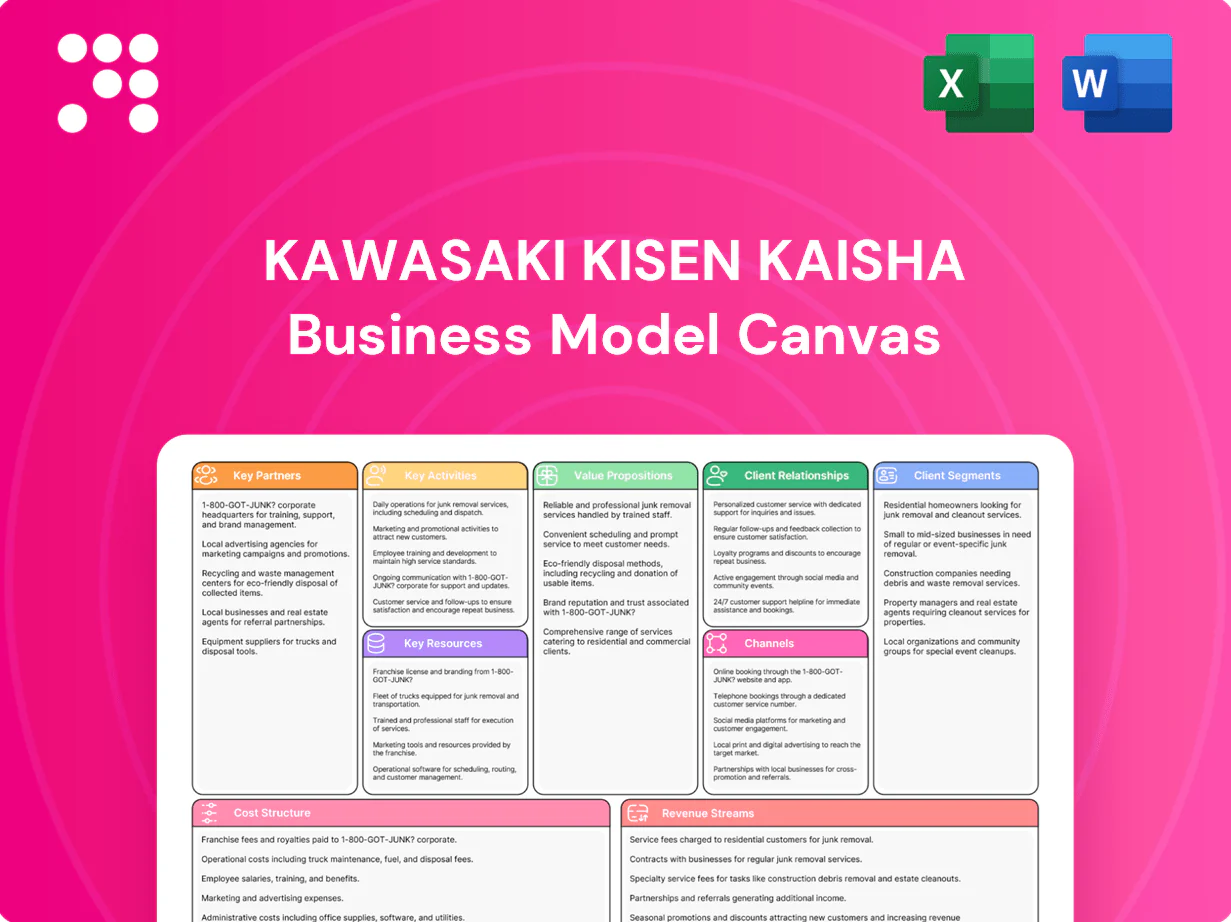
Kawasaki Kisen Kaisha Business Model Canvas

Maritime Business Model Canvas: concise mapping of value, revenue, and key partnerships
Unlock the strategic core of Kawasaki Kisen Kaisha with our concise Business Model Canvas that maps value propositions, revenue streams, and key partnerships across nine blocks. Ideal for investors, consultants, and founders seeking actionable insights. Purchase the full, editable Canvas to benchmark, adapt, and implement proven maritime strategies.
Partnerships

Port authorities and terminal operators
K LINE partners with global port authorities and terminal operators to secure berthing windows and streamline cargo handling, strengthening operations in 2024. These collaborations cut turnaround time and mitigate congestion risk through coordinated scheduling and resource sharing. Joint planning with terminals enhances reliability and schedule integrity, while coordinated investments in cranes and yard automation support capacity and productivity gains.
Shipyards and maintenance service providers
Close ties with shipbuilders and dry-dock yards enable K Line to schedule timely newbuilds, retrofits, and class renewals, supporting a fleet of roughly 400–500 vessels and accelerating ammonia/LNG-capable retrofits announced in 2024. Access to global maintenance networks keeps operational availability high and reduces off-hire days, while collaborative R&D with yards has cut fuel consumption on trial ships by mid-single-digit percentages. Standardized MRO contracts stabilize lifecycle costs and cap annual maintenance spend volatility for the fleet.

Fuel and energy suppliers
Strategic relationships with bunker providers secure supply across regions and ports, supporting fleet operations and resilience. Partnerships on LNG, VLSFO, biofuels and emerging e-fuels underpin decarbonization pathways, aligned with over 80 ports offering LNG bunkering by 2024. Hedging and centralized procurement programs mitigate price volatility—bunker prices swung more than 40% in recent years—while joint fuel trials validate emission‑reduction pathways.

Technology and data partners
Alliances with maritime tech firms give K Line voyage optimization, IoT telemetry and fleet monitoring that can cut fuel use 5–12% and lower emissions; advanced analytics boost utilization and safety through predictive maintenance and route planning. Cybersecurity and EDI integrations link shippers and terminals, supporting near-real-time booking and documentation flows. Co-innovation partnerships accelerate digital transformation and operational resilience.
- Fuel savings: 5–12%
- EDI adoption: improves booking/document flow
- Predictive maintenance: reduces downtime
- Co-innovation: speeds digital rollout
Cargo owners, charterers, and logistics intermediaries
Long-term contracts with automakers, energy majors, miners and grain houses stabilize volumes and underpin K Line’s freight mix; Kawasaki Kisen reported consolidated revenue of ¥1,044.6 billion for FY2023 (year ended March 2024), reflecting contract-backed demand. Forwarders and NVOCCs extend market reach, joint planning aligns vessel capacity with seasonal flows, and SLAs ensure predictability and performance.
- Long-term contracts: revenue stability
- Forwarders/NVOCCs: extended reach
- Joint planning: seasonal capacity fit
- SLAs: service predictability
Operator secures retrofits, saves 5-12% fuel across 400-500 vessels
K LINE leverages port/terminal, shipyard, bunker and tech partners to secure slots, speed retrofits and cut fuel/emissions, supporting ~400–500 vessels and FY2023 revenue ¥1,044.6bn. Collaborations enabled ammonia/LNG retrofit programs in 2024 and 5–12% fuel savings from voyage optimization. Long-term contracts with automakers/miners stabilize volumes and reduce revenue volatility.
| Metric | Value |
|---|---|
| Fleet size | 400–500 |
| FY2023 rev | ¥1,044.6bn |
| LNG ports (2024) | 80+ |
| Fuel savings | 5–12% |
What is included in the product
 Detailed Word Document
A comprehensive, pre-written Business Model Canvas for Kawasaki Kisen Kaisha (K Line) covering nine BMC blocks—customer segments, value propositions, channels, customer relationships, revenue streams, key resources, key activities, key partnerships, and cost structure—with detailed narratives and insights; ideal for presentations and investor discussions, including competitive advantage analysis and linked SWOT to support strategic decisions.

 Customizable Excel Spreadsheet
High-level view of Kawasaki Kisen Kaisha’s business model with editable cells to quickly pinpoint logistics bottlenecks, cost drivers and revenue levers.
Activities

Global liner and tramp operations
Operate containership, car carrier, dry-bulk and tanker voyages worldwide, managing schedules, rotations and berth windows across a fleet of around 400 vessels to match demand. Routing is optimized for safety, cost and emissions and the company balances owned and chartered tonnage to flex capacity. K Line targets net-zero by 2050 with interim 2030 GHG reductions and reports annual revenues above JPY 1 trillion.
Chartering and fleet deployment
K Line secures time and voyage charters to flex capacity across spot and contract markets, leveraging a roughly 400-vessel fleet to match seasonal demand. Vessel classes are aligned to cargo profiles and trade lanes to maximize utilization and freight rates. Charter party negotiation focuses on robust bunker clauses and off-hire terms, while continuous asset repositioning seeks to optimize yield and reduce ballast days.

Cargo handling and terminal operations
Coordinate loading, stowage and discharge to minimize port time, leveraging ONE’s consolidated container platform (initial capacity ~1.5 million TEU) for optimized slot planning and faster turnaround. Operate or co-manage terminals to assure throughput, using terminal partnerships and digital yard control to increase moves per hour. Enforce dockside safety and quality standards through audited procedures and integrate yard, gate and rail flows to sustain velocity and lower dwell times.

Compliance, safety, and risk management
Kawasaki Kisen Kaisha enforces IMO, flag and class regulations fleet-wide, covering ≈300 vessels (2024), and implements ISM/ISPS, vetting and environmental controls to sustain certification and port access. Insurance, voyage risk management and weather routing reduce claims and fuel use, while audits and continuous crew training maintain operational resilience and regulatory compliance.
- IMO/flag/class compliance — ≈300 vessels (2024)
- ISM/ISPS, vetting, environmental controls
- Insurance, voyage risk, weather routing
- Audits and continuous crew training
Customer service and digital enablement
K Line provides booking, tracking and documentation via customer portals and EDI, offers end-to-end value-added logistics from pre-carriage to on-carriage, operates 24/7 operations desks and key account support, and leverages analytics for on-time performance and exception management as of 2024.
- 24/7 operations
- Booking/tracking via EDI/portals
- Pre- to on-carriage logistics
- Analytics for OTP & exceptions
Operate ≈300-vessel fleet; optimize routing for net-zero 2050
Operate and commercialize ≈300-vessel fleet (2024) across containerships, car carriers, bulk and tankers, balancing owned vs chartered tonnage to match demand. Optimize routing, port rotations and terminal operations to reduce ballast days, fuel use and port time while targeting net-zero by 2050 with 2030 interim GHG cuts. Provide 24/7 booking, EDI/portal tracking, end-to-end logistics and analytics driving on-time performance.
| Metric | Value | Year |
|---|---|---|
| Fleet size | ≈300 vessels | 2024 |
| Revenue | >JPY 1 trillion | 2024 |
| Net-zero target | 2050 | - |
Full Version Awaits
Business Model Canvas
The Kawasaki Kisen Kaisha Business Model Canvas shown here is the actual document you’ll receive—no mockups or samples. Upon purchase, you’ll download this exact file, fully formatted and ready to edit in Word and Excel. What you see is the full structure and content, delivered intact and ready for immediate use.

Maritime Business Model Canvas: concise mapping of value, revenue, and key partnerships
Unlock the strategic core of Kawasaki Kisen Kaisha with our concise Business Model Canvas that maps value propositions, revenue streams, and key partnerships across nine blocks. Ideal for investors, consultants, and founders seeking actionable insights. Purchase the full, editable Canvas to benchmark, adapt, and implement proven maritime strategies.
Partnerships
Port authorities and terminal operators
K LINE partners with global port authorities and terminal operators to secure berthing windows and streamline cargo handling, strengthening operations in 2024. These collaborations cut turnaround time and mitigate congestion risk through coordinated scheduling and resource sharing. Joint planning with terminals enhances reliability and schedule integrity, while coordinated investments in cranes and yard automation support capacity and productivity gains.
Shipyards and maintenance service providers
Close ties with shipbuilders and dry-dock yards enable K Line to schedule timely newbuilds, retrofits, and class renewals, supporting a fleet of roughly 400–500 vessels and accelerating ammonia/LNG-capable retrofits announced in 2024. Access to global maintenance networks keeps operational availability high and reduces off-hire days, while collaborative R&D with yards has cut fuel consumption on trial ships by mid-single-digit percentages. Standardized MRO contracts stabilize lifecycle costs and cap annual maintenance spend volatility for the fleet.
Fuel and energy suppliers
Strategic relationships with bunker providers secure supply across regions and ports, supporting fleet operations and resilience. Partnerships on LNG, VLSFO, biofuels and emerging e-fuels underpin decarbonization pathways, aligned with over 80 ports offering LNG bunkering by 2024. Hedging and centralized procurement programs mitigate price volatility—bunker prices swung more than 40% in recent years—while joint fuel trials validate emission‑reduction pathways.
Technology and data partners
Alliances with maritime tech firms give K Line voyage optimization, IoT telemetry and fleet monitoring that can cut fuel use 5–12% and lower emissions; advanced analytics boost utilization and safety through predictive maintenance and route planning. Cybersecurity and EDI integrations link shippers and terminals, supporting near-real-time booking and documentation flows. Co-innovation partnerships accelerate digital transformation and operational resilience.
- Fuel savings: 5–12%
- EDI adoption: improves booking/document flow
- Predictive maintenance: reduces downtime
- Co-innovation: speeds digital rollout
Cargo owners, charterers, and logistics intermediaries
Long-term contracts with automakers, energy majors, miners and grain houses stabilize volumes and underpin K Line’s freight mix; Kawasaki Kisen reported consolidated revenue of ¥1,044.6 billion for FY2023 (year ended March 2024), reflecting contract-backed demand. Forwarders and NVOCCs extend market reach, joint planning aligns vessel capacity with seasonal flows, and SLAs ensure predictability and performance.
- Long-term contracts: revenue stability
- Forwarders/NVOCCs: extended reach
- Joint planning: seasonal capacity fit
- SLAs: service predictability
Operator secures retrofits, saves 5-12% fuel across 400-500 vessels
K LINE leverages port/terminal, shipyard, bunker and tech partners to secure slots, speed retrofits and cut fuel/emissions, supporting ~400–500 vessels and FY2023 revenue ¥1,044.6bn. Collaborations enabled ammonia/LNG retrofit programs in 2024 and 5–12% fuel savings from voyage optimization. Long-term contracts with automakers/miners stabilize volumes and reduce revenue volatility.
| Metric | Value |
|---|---|
| Fleet size | 400–500 |
| FY2023 rev | ¥1,044.6bn |
| LNG ports (2024) | 80+ |
| Fuel savings | 5–12% |
What is included in the product
Detailed Word Document
A comprehensive, pre-written Business Model Canvas for Kawasaki Kisen Kaisha (K Line) covering nine BMC blocks—customer segments, value propositions, channels, customer relationships, revenue streams, key resources, key activities, key partnerships, and cost structure—with detailed narratives and insights; ideal for presentations and investor discussions, including competitive advantage analysis and linked SWOT to support strategic decisions.
Customizable Excel Spreadsheet
High-level view of Kawasaki Kisen Kaisha’s business model with editable cells to quickly pinpoint logistics bottlenecks, cost drivers and revenue levers.
Activities
Global liner and tramp operations
Operate containership, car carrier, dry-bulk and tanker voyages worldwide, managing schedules, rotations and berth windows across a fleet of around 400 vessels to match demand. Routing is optimized for safety, cost and emissions and the company balances owned and chartered tonnage to flex capacity. K Line targets net-zero by 2050 with interim 2030 GHG reductions and reports annual revenues above JPY 1 trillion.
Chartering and fleet deployment
K Line secures time and voyage charters to flex capacity across spot and contract markets, leveraging a roughly 400-vessel fleet to match seasonal demand. Vessel classes are aligned to cargo profiles and trade lanes to maximize utilization and freight rates. Charter party negotiation focuses on robust bunker clauses and off-hire terms, while continuous asset repositioning seeks to optimize yield and reduce ballast days.
Cargo handling and terminal operations
Coordinate loading, stowage and discharge to minimize port time, leveraging ONE’s consolidated container platform (initial capacity ~1.5 million TEU) for optimized slot planning and faster turnaround. Operate or co-manage terminals to assure throughput, using terminal partnerships and digital yard control to increase moves per hour. Enforce dockside safety and quality standards through audited procedures and integrate yard, gate and rail flows to sustain velocity and lower dwell times.
Compliance, safety, and risk management
Kawasaki Kisen Kaisha enforces IMO, flag and class regulations fleet-wide, covering ≈300 vessels (2024), and implements ISM/ISPS, vetting and environmental controls to sustain certification and port access. Insurance, voyage risk management and weather routing reduce claims and fuel use, while audits and continuous crew training maintain operational resilience and regulatory compliance.
- IMO/flag/class compliance — ≈300 vessels (2024)
- ISM/ISPS, vetting, environmental controls
- Insurance, voyage risk, weather routing
- Audits and continuous crew training
Customer service and digital enablement
K Line provides booking, tracking and documentation via customer portals and EDI, offers end-to-end value-added logistics from pre-carriage to on-carriage, operates 24/7 operations desks and key account support, and leverages analytics for on-time performance and exception management as of 2024.
- 24/7 operations
- Booking/tracking via EDI/portals
- Pre- to on-carriage logistics
- Analytics for OTP & exceptions
Operate ≈300-vessel fleet; optimize routing for net-zero 2050
Operate and commercialize ≈300-vessel fleet (2024) across containerships, car carriers, bulk and tankers, balancing owned vs chartered tonnage to match demand. Optimize routing, port rotations and terminal operations to reduce ballast days, fuel use and port time while targeting net-zero by 2050 with 2030 interim GHG cuts. Provide 24/7 booking, EDI/portal tracking, end-to-end logistics and analytics driving on-time performance.
| Metric | Value | Year |
|---|---|---|
| Fleet size | ≈300 vessels | 2024 |
| Revenue | >JPY 1 trillion | 2024 |
| Net-zero target | 2050 | - |
Full Version Awaits
Business Model Canvas
The Kawasaki Kisen Kaisha Business Model Canvas shown here is the actual document you’ll receive—no mockups or samples. Upon purchase, you’ll download this exact file, fully formatted and ready to edit in Word and Excel. What you see is the full structure and content, delivered intact and ready for immediate use.
Original: $10.00
-65%$10.00
$3.50Description
Maritime Business Model Canvas: concise mapping of value, revenue, and key partnerships
Unlock the strategic core of Kawasaki Kisen Kaisha with our concise Business Model Canvas that maps value propositions, revenue streams, and key partnerships across nine blocks. Ideal for investors, consultants, and founders seeking actionable insights. Purchase the full, editable Canvas to benchmark, adapt, and implement proven maritime strategies.
Partnerships
Port authorities and terminal operators
K LINE partners with global port authorities and terminal operators to secure berthing windows and streamline cargo handling, strengthening operations in 2024. These collaborations cut turnaround time and mitigate congestion risk through coordinated scheduling and resource sharing. Joint planning with terminals enhances reliability and schedule integrity, while coordinated investments in cranes and yard automation support capacity and productivity gains.
Shipyards and maintenance service providers
Close ties with shipbuilders and dry-dock yards enable K Line to schedule timely newbuilds, retrofits, and class renewals, supporting a fleet of roughly 400–500 vessels and accelerating ammonia/LNG-capable retrofits announced in 2024. Access to global maintenance networks keeps operational availability high and reduces off-hire days, while collaborative R&D with yards has cut fuel consumption on trial ships by mid-single-digit percentages. Standardized MRO contracts stabilize lifecycle costs and cap annual maintenance spend volatility for the fleet.
Fuel and energy suppliers
Strategic relationships with bunker providers secure supply across regions and ports, supporting fleet operations and resilience. Partnerships on LNG, VLSFO, biofuels and emerging e-fuels underpin decarbonization pathways, aligned with over 80 ports offering LNG bunkering by 2024. Hedging and centralized procurement programs mitigate price volatility—bunker prices swung more than 40% in recent years—while joint fuel trials validate emission‑reduction pathways.
Technology and data partners
Alliances with maritime tech firms give K Line voyage optimization, IoT telemetry and fleet monitoring that can cut fuel use 5–12% and lower emissions; advanced analytics boost utilization and safety through predictive maintenance and route planning. Cybersecurity and EDI integrations link shippers and terminals, supporting near-real-time booking and documentation flows. Co-innovation partnerships accelerate digital transformation and operational resilience.
- Fuel savings: 5–12%
- EDI adoption: improves booking/document flow
- Predictive maintenance: reduces downtime
- Co-innovation: speeds digital rollout
Cargo owners, charterers, and logistics intermediaries
Long-term contracts with automakers, energy majors, miners and grain houses stabilize volumes and underpin K Line’s freight mix; Kawasaki Kisen reported consolidated revenue of ¥1,044.6 billion for FY2023 (year ended March 2024), reflecting contract-backed demand. Forwarders and NVOCCs extend market reach, joint planning aligns vessel capacity with seasonal flows, and SLAs ensure predictability and performance.
- Long-term contracts: revenue stability
- Forwarders/NVOCCs: extended reach
- Joint planning: seasonal capacity fit
- SLAs: service predictability
Operator secures retrofits, saves 5-12% fuel across 400-500 vessels
K LINE leverages port/terminal, shipyard, bunker and tech partners to secure slots, speed retrofits and cut fuel/emissions, supporting ~400–500 vessels and FY2023 revenue ¥1,044.6bn. Collaborations enabled ammonia/LNG retrofit programs in 2024 and 5–12% fuel savings from voyage optimization. Long-term contracts with automakers/miners stabilize volumes and reduce revenue volatility.
| Metric | Value |
|---|---|
| Fleet size | 400–500 |
| FY2023 rev | ¥1,044.6bn |
| LNG ports (2024) | 80+ |
| Fuel savings | 5–12% |
What is included in the product
Detailed Word Document
A comprehensive, pre-written Business Model Canvas for Kawasaki Kisen Kaisha (K Line) covering nine BMC blocks—customer segments, value propositions, channels, customer relationships, revenue streams, key resources, key activities, key partnerships, and cost structure—with detailed narratives and insights; ideal for presentations and investor discussions, including competitive advantage analysis and linked SWOT to support strategic decisions.
Customizable Excel Spreadsheet
High-level view of Kawasaki Kisen Kaisha’s business model with editable cells to quickly pinpoint logistics bottlenecks, cost drivers and revenue levers.
Activities
Global liner and tramp operations
Operate containership, car carrier, dry-bulk and tanker voyages worldwide, managing schedules, rotations and berth windows across a fleet of around 400 vessels to match demand. Routing is optimized for safety, cost and emissions and the company balances owned and chartered tonnage to flex capacity. K Line targets net-zero by 2050 with interim 2030 GHG reductions and reports annual revenues above JPY 1 trillion.
Chartering and fleet deployment
K Line secures time and voyage charters to flex capacity across spot and contract markets, leveraging a roughly 400-vessel fleet to match seasonal demand. Vessel classes are aligned to cargo profiles and trade lanes to maximize utilization and freight rates. Charter party negotiation focuses on robust bunker clauses and off-hire terms, while continuous asset repositioning seeks to optimize yield and reduce ballast days.
Cargo handling and terminal operations
Coordinate loading, stowage and discharge to minimize port time, leveraging ONE’s consolidated container platform (initial capacity ~1.5 million TEU) for optimized slot planning and faster turnaround. Operate or co-manage terminals to assure throughput, using terminal partnerships and digital yard control to increase moves per hour. Enforce dockside safety and quality standards through audited procedures and integrate yard, gate and rail flows to sustain velocity and lower dwell times.
Compliance, safety, and risk management
Kawasaki Kisen Kaisha enforces IMO, flag and class regulations fleet-wide, covering ≈300 vessels (2024), and implements ISM/ISPS, vetting and environmental controls to sustain certification and port access. Insurance, voyage risk management and weather routing reduce claims and fuel use, while audits and continuous crew training maintain operational resilience and regulatory compliance.
- IMO/flag/class compliance — ≈300 vessels (2024)
- ISM/ISPS, vetting, environmental controls
- Insurance, voyage risk, weather routing
- Audits and continuous crew training
Customer service and digital enablement
K Line provides booking, tracking and documentation via customer portals and EDI, offers end-to-end value-added logistics from pre-carriage to on-carriage, operates 24/7 operations desks and key account support, and leverages analytics for on-time performance and exception management as of 2024.
- 24/7 operations
- Booking/tracking via EDI/portals
- Pre- to on-carriage logistics
- Analytics for OTP & exceptions
Operate ≈300-vessel fleet; optimize routing for net-zero 2050
Operate and commercialize ≈300-vessel fleet (2024) across containerships, car carriers, bulk and tankers, balancing owned vs chartered tonnage to match demand. Optimize routing, port rotations and terminal operations to reduce ballast days, fuel use and port time while targeting net-zero by 2050 with 2030 interim GHG cuts. Provide 24/7 booking, EDI/portal tracking, end-to-end logistics and analytics driving on-time performance.
| Metric | Value | Year |
|---|---|---|
| Fleet size | ≈300 vessels | 2024 |
| Revenue | >JPY 1 trillion | 2024 |
| Net-zero target | 2050 | - |
Full Version Awaits
Business Model Canvas
The Kawasaki Kisen Kaisha Business Model Canvas shown here is the actual document you’ll receive—no mockups or samples. Upon purchase, you’ll download this exact file, fully formatted and ready to edit in Word and Excel. What you see is the full structure and content, delivered intact and ready for immediate use.











