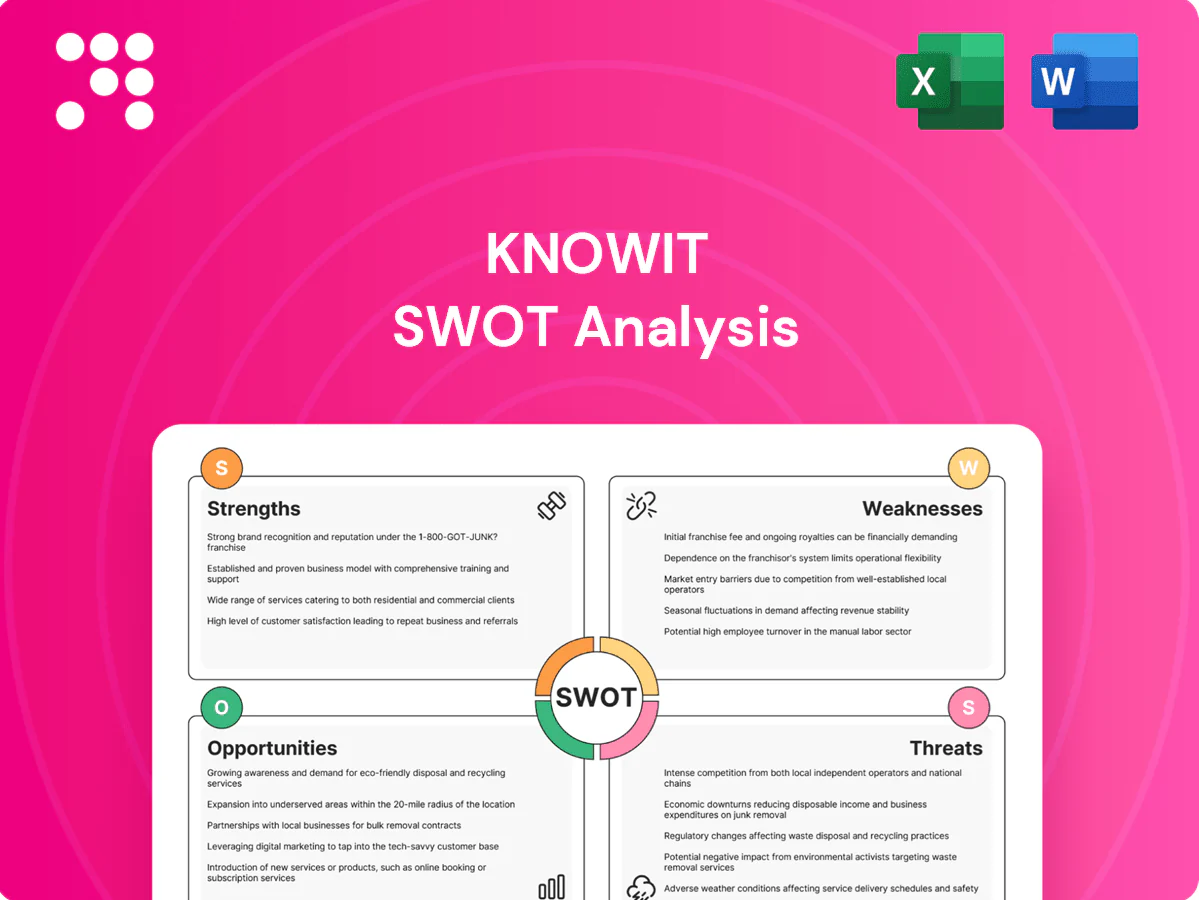
Knowit SWOT Analysis

Go Beyond the Preview—Access the Full Strategic Report
Knowit’s SWOT snapshot highlights its digital consulting strengths, market opportunities, and key risks, but the full analysis reveals the strategic levers behind those points. Purchase the complete SWOT to access a research-backed, editable report and Excel matrix. Ideal for investors, advisors, and leaders who need actionable, presentation-ready insights.
Strengths

End-to-end digital transformation capability
Combining management consulting, system development, strategy and experience design lets Knowit deliver seamless vision-to-execution programs, reflected in its ~6.0 billion SEK revenue in 2024. Clients face fewer handoffs and see faster time-to-value, often accelerating delivery cycles. This integrated model differentiates Knowit from niche boutiques and supports large, multi-year programs with consistent governance.
User-centric and experience-led design
Strong, user-centric and experience-led design at Knowit drives higher adoption and satisfaction, improving ROI on digital initiatives by reducing churn and accelerating time-to-value. Human-centered methods cut rework and risks, producing better outcomes and faster delivery. This emphasis matches modern product thinking and supports measurable uplifts in NPS and conversion metrics.

Innovation and sustainability focus
Positioning around innovative, sustainable solutions aligns with enterprise ESG priorities and strengthens Knowit’s bid for green IT, energy-efficiency and circular digital product contracts. This focus supports wins in public sector and regulated tenders across the Nordics, leveraging Knowit’s presence in Sweden, Norway and Finland and its ~3,500 consultants. It also bolsters brand differentiation and pricing power, building on reported ~SEK 4bn group revenue (2023).

Cross-industry domain knowledge
Knowit's cross-industry domain knowledge, with operations across public sector, finance and telecom and listed on Nasdaq Stockholm, enables rapid pattern recognition and development of reusable accelerators that cut time-to-value.
Clients receive transferred best practices that lower delivery risk and cost while allowing solutions to be tailored to specific regulatory and operational realities.
- Reusable accelerators: faster deployment
- Cross-sector best practices: lower delivery risk
- Cost reduction: economies of scale
- Regulatory tailoring: compliant implementations
Agile delivery and modern engineering
Agile methods and iterative delivery lower project risk and improve responsiveness, while DevOps and cloud-native engineering accelerate release cadence and mean-time-to-repair, enhancing scalability and reliability for Knowit’s client solutions.
These practices tighten business–IT alignment, enable continuous improvement loops, and support faster value realization across digital transformation engagements.
- Agile iterative delivery
- DevOps & cloud-native engineering
- Improved scalability & reliability
- Tighter business–IT alignment
Integrated consulting, UX & cloud delivery: ~6.0bn SEK, ~3.5k consultants
Knowit’s integrated consulting, development and UX model generated ~6.0bn SEK revenue in 2024 with ~3,500 consultants, reducing handoffs and accelerating time-to-value. Reusable accelerators and human-centered design cut rework and cost. Agile, DevOps and cloud-native delivery improve scalability and MTTRepair, supporting Nordic public and regulated wins.
| Metric | Value |
|---|---|
| Revenue 2024 | ~6.0bn SEK |
| Consultants | ~3,500 |
| Listing | Nasdaq Stockholm |
What is included in the product
 Detailed Word Document
Delivers a strategic overview of Knowit’s internal and external business factors, outlining strengths, weaknesses, opportunities and threats to assess its competitive position, key growth drivers, operational gaps and market risks.

 Customizable Excel Spreadsheet
Delivers a concise, visual SWOT matrix that streamlines strategic alignment and stakeholder updates, with editable sections for rapid scenario updates and cross-unit comparisons.
Weaknesses

Project-based revenue volatility
Reliance on discretionary transformation budgets makes Knowit vulnerable to uneven utilization, as clients can postpone or cancel projects when priorities shift. Economic slowdowns typically delay deal closures, pressuring margins and making quarterly forecasting less reliable. This volatility complicates long-term resource planning and increases the risk of under- or overcapacity in consulting teams.
Talent attraction and retention pressure
Competition for skilled consultants, designers and engineers in the Nordics pushes Knowit to match market-driven pay and benefits; industry attrition in IT consulting runs around 15–20% annually, risking delivery continuity and loss of institutional knowledge. Wage inflation of roughly 5–8% in 2023–24 has compressed consultancy margins, and rapid hiring to meet demand risks cultural dilution and uneven service quality.

Scale limits versus global giants
Knowit is primarily Nordic with operations in Sweden, Norway, Finland and Denmark and roughly 3,700 employees, which limits capacity to compete with global giants on mega-deals and multinational rollouts. Large multinationals with global delivery networks and deeper benches often win procurements seeking 24/7 follow-the-sun support. This constrains Knowit's average deal size and wallet share in global sourcing processes.

Potential over-customization
Potential over-customization raises complexity, ongoing maintenance costs and delivery risk; without stronger productization Knowit, listed on Nasdaq Stockholm (KNOW), may see margin pressure as bespoke work limits repeatability and scale.
- Higher complexity → increased maintenance burden
- Lower productization → margin erosion risk
- Underused accelerators → slower delivery
Dependency on key clients and sectors
Concentration in a few verticals and key accounts makes Knowit vulnerable: roughly SEK 4.8 billion in 2024 net sales magnifies revenue risk if one major client reduces spend.
Material shifts in a client’s strategy can quickly depress pipelines and utilization, while diversification initiatives have struggled to outpace rapid market shifts and new competitors.
High exposure to a few clients also weakens pricing power, increasing negotiation risk and margin pressure in downturns.
- Top-client dependency: amplifies revenue volatility
- Pipeline sensitivity: client strategy shifts cause material impact
- Diversification lag: slower than market change
- Pricing exposure: limited negotiation leverage
Nordic IT squeeze: 15-20% attrition, 5-8% wage inflation
Dependence on discretionary transformation budgets creates revenue volatility and forecasting risk. Talent attrition (~15–20%) and ~3,700 employees strain delivery continuity amid 5–8% wage inflation, compressing margins. Nordic focus with SEK 4.8bn 2024 sales limits scale versus global players and exposes pricing and client-concentration risk.
| Metric | Value |
|---|---|
| 2024 net sales | SEK 4.8bn |
| Employees | ~3,700 |
| Attrition | 15–20% |
| Wage inflation (2023–24) | 5–8% |
Same Document Delivered
Knowit SWOT Analysis
This is the actual Knowit SWOT analysis document you’ll receive upon purchase—no surprises, just professional quality. The preview below is taken directly from the full report you'll get, and the complete, editable version becomes available after checkout. You’re viewing a live excerpt of the real file; buy now to unlock the full, detailed analysis.

Go Beyond the Preview—Access the Full Strategic Report
Knowit’s SWOT snapshot highlights its digital consulting strengths, market opportunities, and key risks, but the full analysis reveals the strategic levers behind those points. Purchase the complete SWOT to access a research-backed, editable report and Excel matrix. Ideal for investors, advisors, and leaders who need actionable, presentation-ready insights.
Strengths
End-to-end digital transformation capability
Combining management consulting, system development, strategy and experience design lets Knowit deliver seamless vision-to-execution programs, reflected in its ~6.0 billion SEK revenue in 2024. Clients face fewer handoffs and see faster time-to-value, often accelerating delivery cycles. This integrated model differentiates Knowit from niche boutiques and supports large, multi-year programs with consistent governance.
User-centric and experience-led design
Strong, user-centric and experience-led design at Knowit drives higher adoption and satisfaction, improving ROI on digital initiatives by reducing churn and accelerating time-to-value. Human-centered methods cut rework and risks, producing better outcomes and faster delivery. This emphasis matches modern product thinking and supports measurable uplifts in NPS and conversion metrics.
Innovation and sustainability focus
Positioning around innovative, sustainable solutions aligns with enterprise ESG priorities and strengthens Knowit’s bid for green IT, energy-efficiency and circular digital product contracts. This focus supports wins in public sector and regulated tenders across the Nordics, leveraging Knowit’s presence in Sweden, Norway and Finland and its ~3,500 consultants. It also bolsters brand differentiation and pricing power, building on reported ~SEK 4bn group revenue (2023).
Cross-industry domain knowledge
Knowit's cross-industry domain knowledge, with operations across public sector, finance and telecom and listed on Nasdaq Stockholm, enables rapid pattern recognition and development of reusable accelerators that cut time-to-value.
Clients receive transferred best practices that lower delivery risk and cost while allowing solutions to be tailored to specific regulatory and operational realities.
- Reusable accelerators: faster deployment
- Cross-sector best practices: lower delivery risk
- Cost reduction: economies of scale
- Regulatory tailoring: compliant implementations
Agile delivery and modern engineering
Agile methods and iterative delivery lower project risk and improve responsiveness, while DevOps and cloud-native engineering accelerate release cadence and mean-time-to-repair, enhancing scalability and reliability for Knowit’s client solutions.
These practices tighten business–IT alignment, enable continuous improvement loops, and support faster value realization across digital transformation engagements.
- Agile iterative delivery
- DevOps & cloud-native engineering
- Improved scalability & reliability
- Tighter business–IT alignment
Integrated consulting, UX & cloud delivery: ~6.0bn SEK, ~3.5k consultants
Knowit’s integrated consulting, development and UX model generated ~6.0bn SEK revenue in 2024 with ~3,500 consultants, reducing handoffs and accelerating time-to-value. Reusable accelerators and human-centered design cut rework and cost. Agile, DevOps and cloud-native delivery improve scalability and MTTRepair, supporting Nordic public and regulated wins.
| Metric | Value |
|---|---|
| Revenue 2024 | ~6.0bn SEK |
| Consultants | ~3,500 |
| Listing | Nasdaq Stockholm |
What is included in the product
Detailed Word Document
Delivers a strategic overview of Knowit’s internal and external business factors, outlining strengths, weaknesses, opportunities and threats to assess its competitive position, key growth drivers, operational gaps and market risks.
Customizable Excel Spreadsheet
Delivers a concise, visual SWOT matrix that streamlines strategic alignment and stakeholder updates, with editable sections for rapid scenario updates and cross-unit comparisons.
Weaknesses
Project-based revenue volatility
Reliance on discretionary transformation budgets makes Knowit vulnerable to uneven utilization, as clients can postpone or cancel projects when priorities shift. Economic slowdowns typically delay deal closures, pressuring margins and making quarterly forecasting less reliable. This volatility complicates long-term resource planning and increases the risk of under- or overcapacity in consulting teams.
Talent attraction and retention pressure
Competition for skilled consultants, designers and engineers in the Nordics pushes Knowit to match market-driven pay and benefits; industry attrition in IT consulting runs around 15–20% annually, risking delivery continuity and loss of institutional knowledge. Wage inflation of roughly 5–8% in 2023–24 has compressed consultancy margins, and rapid hiring to meet demand risks cultural dilution and uneven service quality.
Scale limits versus global giants
Knowit is primarily Nordic with operations in Sweden, Norway, Finland and Denmark and roughly 3,700 employees, which limits capacity to compete with global giants on mega-deals and multinational rollouts. Large multinationals with global delivery networks and deeper benches often win procurements seeking 24/7 follow-the-sun support. This constrains Knowit's average deal size and wallet share in global sourcing processes.
Potential over-customization
Potential over-customization raises complexity, ongoing maintenance costs and delivery risk; without stronger productization Knowit, listed on Nasdaq Stockholm (KNOW), may see margin pressure as bespoke work limits repeatability and scale.
- Higher complexity → increased maintenance burden
- Lower productization → margin erosion risk
- Underused accelerators → slower delivery
Dependency on key clients and sectors
Concentration in a few verticals and key accounts makes Knowit vulnerable: roughly SEK 4.8 billion in 2024 net sales magnifies revenue risk if one major client reduces spend.
Material shifts in a client’s strategy can quickly depress pipelines and utilization, while diversification initiatives have struggled to outpace rapid market shifts and new competitors.
High exposure to a few clients also weakens pricing power, increasing negotiation risk and margin pressure in downturns.
- Top-client dependency: amplifies revenue volatility
- Pipeline sensitivity: client strategy shifts cause material impact
- Diversification lag: slower than market change
- Pricing exposure: limited negotiation leverage
Nordic IT squeeze: 15-20% attrition, 5-8% wage inflation
Dependence on discretionary transformation budgets creates revenue volatility and forecasting risk. Talent attrition (~15–20%) and ~3,700 employees strain delivery continuity amid 5–8% wage inflation, compressing margins. Nordic focus with SEK 4.8bn 2024 sales limits scale versus global players and exposes pricing and client-concentration risk.
| Metric | Value |
|---|---|
| 2024 net sales | SEK 4.8bn |
| Employees | ~3,700 |
| Attrition | 15–20% |
| Wage inflation (2023–24) | 5–8% |
Same Document Delivered
Knowit SWOT Analysis
This is the actual Knowit SWOT analysis document you’ll receive upon purchase—no surprises, just professional quality. The preview below is taken directly from the full report you'll get, and the complete, editable version becomes available after checkout. You’re viewing a live excerpt of the real file; buy now to unlock the full, detailed analysis.
Original: $10.00
-65%$10.00
$3.50Description
Go Beyond the Preview—Access the Full Strategic Report
Knowit’s SWOT snapshot highlights its digital consulting strengths, market opportunities, and key risks, but the full analysis reveals the strategic levers behind those points. Purchase the complete SWOT to access a research-backed, editable report and Excel matrix. Ideal for investors, advisors, and leaders who need actionable, presentation-ready insights.
Strengths
End-to-end digital transformation capability
Combining management consulting, system development, strategy and experience design lets Knowit deliver seamless vision-to-execution programs, reflected in its ~6.0 billion SEK revenue in 2024. Clients face fewer handoffs and see faster time-to-value, often accelerating delivery cycles. This integrated model differentiates Knowit from niche boutiques and supports large, multi-year programs with consistent governance.
User-centric and experience-led design
Strong, user-centric and experience-led design at Knowit drives higher adoption and satisfaction, improving ROI on digital initiatives by reducing churn and accelerating time-to-value. Human-centered methods cut rework and risks, producing better outcomes and faster delivery. This emphasis matches modern product thinking and supports measurable uplifts in NPS and conversion metrics.
Innovation and sustainability focus
Positioning around innovative, sustainable solutions aligns with enterprise ESG priorities and strengthens Knowit’s bid for green IT, energy-efficiency and circular digital product contracts. This focus supports wins in public sector and regulated tenders across the Nordics, leveraging Knowit’s presence in Sweden, Norway and Finland and its ~3,500 consultants. It also bolsters brand differentiation and pricing power, building on reported ~SEK 4bn group revenue (2023).
Cross-industry domain knowledge
Knowit's cross-industry domain knowledge, with operations across public sector, finance and telecom and listed on Nasdaq Stockholm, enables rapid pattern recognition and development of reusable accelerators that cut time-to-value.
Clients receive transferred best practices that lower delivery risk and cost while allowing solutions to be tailored to specific regulatory and operational realities.
- Reusable accelerators: faster deployment
- Cross-sector best practices: lower delivery risk
- Cost reduction: economies of scale
- Regulatory tailoring: compliant implementations
Agile delivery and modern engineering
Agile methods and iterative delivery lower project risk and improve responsiveness, while DevOps and cloud-native engineering accelerate release cadence and mean-time-to-repair, enhancing scalability and reliability for Knowit’s client solutions.
These practices tighten business–IT alignment, enable continuous improvement loops, and support faster value realization across digital transformation engagements.
- Agile iterative delivery
- DevOps & cloud-native engineering
- Improved scalability & reliability
- Tighter business–IT alignment
Integrated consulting, UX & cloud delivery: ~6.0bn SEK, ~3.5k consultants
Knowit’s integrated consulting, development and UX model generated ~6.0bn SEK revenue in 2024 with ~3,500 consultants, reducing handoffs and accelerating time-to-value. Reusable accelerators and human-centered design cut rework and cost. Agile, DevOps and cloud-native delivery improve scalability and MTTRepair, supporting Nordic public and regulated wins.
| Metric | Value |
|---|---|
| Revenue 2024 | ~6.0bn SEK |
| Consultants | ~3,500 |
| Listing | Nasdaq Stockholm |
What is included in the product
Detailed Word Document
Delivers a strategic overview of Knowit’s internal and external business factors, outlining strengths, weaknesses, opportunities and threats to assess its competitive position, key growth drivers, operational gaps and market risks.
Customizable Excel Spreadsheet
Delivers a concise, visual SWOT matrix that streamlines strategic alignment and stakeholder updates, with editable sections for rapid scenario updates and cross-unit comparisons.
Weaknesses
Project-based revenue volatility
Reliance on discretionary transformation budgets makes Knowit vulnerable to uneven utilization, as clients can postpone or cancel projects when priorities shift. Economic slowdowns typically delay deal closures, pressuring margins and making quarterly forecasting less reliable. This volatility complicates long-term resource planning and increases the risk of under- or overcapacity in consulting teams.
Talent attraction and retention pressure
Competition for skilled consultants, designers and engineers in the Nordics pushes Knowit to match market-driven pay and benefits; industry attrition in IT consulting runs around 15–20% annually, risking delivery continuity and loss of institutional knowledge. Wage inflation of roughly 5–8% in 2023–24 has compressed consultancy margins, and rapid hiring to meet demand risks cultural dilution and uneven service quality.
Scale limits versus global giants
Knowit is primarily Nordic with operations in Sweden, Norway, Finland and Denmark and roughly 3,700 employees, which limits capacity to compete with global giants on mega-deals and multinational rollouts. Large multinationals with global delivery networks and deeper benches often win procurements seeking 24/7 follow-the-sun support. This constrains Knowit's average deal size and wallet share in global sourcing processes.
Potential over-customization
Potential over-customization raises complexity, ongoing maintenance costs and delivery risk; without stronger productization Knowit, listed on Nasdaq Stockholm (KNOW), may see margin pressure as bespoke work limits repeatability and scale.
- Higher complexity → increased maintenance burden
- Lower productization → margin erosion risk
- Underused accelerators → slower delivery
Dependency on key clients and sectors
Concentration in a few verticals and key accounts makes Knowit vulnerable: roughly SEK 4.8 billion in 2024 net sales magnifies revenue risk if one major client reduces spend.
Material shifts in a client’s strategy can quickly depress pipelines and utilization, while diversification initiatives have struggled to outpace rapid market shifts and new competitors.
High exposure to a few clients also weakens pricing power, increasing negotiation risk and margin pressure in downturns.
- Top-client dependency: amplifies revenue volatility
- Pipeline sensitivity: client strategy shifts cause material impact
- Diversification lag: slower than market change
- Pricing exposure: limited negotiation leverage
Nordic IT squeeze: 15-20% attrition, 5-8% wage inflation
Dependence on discretionary transformation budgets creates revenue volatility and forecasting risk. Talent attrition (~15–20%) and ~3,700 employees strain delivery continuity amid 5–8% wage inflation, compressing margins. Nordic focus with SEK 4.8bn 2024 sales limits scale versus global players and exposes pricing and client-concentration risk.
| Metric | Value |
|---|---|
| 2024 net sales | SEK 4.8bn |
| Employees | ~3,700 |
| Attrition | 15–20% |
| Wage inflation (2023–24) | 5–8% |
Same Document Delivered
Knowit SWOT Analysis
This is the actual Knowit SWOT analysis document you’ll receive upon purchase—no surprises, just professional quality. The preview below is taken directly from the full report you'll get, and the complete, editable version becomes available after checkout. You’re viewing a live excerpt of the real file; buy now to unlock the full, detailed analysis.











