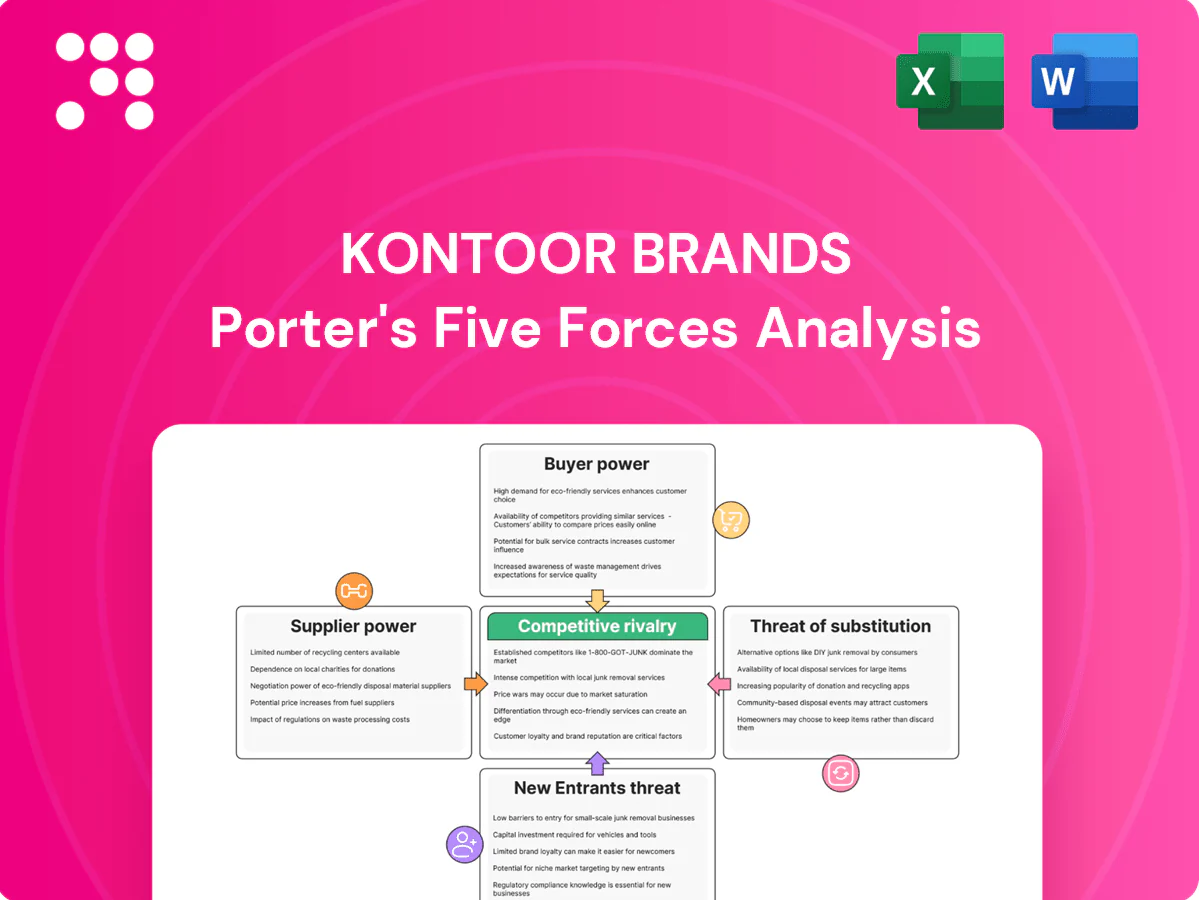
Kontoor Brands Porter's Five Forces Analysis

Elevate Your Analysis with the Complete Porter's Five Forces Analysis
Kontoor Brands faces moderate buyer power, intense rivalry among apparel peers, and rising substitute threats from fast fashion and DTC brands. Supplier influence is limited, while barriers to entry remain moderate due to brand and scale. This snapshot highlights pressures shaping margins and growth. Unlock the full Porter's Five Forces Analysis for detailed ratings, visuals, and actionable strategy recommendations.
Suppliers Bargaining Power

Diverse but specialized fabric sources
Diverse but quality‑tiered suppliers provide denim‑grade cotton, specialty stretch fabrics and finishing chemicals; in 2024 premium denim mills and specialty dye houses remained materially fewer than commodity cotton suppliers, increasing leverage on high‑end SKUs. Kontoor can dual‑source many inputs, but long qualification cycles and consistency needs constrain rapid switching. This yields moderate supplier power on premium product lines.
Compliance and sustainability constraints
Traceability, water-use limits and chemical compliance shrink the pool of compliant mills; meeting ZDHC and OEKO-TEX standards further narrows eligible suppliers, strengthening those mills’ bargaining power. Kontoor Brands reported about $1.7 billion in net sales in FY2024, tying brand reputation to audited partners and constraining rapid supplier switches. Suppliers exceeding ESG norms can command price premiums and preferential contracts.

Logistics and lead-time sensitivity
Long denim lead times of roughly 12–20 weeks, with finishing adding 2–4 weeks, heighten dependence on reliable partners. Freight volatility — Drewry WCI averaged about USD 2,300 per 40ft in 2024 — and port congestion raise landed-cost leverage for nearby or flexible-capacity suppliers. Nearshoring providers in Mexico/Turkey gain pricing power; Kontoor mitigates risk via planning and diversified regional sourcing.

Input price volatility
Input price volatility — notably cotton, energy and chemicals — increased supplier leverage in 2024, driving more frequent pass-throughs to apparel makers; hedging and multi-year purchase agreements reduce but do not eliminate spike risk. Suppliers can favor higher-margin customers when capacity tightens, though Kontoor’s global scale and 2024 purchasing volumes (net sales ~1.6 billion) preserve negotiating balance.
- 2024: elevated cotton/energy volatility increased pass-through pressure
- Hedging/long-term contracts mitigate but not remove spikes
- Suppliers prioritize higher-margin buyers in tight capacity
- Kontoor scale (~1.6B sales) supports stronger negotiation
Limited vertical integration
Kontoor largely relies on external mills and contractors rather than owning upstream fabric production, increasing exposure to supplier pricing and input-cost volatility; process know-how, quality standards and long-term contracts let the company benchmark suppliers and reallocate volumes over time, keeping negotiation leverage. Net effect: moderate supplier power that varies by material tier and specialty inputs.
- Reliance on external mills: elevated exposure
- Process standards: enable supplier switching
- Long-term contracts: dampen short-term price shocks
- Overall: moderate supplier power, higher for specialty tiers
Supplier power elevated - $1.7B; 12-24 wks
Supplier power is moderate overall but high for premium denim and compliant mills due to limited specialty-capacity and traceability rules; Kontoor reported FY2024 net sales of ~$1.7B which preserves negotiation leverage. Long lead times (12–20+ weeks), Drewry WCI ≈ $2,300/40ft and cotton/energy volatility elevated supplier pricing power despite hedging and long-term contracts.
| Metric | 2024 Value | Impact |
|---|---|---|
| Net sales | $1.7B | Supports leverage |
| Lead time | 12–24 weeks | Limits switching |
| Drewry WCI | $2,300/40ft | Raises landed cost |
What is included in the product
 Detailed Word Document
Tailored for Kontoor Brands, this Porter's Five Forces analysis uncovers competition drivers, buyer and supplier power, substitute threats, and entry barriers, highlighting disruptive trends and strategic levers that influence pricing, profitability, and market share.

 Customizable Excel Spreadsheet
A concise Porter's Five Forces snapshot for Kontoor Brands—instantly clarifies competitive pressures and supplier/customer leverage to speed strategic choices. Clean, copy-ready layout with adjustable pressure levels lets teams model scenarios (e.g., retail shifts, raw-material cost swings) without complex tools.
Customers Bargaining Power

Concentration of wholesale retailers
Mass merchants such as Walmart and Target, plus large department stores, command the shelf space and high-volume placements critical for Kontoor Brands, forcing deep markdown support and stringent payment terms. Their purchasing scale compresses margins and negotiating leverage, making the loss of a single key account materially reduce sell-through visibility and volumes. This concentration of wholesale demand concentrates buyer power and heightens distribution risk for Kontoor.
Low switching costs for consumers
Low switching costs let denim consumers move freely among mid-priced brands and private labels; Kontoor Brands reported approximately $2.5 billion in net sales in fiscal 2024, underscoring scale but not immunity to churn. Rapid style, fit, and promotional cycles drive quick substitution, while online price transparency and comparison tools elevate price elasticity. This combination raises customer bargaining power and margin pressure.

Brand equity of Wrangler and Lee
Wrangler and Lee’s deep heritage and proven fit loyalty lower churn among core consumers, supporting Kontoor Brands’ 2024 net sales of about $2.1 billion and an estimated US denim market share near 11%. Retail partners prize consistent velocity from these staples, which tempers aggressive price or promotional demands. Growing DTC channels—roughly 18% of revenue in 2024—strengthen brand pull and enable data-driven pricing. This combination moderates buyer power, notably for evergreen styles.

Omnichannel and DTC mix
Kontoor Brands’ expansion of company stores, e-commerce and marketplace channels shifts revenue away from wholesale, strengthening margin and assortment control through first-party customer data; as DTC share rises, reliance on large retail buyers falls and buyer bargaining power weakens.
Private label competition
Retailers’ private-label apparel provides lower-priced alternatives and captures higher margin, using favorable shelf placement and promotional slots to squeeze national brands like Kontoor.
Kontoor must defend pricing by emphasizing superior fit, proven durability, and its heritage brand story to maintain premium positioning against value-tier entrants.
This dynamic sustains elevated buyer power at value segments, forcing ongoing product and marketing differentiation.
Retailer leverage concentrates distribution risk; DTC at ~18% cushions demand
Large national retailers exert strong price and payment leverage, concentrating distribution risk despite Kontoor Brands’ approximately $2.5 billion in fiscal 2024 net sales. Low switching costs and online price transparency raise buyer power, while Wrangler and Lee loyalty plus an ~18% DTC mix in 2024 moderate demands for core styles. Overall buyer power remains elevated in value tiers where private labels press margins.
| Metric | 2024 |
|---|---|
| Net sales | $2.5B |
| DTC share | ~18% |
| US denim market share | ~11% |
Same Document Delivered
Kontoor Brands Porter's Five Forces Analysis
This preview shows the exact Kontoor Brands Porter's Five Forces analysis you'll receive immediately after purchase—no surprises or placeholders. The document displayed here is fully formatted and ready for download the moment you buy. You're viewing the final, complete file.

Elevate Your Analysis with the Complete Porter's Five Forces Analysis
Kontoor Brands faces moderate buyer power, intense rivalry among apparel peers, and rising substitute threats from fast fashion and DTC brands. Supplier influence is limited, while barriers to entry remain moderate due to brand and scale. This snapshot highlights pressures shaping margins and growth. Unlock the full Porter's Five Forces Analysis for detailed ratings, visuals, and actionable strategy recommendations.
Suppliers Bargaining Power
Diverse but specialized fabric sources
Diverse but quality‑tiered suppliers provide denim‑grade cotton, specialty stretch fabrics and finishing chemicals; in 2024 premium denim mills and specialty dye houses remained materially fewer than commodity cotton suppliers, increasing leverage on high‑end SKUs. Kontoor can dual‑source many inputs, but long qualification cycles and consistency needs constrain rapid switching. This yields moderate supplier power on premium product lines.
Compliance and sustainability constraints
Traceability, water-use limits and chemical compliance shrink the pool of compliant mills; meeting ZDHC and OEKO-TEX standards further narrows eligible suppliers, strengthening those mills’ bargaining power. Kontoor Brands reported about $1.7 billion in net sales in FY2024, tying brand reputation to audited partners and constraining rapid supplier switches. Suppliers exceeding ESG norms can command price premiums and preferential contracts.
Logistics and lead-time sensitivity
Long denim lead times of roughly 12–20 weeks, with finishing adding 2–4 weeks, heighten dependence on reliable partners. Freight volatility — Drewry WCI averaged about USD 2,300 per 40ft in 2024 — and port congestion raise landed-cost leverage for nearby or flexible-capacity suppliers. Nearshoring providers in Mexico/Turkey gain pricing power; Kontoor mitigates risk via planning and diversified regional sourcing.
Input price volatility
Input price volatility — notably cotton, energy and chemicals — increased supplier leverage in 2024, driving more frequent pass-throughs to apparel makers; hedging and multi-year purchase agreements reduce but do not eliminate spike risk. Suppliers can favor higher-margin customers when capacity tightens, though Kontoor’s global scale and 2024 purchasing volumes (net sales ~1.6 billion) preserve negotiating balance.
- 2024: elevated cotton/energy volatility increased pass-through pressure
- Hedging/long-term contracts mitigate but not remove spikes
- Suppliers prioritize higher-margin buyers in tight capacity
- Kontoor scale (~1.6B sales) supports stronger negotiation
Limited vertical integration
Kontoor largely relies on external mills and contractors rather than owning upstream fabric production, increasing exposure to supplier pricing and input-cost volatility; process know-how, quality standards and long-term contracts let the company benchmark suppliers and reallocate volumes over time, keeping negotiation leverage. Net effect: moderate supplier power that varies by material tier and specialty inputs.
- Reliance on external mills: elevated exposure
- Process standards: enable supplier switching
- Long-term contracts: dampen short-term price shocks
- Overall: moderate supplier power, higher for specialty tiers
Supplier power elevated - $1.7B; 12-24 wks
Supplier power is moderate overall but high for premium denim and compliant mills due to limited specialty-capacity and traceability rules; Kontoor reported FY2024 net sales of ~$1.7B which preserves negotiation leverage. Long lead times (12–20+ weeks), Drewry WCI ≈ $2,300/40ft and cotton/energy volatility elevated supplier pricing power despite hedging and long-term contracts.
| Metric | 2024 Value | Impact |
|---|---|---|
| Net sales | $1.7B | Supports leverage |
| Lead time | 12–24 weeks | Limits switching |
| Drewry WCI | $2,300/40ft | Raises landed cost |
What is included in the product
Detailed Word Document
Tailored for Kontoor Brands, this Porter's Five Forces analysis uncovers competition drivers, buyer and supplier power, substitute threats, and entry barriers, highlighting disruptive trends and strategic levers that influence pricing, profitability, and market share.
Customizable Excel Spreadsheet
A concise Porter's Five Forces snapshot for Kontoor Brands—instantly clarifies competitive pressures and supplier/customer leverage to speed strategic choices. Clean, copy-ready layout with adjustable pressure levels lets teams model scenarios (e.g., retail shifts, raw-material cost swings) without complex tools.
Customers Bargaining Power
Concentration of wholesale retailers
Mass merchants such as Walmart and Target, plus large department stores, command the shelf space and high-volume placements critical for Kontoor Brands, forcing deep markdown support and stringent payment terms. Their purchasing scale compresses margins and negotiating leverage, making the loss of a single key account materially reduce sell-through visibility and volumes. This concentration of wholesale demand concentrates buyer power and heightens distribution risk for Kontoor.
Low switching costs for consumers
Low switching costs let denim consumers move freely among mid-priced brands and private labels; Kontoor Brands reported approximately $2.5 billion in net sales in fiscal 2024, underscoring scale but not immunity to churn. Rapid style, fit, and promotional cycles drive quick substitution, while online price transparency and comparison tools elevate price elasticity. This combination raises customer bargaining power and margin pressure.
Brand equity of Wrangler and Lee
Wrangler and Lee’s deep heritage and proven fit loyalty lower churn among core consumers, supporting Kontoor Brands’ 2024 net sales of about $2.1 billion and an estimated US denim market share near 11%. Retail partners prize consistent velocity from these staples, which tempers aggressive price or promotional demands. Growing DTC channels—roughly 18% of revenue in 2024—strengthen brand pull and enable data-driven pricing. This combination moderates buyer power, notably for evergreen styles.
Omnichannel and DTC mix
Kontoor Brands’ expansion of company stores, e-commerce and marketplace channels shifts revenue away from wholesale, strengthening margin and assortment control through first-party customer data; as DTC share rises, reliance on large retail buyers falls and buyer bargaining power weakens.
Private label competition
Retailers’ private-label apparel provides lower-priced alternatives and captures higher margin, using favorable shelf placement and promotional slots to squeeze national brands like Kontoor.
Kontoor must defend pricing by emphasizing superior fit, proven durability, and its heritage brand story to maintain premium positioning against value-tier entrants.
This dynamic sustains elevated buyer power at value segments, forcing ongoing product and marketing differentiation.
Retailer leverage concentrates distribution risk; DTC at ~18% cushions demand
Large national retailers exert strong price and payment leverage, concentrating distribution risk despite Kontoor Brands’ approximately $2.5 billion in fiscal 2024 net sales. Low switching costs and online price transparency raise buyer power, while Wrangler and Lee loyalty plus an ~18% DTC mix in 2024 moderate demands for core styles. Overall buyer power remains elevated in value tiers where private labels press margins.
| Metric | 2024 |
|---|---|
| Net sales | $2.5B |
| DTC share | ~18% |
| US denim market share | ~11% |
Same Document Delivered
Kontoor Brands Porter's Five Forces Analysis
This preview shows the exact Kontoor Brands Porter's Five Forces analysis you'll receive immediately after purchase—no surprises or placeholders. The document displayed here is fully formatted and ready for download the moment you buy. You're viewing the final, complete file.
Description
Elevate Your Analysis with the Complete Porter's Five Forces Analysis
Kontoor Brands faces moderate buyer power, intense rivalry among apparel peers, and rising substitute threats from fast fashion and DTC brands. Supplier influence is limited, while barriers to entry remain moderate due to brand and scale. This snapshot highlights pressures shaping margins and growth. Unlock the full Porter's Five Forces Analysis for detailed ratings, visuals, and actionable strategy recommendations.
Suppliers Bargaining Power
Diverse but specialized fabric sources
Diverse but quality‑tiered suppliers provide denim‑grade cotton, specialty stretch fabrics and finishing chemicals; in 2024 premium denim mills and specialty dye houses remained materially fewer than commodity cotton suppliers, increasing leverage on high‑end SKUs. Kontoor can dual‑source many inputs, but long qualification cycles and consistency needs constrain rapid switching. This yields moderate supplier power on premium product lines.
Compliance and sustainability constraints
Traceability, water-use limits and chemical compliance shrink the pool of compliant mills; meeting ZDHC and OEKO-TEX standards further narrows eligible suppliers, strengthening those mills’ bargaining power. Kontoor Brands reported about $1.7 billion in net sales in FY2024, tying brand reputation to audited partners and constraining rapid supplier switches. Suppliers exceeding ESG norms can command price premiums and preferential contracts.
Logistics and lead-time sensitivity
Long denim lead times of roughly 12–20 weeks, with finishing adding 2–4 weeks, heighten dependence on reliable partners. Freight volatility — Drewry WCI averaged about USD 2,300 per 40ft in 2024 — and port congestion raise landed-cost leverage for nearby or flexible-capacity suppliers. Nearshoring providers in Mexico/Turkey gain pricing power; Kontoor mitigates risk via planning and diversified regional sourcing.
Input price volatility
Input price volatility — notably cotton, energy and chemicals — increased supplier leverage in 2024, driving more frequent pass-throughs to apparel makers; hedging and multi-year purchase agreements reduce but do not eliminate spike risk. Suppliers can favor higher-margin customers when capacity tightens, though Kontoor’s global scale and 2024 purchasing volumes (net sales ~1.6 billion) preserve negotiating balance.
- 2024: elevated cotton/energy volatility increased pass-through pressure
- Hedging/long-term contracts mitigate but not remove spikes
- Suppliers prioritize higher-margin buyers in tight capacity
- Kontoor scale (~1.6B sales) supports stronger negotiation
Limited vertical integration
Kontoor largely relies on external mills and contractors rather than owning upstream fabric production, increasing exposure to supplier pricing and input-cost volatility; process know-how, quality standards and long-term contracts let the company benchmark suppliers and reallocate volumes over time, keeping negotiation leverage. Net effect: moderate supplier power that varies by material tier and specialty inputs.
- Reliance on external mills: elevated exposure
- Process standards: enable supplier switching
- Long-term contracts: dampen short-term price shocks
- Overall: moderate supplier power, higher for specialty tiers
Supplier power elevated - $1.7B; 12-24 wks
Supplier power is moderate overall but high for premium denim and compliant mills due to limited specialty-capacity and traceability rules; Kontoor reported FY2024 net sales of ~$1.7B which preserves negotiation leverage. Long lead times (12–20+ weeks), Drewry WCI ≈ $2,300/40ft and cotton/energy volatility elevated supplier pricing power despite hedging and long-term contracts.
| Metric | 2024 Value | Impact |
|---|---|---|
| Net sales | $1.7B | Supports leverage |
| Lead time | 12–24 weeks | Limits switching |
| Drewry WCI | $2,300/40ft | Raises landed cost |
What is included in the product
Detailed Word Document
Tailored for Kontoor Brands, this Porter's Five Forces analysis uncovers competition drivers, buyer and supplier power, substitute threats, and entry barriers, highlighting disruptive trends and strategic levers that influence pricing, profitability, and market share.
Customizable Excel Spreadsheet
A concise Porter's Five Forces snapshot for Kontoor Brands—instantly clarifies competitive pressures and supplier/customer leverage to speed strategic choices. Clean, copy-ready layout with adjustable pressure levels lets teams model scenarios (e.g., retail shifts, raw-material cost swings) without complex tools.
Customers Bargaining Power
Concentration of wholesale retailers
Mass merchants such as Walmart and Target, plus large department stores, command the shelf space and high-volume placements critical for Kontoor Brands, forcing deep markdown support and stringent payment terms. Their purchasing scale compresses margins and negotiating leverage, making the loss of a single key account materially reduce sell-through visibility and volumes. This concentration of wholesale demand concentrates buyer power and heightens distribution risk for Kontoor.
Low switching costs for consumers
Low switching costs let denim consumers move freely among mid-priced brands and private labels; Kontoor Brands reported approximately $2.5 billion in net sales in fiscal 2024, underscoring scale but not immunity to churn. Rapid style, fit, and promotional cycles drive quick substitution, while online price transparency and comparison tools elevate price elasticity. This combination raises customer bargaining power and margin pressure.
Brand equity of Wrangler and Lee
Wrangler and Lee’s deep heritage and proven fit loyalty lower churn among core consumers, supporting Kontoor Brands’ 2024 net sales of about $2.1 billion and an estimated US denim market share near 11%. Retail partners prize consistent velocity from these staples, which tempers aggressive price or promotional demands. Growing DTC channels—roughly 18% of revenue in 2024—strengthen brand pull and enable data-driven pricing. This combination moderates buyer power, notably for evergreen styles.
Omnichannel and DTC mix
Kontoor Brands’ expansion of company stores, e-commerce and marketplace channels shifts revenue away from wholesale, strengthening margin and assortment control through first-party customer data; as DTC share rises, reliance on large retail buyers falls and buyer bargaining power weakens.
Private label competition
Retailers’ private-label apparel provides lower-priced alternatives and captures higher margin, using favorable shelf placement and promotional slots to squeeze national brands like Kontoor.
Kontoor must defend pricing by emphasizing superior fit, proven durability, and its heritage brand story to maintain premium positioning against value-tier entrants.
This dynamic sustains elevated buyer power at value segments, forcing ongoing product and marketing differentiation.
Retailer leverage concentrates distribution risk; DTC at ~18% cushions demand
Large national retailers exert strong price and payment leverage, concentrating distribution risk despite Kontoor Brands’ approximately $2.5 billion in fiscal 2024 net sales. Low switching costs and online price transparency raise buyer power, while Wrangler and Lee loyalty plus an ~18% DTC mix in 2024 moderate demands for core styles. Overall buyer power remains elevated in value tiers where private labels press margins.
| Metric | 2024 |
|---|---|
| Net sales | $2.5B |
| DTC share | ~18% |
| US denim market share | ~11% |
Same Document Delivered
Kontoor Brands Porter's Five Forces Analysis
This preview shows the exact Kontoor Brands Porter's Five Forces analysis you'll receive immediately after purchase—no surprises or placeholders. The document displayed here is fully formatted and ready for download the moment you buy. You're viewing the final, complete file.











