Kratos Boston Consulting Group Matrix

Unlock Strategic Clarity
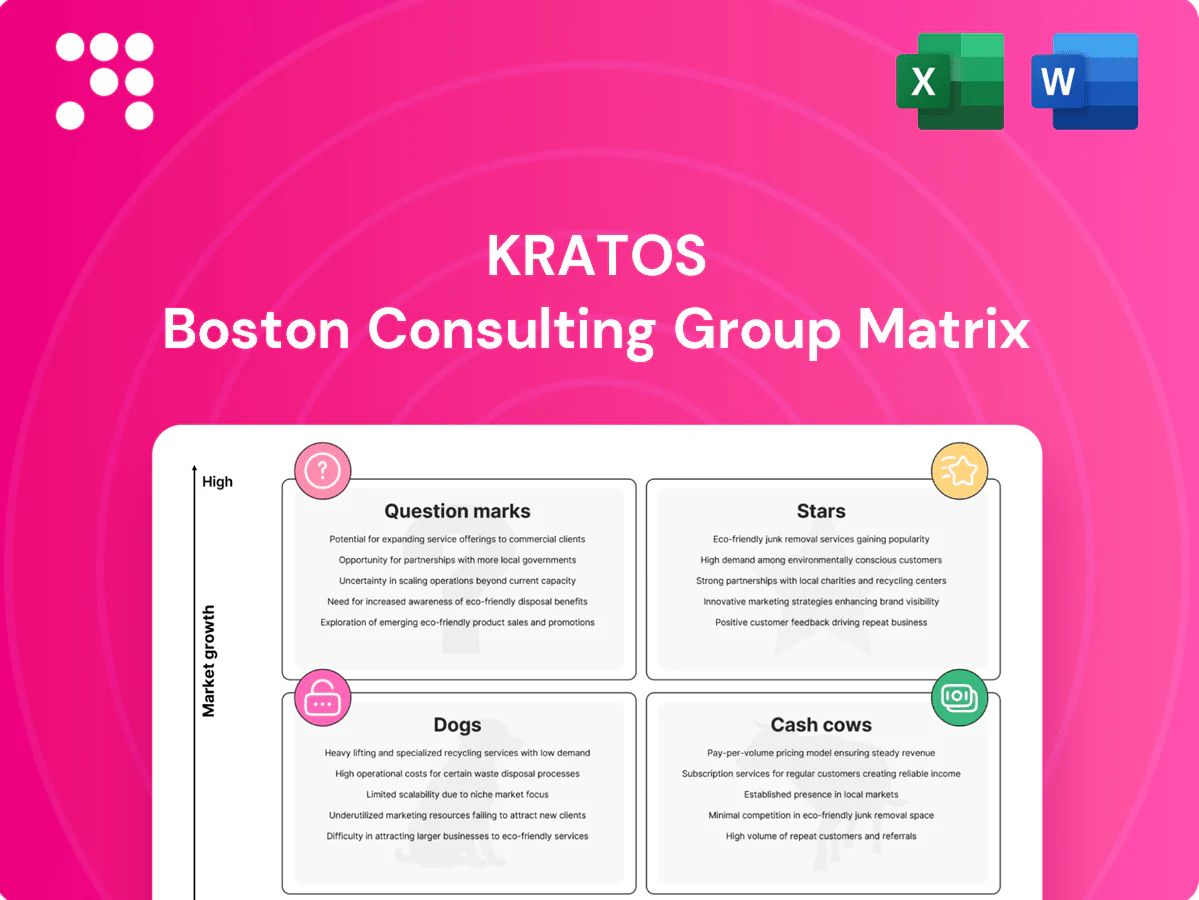
The Kratos BCG Matrix snapshot shows where products sit today—fast-rising Stars, steady Cash Cows, costly Dogs, or risky Question Marks—and teases the moves you should consider next. This preview only scratches the surface; buy the full BCG Matrix for quadrant-by-quadrant placements, data-backed recommendations, and a clear capital-allocation roadmap. Get instant access to a ready-to-use Word report and high-level Excel summary so you can present, decide, and act with confidence.
Stars

Affordable tactical UAS (loyal wingman)
High growth for attritable loyal‑wingman drones is underpinning demand; Kratos reported roughly $1.2B revenue and a multi‑billion dollar program pipeline in 2024, giving it clear price–performance share momentum versus legacy primes. The company still burns cash on flight testing, autonomy and production scale-up, pressuring free cash flow in 2024. Maintain funding: this platform is positioned to become a cash cow as program awards convert to repeat production.
Autonomy and mission management for UAS swarms
Defense buyers are shifting to software‑defined tactics and teaming; with the US defense budget at about $858B in 2024, procurement favors software-centric UAS solutions. Kratos sits close to the airframe, accelerating autonomy adoption and a data flywheel that reduces ops cost per sortie. Growth is rapid but requires heavy investment in AI, V&V and secure comms; double down now to cement leadership while standards form.

Satellite communications ground systems (virtualized)
LEO and MEO constellations and software‑defined payloads are reshaping the ground segment, driving demand for virtualized, cloud-native control and processing. Kratos’ virtualization and network orchestration align directly with this shift, delivering cost and flexibility advantages. The model wins early customers but scaling to major platform status requires meaningful capex and systems‑integration capacity. Invest to convert early wins into entrenched, repeatable platforms.

Space resiliency and SSA/telemetry solutions
Space is growing, contested, and budget‑protected: Starlink surpassed 5,000 operational satellites in 2024 while US Space Force funding remained around $26B in FY2024, keeping resiliency programs prioritized. Telemetry, command, and threat‑awareness solutions are mission‑critical and scale with constellations but require rapid feature development and field hardening. Keep pouring fuel as the market races upward.
- segment: SSA/telemetry
- scale: constellation growth (5,000+ Starlink 2024)
- need: fast dev + field hardening
- funding: budget‑protected (~$26B US Space Force FY2024)
Secure microwave/RF for emerging sensors and missiles
Modern radars and seekers require high-end, affordable RF; Kratos’ performance-per-dollar is compelling as new programs ramp while US DoD budget was about 858B in 2024 supporting sensor and missile procurement. Tooling, yield and supply-chain buildout still soak cash during volume ramp. Invest through the ramp to grab share before production steadies.
- Performance-per-dollar advantage
- Ramping drives upfront capex and supply costs
- DoD FY2024 budget ~858B supports procurement
UAS & space systems: $1.2B, multi-billion pipeline - convert wins to cash
High growth in attritable UAS and space systems gives Kratos star status with ~ $1.2B revenue and multi‑billion program pipeline in 2024, but negative free cash flow from testing and scale‑up. US defense budget ~$858B and Space Force ~$26B (FY2024) underpin demand for software‑defined, cloud‑native solutions. Invest to convert wins into repeatable production and cash cows.
| Metric | 2024 |
|---|---|
| Revenue | $1.2B |
| US DoD budget | $858B |
| US Space Force | $26B |
What is included in the product
 Detailed Word Document
BCG analysis of Kratos units: identifies Stars, Cash Cows, Question Marks, Dogs and gives invest, hold or divest guidance.

 Customizable Excel Spreadsheet
One-page Kratos BCG Matrix placing each unit in a quadrant to spot focus areas fast, relieving portfolio confusion for execs.
Cash Cows

Aerial target drones and sustainment
Kratos aerial target drones sit on a large installed base with steady training demand and predictable reorder cadence tied to US defense spending (FY2024 DoD enacted budget ~858 billion USD). Margins benefit from mature supply chains and repeatable operations, driving strong cash generation. Market growth is low but Kratos holds high share with sticky customers; operations are milked for cash while selectively modernizing payloads.
Legacy SATCOM ground equipment and support
Legacy SATCOM ground equipment and support serve mature DoD and government networks that require continuous upkeep, spares, and services, benefiting from stable renewals tied to the FY2024 US defense budget of about 858 billion USD. These offerings hold high share in defined niches with modest growth and light incremental investment needs. Operational cash generation is strong; firms should optimize efficiency and harvest cash to fund newer space software plays.

Production RF/microwave modules for fielded platforms
Production RF/microwave modules supply steady, recurring demand tied to long program lifecycles (typically 5–20+ years), supporting Kratos revenue which reached about $1.09B in fiscal 2024 with a backlog near $1.6B. Proven module designs yield >90% in production runs, benefit from entrenched military qualifications, and deliver strong cash conversion and margins. Growth is limited but predictable; keep unit costs tight and protect key accounts to sustain cash flow.

Training, ops, and logistics support contracts
Installed Kratos systems require ongoing training and O&M, delivering steady, predictable utilization and low business-development friction; in 2024 defense support contracts commonly show service margins around 12–20% as process discipline and tooling scale. Margins improve materially with standardized playbooks and automation, while maintaining quality and avoiding scope creep preserves renewals and lifetime value.
- Predictable recurring revenue
- Low biz-dev friction
- Margins 12–20% with scale
- Invest in tooling/process
- Guard service quality; prevent scope creep
Cyber hardening for existing defense networks
Cyber hardening for existing defense networks is compliance-driven with recurring updates and 24/7 monitoring; in 2024 the defense cybersecurity services market was roughly $24B with an estimated 5% CAGR. Revenue is recurring (>60%), margins moderate at ~15–20% via standardized toolchains; growth is slow but durable, so keep the bench lean and pipeline renewing.
- Compliance-driven
- Recurring revenue >60%
- Margins ~15–20%
- Market ≈$24B (2024)
- 5% CAGR, slow durable growth
- Lean bench, renewing pipeline
Aerospace defense cash engines: drones, SATCOM, RF and cyber driving steady DoD revenues
Kratos cash cows—aerial target drones, legacy SATCOM, RF/microwave modules, O&M and cyber hardening—deliver predictable recurring revenue tied to FY2024 US DoD spending (~858B USD) and Kratos FY2024 revenue ~1.09B with ~1.6B backlog. Margins range ~12–20% (services) and ~15–20% (cyber); growth low (≈5% for cyber), strong cash conversion funds modernization.
| Segment | 2024 Metric | Margin | Growth |
|---|---|---|---|
| Aerial drones | Stable reorder cadence | High | Low |
| SATCOM | Continuous renewals | 12–20% | Low |
| RF modules | Revenue support; backlog ~$1.6B | High | Low |
| Cyber | Market ~$24B (2024) | 15–20% | ≈5% CAGR |
Delivered as Shown
Kratos BCG Matrix
The Kratos BCG Matrix you're previewing is the exact, final file you'll receive after purchase. No watermarks, no placeholders—just a fully formatted strategic report built for clarity and action. Once bought, the same document is immediately downloadable, editable, and presentation-ready. Designed by strategy pros, it fits straight into your planning or investor decks with zero surprises.

Unlock Strategic Clarity
The Kratos BCG Matrix snapshot shows where products sit today—fast-rising Stars, steady Cash Cows, costly Dogs, or risky Question Marks—and teases the moves you should consider next. This preview only scratches the surface; buy the full BCG Matrix for quadrant-by-quadrant placements, data-backed recommendations, and a clear capital-allocation roadmap. Get instant access to a ready-to-use Word report and high-level Excel summary so you can present, decide, and act with confidence.
Stars
Affordable tactical UAS (loyal wingman)
High growth for attritable loyal‑wingman drones is underpinning demand; Kratos reported roughly $1.2B revenue and a multi‑billion dollar program pipeline in 2024, giving it clear price–performance share momentum versus legacy primes. The company still burns cash on flight testing, autonomy and production scale-up, pressuring free cash flow in 2024. Maintain funding: this platform is positioned to become a cash cow as program awards convert to repeat production.
Autonomy and mission management for UAS swarms
Defense buyers are shifting to software‑defined tactics and teaming; with the US defense budget at about $858B in 2024, procurement favors software-centric UAS solutions. Kratos sits close to the airframe, accelerating autonomy adoption and a data flywheel that reduces ops cost per sortie. Growth is rapid but requires heavy investment in AI, V&V and secure comms; double down now to cement leadership while standards form.
Satellite communications ground systems (virtualized)
LEO and MEO constellations and software‑defined payloads are reshaping the ground segment, driving demand for virtualized, cloud-native control and processing. Kratos’ virtualization and network orchestration align directly with this shift, delivering cost and flexibility advantages. The model wins early customers but scaling to major platform status requires meaningful capex and systems‑integration capacity. Invest to convert early wins into entrenched, repeatable platforms.
Space resiliency and SSA/telemetry solutions
Space is growing, contested, and budget‑protected: Starlink surpassed 5,000 operational satellites in 2024 while US Space Force funding remained around $26B in FY2024, keeping resiliency programs prioritized. Telemetry, command, and threat‑awareness solutions are mission‑critical and scale with constellations but require rapid feature development and field hardening. Keep pouring fuel as the market races upward.
- segment: SSA/telemetry
- scale: constellation growth (5,000+ Starlink 2024)
- need: fast dev + field hardening
- funding: budget‑protected (~$26B US Space Force FY2024)
Secure microwave/RF for emerging sensors and missiles
Modern radars and seekers require high-end, affordable RF; Kratos’ performance-per-dollar is compelling as new programs ramp while US DoD budget was about 858B in 2024 supporting sensor and missile procurement. Tooling, yield and supply-chain buildout still soak cash during volume ramp. Invest through the ramp to grab share before production steadies.
- Performance-per-dollar advantage
- Ramping drives upfront capex and supply costs
- DoD FY2024 budget ~858B supports procurement
UAS & space systems: $1.2B, multi-billion pipeline - convert wins to cash
High growth in attritable UAS and space systems gives Kratos star status with ~ $1.2B revenue and multi‑billion program pipeline in 2024, but negative free cash flow from testing and scale‑up. US defense budget ~$858B and Space Force ~$26B (FY2024) underpin demand for software‑defined, cloud‑native solutions. Invest to convert wins into repeatable production and cash cows.
| Metric | 2024 |
|---|---|
| Revenue | $1.2B |
| US DoD budget | $858B |
| US Space Force | $26B |
What is included in the product
Detailed Word Document
BCG analysis of Kratos units: identifies Stars, Cash Cows, Question Marks, Dogs and gives invest, hold or divest guidance.
Customizable Excel Spreadsheet
One-page Kratos BCG Matrix placing each unit in a quadrant to spot focus areas fast, relieving portfolio confusion for execs.
Cash Cows
Aerial target drones and sustainment
Kratos aerial target drones sit on a large installed base with steady training demand and predictable reorder cadence tied to US defense spending (FY2024 DoD enacted budget ~858 billion USD). Margins benefit from mature supply chains and repeatable operations, driving strong cash generation. Market growth is low but Kratos holds high share with sticky customers; operations are milked for cash while selectively modernizing payloads.
Legacy SATCOM ground equipment and support
Legacy SATCOM ground equipment and support serve mature DoD and government networks that require continuous upkeep, spares, and services, benefiting from stable renewals tied to the FY2024 US defense budget of about 858 billion USD. These offerings hold high share in defined niches with modest growth and light incremental investment needs. Operational cash generation is strong; firms should optimize efficiency and harvest cash to fund newer space software plays.
Production RF/microwave modules for fielded platforms
Production RF/microwave modules supply steady, recurring demand tied to long program lifecycles (typically 5–20+ years), supporting Kratos revenue which reached about $1.09B in fiscal 2024 with a backlog near $1.6B. Proven module designs yield >90% in production runs, benefit from entrenched military qualifications, and deliver strong cash conversion and margins. Growth is limited but predictable; keep unit costs tight and protect key accounts to sustain cash flow.
Training, ops, and logistics support contracts
Installed Kratos systems require ongoing training and O&M, delivering steady, predictable utilization and low business-development friction; in 2024 defense support contracts commonly show service margins around 12–20% as process discipline and tooling scale. Margins improve materially with standardized playbooks and automation, while maintaining quality and avoiding scope creep preserves renewals and lifetime value.
- Predictable recurring revenue
- Low biz-dev friction
- Margins 12–20% with scale
- Invest in tooling/process
- Guard service quality; prevent scope creep
Cyber hardening for existing defense networks
Cyber hardening for existing defense networks is compliance-driven with recurring updates and 24/7 monitoring; in 2024 the defense cybersecurity services market was roughly $24B with an estimated 5% CAGR. Revenue is recurring (>60%), margins moderate at ~15–20% via standardized toolchains; growth is slow but durable, so keep the bench lean and pipeline renewing.
- Compliance-driven
- Recurring revenue >60%
- Margins ~15–20%
- Market ≈$24B (2024)
- 5% CAGR, slow durable growth
- Lean bench, renewing pipeline
Aerospace defense cash engines: drones, SATCOM, RF and cyber driving steady DoD revenues
Kratos cash cows—aerial target drones, legacy SATCOM, RF/microwave modules, O&M and cyber hardening—deliver predictable recurring revenue tied to FY2024 US DoD spending (~858B USD) and Kratos FY2024 revenue ~1.09B with ~1.6B backlog. Margins range ~12–20% (services) and ~15–20% (cyber); growth low (≈5% for cyber), strong cash conversion funds modernization.
| Segment | 2024 Metric | Margin | Growth |
|---|---|---|---|
| Aerial drones | Stable reorder cadence | High | Low |
| SATCOM | Continuous renewals | 12–20% | Low |
| RF modules | Revenue support; backlog ~$1.6B | High | Low |
| Cyber | Market ~$24B (2024) | 15–20% | ≈5% CAGR |
Delivered as Shown
Kratos BCG Matrix
The Kratos BCG Matrix you're previewing is the exact, final file you'll receive after purchase. No watermarks, no placeholders—just a fully formatted strategic report built for clarity and action. Once bought, the same document is immediately downloadable, editable, and presentation-ready. Designed by strategy pros, it fits straight into your planning or investor decks with zero surprises.
Original: $10.00
-65%$10.00
$3.50Description
Unlock Strategic Clarity
The Kratos BCG Matrix snapshot shows where products sit today—fast-rising Stars, steady Cash Cows, costly Dogs, or risky Question Marks—and teases the moves you should consider next. This preview only scratches the surface; buy the full BCG Matrix for quadrant-by-quadrant placements, data-backed recommendations, and a clear capital-allocation roadmap. Get instant access to a ready-to-use Word report and high-level Excel summary so you can present, decide, and act with confidence.
Stars
Affordable tactical UAS (loyal wingman)
High growth for attritable loyal‑wingman drones is underpinning demand; Kratos reported roughly $1.2B revenue and a multi‑billion dollar program pipeline in 2024, giving it clear price–performance share momentum versus legacy primes. The company still burns cash on flight testing, autonomy and production scale-up, pressuring free cash flow in 2024. Maintain funding: this platform is positioned to become a cash cow as program awards convert to repeat production.
Autonomy and mission management for UAS swarms
Defense buyers are shifting to software‑defined tactics and teaming; with the US defense budget at about $858B in 2024, procurement favors software-centric UAS solutions. Kratos sits close to the airframe, accelerating autonomy adoption and a data flywheel that reduces ops cost per sortie. Growth is rapid but requires heavy investment in AI, V&V and secure comms; double down now to cement leadership while standards form.
Satellite communications ground systems (virtualized)
LEO and MEO constellations and software‑defined payloads are reshaping the ground segment, driving demand for virtualized, cloud-native control and processing. Kratos’ virtualization and network orchestration align directly with this shift, delivering cost and flexibility advantages. The model wins early customers but scaling to major platform status requires meaningful capex and systems‑integration capacity. Invest to convert early wins into entrenched, repeatable platforms.
Space resiliency and SSA/telemetry solutions
Space is growing, contested, and budget‑protected: Starlink surpassed 5,000 operational satellites in 2024 while US Space Force funding remained around $26B in FY2024, keeping resiliency programs prioritized. Telemetry, command, and threat‑awareness solutions are mission‑critical and scale with constellations but require rapid feature development and field hardening. Keep pouring fuel as the market races upward.
- segment: SSA/telemetry
- scale: constellation growth (5,000+ Starlink 2024)
- need: fast dev + field hardening
- funding: budget‑protected (~$26B US Space Force FY2024)
Secure microwave/RF for emerging sensors and missiles
Modern radars and seekers require high-end, affordable RF; Kratos’ performance-per-dollar is compelling as new programs ramp while US DoD budget was about 858B in 2024 supporting sensor and missile procurement. Tooling, yield and supply-chain buildout still soak cash during volume ramp. Invest through the ramp to grab share before production steadies.
- Performance-per-dollar advantage
- Ramping drives upfront capex and supply costs
- DoD FY2024 budget ~858B supports procurement
UAS & space systems: $1.2B, multi-billion pipeline - convert wins to cash
High growth in attritable UAS and space systems gives Kratos star status with ~ $1.2B revenue and multi‑billion program pipeline in 2024, but negative free cash flow from testing and scale‑up. US defense budget ~$858B and Space Force ~$26B (FY2024) underpin demand for software‑defined, cloud‑native solutions. Invest to convert wins into repeatable production and cash cows.
| Metric | 2024 |
|---|---|
| Revenue | $1.2B |
| US DoD budget | $858B |
| US Space Force | $26B |
What is included in the product
Detailed Word Document
BCG analysis of Kratos units: identifies Stars, Cash Cows, Question Marks, Dogs and gives invest, hold or divest guidance.
Customizable Excel Spreadsheet
One-page Kratos BCG Matrix placing each unit in a quadrant to spot focus areas fast, relieving portfolio confusion for execs.
Cash Cows
Aerial target drones and sustainment
Kratos aerial target drones sit on a large installed base with steady training demand and predictable reorder cadence tied to US defense spending (FY2024 DoD enacted budget ~858 billion USD). Margins benefit from mature supply chains and repeatable operations, driving strong cash generation. Market growth is low but Kratos holds high share with sticky customers; operations are milked for cash while selectively modernizing payloads.
Legacy SATCOM ground equipment and support
Legacy SATCOM ground equipment and support serve mature DoD and government networks that require continuous upkeep, spares, and services, benefiting from stable renewals tied to the FY2024 US defense budget of about 858 billion USD. These offerings hold high share in defined niches with modest growth and light incremental investment needs. Operational cash generation is strong; firms should optimize efficiency and harvest cash to fund newer space software plays.
Production RF/microwave modules for fielded platforms
Production RF/microwave modules supply steady, recurring demand tied to long program lifecycles (typically 5–20+ years), supporting Kratos revenue which reached about $1.09B in fiscal 2024 with a backlog near $1.6B. Proven module designs yield >90% in production runs, benefit from entrenched military qualifications, and deliver strong cash conversion and margins. Growth is limited but predictable; keep unit costs tight and protect key accounts to sustain cash flow.
Training, ops, and logistics support contracts
Installed Kratos systems require ongoing training and O&M, delivering steady, predictable utilization and low business-development friction; in 2024 defense support contracts commonly show service margins around 12–20% as process discipline and tooling scale. Margins improve materially with standardized playbooks and automation, while maintaining quality and avoiding scope creep preserves renewals and lifetime value.
- Predictable recurring revenue
- Low biz-dev friction
- Margins 12–20% with scale
- Invest in tooling/process
- Guard service quality; prevent scope creep
Cyber hardening for existing defense networks
Cyber hardening for existing defense networks is compliance-driven with recurring updates and 24/7 monitoring; in 2024 the defense cybersecurity services market was roughly $24B with an estimated 5% CAGR. Revenue is recurring (>60%), margins moderate at ~15–20% via standardized toolchains; growth is slow but durable, so keep the bench lean and pipeline renewing.
- Compliance-driven
- Recurring revenue >60%
- Margins ~15–20%
- Market ≈$24B (2024)
- 5% CAGR, slow durable growth
- Lean bench, renewing pipeline
Aerospace defense cash engines: drones, SATCOM, RF and cyber driving steady DoD revenues
Kratos cash cows—aerial target drones, legacy SATCOM, RF/microwave modules, O&M and cyber hardening—deliver predictable recurring revenue tied to FY2024 US DoD spending (~858B USD) and Kratos FY2024 revenue ~1.09B with ~1.6B backlog. Margins range ~12–20% (services) and ~15–20% (cyber); growth low (≈5% for cyber), strong cash conversion funds modernization.
| Segment | 2024 Metric | Margin | Growth |
|---|---|---|---|
| Aerial drones | Stable reorder cadence | High | Low |
| SATCOM | Continuous renewals | 12–20% | Low |
| RF modules | Revenue support; backlog ~$1.6B | High | Low |
| Cyber | Market ~$24B (2024) | 15–20% | ≈5% CAGR |
Delivered as Shown
Kratos BCG Matrix
The Kratos BCG Matrix you're previewing is the exact, final file you'll receive after purchase. No watermarks, no placeholders—just a fully formatted strategic report built for clarity and action. Once bought, the same document is immediately downloadable, editable, and presentation-ready. Designed by strategy pros, it fits straight into your planning or investor decks with zero surprises.











